
Life, 1915-02-11 · page 10 of 44
Life — February 11, 1915 — page 10: what you’re looking at
What you’re looking at
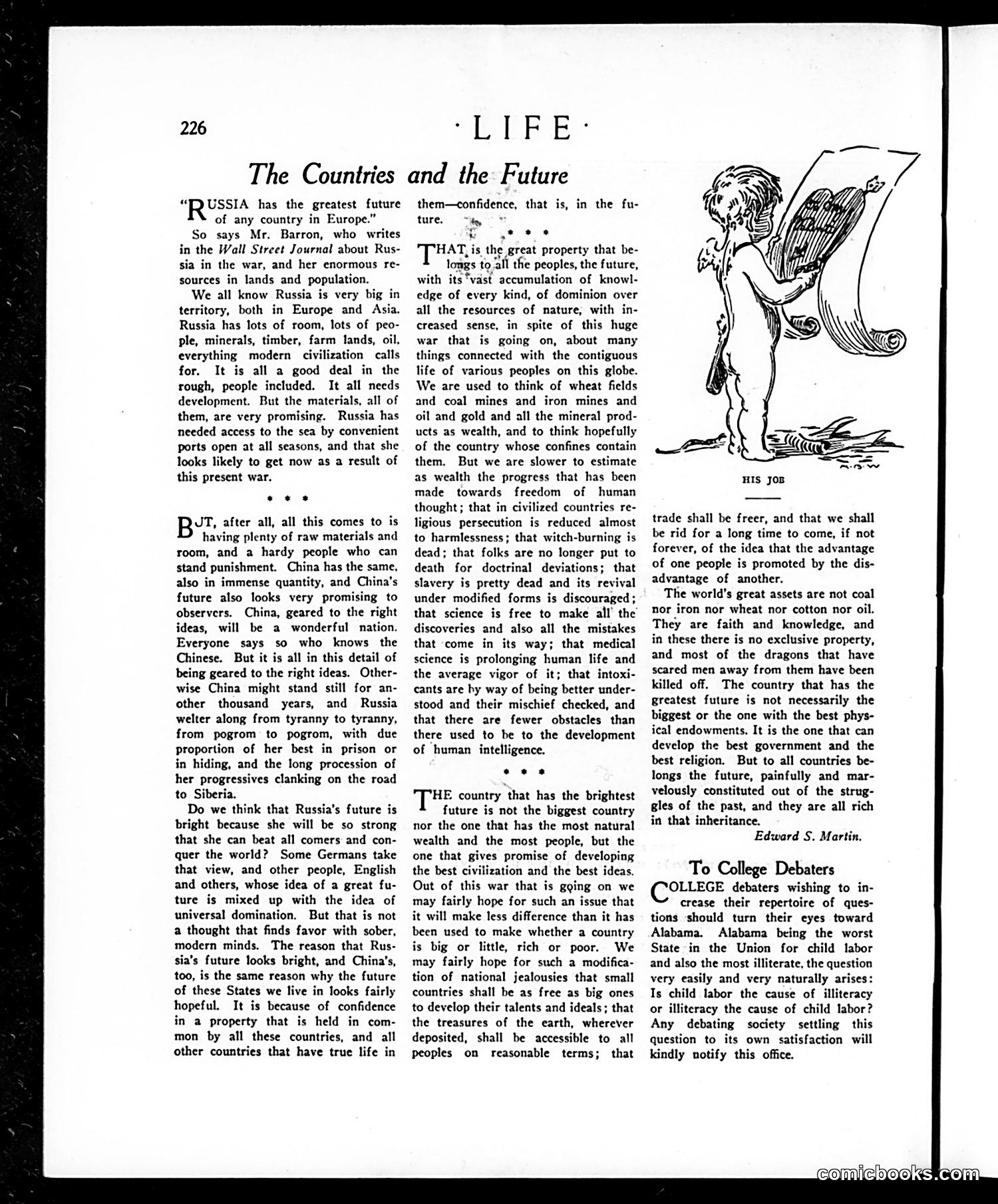
The main cartoon titled "HIS JOB" depicts a cherub or cupid-like figure holding what appears to be a torch or flame. This illustration accompanies an article titled "The Countries and the Future" discussing Russia's potential for growth based on natural resources. The satire appears to be about Russia's role in post-war development. The cherub figure likely represents hope, idealism, or future promise—ironic given the article's discussion of whether Russia or China will lead civilization forward. The text debates which nation can "beat all comers and conquer the world," mixing practical assessments of resources with philosophical questions about human progress, freedom, and which system will produce superior ideas and society. The cartoon's cherub with its job of bearing light suggests naive optimism about global futures amid serious geopolitical competition.
📄 Transcribed text from this page (OCR, searchable)
Machine-transcribed from the original scan — historical spelling and the odd misread are preserved.
aE RE ~ The Countries and the Future “RUSSIA has the greatest future of any country in Europe.” So says Mr. Barron, who writes in the Wall Street Journal about Rus- sia in the war, and her enormous re- sources in lands and population. We all know Russia is very big in territory, both in Europe and Asia. Russia has lots of room, lots of peo- ple, minerals, timber, farm lands, oil, everything modern civilization calls for. It is all a good deal in the rough, people included. It all needs development. But the materials, all of them, are very promising. Russia has needed access to the sea by convenient ports open at all seasons, and that she looks likely to get now as a result of this present war. eee JT, after all, all this comes to is having plenty of raw materials and room, and a hardy people who can stand punishment. China has the same, also in immense quantity, and China's future also looks very promising to observers. China, geared to the right ideas, will be a wonderful nation. Everyone says so who knows the Chinese. But it is all in this detail of being geared to the right ideas. Other- wise China might stand still for an- other thousand years, and Russia welter along from tyranny to tyranny, from pogrom to pogrom, with due Proportion of her best in prison or in hiding, and the long procession of her progressives clanking on the road to Siberia. Do we think that Russia’s future is bright because she will be so strong that she can beat all comers and con- quer the world? Some Germans take that view, and other people, English and others, whose idea of a great fu- ture is mixed up with the idea of universal domination. But that is not a thought that finds favor with sober, modern minds. The reason that Rus- sia’s future looks bright, and China's, too, is the same reason why the future of these States we live in looks fairly hopeful. It is because of confidence in a property that is held in com- mon by all these countries, and all other countries that have true life in them—confidence, that is, in the fu- ture. “ay, {[ ,e 0 'HAT, is the great property that be- longs to ‘all the peoples, the future, with its *vast accumulation of knowl- edge of every kind, of dominion over all the resources of nature, with in- creased sense, in spite of this huge war that is going on, about many things connected with the contiguous life of various peoples on this globe. We are used to think of wheat fields and coal mines and iron mines and oil and gold and all the mineral prod- ucts as wealth, and to think hopefully of the country whose confines contain them. But we are slower to estimate as wealth the progress that has been made towards freedom of human thought; that in civilized countries re- ligious persecution is reduced almost to harmlessness; that witch-burning is dead; that folks are no longer put to death for doctrinal deviations; that slavery is pretty dead and its revival under modified forms is discouraged ; that science is free to make all’ the discoveries and also all the mistakes that come in its way; that medical science is prolonging human life and the average vigor of it; that intoxi- cants are by way of being better under- stood and their mischief checked, and that there are fewer obstacles than there used to be to the development of human intelligence. tet country that has the brightest future is not the biggest country nor the one that has the most natural wealth and the most people, but the one that gives promise of developing the best civilization and the best ideas. Out of this war that is gging on we may fairly hope for such an issue that it will make less difference than it has been used to make whether a country is big or little, rich or poor. We may fairly hope for such a modifica- tion of national jealousies that small countries shall be as free as big ones to develop their talents and ideals; that the treasures of the earth, wherever deposited, shall be accessible to all peoples on reasonable terms; that HIS JoB trade shall be freer, and that we shall be rid for a long time to come, if not forever, of the idea that the advantage of one people is promoted by the dis- advantage of another. The world’s great assets are not coal nor iron nor wheat nor cotton nor oil. They are faith and knowledge, and in these there is no exclusive property, and most of the dragons that have scared men away from them have been killed off. The country that has the Greatest future is not necessarily the biggest or the one with the best phys- ical endowments. It is the one that can develop the best government and the best religion. But to all countries be- longs the future, painfully and mar- velously constituted out of the strug- gles of the past, and they are all rich in that inheritance. Edward S. Martin. To College Debaters GOLLEGE debaters wishing to in- crease their repertoire of ques- tions should turn their eyes toward Alabama. Alabama being the worst State in the Union for child labor and also the most illiterate, the question very easily and very naturally arises: Is child labor the cause of illiteracy or illiteracy the cause of child labor? Any debating society settling this question to its own satisfaction will kindly notify this office.