
A complete issue · 44 pages · 1915
Life — February 4, 1915
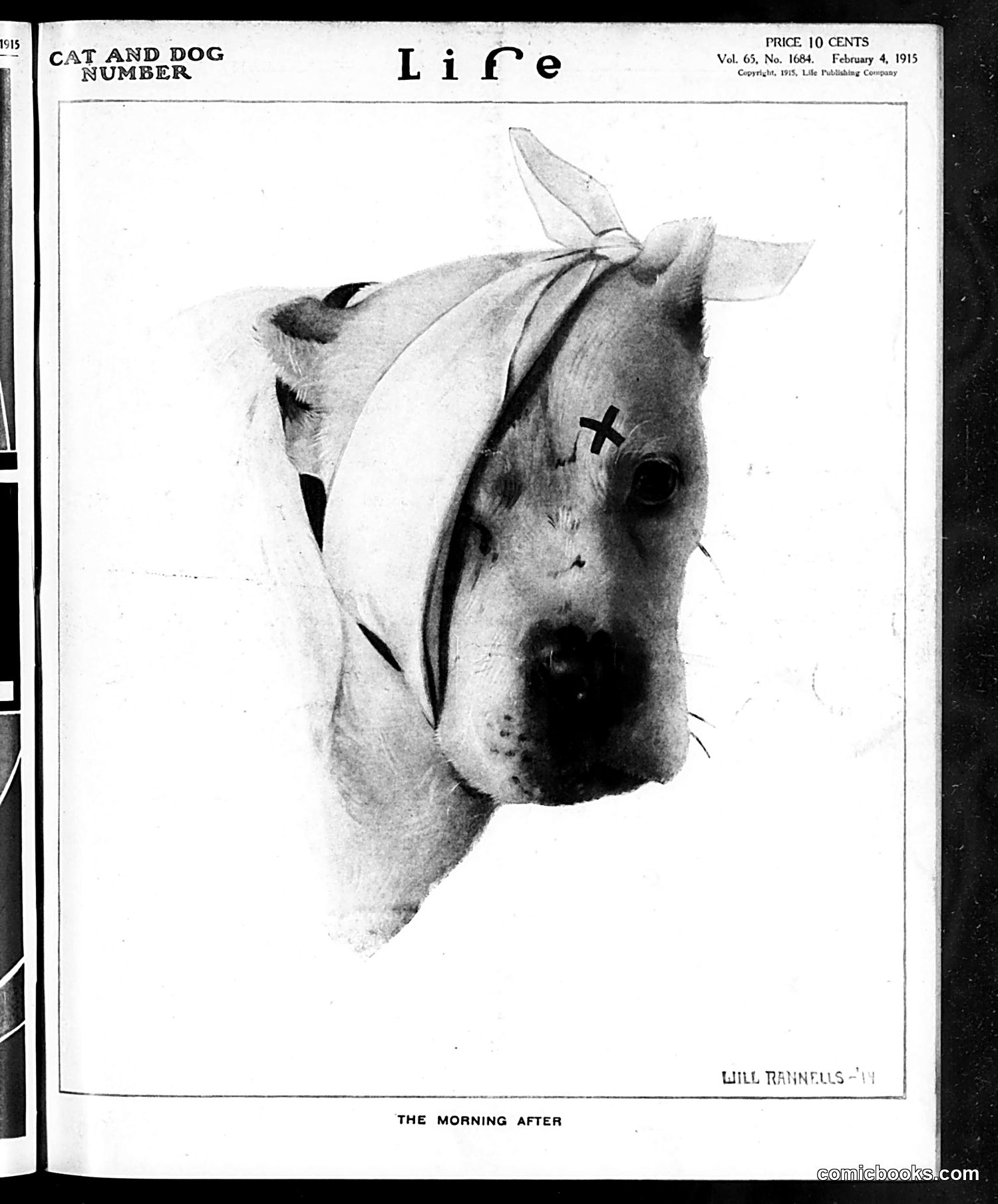
This cartoon depicts a bandaged horse's head, suggesting injury or defeat. The title "The Morning After" implies consequences following some event. Given the February 1915 date during World War I, this likely references the ongoing conflict in Europe or America's relationship to it. The bandaging and cross mark suggest medical treatment or suffering. The illustration appears to be social or political commentary on wartime consequences—possibly satirizing military leadership, diplomatic failures, or the aftermath of a specific battle or political decision. Without additional context from the article text, the specific reference remains unclear, though the visual metaphor of a wounded animal "the morning after" suggests commentary on poor judgment with painful results.
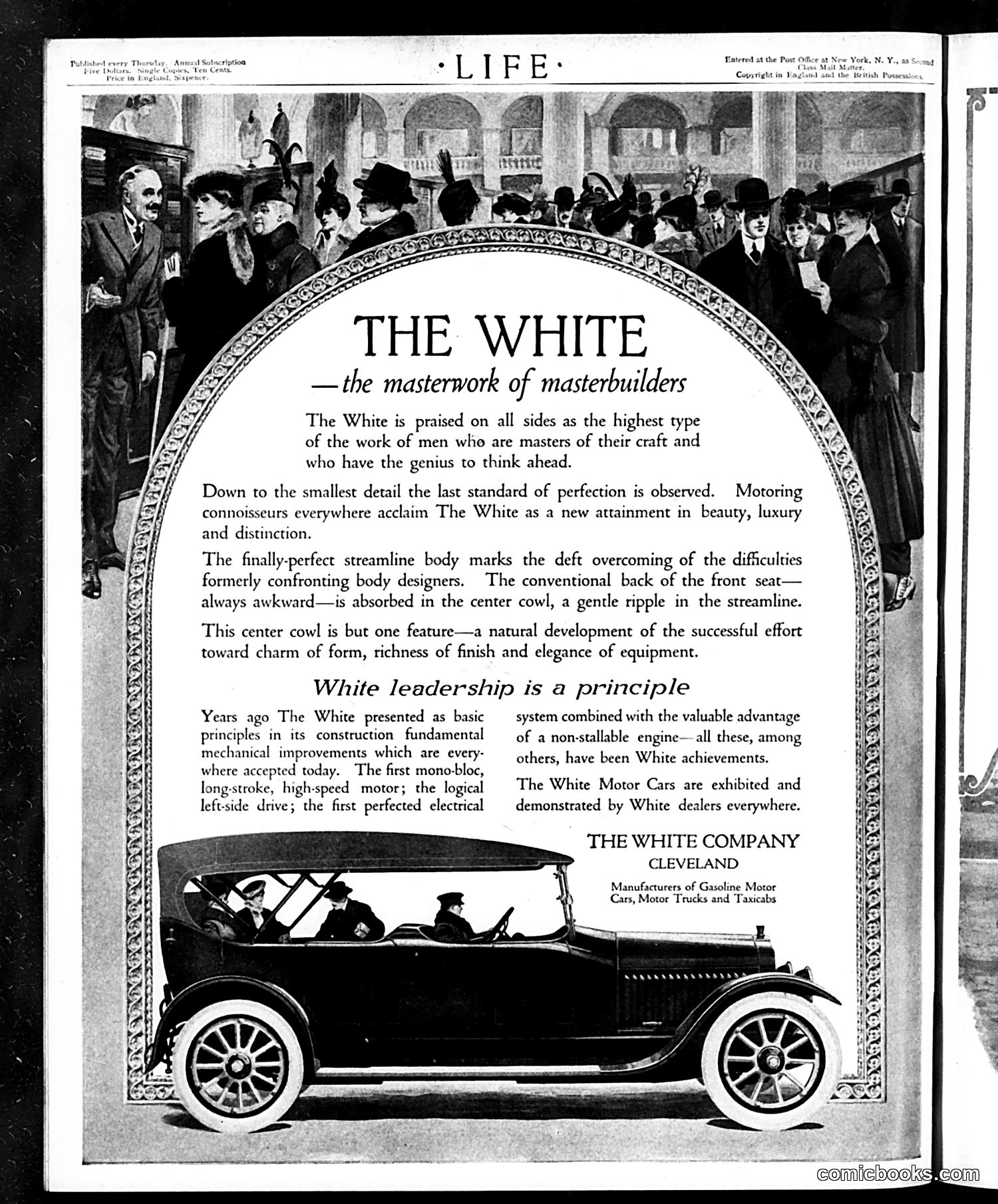
This is **not a satirical cartoon page** — it's a straightforward **automobile advertisement** for The White Company of Cleveland, manufacturers of "The White" motor car. The upper illustration shows an elegant crowd gathered in what appears to be a grand civic or institutional building, establishing an aspirational social context. The car depicted below represents luxury and engineering achievement. The advertising copy emphasizes The White as "the masterwork of masterbuilders," highlighting technical innovations like the mono-bloc engine, left-side drive, and electrical systems. The text positions the vehicle as a marker of sophistication and distinction for affluent buyers. This represents early 20th-century luxury automotive marketing, using social prestige and engineering prowess as selling points to wealthy consumers.
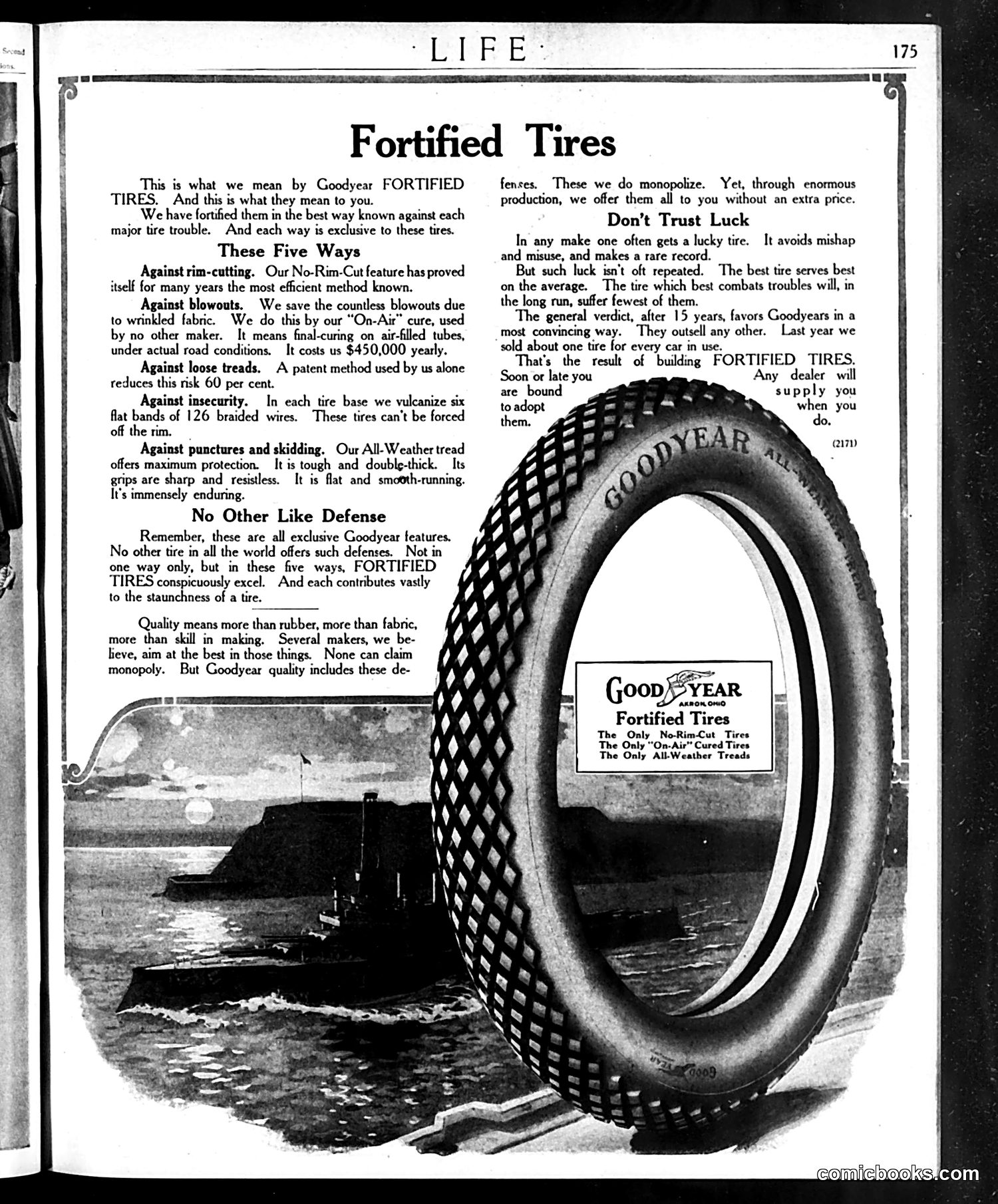
This is **not a political cartoon or satire**—it's a straightforward **advertisement for Goodyear Fortified Tires**, published in *Life* magazine (page 175). The ad promotes five exclusive features: rim-cutting resistance, blowout protection, loose-tread reduction, puncture/skidding defense, and insecurity prevention via braided wires. The large tire image dominates, showing the distinctive tread pattern. The copy emphasizes that Goodyear monopolizes these defenses and offers them "without an extra price." A ship photograph appears in the background, likely suggesting reliability and durability. This represents early automotive advertising, when tire safety was a major selling point and manufacturers competed on technical features rather than brand prestige alone.
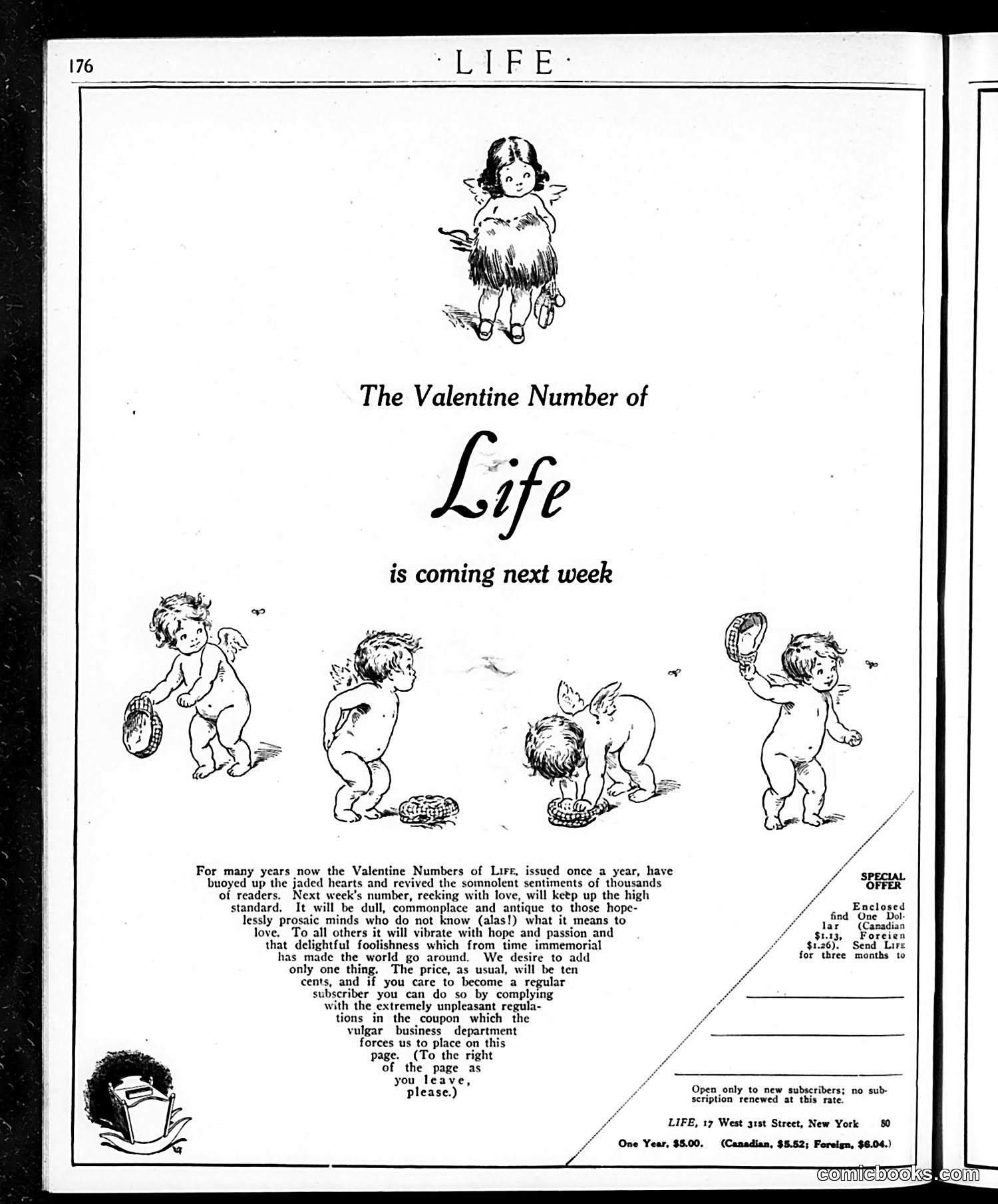
This is primarily a **subscription advertisement** for *Life* magazine's Valentine issue, not political satire. The page promotes the upcoming Valentine Number, featuring cherub/cupid illustrations (classical romantic imagery common to Valentine's Day themes). The text emphasizes that *Life*'s annual Valentine Numbers have long been popular with readers for their sentimental content. The publisher highlights the issue's continued tradition and offers a subscription deal: ten cents per issue, with special reduced rates for new subscribers (noted in the right margin). The small illustration at bottom left appears to be the magazine's logo or mascot. **Context**: This reflects early 20th-century magazine marketing, when annual themed issues were major publishing events. The "vulgar business department" reference is a self-deprecating joke about commercialism intruding on romance.
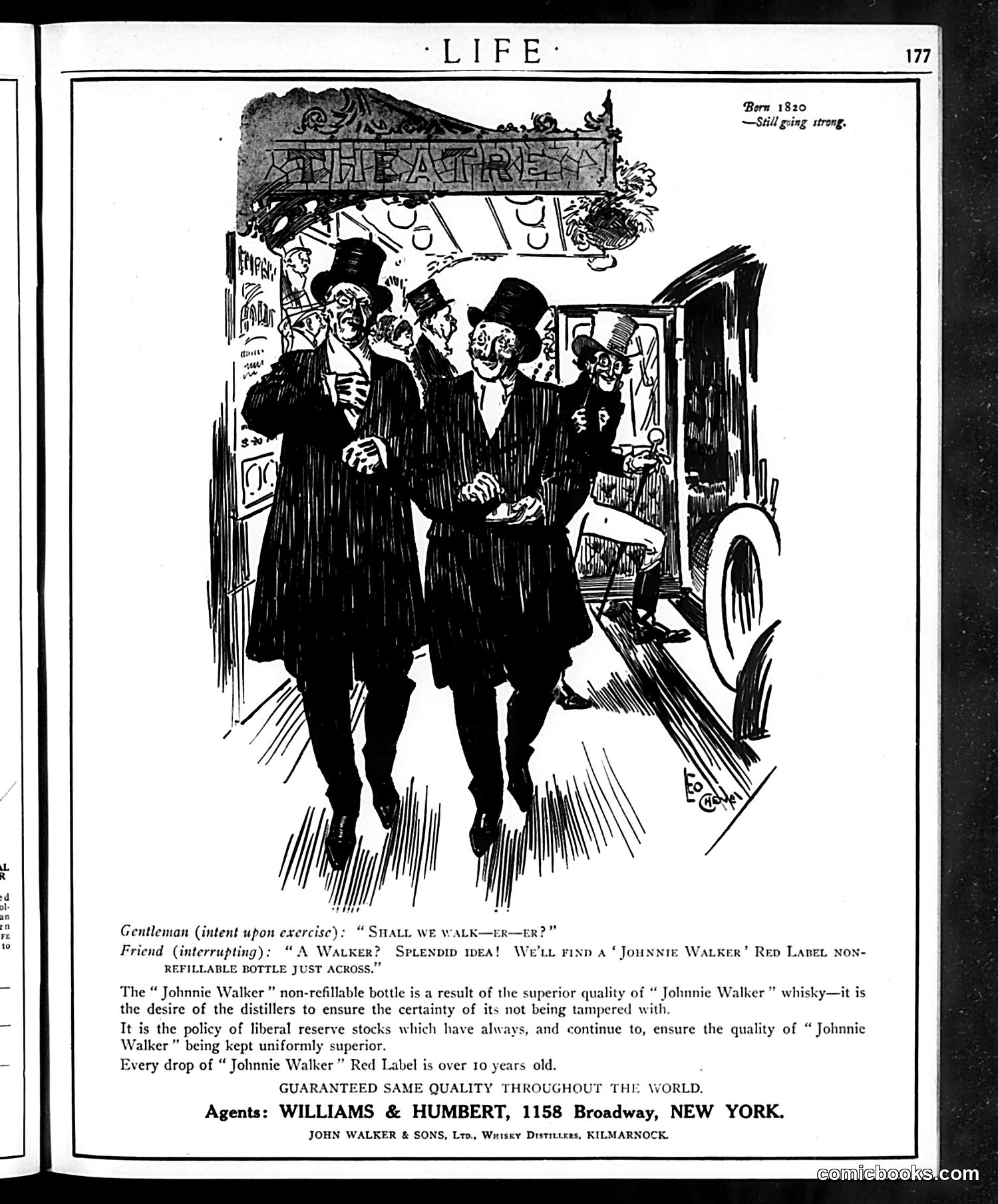
This page is primarily a **Johnnie Walker whisky advertisement** disguised as editorial content. The illustration depicts two well-dressed gentlemen outside a theater, with the caption playing on a pun: one suggests they "walk" for exercise; the friend interrupts proposing they find a "Johnnie Walker" Red Label bottle instead—a non-refillable whisky bottle. The "satire" is purely commercial: the ad associates the whisky brand with sophistication and leisure-class gentlemen. The theater marquee and refined clothing reinforce aspirational messaging. The text emphasizes quality control and age (over 10 years old), addressing consumer concerns about product authenticity during an era when counterfeit spirits were common. This represents early **advertising-as-editorial**, blending promotion with entertainment in a magazine format.
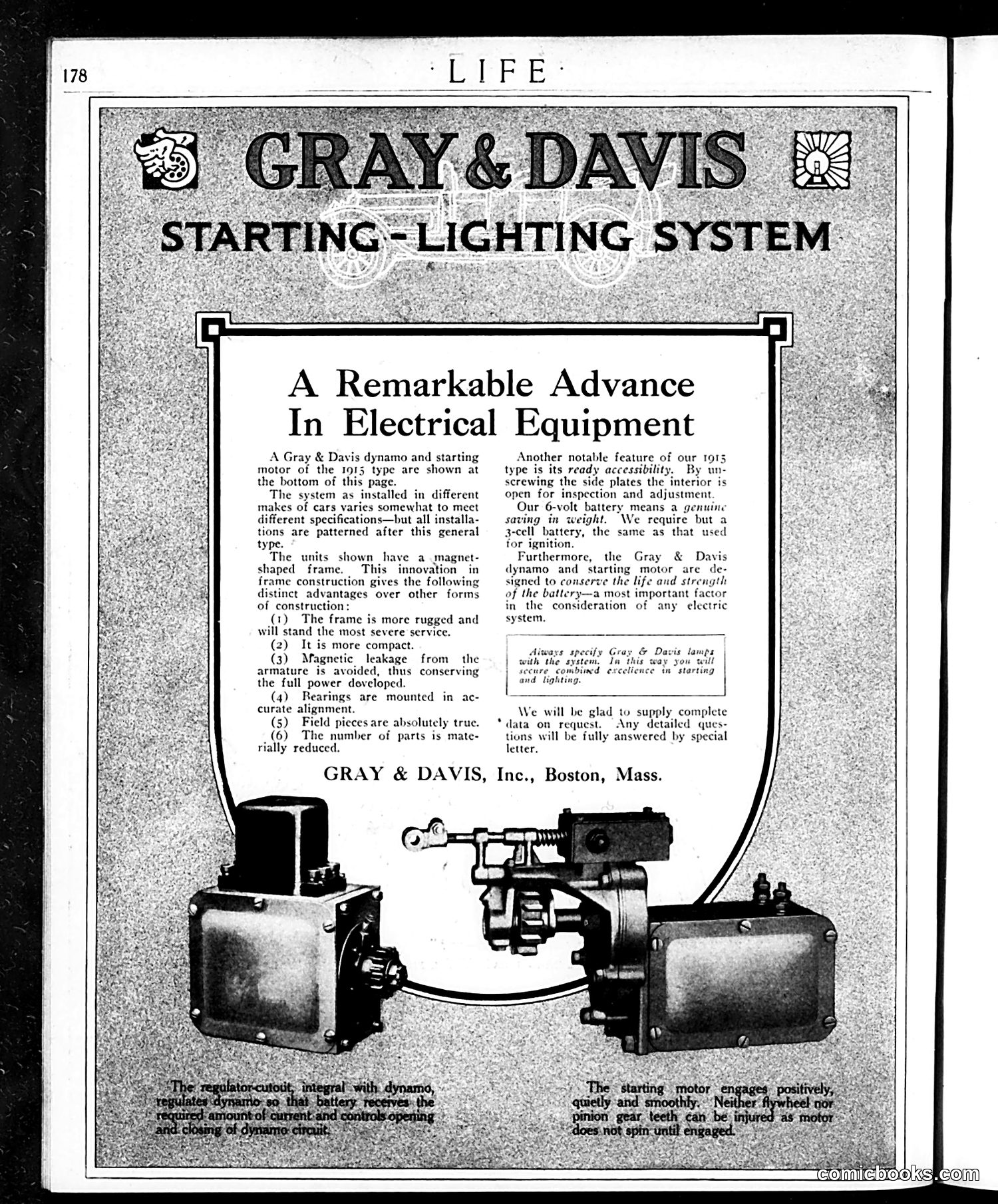
This page is **not a cartoon or satirical content**—it is a straightforward **advertisement** for Gray & Davis electrical equipment, specifically their starting and lighting system for automobiles. The ad promotes their 1915 dynamo and starting motor as "A Remarkable Advance In Electrical Equipment," highlighting technical features like a shaped frame design, magnetic leakage prevention, and a 6-volt battery system. The company emphasizes durability, compactness, and reliability. Two mechanical components are illustrated at the bottom: the regulator-circuit integrated with dynamo (left) and the starting motor (right). This represents early automotive technology marketing rather than satire or political commentary. Gray & Davis, Inc. was a Boston-based manufacturer addressing practical automotive innovations of the era.
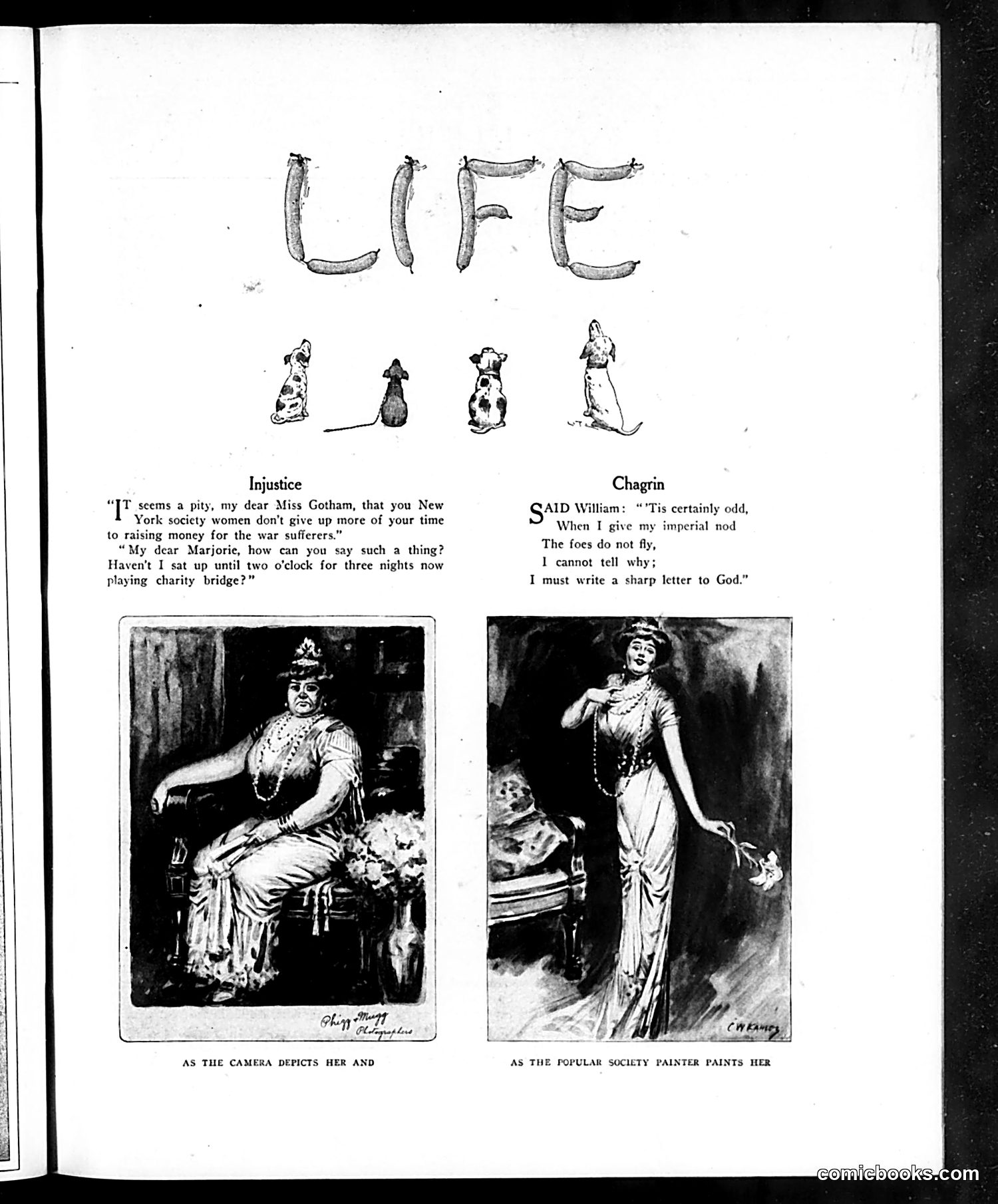
This page satirizes wealthy New York society women during wartime (likely WWI era). The "Injustice" section mocks Miss Gotham, a society woman who claims she cannot raise money for war relief because she's been "sitting up until two o'clock for three nights now playing charity bridge"—suggesting her social activities are exhausting excuses for avoiding real charitable work. The "Chagrin" section quotes William complaining that "The foes do not fly" and he must "write a sharp letter to God"—likely mocking military incompetence or aristocratic entitlement. The two portrait illustrations contrast reality ("As the camera directs her and") with romanticized society portraiture ("As the popular society painter paints her"), critiquing the gap between wealthy women's actual behavior and their idealized public images.
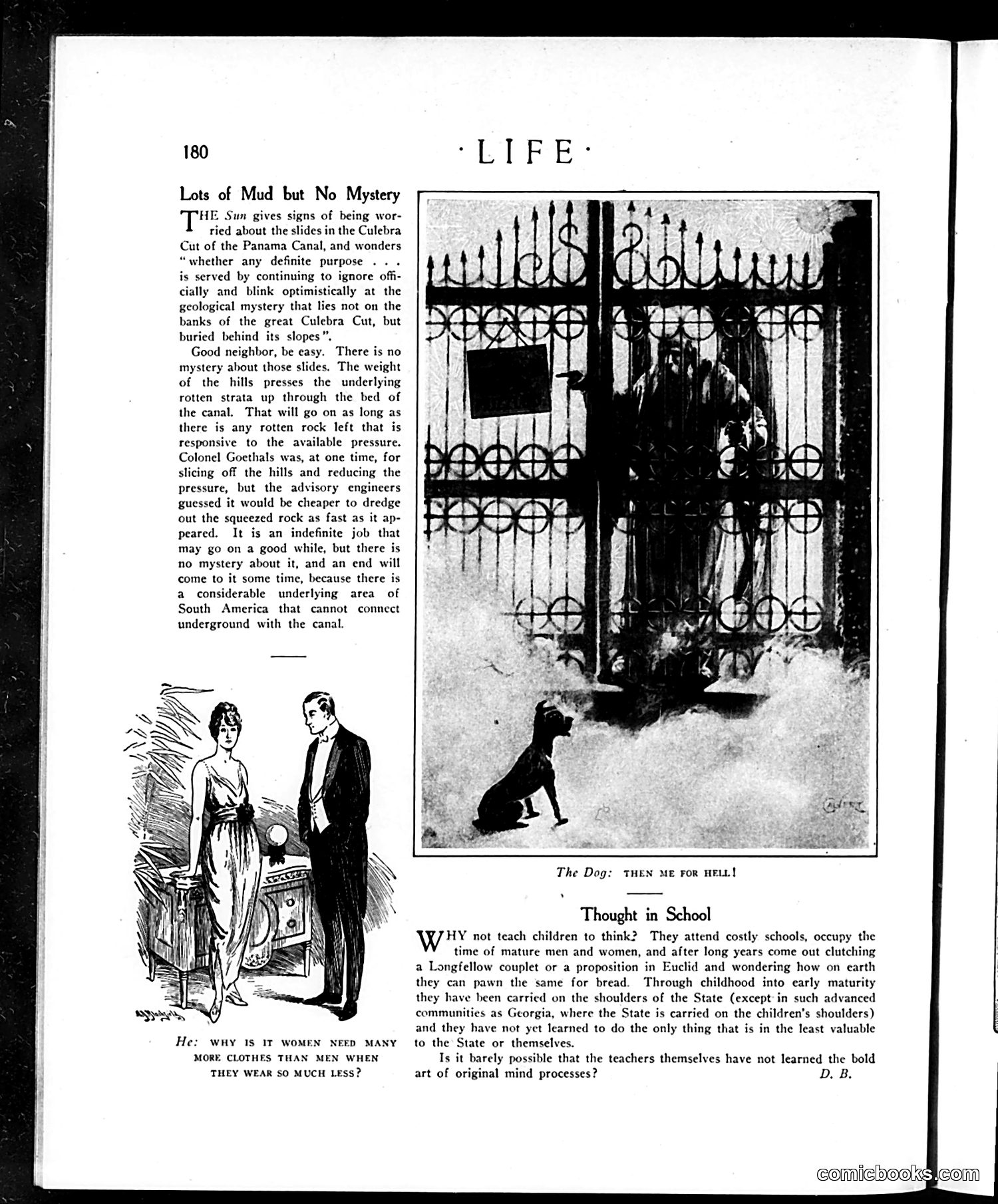
This page contains two distinct satirical items from Life magazine: 1. **"Lots of Mud but No Mystery"** (top left): A geological commentary on the Culebra Cut of the Panama Canal, discussing slides and structural instability. The accompanying sketch shows a well-dressed couple examining a canal project, satirizing public fascination with engineering "mysteries." 2. **"The Dog: Then Me for Hell!"** (top right): A cartoon showing a dog at ornate gates—likely representing heaven or hell—with the caption suggesting ironic commentary on divine judgment. 3. **"Thought in School"** (bottom): Signed "D.B.," this critiques American education, arguing schools fail to teach independent thinking. It includes a sketch captioned "He: Why is it women need many more clothes than men when they wear so much less?" This appears to joke about women's limited clothing choices despite supposedly needing more variety. The satire targets both infrastructure hubris and educational/social gender assumptions.
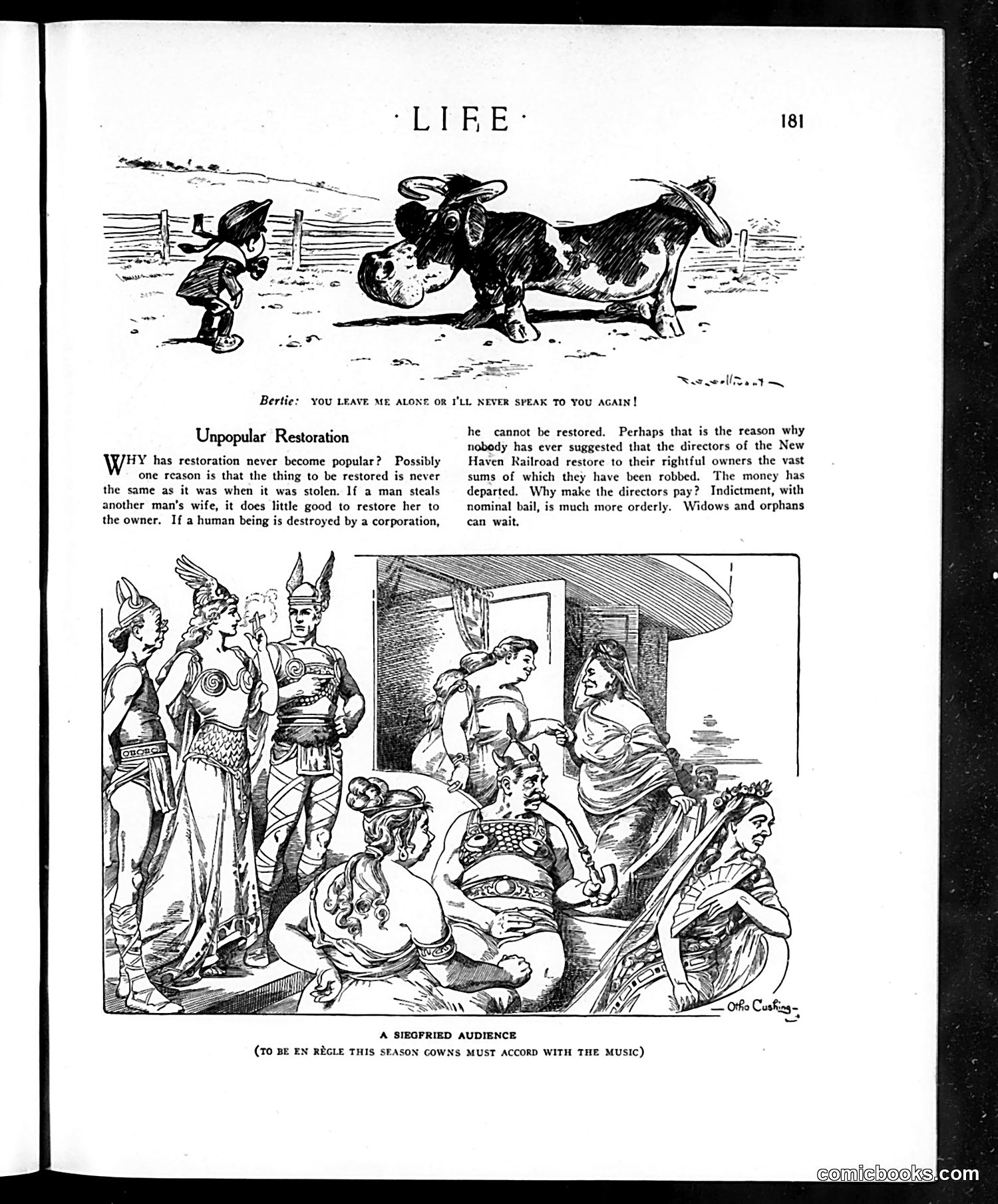
**Top Cartoon:** A domestic scene showing a dachshund lying down while speaking to a smaller figure (likely a child or another animal), saying "YOU LEAVE ME ALONE OR I'LL NEVER SPEAK TO YOU AGAIN!" This is simple visual humor—personifying the dog as making human threats about conversation. **Article: "Unpopular Restoration"** discusses why restoration efforts lack public support, using a human analogy: restoring a destroyed person is as pointless as restoring a stolen wife to an owner. It critiques the New Haven Railroad's directors for not restoring stolen money, questioning why they should be bailed out. The piece implies widows and orphans deserve compensation more than corporations. **Bottom Cartoon:** "A Siegfried Audience" shows elaborately costumed operatic figures, satirizing Wagner's *Siegfried* and perhaps operatic pretension or the clash between costume spectacle and musical substance.
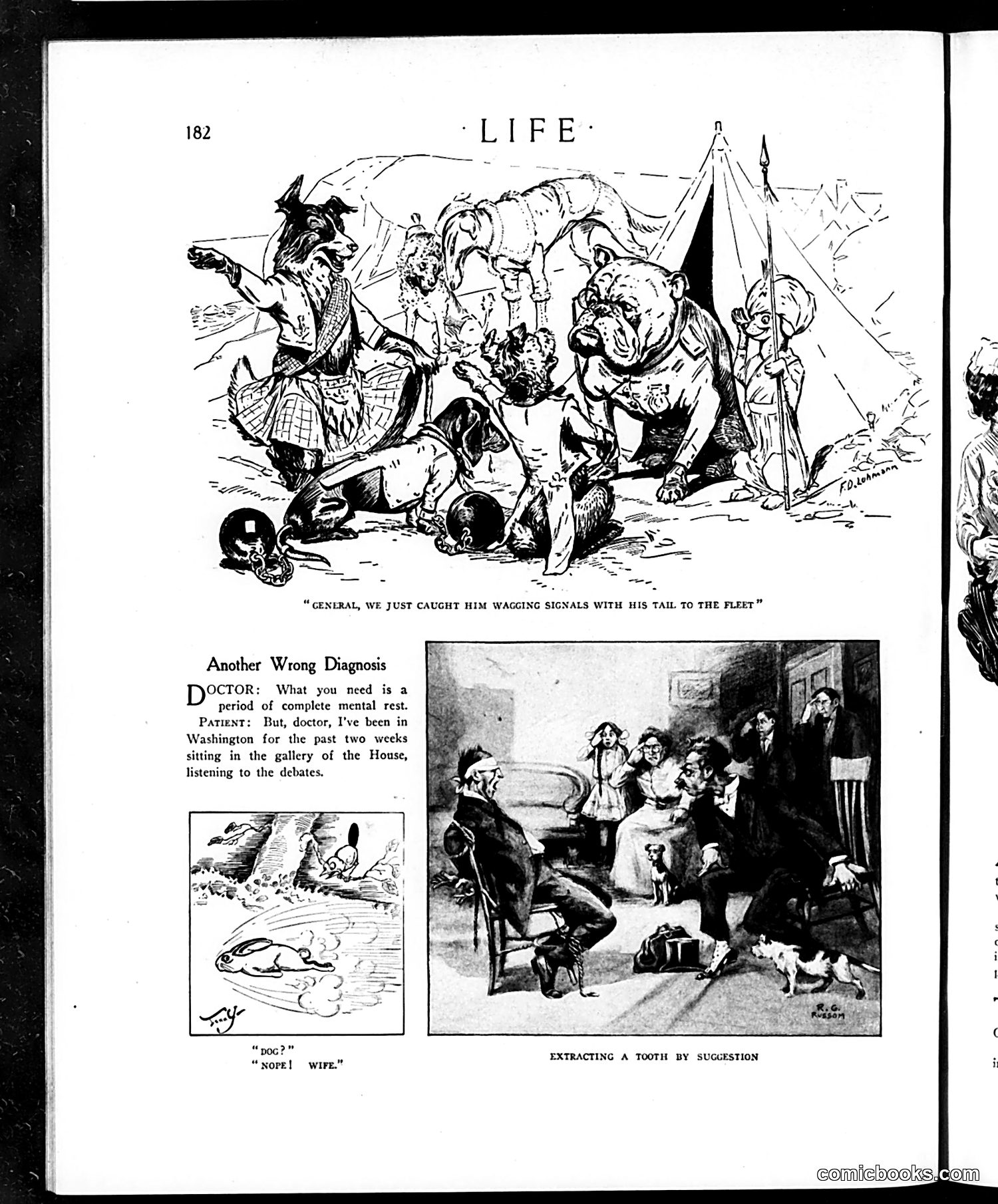
This page from *Life* magazine contains three satirical pieces: 1. **Top cartoon**: Military animals (appearing to be dogs or wolves in Scottish dress) report catching a dog "wagging signals with his tail to the fleet"—a WWI-era joke about military espionage and animal incompetence. 2. **"Another Wrong Diagnosis"**: A doctor prescribes mental rest to a patient who's been attending Congressional debates in Washington. The small cartoon below shows a confused fisherman—the joke is that exposure to politics is itself exhausting and confusing. 3. **"Extracting a Tooth by Suggestion"**: A dentist uses hypnosis instead of tools on a patient while onlookers observe—satirizing the era's fascination with psychology and "modern" medical alternatives to traditional methods. The humor targets military inefficiency, political tedium, and pseudoscientific medicine.
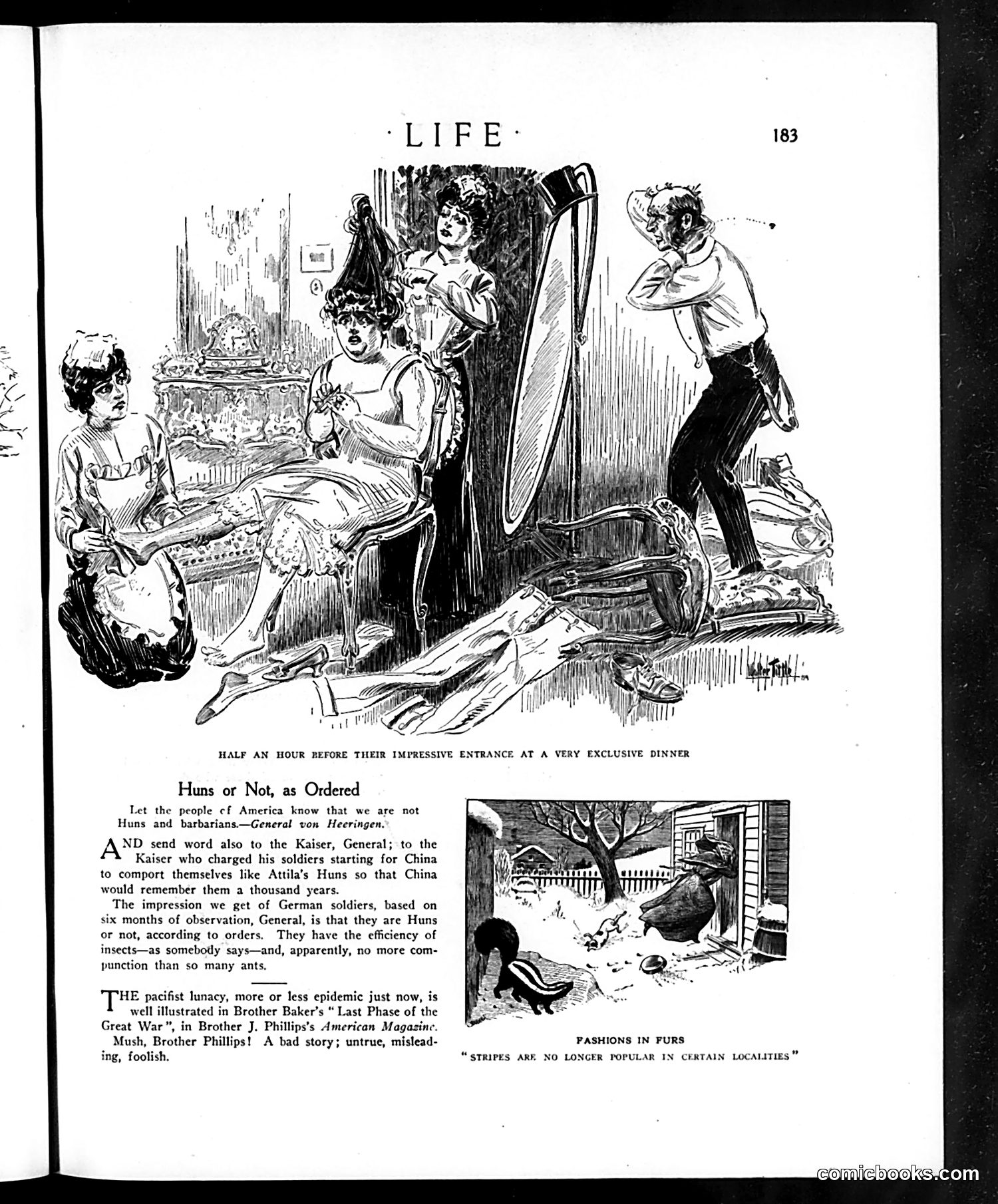
This page from *Life* magazine contains satirical content about World War I-era attitudes toward Germans. **Top Cartoon**: Shows wealthy Americans preparing for an exclusive dinner, with servants arranging elaborate clothing and accessories scattered about. The caption "Half an Hour Before Their Impressive Entrance at a Very Exclusive Dinner" satirizes social pretension. **"Huns or Not, as Ordered"**: The main article mocks American attitudes toward Germans, specifically referencing Kaiser Wilhelm and German soldiers. It critiques propaganda describing Germans as "Huns" (comparing them to Attila's forces) and satirizes military discipline. The piece calls out misleading war reporting by *American Magazine*, calling it "a bad story; untrue, misleading, foolish." **Bottom cartoon**: Titled "Fashions in Furs," appears unrelated fashion commentary.
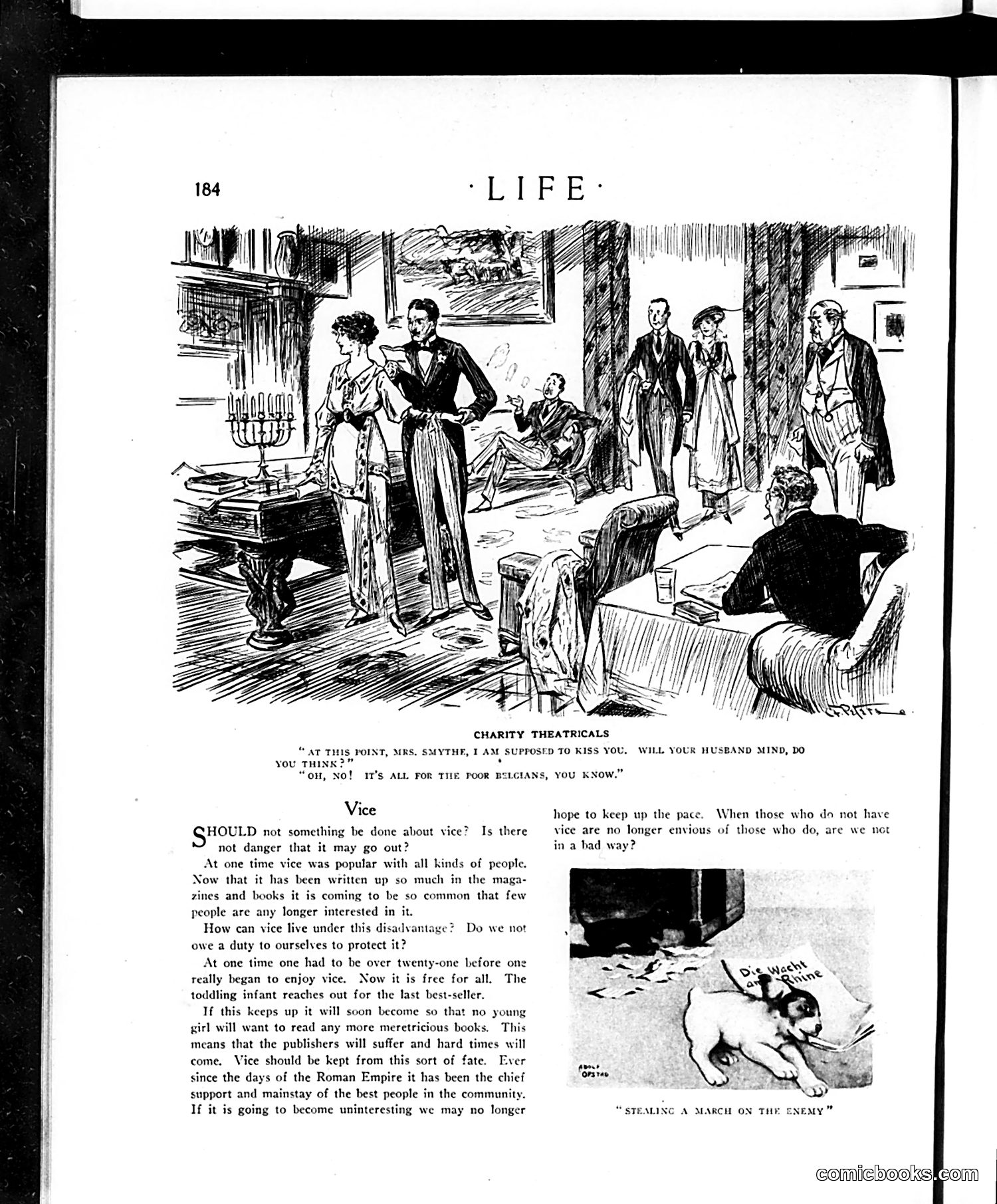
**Top Cartoon: "Charity Theatricals"** The sketch depicts a theatrical scene where a woman announces she'll kiss her husband for charity. His reluctant response—"Oh, no! It's all for the poor, religous, you know"—satirizes hypocrisy in charitable fundraising. The joke mocks how people invoke noble causes (helping poor clergy) to justify uncomfortable social situations, suggesting charitable events were sometimes pretexts for impropriety rather than genuine benevolence. **Bottom Image: "Stealing a March on the Enemy"** This photograph shows what appears to be a sleeping dog, humorously captioned. The phrase "stealing a march" (gaining advantage through stealth) juxtaposes military language with domestic animal behavior, creating mild comedic contrast. **Article: "Vice"** The text discusses growing social concern about vice becoming commonplace and "uninteresting," particularly in youth culture and literature.
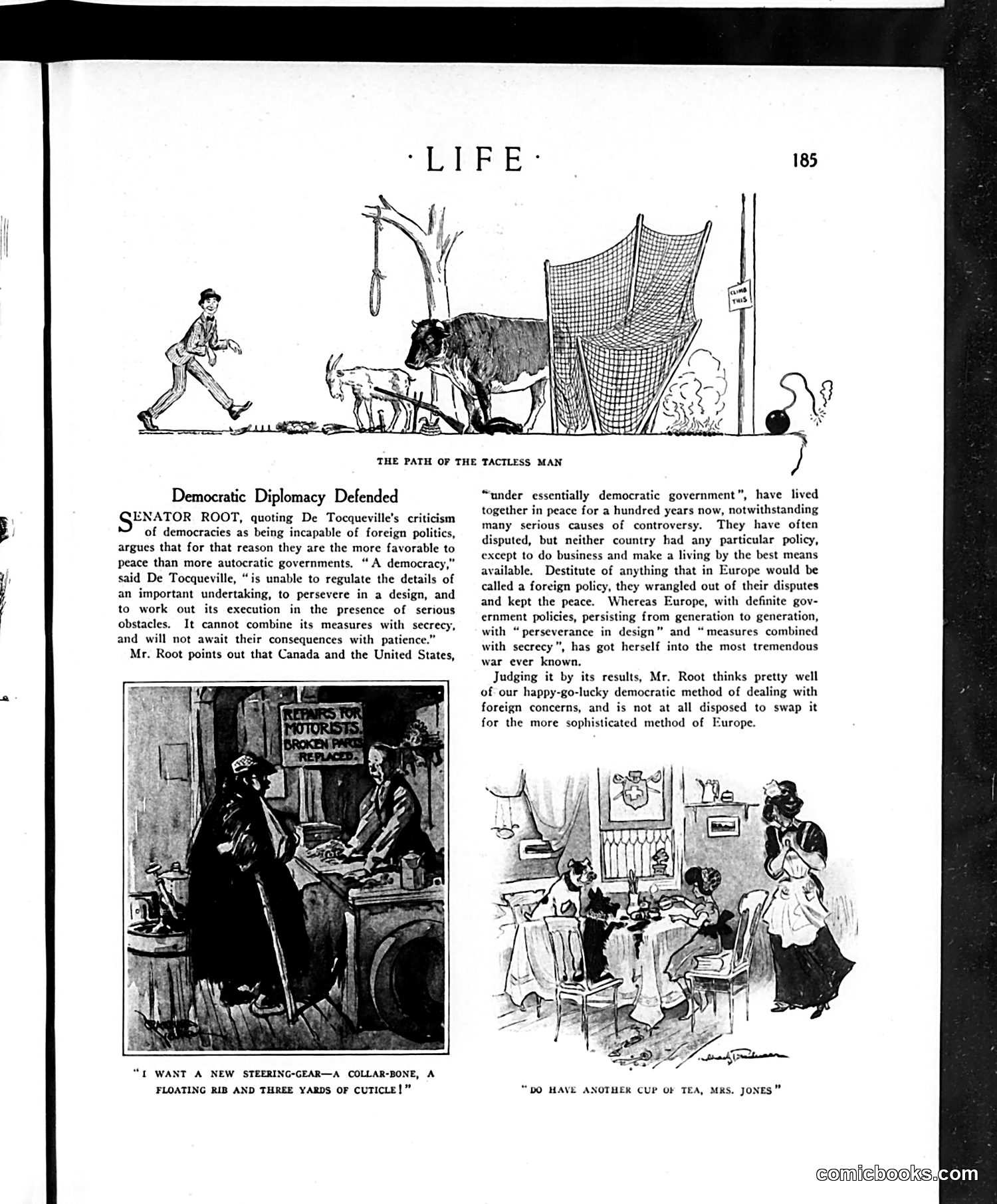
This page defends democratic governments' foreign policy approach. Senator Root argues that democracies like Canada and the U.S., despite De Tocqueville's criticism of their diplomatic capabilities, have successfully maintained peace for a century through non-secret, transparent methods—contrasting with secretive European diplomacy that led to World War I. The top cartoon, "The Path of the Tactless Man," satirizes the blundering diplomat who creates obstacles through clumsy behavior. The two lower cartoons are unrelated domestic humor: one depicts someone requesting automotive parts; the other shows a woman offering tea. These illustrate typical Life magazine's mix of political commentary and everyday social satire reflecting early 20th-century American life.
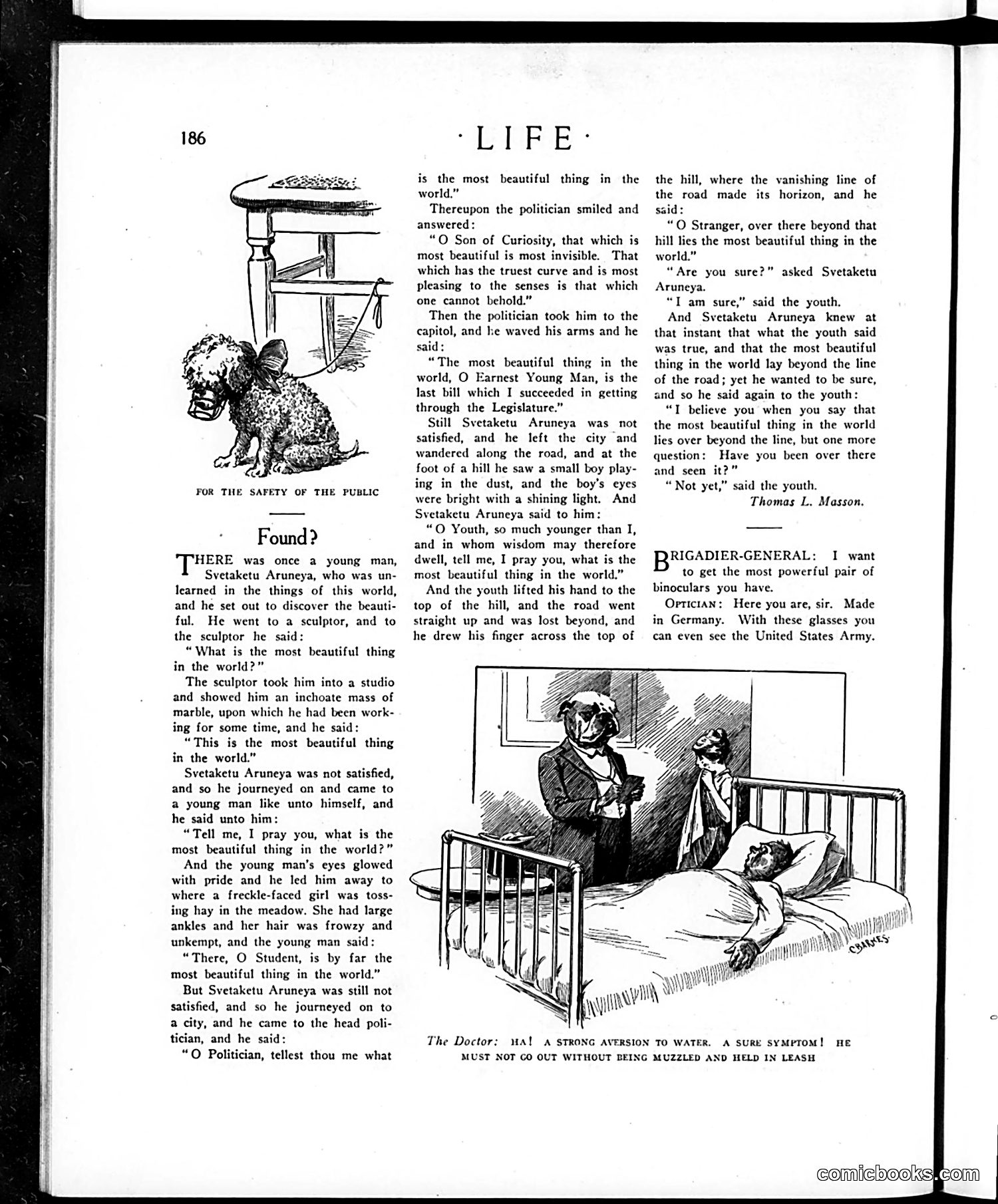
**Main Story: "Found?"** This is a philosophical fable by Thomas L. Mason about a young man (Svetaketu Aruneya) seeking the "most beautiful thing in the world." He consults various authorities—a sculptor, a young woman, a politician—each offering different answers. The story's point appears to be satirizing how different professions/viewpoints give conflicting answers to fundamental questions. The youth ultimately discovers beauty exists beyond what can be seen or possessed, suggesting that invisible or intangible things matter most. **Secondary Cartoon: "Brigadier-General"** A brief joke about German-made binoculars being so powerful they can "see the United States Army." This is likely Cold War-era satire about German military technology and American military concerns. Both pieces employ gentle philosophical humor rather than sharp political attack.
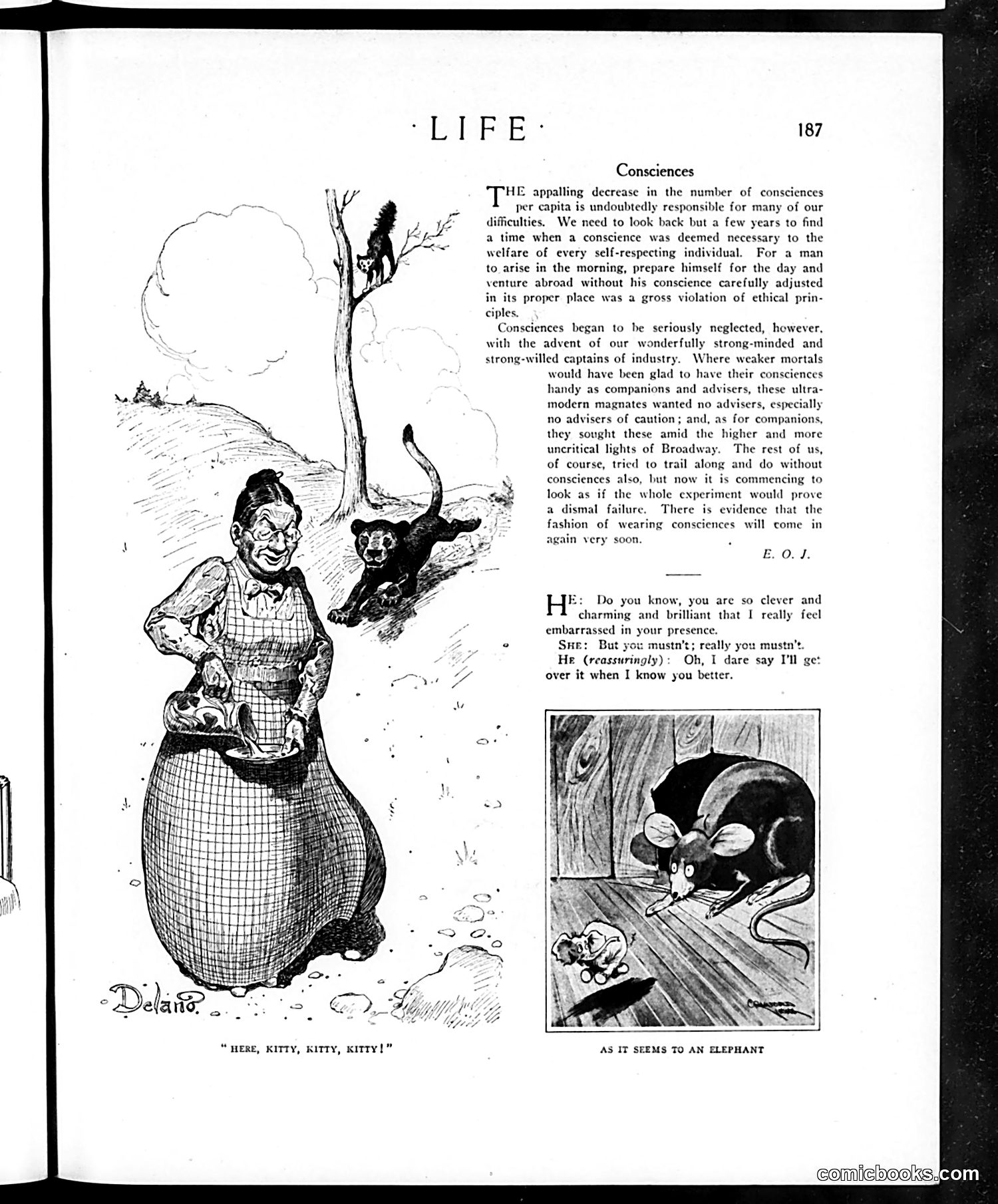
This page satirizes the decline of personal morality in early 20th-century America, particularly blaming wealthy industrialists ("captains of industry") for abandoning conscience as a social necessity. The article argues that strong-willed business leaders rejected ethical restraint, instead seeking entertainment in morally loose venues like Broadway, and that ordinary people followed their example—to society's detriment. The left cartoon by Delano depicts a woman calling "Here, kitty, kitty, kitty!"—a traditional summons for cats—while holding what appears to be a dead mouse or rat. The dark humor suggests she's trying to attract cats using bait, a commentary on manipulation or deception. The right cartoon, captioned "As It Seems to an Elephant," shows the same scene from an elephant's perspective—the woman appears enormous and threatening, the mouse absurdly tiny. This illustrates how context and perspective drastically alter perception of the same scenario. Both cartoons support the text's theme about moral perspective and judgment.
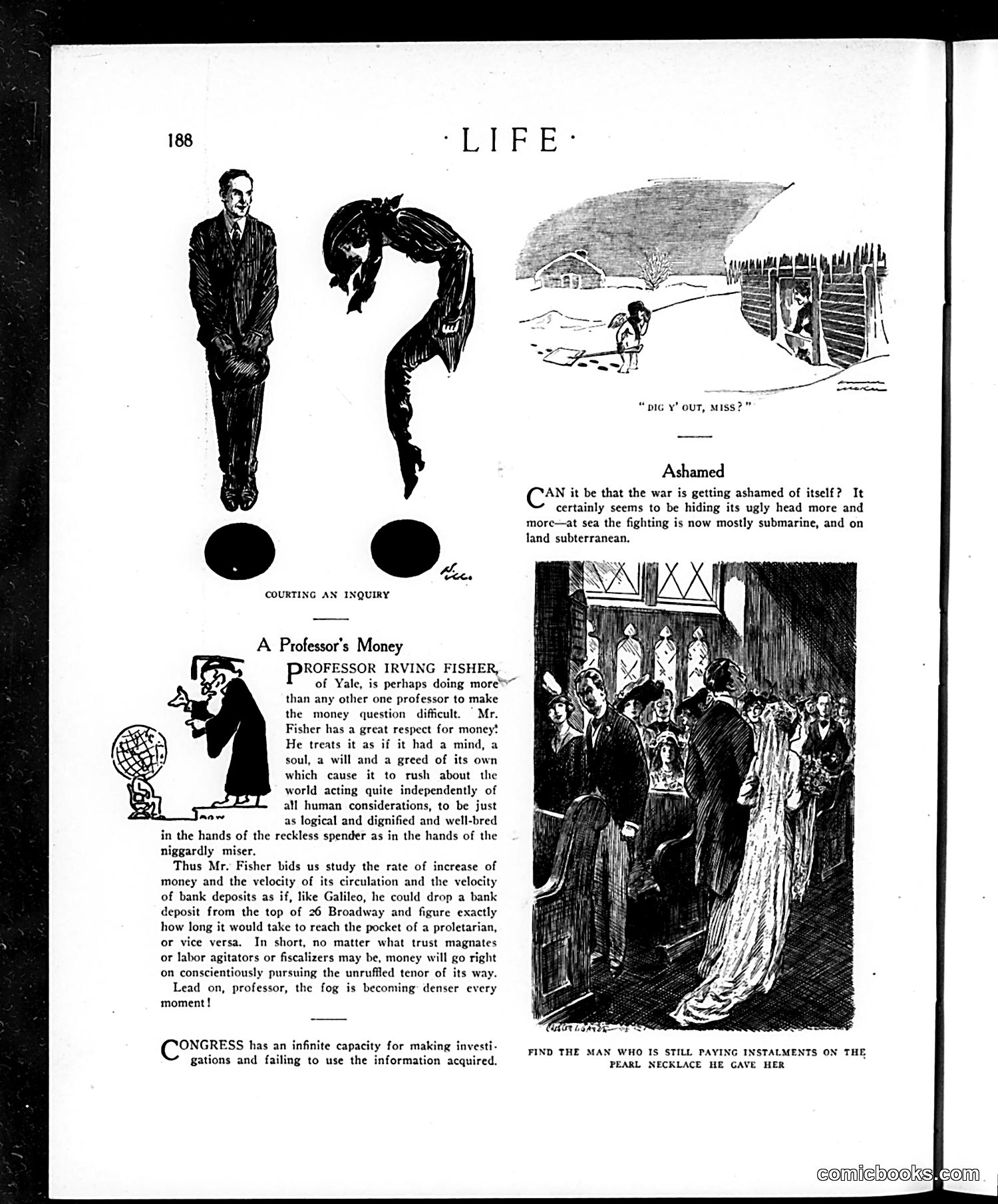
This page contains three distinct satirical pieces: **"A Professor's Money"** mocks Yale economist Irving Fisher for treating money as an autonomous force with its own "mind" and "will," independent of human action. The satire suggests Fisher's economic theories are overly abstract and impractical—reducing real financial systems to theoretical abstractions disconnected from working people's actual lives. **"Ashamed"** is a brief commentary on World War I, sarcastically observing that modern warfare has become hidden (submarine and underground combat) rather than openly displayed, suggesting the war itself is "ashamed" of its brutality. **"Find the Man"** is a social joke about a man still paying installments on an expensive pearl necklace he gave to a woman—likely implying he's been abandoned or the relationship has failed, but he remains financially obligated. The "Courting an Inquiry" cartoon depicts a formal social interaction, while the bottom illustration shows a formal church or legal proceeding. These complement the page's satirical tone about society, economics, and relationships.
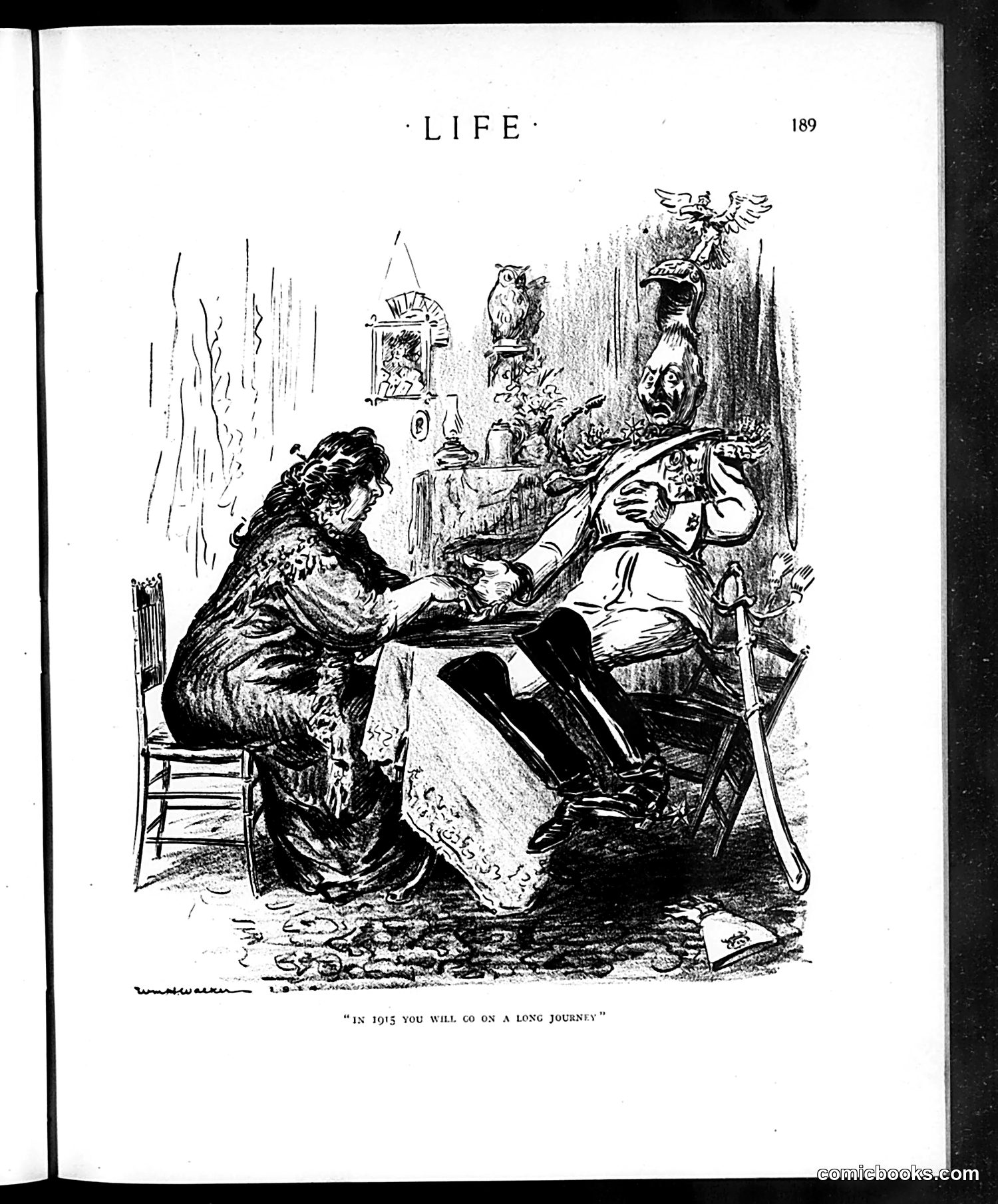
This cartoon appears from Life magazine's satirical section. It depicts a fortune teller or mystic (left) reading the palm of a reclining military officer (right), with the caption predicting a "long journey" in 1915. The setting—decorated with occult imagery (owls, mysterious objects)—satirizes fortune-telling practices. The joke likely references World War I, which was raging in Europe in 1915. The "long journey" is a euphemistic prediction of military deployment or combat abroad. The cartoon mocks both the superstitious belief in fortune-telling and, implicitly, anxieties about American involvement in the Great War—a major contemporary concern in 1915 before formal U.S. entry in 1917.
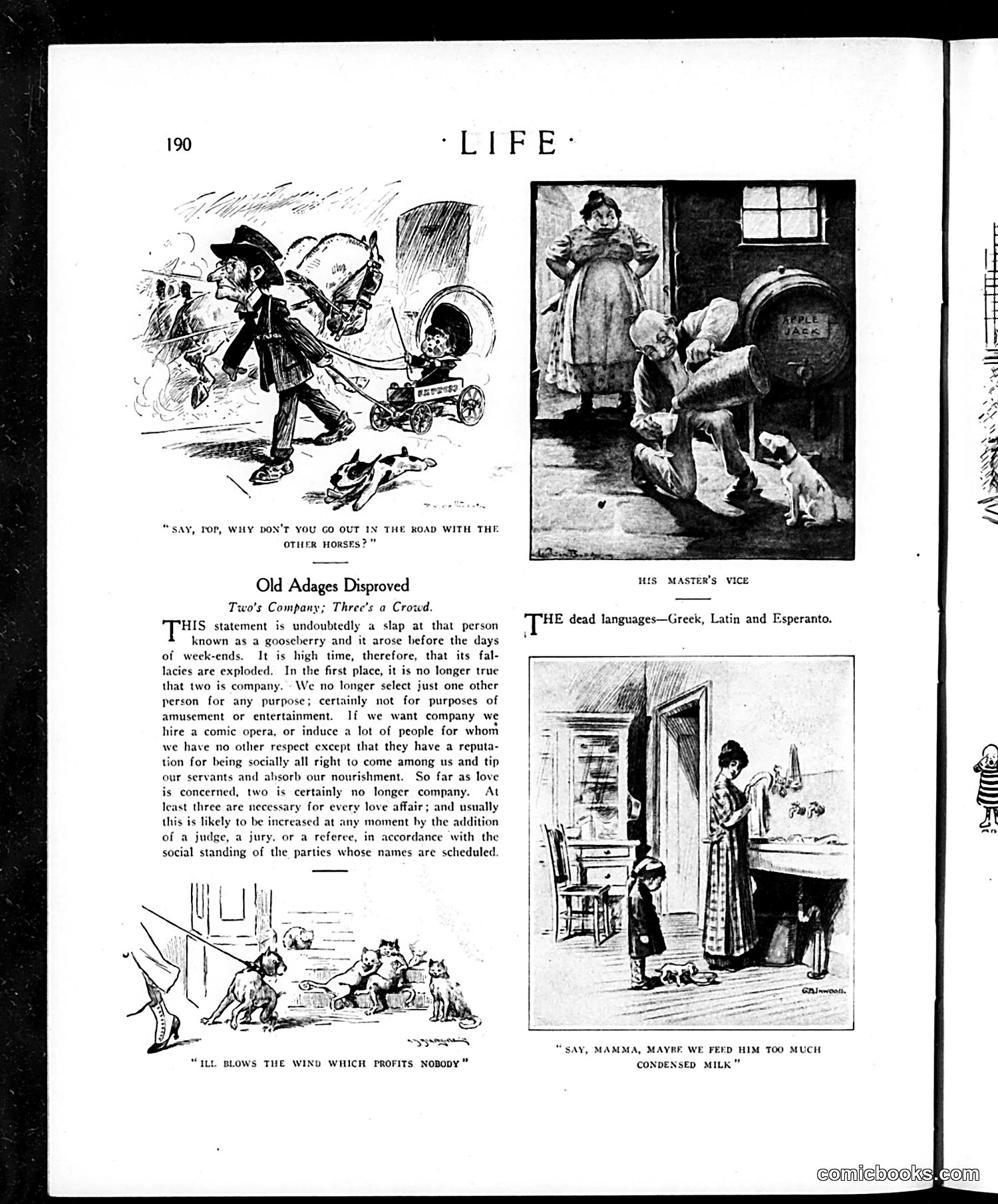
This page from *Life* magazine contains satirical commentary on early-20th-century social customs using cartoons and essays. **"Old Adages Disproved"** critiques the saying "two's company, three's a crowd." The essay argues this maxim no longer applies to modern life. For romance, the author sarcastically notes that three people are now standard—and frequently more when judges, juries, or referees become involved (a reference to divorce proceedings and breach-of-promise lawsuits, which were common scandal fodder). The cartoon showing a man with children illustrates the chaos of actual relationships versus the adage's romantic ideal. **"His Master's Vice"** appears to reference dead languages (Greek, Latin, Esperanto). The bottom illustration, captioned "Say, Mamma, maybe we feed him too much condensed milk," shows a child and mother with a barrel, likely satirizing modern parenting practices or commercial products marketed to families. The overall theme mocks outdated social conventions and naive assumptions about love and domesticity in a more complex modern age.
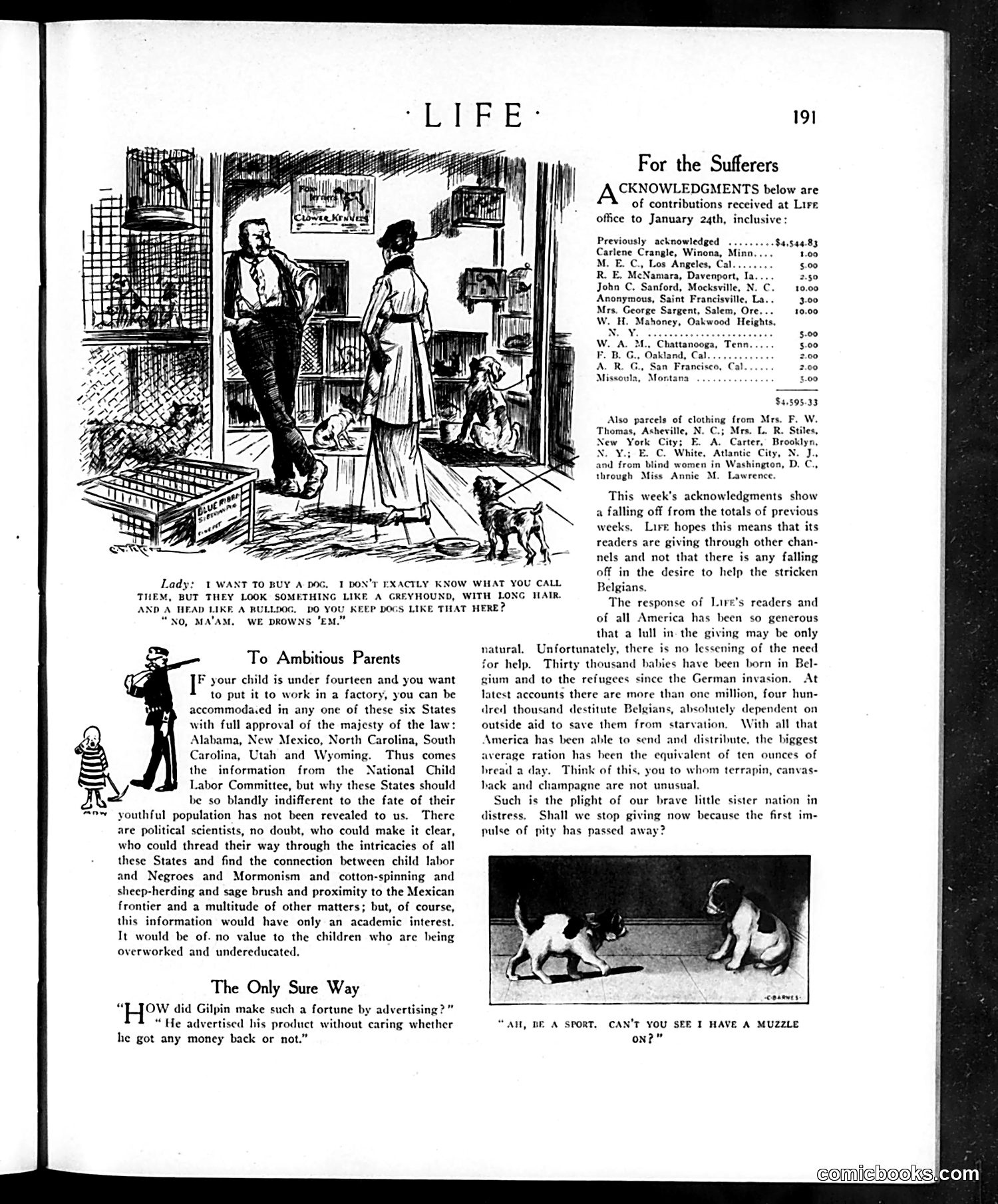
This page contains three distinct satirical pieces: **Top cartoon**: A woman asks a pet-shop owner about dog breeds, describing "something like a greyhound, with long hair." His brutal reply—"No, ma'am, we drowns 'em"—mocks indifference to unwanted animals. **"To Ambitious Parents"**: Life satirizes six U.S. states (Alabama, New Mexico, North Carolina, South Carolina, Utah, Wyoming) that legally permitted child labor. The piece is sarcastic, noting that while politicians claim these states' policies serve some larger purpose, the actual consequence is simply that children are "overworked and undereducated." **"The Only Sure Way"**: A joke about advertising: a man grew wealthy by promoting his product without caring whether he made money—implying paradoxical success through apparent indifference. The page also lists donations for Belgian relief (WWI era), noting that contributions have declined. Life urges readers to continue giving despite initial sympathy fading. Together, these pieces exemplify Life's muckraking satirical approach to social problems—child labor exploitation, indifference to suffering, and humanitarian crises.
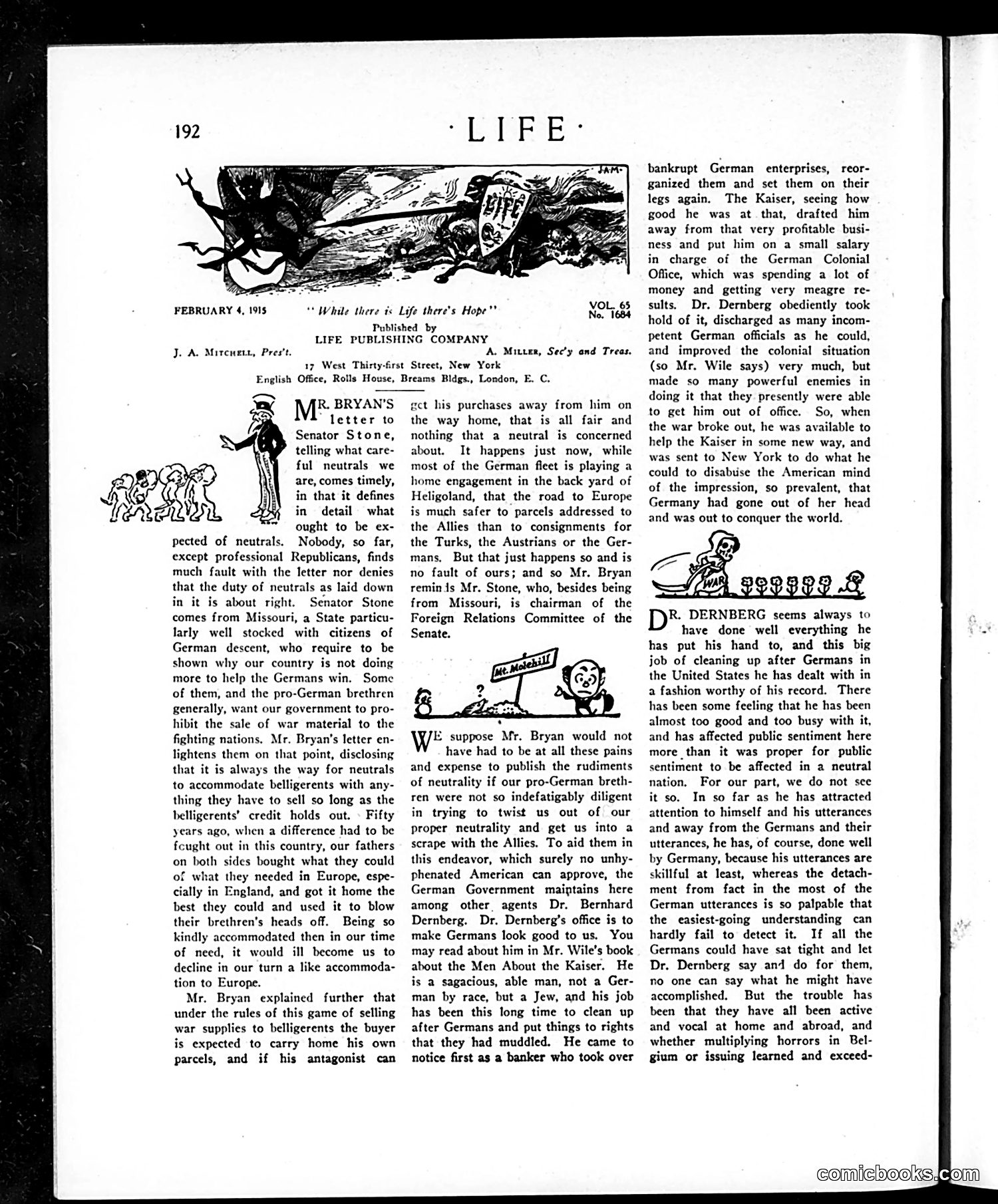
This page defends American neutrality during World War I, specifically responding to pro-German pressure. Secretary of State William Jennings Bryan's recent letter to Senator Stone (a Missouri politician with many German-American constituents) is praised for explaining that neutrals may legally sell war materials to belligerents—the Allies currently have safer sea routes for purchases, which is not America's responsibility. The article attacks Dr. Bernhard Dernberg, the German government's official representative in America tasked with improving Germany's public image. The author dismisses Dernberg's propaganda efforts and criticizes "pro-German brethren" and "hyphenated Americans" (German-Americans) for pressuring the U.S. to abandon neutrality. The cartoons (spider, figures) appear to mock German diplomatic manipulation and subversive activities. The overall message: America's arms sales to Allies reflect proper neutrality, not pro-Allied bias.
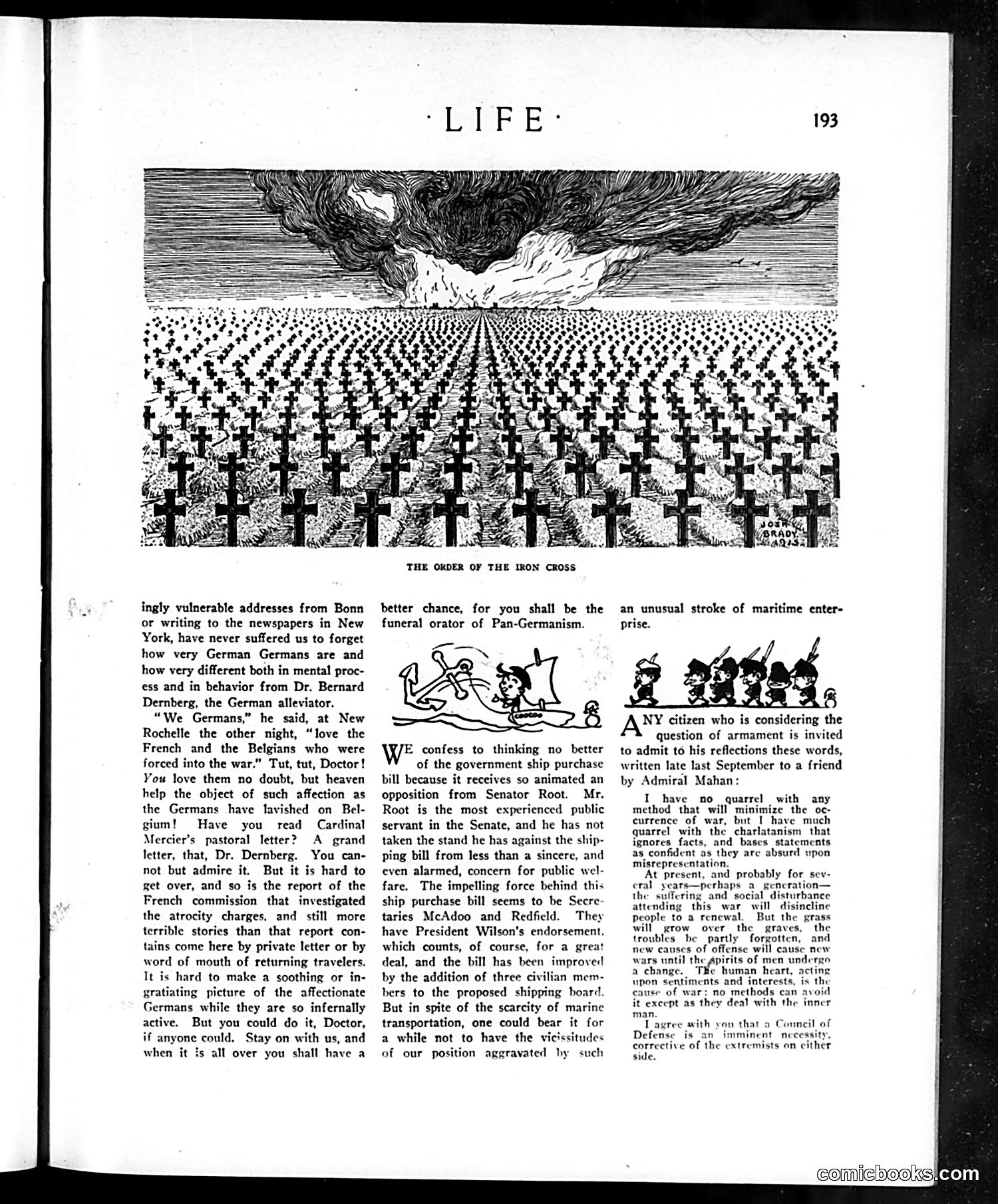
The image depicts an enormous field of grave crosses stretching to the horizon beneath a dark, stormy sky—a stark visualization of World War I casualties. The caption "THE ORDER OF THE IRON CROSS" is a bitter pun: the Iron Cross was Nazi Germany's military decoration, but here the "order" refers to the systematic arrangement of graves, sardonically suggesting mass death as Germany's true "achievement." The accompanying text attacks **Dr. Bernard Dernberg**, a German official attempting to improve Germany's image in America by claiming Germans "love the French and Belgians." The author scathingly rejects this propaganda, referencing Cardinal Mercier's documented reports of German atrocities in Belgium and French investigations into war crimes. The satire suggests Dernberg's public relations efforts are obscene given the mounting death toll. The cartoon simultaneously critiques American military and political debates—notably Senator Root's opposition to Wilson's government ship-purchase bill—implying such domestic disputes seem trivial against the war's carnage documented by the grave field above.
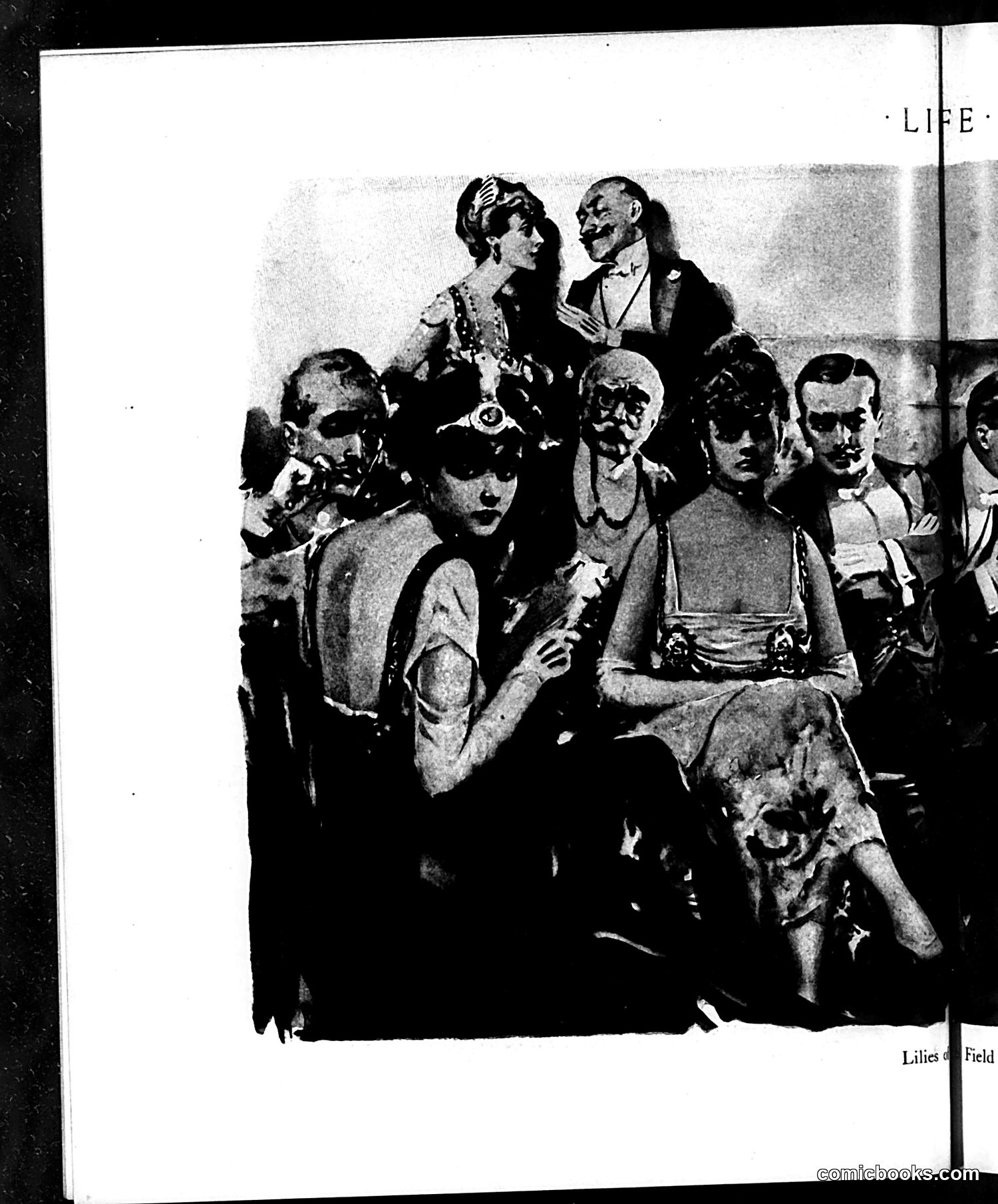
This appears to be a satirical illustration from *Life* magazine titled "Lilies of the Field." The image shows a group of elaborately dressed figures in what seems to be a social gathering or theatrical scene. The styling and caricatured features suggest social satire, likely targeting wealthy or upper-class individuals and their pretensions. The title "Lilies of the Field" is a biblical reference (Matthew 6:28) about how lilies neither toil nor spin, often used to mock the idle wealthy or those living lavishly without productive labor. The exaggerated costumes and poses suggest the cartoon mocks artificial elegance, social affectation, or perhaps leisure-class excess during the era when *Life* magazine was published. Without clearer text or additional context, the specific targets and precise satirical point remain unclear.
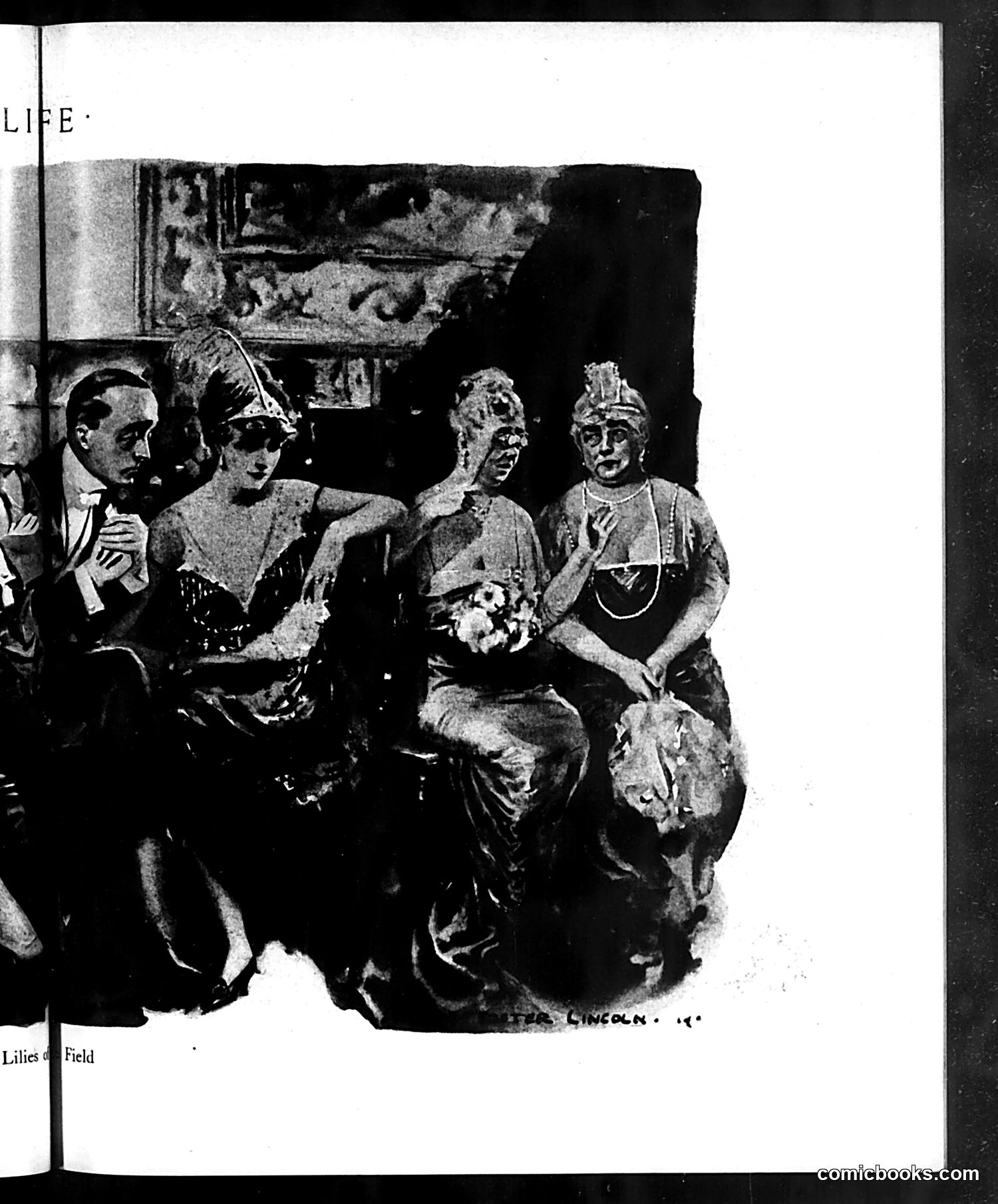
This appears to be a satirical illustration from *Life* magazine showing four figures in elaborate costumes and headdresses engaged in conversation. The illustration is credited to "Lincoln" (visible at bottom). The page header reads "LIFE" and the lower left corner shows "Lilies of the Field," suggesting this may be commentary on pretentious or ostentatious display. The four elaborately dressed figures—wearing ornate headpieces and decorated garments—appear to be caricatures of wealthy or socially prominent people. The satire likely mocks their affected fashion, vanity, or social pretensions, particularly the exaggerated headwear and jewelry. The specific identities remain unclear from the image alone, but the cartoon targets what appears to be high society's frivolous fashion choices or social climbing behavior typical of *Life* magazine's satirical commentary.
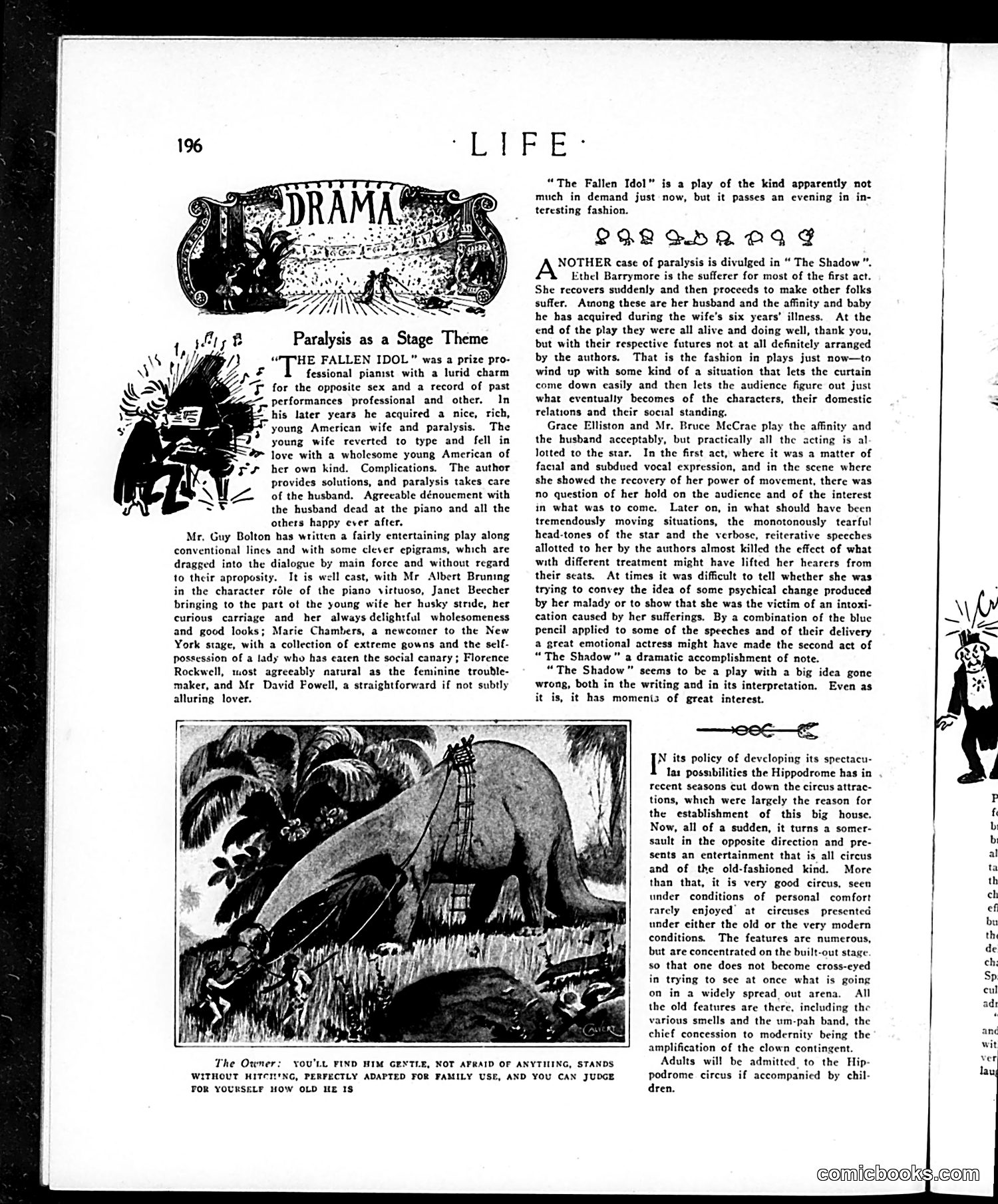
This page reviews two Broadway plays dealing with paralysis as plot devices: **"The Fallen Idol"** features a pianist virtuoso who acquires both a rich American wife and paralysis. The review mocks the contrived plot where paralysis conveniently eliminates the husband, allowing the wife to pursue a wholesome American lover. The satire targets formulaic theater: using disability as a convenient dramatic solution rather than meaningful storytelling. **"The Shadow"** stars Ethel Barrymore as a woman who recovers from paralysis mid-play, then causes others to suffer. The reviewer criticizes both the loose ending and Barrymore's performance—her "monotonously tearful head-tones" undermine potentially moving scenes. The critic suggests better editing and delivery could have elevated the material. The accompanying circus illustration appears unrelated to the drama reviews. Both play reviews exemplify early 20th-century theater criticism lampooning melodramatic conventions and star-dependent casting.
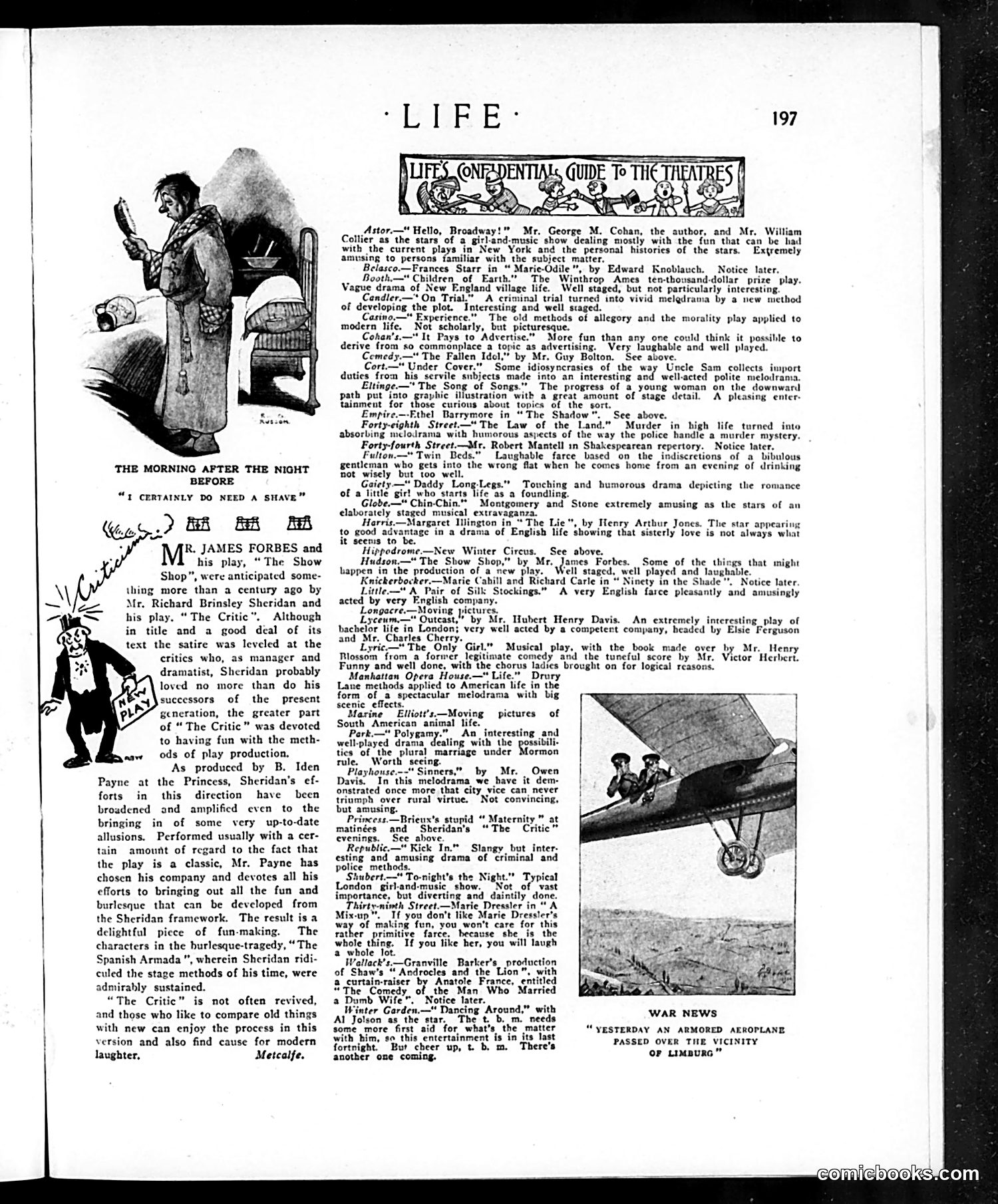
This page is primarily a **theater review guide** from *Life* magazine, not a political cartoon. The small illustration labeled "The Morning After the Night Before" shows a disheveled man saying "I certainly do need a shave"—a simple visual gag about hangover aftermath. The bulk of the page contains brief reviews of Broadway productions. The text discusses James Forbes's play "The Show Shop" in relation to Sheridan's 18th-century satire "The Critic," praising how both mock theatrical production methods. Reviews cover contemporary shows like George M. Cohan's "Hello, Broadway!" and various melodramas and farces popular in the era. The bottom photographs show a war-related image: an armored aeroplane passing over Limburg (presumably WWI-era). This reflects *Life*'s mix of entertainment coverage with current events during the First World War period.
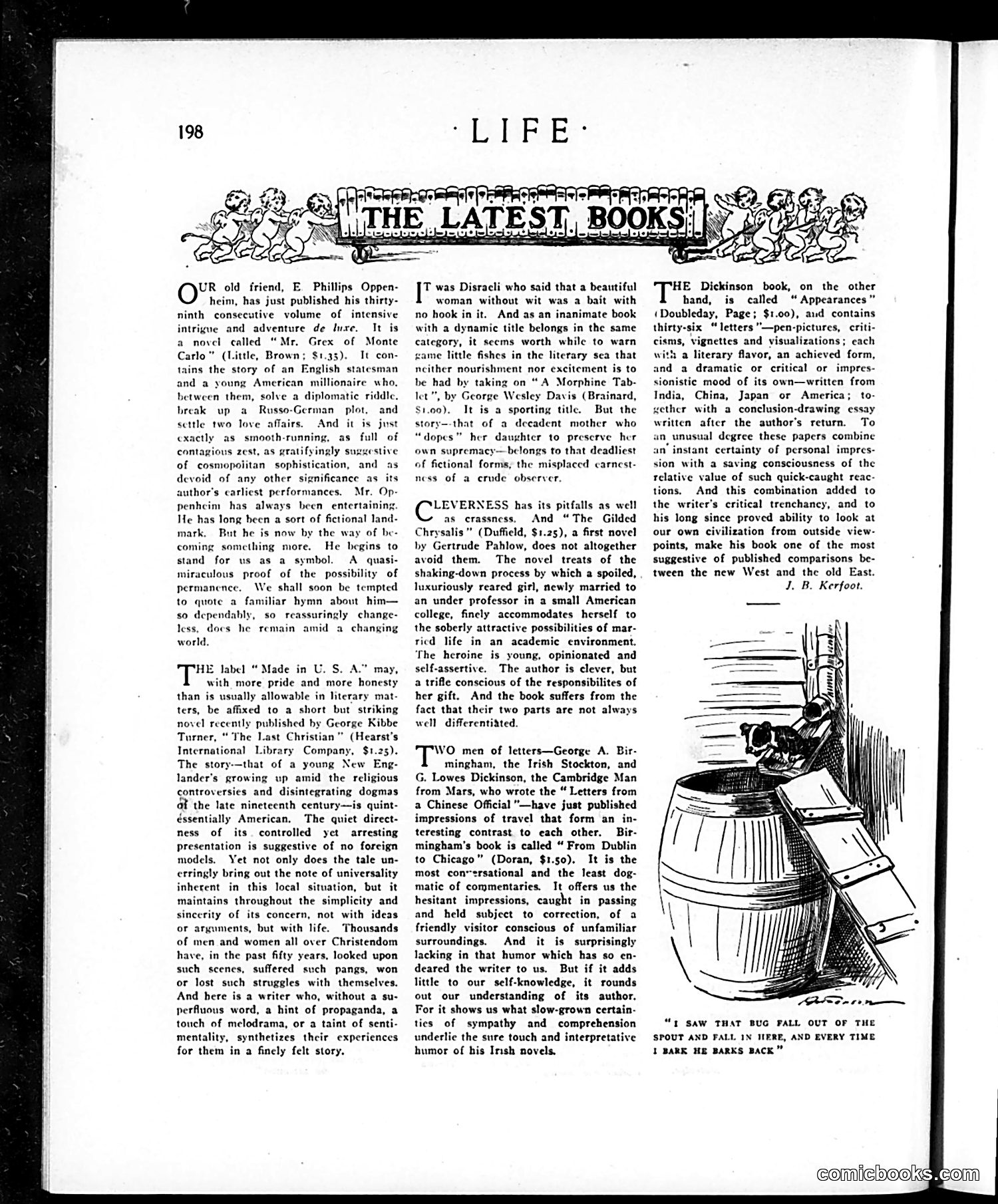
This page contains literary book reviews rather than political cartoons. The small illustration shows a humorous scene of a bug falling into what appears to be a inkwell or container, with the caption about the bug repeatedly falling back in—likely a visual joke about persistent problems or circular failures. The reviews discuss recent novels: E. Phillips Oppenheim's "Mr. Grex of Monte Carlo" (praised as entertaining but formulaic); George Kibbe Turner's "The Last Christian" (commended as genuinely American literature addressing religious doubt); "A Morphine Tablet" by George Wesley Davis (criticized as having a sensational title but poor execution); and Gertrude Pahlow's "The Gilded Chrysalis" (noted as clever but self-conscious). The reviews reflect early 20th-century literary taste and concerns—particularly the tension between entertainment value and artistic authenticity, and anxiety about modern social problems like drug addiction.
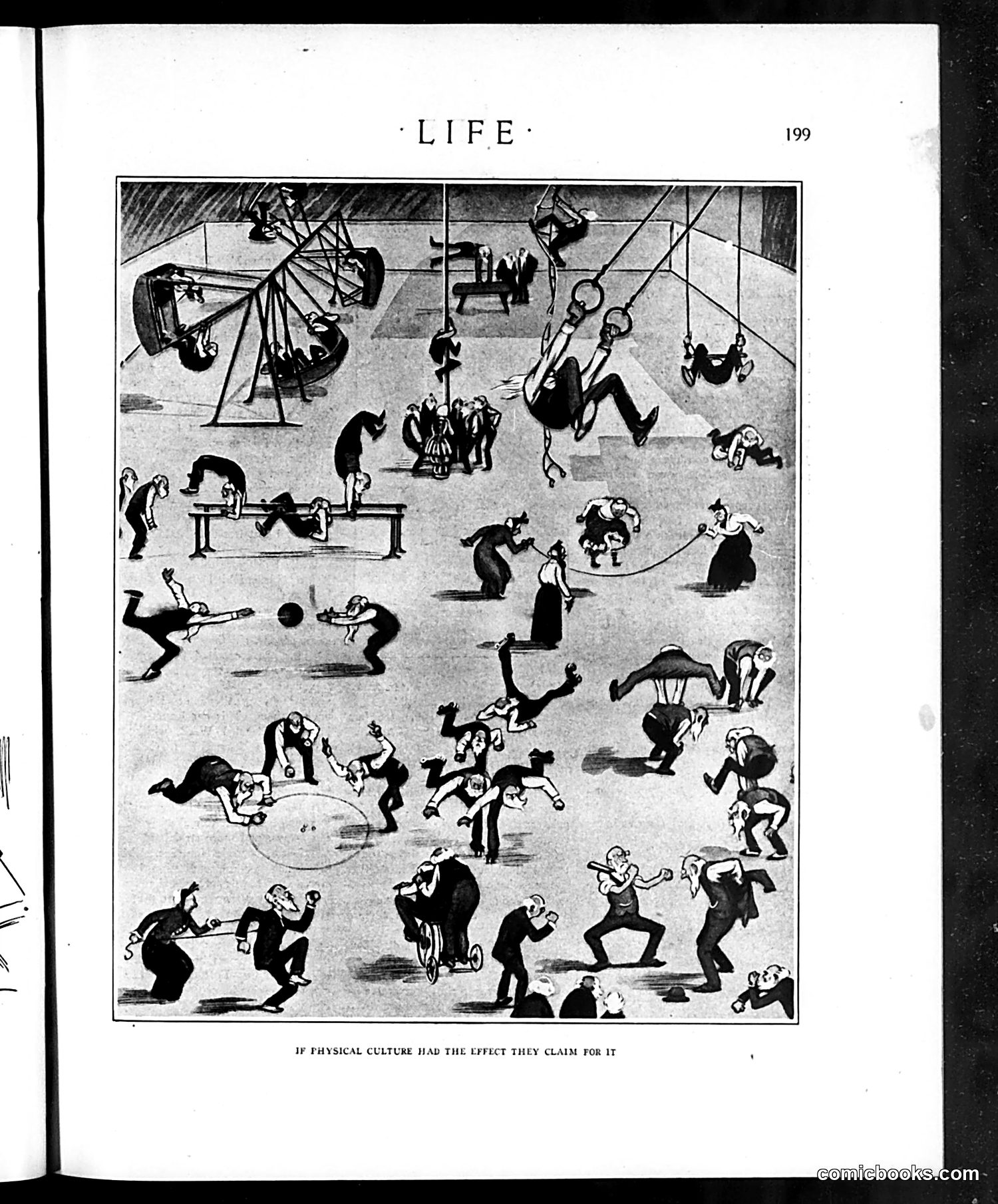
This is a satirical cartoon mocking claims about "physical culture" (the fitness and bodybuilding movement popular in the early 20th century). The caption reads: "IF PHYSICAL CULTURE HAD THE EFFECT THEY CLAIM FOR IT." The cartoon depicts a crowded recreational space where men in business suits and formal wear are engaging in various athletic activities—using gym equipment, doing acrobatics, playing sports, and using what appears to be early exercise apparatus. The satire suggests that if physical culture actually delivered on its promised benefits (strength, health, vitality), these sedentary office workers would transform into the idealized specimens promoters claimed. The joke mocks the gap between fitness marketing's promises and reality—implying these businessmen remain essentially unchanged despite their efforts, still appearing awkward and unfit in their formal clothing and postures.
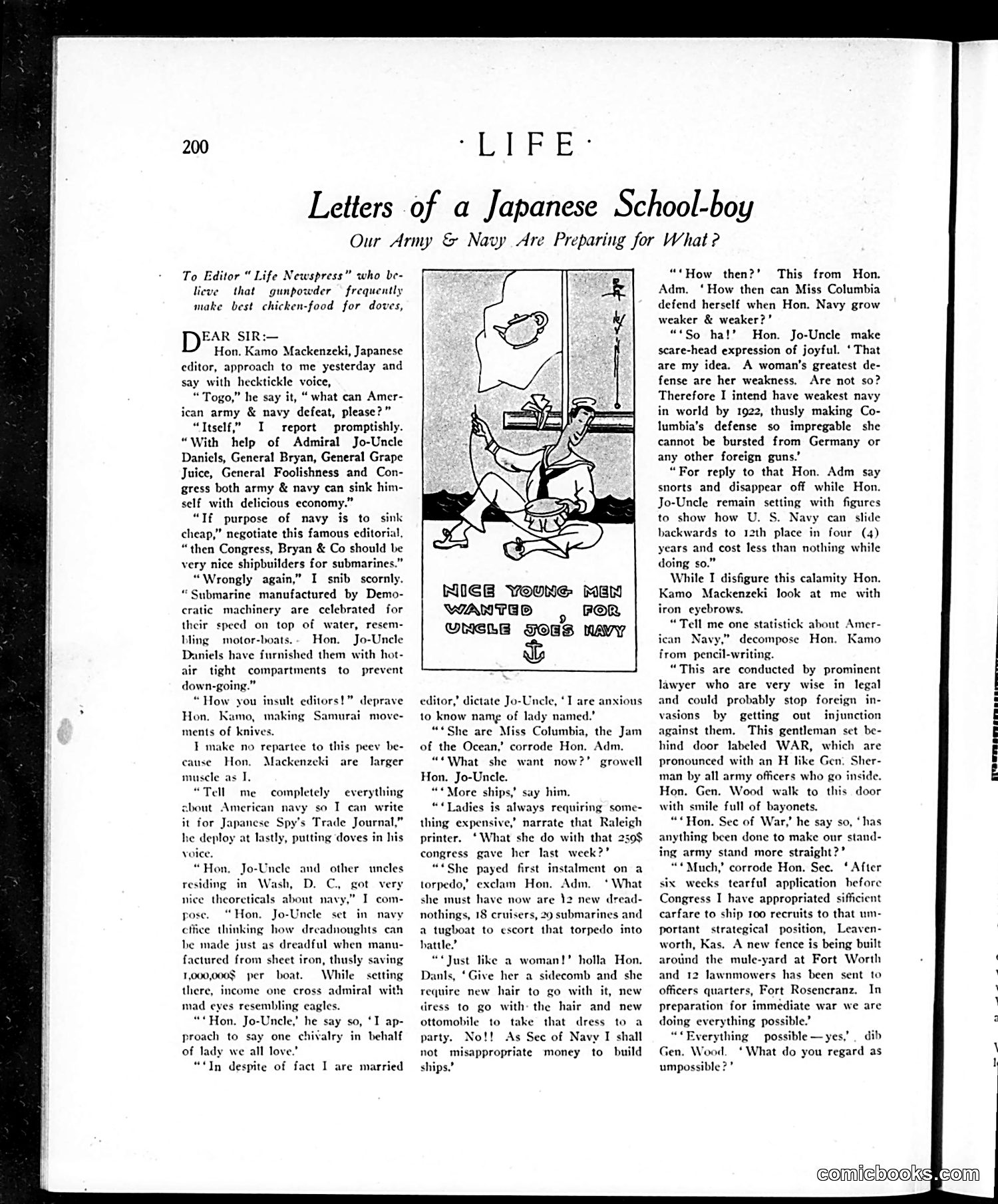
This piece satirizes the Wilson administration's naval policy through a mock letter from a Japanese school-boy observer. The cartoon mocks American leaders—particularly Secretary of the Navy Josephus Daniels ("Jo-Uncle") and other Democratic officials—for their supposedly weak military preparedness. The satire targets the debate over naval expansion: Daniels and Congress are portrayed as unwilling to fund adequate warships, instead obsessing over economizing. The cartoon ridicules their logic by having the Japanese character propose deliberately *weakening* America's navy by 1922, making the country defenseless while claiming this paradoxically strengthens defense. "Miss Columbia" represents America herself. The piece critiques both pacifist sentiment and the administration's actual naval spending decisions. The broken English and exaggerated characterization of the Japanese observer was typical of early-20th-century American satirical magazines, though the actual argument—that America was unprepared militarily—reflects genuine contemporary defense debates.
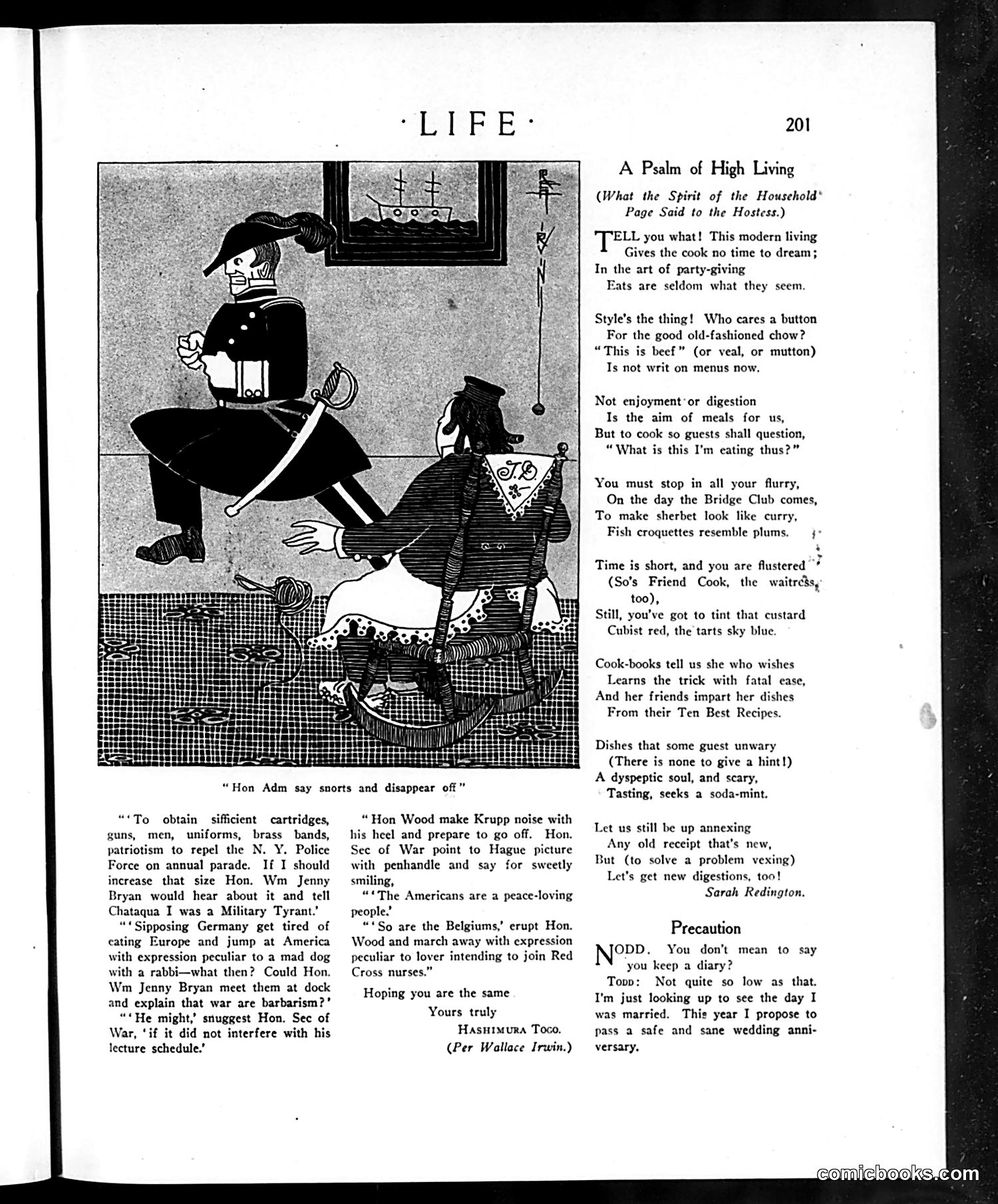
This page contains two satirical pieces from *Life* magazine: **Main Cartoon** ("Hon Adm say snorts and disappear off"): A dialogue mocking William Jennings Bryan, the three-time presidential candidate and pacifist. The military Secretary of War ridicules Bryan's peace advocacy, imagining scenarios where his opposition to military preparedness would fail against real threats (like Germany/Kaiser Wilhelm II, represented by the German general). The joke: Bryan's lectures on avoiding war are useless in actual conflict. References include Belgium's invasion by Germany and the Red Cross. **"A Psalm of High Living"**: Satirizes wealthy hostesses obsessed with fashionable presentation over substance—disguising ordinary food (beef as exotic dishes, fish as plums) to impress dinner guests. The joke targets the shallow materialism and performative nature of high society entertaining, where style trumps nutrition or honesty. **"Precaution"**: A brief joke about a woman checking her marriage date in a diary to plan a "safe and sane" anniversary, implying marital discord.
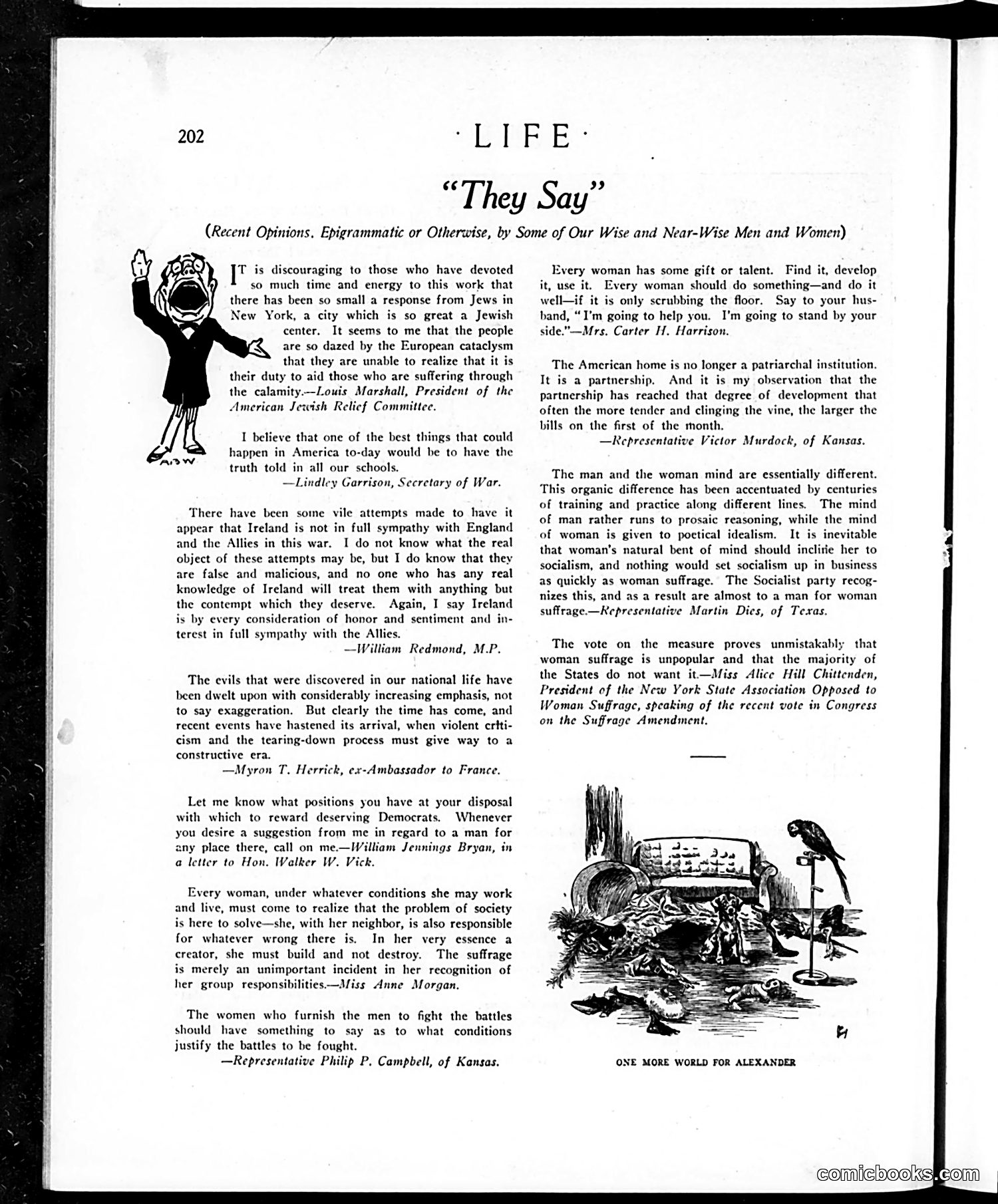
This Life magazine page presents satirical commentary on contemporary political and social issues circa 1915-1920, formatted as purported quotations from prominent figures. The main cartoon (bottom right, titled "One More Word for Alexander") depicts a parrot on a desk with papers and books—likely satirizing empty political rhetoric or repetitive messaging. The quotations themselves comprise the satire. They address: Jewish charitable giving (Louis Marshall), education truth-telling (Lindley Garrison), Irish-Allied loyalty (William Redmond), post-reform constructive action (Myron Herrick), and Democratic patronage (William Jennings Bryan). Several quotations debate women's roles—notably whether women's suffrage is trivial (Miss Anne Morgan) versus consequential (Representative Campbell), and whether women's minds naturally incline toward socialism (Representative Dies). The satire works by juxtaposing these statements to highlight contradictions in contemporary political discourse, particularly regarding women's rights and war-era priorities. The page mocks both inflated rhetoric and the era's unresolved tensions about women's place in American society.
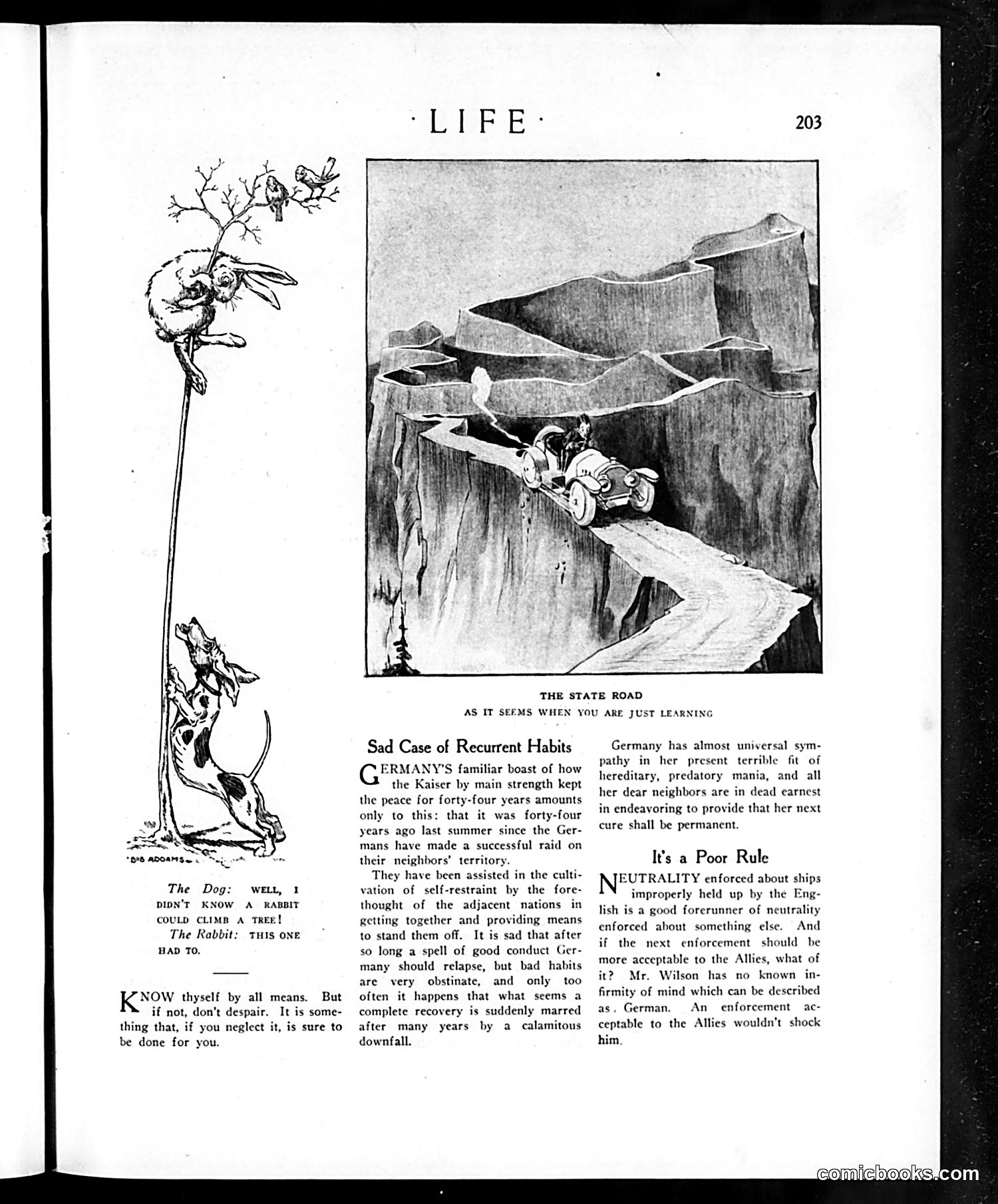
This page contains two distinct pieces of anti-German wartime satire, likely from 1917-1918. **Left cartoon**: A dog chases a rabbit up a tree. The joke plays on the phrase "climb a tree"—the rabbit explains it "had to," suggesting desperation forces even the impossible. **Main article "Sad Case of Recurrent Habits"**: Mocks Germany's claim of keeping peace for 44 years under the Kaiser, arguing this merely means 44 years since their *last* successful raid on neighbors. It frames German aggression as an incurable "hereditary, predatory mania" and likens the current war to forced medical treatment—hoping "her next cure shall be permanent." **"It's a Poor Rule"**: Criticizes President Wilson's neutrality enforcement regarding British ship seizures, sarcastically suggesting if future neutrality enforcement favors the Allies instead, Wilson won't object since he lacks "German" tendencies. This suggests Wilson should abandon strict neutrality favoring the Allies. Both pieces reflect American wartime propaganda against Germany.
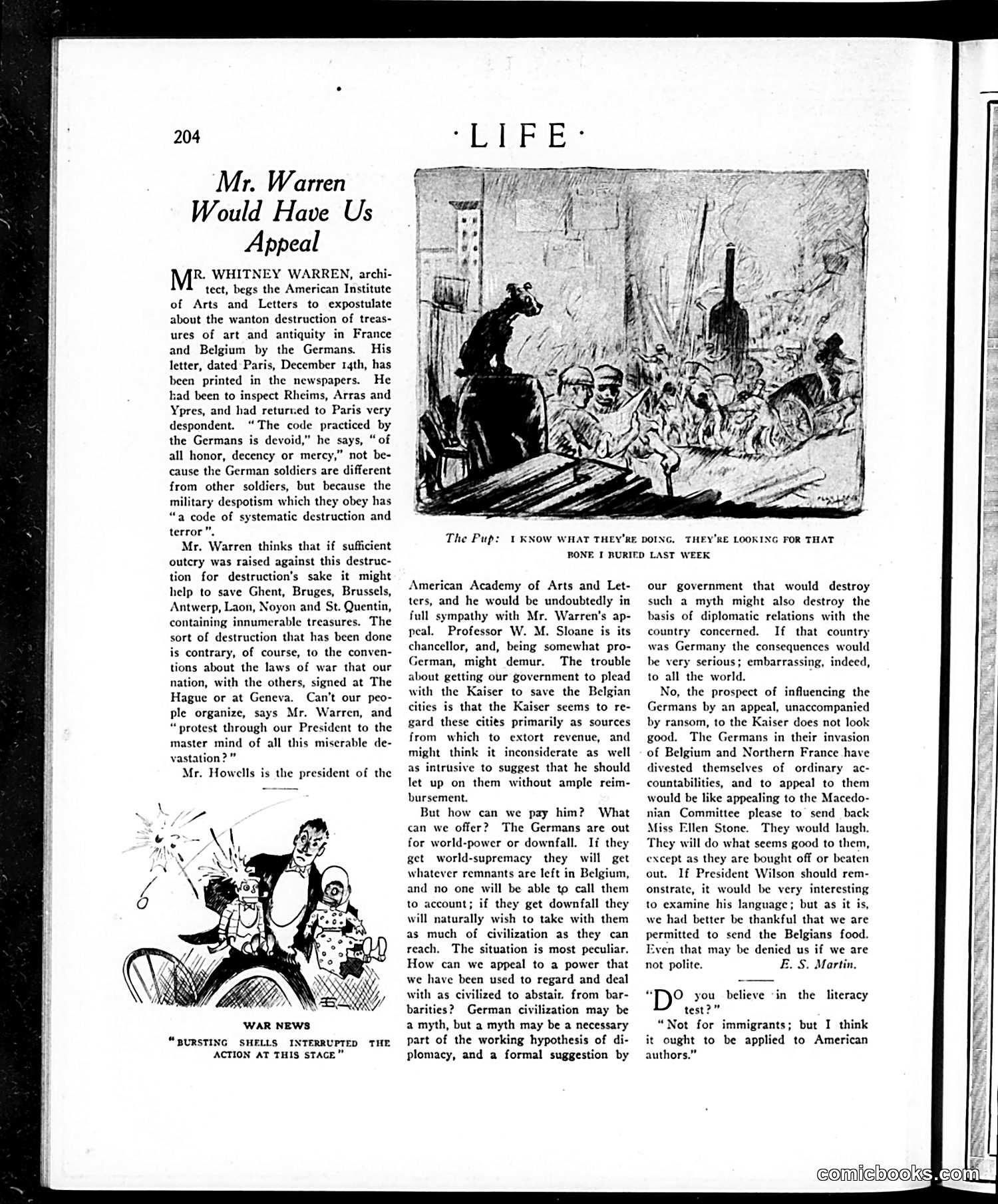
This page addresses German destruction of Belgian and French cultural treasures during World War I (the text references December 1914). **The main article** reports architect Whitney Warren's plea to American cultural institutions to formally protest German destruction of historic sites in Rheims, Arras, Ypres, and Belgian cities. The satirical *counterargument* (attributed to E.S. Martin) argues such appeals are futile: Germany seeks world domination or faces defeat; either way, they'll plunder what remains. Appealing to German "civilization" is pointless since they've abandoned accountability. Martin suggests America can only help by quietly sending food aid to Belgians—loud protests would accomplish nothing and might anger Germany further. **The cartoon** shows soldiers pillaging, with a dog caption joking they're "looking for that bone I buried last week"—dark humor suggesting Germans are simply looting like animals with no rational motive to appeal to. The piece reflects American ambivalence about intervention and skepticism toward idealistic diplomatic appeals during the early war period.
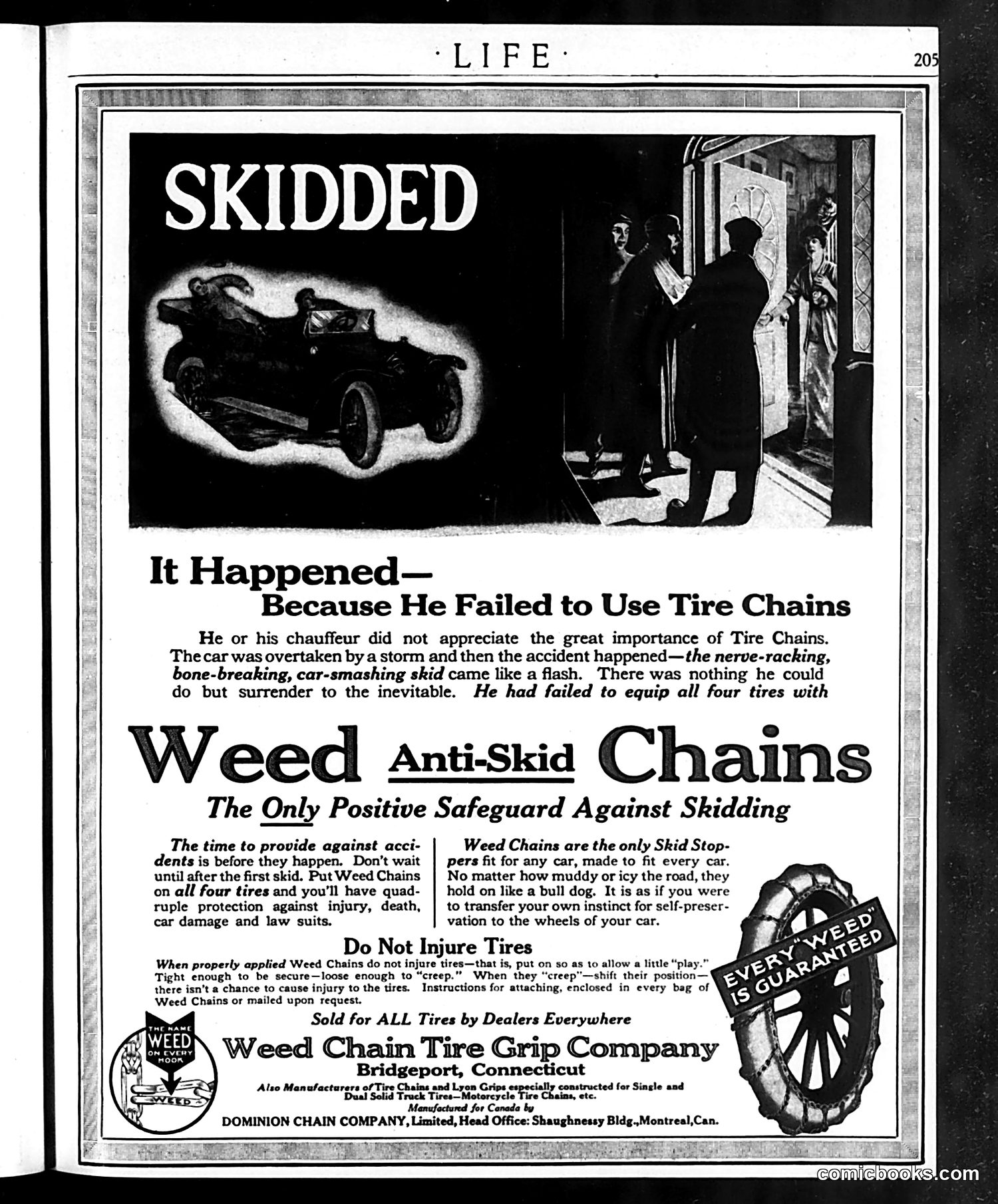
This is a **product advertisement**, not political satire. The page promotes Weed Anti-Skid Chains, tire traction devices for early automobiles. The "cartoon" at top is a cautionary narrative: it depicts a car accident caused by a driver who neglected to install tire chains before a storm. The skid happens "like a flash," leaving the driver helpless. This advertisement exploits **fear-based marketing**—a common early 20th-century sales tactic. By dramatizing a preventable tragedy, it argues that chains are "the Only Positive Safeguard Against Skidding" and warns: "Don't wait until after the first skid." The text emphasizes chains prevent "injury, death, car damage and law suits," appealing to both safety and liability concerns. The manufacturer, Weed Chain Tire Grip Company (Bridgeport, Connecticut), positioned their product as essential equipment for all motorists—particularly relevant when winter driving and poor road conditions made skidding a genuine hazard.
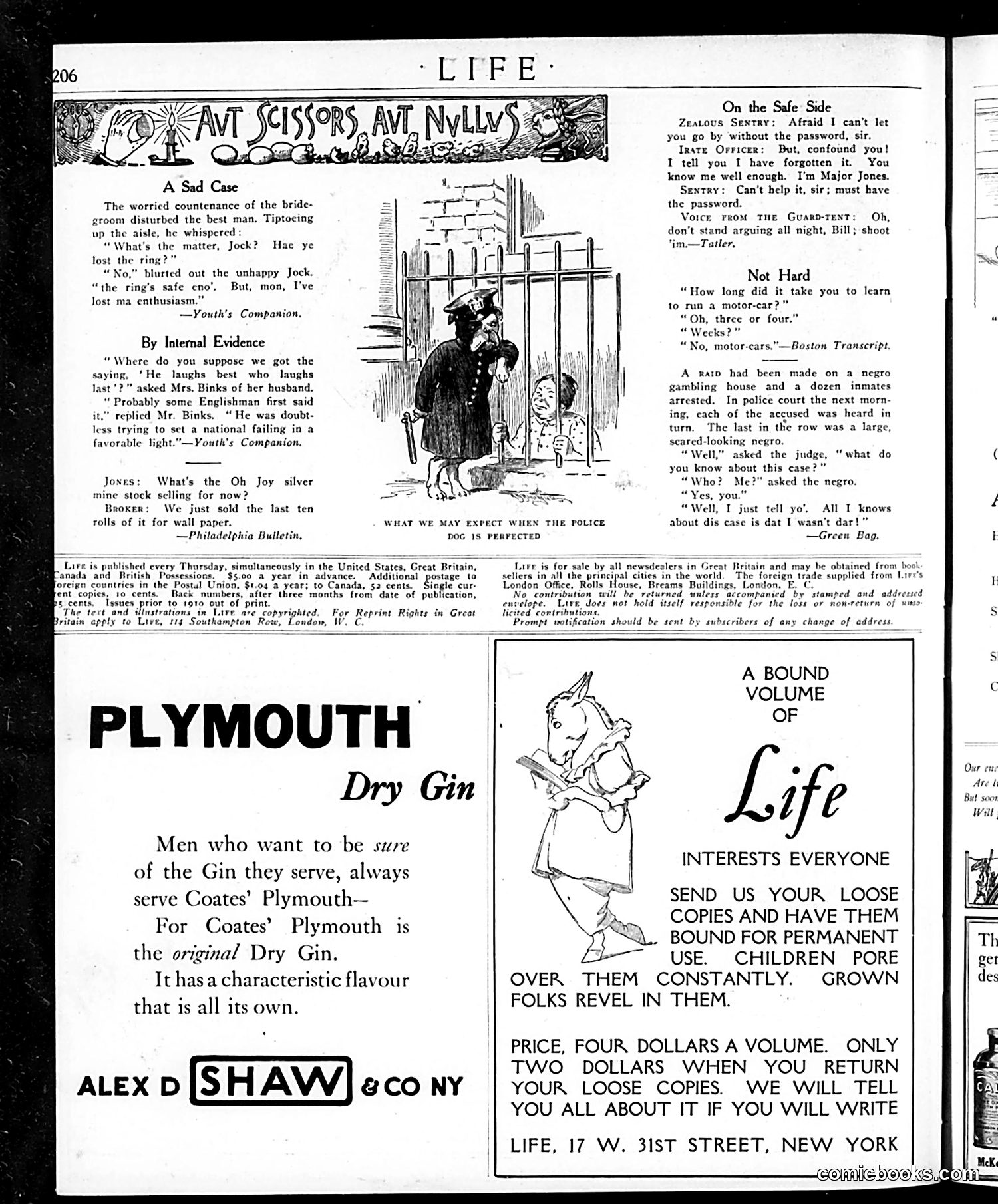
This page from *Life* magazine contains several short humor pieces typical of early 20th-century American satirical publications: **The cartoons/jokes** mock everyday situations: a groom losing enthusiasm on his wedding day; a couple debating the origin of "he laughs best who laughs last" (implying the English are naturally pessimistic); a stock market collapse where worthless mining stock is sold as wallpaper; and a police interrogation where a frightened Black man claims ignorance of a gambling raid. **The racial humor** in the last piece reflects the casual racism of the era—the "scared-looking negro" character is presented as comedic through stereotypical dialect and assumed stupidity. **The page is primarily advertising**, with prominent ads for Plymouth Dry Gin and a bound volume collection offer for *Life* itself. The satire targets financial speculation, English temperament, and authority figures, while the racial content reveals period attitudes. Modern readers should recognize this as reflecting historical prejudices rather than endorsing them.
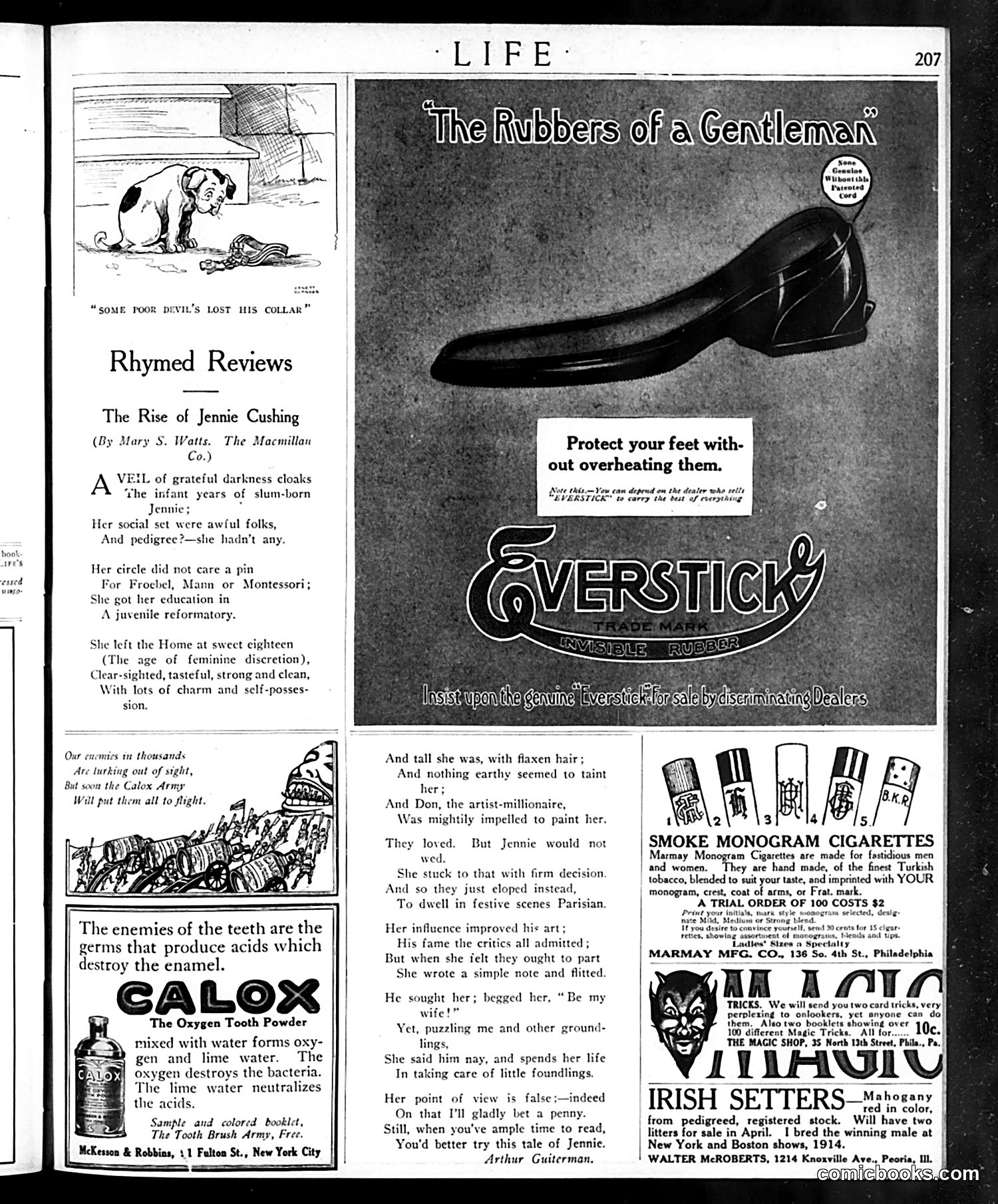
This page contains a book review in verse and period advertisements. The review by Arthur Guiterman concerns "The Rise of Jennie Cushing," a novel about a woman from a poor, disreputable background who becomes refined and educated. The satirical poem praises her character development but mocks her choice to reject marriage to a wealthy artist and instead dedicate herself to caring for orphans—calling her "point of view" false, suggesting this selfless life choice is foolish. The advertisements reflect early 20th-century consumer goods: Everstick rubber shoe heels, Calox tooth powder (marketed with military imagery about fighting "enemies" of teeth), monogrammed cigarettes, and Irish Setter puppies. The small cartoon at top left shows a dog finding a lost collar, unrelated to the content below. The overall page reflects contemporary attitudes: mild class consciousness, skepticism toward women's unconventional choices, and brand-name consumer culture establishing itself in American life.
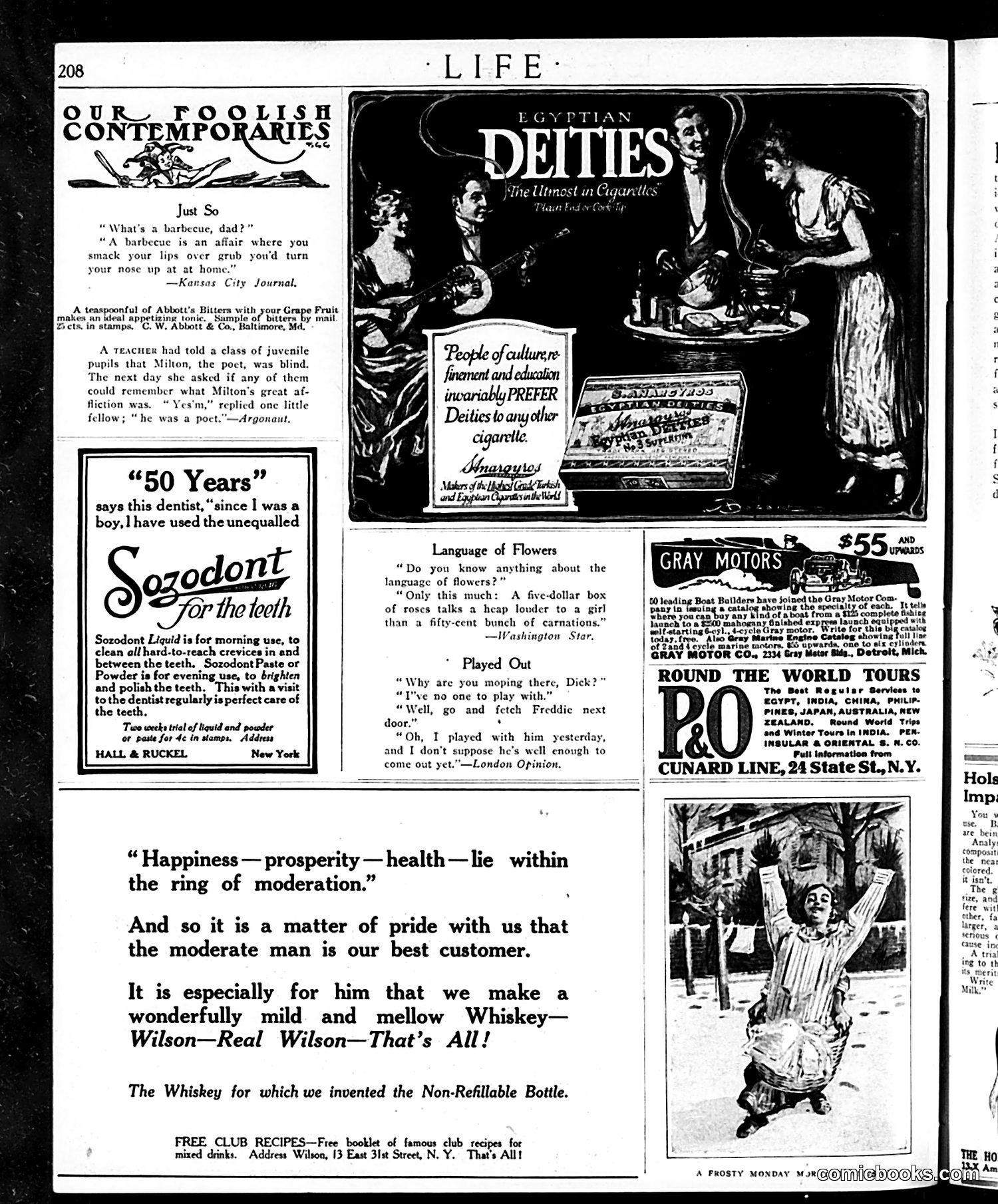
This page is primarily **advertising and humor content**, typical of Life magazine's satirical format. The main elements include: **Humor Sections**: Several brief jokes mock human nature—a father's cynical definition of barbecue, a child's innocent insult calling poet Milton's blindness his "affliction" as being a poet, and jokes about flowers' monetary "language" and played-out friendships. **Advertisements**: The page features prominent ads for **Sozodont toothpaste**, **Gray Motors** (boat engines), **Cunard shipping lines**, and notably, a **Wilson Real Whiskey ad** emphasizing the "moderate man" as the ideal customer—ironic given Prohibition-era context (the non-refillable bottle reference suggests evasion of liquor laws). **Egyptian Deities Advertisement**: An illustrated ad for what appears to be a theatrical production or product featuring classical figures. The page reflects early 20th-century consumer culture, dental hygiene marketing, and the period's tension between promoting alcohol while nominally respecting Prohibition restrictions.
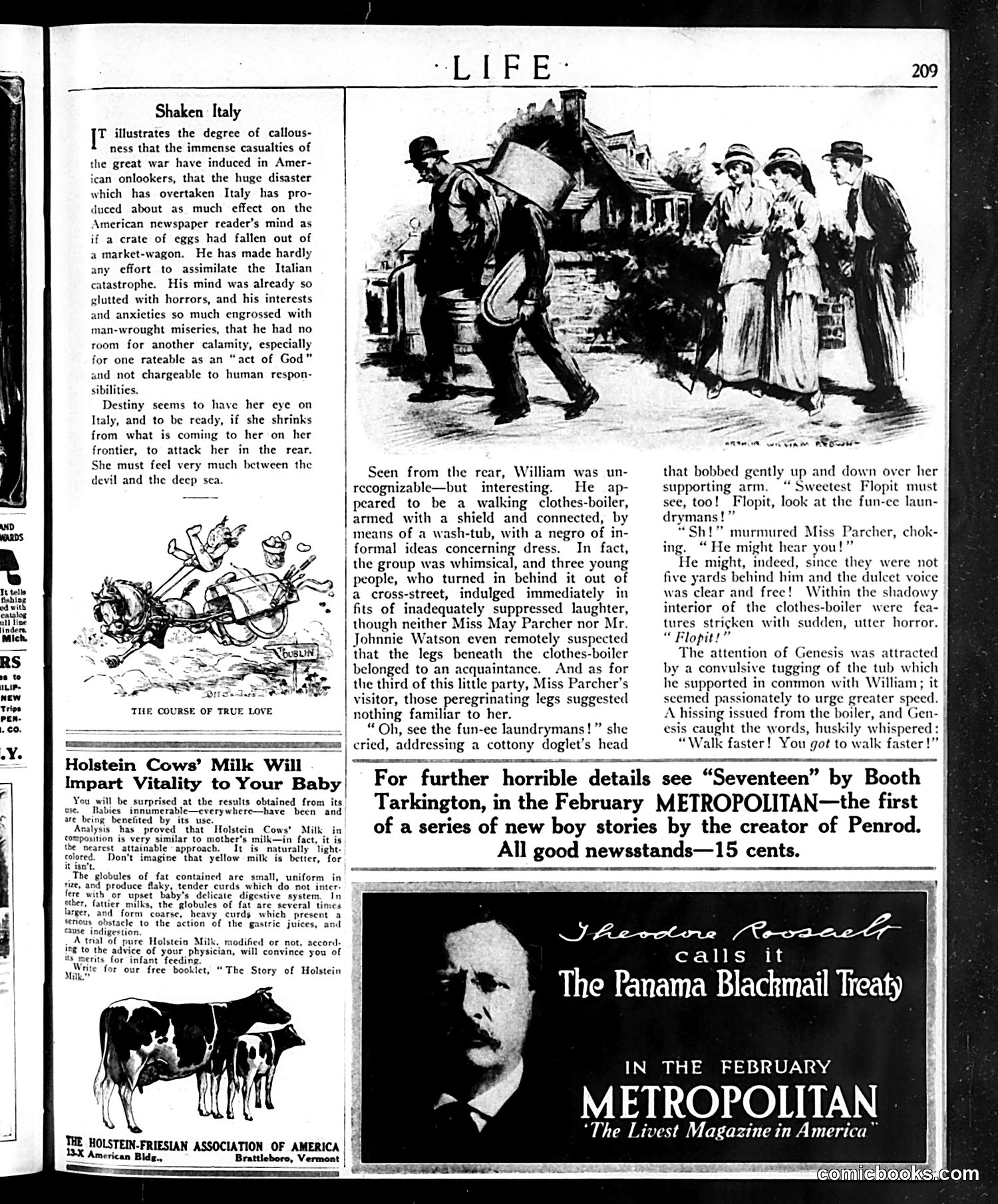
**Main Content:** This page features a serialized excerpt from Booth Tarkington's "Seventeen," depicting a humorous scene where a young man named William is disguised inside a clothes-boiler (a large metal laundry vessel) as a costume or prank. Young women spot him from behind and mockingly call him a "fun-ee laundryman" while carrying a small dog named Flopit. William, mortified at being recognized and ridiculed, urgently whispers to his companion Genesis (apparently a Black assistant helping him carry the contraption) to walk faster to escape. **The Humor:** The satire lies in the contrast between William's awkward, undignified predicament and his desperate attempt to maintain dignity—the comedy of youth, embarrassment, and failed disguise. **Context:** This was serialized fiction advertising for *Metropolitan* magazine, appealing to readers of popular comedic literature about American youth and social mishaps. The casual, period-appropriate racial dynamics (Genesis as assistant) reflect 1910s-era entertainment conventions. The page also includes unrelated advertising for Holstein cow milk for babies.
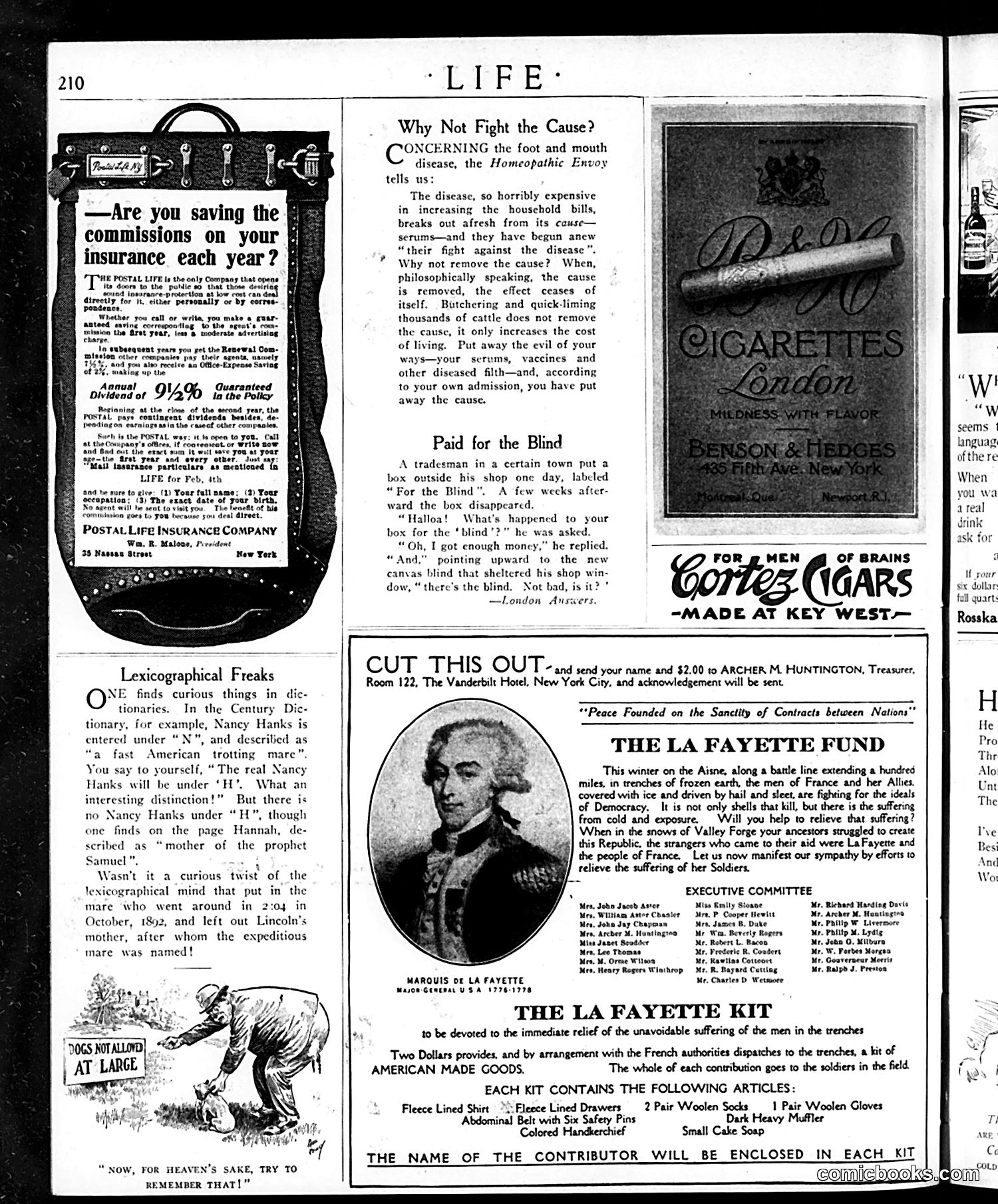
This page mixes advertisements with editorial content typical of early 20th-century Life magazine. **Main Content:** The "Lexicographical Freaks" piece satirizes dictionary errors—specifically that Nancy Hanks (Abraham Lincoln's mother) appears only as an entry for a racehorse, not the historical figure. The joke critiques careless reference work. **Cartoons:** A small illustration shows a figure labeled "Dogs Not Allowed at Large," satirizing enforcement of municipal regulations. **Major Feature:** The La Fayette Fund solicits donations for French soldiers suffering in WWI trenches (specifically the Aisne). It frames aid to France as reciprocal gratitude for Lafayette's Revolutionary War support, and lists prominent donors (Astors, Harrimans, etc.), typical Progressive Era philanthropic appeals. **Advertisements:** Insurance and cigar ads occupy significant space—standard magazine revenue sources of the era. The page reflects 1910s concerns: American support for Allied forces, lexicographical standards, and insurance accessibility.
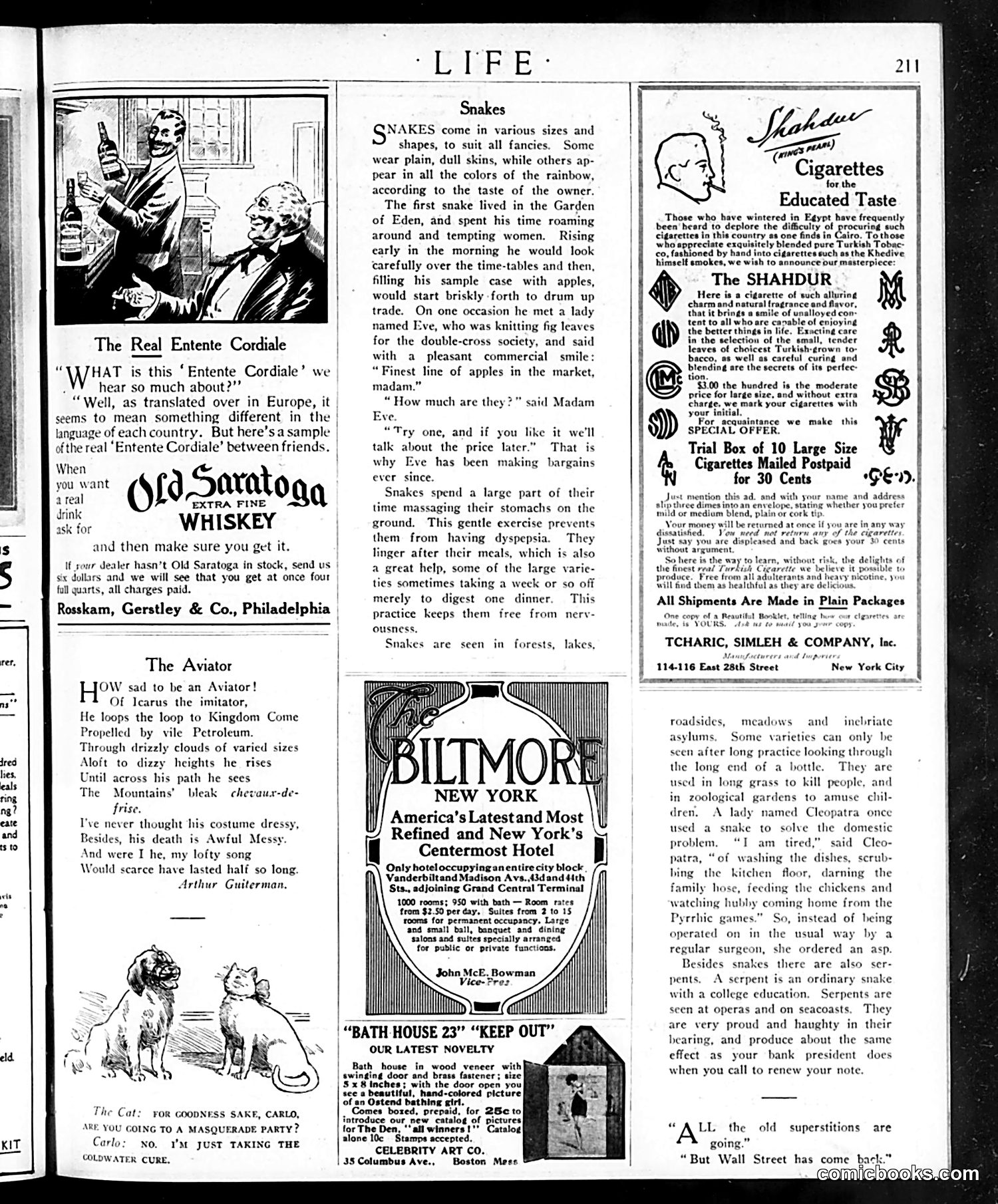
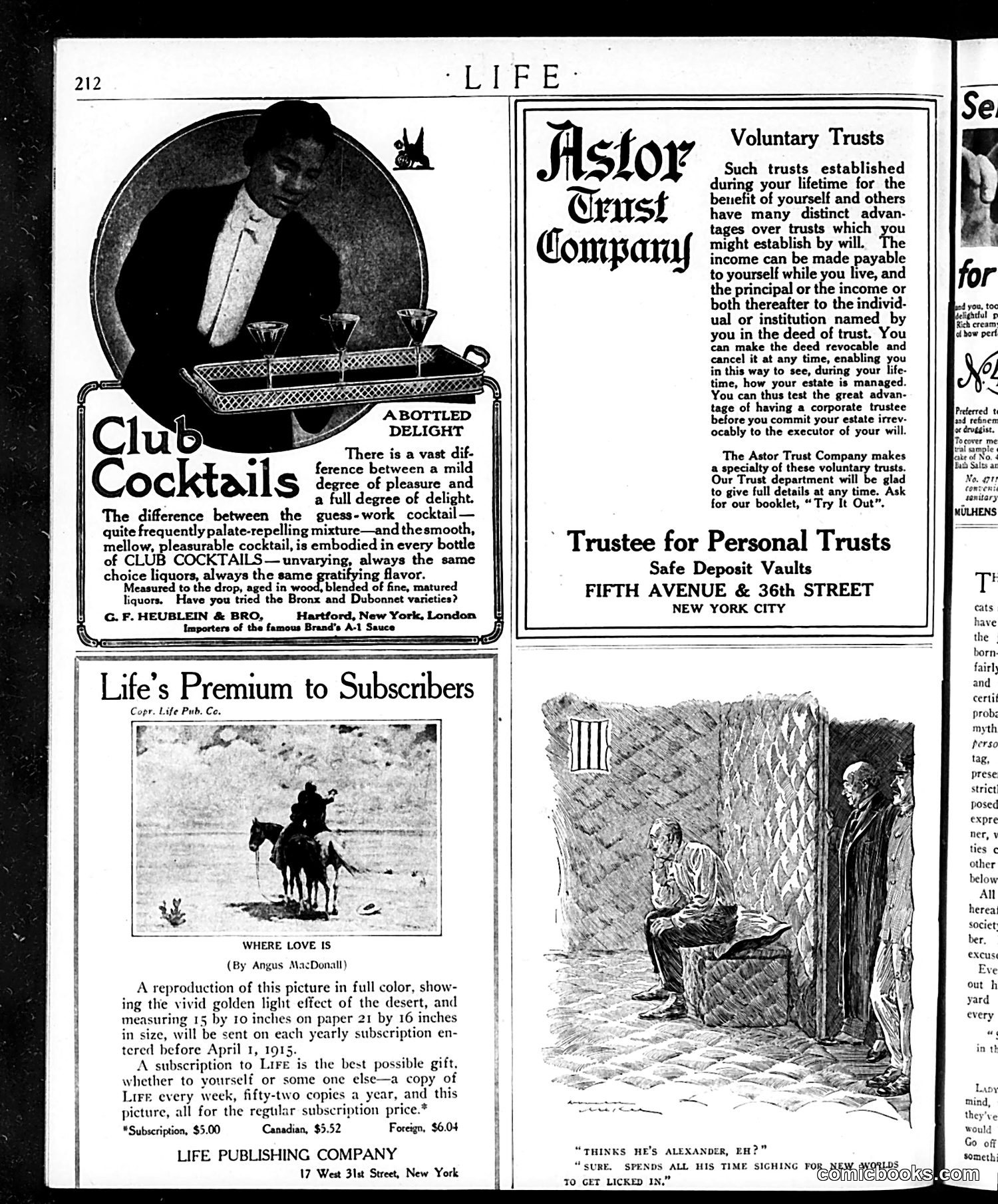
This page is primarily **advertising and subscription material**, not political satire. The main cartoon at bottom depicts a prison scene with the caption "THINKS HE'S ALEXANDER, EH?" / "SURE. SPENDS ALL HIS TIME SIGHING FOR NEW WORLDS TO GET LICKED IN." This appears to be a humorous reference to Alexander the Great's legendary ambitions—the joke being that a prisoner fantasizes about conquering the world while he himself cannot escape his cell. It's a straightforward joke about delusion and ambition rather than contemporary political commentary. The page also advertises: - **Club Cocktails** (premium mixed drinks) - **Astor Trust Company** (financial services) - **Life's subscription premium**: a color reproduction of landscape painting "Where Love Is" by Angus MacDonall The overall content reflects early 1900s consumer culture and financial services aimed at affluent readers.
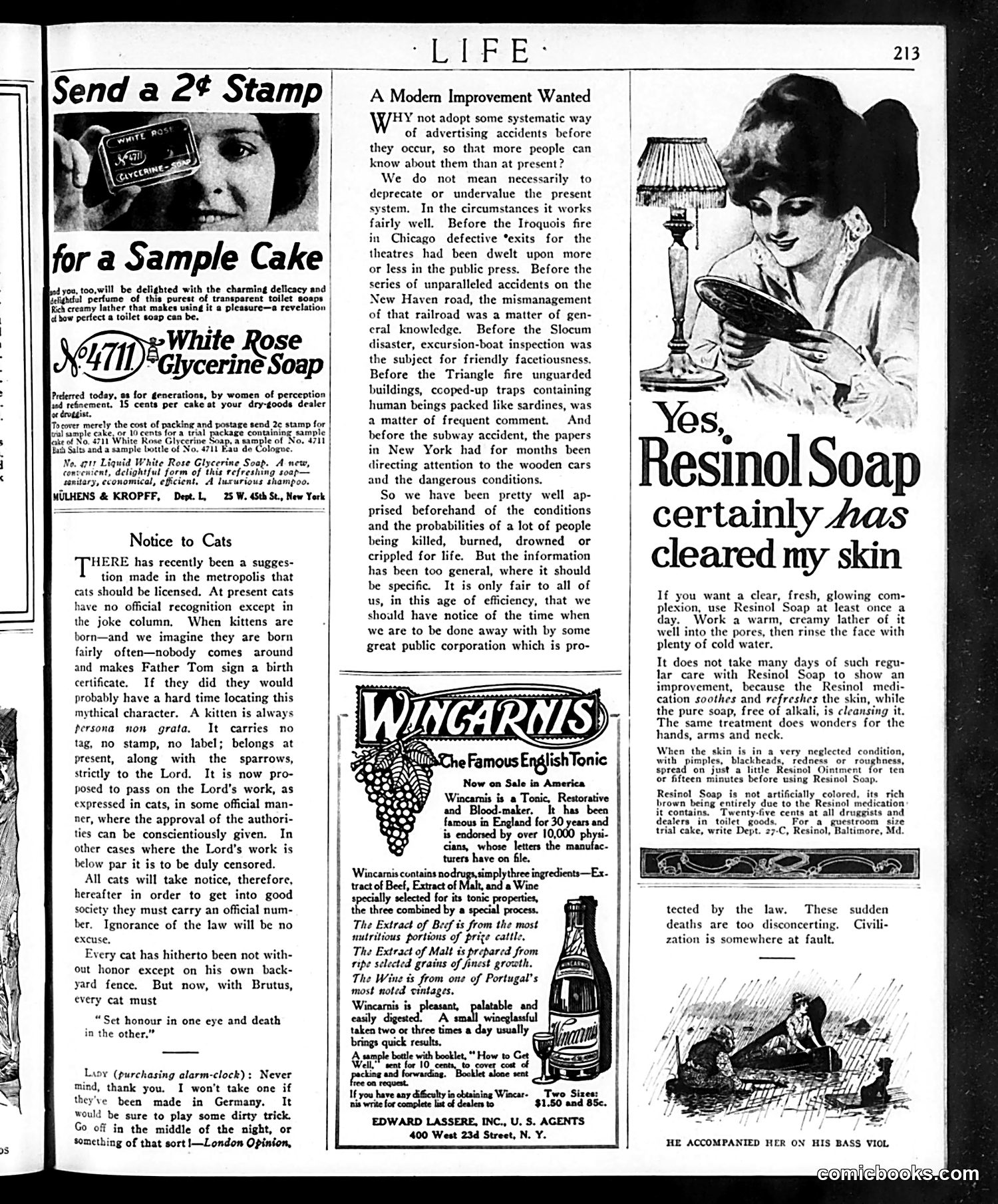
This page consists primarily of **advertisements and satirical commentary**, not political cartoons. The main satirical pieces are: 1. **"A Modern Improvement Wanted"** — This essay sardonically critiques public safety by proposing that accidents should be "advertised" beforehand. It references actual tragedies (Iroquois Theatre fire in Chicago, New Haven railroad accidents, the Slocum disaster, Triangle fire, subway accidents) where dangerous conditions were publicly known *before* disaster struck. The satire argues that information about these hazards was "too general" rather than specific about *when* people would die—mocking corporate negligence by treating prevention as merely a publicity problem. 2. **"Notice to Cats"** — A humorous piece proposing cat licensing, playing on bureaucratic absurdity. It jokes that cats, unlike humans, currently operate outside official recognition, and suggesting they now need "numbers" to achieve "good society." The page is otherwise filled with period product advertisements (soap, tonic wine) typical of 1910s-era Life magazine.
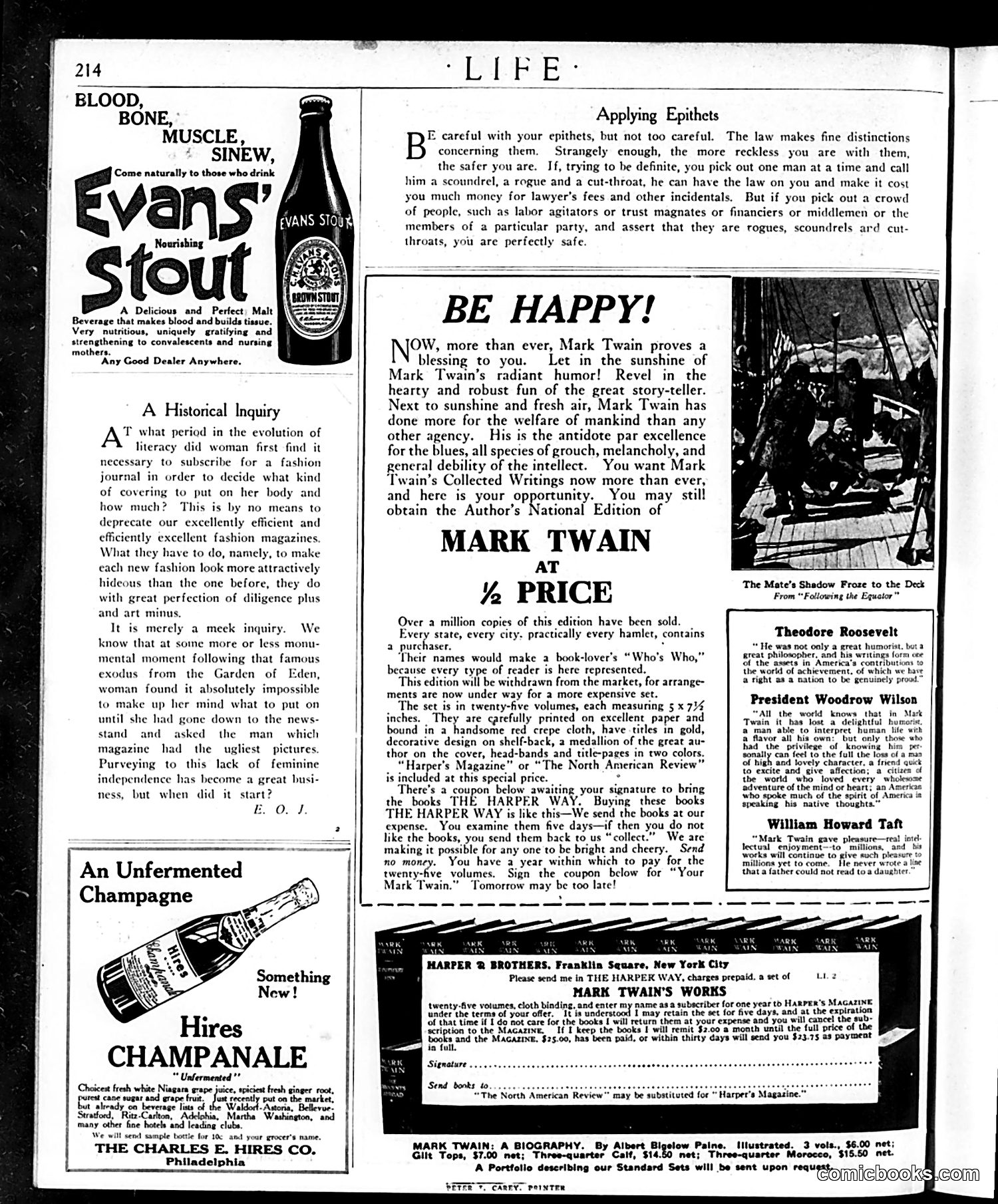
This page from *Life* magazine (a satirical publication) mixes editorial commentary with advertisements. The main content includes: **"Applying Epithets"** - A satirical piece about legal libel distinctions. The joke: you can safely call entire groups (labor agitators, financiers, political parties) "rogues and scoundrels" without legal consequence, but calling one individual the same invites costly lawsuits. It mocks how blanket accusations against groups escape legal accountability while targeted insults don't. **"A Historical Inquiry"** - Light satire questioning when women supposedly became dependent on fashion magazines to decide what to wear, poking fun at both feminine indecision and the fashion magazine industry's manipulation. The rest is **advertising**: Evans' Stout (nutritious malt beverage), Hires Champagne, and a major pitch for Mark Twain's collected writings at half-price through Harper publishers. The Mark Twain ad emphasizes his humor as a remedy for modern melancholy—appealing to readers during what appears to be a period of social anxiety.
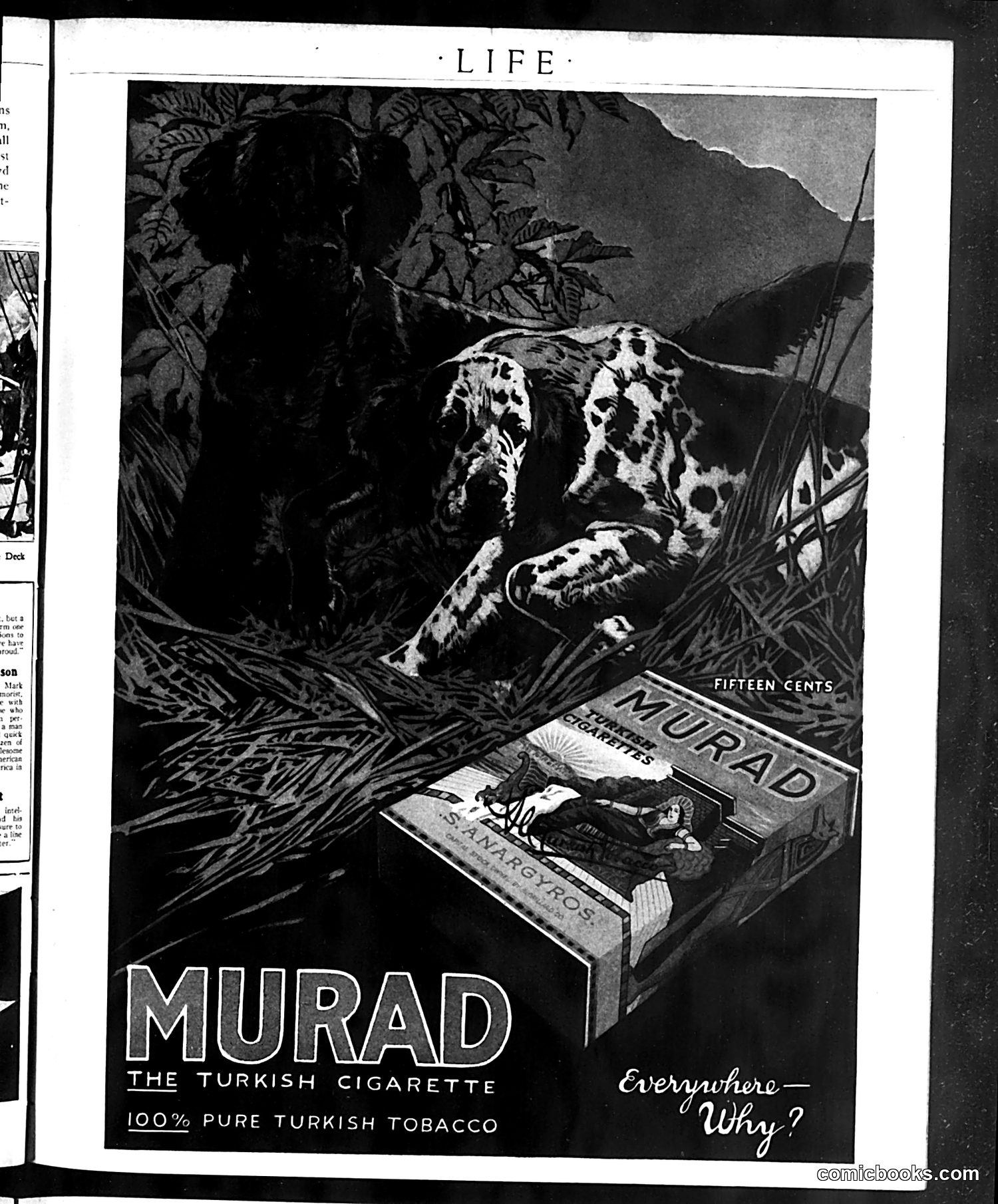
This is a **Murad cigarette advertisement**, not political satire. The image shows two hunting dogs discovering a box of Murad cigarettes in tall grass, with mountains in the background. The ad's tagline reads "Everywhere—Why?" The advertisement uses the dogs as a clever visual metaphor: just as hunting dogs instinctively find their quarry anywhere in nature, Murad cigarettes are supposedly so popular and widely distributed that consumers will find them "everywhere." The exotic mountain backdrop reinforces Murad's appeal as a premium Turkish tobacco product. This reflects early 20th-century advertising strategies that emphasized product ubiquity and quality through clever animal imagery and rhetorical questions designed to engage readers.
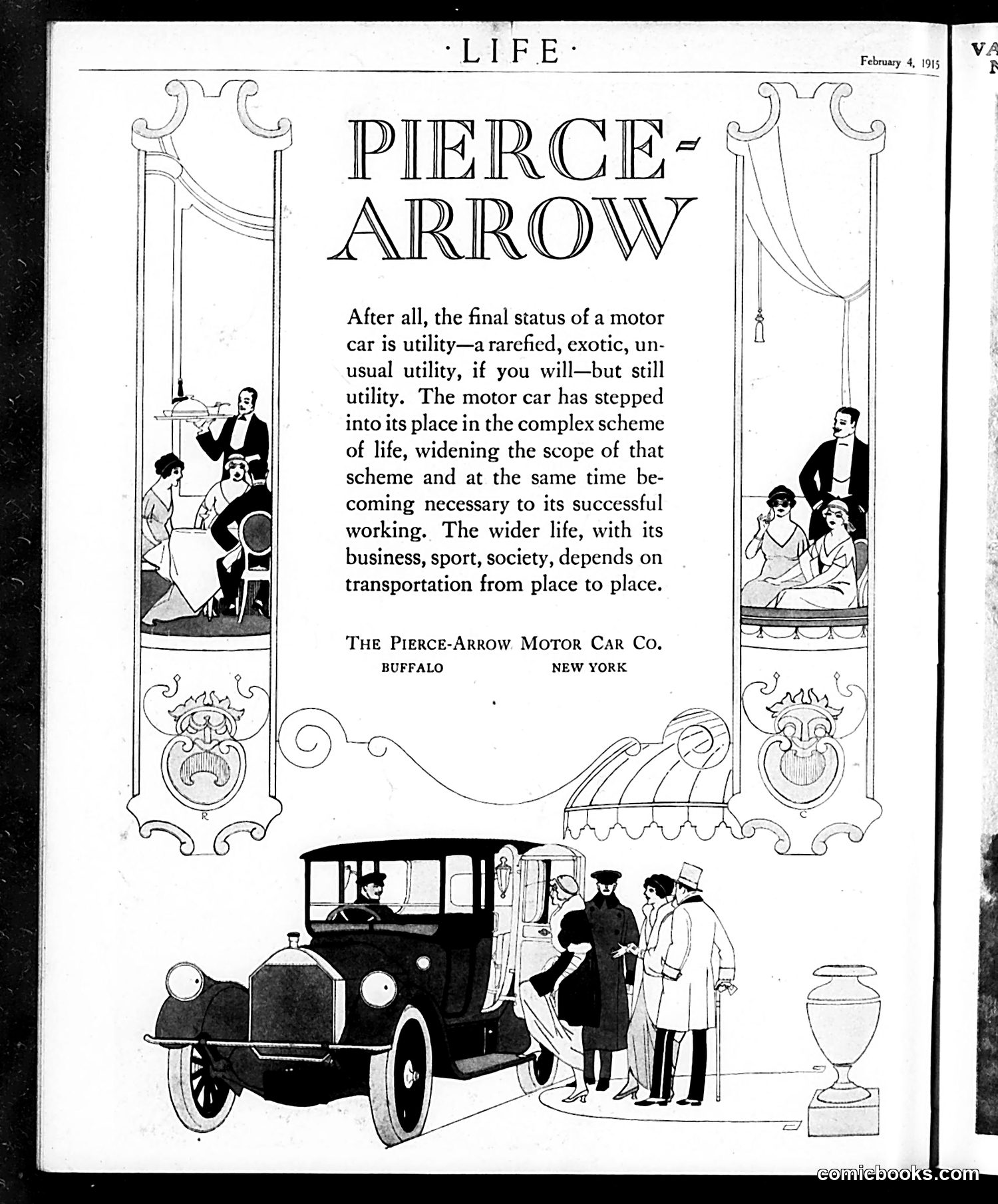
This is a **automobile advertisement** from Life magazine (February 4, 1915), not political satire. The Pierce-Arrow Motor Car Company uses decorative Art Nouveau framing to market their luxury vehicle. The ad's argument: motor cars have become essential to modern life—necessary for business, sport, and society, not merely luxuries. The illustrations show affluent people in formal dress using the vehicle for social occasions. The "satire" is subtle self-awareness: Pierce-Arrow acknowledges their car is "rarefied, exotic, unusual" yet claims it's fundamentally about **utility**. This is marketing rhetoric—positioning an expensive luxury item as a practical necessity for the active, well-to-do lifestyle. The decorative borders and refined illustrations reinforce the car's positioning as sophisticated and status-conferring for wealthy buyers circa 1915.