
Life, 1915-02-04 · page 30 of 44
Life — February 4, 1915 — page 30: what you’re looking at
What you’re looking at
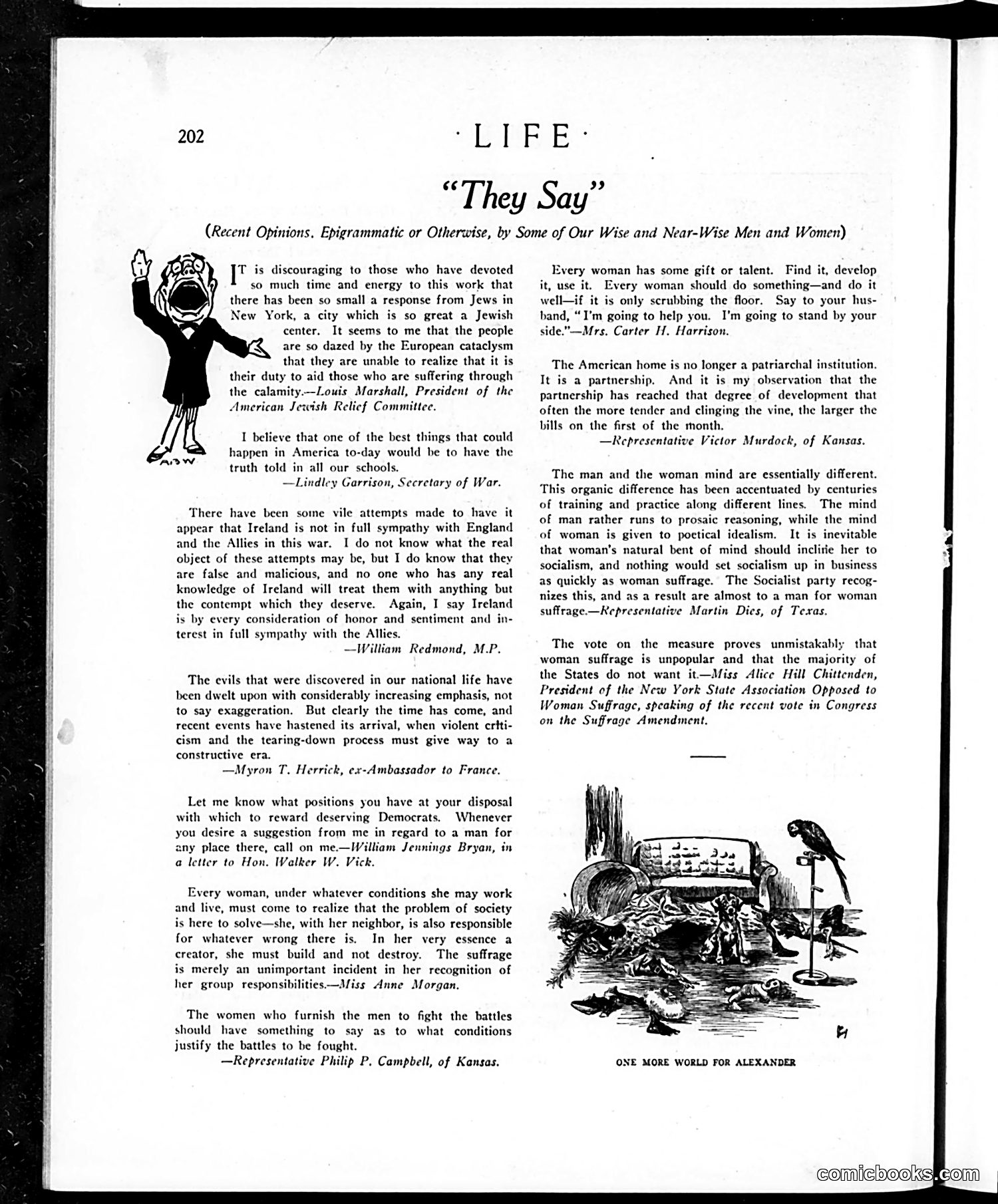
This Life magazine page presents satirical commentary on contemporary political and social issues circa 1915-1920, formatted as purported quotations from prominent figures. The main cartoon (bottom right, titled "One More Word for Alexander") depicts a parrot on a desk with papers and books—likely satirizing empty political rhetoric or repetitive messaging. The quotations themselves comprise the satire. They address: Jewish charitable giving (Louis Marshall), education truth-telling (Lindley Garrison), Irish-Allied loyalty (William Redmond), post-reform constructive action (Myron Herrick), and Democratic patronage (William Jennings Bryan). Several quotations debate women's roles—notably whether women's suffrage is trivial (Miss Anne Morgan) versus consequential (Representative Campbell), and whether women's minds naturally incline toward socialism (Representative Dies). The satire works by juxtaposing these statements to highlight contradictions in contemporary political discourse, particularly regarding women's rights and war-era priorities. The page mocks both inflated rhetoric and the era's unresolved tensions about women's place in American society.
📄 Transcribed text from this page (OCR, searchable)
Machine-transcribed from the original scan — historical spelling and the odd misread are preserved.
Je 1KE ES “They Say” (Recent Opinions, Epigrammatic or Otherwise, by Some of Our W1 T is discouraging to those who have devoted so much time and energy to this work that there has been so small a response from Jews in New York, a city which is so great a Jewish center, It seems to me that the people are so dazed by the European cataclysm that they are unable to realize that it is their duty to aid those who are suffering through the calamity.—Louis Marshall, President of the American Jewish Relief Committee. I believe that one of the best things that could happen in America to-day would be to have the truth told in all our schools. —Lindley Garrison, Secretary of War. There have been some vile attempts made to have it appear that Ireland is not in full sympathy with England and the Allies in this war. I do not know what the real object of these attempts may be, but I do know that they are false and malicious, and no one who has any real knowledge of Ireland will treat them with anything but the contempt which they deserve. Again, I say Ireland is by every consideration of honor and sentiment and in- terest in full sympathy with the Allies. —William Redmond, M.P. The evils that were discovered in our national life have been dwelt upon with considerably increasing emphasis, not to say exaggeration. But clearly the time has come, and recent events have hastened its arrival, when violent criti- cism and the tearing-down process must give way to a constructive era. —Myron T. Herrick, ex-Ambassador to France. Let me know what positions you have at your disposal with which to reward deserving Democrats. Whenever you desire a suggestion from me in regard to a man for any place there, call on me.—William Jennings Bryan, in a@ letter to Hon. Walker W. Vick. Every woman, under whatever conditions she may work and live, must come to realize that the problem of society is here to solve—she, with her neighbor, is also responsible for whatever wrong there is. In her very essence a creator, she must build and not destroy. The suffrage is merely an unimportant incident in her recognition of her group responsibilities—Afliss Anne Morgan. The women who furnish the men to fight the battles should have something to say as to what conditions justify the battles to be fought. —Representative Philip P. Campbell, of Kansas. and Near-Wise Men and Women) Every woman has some gift or talent. Find it, develop it, use it. Every woman should do something—and do it well—if it is only scrubbing the floor. Say to your hus- “I'm going to help you. I'm going to stand by your Mrs. Carter H. Harrison. The American home is no longer a patriarchal institution. It is a partnership. And it is my observation that the partnership has reached that degree of development that often the more tender and clinging the vine, the larger the bills on the first of the month, —Representative Victor Murdock, of Kansas. The man and the woman mind are essentially different. This organic difference has been accentuated by centuries of training and practice along different lines. The mind of man rather runs to prosaic reasoning, while the mind of woman is given to poetical idealism. It is inevitable that woman's natural bent of mind should inclirie her to socialism, and nothing would set socialism up in business as quickly as woman suffrage. The Socialist party recog- nizes this, and as a result are almost to a man for woman suffrage—Kepresentative Martin Dies, of Texas. The vote on the measure proves unmistakably that woman suffrage is unpopular and that the majority of the States do not want it—Miss Alice Hill Chittenden, President of the New York State Association Opposed to Woman Suffrage, speaking of the recent vote in Congress on the Suffrage Amendment. ONE MORE WORLD FOR ALEXANDER