
Life, 1915-02-04 · page 26 of 44
Life — February 4, 1915 — page 26: what you’re looking at
What you’re looking at
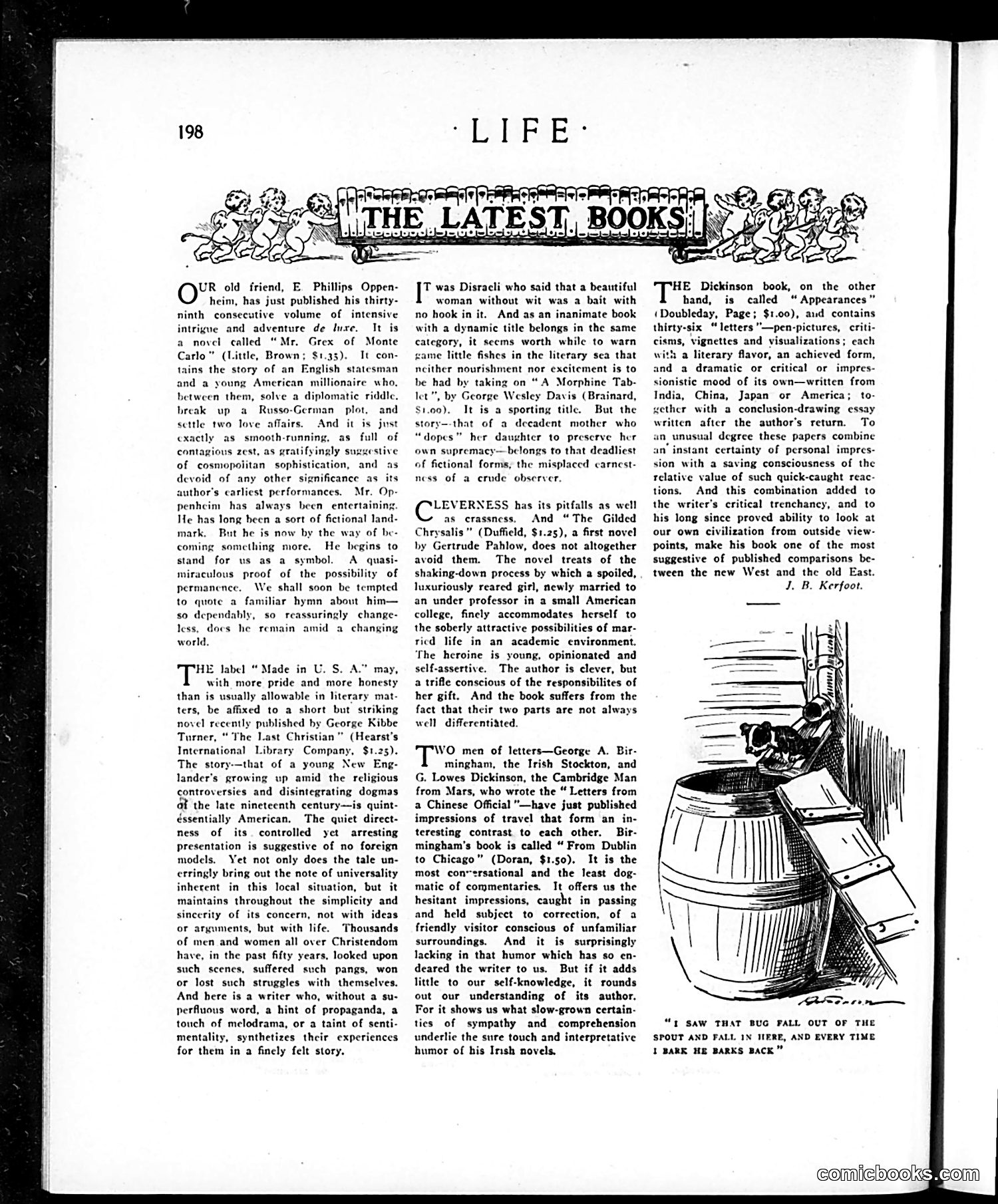
This page contains literary book reviews rather than political cartoons. The small illustration shows a humorous scene of a bug falling into what appears to be a inkwell or container, with the caption about the bug repeatedly falling back in—likely a visual joke about persistent problems or circular failures. The reviews discuss recent novels: E. Phillips Oppenheim's "Mr. Grex of Monte Carlo" (praised as entertaining but formulaic); George Kibbe Turner's "The Last Christian" (commended as genuinely American literature addressing religious doubt); "A Morphine Tablet" by George Wesley Davis (criticized as having a sensational title but poor execution); and Gertrude Pahlow's "The Gilded Chrysalis" (noted as clever but self-conscious). The reviews reflect early 20th-century literary taste and concerns—particularly the tension between entertainment value and artistic authenticity, and anxiety about modern social problems like drug addiction.
📄 Transcribed text from this page (OCR, searchable)
Machine-transcribed from the original scan — historical spelling and the odd misread are preserved.
oO” old friend, E Phillips Oppen- heim, has just published his thirty- ninth consecutive volume of intensive intrigue and adventure de luxe. It is a novel called “Mr. Grex of Monte Carlo” (Little, Brown; $1.33). It con- tains the story of an English statesman and a young American millionaire who. between them, solve a diplomatic riddle. break up a Russo-German plot, and settle two love affairs. And it is just exactly as smooth-running, as full of contagious zest, as gratifyingly sv of cosmopolitan sophistication, and as devoid of any other significance as its author's carliest performances. Mr. Op- penhcim has always been entertaining He has long heen a sort of fictional land- mark. But he is now by the way of he- coming something more, He begins to stand for us as a symbol. A quasi- miraculous proof of the possibility of permanence. We shall soon be tempted to quote a familiar hymn about him— so dependably, so reassuringly change- less, docs he remain amid a changing world. stive 'HE Jabel “ Made in U. S. A.” may, with more pride and more honesty than is usually allowable in literary mat- ters, be affixed to a short but striking novel recently published by George Kibbe Turner, “ The Last Christian” (Hearst's International Library Company, $1.25). The story-—that of a young New Eng- lander’s growing up amid the religious controversies and disintegrating dogmas Of the late nineteenth century—is quint- éssentially American. The quiet direct- ness of its controlled yet arresting Presentation is suggestive of no forcign models, Yet not only does the tale un- crringly bring out the note of universality inherent in this local situation, but it maintains throughout the simplicity and sincerity of its concern, not with ideas or arguments, but with life. Thousands of men and women all over Christendom have, in the past fifty years, looked upon such scenes, suffered such pangs, won or lost such struggles with themselv And bere is a writer who, without a su- perfluous word, a hint of propaganda, a touch of melodrama, or a taint of senti- mentality, synthetizes their experiences for them in a finely felt story. T was Disracli who said that a beautiful woman without wit was a bait with no hook in it. And as an inanimate book with a dynamic title belongs in the same category, it seems worth while to warn game little fishes in the literary sea that ncither nourishment nor excitement is to be had by taking on “A Morphine Tab- let", by George Wesley Davis (Brainard, S100). It is a sporting title. But the story--that of a decadent mothcr who “dopes” her daughter to preserve her own supremacy—belongs to that deadliest of fictional forms, the misplaced carnest- ness of a crude observer. LEVERNESS has its pitfalls as well as crassness, And “The Gilded Chrysalis” (Duffield, $1.25), a first novel by Gertrude Pahlow, does not altogether avoid them. The novel treats of the shaking-down process by which a spoiled, luxuriously reared girl, newly married to an under professor in a small American college, finely accommodates herself to the soberly attractive possibilities of mar- ried life in an academic environment. ‘The heroine is young, opinionated and self-assertive. The author is clever, but a trifle conscious of the responsibilites of her gift. And the book suffers from the fact that their two parts are not always well differentiated. WO men of letters—George A. Bir- mingham, the Irish Stockton, and G. Lowes Dickinson, the Cambridge Man from Mars, who wrote the “ Letters from a Chinese Official "—have just published impressions of travel that form an in- teresting contrast to each other. Bir- mingham’s book is called “ From Dublin to Chicago” (Doran, $1.50), It is the most con~ersational and the least dog- matic of commentaries. It offers us the hesitant impressions, caught in passing and held subject to correction, of a friendly visitor conscious of unfamiliar surroundings. And it is surprisingly lacking in that humor which has so en- deared the writer to us. But if it adds little to our self-knowledge, it rounds out our understanding of its author. For it shows us what slow-grown certain- ties of sympathy and comprehension underlie the sure touch and interpretative humor of his Irish novels, HE Dickinson book, on the other hand, is called “Appearances” ‘Doubleday, Page; $1.00), aud contains ignettes and visualizations; each a literary flavor, an achieved form, and a dramatic or critical or impres- i ic mood of its own—written from India, China, Japan or America; to- xether with a conclusion-drawing essay written after the author's return. To an unusual degree these papers combine in’ instant certainty of personal impres- sion with a saving consciousness of the relative value of such quick-caught reac- tions. And this combination added to the writer's critical trenchancy, and to his long since proved ability to look at our own civilization from outside view- points, make his book one of the most suggestive of published comparisons be- tween the new West and the old East. J. B. Kerfoot. “1 SAW THAT BUG PALL OUT OF THE SPOUT AND FALL IN HERE, AND EVERY TIME 1 BARK ME BARKS BACK” comichoo!