
Life, 1915-02-04 · page 15 of 44
Life — February 4, 1915 — page 15: what you’re looking at
What you’re looking at
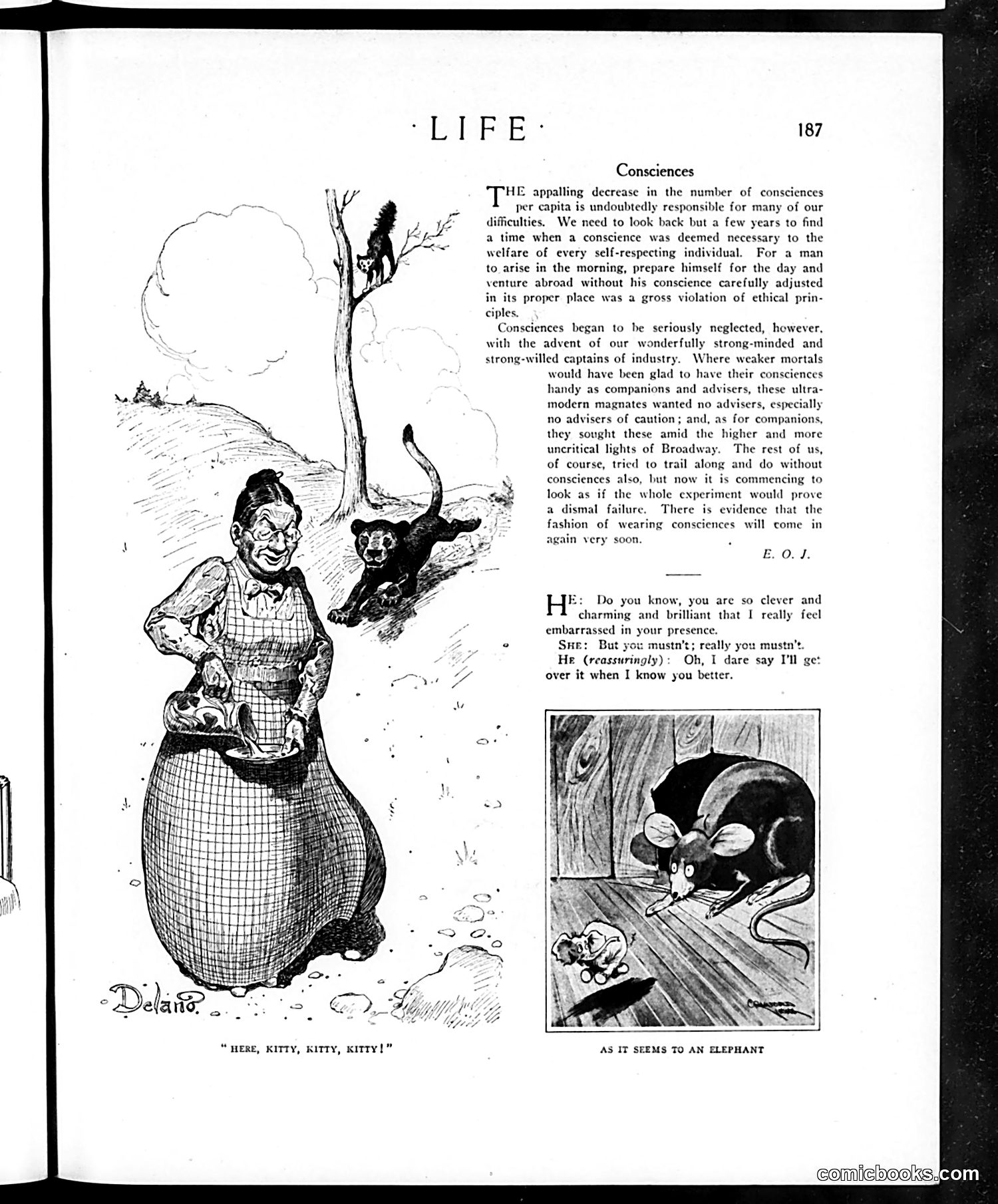
This page satirizes the decline of personal morality in early 20th-century America, particularly blaming wealthy industrialists ("captains of industry") for abandoning conscience as a social necessity. The article argues that strong-willed business leaders rejected ethical restraint, instead seeking entertainment in morally loose venues like Broadway, and that ordinary people followed their example—to society's detriment. The left cartoon by Delano depicts a woman calling "Here, kitty, kitty, kitty!"—a traditional summons for cats—while holding what appears to be a dead mouse or rat. The dark humor suggests she's trying to attract cats using bait, a commentary on manipulation or deception. The right cartoon, captioned "As It Seems to an Elephant," shows the same scene from an elephant's perspective—the woman appears enormous and threatening, the mouse absurdly tiny. This illustrates how context and perspective drastically alter perception of the same scenario. Both cartoons support the text's theme about moral perspective and judgment.
📄 Transcribed text from this page (OCR, searchable)
Machine-transcribed from the original scan — historical spelling and the odd misread are preserved.
*IEARSE * 187 Consciences HE appalling decrease in the number of consciences per capita is undoubtedly responsible for many of our difficulties. We need to look back but a few years to find a time when a conscience was deemed necessary to the welfare of every self-respecting individual. For a man to arise in the morning, prepare himself for the day and venture abroad without his conscience carefully adjusted in its proper place was a gross violation of ethical prin- ciples, Consciences began to be seriously neglected, however, with the advent of our wonderfully strong-minded and strong-willed captains of industry. Where weaker mortals would have been glad to have their consciences handy as companions and advisers, these ultra- modern magnates wanted no advisers, especially no advisers of caution; and, as for companions, they sought these amid the higher and more uncritical lights of Broadway. The rest of us, of course, tried to trail along and do without consciences also, but now it is commencing to look as if the whole experiment would prove a dismal failure. There is evidence that the fashion of wearing consciences will come in again very soon. E.05 4. HE:, Be. you know, you are so clever and charming and brilliant that I really feel embarrassed in your presence. Sue: But you mustn't; really you mustn't. He (reassuringly): Oh, I dare say I'll ge: over it when I know you better. “HERE, KITTY, KITTY, KITTY!” AS IT SEEMS TO AN ELEPHANT Comichooks.(feyu)