
Life, 1915-02-04 · page 21 of 44
Life — February 4, 1915 — page 21: what you’re looking at
What you’re looking at
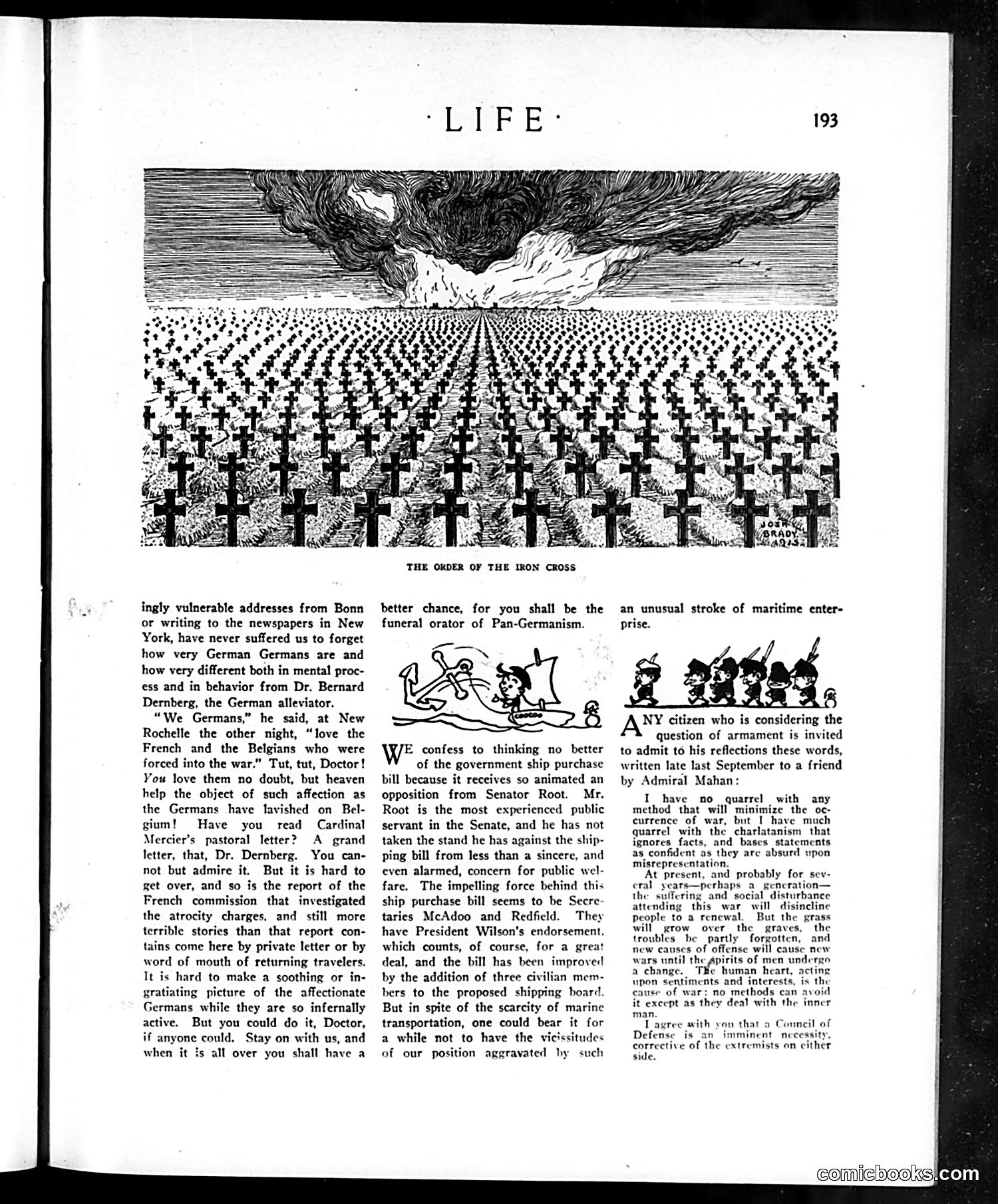
The image depicts an enormous field of grave crosses stretching to the horizon beneath a dark, stormy sky—a stark visualization of World War I casualties. The caption "THE ORDER OF THE IRON CROSS" is a bitter pun: the Iron Cross was Nazi Germany's military decoration, but here the "order" refers to the systematic arrangement of graves, sardonically suggesting mass death as Germany's true "achievement." The accompanying text attacks **Dr. Bernard Dernberg**, a German official attempting to improve Germany's image in America by claiming Germans "love the French and Belgians." The author scathingly rejects this propaganda, referencing Cardinal Mercier's documented reports of German atrocities in Belgium and French investigations into war crimes. The satire suggests Dernberg's public relations efforts are obscene given the mounting death toll. The cartoon simultaneously critiques American military and political debates—notably Senator Root's opposition to Wilson's government ship-purchase bill—implying such domestic disputes seem trivial against the war's carnage documented by the grave field above.
📄 Transcribed text from this page (OCR, searchable)
Machine-transcribed from the original scan — historical spelling and the odd misread are preserved.
ingly vulnerable addresses from Bonn or writing to the newspapers in New York, have never suffered us to forget how very German Germans are and how very different both in mental proc- ess and in behavior from Dr. Bernard Dernberg, the German alleviator. “We Germans,” he said, at New Rochelle the other night, “love the French and the Belgians who were forced into the war.” Tut, tut, Doctor! You love them no doubt, but heaven help the object of such affection as the Germans have lavished on Bel- gium! Have you read Cardinal Mercier’s pastoral letter? A grand letter, that, Dr. Dernberg. You can- not but admire it. But it is hard to get over, and so is the report of the French commission that investigated the atrocity charges, and still more terrible stories than that report con- tains come here by private letter or by word of mouth of returning travelers. It is hard to make a soothing or in- gratiating picture of the affectionate Germans while they are so infernally active. But you could do it, Doctor, if anyone could. Stay on with us, and when it is all over you shall have a THE ORDER OF THE IRON CROSS better chance, for you shall be the funeral orator of Pan-Germanism. E confess to thinking no better of the government ship purchase bill because it receives so animated an opposition from Senator Root. Mr. Root is the most experienced public servant in the Senate, and he has not taken the stand he has against the ship- ping bill from less than a sincere, and even alarmed, concern for public wel- fare. The impelling force behind this ship purchase bill seems to be Secre- taries McAdoo and Redfield. They have President Wilson's endorsement. which counts, of course, for a great deal, and the bill has been improved by the addition of three civilian mem- bers to the proposed shipping board. But in spite of the scarcity of marine transportation, one could bear it for a while not to have the vicissitudes of our position aggravated hy such an unusual stroke of maritime enter- prise. R AYY citizen who is considering the question of armament is invited to admit to his reflections these words, written late last September to a friend by Admiral Mahan: I have no quarrel with any method that will minimize the oc- currence of war, but I have much quarrel with the charlatanism that ignores facts, and bases statements as confident as they are absurd upon misrepresentation. At present, and probably for se’ eral years—perhaps a generation— the suffering and social disturbance attending this war will disincline people to a renewal, But the grass will grow over the graves, the troubles be partly forgotten, and new causes of offense will cause new wars until the spirits of men undergo a change. Te human heart, acting upon sentiments and interests, is the cause of war methods can avoid it except as they deal with th man. I ith you that a Defense an’ imminent necessity, corrective of the extremists on cither side.