
Life, 1915-02-04 · page 24 of 44
Life — February 4, 1915 — page 24: what you’re looking at
What you’re looking at
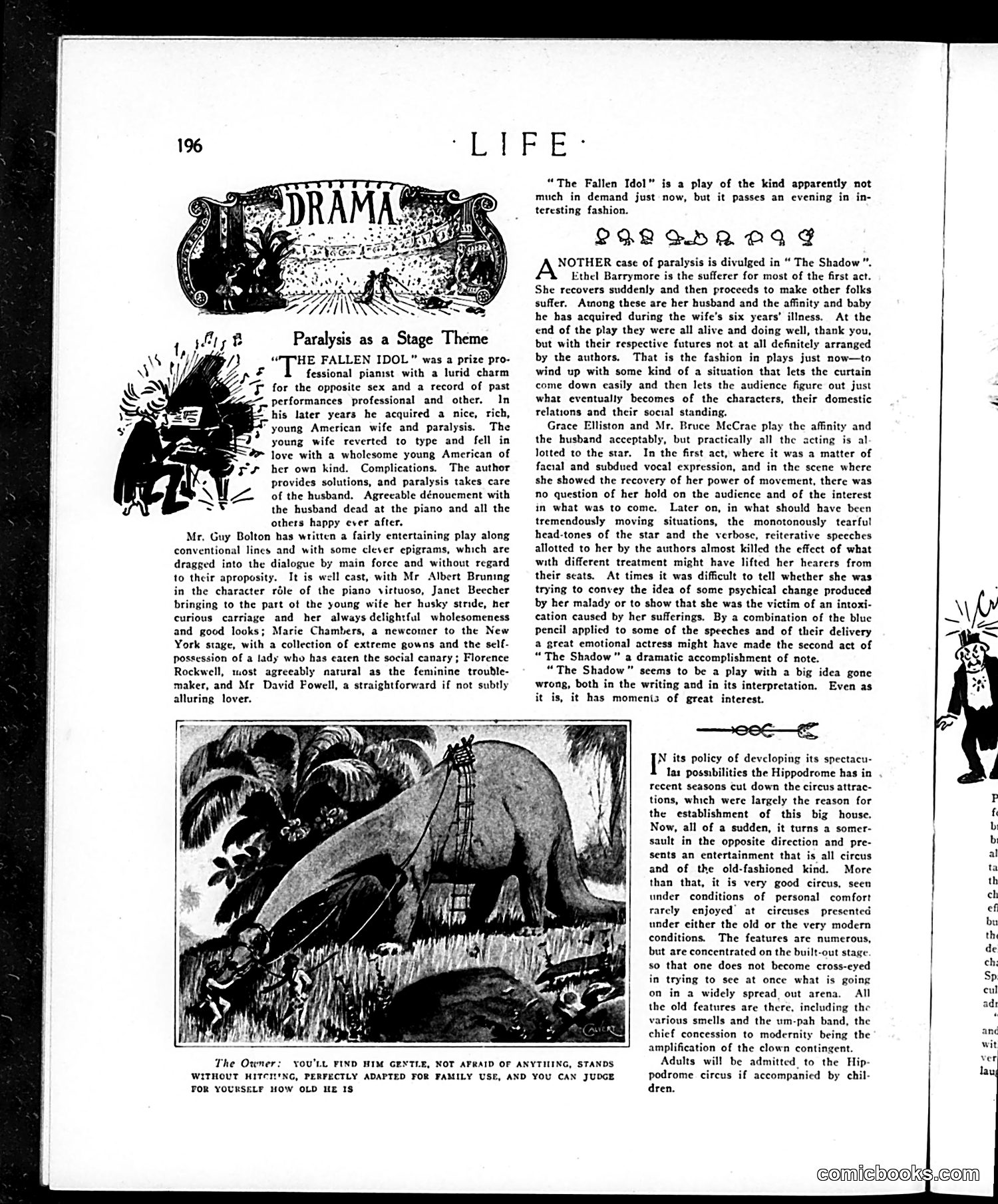
This page reviews two Broadway plays dealing with paralysis as plot devices: **"The Fallen Idol"** features a pianist virtuoso who acquires both a rich American wife and paralysis. The review mocks the contrived plot where paralysis conveniently eliminates the husband, allowing the wife to pursue a wholesome American lover. The satire targets formulaic theater: using disability as a convenient dramatic solution rather than meaningful storytelling. **"The Shadow"** stars Ethel Barrymore as a woman who recovers from paralysis mid-play, then causes others to suffer. The reviewer criticizes both the loose ending and Barrymore's performance—her "monotonously tearful head-tones" undermine potentially moving scenes. The critic suggests better editing and delivery could have elevated the material. The accompanying circus illustration appears unrelated to the drama reviews. Both play reviews exemplify early 20th-century theater criticism lampooning melodramatic conventions and star-dependent casting.
📄 Transcribed text from this page (OCR, searchable)
Machine-transcribed from the original scan — historical spelling and the odd misread are preserved.
Paralysis as a Stage Theme HE FALLEN IDOL” was a prize pro- fessional piamst with a lurid charm EG for the opposite sex and a record of past performances professional and other. In AZ his later years he acquired a nice, rich, F young American wife and paralysis. The young wife reverted to type and fell in ‘%™ love with a wholesome young American of By sr her own kind. Complications. The author provides solutions, and paralysis takes care of the husband. Agreeable dénouement with the husband dead at the piano and all the others happy ever after. Mr. Guy Bolton has written a fairly entertaining play along conventional lines and with some clever epigrams, which are dragged into the dialogue by main force and without regard to their aproposity. It is cast, with Mr Albert Bruning in the character réle of the piano virtuoso, Janct Beecher bringing to the part of the young wife her husky stride, her curious carriage and her always delightful wholesomeness and good looks; Marie Chambers, a newcomer to the New York stage, with a collection of extreme gowns and the self- possession of a lady who has eaten the social canary ; Florence Rockwell, most agreeably natural as the feminine trouble- maker, and Mr David Fowell, a straightforward if not subtly alluring lover. “EP re* “The Fallen Idol” is a play of the kind apparently not much in demand just now, but it passes an evening in in- teresting fashion. OBkPDREDE NOTHER case of paralysis is divulged in “ The Shadow”. Ethel Barrymore is the sufferer for most of the first act. She recovers suddenly and then proceeds to make other folks suffer. Atnong these are her husband and the affinity and baby he has acquired during the wife’s six years’ illness. At the end of the play they were all alive and doing well, thank you, but with their respective futures not at all definitely arranged by the authors. That is the fashion in plays just now—to wind up with some kind of a situation that lets the curtain come down easily and then lets the audience figure out just what eventually becomes of the characters, their domestic relations and their social standing. Grace Elliston and Mr. Bruce McCrae play the affinity and the husband acceptably, but practically all the acting is al lotted to the star. In the first act, where it was a matter of facial and subdued vocal expression, and in the scene where she showed the recovery of her power of movement, there was no question of her hold on the audience and of the interest in what was to come. Later on, in what should have been tremendously moving situations, the monotonously tearful head-tones of the star and the verbose, reiterative speeches allotted to her by the authors almost killed the effect of what with different treatment might have lifted her hearers from their seats. At times it was difficult to tell whether she was trying to convey the idea of some psychical change produced by her malady or to show that she was the victim of an intoxi- cation caused by her sufferings. By a combination of the bluc pencil applicd to some of the speeches and of their delivery a great emotional actress might have made the second act of “The Shadow" a dramatic accomplishment of note. “The Shadow” seems to be a play with a big idea gone wrong, both in the writing and in its interpretation. Even as it is, it has moments of great interest. —<e8 EE N its policy of developing its spectacu- las possibilities the Hippodrome has in Tecent seasons cut down the circus attrac- tions, which were largely the reason for the establishment of this big house. Now, all of a sudden, it turns a somer- sault in the opposite direction and pre- sents an entertainment that is all circus and of the old-fashioned kind. More than that, it is very good circus, seen under conditions of personal comfort rarely enjoyed’ at circuses presented under either the old or the very modern conditions. The features are numerous, but are concentrated on the built-out stage. so that one does not become cross-eyed in trying to see at once what is going on in a widely spread out arena. All the old features are there, including the various smells and the um-pah band, the chief concession to modernity being the amplification of the clown contingent. The Owner: Yyou'LtL FIND HIM GENTLE, NOT AFRAID OF ANYTILING, STANDS G, PERFECTLY ADAPTED FOR FAMILY USE, AND YOU CAN JUDGE witHout HIT?! FOR YOURSELF NOW OLD HE 1S Adults will be admitted, to the Hip- podrome circus if accompanied by chil- dren. comichooks.com