
Life, 1915-02-04 · page 25 of 44
Life — February 4, 1915 — page 25: what you’re looking at
What you’re looking at
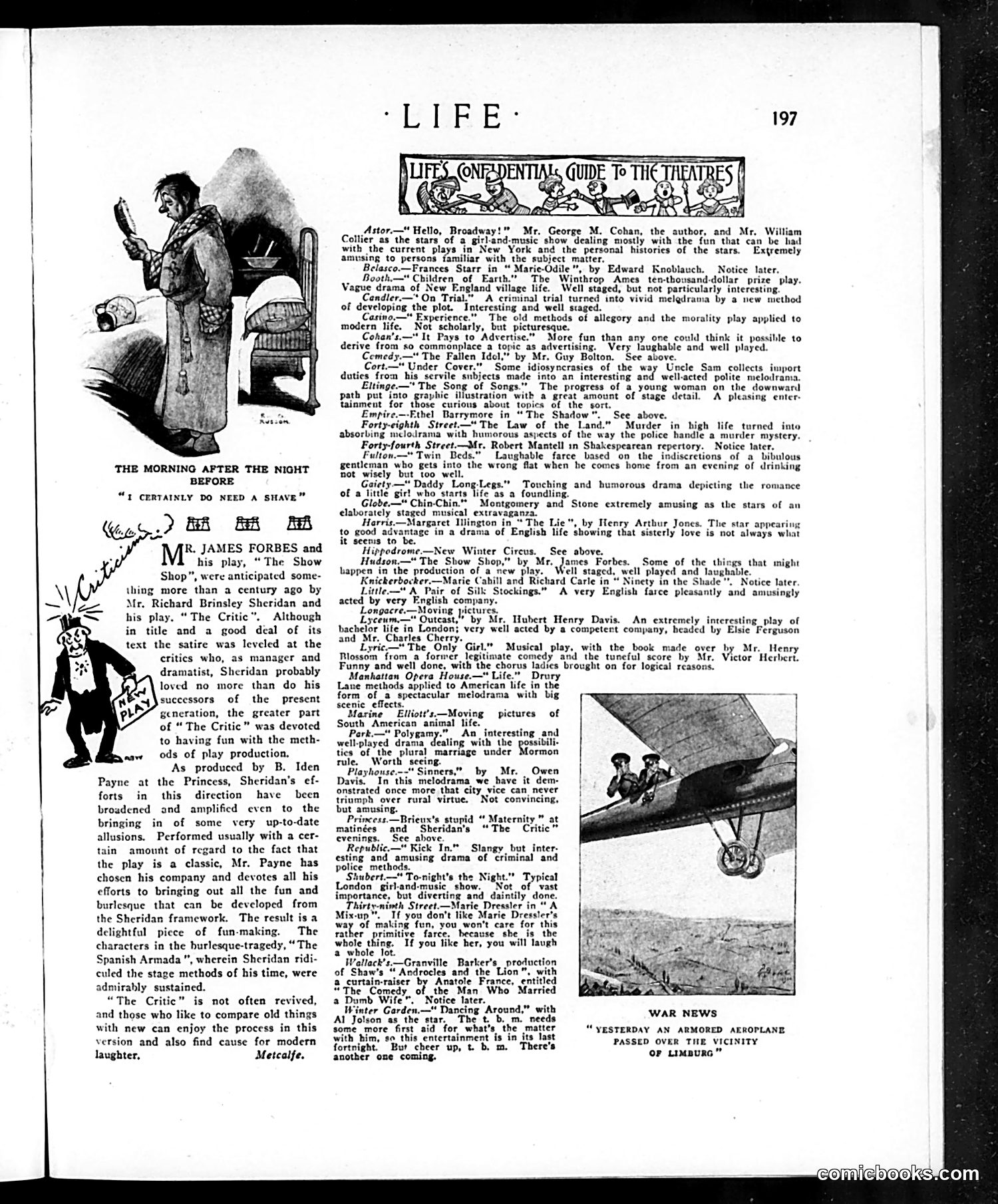
This page is primarily a **theater review guide** from *Life* magazine, not a political cartoon. The small illustration labeled "The Morning After the Night Before" shows a disheveled man saying "I certainly do need a shave"—a simple visual gag about hangover aftermath. The bulk of the page contains brief reviews of Broadway productions. The text discusses James Forbes's play "The Show Shop" in relation to Sheridan's 18th-century satire "The Critic," praising how both mock theatrical production methods. Reviews cover contemporary shows like George M. Cohan's "Hello, Broadway!" and various melodramas and farces popular in the era. The bottom photographs show a war-related image: an armored aeroplane passing over Limburg (presumably WWI-era). This reflects *Life*'s mix of entertainment coverage with current events during the First World War period.
📄 Transcribed text from this page (OCR, searchable)
Machine-transcribed from the original scan — historical spelling and the odd misread are preserved.
THE MORNING AFTER THE NIGHT BEFORE “1 CERTAINLY DO NEED A SHAVE” R, JAMES FORBES and his play, “The Show Shop”, were anticipated some- thing more than a century ago by Mr, Richard Brinsley Sheridan and his play, “The Critic”. Although in title and a good deal of its text the satire was leveled at the critics who, as manager and dramatist, Sheridan probably loved no more than do his successors of the present generation, the greater part of “ The Critic” was devoted to having fun with the meth- ods of play production, As produced by B. Iden Payne at the Princess, Sheridan's ef- forts in this direction have been broadened and amplificd even to the bringing in of some very up-to-date allusions, Performed usually with a cer- tain amount of regard to the fact that the play is a classic, Mr. Payne has chosen his company and devotes all his efforts to bringing out all the fun and burlesque that can be developed from the Sheridan framework. The result is a delightful piece of fun-making. The characters in the burlesque-tragedy, “The Spanish Armada”, wherein Sheridan ridi- culed the stage methods of his time, were admirably sustained. “The Critic” is not often revived, and those who like to compare old things with new can enjoy the process in this version and also find cause for modern laughter, Metcalfe. 197 Astor.— Hello, Broadway!” Mr. George M. Cohan, the author, and Mr. William Collier as the stars’ of a girl-and-music show dealing mostly with the fun that can be had with the current plays in New York and the personal histories of the stars. Extremely amusing to persons familiar with the subject matter. Belasco.—Frances Starr_in “ Marie-Odile”, by Edward Knoblauch. Notice later. . Booth —* Children of Earth.” The Winthrop Ames ten-thousand-dollar prize play. Vague drama of New England village life. Well staged, but not particularly interesting. Candler.—* On Trial.” A criminal trial turned into vivid melgdrama by a new method of developing the plot. Interesting and well scaged Casino.—" Experience.” The old methods of legory and the morality play applied to modern life. Not scholarly, but picturesque. nae ee et Cohan’ It Pays to Advertise.” More fun than any one could think it possible to derive from so commonplace a topic as advertising. Very laughable and well played. The Fallen Idol,” by Mr. Guy Bolton. See above. Under Cover." Some idiosyncrasies of the way Uncle Sam collects import rom his servile subjects made into an interesting and well-acted polite melodrama, Eltinge.—" The Song of Songs."" The progress of a young woman on the downward path put into graphic illustration with a great amount of stage detail. A pleasing enter- tainment for those curious about topics of the sort. Empire.—-Fthel Barrymore in “The Shadow". See above. Forty-eighth Street.—" The Law of the Land.” Murder in high life turned into absorbing melodrama with humorous aspects of the way the police handle a murder mystery. Forty-fourth Street.—Mr. Robert Mantell in Shakespearean repertory. Notice later. Fulton.—* Twin Beds.” Laughable farce based on the indiscretions of a bibulous gentleman who gets into the wrong flat when he comes home from an evening of drinking not wisely but too well. Gaiety—" Daddy Long-Legs."" Touching and humorous drama depicting the romance of a little gir! who starts life as a foundlin Globe.—" Chin-Chin.” Montgomery ani elaborately staged musical extravaganza. Harris.—Margaret Mlington in “The Lie”, by Henry Arthur Jones. The star appearing to good advantage in a drama of English life showing that sisterly love is not always what it seems to be. Hippodrome.—New Winter Circus. See above. Hudson.—" The Show Shop,” by Mr, James Forbes. happen in the production of a new play. Well staged, well played and laughable. Knickerbocker.—Marie Cabill and Richard Carle in “ Ninety in the Shade". Notice later. Little—" A Pair of Silk Stockings.” A very English farce pleasantly and amusingly acted by very English company. Longacre.—Moving pictures. Lyceum.—" Outcast,” by Mr, Hubert Henry Davis. An extremely interesting play of bachelor life in London; very weil acted by a competent company, headed by Elsie Ferguson and Mr. Charles Cherry. Lyric—" The Only Girl." Musical play, with the book made over by Mr. Henry Blossom from a former, legitimate comedy and the tuneful score by Mr. Victor Herbert. Funny and well done, with the chorus ladies brought on for logical reasons. Manhattan Opera House.—" Life.” Drury Lane methods applied to American life in the form of a spectacular melodrama with big scenic effects. Marine Eltiott’s—Moving pictures of South American animal life. Park.—" Polygamy.” An interesting and Stone extremely amusing as the stars of an Some of the things that might well-played drama dealing with the possibili- tics of the plural marriage under Mormon rule. Worth sceing. Playhousi Sinners,” by Mr. Owen Davis. In this melodrama we have it dem- onstrated once more that city vice can never triumph over rural virtue. Not convincing, but amusing. Princess.—Brieux's stupid “ Maternity” at matinées and Sheridan's “The Critic” evenings. See above. Republic.— Kick In." Slangy, but inter. esting and amusing drama of criminal and police methods. Shubert.— To-night's the Night.” Typical and-music, show. of vast and daintily done. Marie Dressler in ‘A If you don't like Marie Dressler’s for this the Jaugh Mix-up". way of making fun, you won't care rather primitive farce, because 8 whole thing. If you like her, you wil a whole lot. Wellack’s.—Granville Barker's production of Shaw's “Androcles and the Lion”, with a curtain-raiser by Anatole France, entitled “The Comedy, of the Man Who’ Married a Dumb Wife”. Notice later. Winter Garden.—" Dancing Around,” with Al Jolson as the star, The t, b. m. needs some more frst aid for what's the matter with bim, so this entertainment is in its I: fortnight. Bur cheer up, tb, m. There's another one coming. ‘WAR NEWS “YESTERDAY AN ARMORED AEROPLANE PASSED OVER TIE VICINITY