
Life, 1915-02-04 · page 32 of 44
Life — February 4, 1915 — page 32: what you’re looking at
What you’re looking at
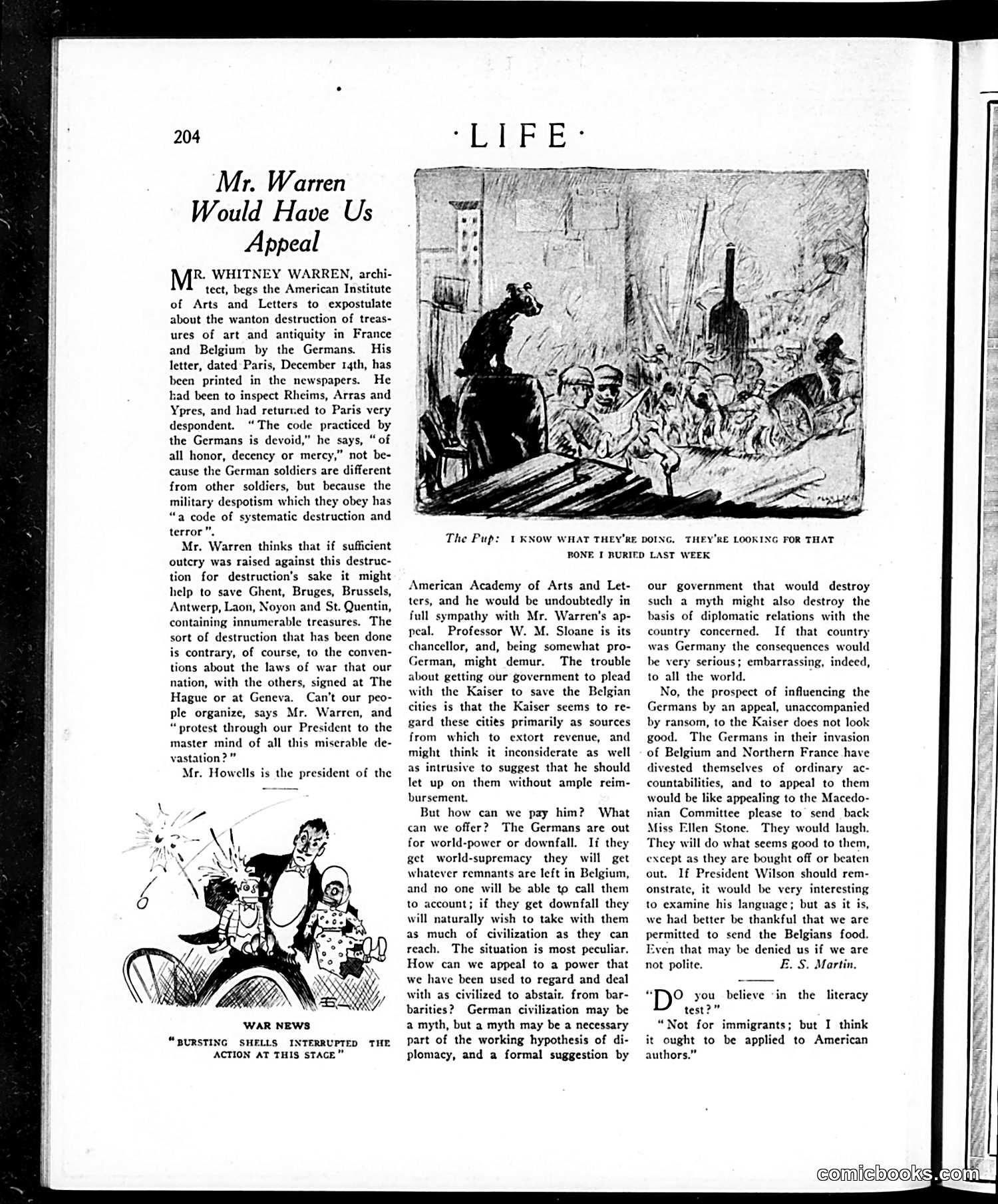
This page addresses German destruction of Belgian and French cultural treasures during World War I (the text references December 1914). **The main article** reports architect Whitney Warren's plea to American cultural institutions to formally protest German destruction of historic sites in Rheims, Arras, Ypres, and Belgian cities. The satirical *counterargument* (attributed to E.S. Martin) argues such appeals are futile: Germany seeks world domination or faces defeat; either way, they'll plunder what remains. Appealing to German "civilization" is pointless since they've abandoned accountability. Martin suggests America can only help by quietly sending food aid to Belgians—loud protests would accomplish nothing and might anger Germany further. **The cartoon** shows soldiers pillaging, with a dog caption joking they're "looking for that bone I buried last week"—dark humor suggesting Germans are simply looting like animals with no rational motive to appeal to. The piece reflects American ambivalence about intervention and skepticism toward idealistic diplomatic appeals during the early war period.
📄 Transcribed text from this page (OCR, searchable)
Machine-transcribed from the original scan — historical spelling and the odd misread are preserved.
204 Mr. Warren Would Have Us Appeal R. WHITNEY WARREN, archi- tect, begs the American Institute of Arts and Letters to expostulate about the wanton destruction of treas- ures of art and antiquity in France and Belgium by the Germans. His letter, dated Paris, December 14th, has been printed in the newspapers. He had been to inspect Rheims, Arras and Ypres, and had returned to Paris very despondent. “The code practiced by the Germans is devoid,” he says, “of all honor, decency or mercy,” not be- cause the German soldiers are different from other soldiers, but because the ilitary despotism which they obey has “a code of systematic destruction and terror”. Mr. Warren thinks that if sufficient outcry was raised against this destruc- tion for destruction’s sake it might help to save Ghent, Bruges, Brussels, Antwerp, Laon, Noyon and St. Quentin, containing innumerable treasures. The sort of destruction that has been done is contrary, of course, to the conven- tions about the laws of war that our nation, with the others, signed at The Hague or at Geneva. Can't our peo- ple organize, says Mr. Warren, and “protest through our President to the master mind of all this miserable de- vastation?” Mr. Howells is the president of the WAR NEWS “BURSTING SHELLS INTERRUPTED THE ACTION AT THIS STACE” The Pup: I KNOW WHAT THEY'RE DOING. THEY'RE LOOKING FOR THAT BONE I BURIED LAST WEEK American Academy of Arts and Let- ters, and he would be undoubtedly in full sympathy with Mr, Warren's ap- peal. Professor W. M. Sloane is its chancellor, and, being somewhat pro- German, might demur. The trouble about getting our government to plead with the Kaiser to save the Belgian cities is that the Kaiser seems to re- gard these cities primarily as sources from which to extort revenue, and might think it inconsiderate as well as intrusive to suggest that he should let up on them without ample reim- bursement. But how can we pay him? What can we offer? The Germans are out for world-power or downfall. Ii they get world-supremacy they will get whatever remnants are left in Belgium, and no one will be able to call them to account; if they get downfall they will naturally wish to take with them as much of civilization as they can reach. The situation is most peculiar. How can we appeal to a power that we have been used to regard and deal with as civilized to abstair. from bar- barities? German civilization may be a myth, but a myth may be a necessary part of the working hypothesis of di- plomacy, and a formal suggestion by our government that would destroy such a myth might also destroy the basis of diplomatic relations with the country concerned. If that country was Germany the consequences would be very serious; embarrassing, indeed, to all the world. No, the prospect of influencing the Germans by an appeal, unaccompanied by ransom, to the Kaiser does not look good. The Germans in their invasion of Belgium and Northern France have divested themselves of ordinary ac- countabilities, and to appeal to them would be like appealing to the Macedo- nian Committee please to send back Miss Ellen Stone. They would laugh. They will do what seems good to them, except as they are bought off or beaten out. If President Wilson should rem- onstrate, it would be very interesting to examine his language; but as it is, we had better be thankful that we are permitted to send the Belgians food. Even that may be denied us if we are not polite. E. S. Martin, “D° you believe ‘in the literacy test?” “Not for immigrants; but I think it ought to be applied to American authors.” comichoo! Scone