
A complete issue · 40 pages · 1914
Life — August 20, 1914
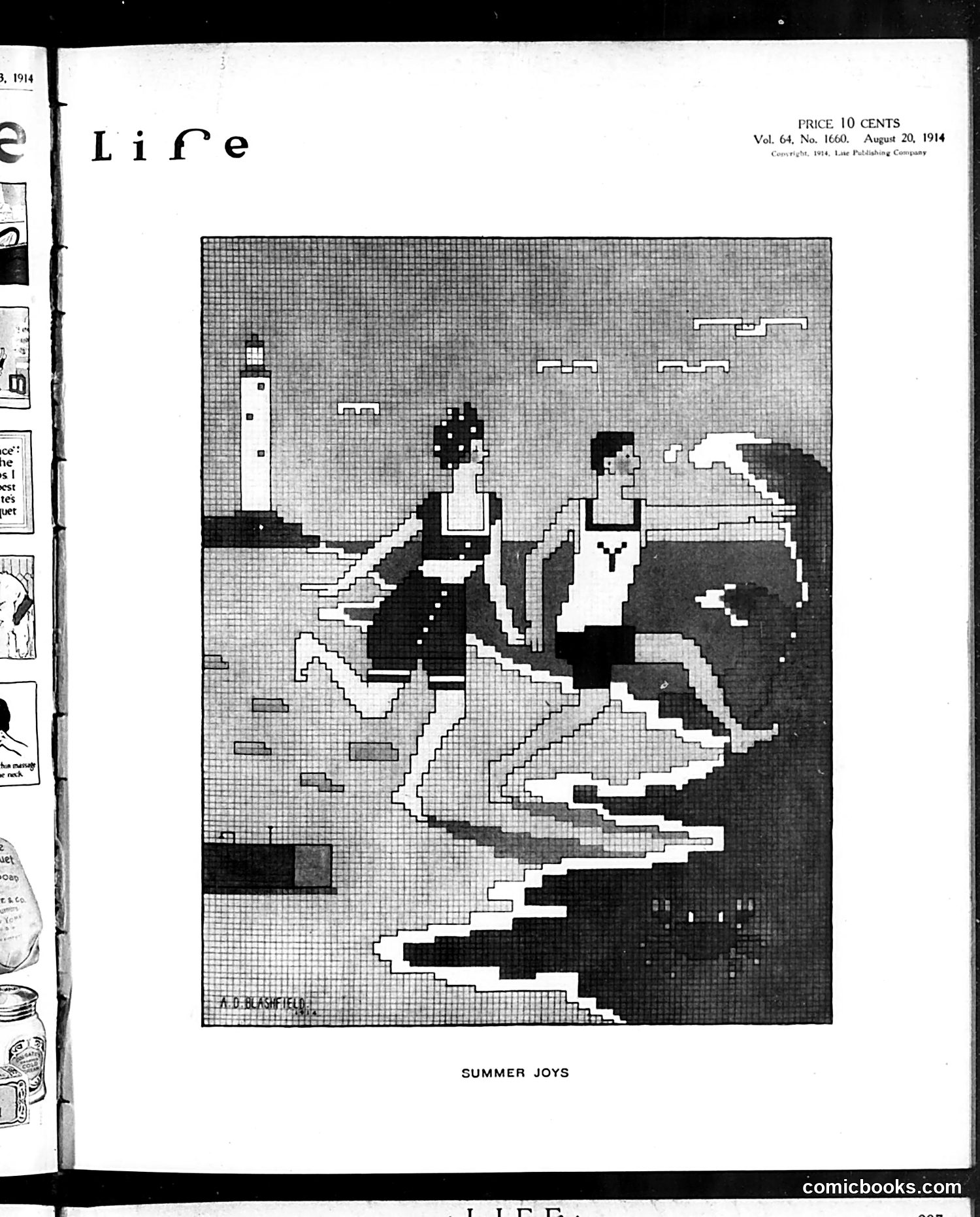
This illustration by A.D. Blashfield depicts two fashionably-dressed women enjoying seaside leisure activities—one in a dark bathing costume and one in white. A lighthouse appears in the background, establishing a beach setting. The cartoon's title "Summer Joys" celebrates recreational pleasures available to affluent Americans during summer months. The artwork reflects early 20th-century fashion and leisure culture, showcasing the kinds of resort activities popular among the upper classes. Published just weeks after World War I began in Europe (August 1914), this light domestic scene contrasts sharply with the violent conflict unfolding abroad—though the magazine appears unaware of or unconcerned with that context on this particular page.
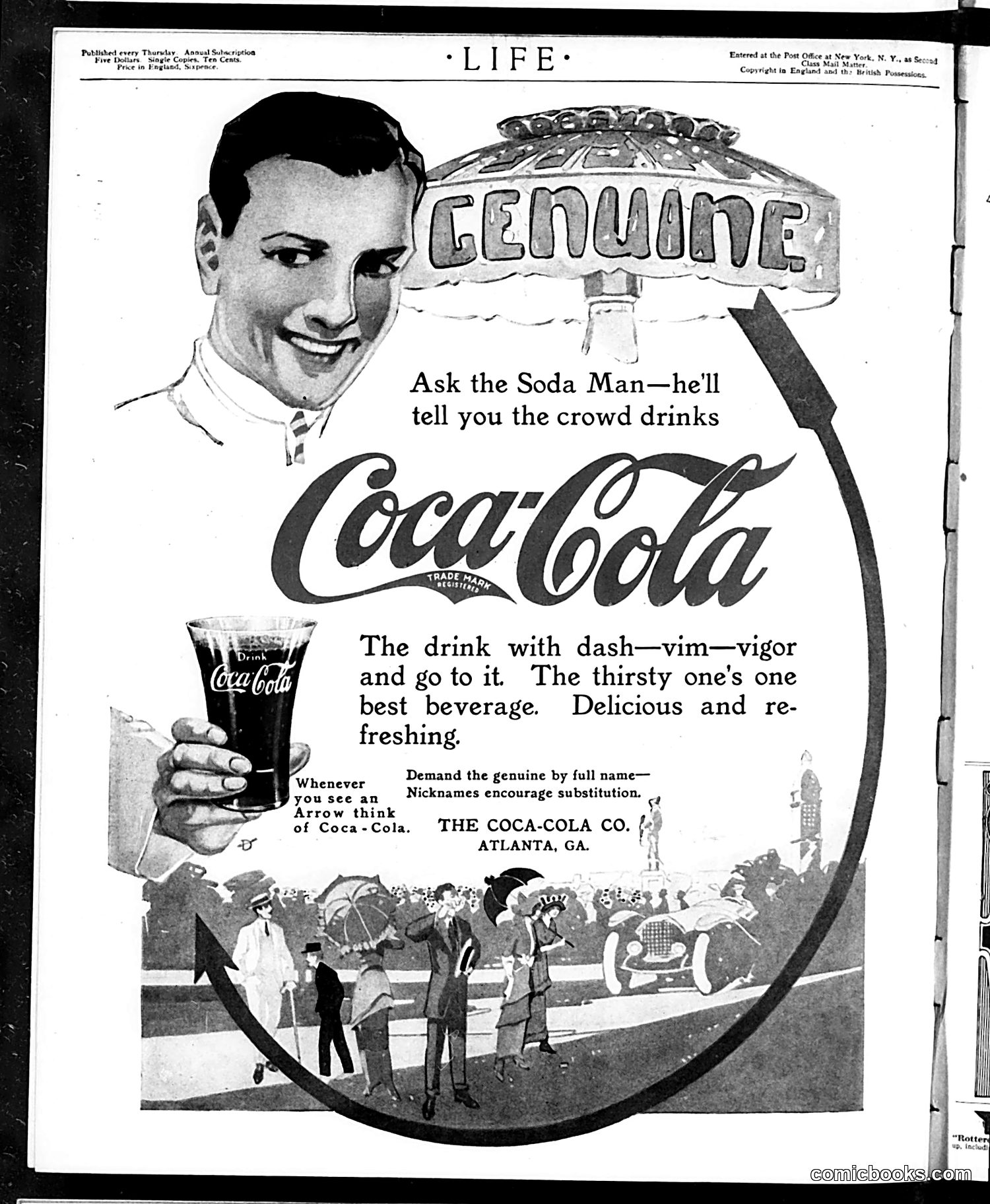
This is a Coca-Cola advertisement, not political satire. The page features a smiling man in formal attire promoting the beverage as "the drink with dash—vim—vigor," marketed to "the thirsty one's" seeking something "delicious and refreshing." The ad emphasizes authenticity ("Demand the genuine by full name"), warning consumers against substitutions or imitations—a common concern in early-20th-century commerce when product counterfeiting was widespread. The "soda man" mentioned would be a fountain attendant who dispensed the drink. The visual elements include a glass of Coca-Cola and a scene of people at what appears to be a public gathering or park, suggesting the drink's appeal as a social beverage. The emphasis on asking the "soda man" reflects the era when Coca-Cola was primarily consumed at soda fountains rather than packaged for home use.
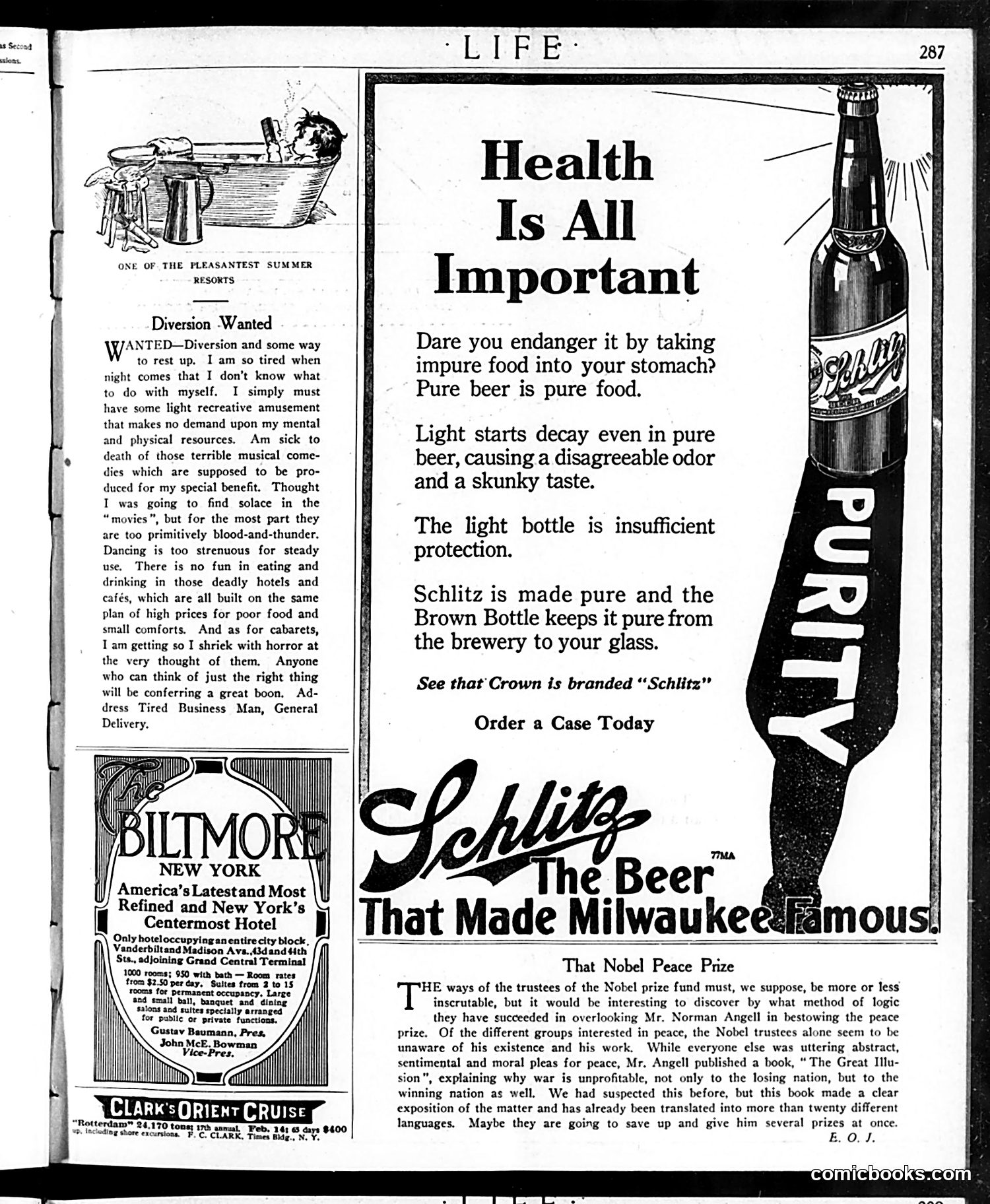
This page is primarily **advertising**, not satire or political commentary. The dominant content is a **Schlitz beer advertisement** claiming "Health Is All Important" and promoting beer as "pure food." The ad argues that Schlitz's brown bottle protects beer from light damage better than competitors' light bottles—a genuine product differentiation claim. Below is a smaller **Biltmore Hotel ad** (New York) and a **cruise line advertisement**. On the left is a personal "Diversion Wanted" classified-style ad from someone seeking entertainment relief from their mundane life. At the bottom, a brief editorial note discusses the **Nobel Peace Prize** and Norman Angell's anti-war book. The page reflects early 20th-century magazine format: mixed advertising, classifieds, and editorial content. There is **no political cartoon** present.
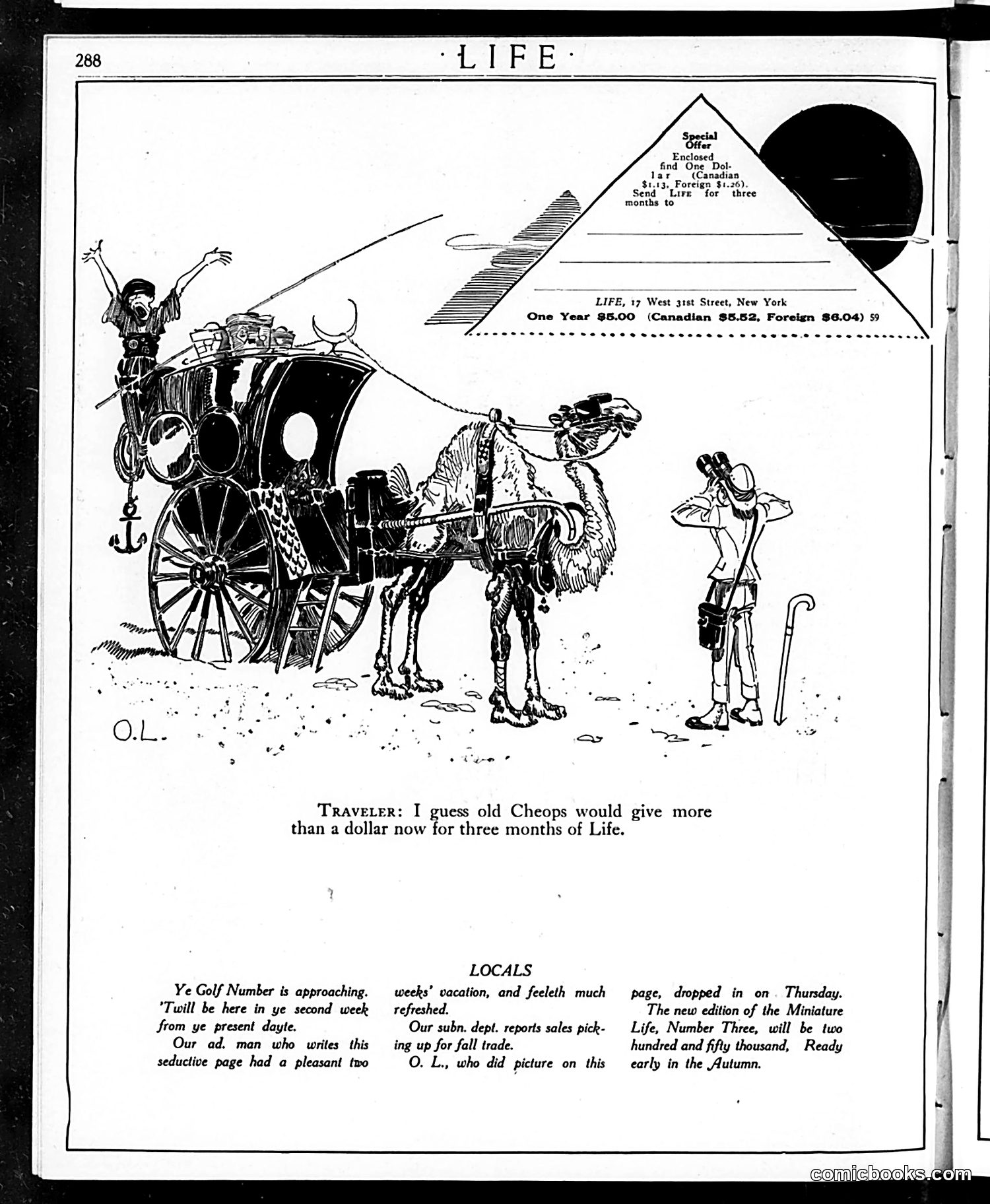
This page contains a single cartoon by artist O.L. depicting a desert traveler with a camel encountering a person on foot. The traveler remarks, "I guess old Cheops would give more than a dollar now for three months of Life." The joke references **Cheops** (the ancient Egyptian pharaoh), suggesting that even someone with vast historical wealth would pay premium rates for a three-month subscription to *Life* magazine. This is self-promotional satire—the magazine humorously claims its content is so valuable that even ancient rulers would consider it worthwhile. The cartoon also functions as a subscription advertisement, listing rates ($5.00 for one year domestically, with higher foreign rates). The "Locals" section mentions upcoming content and editorial notes.
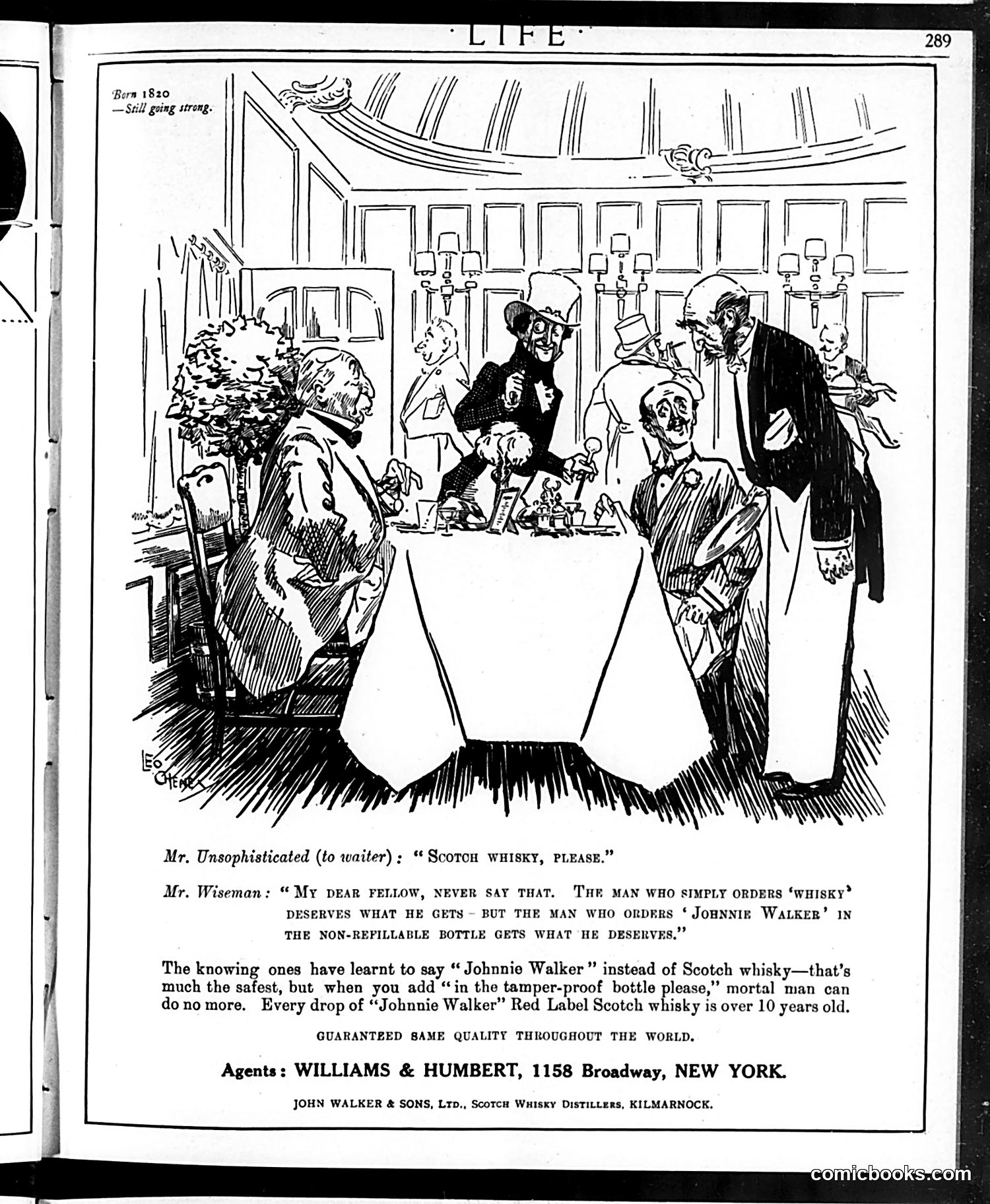
This is primarily a **Johnnie Walker Scotch whisky advertisement** from Life magazine (page 289), not political satire. The cartoon depicts a formal dinner scene where an unsophisticated diner ("Mr. Unsophisticated") requests "Scotch whisky, please." A refined gentleman ("Mr. Wiseman") corrects him, explaining that ordering "Johnnie Walker" in a tamper-proof bottle demonstrates superior taste and ensures quality. The advertisement's humor relies on **class-based mockery**: it positions Johnnie Walker as the drink of the "knowing ones" while suggesting ordinary Scotch whisky drinkers lack sophistication. The joke reinforces brand prestige through social embarrassment—implying that proper etiquette requires specifying the brand name rather than the generic spirit. The agents listed (Williams & Humbert, New York) distributed this premium Scottish whisky.
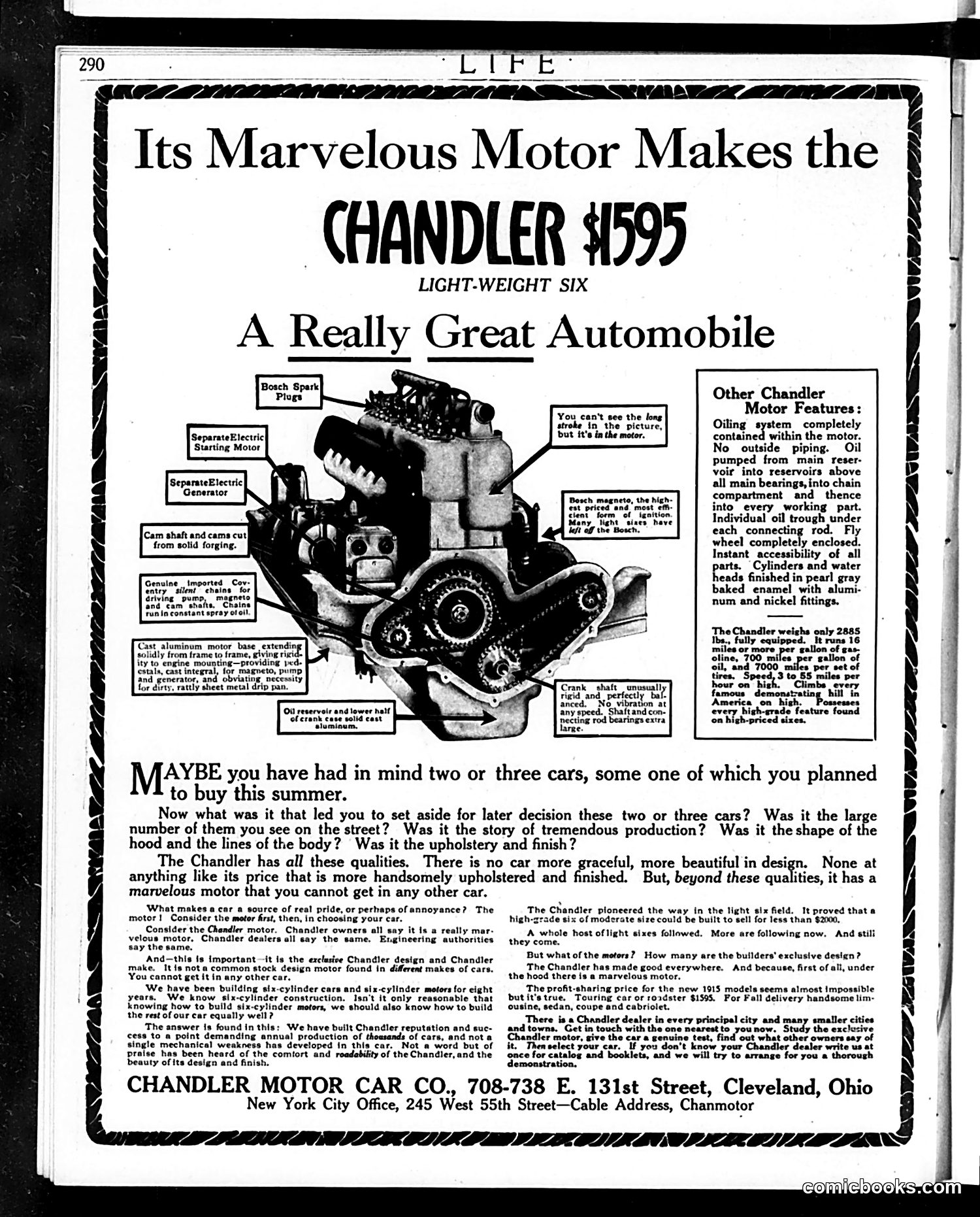
This is **not a cartoon or satire** — it's a straightforward product advertisement for the Chandler automobile, priced at $1,595. The page features a detailed technical diagram of the Chandler "Light-Weight Six" engine with labeled components (spark plugs, electric starter/generator, crankshaft, oil system, etc.). The accompanying text is a earnest sales pitch emphasizing the car's engineering features: precision manufacturing, enclosed wheels, innovative oiling systems, and superior design compared to competitors. The advertisement highlights durability (claiming 15,000 miles per gallon of gasoline efficiency) and appeals to affluent buyers seeking quality craftsmanship. This represents typical automotive advertising from the early 20th century, when manufacturers marketed vehicles as engineering marvels to justify premium pricing to potential customers.
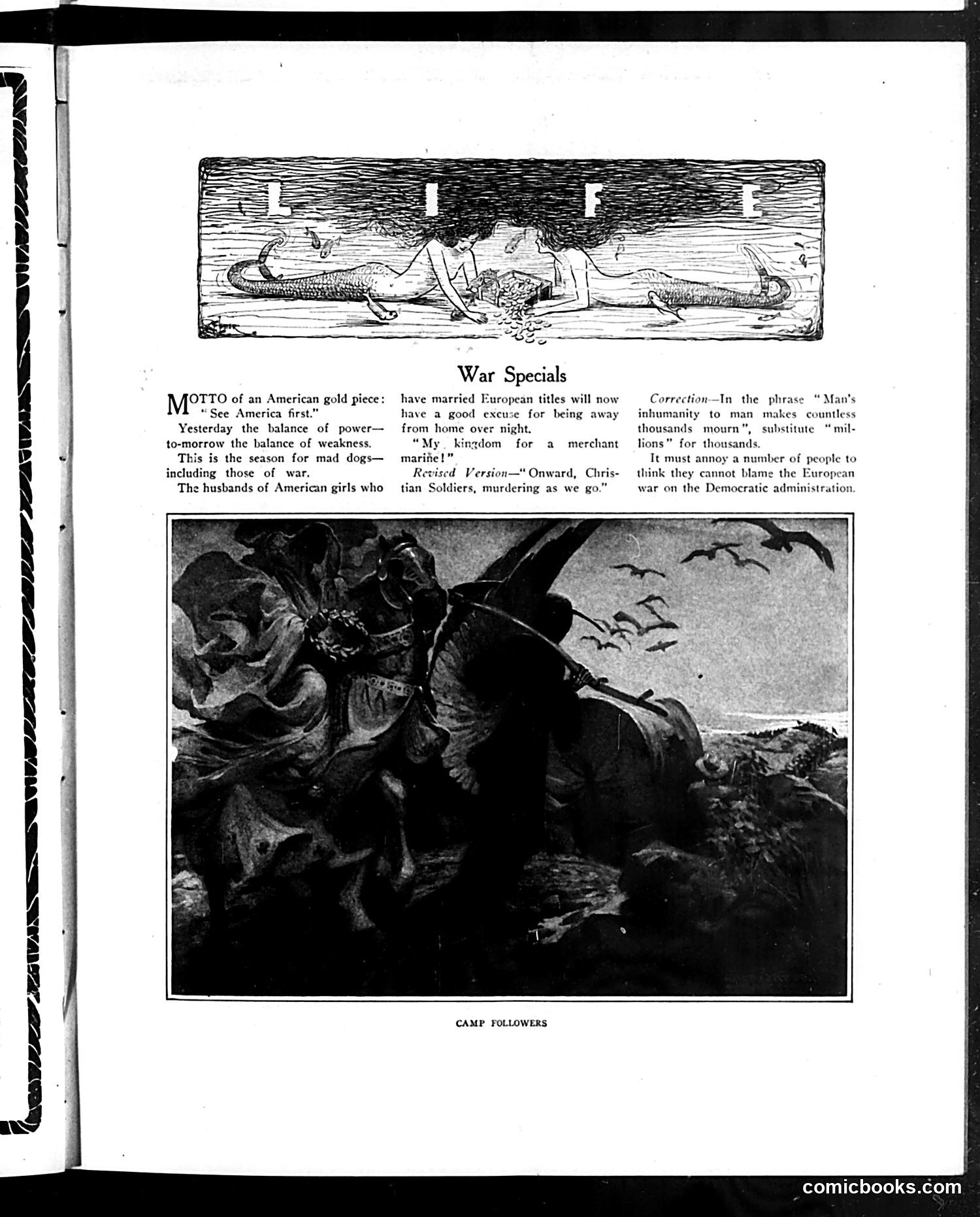
This page from *Life* magazine contains satirical commentary on World War I and American society. The "War Specials" section includes three brief, cynical quips: one mocking American weakness ("balance of power—tomorrow the balance of washers"), another joking darkly about mad dogs and war season, and a third about European titles and marriage—suggesting war-widows might seek advantageous marriages to titled Europeans. The photograph below, captioned "Camp Followers," depicts women accompanying soldiers, likely referencing the historical practice of civilians (often women) following military camps. The image appears to illustrate the social disruptions caused by war mobilization, though the specific context and individuals are unclear from the page alone.
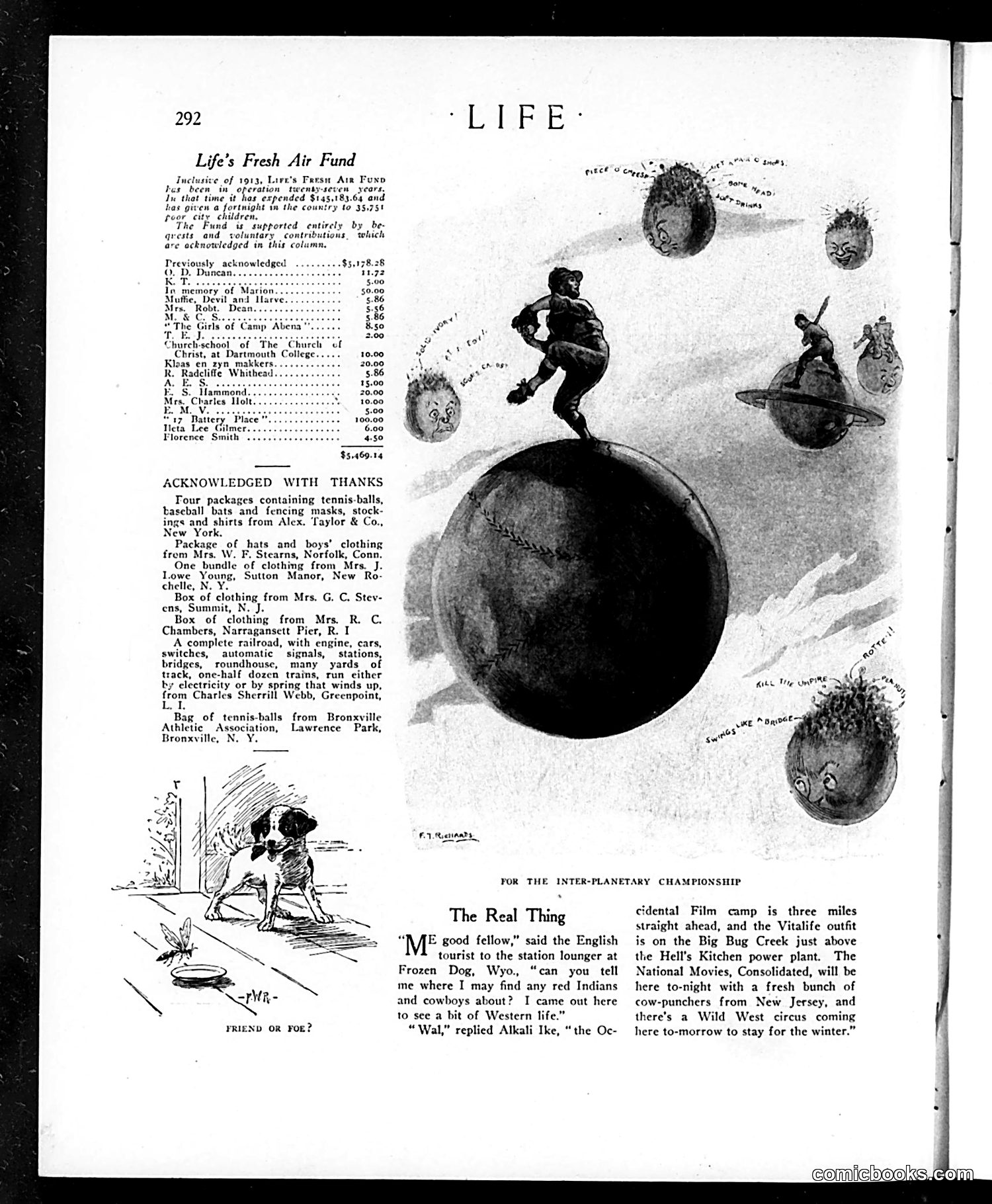
This page contains two distinct sections: **Upper Left:** A fundraising report for Life's Fresh Air Fund (established 1913), listing donor contributions totaling $5,469.14. Below is a small cartoon captioned "FRIEND OR FOE?" showing a dog encountering what appears to be a frog or toad—a simple humorous illustration with no clear political meaning. **Right Side:** An illustrated story titled "The Real Thing" beginning with dialogue between an English tourist and a Native American named Alkali Ike at Frozen Dog, Wyoming. The tourist seeks "real Indians and cowboys" and Western life experiences. The accompanying illustration shows a man juggling planets in a surreal, imaginative style. The page is primarily **not satirical**—it's a mix of charitable fundraising documentation and light entertainment fiction typical of Life magazine's content.
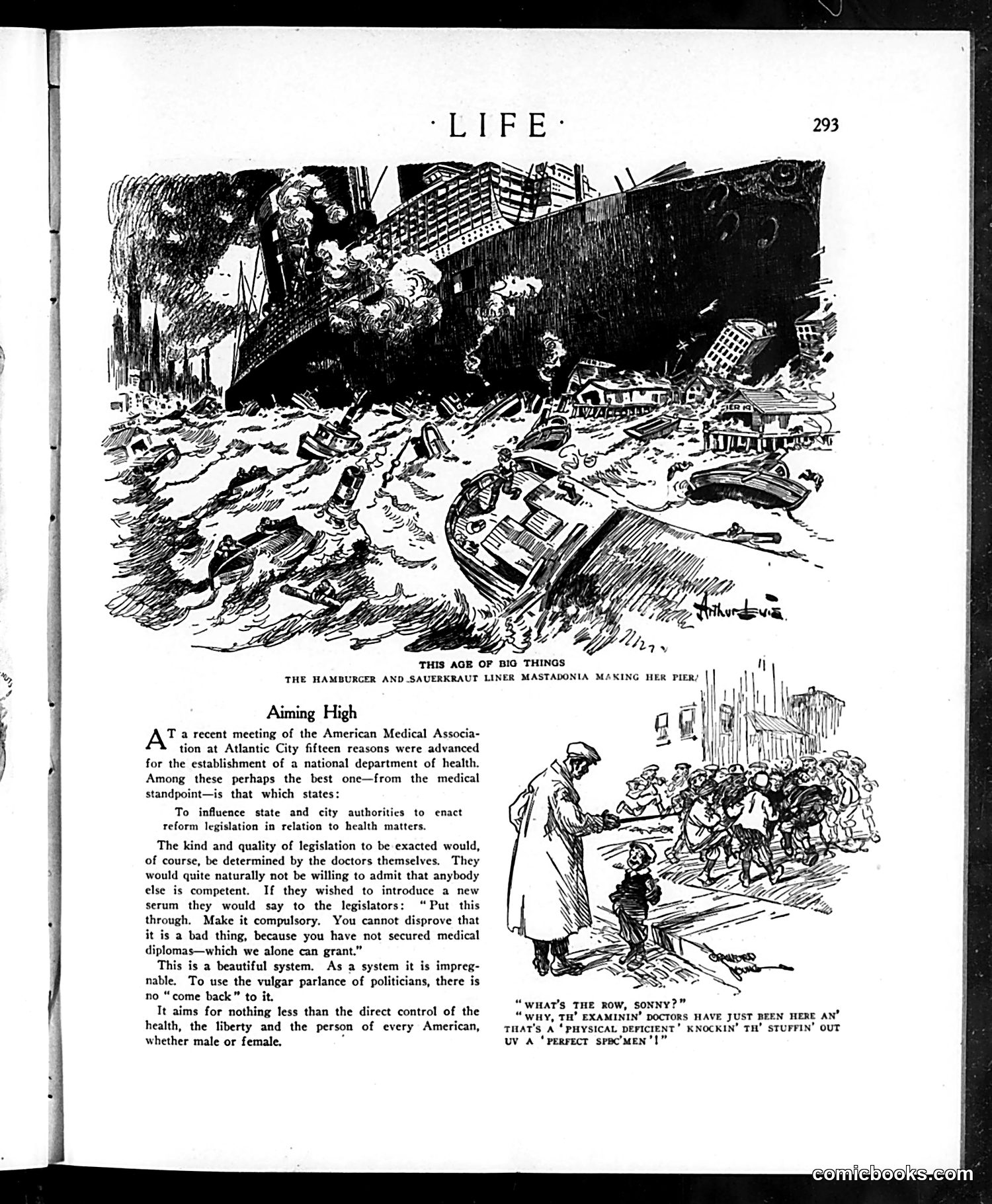
**Top Cartoon**: "This Age of Big Things" satirizes the Hamburger and Sauerkraut Liner Mastadonia making its pier. The exaggerated scale—massive ship dwarfing the dock—mocks the era's obsession with ever-larger industrial achievements and commercial vessels. **Bottom Cartoon & Article**: "Aiming High" discusses the American Medical Association's proposal for a national health department. The sketch shows a doctor examining patients. The caption joke ("What's the row, Sonny?" / "Why, th' examinin' doctors have just been here...") satirizes the contradiction: doctors demand medical credentials to control health policy, yet simultaneously want to exclude "perfect specimen" men from scrutiny. The article critiques this gatekeeping—physicians wanting monopolistic control over health matters while avoiding outside oversight.
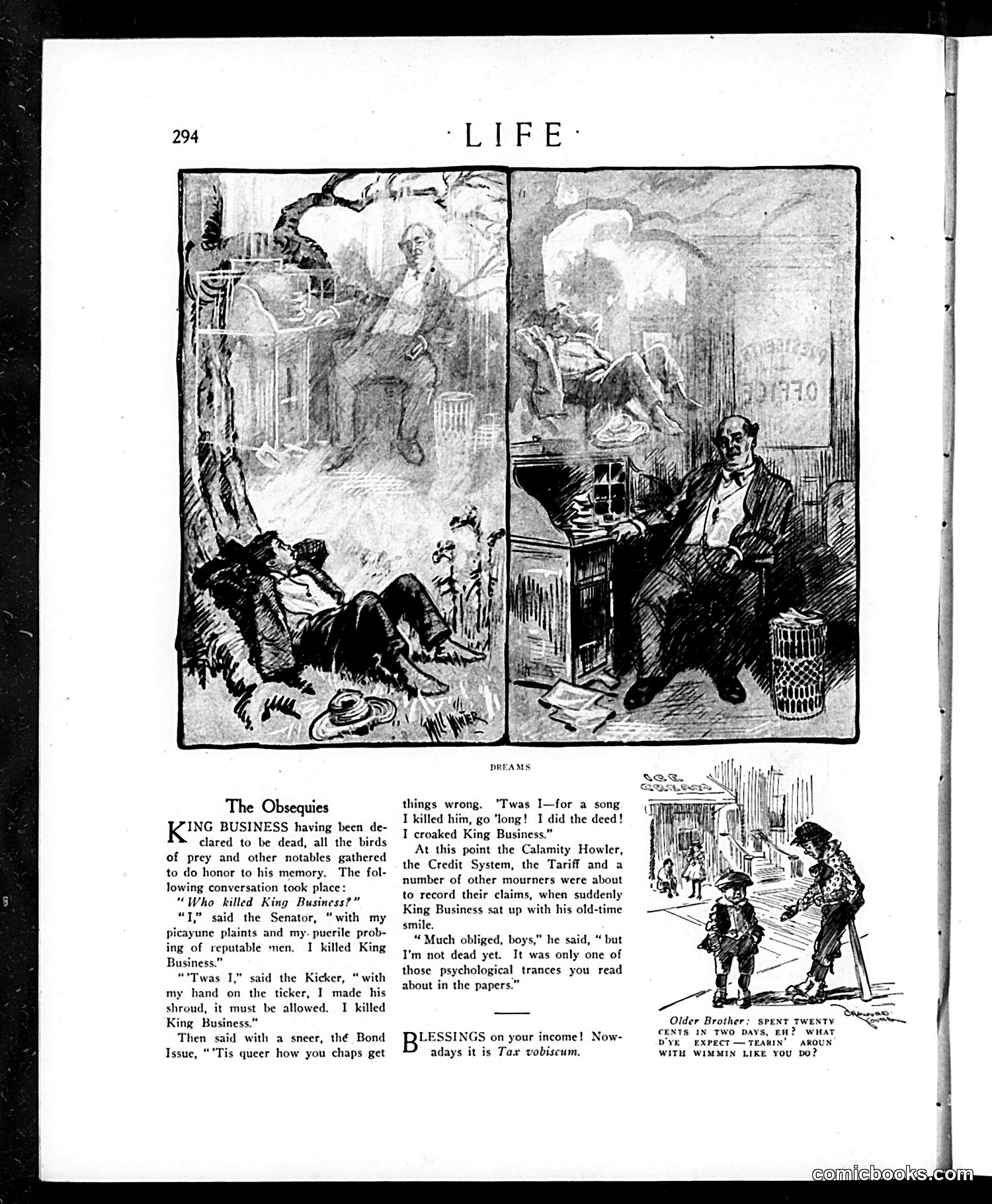
This page presents a satirical piece titled "The Obsequies" (funeral rites) mocking the death of "King Business." The left panel shows mourners gathered at what appears to be a funeral, while the right panel depicts a man sitting at a desk, smiling. The text reveals the joke: various characters claim credit for killing "King Business"—a Senator, the Kicker (likely a labor agitator), and the Bond Issue representative all boast of delivering fatal blows. King Business then reveals he's not actually dead, describing his "death" as merely a psychological phase reported in newspapers. The satire appears to mock exaggerated claims about economic conditions and the resilience of American business, suggesting reports of economic doom are greatly exaggerated.
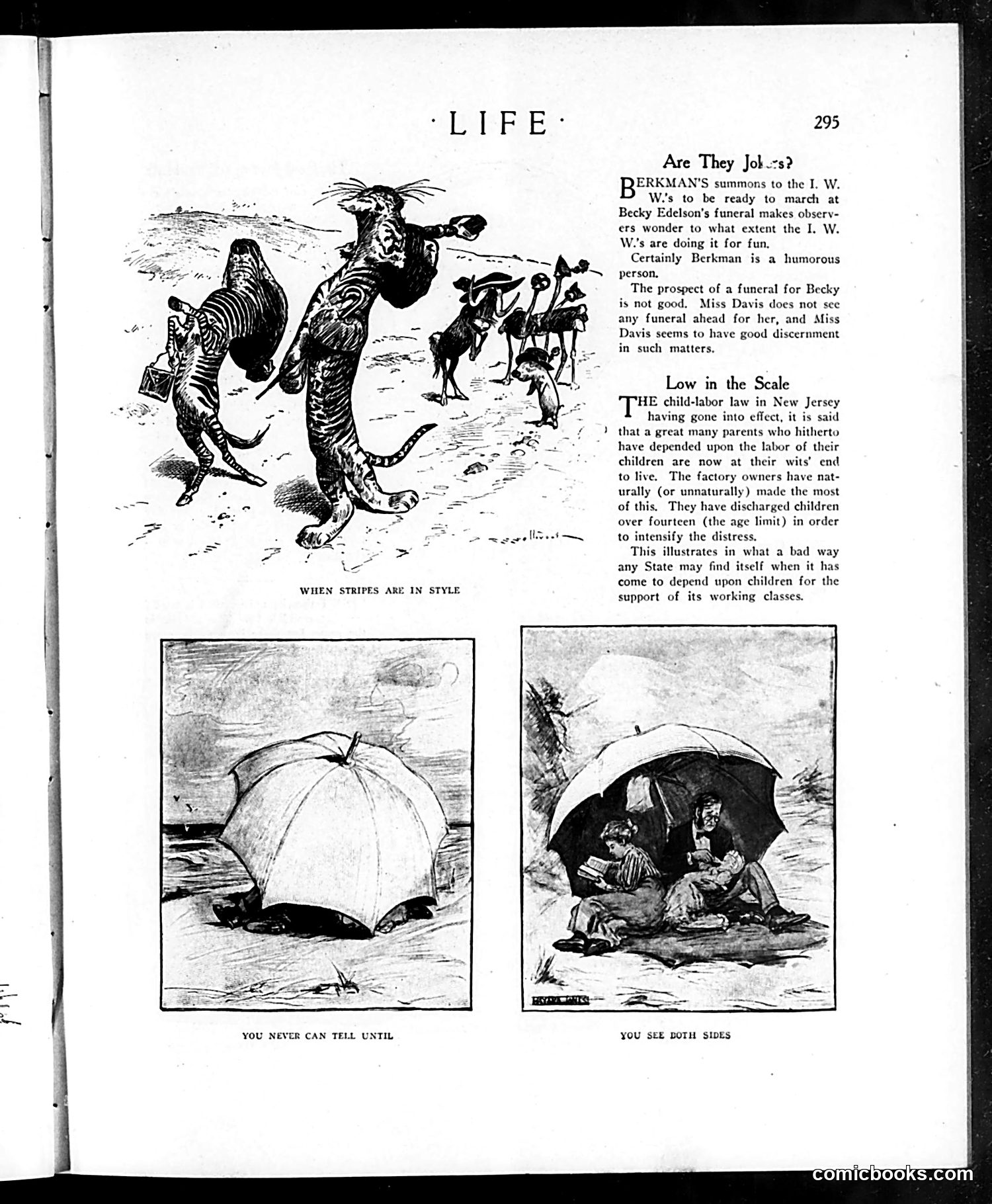
**Top Cartoon - "When Stripes Are in Style":** This satirical image depicts animals dressed in striped clothing, likely referencing fashion trends. The humor appears to play on the phrase "in style" by literally showing animals wearing stripes as if following a fashion fad. **Text Section - "Are They Jolly?":** Discusses Berkman's summons to the I.W.W. (Industrial Workers of the World), mentioning Becky Edelson's funeral and questioning the organization's activities. The tone is mockingly skeptical of radical labor groups. **"Low in the Scale":** Critiques New Jersey's child-labor law, noting that factory owners have discharged children over fourteen to avoid intensifying workers' distress. The piece satirizes how states become dependent on child labor for their working classes' economic support. **Bottom panels ("You Never Can Tell" / "You See Both Sides"):** Appear to use umbrellas as visual metaphors, likely commenting on hidden truths or perspectives in current events.
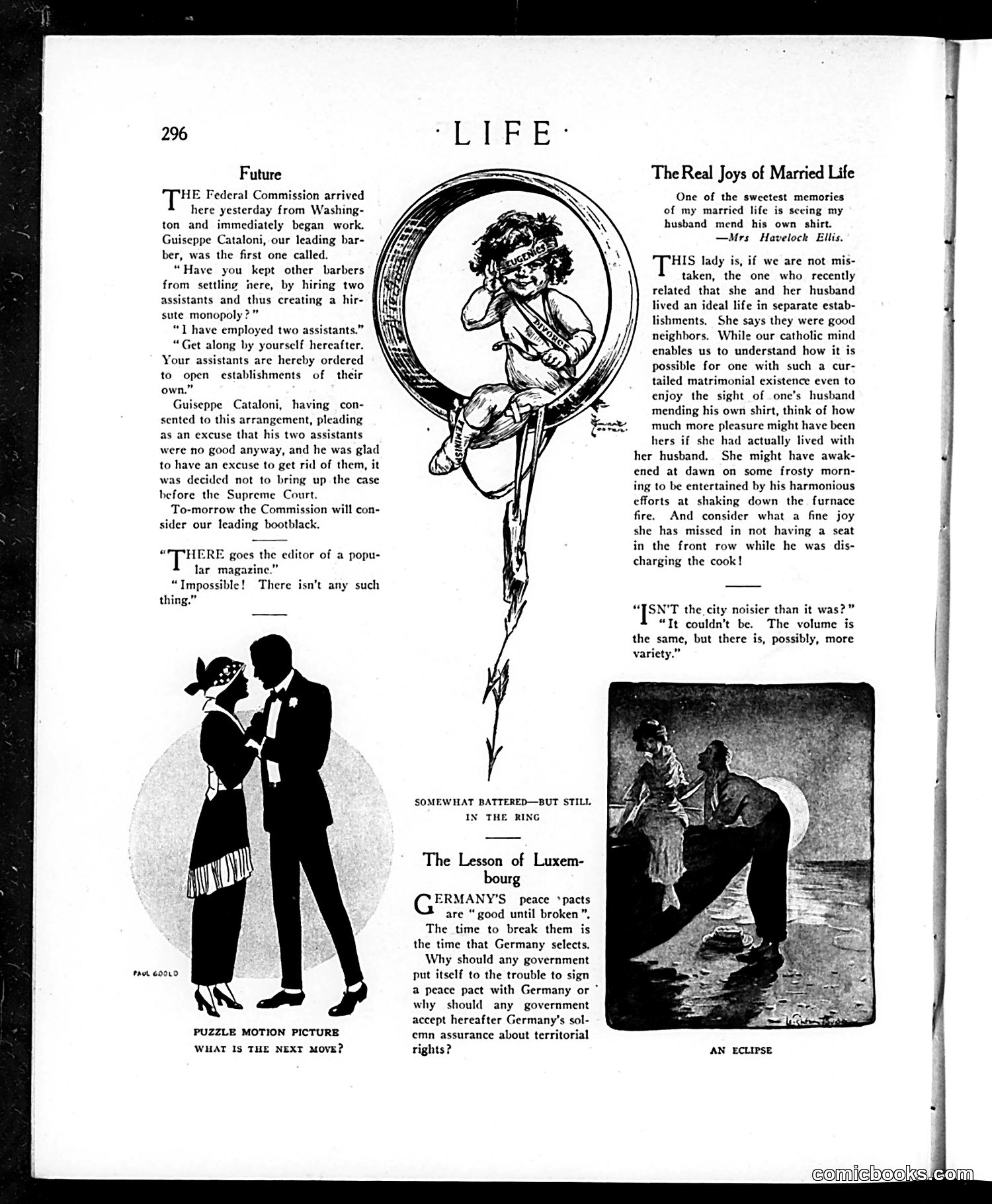
This page contains three distinct pieces of social commentary: **"Future"** (top left): Satirizes federal bureaucracy, mocking the Federal Commission's inefficient hiring practices where officials endlessly debate simple decisions about assistant barbers. **Central illustration**: A cherub or cupid figure in a circular frame, captioned "Somewhat Battered—But Still in the Ring," appears to represent marriage or romantic love persisting despite hardship. **"The Real Joys of Married Life"** (right): Uses domestic humor to critique separate-establishment marriages, suggesting spouses miss intimate daily interactions like mending shirts together—implying modern marriage trends were creating emotional distance. **"The Lesson of Luxembourg"** (bottom): Political commentary questioning why governments should trust or make peace pacts with Germany, whose agreements are unreliable ("good until broken"). The page demonstrates Life's mix of bureaucratic satire, relationship commentary, and political critique typical of the era.
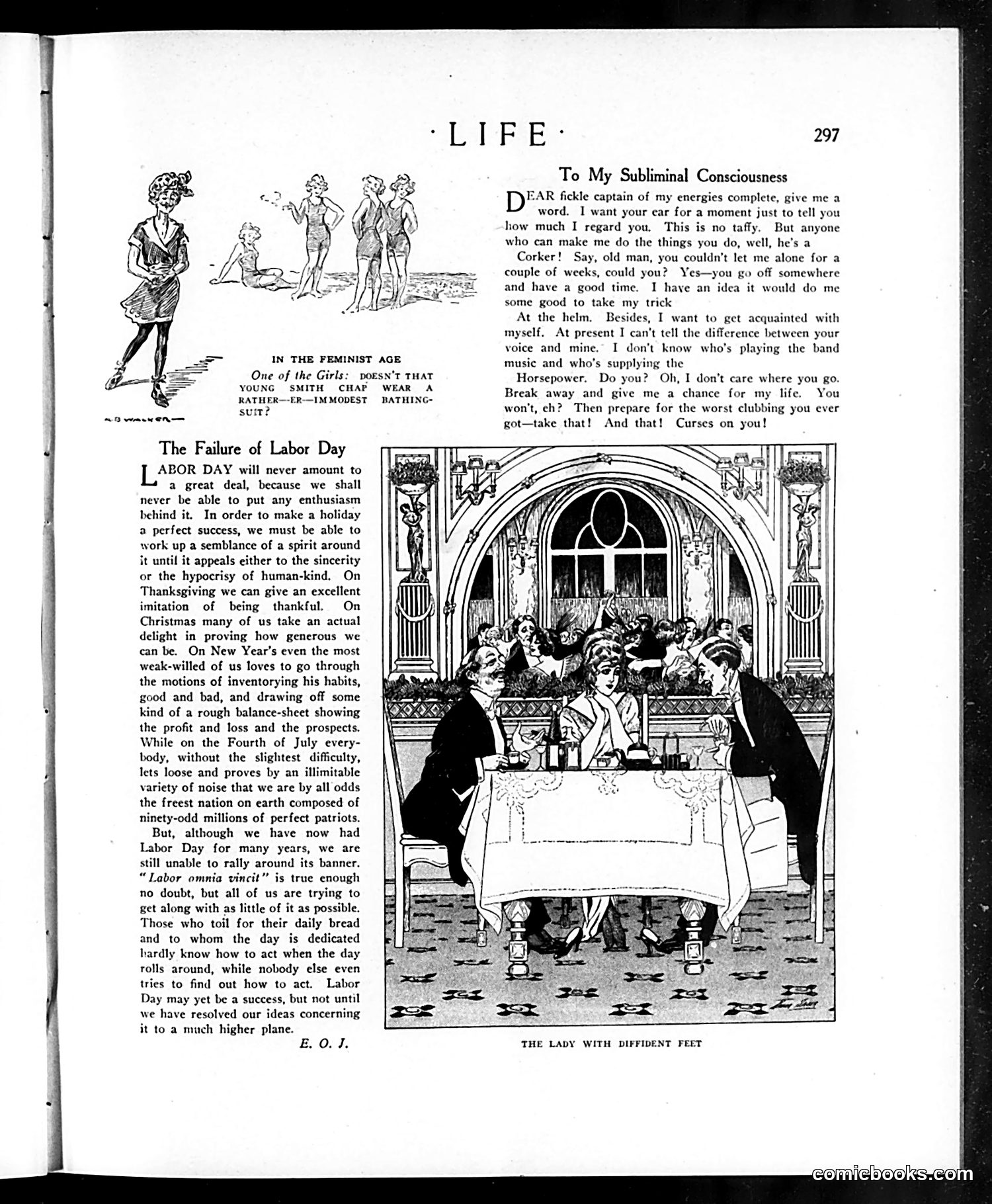
**Top Section ("In the Feminist Age"):** A satirical sketch showing a young girl in a bathing suit, with the caption noting she's "modest" about her outfit—clearly mocking early 20th-century feminist-era debates about women's clothing becoming less restrictive. **"The Failure of Labor Day" Article:** The text criticizes Labor Day's inability to inspire genuine patriotic enthusiasm, suggesting Americans struggle to celebrate workers meaningfully while maintaining social order. The author argues the holiday needs reimagining on "a much higher plane." **"The Lady with Different Feet" Illustration:** A formal dinner scene where a woman appears to have noticeably different feet—the joke appears to reference infidelity or hidden scandals beneath respectable social appearances, a common satirical theme of the era.
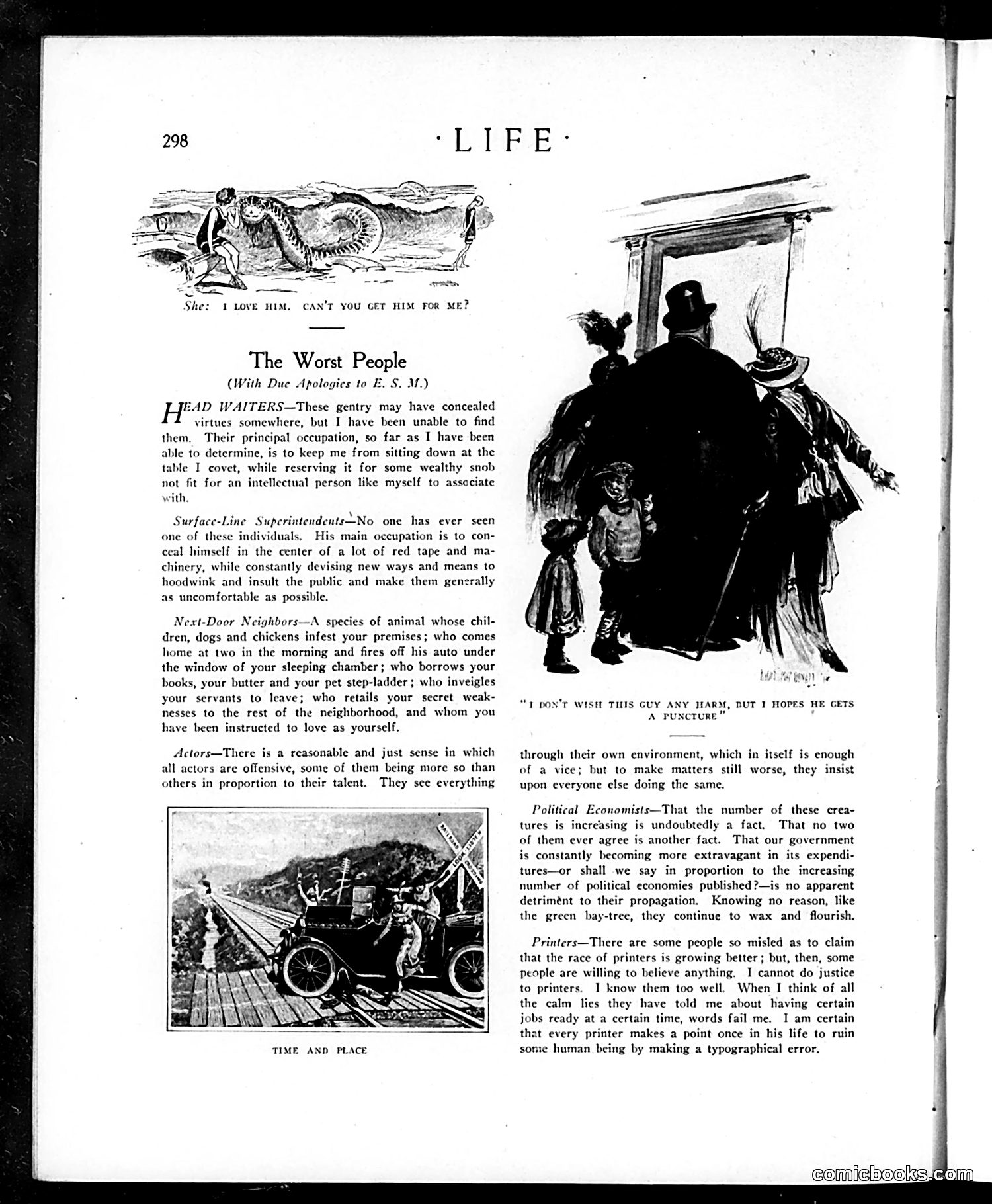
This page satirizes various unpopular professions and social types through mock character sketches. The article criticizes: - **Head Waiters**: Described as conceited, keeping intellectuals from dining comfortably - **Surface-Line Superintendents**: Officials who use bureaucratic obstruction and tape - **Next-Door Neighbors**: Nuisances who borrow items, fire up cars early, and spread gossip - **Actors**: Self-important people disproportionately offensive relative to their talent - **Political Economists**: Disagreeable academics whose theories contradict each other - **Printers**: Workers who deliberately sabotage jobs through "typographical errors" The cartoon illustrations (a couple with a log, people at a doorway) humorously depict these social annoyances. The satire uses exaggeration and specific grievances to mock common frustrations with service workers, neighbors, and professionals of the era.
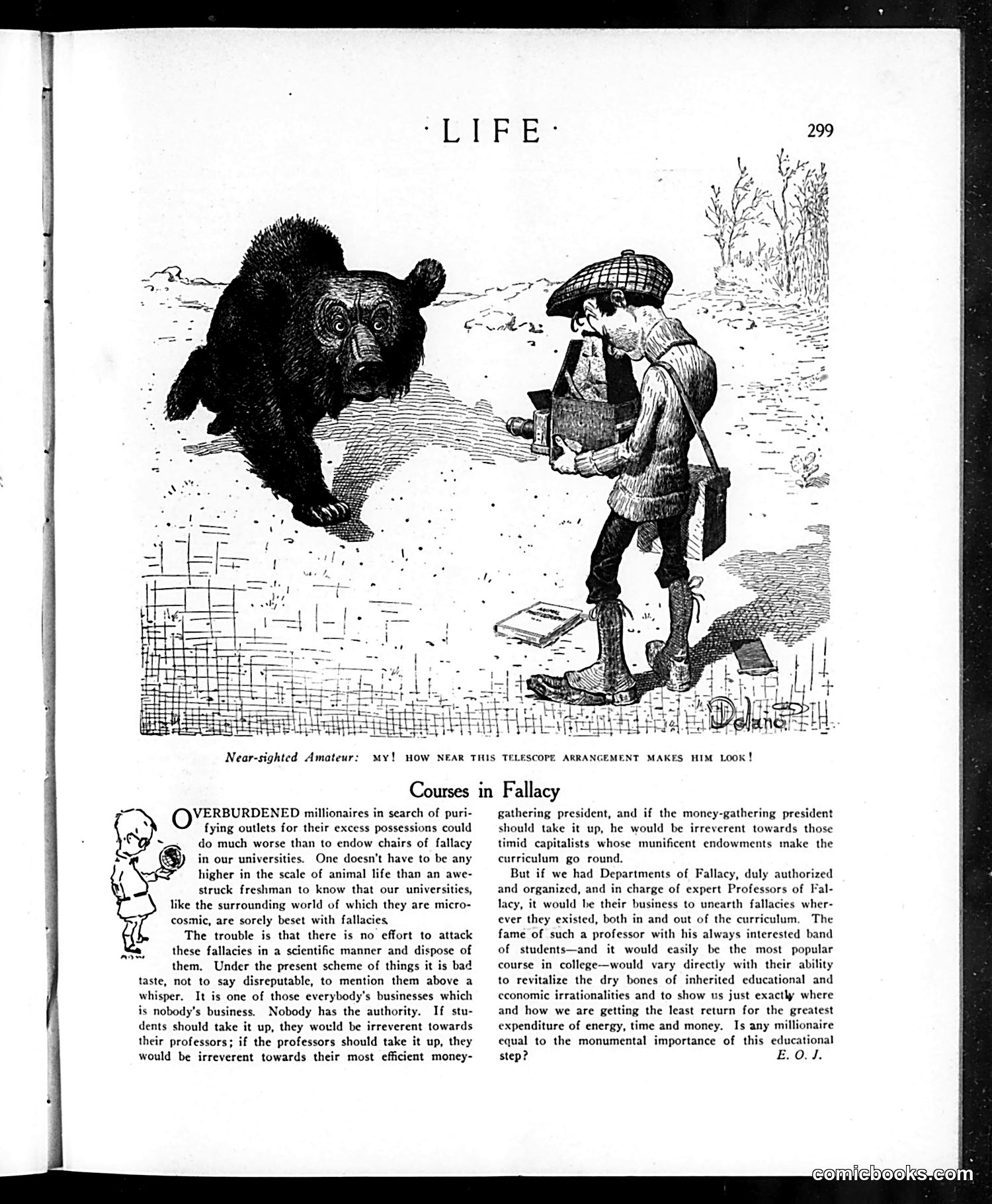
The top cartoon jokes about a nearsighted amateur photographer using a telescope as a camera lens, making a bear appear comically close-up. The humor is visual wordplay on "arrangement." The main article satirizes universities' failure to systematically critique fallacies and flawed reasoning. The author argues that no one—students, professors, or wealthy donors funding the institution—will challenge false ideas because doing so would be seen as disrespectful to their superiors. The piece proposes creating academic "Departments of Fallacy" with authorized professors to openly identify errors in education and economics. The satirical point: universities claim to pursue truth but actually protect inherited falsehoods through institutional hierarchy and donor pressure. A such department, the author suggests, would likely be the most popular course on campus—implying academia is deeply riddled with unexamined errors.
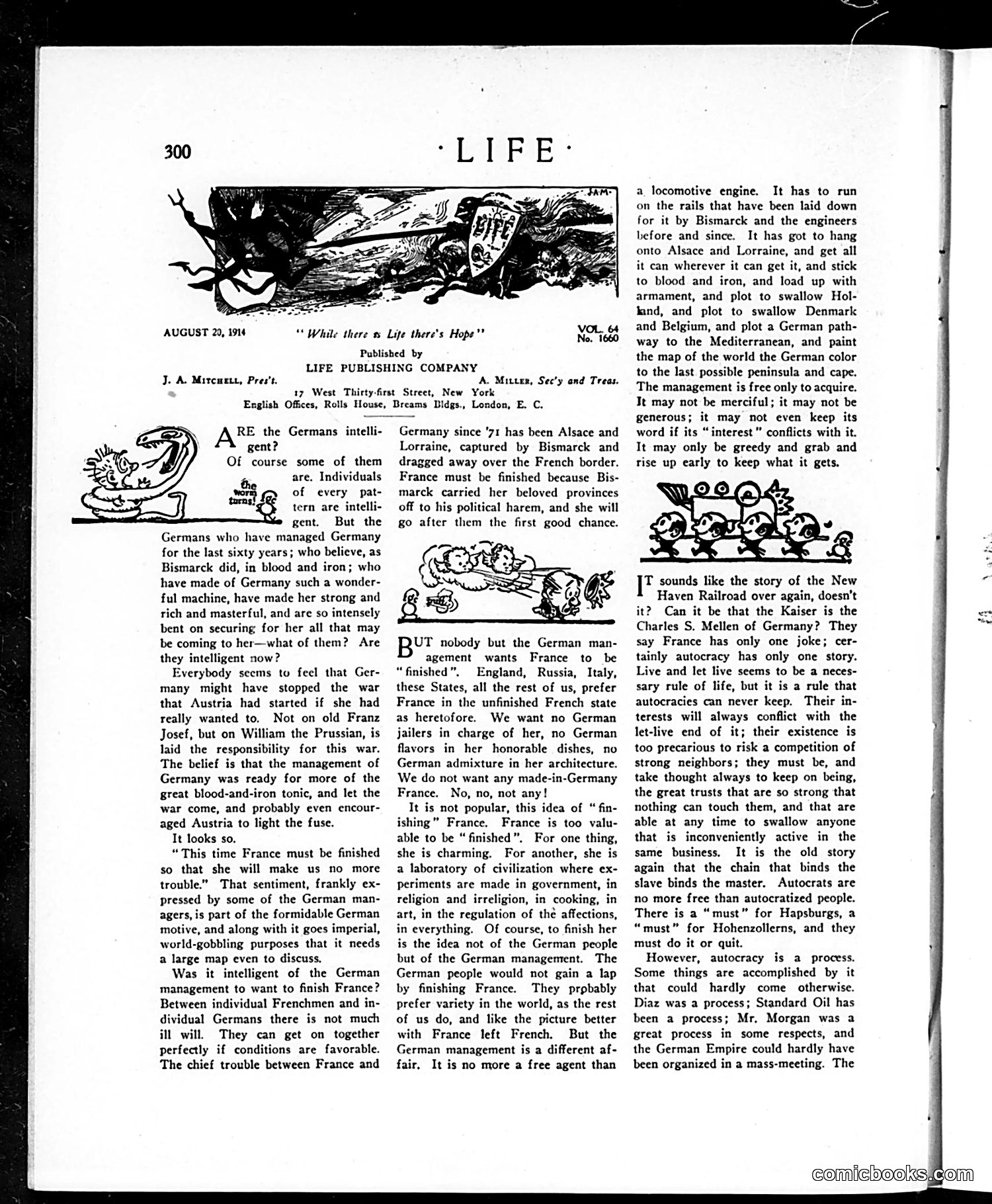
This editorial cartoons and essay appear during the opening weeks of World War I, addressing whether German leadership is "intelligent" for pursuing war against France. The piece argues that while individual Germans are reasonable, the German *management*—the ruling apparatus descended from Bismarck's "blood and iron" philosophy—operates mechanically, unable to deviate from an imperialist agenda. It must pursue France because Bismarck seized Alsace-Lorraine in 1871, and the system compels endless territorial acquisition. The author sardonically observes that ordinary Germans and French get along fine; the conflict stems from the German leadership's mechanical drive to "finish France." The essay distinguishes between the German people (who'd prefer a French neighbor) and the German management (enslaved to expansionist ideology like a locomotive on predetermined rails). The cartoon's crude imagery emphasizes this dehumanization of German leadership as an autonomous machine disconnected from human reason or mercy.
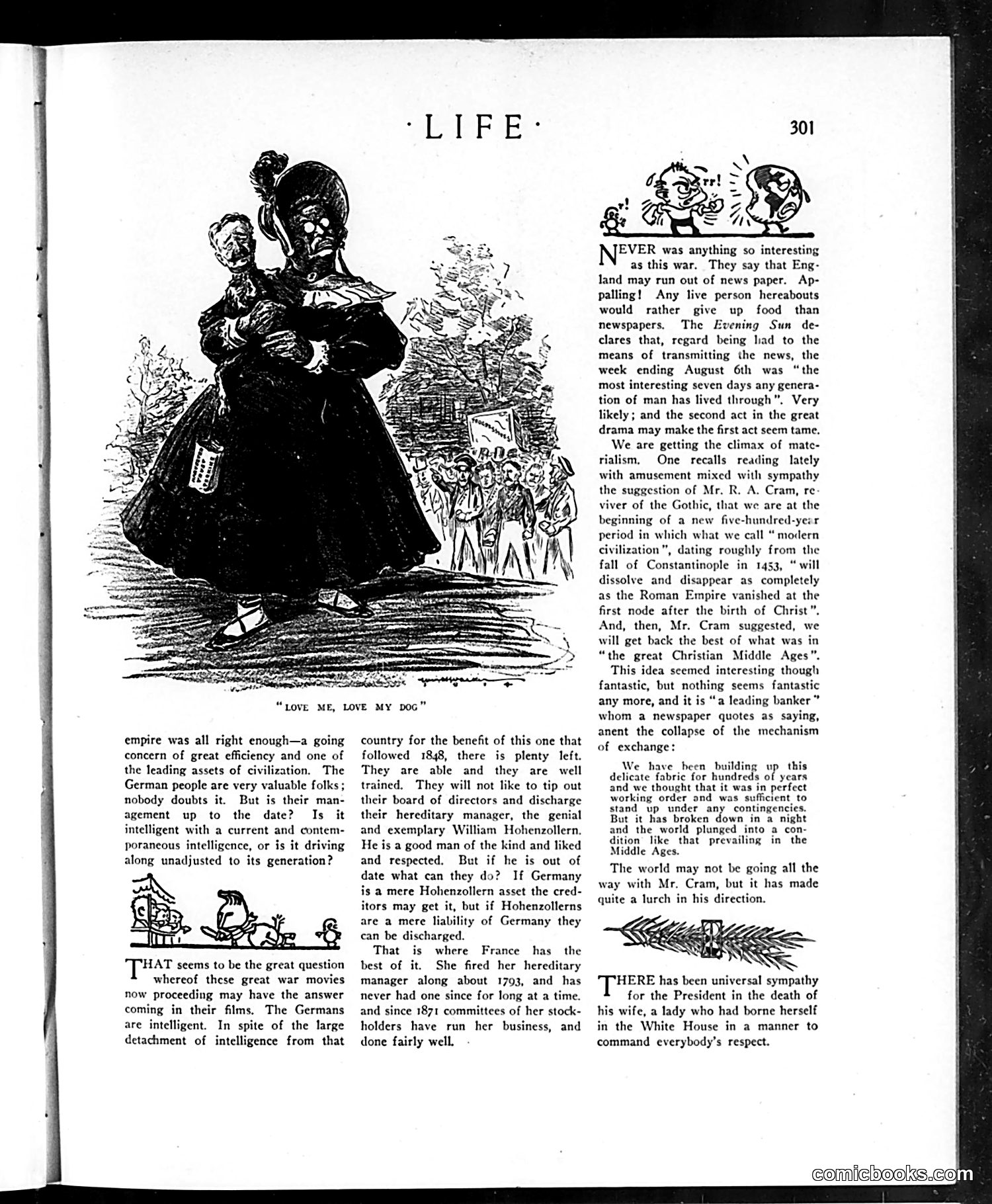
The cartoon depicts a woman (likely representing Germany or German authority) holding a small dog, surrounded by a cheering crowd. The title's phrase satirizes blind loyalty—suggesting people must accept whatever comes with their leader, even flaws. The accompanying text debates whether Germany's government under Kaiser Wilhelm II is "up to date." The author argues that while German people are intelligent and capable, their hereditary monarchy may be obsolete. He contrasts this with France, which eliminated its hereditary ruler in 1793 and has functioned well through democratic committees since 1871. This appears to be WWI-era commentary questioning whether Germany's imperial system is suited to modern times—a subtle argument that monarchy itself, not German character, may be the problem. The satire suggests that clinging to outdated leadership structures (the "dog" one must love) is foolish, especially during total war.
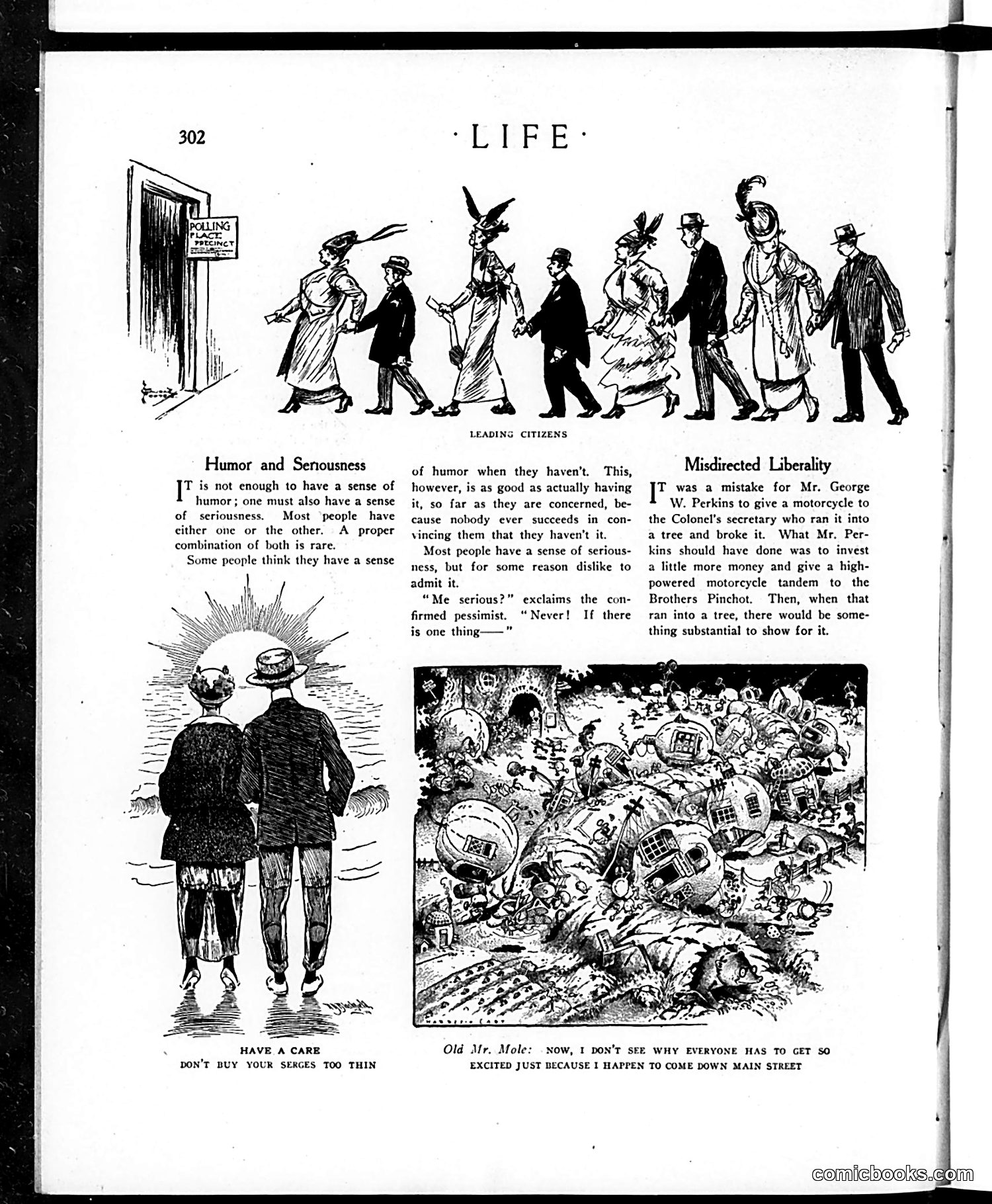
This page satirizes early 20th-century American society through multiple cartoons: **"Leading Citizens"** (top): Shows a parade of formally-dressed figures, likely mocking prominent public figures parading down a street. **"Misdirected Liberality"**: References a real incident involving George W. Perkins (a wealthy businessman/politician) giving a motorcycle to someone's secretary, which crashed. The cartoon sarcastically suggests Perkins should have instead given motorcycles to the Pinchot brothers—a pointed jab at wealthy philanthropists making wasteful charitable gestures. The Pinchots were prominent Progressive-era figures, making this likely political mockery. **"Have a Care"** (bottom left): Warns against buying thin serge fabric—practical consumer advice wrapped in satirical commentary about materialism. **"Old Mr. Mole"** (bottom right): Shows an elderly figure surrounded by motorcycles and debris, captioning his indifference to chaos caused by his presence downtown—likely mocking obliviousness of prominent citizens to disruption they cause. The page generally satirizes wealthy elites and their disconnection from ordinary life.
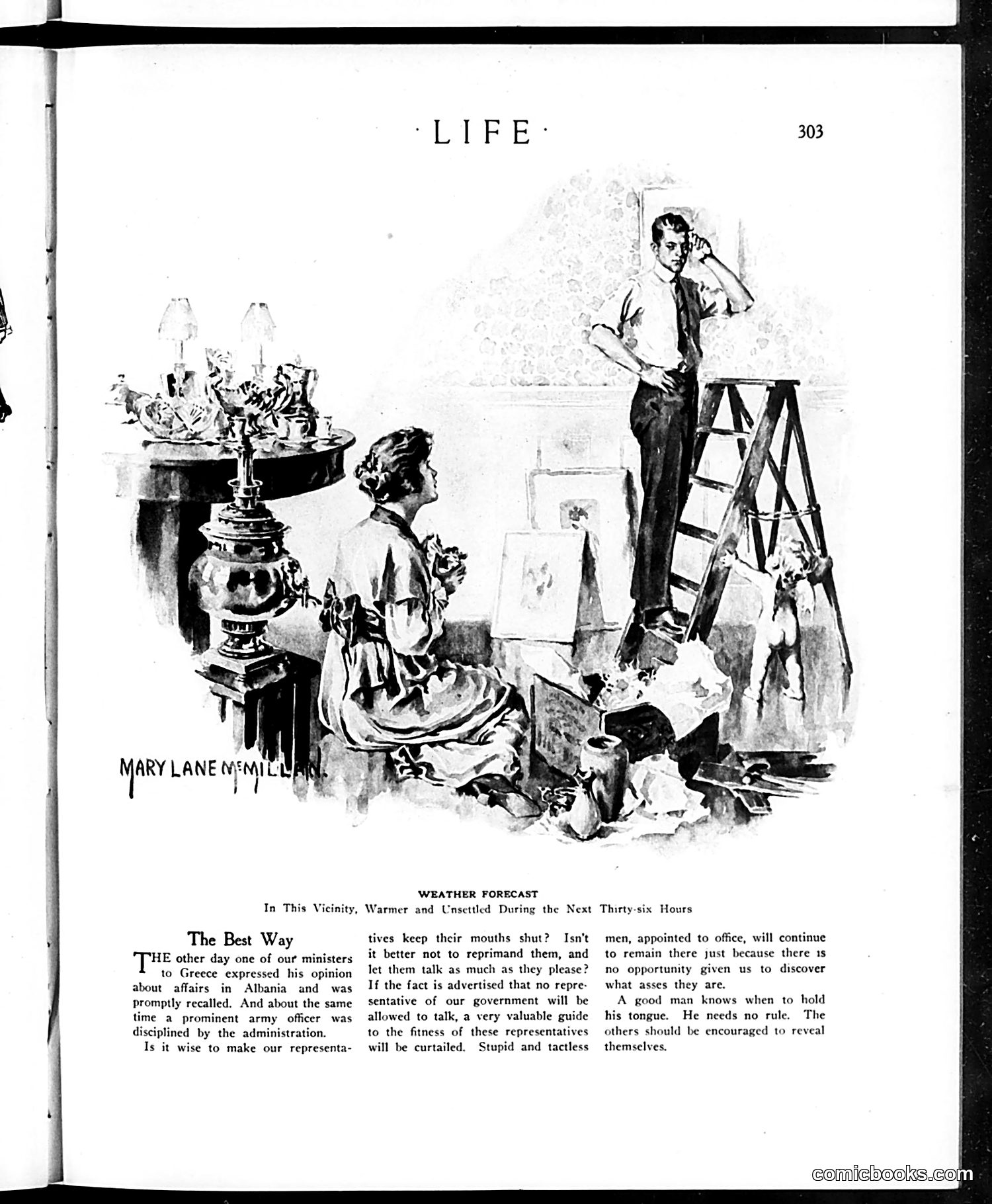
This satirical piece critiques government censorship of public officials. The article references two recent incidents: a U.S. minister to Greece was recalled after publicly commenting on Albanian affairs, and an army officer was disciplined by the administration for speaking out. The cartoon (illustrated by Mary Lane McMillan) depicts people decorating a home—likely symbolizing a government or institution being "prettified" while problems remain hidden underneath. The satire's argument: **suppressing officials' speech prevents the public from identifying incompetent appointees.** The author contends that competent leaders naturally know when to stay quiet, so encouraging speech actually reveals who is unfit for office. By muzzling representatives, the government prevents citizens from discovering which officials are "asses"—thus protecting mediocrity rather than maintaining order. This reflects Progressive Era concerns about government transparency and meritocracy versus patronage appointments.
This appears to be a photograph rather than a political cartoon or satirical illustration. The black-and-white image shows a woman in a bathing suit sitting on a beach, gazing toward rocky outcrops and the ocean. The sky features dramatic clouds. Without additional text or captions visible on this page, the specific satirical or political meaning is unclear. The "LIFE" magazine header suggests this is from the early-to-mid 20th century American publication, but the photograph itself appears to be a straightforward beach scene rather than political commentary. The OCR text "comicbooks.com" appears to be a watermark rather than page content. Context beyond what's visible here would be needed to explain any intended satire or social commentary.
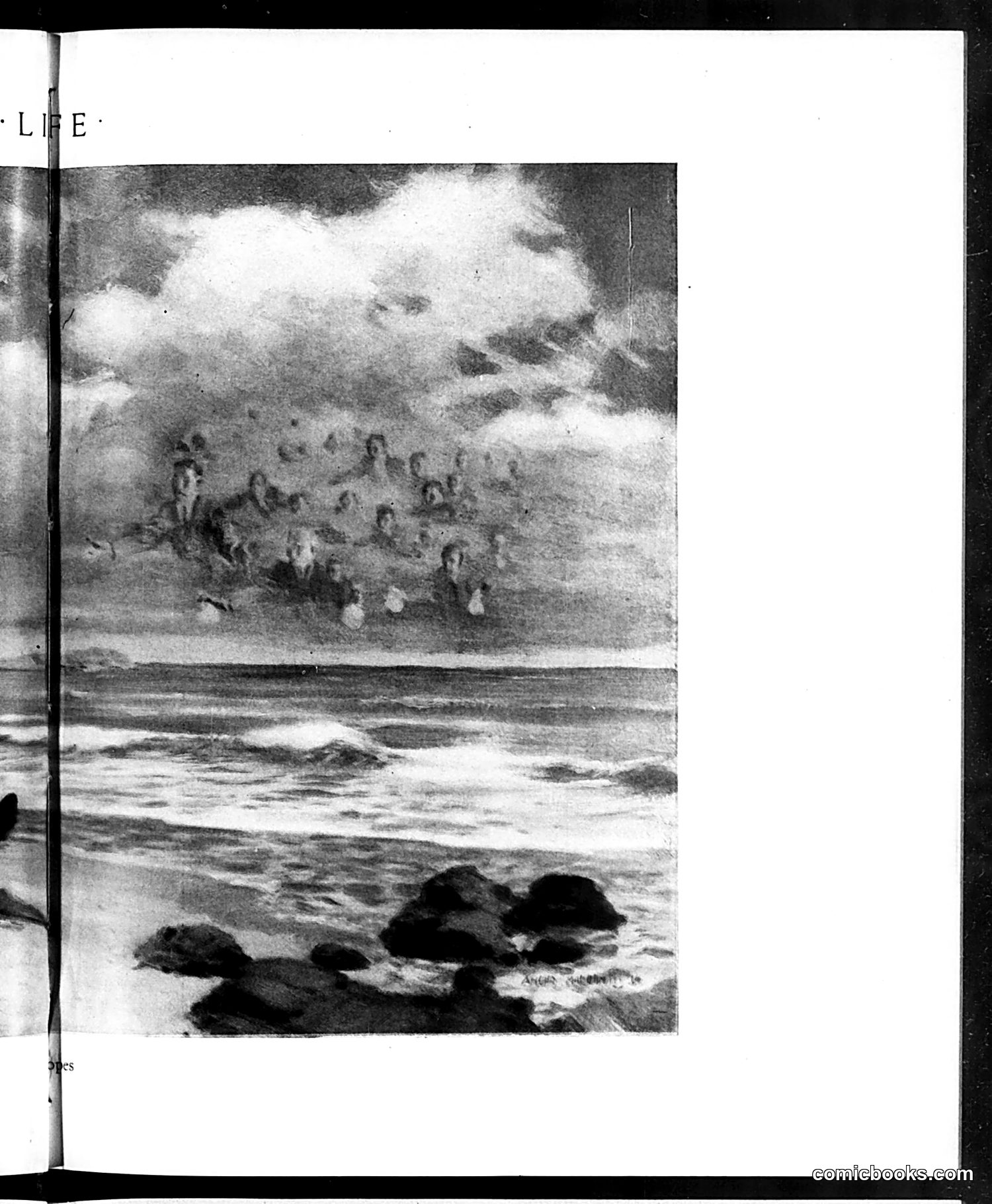
This page from *Life* magazine contains a black and white photograph rather than a cartoon. The image shows a dramatic seaside scene with dark rocks in the foreground, turbulent ocean waves, and a group of people visible on a beach or sandy area in the middle distance, beneath an overcast, cloudy sky. Without additional text or caption visible on this page, I cannot definitively identify the specific event, location, or satirical commentary this image is meant to convey. The photograph appears documentary in nature rather than overtly satirical. To understand its intended meaning and social/political commentary, the accompanying article text or caption would be necessary—which is not legible in this reproduction.
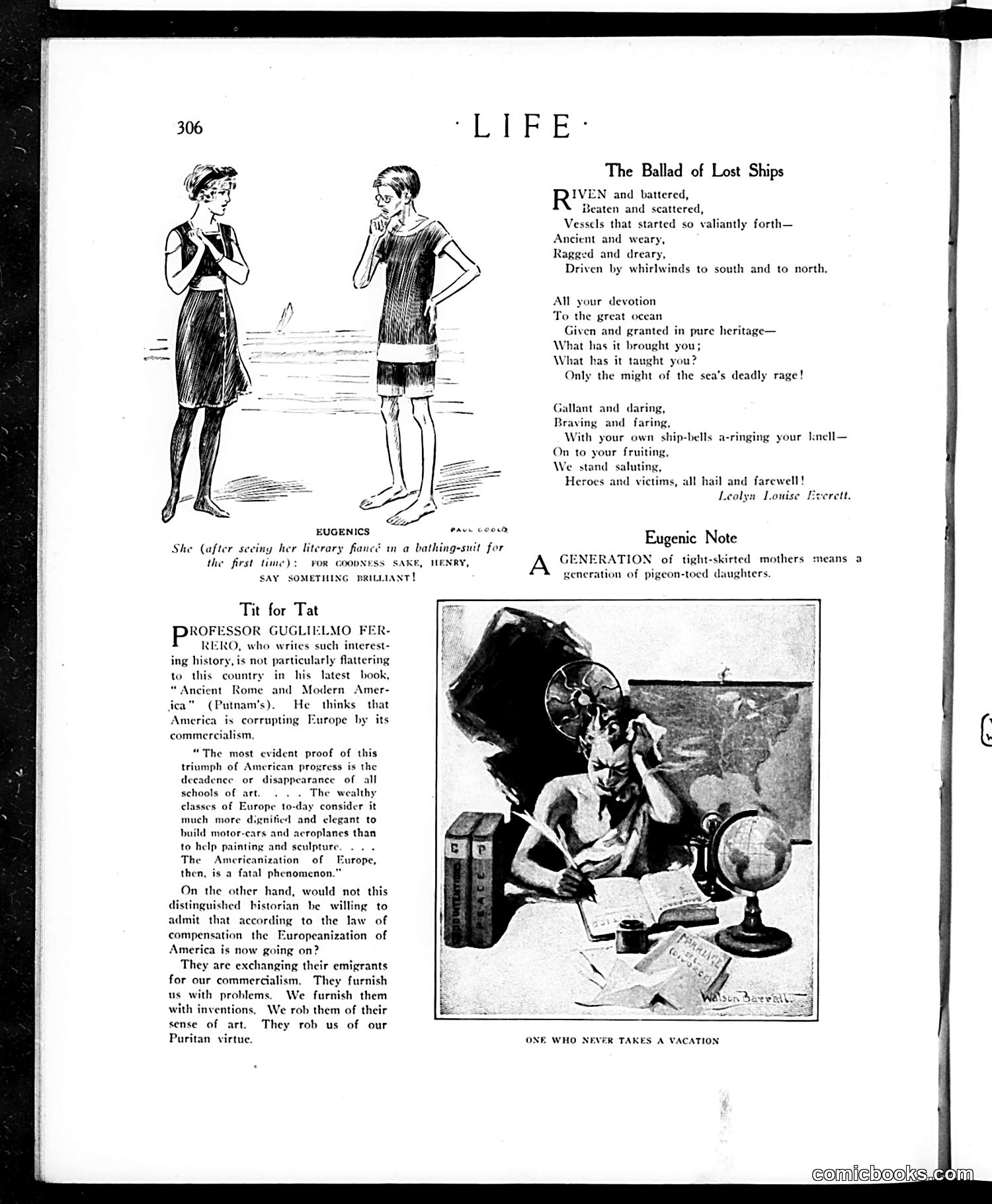
This page contains three distinct pieces of social commentary: **"The Ballad of Lost Ships"** is a romantic poem mourning doomed vessels and their brave crews—likely reflecting early-20th-century nostalgia for maritime adventure amid industrial modernity. **"Eugenics"** is a brief cartoon joke mocking the eugenics movement (then fashionable among intellectuals). A woman is disappointed seeing her literary fiancé in a bathing suit, prompting the caption's sarcastic suggestion that tight-skirted mothers produce "pigeon-toed daughters"—satirizing how eugenic thinking reduced human worth to physical appearance. **"Tit for Tat"** critiques Italian historian Guglielmo Ferrero's recent book blaming American commercialism for corrupting European art and culture. Life's author turns the argument around: if America corrupts Europe with commerce, Europe corrupts America by exporting emigrants and robbing Americans of "Puritan virtue"—a pointed jab at immigrant communities while defending American values. All three pieces reflect early-1900s American anxieties about cultural decline and foreign influence.
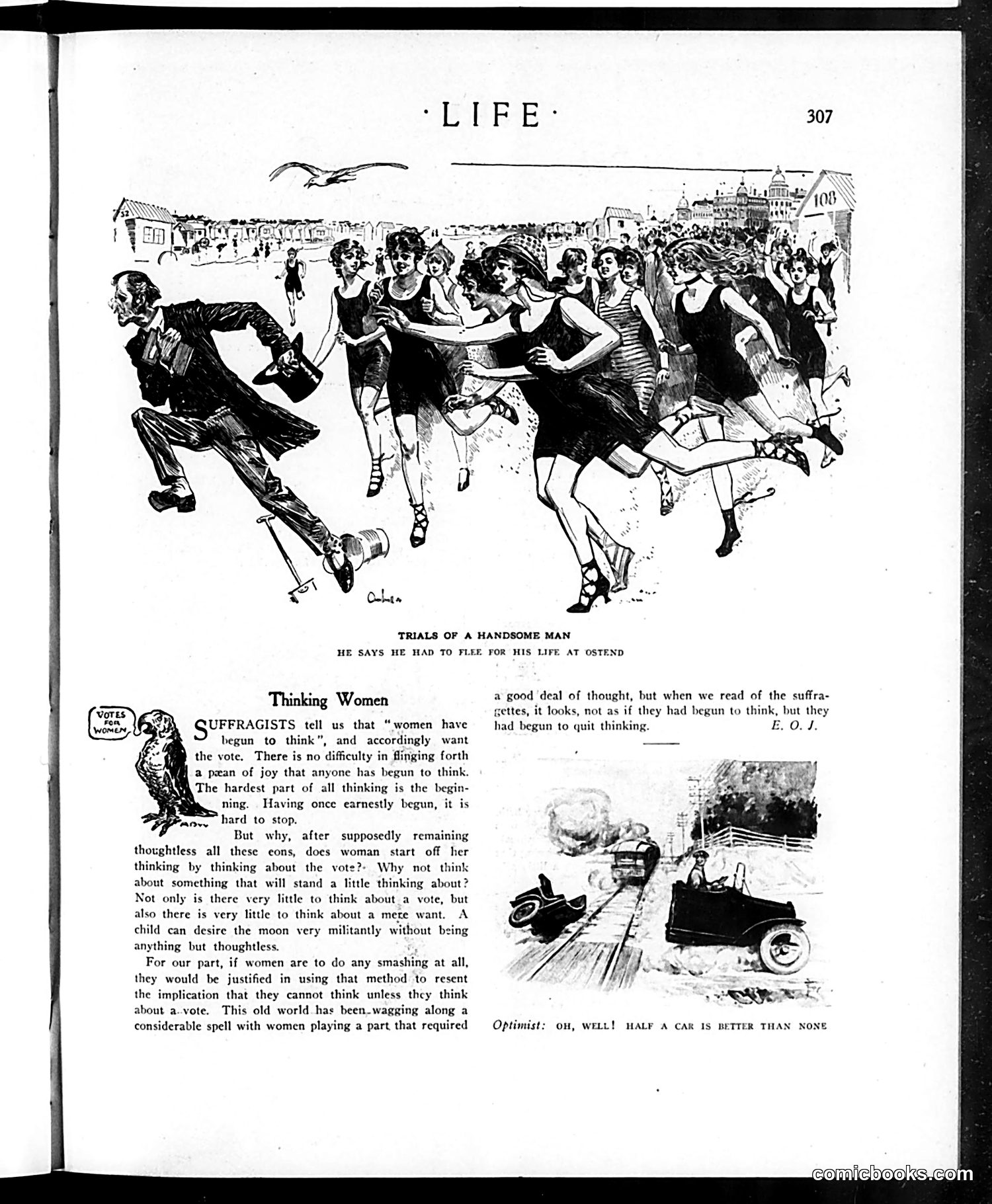
This page contains satirical commentary on the women's suffrage movement circa the early 1900s. The article "Thinking Women" mocks suffragettes—women advocating for voting rights—by claiming they haven't actually "begun to think" but rather "quit thinking." The author argues that if women were truly thoughtful, they wouldn't focus on the vote as their first intellectual priority, and that desiring political representation requires no genuine thought, just desire. The top illustration depicts a "handsome man" fleeing women at Ostend (a Belgian beach resort), suggesting anxiety about aggressive or pursuing women—likely a dig at suffragettes as emasculating or predatory. The bottom cartoon shows a car accident, with the caption "Half a car is better than none"—likely satirizing optimism or compromise, possibly referencing debates over partial women's rights versus full suffrage. The overall tone is dismissive toward women's political activism, framing it as thoughtless mob behavior rather than legitimate political engagement.
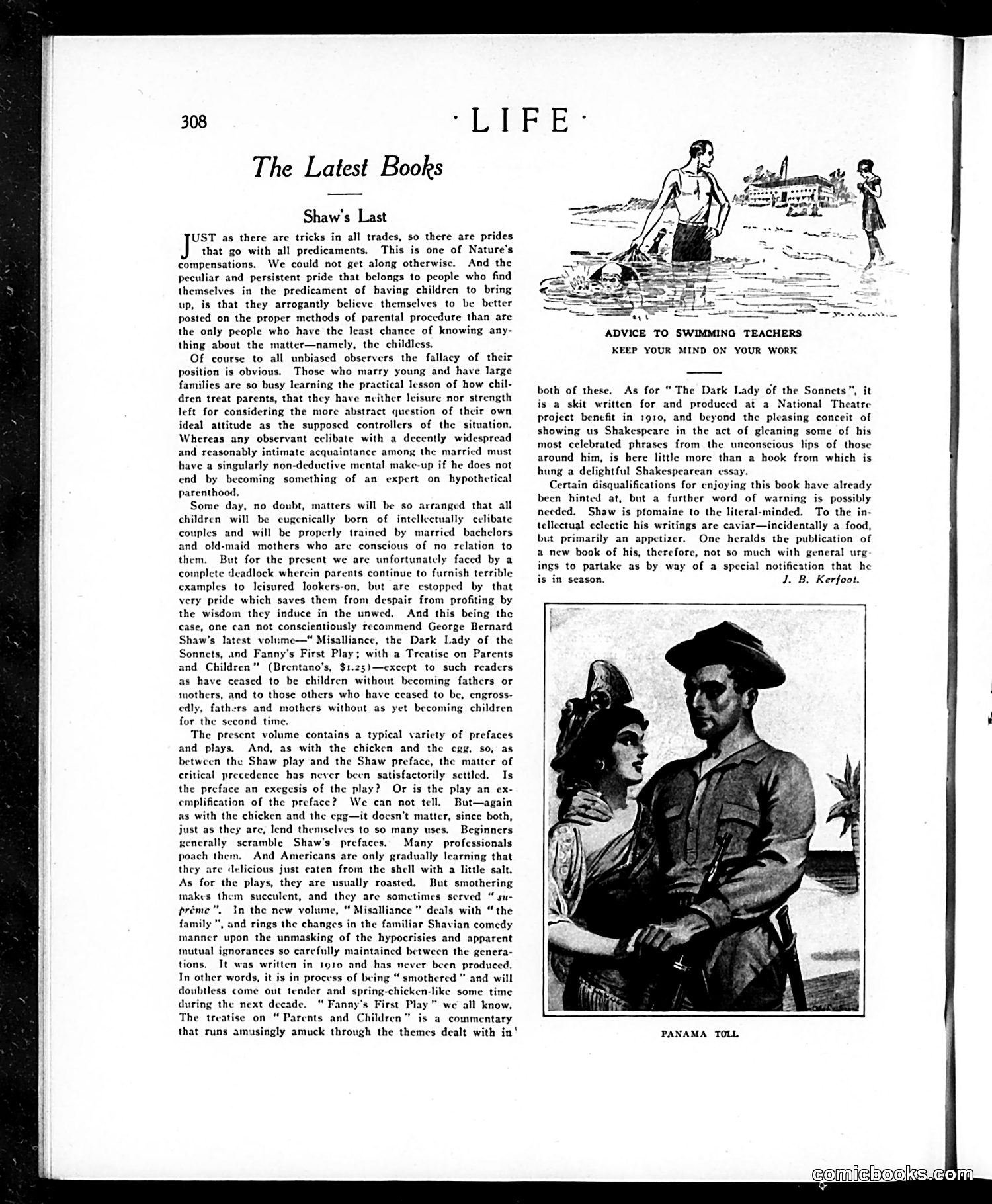
This page reviews George Bernard Shaw's latest book collection. The lengthy essay critiques parental authority humorously, arguing that childless people actually understand child-rearing better than parents themselves—a paradox the author extends through extended metaphors about cooking (scrambling, poaching, roasting prefaces and plays). The review discusses three Shaw works: *Misalliance* (about family hypocrisy), *The Dark Lady of the Sonnets*, and *Fanny's First Play*, plus a treatise on parents and children. The author uses culinary language throughout to describe how different audiences consume Shaw's writings. Two illustrations accompany the text: "Advice to Swimming Teachers" (top) and "Panama Toll" (bottom, showing a caricatured figure). The "Panama Toll" image likely references the Panama Canal, completed in 1914, though the specific satirical point remains unclear from the page alone. The piece exemplifies *Life* magazine's characteristic intellectual satire targeting educated readers familiar with Shaw's work and philosophical debates about parenting.
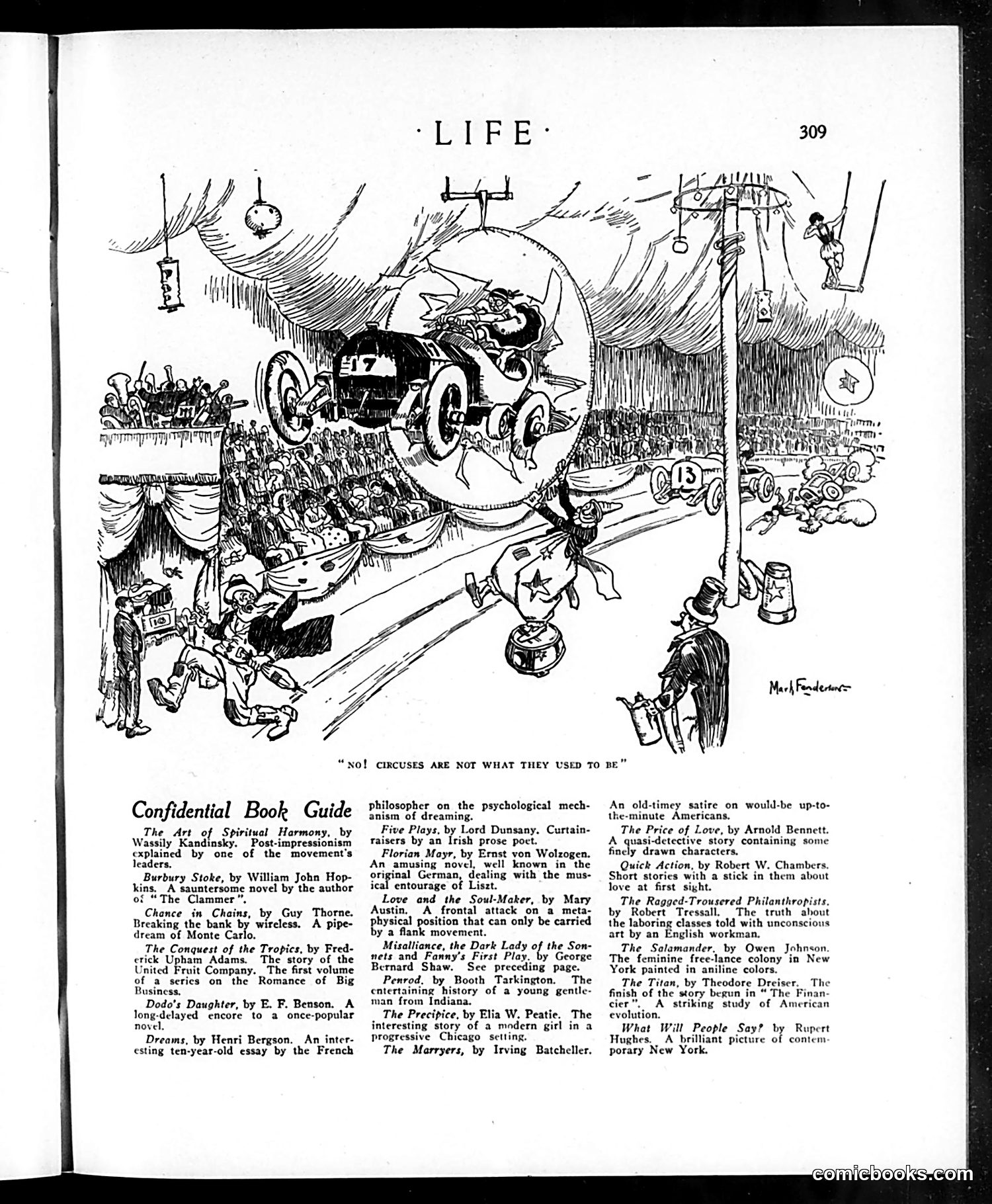
This page features a satirical cartoon captioned "So! Circuses Are Not What They Used to Be." The drawing depicts a modernized circus where a racing car (numbered 17) performs stunts inside a ring, replacing traditional acrobats and animals. Spectators watch from bleachers while performers operate mechanical equipment overhead—suggesting technology has overtaken traditional circus entertainment. The satire targets early 20th-century American society's obsession with speed, automobiles, and technological "progress" at the expense of older cultural forms. It mocks how even entertainment has become mechanized and industrialized. The page's lower half is a "Confidential Book Guide"—a literary recommendation column reviewing contemporary novels and plays, mostly by established authors like George Bernard Shaw and Theodore Dreiser. This was typical Life magazine content: mixing visual satire with cultural commentary for educated readers.
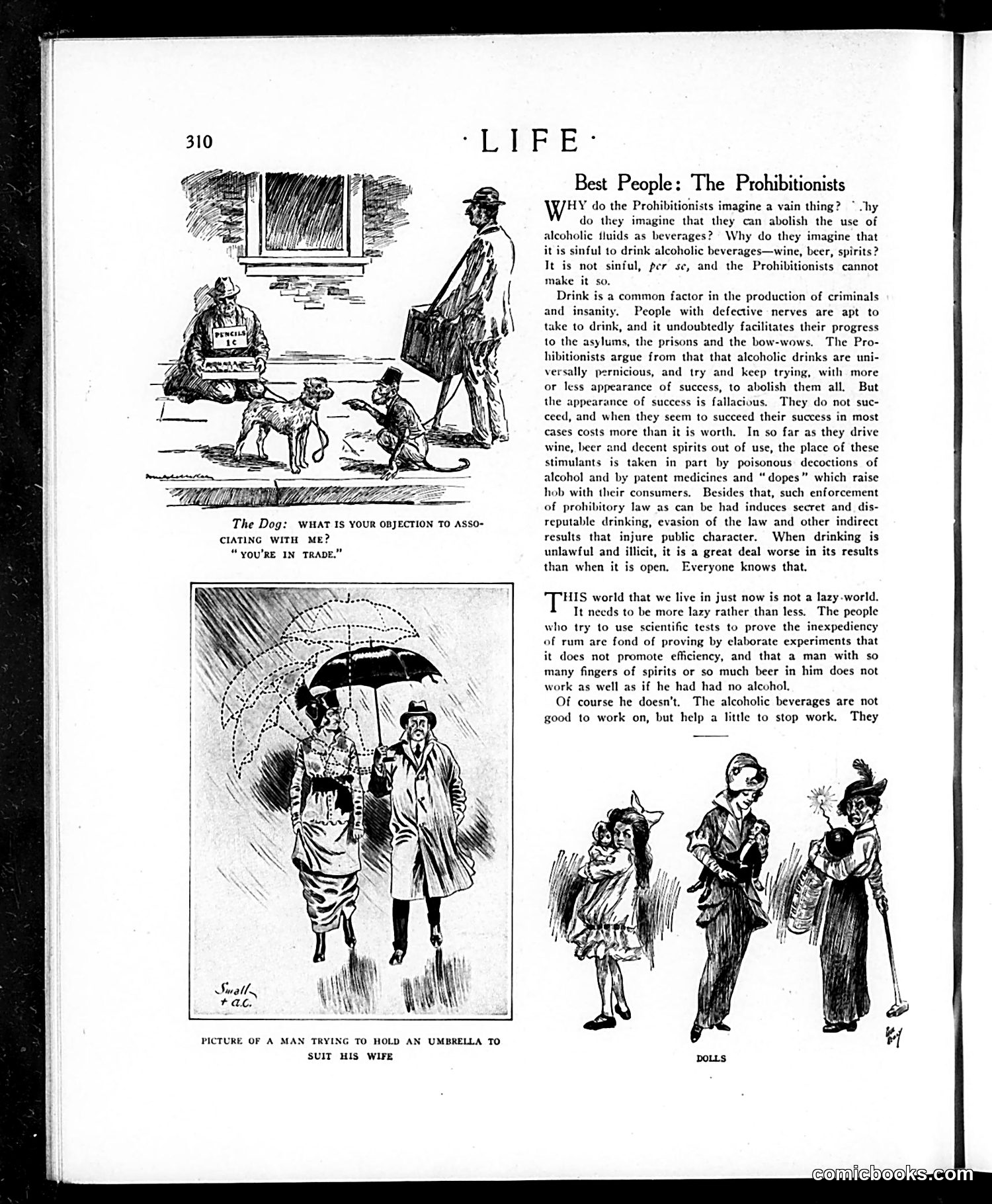
This page attacks Prohibition advocates through multiple cartoons and editorial commentary. The main essay argues that Prohibitionists wrongly claim alcohol is inherently sinful and that banning it will reduce crime and insanity. Life's counterargument: drinking itself isn't immoral, but rather a symptom of existing problems. The piece contends that Prohibition enforcement fails—it merely drives drinkers to dangerous patent medicines and "dopes," encourages lawbreaking, and produces worse outcomes than open drinking. The accompanying cartoons mock social hypocrisy: one shows a dog excluded from "respectable" company for being "in trade" (commerce), satirizing class pretension. Another depicts a man holding an umbrella awkwardly for his wife, suggesting marital discord. The "Dolls" illustration appears to mock shallow socializing. The satire's core: Prohibitionists are deluded moralists whose well-intentioned ban creates more harm than the behavior they oppose.
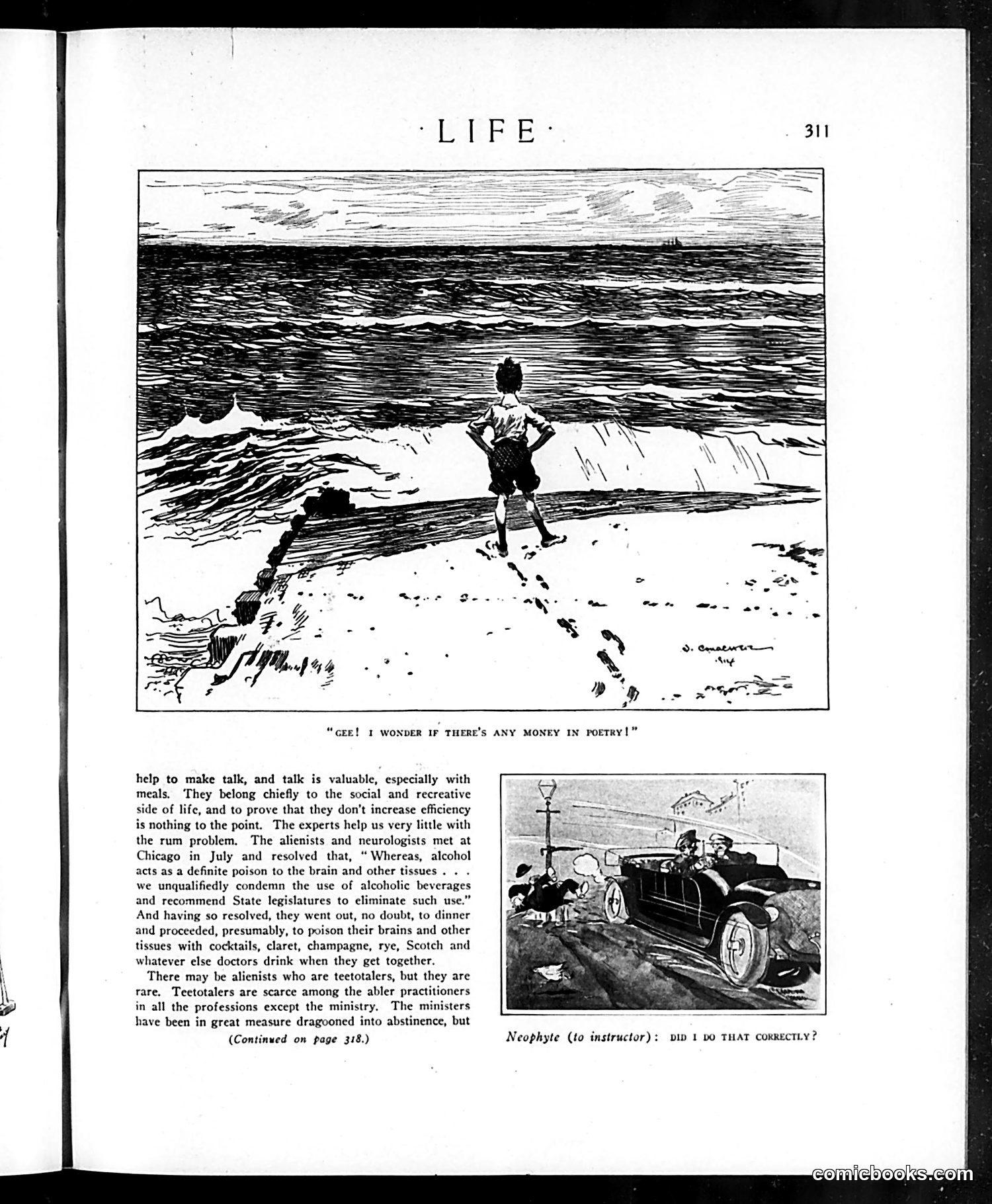
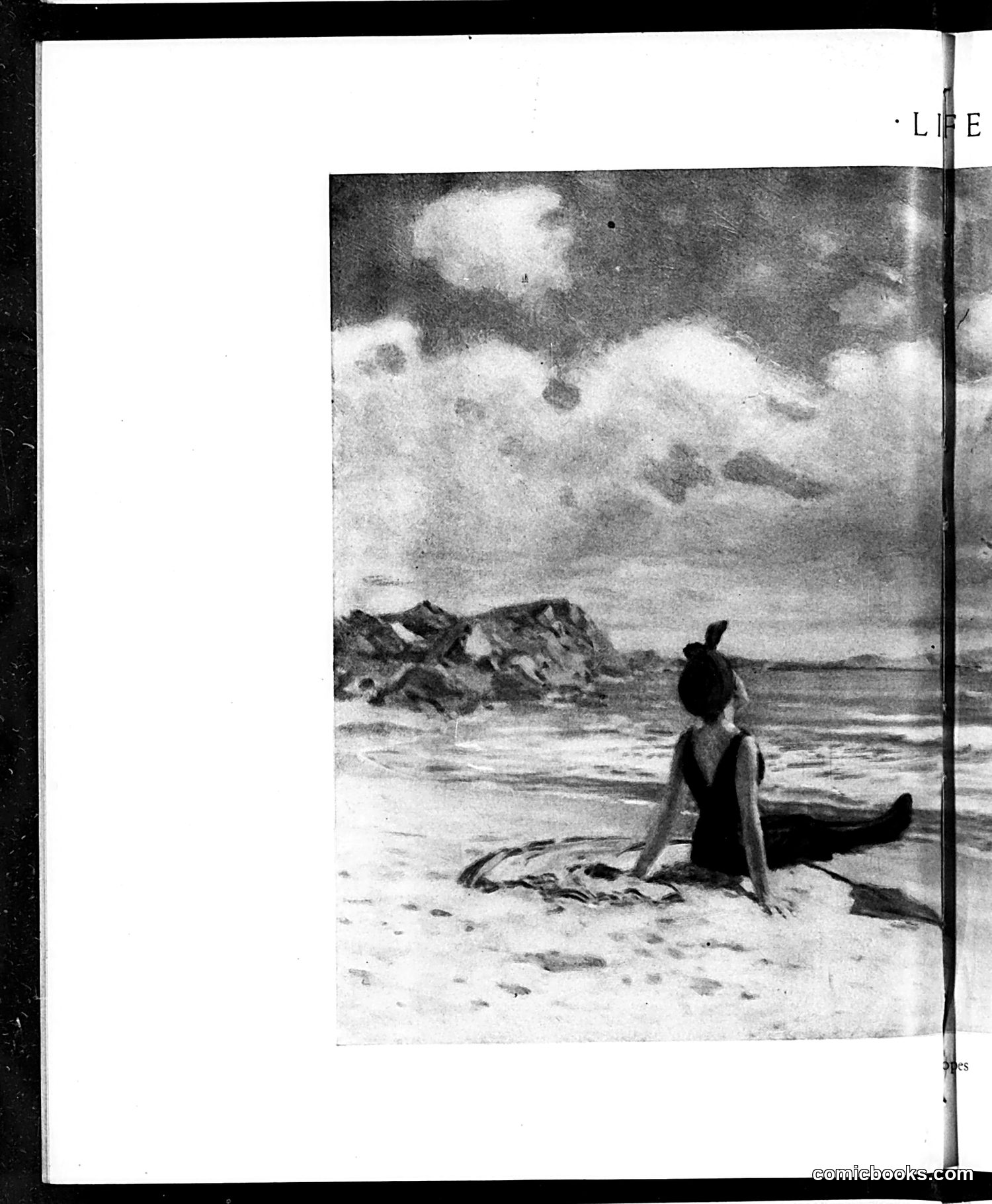
The top cartoon satirizes youthful idealism about poetry's financial prospects. A young person stands on a beach, gazing at the ocean, wondering aloud if poetry can make money—a naive question the image suggests is answered by the barren, solitary setting. The lower section contains satirical editorial commentary about the hypocrisy of medical professionals. Doctors and psychiatrists at a Chicago conference formally condemned alcohol as a brain poison and urged legislative bans on alcoholic beverages. The satire's point: these same professionals then proceeded to dinner where they drank cocktails, champagne, scotch, and other spirits—directly contradicting their official resolution. The text notes that teetotalers are rare among accomplished professionals, except clergy who have been "dragooned into abstinence" through social pressure. The satire exposes the gap between professional proclamations and actual behavior. The lower photograph showing a "neophyte" and instructor appears to illustrate something separately; its connection to the text is unclear.
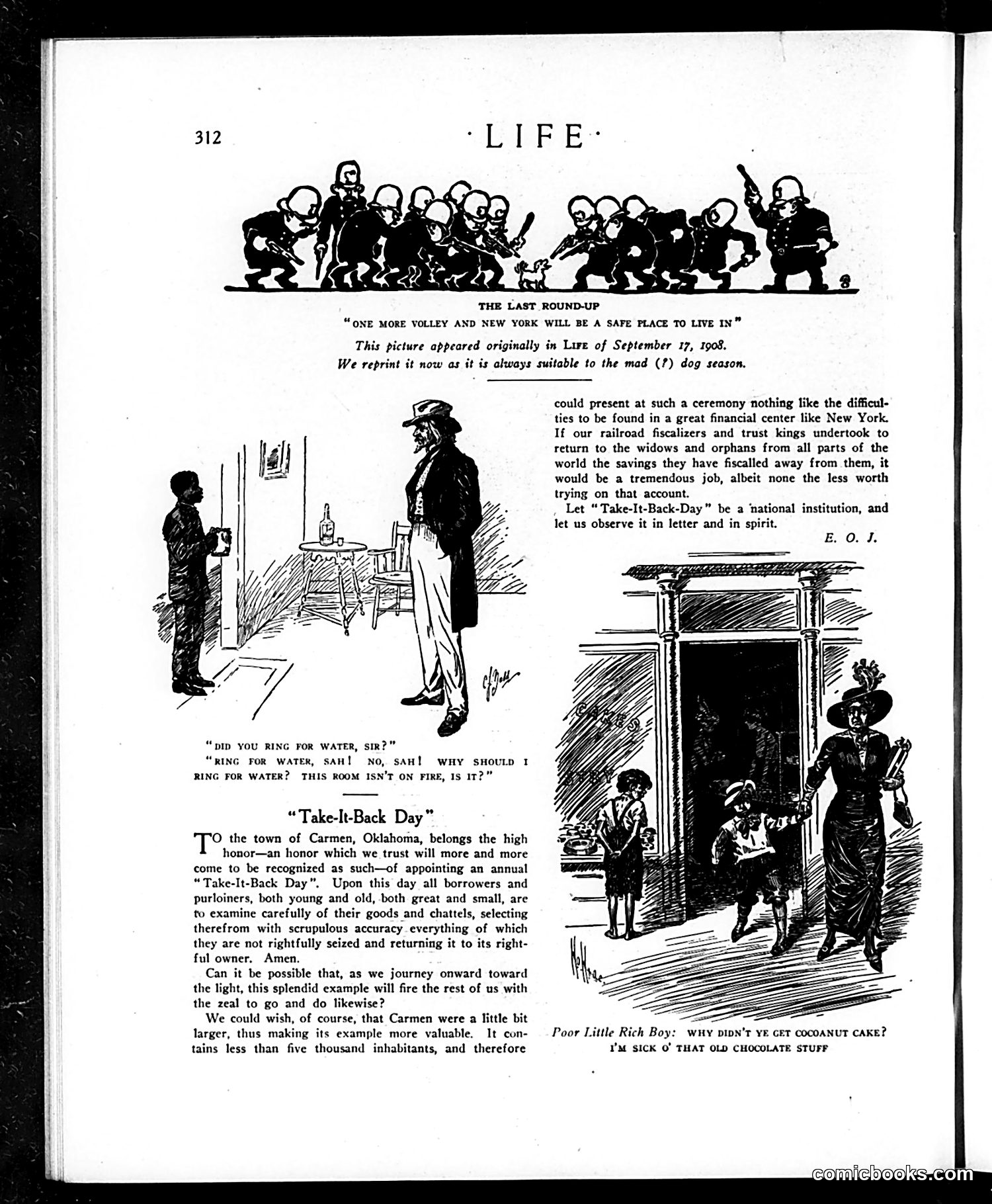
This 1908 *Life* magazine page contains satirical commentary on several social issues: **"The Last Round-Up"** (top cartoon): A darkly humorous image about rabid dogs in New York City, showing armed figures shooting at dogs. The caption suggests eliminating "mad dogs" would make NYC "a safe place to live"—likely satirizing urban crime or violence problems. **Water/Fire Joke**: A servant comedy sketch mocking the absurdity of class dynamics—the master dismisses ringing for water because the room isn't on fire, suggesting servants' labor is undervalued. **"Take-It-Back Day"**: The main article satirizes Carmen, Oklahoma's initiative for citizens to return borrowed items. The piece uses this small town's honesty to mock corporate corruption, specifically targeting "railroad fiscalizers and trust kings" who exploit widows and orphans. It advocates making "Take-It-Back Day" national, sarcastically suggesting wealthy industrialists should return stolen savings to the poor. **Rich Boy Cartoon**: Final joke mocking wealthy children's entitlement—complaining about chocolate cake as too ordinary. Overall, the page critiques wealth inequality, corporate fraud, and class pretension through humor.
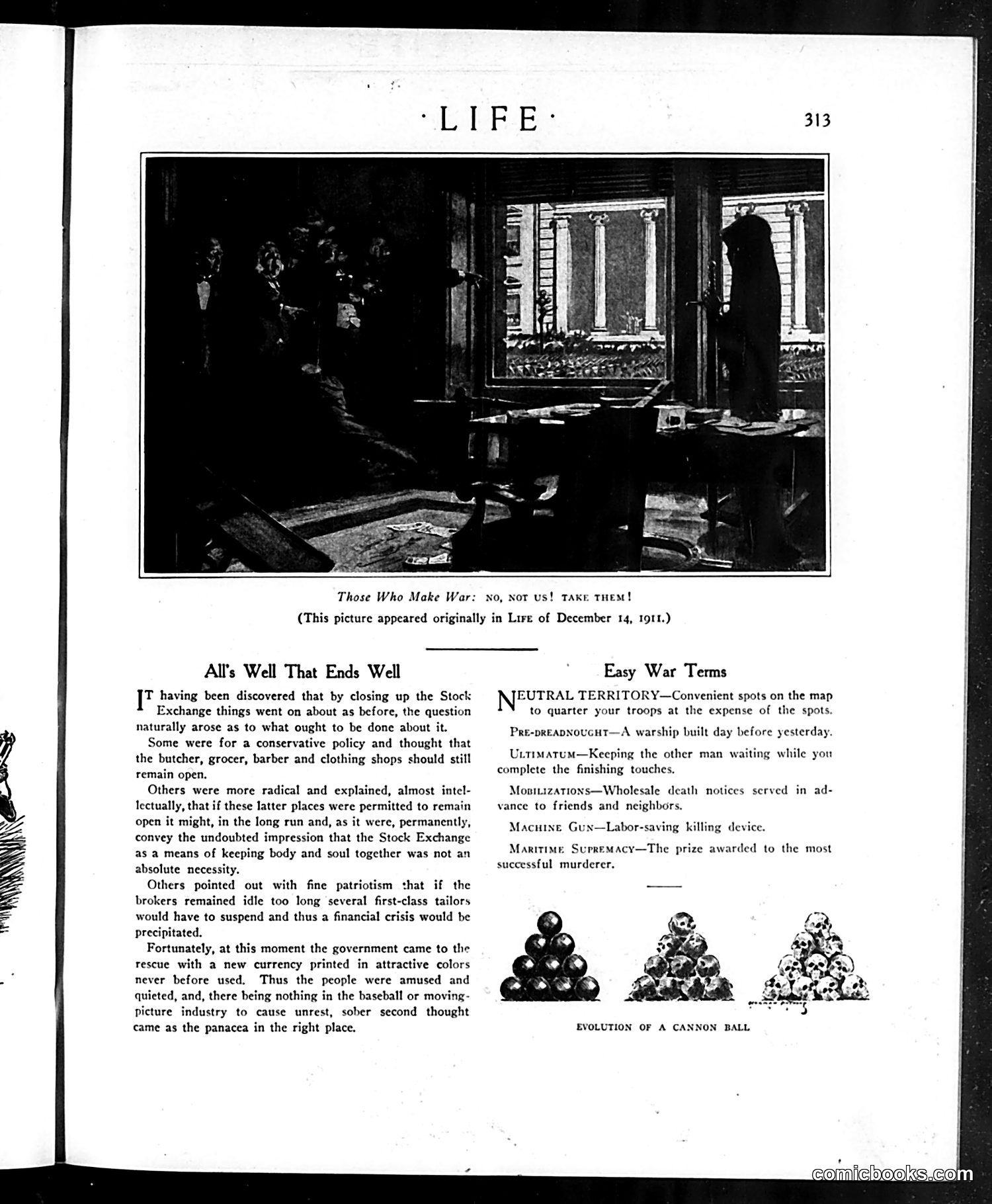
This 1911 *Life* magazine page satirizes economic and military absurdities of the era. **"All's Well That Ends Well"** mocks the stock market's irrelevance: closing the Exchange during a financial crisis proved society functioned fine without it, yet the government "solved" the panic by printing colorful new currency—a distraction rather than genuine reform. The satire suggests the financial system and government responses are theatrical nonsense. **"Easy War Terms"** is a glossary of cynical military euphemisms—"Neutral Territory" means occupying others' land, "Machine Gun" is labor-saving killing, and "Maritime Supremacy" goes to the "most successful murderer." This mocks the genteel language used to describe warfare's brutal reality. **"Evolution of a Cannon Ball"** shows three identical stacked spheres, implying no real "evolution" in weaponry—just repetition dressed up as progress. The opening photograph (from December 1911) depicts anxious figures during what appears to be a financial or political crisis, captioned "Those Who Make War: no, not us! Take them!"—suggesting elites avoid consequences of their decisions.
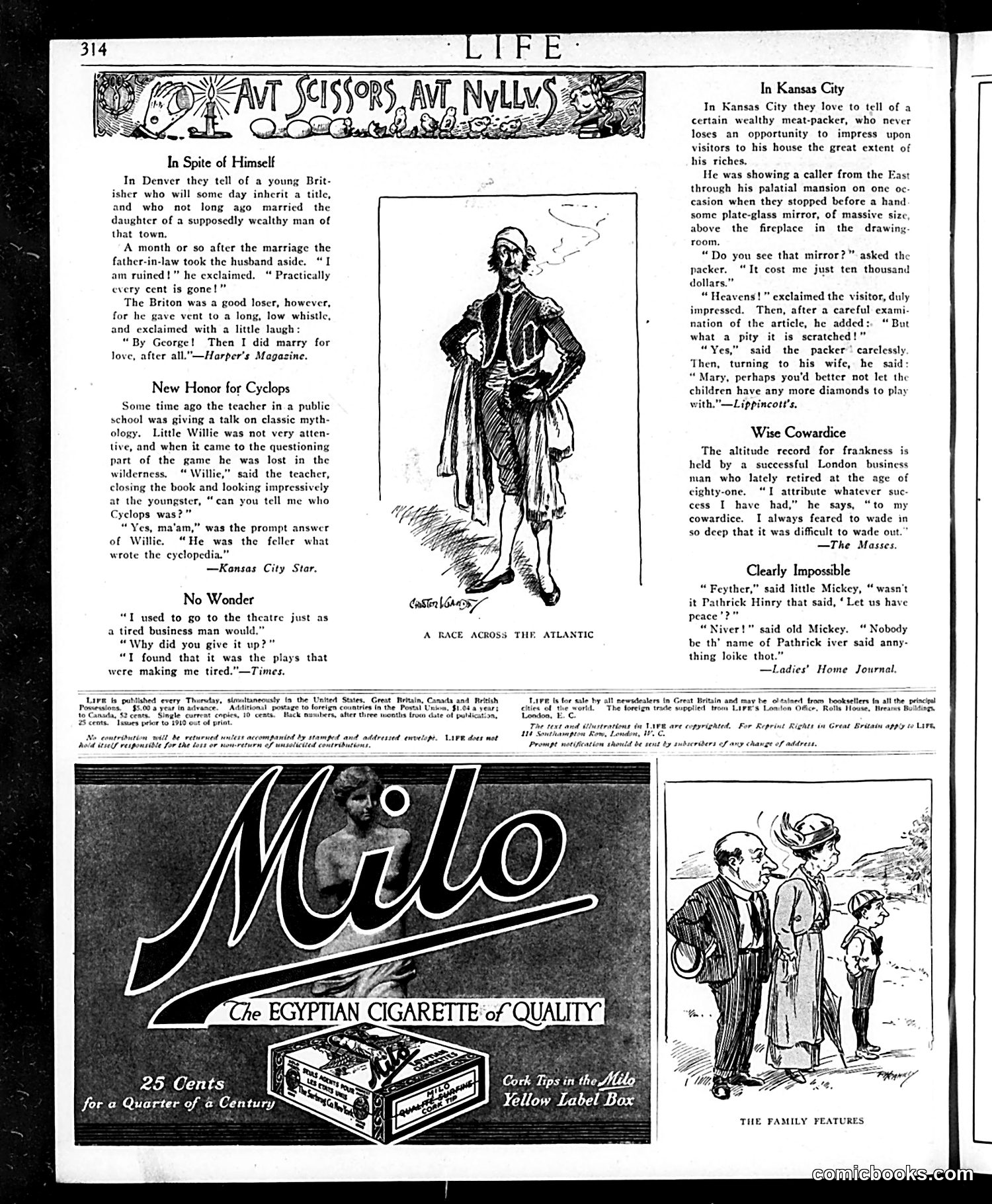
This page contains four brief humorous anecdotes typical of *Life* magazine's satirical humor circa early 1900s: 1. **"In Spite of Himself"**: A British aristocrat marries what he assumes is a wealthy heiress, only to discover her father is bankrupt. He jokes he "married for love after all"—satire on the upper class's mercenary marriage practices. 2. **"New Honor for Cyclops"**: A schoolboy confuses the mythological Cyclops with "cyclopedia" (encyclopedia). Simple wordplay humor about childhood misunderstandings. 3. **"No Wonder"**: A tired businessman stopped attending theater because the plays themselves tired him—gentle mockery of theater quality. 4. **"In Kansas City"**: A wealthy meat-packer boasts about an expensive mirror to impress visitors; when a guest notes it's scratched, he dismissively tells his wife not to let children play with diamonds. Satire on nouveau-riche ostentation and the absurdity of treating luxury items carelessly. The page also contains a Milo cigarette advertisement and a small cartoon titled "The Family Features" (largely illegible in this image).
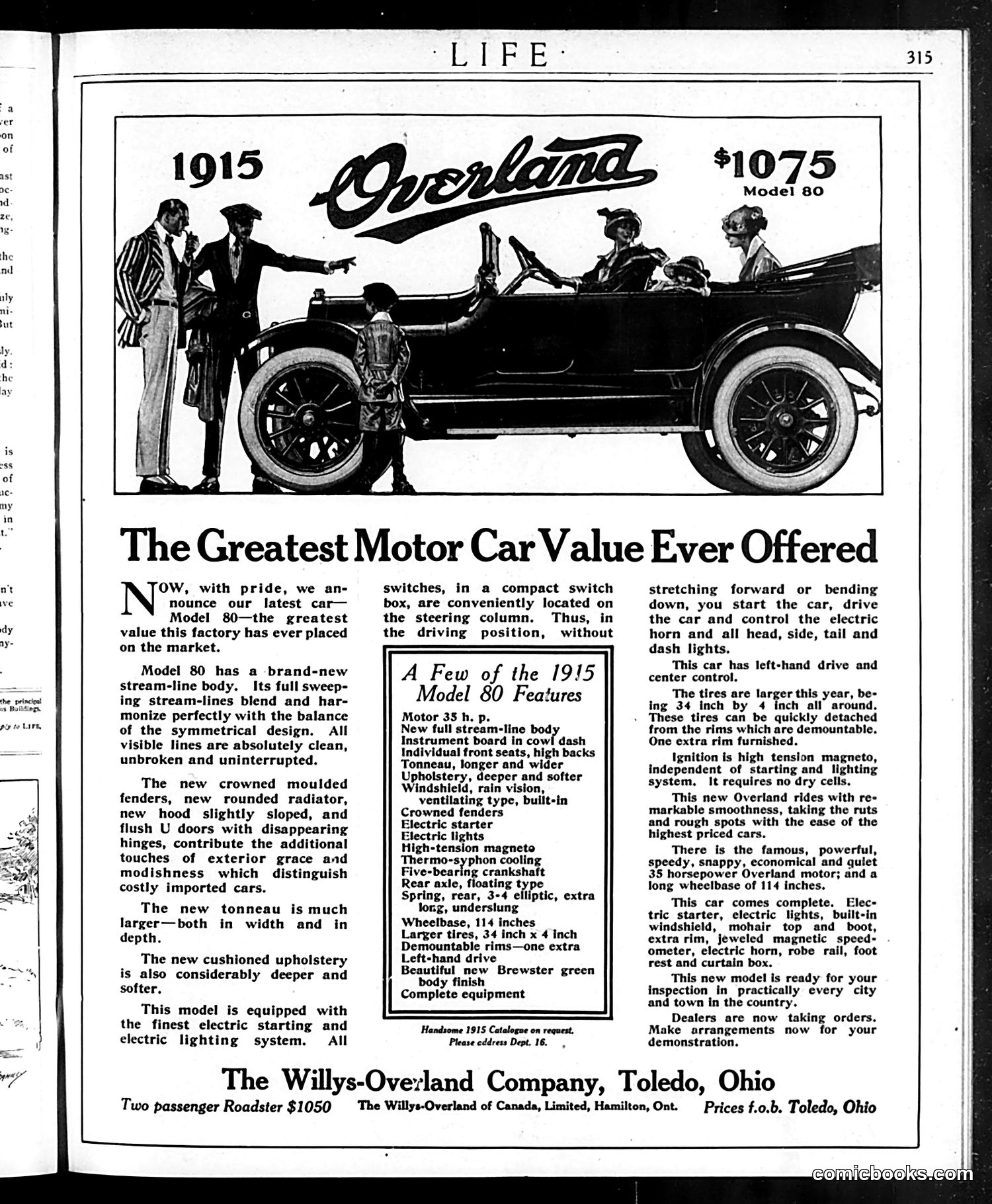
This page is purely a **product advertisement**, not satire or political commentary. It promotes the Willys-Overland Company's Model 80 automobile, priced at $1,075. The image shows well-dressed men and women admiring a sleek open-air automobile, representing the aspirational lifestyle the car promised to buyers. The ad emphasizes luxury features new for 1915: electric starting and lighting, a streamlined body, improved upholstery, left-hand drive, and a powerful 35-horsepower engine with a 114-inch wheelbase. For modern readers: this represents early automotive marketing targeting middle-to-upper-class buyers. Features now standard—electric ignition, power windows—were then premium selling points. The illustrated figures reflect 1910s fashion and social class markers. The ad's breathless tone about "greatest value ever offered" uses hyperbole typical of period advertising.
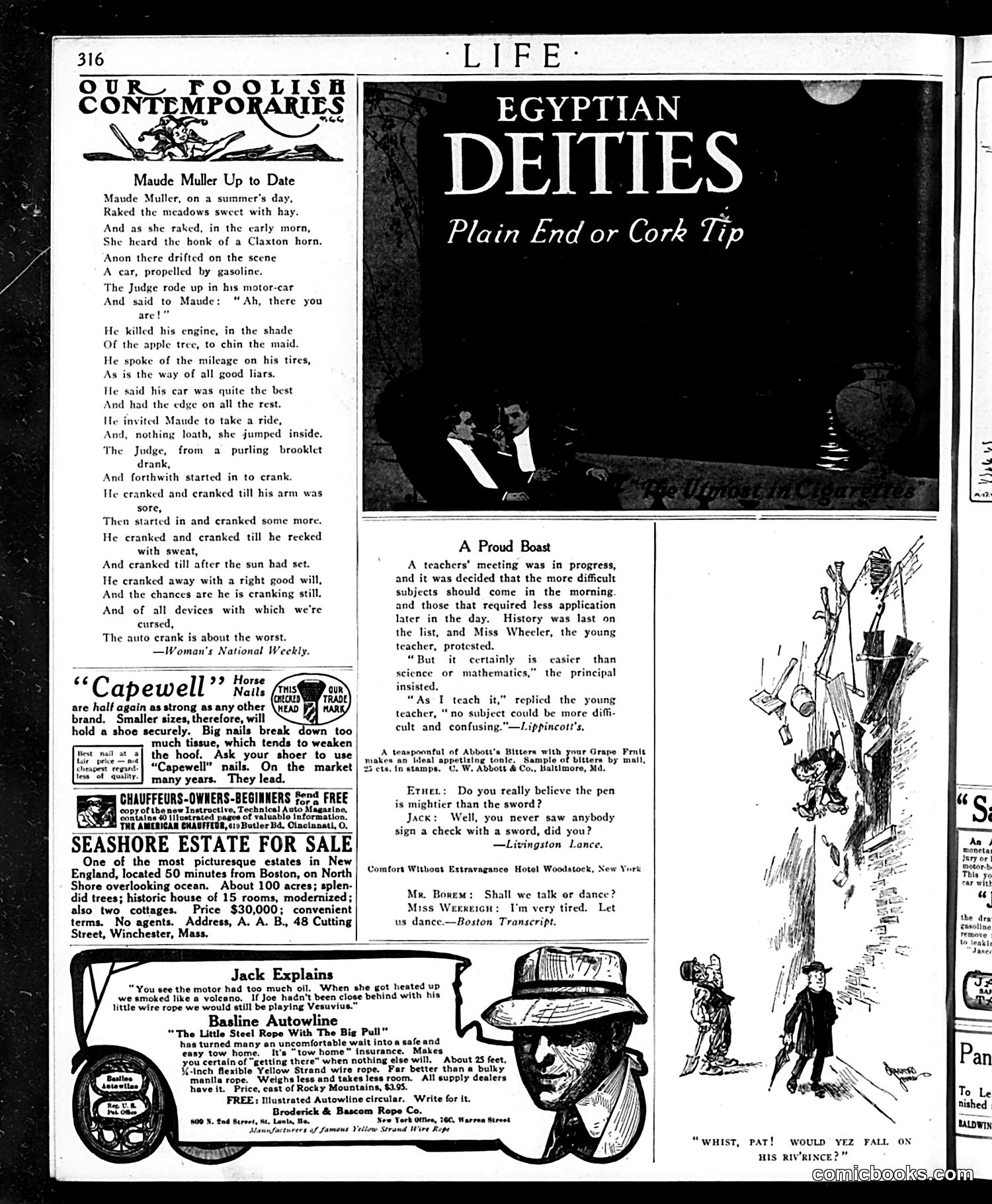
This poem parodies the 19th-century sentimental poem "Maud Muller" by updating it for the automobile age. The original told of a judge and country girl's chance meeting; this version satirizes the early motor car's unreliability. The humor centers on the automobile's mechanical failure: a supposedly superior judge arrives in a gasoline-powered car and brags about its performance and mileage—typical boasting by early car owners. He invites the maiden for a ride, but then spends the entire evening attempting to hand-crank the engine to start it, cranking "till after the sun had set," with "chances are he is cranking still." The satire mocks both the car's notorious difficulty to start and the pretentious bragging of early motorists. The woman's story ends worse than the original poem—no romantic outcome, just tedious mechanical frustration. The poem concludes that "the auto crank is about the worst" of modern devices, a relatable complaint for readers struggling with temperamental early automobiles requiring manual cranking to start.
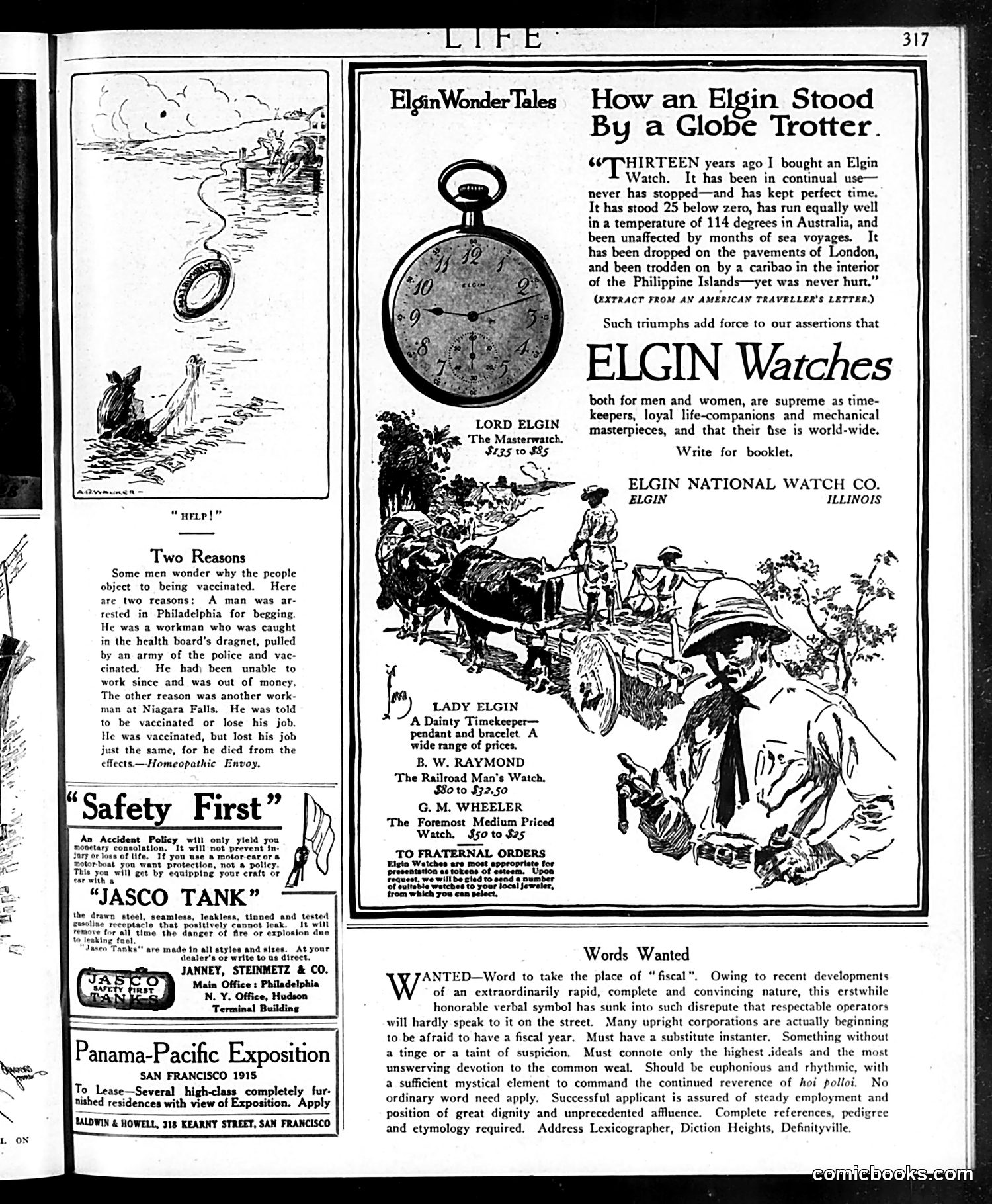
This page contains two distinct pieces of content: **Left side ("Two Reasons"):** A brief satirical critique of mandatory vaccination policies. The cartoon illustrates two cautionary tales: a Philadelphia man arrested for begging after losing work due to vaccination requirements, and a Niagara Falls worker who died from vaccination side effects. The piece mocks forced public health measures by highlighting unintended consequences—job loss and death—suggesting the cure was worse than the disease. This reflects early 20th-century skepticism toward government health mandates. **Right side:** Primarily Elgin Watch advertisements featuring testimonials and product lines (Lord Elgin, Lady Elgin, B.W. Raymond, G.M. Wheeler models). **Bottom:** A humorous "Words Wanted" advertisement seeking a replacement for the word "fiscal" due to corporate scandal associations. It's a satirical jab at business corruption—suggesting "fiscal year" had become disreputable through corporate malfeasance, requiring euphemistic rebranding.
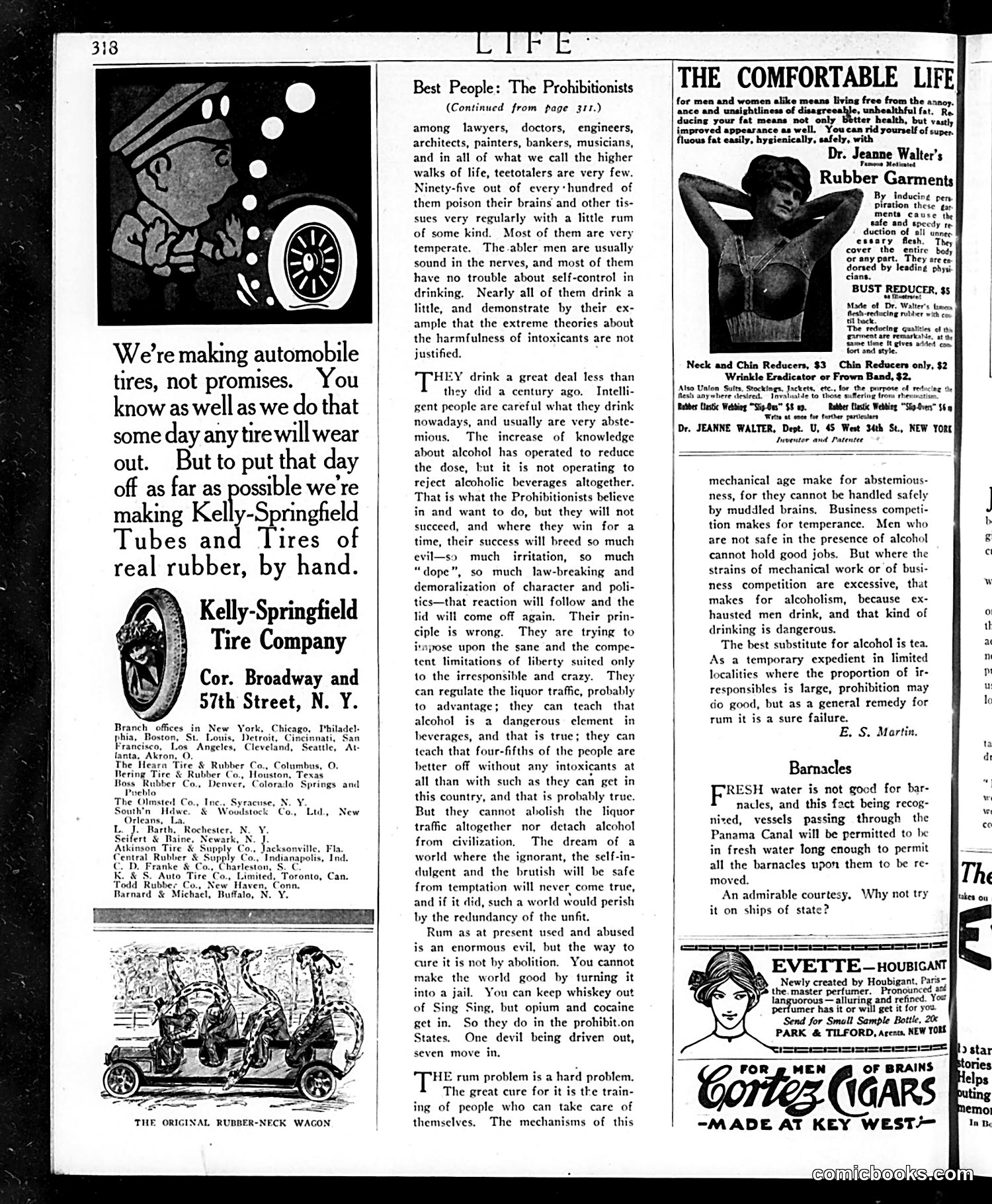
This page combines advertising with social commentary on Prohibition, the then-current (or imminent) ban on alcohol. **The Tire Advertisement** presents Kelly-Springfield's honest marketing pitch: tires wear out eventually, but theirs last longest. The "rubber-neck wagon" illustration is a pun on sightseeing tourists. **The Main Article** ("Best People: The Prohibitionists") argues *against* total alcohol prohibition. The author claims that educated, successful people—lawyers, doctors, engineers—drink moderately and responsibly. He contends that: - Most intelligent people naturally moderate their consumption - Prohibition won't work; it breeds lawbreaking and corruption - The solution is *education*, not legal bans - Attempting to eliminate temptation entirely is futile The piece dismisses Prohibitionists as imposing "limitations of liberty suited only to the irresponsible and crazy." **Context**: This reflects pre-1920 (or early Prohibition-era) debate. Life magazine adopted an anti-Prohibition stance, viewing it as paternalistic overreach that punished the responsible majority for others' weakness.
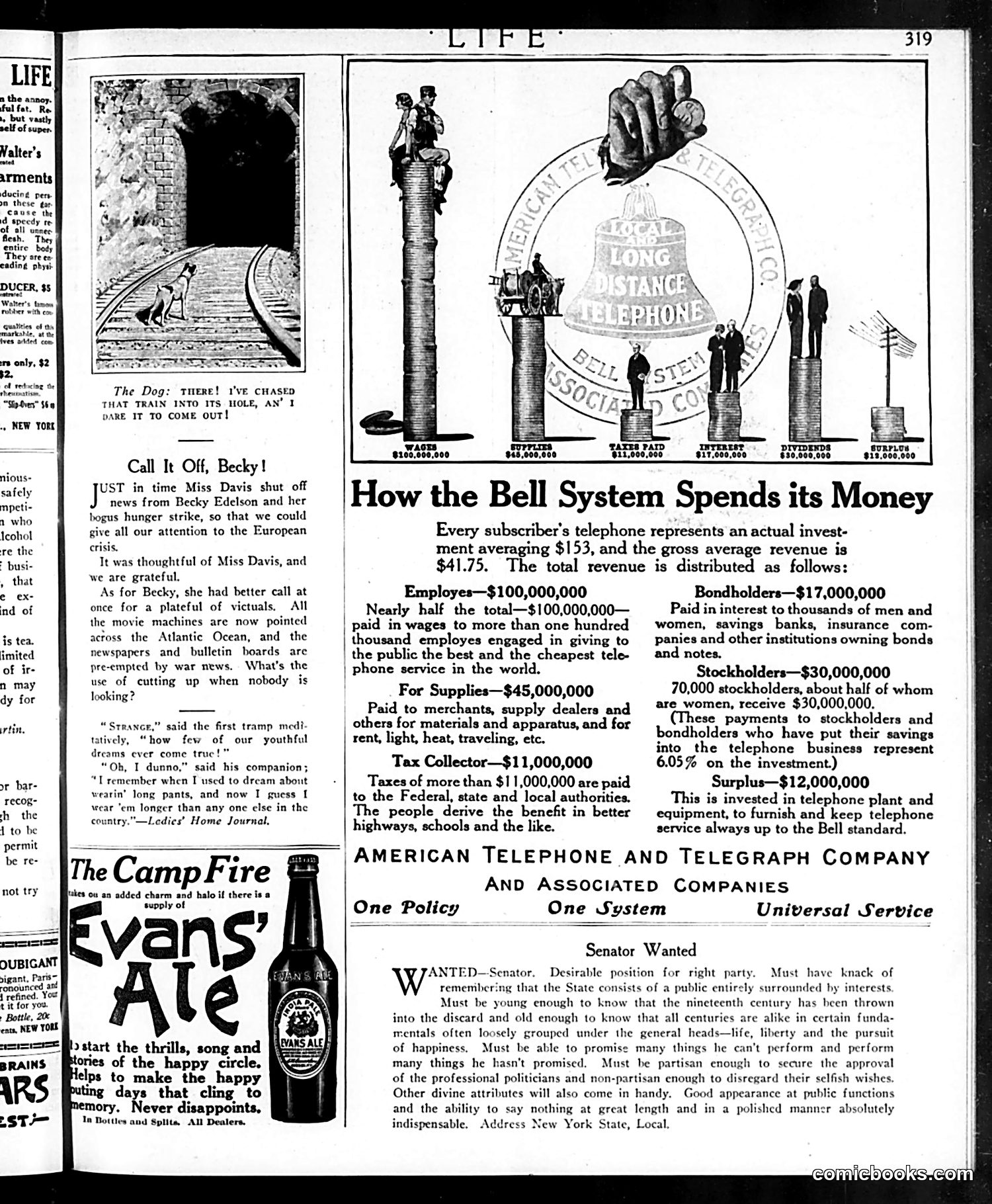
**Main Content:** The page features a Bell System advertisement breaking down how telephone revenue ($41.75 per subscriber) is distributed: employees ($100M), supplies ($45M), taxes ($11M), bondholders ($17M), stockholders ($30M), and surplus ($12M). This appears as corporate propaganda justifying profit distribution during an era of labor tensions. **The Satire:** A "Senator Wanted" classified ad mockingly describes the ideal politician as someone who must: - Remember the state serves "interests" (corporate power) - Promise things he can't deliver and perform unpromised actions - Balance partisan and non-partisan appearances - "Say nothing at great length" This satirizes political corruption and the gap between campaign promises and actual governance. The ad suggests senators are essentially commodities available to the highest bidder, a critique of corporate influence over elected officials—ironically positioned next to the Bell System's self-congratulatory revenue breakdown. The juxtaposition suggests the magazine viewed both corporate and political institutions with skepticism during this period.
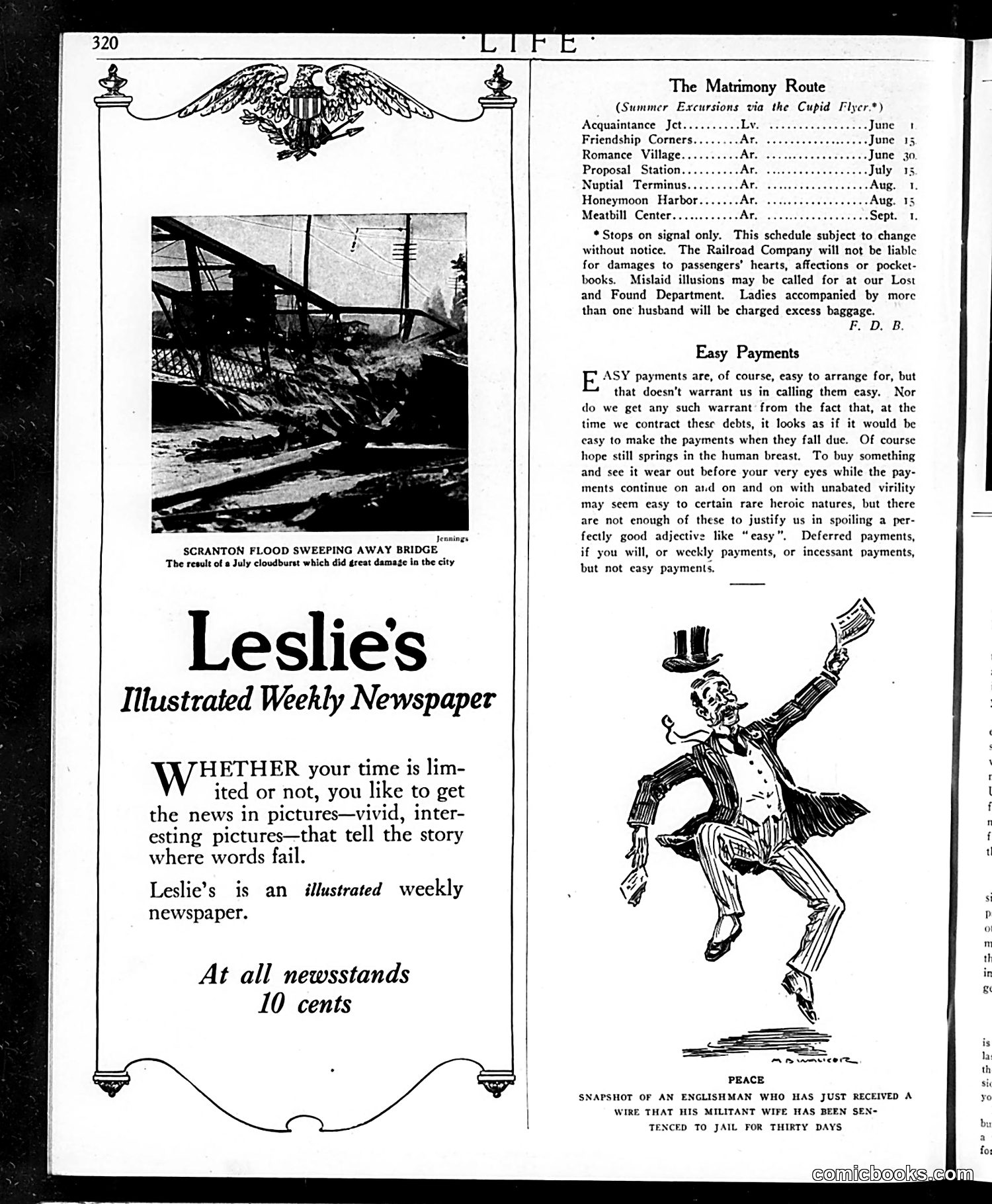
This Life magazine page contains three distinct pieces: **Top left:** A news photo of the Scranton Flood, showing a bridge destroyed by a July cloudburst—straightforward disaster journalism illustrating the magazine's visual approach. **Bottom left:** An advertisement promoting Leslie's as an illustrated weekly newspaper (10 cents), emphasizing that pictures convey news better than words alone. **Right side:** Two satirical pieces: 1. "The Matrimony Route" mocks romantic courtship as a railroad journey with humorous stops (Acquaintance Jct., Romance Village, Proposal Station, etc.), ending at "Meatbill Center"—suggesting marriage becomes financially draining. The fine print jokes about emotional "damages" and excess baggage charges for women with multiple husbands. 2. "Peace" depicts a jubilant Englishman celebrating receiving news his "militant wife" was sentenced to 30 days jail. This references the British suffragette movement; the cartoon satirizes both women's activism and marital discord by treating her imprisonment as good news for her husband. Both rely on anti-feminist humor typical of the era.
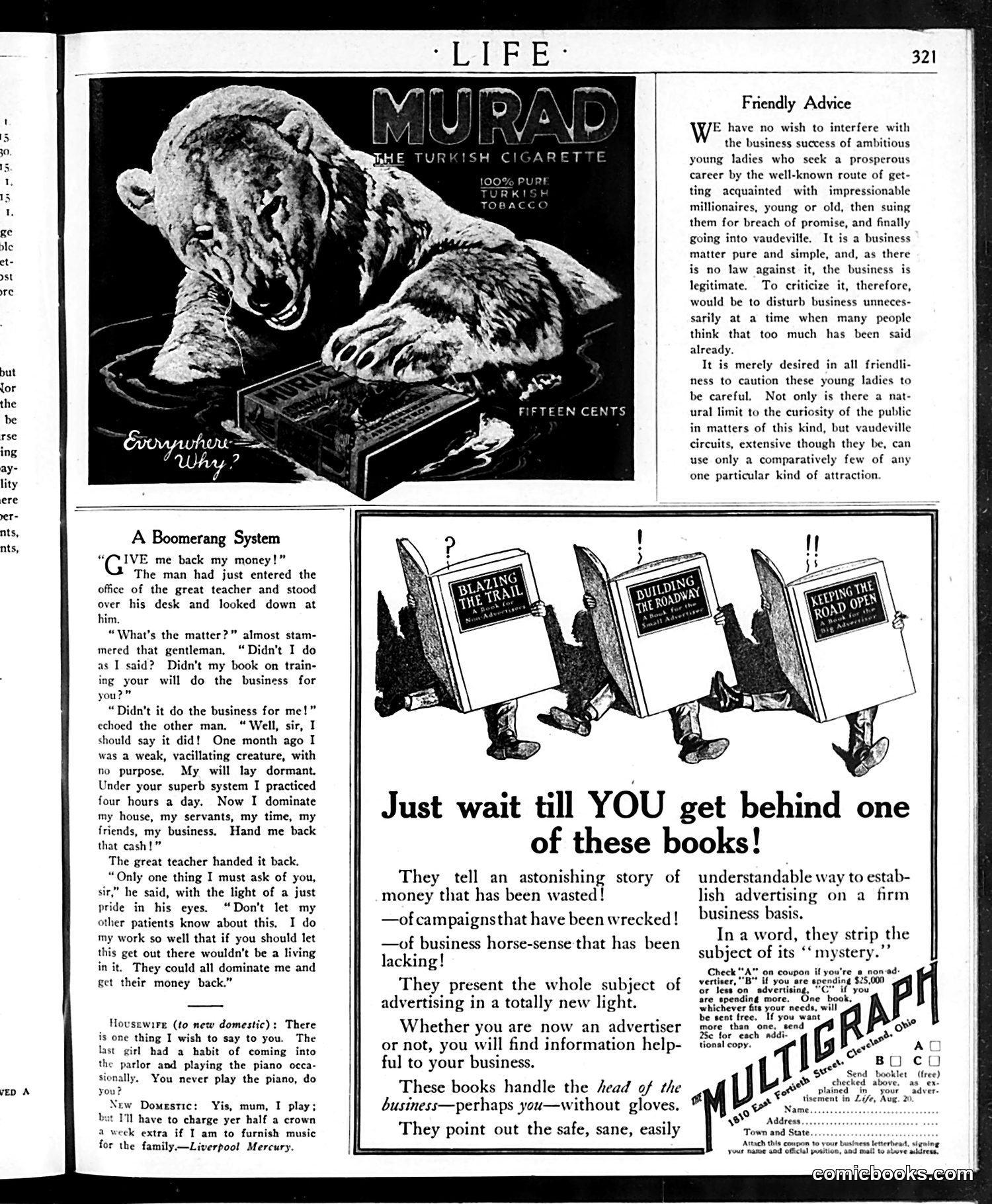
This Life magazine page contains three satirical pieces: **"Friendly Advice"** (top right): A tongue-in-cheek column mocking a common scandal of the era—young women who deliberately courted wealthy men, then sued them for "breach of promise" (breaking an engagement), and subsequently pursued vaudeville careers. Life sarcastically calls this a "legitimate" business while cautioning these women that public interest and vaudeville circuits have limits for "this particular kind of attraction." **"A Boomerang System"** (middle): A humorous anecdote about a self-help teacher who teaches clients "will training." One student becomes *so* dominant after practicing four hours daily that he demands his money back—having proven the method works too well. The teacher secretly agrees, fearing other clients might also demand refunds if they succeed. **Advertisement** (bottom): Promoting business books about advertising strategy and preventing wasted marketing campaigns. The humor targets self-help charlatans and exposes the contradiction in their promises: if the system actually works, customers won't need to pay for it again.
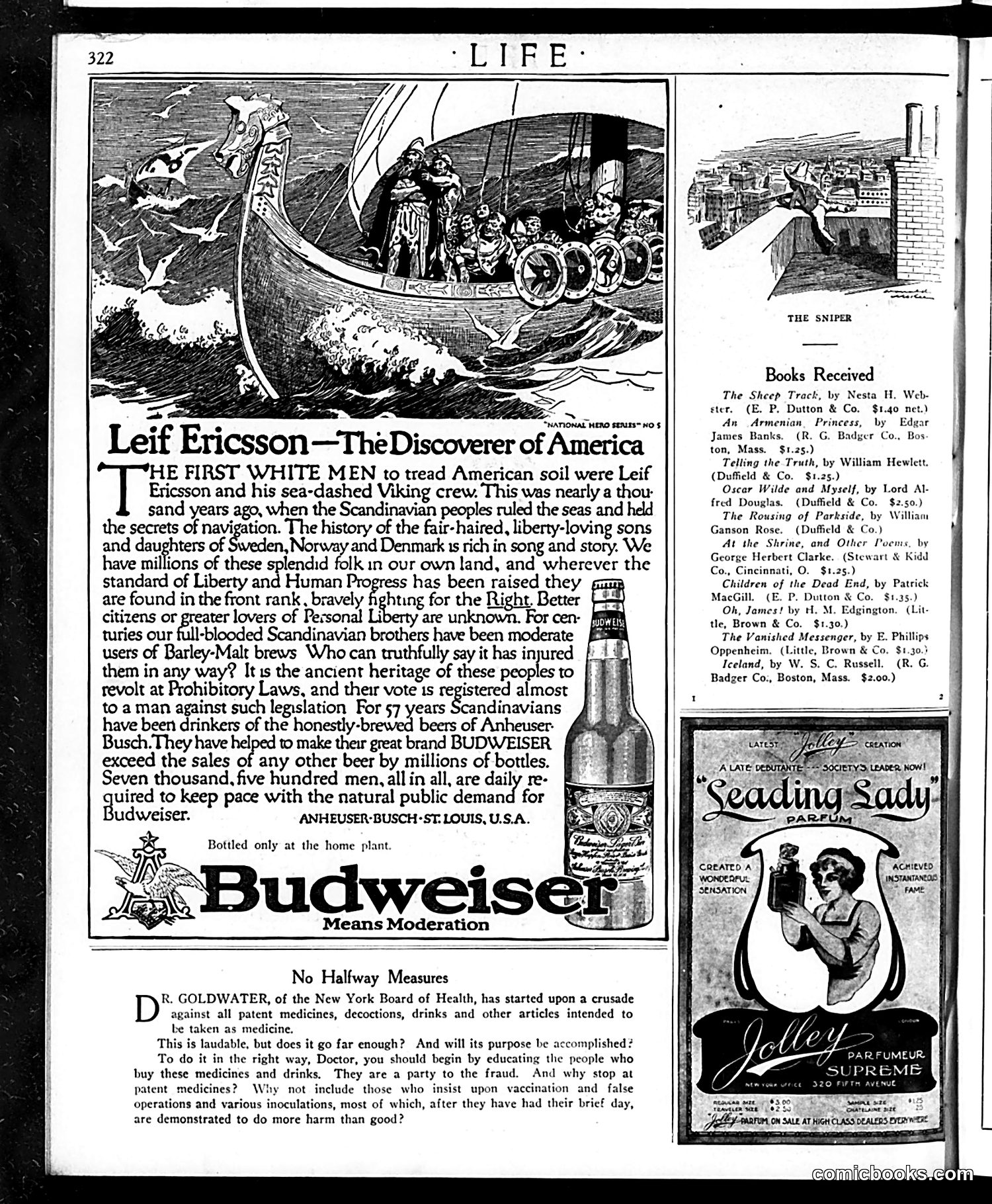
This page contains two distinct elements: **Main Advertisement (Budweiser):** A thinly-veiled political advertisement disguised as historical commentary. During Prohibition-era debates, the ad invokes Leif Ericsson and Scandinavian heritage to argue that beer-drinking is "ancient heritage" and that Scandinavian immigrants—presented as model citizens and liberty-lovers—vote against Prohibition. The ad directly links beer consumption to patriotism and personal freedom, positioning Prohibition as anti-liberty legislation. **"No Halfway Measures" Editorial:** A critique of Dr. Goldwater's health crusade against patent medicines and fraudulent health products. Life sarcastically questions whether he should extend his reforms to include mandatory vaccinations and medical inoculations, which the writer suggests "do more harm than good"—reflecting anti-vaccination sentiment common in that era. The page also includes book reviews and a perfume advertisement, typical magazine filler.
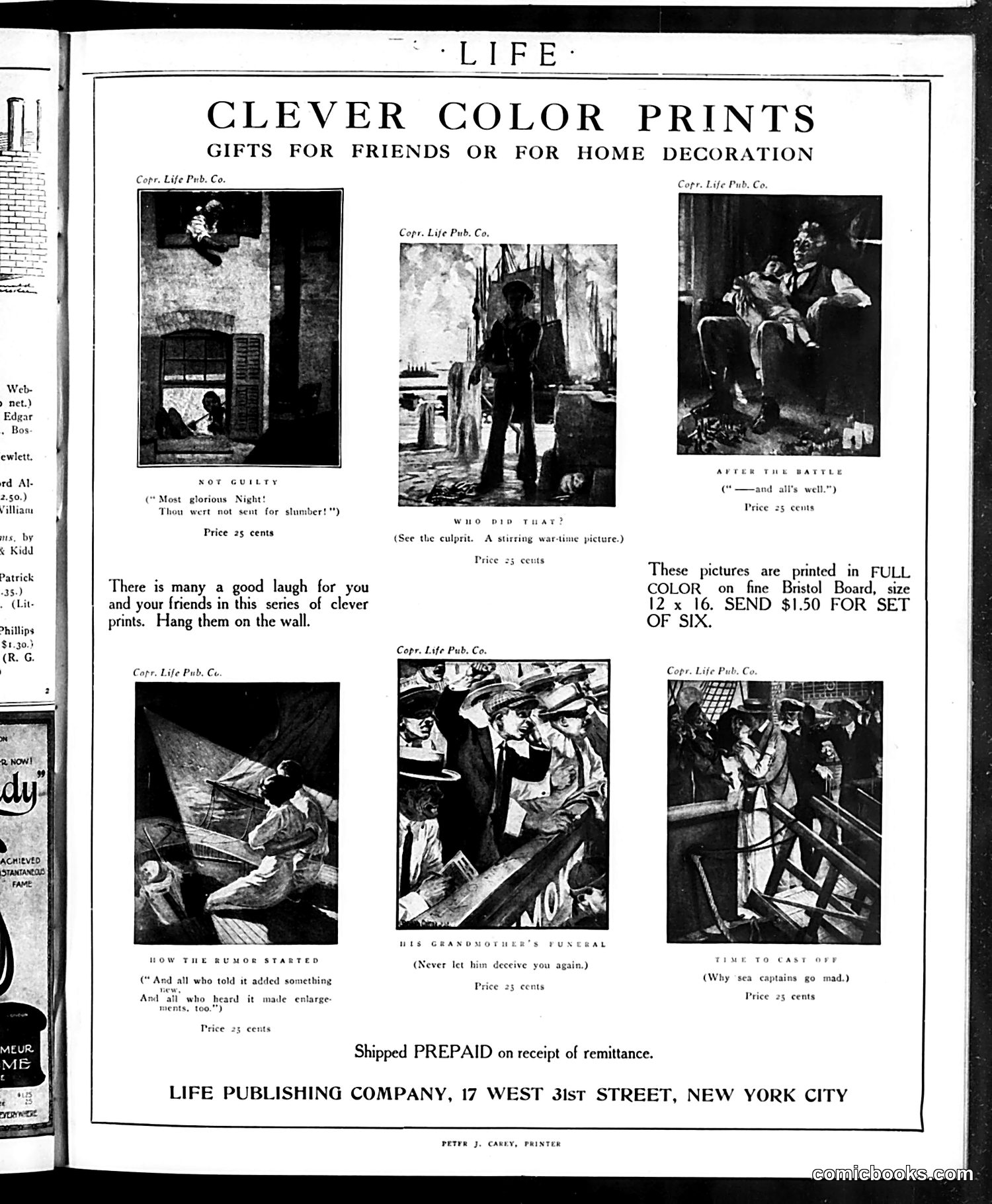
This is primarily an **advertisement** for "Clever Color Prints" sold by Life Publishing Company. The six satirical illustrations are humorous domestic and social scenes presented as affordable gifts or wall decorations (25 cents each; $1.50 for a set of six). The cartoons mock everyday situations: - **"Not Guilty"**: A couple caught in a compromising position - **"How the Rumor Started"**: Illustrates how gossip grows as it spreads - **"Who Did That?"**: A wartime scene (appears WWI-era, given "stirring wartime picture" caption) - **"His Grandmother's Funeral"**: A deceptive suitor - **"After the Battle"**: Domestic conflict between spouses - **"Time to Cast Off"**: A captain's madness (possibly from isolation at sea) The humor relies on **exaggeration and relatable social embarrassments** rather than political commentary. These are lifestyle satires—jokes about romance, gossip, infidelity, and family drama—marketed as inexpensive entertainment for middle-class homes. The page reflects early 20th-century attitudes toward humor and domestic life.
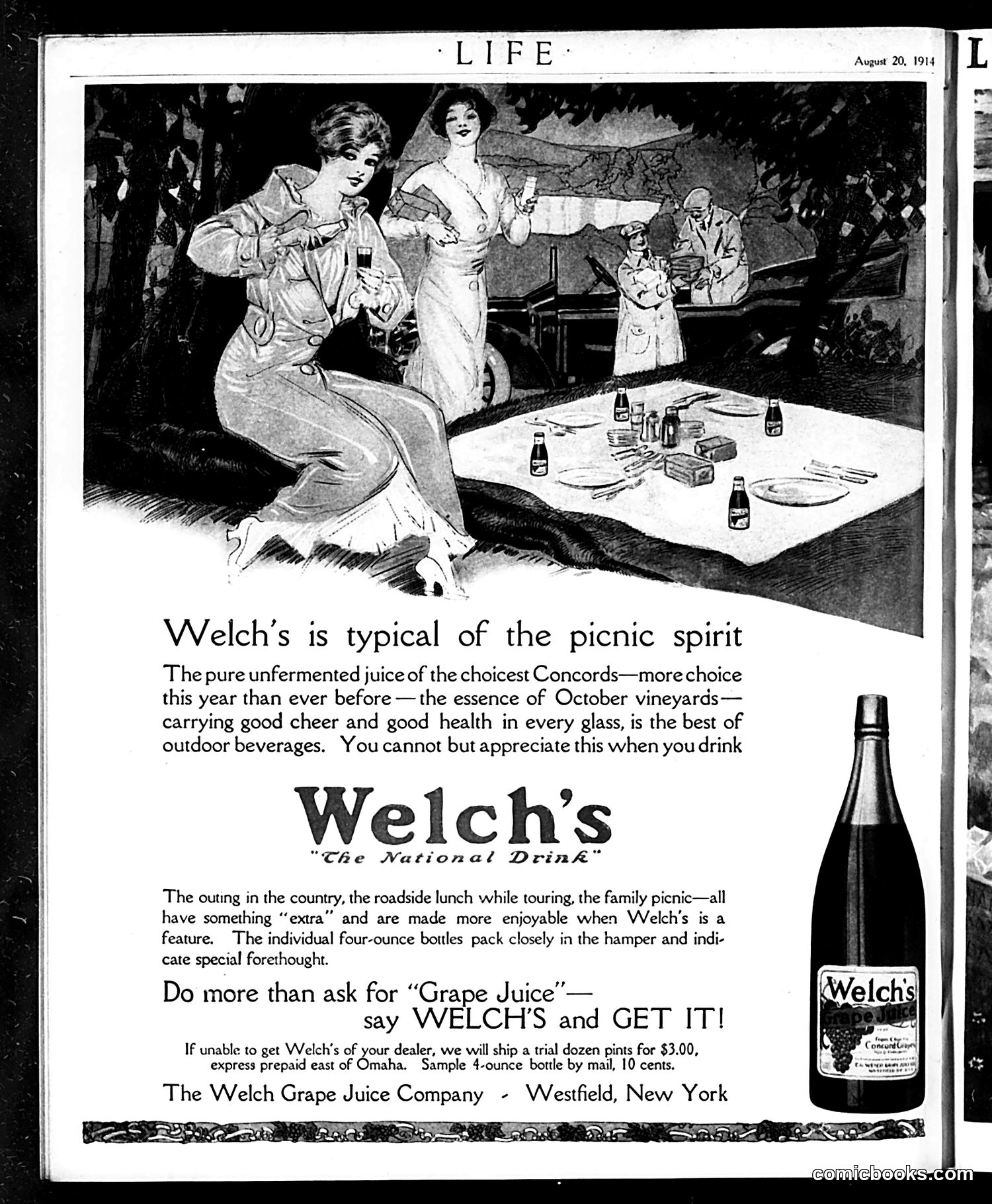
This is a full-page advertisement, not political satire. It depicts a stylized picnic scene with fashionably dressed women and men, marketing Welch's grape juice as "the National Drink" suitable for outdoor gatherings. The ad emphasizes that Welch's is "unfermented"—a significant detail in 1914. This likely references Prohibition advocacy, which was gaining momentum (Prohibition passed in 1919). By marketing non-alcoholic grape juice as ideal for picnics and social outings, Welch's positioned itself as a wholesome alternative to alcohol during a period of increasing temperance sentiment. The advertisement highlights the product's convenience in portable four-ounce bottles and appeals to middle-class consumers planning country outings. It's essentially using social messaging about health and proper behavior to sell a product aligned with emerging anti-alcohol cultural values.