
Life, 1914-08-20 · page 23 of 40
Life — August 20, 1914 — page 23: what you’re looking at
What you’re looking at
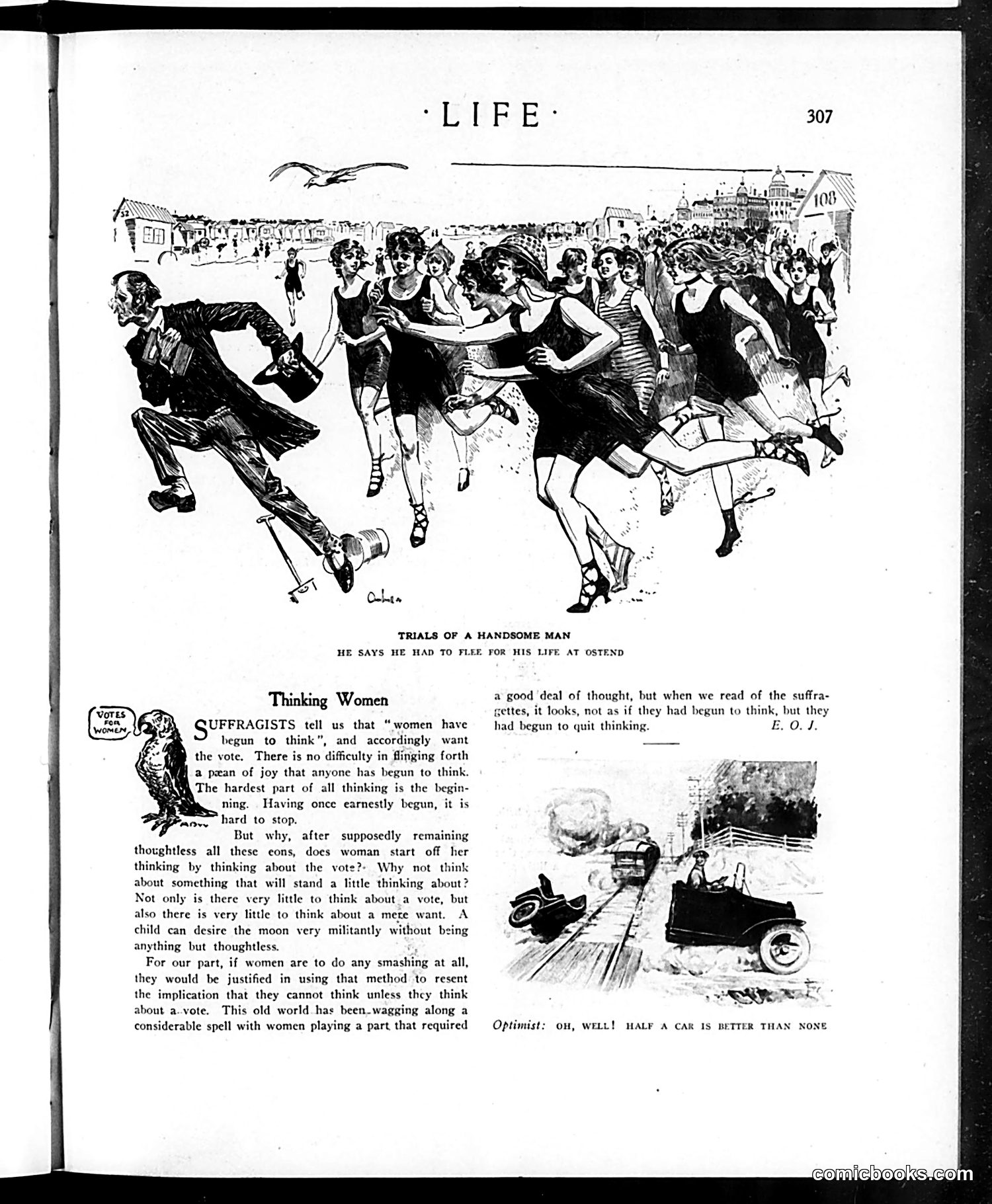
This page contains satirical commentary on the women's suffrage movement circa the early 1900s. The article "Thinking Women" mocks suffragettes—women advocating for voting rights—by claiming they haven't actually "begun to think" but rather "quit thinking." The author argues that if women were truly thoughtful, they wouldn't focus on the vote as their first intellectual priority, and that desiring political representation requires no genuine thought, just desire. The top illustration depicts a "handsome man" fleeing women at Ostend (a Belgian beach resort), suggesting anxiety about aggressive or pursuing women—likely a dig at suffragettes as emasculating or predatory. The bottom cartoon shows a car accident, with the caption "Half a car is better than none"—likely satirizing optimism or compromise, possibly referencing debates over partial women's rights versus full suffrage. The overall tone is dismissive toward women's political activism, framing it as thoughtless mob behavior rather than legitimate political engagement.
📄 Transcribed text from this page (OCR, searchable)
Machine-transcribed from the original scan — historical spelling and the odd misread are preserved.
TRIALS OF A HANDSOME MAN HE SAYS HE HAD TO FLEE FOR HIS LIFE AT OSTEND Thinking Women UFFRAGISTS tell us that “women have begun to think”, and accordingly want the vote. There is no difficulty in flinging forth HW a pxan of joy that anyone has begun to think. The hardest part of all thinking is the begin- ning. Having once earnestly begun, it is hard to stop. But why, after supposedly remaining thoughtless all these eons, does woman start off her thinking by thinking about the vote?» Why not think about something that will stand a little thinking about? Not only is there very little to think about a vote, but also there is very little to think about a mere want. A child can desire the moon very militantly without being anything but thoughtless. ‘ For our part, if women are to do any smashing at all, they would be justified in using that method to resent the implication that they cannot think unless they think about a.vote. This old world has been-wagging along a considerable spell with women playing a part that required a good deal of thought, but when we read of the suffra- gettes, it looks, not as if they had begun to think, but they had begun to quit thinking. Optimist: oH, WELL! HALF A CAR IS BETTER THAN NONE