
Life, 1914-08-20 · page 24 of 40
Life — August 20, 1914 — page 24: what you’re looking at
What you’re looking at
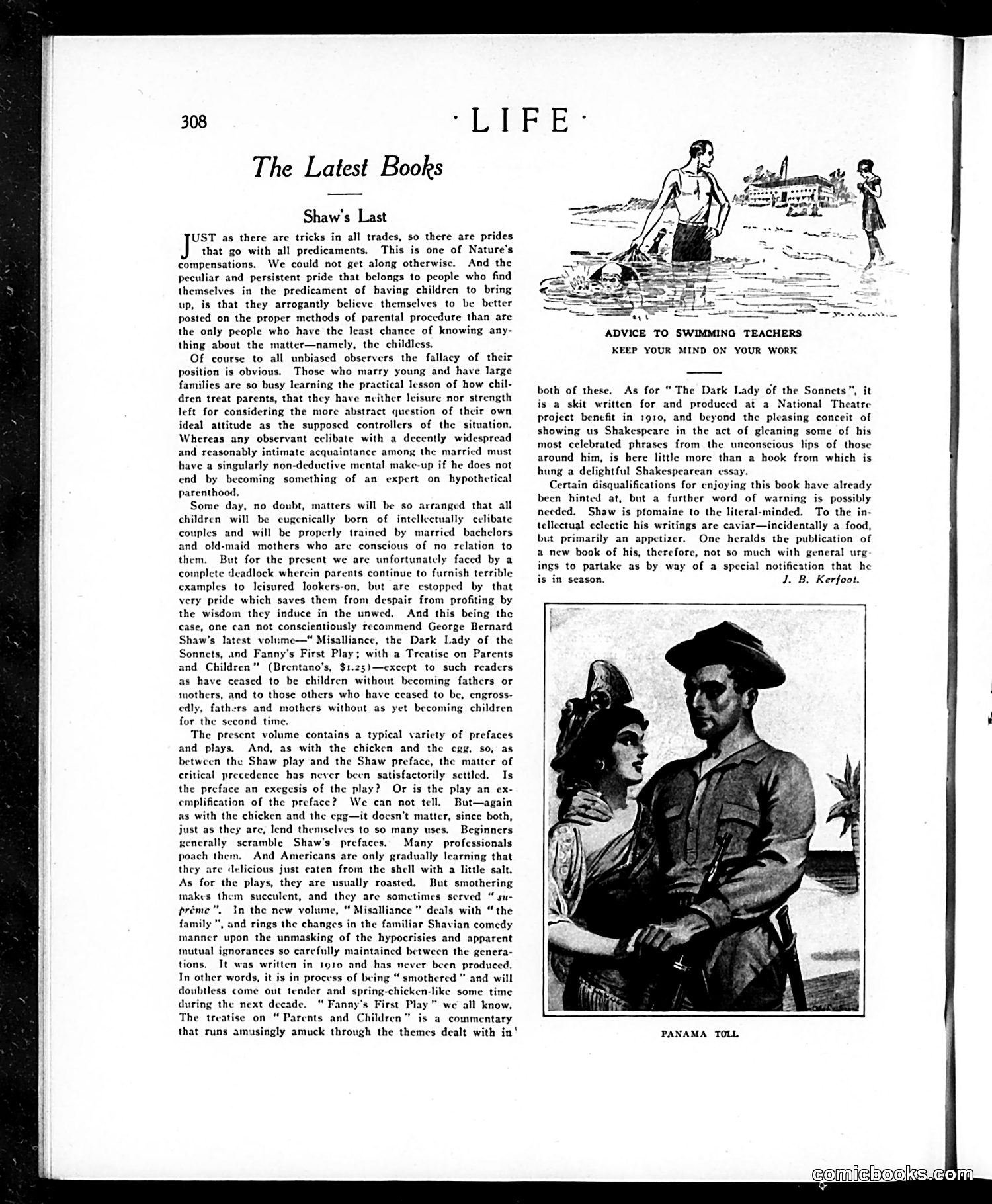
This page reviews George Bernard Shaw's latest book collection. The lengthy essay critiques parental authority humorously, arguing that childless people actually understand child-rearing better than parents themselves—a paradox the author extends through extended metaphors about cooking (scrambling, poaching, roasting prefaces and plays). The review discusses three Shaw works: *Misalliance* (about family hypocrisy), *The Dark Lady of the Sonnets*, and *Fanny's First Play*, plus a treatise on parents and children. The author uses culinary language throughout to describe how different audiences consume Shaw's writings. Two illustrations accompany the text: "Advice to Swimming Teachers" (top) and "Panama Toll" (bottom, showing a caricatured figure). The "Panama Toll" image likely references the Panama Canal, completed in 1914, though the specific satirical point remains unclear from the page alone. The piece exemplifies *Life* magazine's characteristic intellectual satire targeting educated readers familiar with Shaw's work and philosophical debates about parenting.
📄 Transcribed text from this page (OCR, searchable)
Machine-transcribed from the original scan — historical spelling and the odd misread are preserved.
LE BEsE* The Latest Books Shaw's Last UST as there arc tricks in all trades, so there are prides that go with all predicaments. This is one of Nature's compensations. We could not get along otherwise. And the peculiar and persistent pride that belongs to people who find themselves in the predicament of having children to bring up, is that they arrogantly believe themselves to be better posted on the proper methods of parental procedure than are the only people who have the least chance of knowing any- thing about the matter—namely, the childless. Of course to all unbiased observers the fallacy of their position is obvious. Those who marry young and have large families are so busy learning the practical lesson of how chil- dren treat parents, that they have neither leisure nor strength left for considering the more abstract question of their own ideal attitude as the supposed controllers of the situation. Whereas any observant celibate with a decently widespread and reasonably intimate acquaintance among the married must have a singularly non-deductive mental make-up if he does not end by becoming something of an expert on hypothetical parenthood. Some day, no doubt, matters will be so arranged that all children will be eugenically born of intellectually celibate couples and will be properly trained by married bachelors and old-maid mothers who are conscious of no relation to them. But for the present we are unfortunately faced by a complete deadlock whercin parents continue to furnish terrible examples to Ieisured lookers-on, but are estopped by that very pride which saves them from despair from profiting by the wisdom thcy induce in the unwed. And this being the case, one can not conscientiously recommend George Bernard Shaw's latest volume— Misalliance, the Dark Lady of the Sonnets, and Fanny's First Play; with a Treatise on Parents and Children” (Brentano's, $1.25)—except to such readers as have ceased to be children without becoming fathers or imothers, and to those others who have ceased to be, engross- edly, fathers and mothers without as yet becoming children for the second time. The present volume contains a typical variety of prefaces and plays. And, as with the chicken and the cgg, so, as between the Shaw play and the Shaw preface, the matter of critical precedence has never been satisfactorily settled. Is the preface an exegesis of the play? Or is the play an ex- emplification of the preface? We can not tell. But—again as with the chicken and the egg—it docsn’t matter, since both, just as they arc, lend themselves to so many uses. Beginners xenerally scramble Shaw's prefaces. Many professionals poach th And Americans are only gradually learning that they are delicious just eaten from the shell with a little salt. As for the plays, they are usually roasted. But smothering makes them succulent, and they are sometimes served “ su- préme”. In the new volume, “ Misalliance ” deals with “the family ", and rings the changes in the familiar Shavian comedy manner upon the unmasking of the hypocrisies and apparent mutual ignorances so carefully maintained between the genera- tions, It was written in 1910 and has never been produced, In other words, it is in process of being “ smothered " and will doubtless come out tender and spring-chicken-like some time during the next decade. Fanny's First Play” we all know. The treatise on “ Parents and Children” is a commentary that runs amusingly amuck through the themes dealt with in‘ ADVICE TO SWIMMING TEACHERS YOUR MIND ON YOUR WORK both of these. As for “The Dark Lady of the Sonnets”, it is a skit written for and produced at a National Theatre project benefit in 1910, and beyond the pleasing conceit of showing us Shakespeare in the act of gleaning some of his most celebrated phrases from the unconscious lips of those around him, is here little more than a hook from which is hung a delightful Shakespearean essay. Certain disqualifications for enjoying this book have already been hinted at, but a further word of warning is possibly necded. Shaw is ptomaine to the literal-minded. To the in- tellectual eclectic his writings are caviar—incidentally a food, but primarily an appetizer. Onc heralds the publication of a new book of his, therefore, not so much with general urg ings to partake as by way of a special notification that he is in season. J. B. Kerfoot. PANAMA TOLL