
Life, 1914-08-20 · page 25 of 40
Life — August 20, 1914 — page 25: what you’re looking at
What you’re looking at
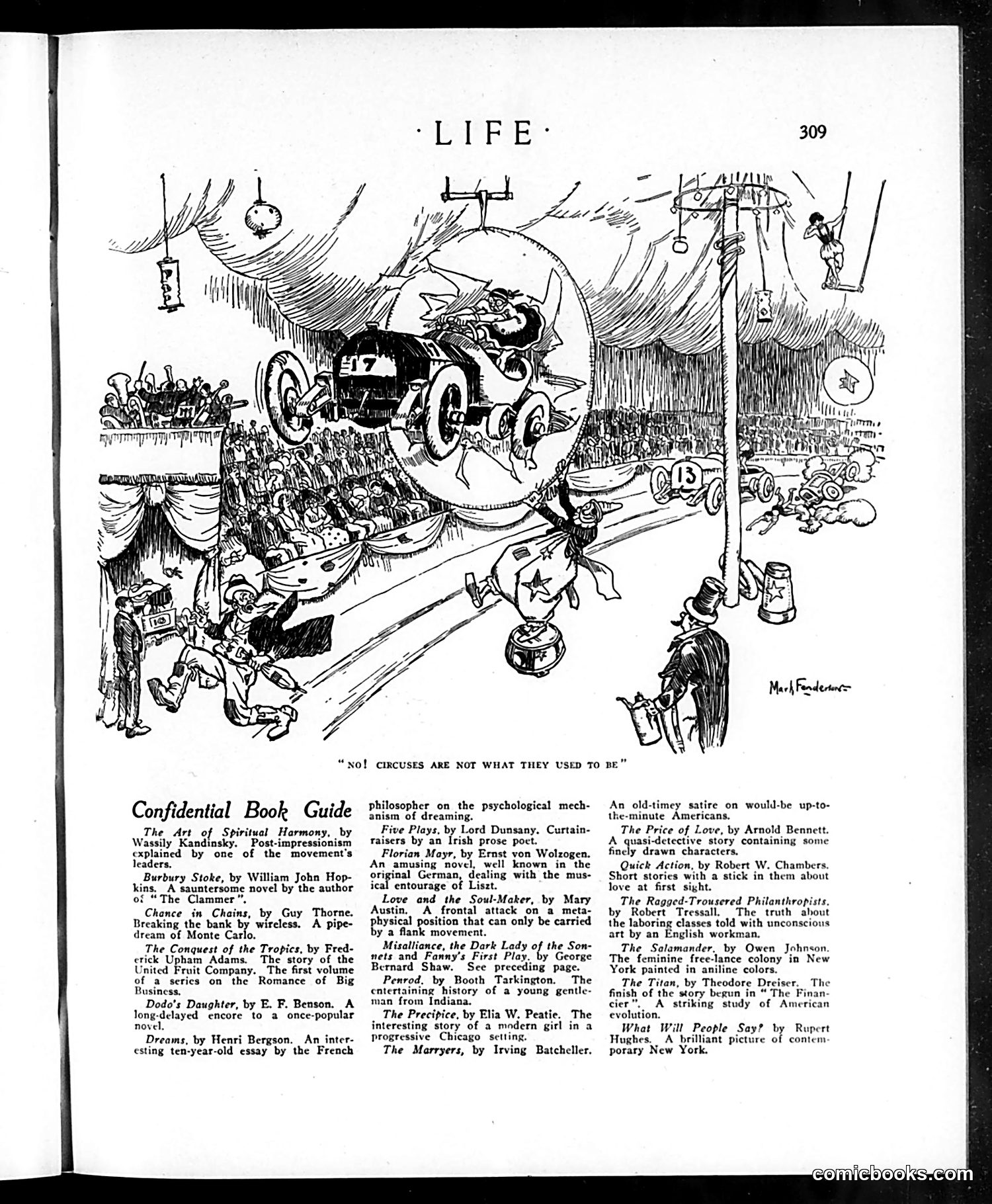
This page features a satirical cartoon captioned "So! Circuses Are Not What They Used to Be." The drawing depicts a modernized circus where a racing car (numbered 17) performs stunts inside a ring, replacing traditional acrobats and animals. Spectators watch from bleachers while performers operate mechanical equipment overhead—suggesting technology has overtaken traditional circus entertainment. The satire targets early 20th-century American society's obsession with speed, automobiles, and technological "progress" at the expense of older cultural forms. It mocks how even entertainment has become mechanized and industrialized. The page's lower half is a "Confidential Book Guide"—a literary recommendation column reviewing contemporary novels and plays, mostly by established authors like George Bernard Shaw and Theodore Dreiser. This was typical Life magazine content: mixing visual satire with cultural commentary for educated readers.
📄 Transcribed text from this page (OCR, searchable)
Machine-transcribed from the original scan — historical spelling and the odd misread are preserved.
“Nol CIRCUSES ARE NOT WHAT THEY USED TO BE” Confidential Book Guide The Art of Spiritual Harmony, by Wassily Kandinsky. Post-impressionism explained by one of the movement's leaders, Burbury Stoke, by William John Hop- kins. A sauntersome novel by the author of “The Clammer”, Chance in Chains, by Guy Thorne. Breaking the bank by wireless. A pipe- dream of Monte Carlo, The Conquest of the Tropics, by Fred- etick Upham Adams. The story of the United Fruit Company. The first volume of a serics on the Romance of Big Business. Dodo's Daughter, by E. F. Benson. A long-delayed encore to a once-popular novel, Dreams, by Henri Bergson. An inter- esting ten-year-old essay by the French philosopher on the psychological mech- anism of dreaming. Five Plays, by Lord Dunsany. Curtain- fi raisers by an Irish prose poet. Florian Mayr, by Ernst von Wolzogen. An amusing novel, well known in the original German, dealing with the mus- ical entourage of Liszt. Love and the Soul-Maker, by Mary Austin, A frontal attack on a meta- physical position that can only be carried by a flank movement. Misalliance, the Dark Lady of the Son- nets and Fanny's First Play. by George Bernard Shaw. See preceding page. Penrod. by Booth Tarkington. The entertaining history of a young gentle- man from Indiana. The Precipice, by Elia W, Peatie. The interesting story of a modern girl in a progressive Chicago setting. The Marryers, by Irving Batcheller. An old-timey satire on would-be up-to- the-minute Americans. The Price of Love, by Arnold Bennett. A goa detecrive story containing some finely drawn characters. Quick Action, by Robert W. Chambers. Short stories with a stick in them about love at first sight. The Ragged-Trousered Philanthropists. by Robert Tressall, The truth about the laboring classes told with unconscious art by an English workman. The Salamander, by Owen Johnson The feminine free-lance colony in New York painted in aniline colors. The Titan, by Theodore Dreiser. The finish of the story begun in “ The Finan- cier A striking study of American evolution. What Will People Say? by Rupert Hughes. A brilliant picture of contem porary New York.