
Life, 1914-08-20 · page 16 of 40
Life — August 20, 1914 — page 16: what you’re looking at
What you’re looking at
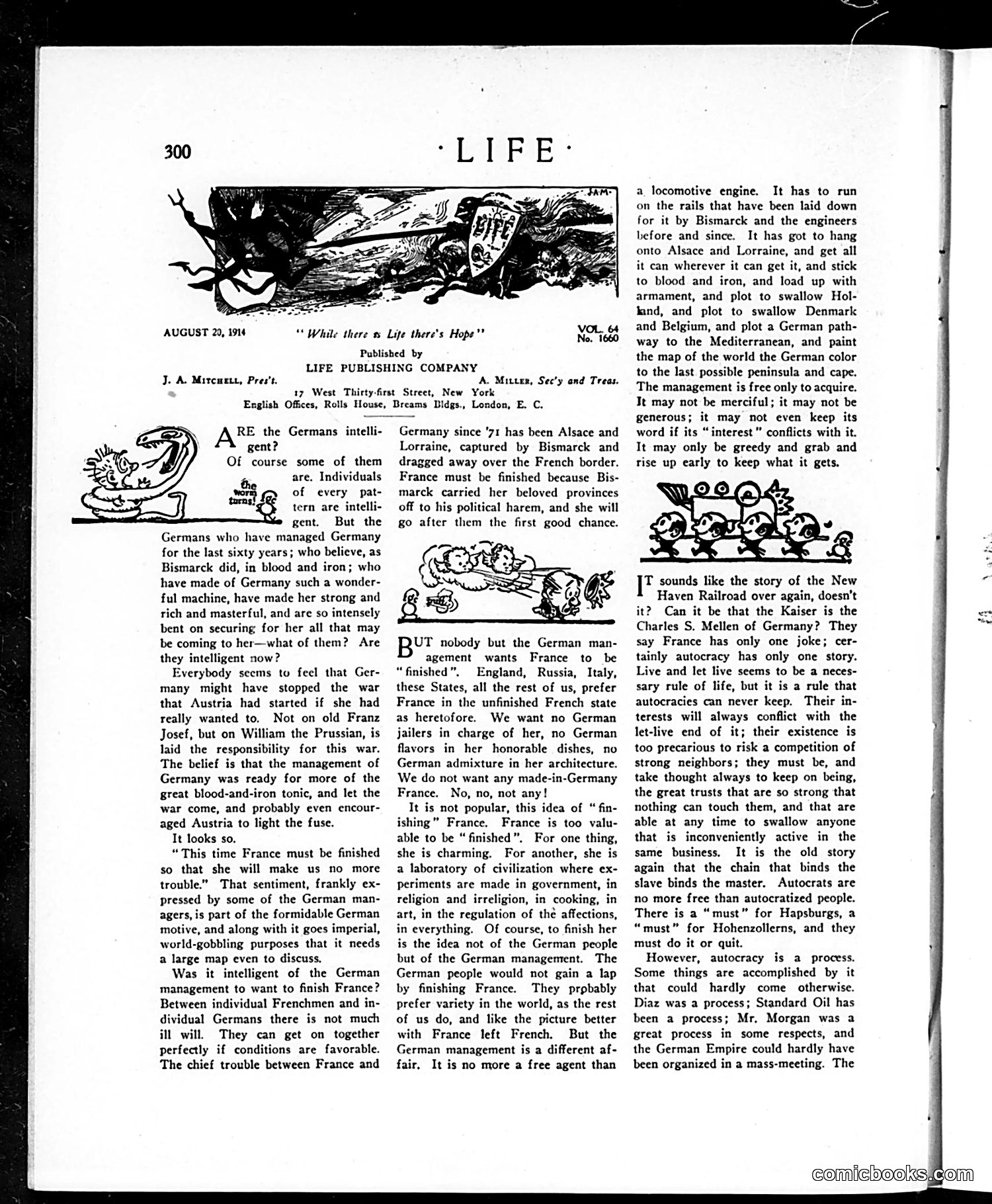
This editorial cartoons and essay appear during the opening weeks of World War I, addressing whether German leadership is "intelligent" for pursuing war against France. The piece argues that while individual Germans are reasonable, the German *management*—the ruling apparatus descended from Bismarck's "blood and iron" philosophy—operates mechanically, unable to deviate from an imperialist agenda. It must pursue France because Bismarck seized Alsace-Lorraine in 1871, and the system compels endless territorial acquisition. The author sardonically observes that ordinary Germans and French get along fine; the conflict stems from the German leadership's mechanical drive to "finish France." The essay distinguishes between the German people (who'd prefer a French neighbor) and the German management (enslaved to expansionist ideology like a locomotive on predetermined rails). The cartoon's crude imagery emphasizes this dehumanization of German leadership as an autonomous machine disconnected from human reason or mercy.
📄 Transcribed text from this page (OCR, searchable)
Machine-transcribed from the original scan — historical spelling and the odd misread are preserved.
AUGUST 20, i914 “While there ss Life there's Hope” Published by LIFE PUBLISHING COMPANY J. A. Mircuett, Pres't. A. Miter, Sec’y and Treas. 17 West Thirty-first Street, New York English Offices, Rolls House, Breams Bidgs., London, E. C. RE the Germans intelli- gent? Of course some of them Ss are. Individuals of every pat- trates tern are intelli- gent. But the Germans who have managed Germany for the last sixty years; who believe, as Bismarck did, in blood and iron; who have made of Germany such a wonder- ful machine, have made her strong and rich and masterful, and are so intensely bent on securing for her all that may be coming to her—what of them? Are they intelligent now? Everybody seems to feel that Ger- many might have stopped the war that Austria had started if she had really wanted to. Not on old Franz Josef, but on William the Prussian, is laid the responsibility for this war. The belief is that the management of Germany was ready for more of the great blood-and-iron tonic, and let the war come, and probably even encour- aged Austria to light the fuse. It looks so. “This time France must be finished so that she will make us no more trouble.” That sentiment, frankly ex- pressed by some of the German man- agers, is part of the formidable German. motive, and along with it goes imperial, world-gobbling purposes that it needs a large map even to discuss, Was it intelligent of the German management to want to finish France? Between individual Frenchmen and in- dividual Germans there is not much ill will. They can get on together perfectly if conditions are favorable. The chief trouble between France and Germany since '71 has been Alsace and Lorraine, captured by Bismarck and dragged away over the French border. France must be finished because Bis- marck carried her beloved provinces off to his political harem, and she will go after them the first good chance. UT nobody but the German man- agement wants France to be “finished”, England, Russia, Italy, these States, all the rest of us, prefer France in the unfinished French state as heretofore. We want no German jailers in charge of her, no German flavors in her honorable dishes, no German admixture in her architecture. We do not want any made-in-Germany France. No, no, not any! It is not popular, this idea of “ fin- ishing” France, France is too valu- able to be “finished”. For one thing, she is charming. For another, she is a laboratory of civilization where ex- periments are made in government, in religion and irreligion, in cooking, in art, in the regulation of the affections, in everything. Of course, to finish her is the idea not of the German people but of the German management. The German people would not gain a lap by finishing France. They probably prefer variety in the world, as the rest of us do, and like the picture better with France left French, But the German management is a different af- fair, It is no more a free agent than a locomotive engine. It has to run on the rails that have been laid down for it by Bismarck and the engineers before and since. It has got to hang onto Alsace and Lorraine, and get all it can wherever it can get it, and stick to blood and iron, and load up with armament, and plot to swallow Hol- land, and plot to swallow Denmark and Belgium, and plot a German path- way to the Mediterranean, and paint the map of the world the German color to the last possible peninsula and cape. The management is free only to acquire. Tt may not be merciful; it may not be generous; it may not even keep its word if its “interest” conflicts with it. It may only be greedy and grab and rise up early to keep what it gets. [t sounds like the story of the New Haven Railroad over again, doesn’t it? Can it be that the Kaiser is the Charles S. Mellen of Germany? They say France has only one joke; cer- tainly autocracy has only one story. Live and let live seems to be a neces- sary rule of life, but it is a rule that autocracies can never keep. Their in- terests will always conflict with the let-live end of it; their existence is too precarious to risk a competition of strong neighbors; they must be, and take thought always to keep on being, the great trusts that are so strong that nothing can touch them, and that are able at any time to swallow anyone that is inconveniently active in the same business. It is the old story again that the chain that binds the slave binds the master. Autocrats are no more free than autocratized people. There is a “must” for Hapsburgs, a “must” for Hohenzollerns, and they must do it or quit. However, autocracy is a process. Some things are accomplished by it that could hardly come otherwise. Diaz was a process; Standard Oil has been a process; Mr. Morgan was a great process in some respects, and the German Empire could hardly have been organized in a mass-meeting. The comichookscom