
Life, 1914-08-20 · page 26 of 40
Life — August 20, 1914 — page 26: what you’re looking at
What you’re looking at
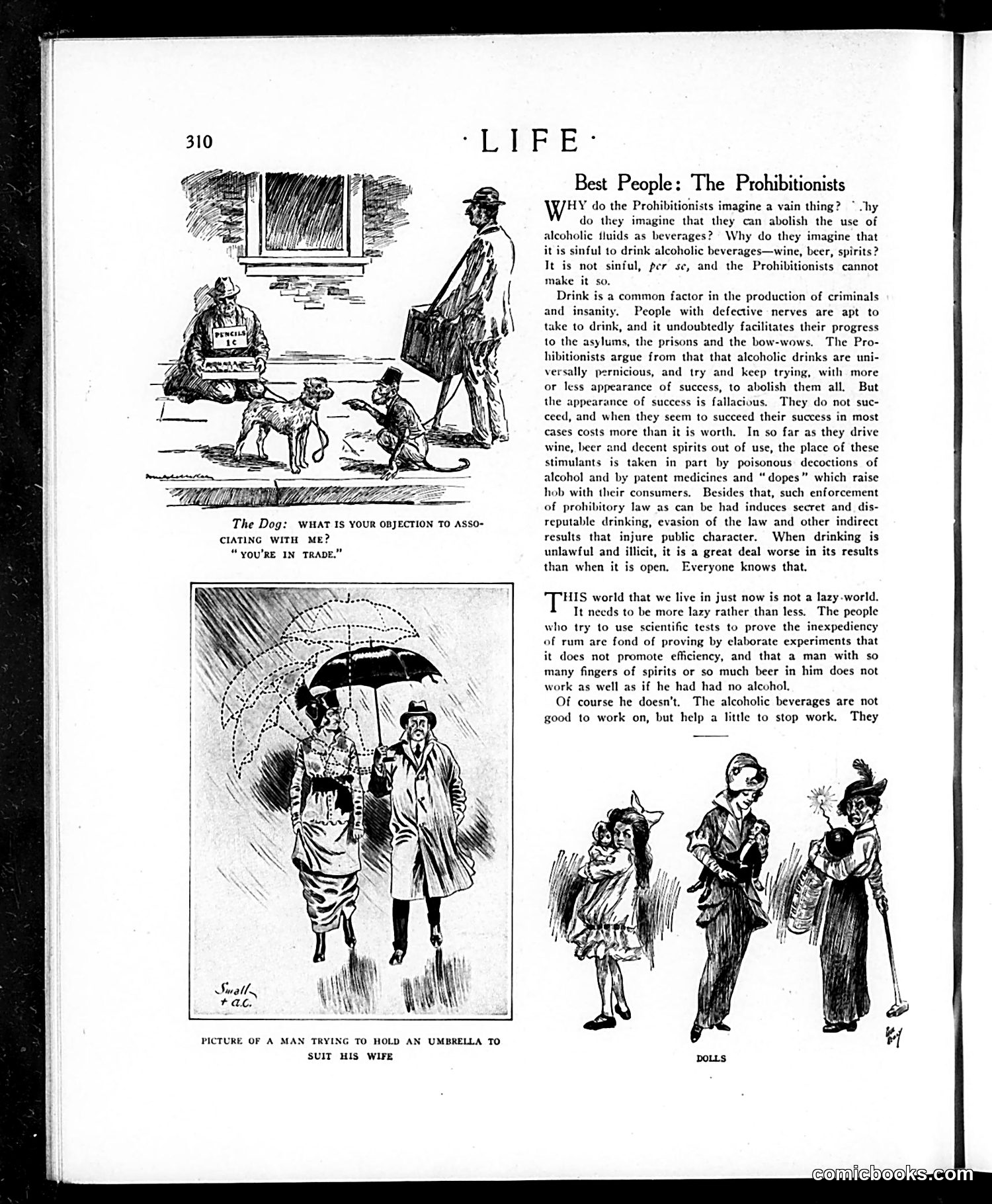
This page attacks Prohibition advocates through multiple cartoons and editorial commentary. The main essay argues that Prohibitionists wrongly claim alcohol is inherently sinful and that banning it will reduce crime and insanity. Life's counterargument: drinking itself isn't immoral, but rather a symptom of existing problems. The piece contends that Prohibition enforcement fails—it merely drives drinkers to dangerous patent medicines and "dopes," encourages lawbreaking, and produces worse outcomes than open drinking. The accompanying cartoons mock social hypocrisy: one shows a dog excluded from "respectable" company for being "in trade" (commerce), satirizing class pretension. Another depicts a man holding an umbrella awkwardly for his wife, suggesting marital discord. The "Dolls" illustration appears to mock shallow socializing. The satire's core: Prohibitionists are deluded moralists whose well-intentioned ban creates more harm than the behavior they oppose.
📄 Transcribed text from this page (OCR, searchable)
Machine-transcribed from the original scan — historical spelling and the odd misread are preserved.
"EEE * The Dog: WHAT IS YOUR OBJECTION TO ASSO- CIATING WITH ME? “YOU'RE IN TRADE.” PICTURE OF A MAN TRYING TO HOLD AN UMBRELLA TO SUIT HIS WIFE Best People: The Prohibitionists wry do the Prohibitionists imagine a vain thing? * “hy do they imagine that they can abolish the use of alcoholic fluids as beverages? Why do they imagine that it is sinful to drink alcoholic beverages—wine, beer, spirits? It is not sinful, per se, and the Prohibitionists cannot make it so. Drink is a common factor in the production of criminals and insanity. People with defective nerves are apt to take to drink, and it undoubtedly facilitates their progress to the asylums, the prisons and the bow-wows. The Pro- hibitionists argue from that that alcoholic drinks are uni- versally pernicious, and try and keep trying, with more or less appearance of success, to abolish them all. But the appearance of success is fallacious. They do not suc- ceed, and when they seem to succeed their success in most cases costs more than it is worth. In so far as they drive wine, beer and decent spirits out of use, the place of these stimulants is taken in part by poisonous decoctions of alcohol and by patent medicines and “dopes” which raise hob with their consumers, Besides that, such enforcement of prohibitory law as can be had induces secret and dis- reputable drinking, evasion of the law and other indirect results that injure public character. When drinking is unlawful and illicit, it is a great deal worse in its results than when it is open, Everyone knows that. HIS world that we live in just now is not a lazy-world. It needs to be more lazy rather than less. The people who try to use scientific tests to prove the inexpediency of rum are fond of proving by elaborate experiments that it does not promote efficiency, and that a man with so many fingers of spirits or so much beer in him does not work as well as if he had had no alcohol. Of course he doesn't. The alcoholic beverages are not good to work on, but help a little to stop work, They