
Life, 1914-08-20 · page 22 of 40
Life — August 20, 1914 — page 22: what you’re looking at
What you’re looking at
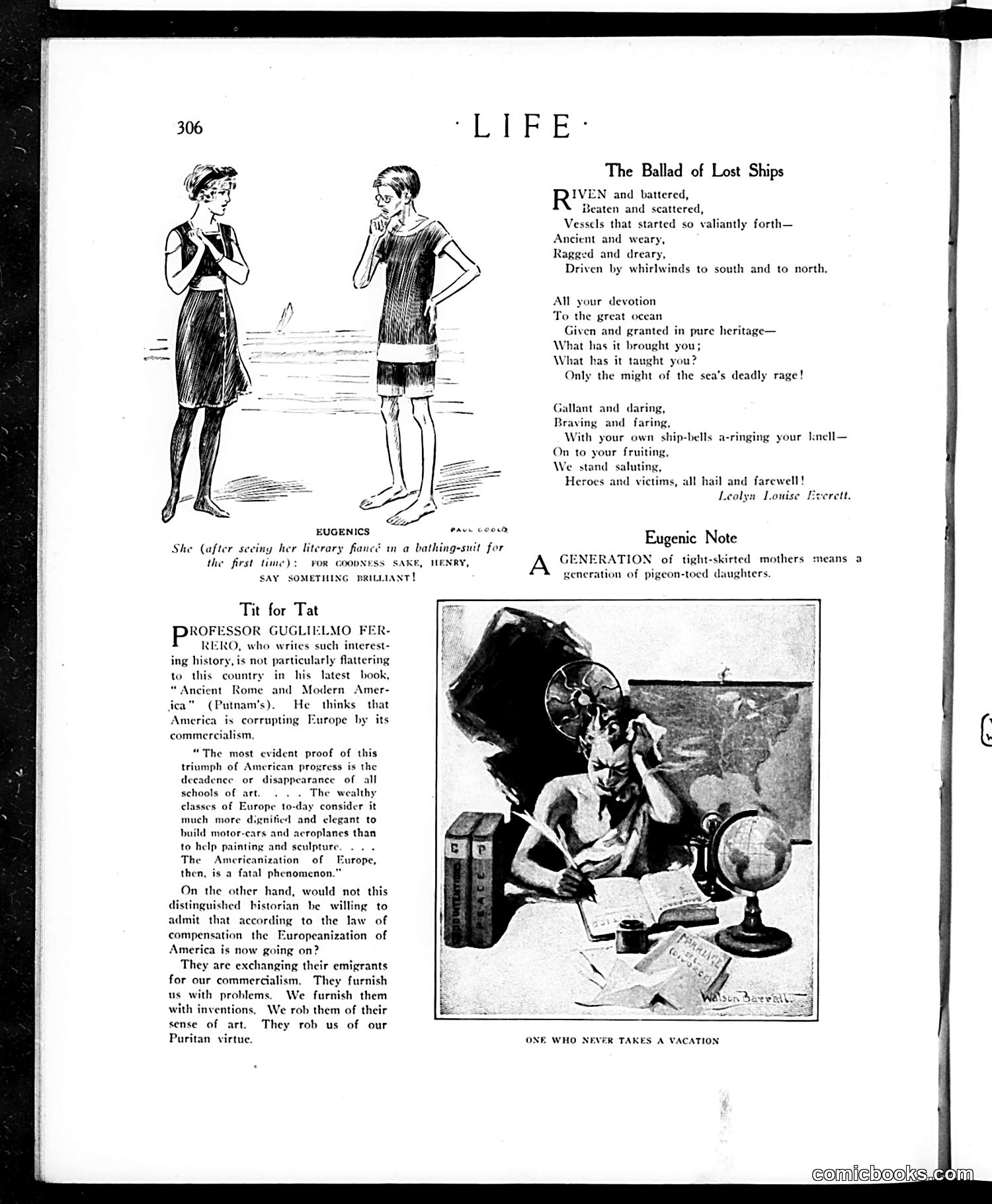
This page contains three distinct pieces of social commentary: **"The Ballad of Lost Ships"** is a romantic poem mourning doomed vessels and their brave crews—likely reflecting early-20th-century nostalgia for maritime adventure amid industrial modernity. **"Eugenics"** is a brief cartoon joke mocking the eugenics movement (then fashionable among intellectuals). A woman is disappointed seeing her literary fiancé in a bathing suit, prompting the caption's sarcastic suggestion that tight-skirted mothers produce "pigeon-toed daughters"—satirizing how eugenic thinking reduced human worth to physical appearance. **"Tit for Tat"** critiques Italian historian Guglielmo Ferrero's recent book blaming American commercialism for corrupting European art and culture. Life's author turns the argument around: if America corrupts Europe with commerce, Europe corrupts America by exporting emigrants and robbing Americans of "Puritan virtue"—a pointed jab at immigrant communities while defending American values. All three pieces reflect early-1900s American anxieties about cultural decline and foreign influence.
📄 Transcribed text from this page (OCR, searchable)
Machine-transcribed from the original scan — historical spelling and the odd misread are preserved.
‘LIFE: The Ballad of Lost Ships IVEN and battered, Beaten and scattered, Vessels that started so valiantly forth— Ancient and weary, Ragged and drear Driven by whirlwinds to south and to north, All your devotion To the great ocean Given and granted in pure heritage— What has it brought you; What has it taught you? Only the might of the sea’s deadly rage! Gallant and daring, Braving and faring, With your own ship-bells a-ringing your knell— On to your fruiting, We stand saluting, Heroes and victims, all hail and farewell! Leolyn Louise Everett. EUGENICS pave coed . , ‘ ae Eugenic Note She (after seeing her literary fiancé in a bathing-suit for ATION of tight-skirted mothers means the first time): POR CoopNESs SAKE, HENRY, 7 SAY SOMETHING BRILLIANT! generation of pigeon-toed daughters. Tit for Tat ROFESSOR GUGLIELMO FER- RERO, who writes such interes ing history, is not particularly flattering to this country in his latest book, neient Rome and Modern Amer- ica” (Putnam's). He thinks that America is corrupting Europe by: its commercialism, “The most evident proof of this triumph of American progress is the decadence or disappearance of all schools of art. . . . The wealthy classes of Europe to-day consider it much more dignified and elegant to build motor-cars and acroplanes than to help painting and sculpture. The Americanization of Europe, then, is a fatal phenomenon.” On the other hand, would not this distinguished historian be willing to admit that according to the law of compensation the Europeanization of America is now going on? They are exchanging their emigrants for our commercialism. They furnish us with problems. We furnish them with inventions. We rob them of their sense of art. They rob us of our Puritan virtue. ONE WHO NEVER TAKES A VACATION