
A complete issue · 40 pages · 1914
Life — August 13, 1914
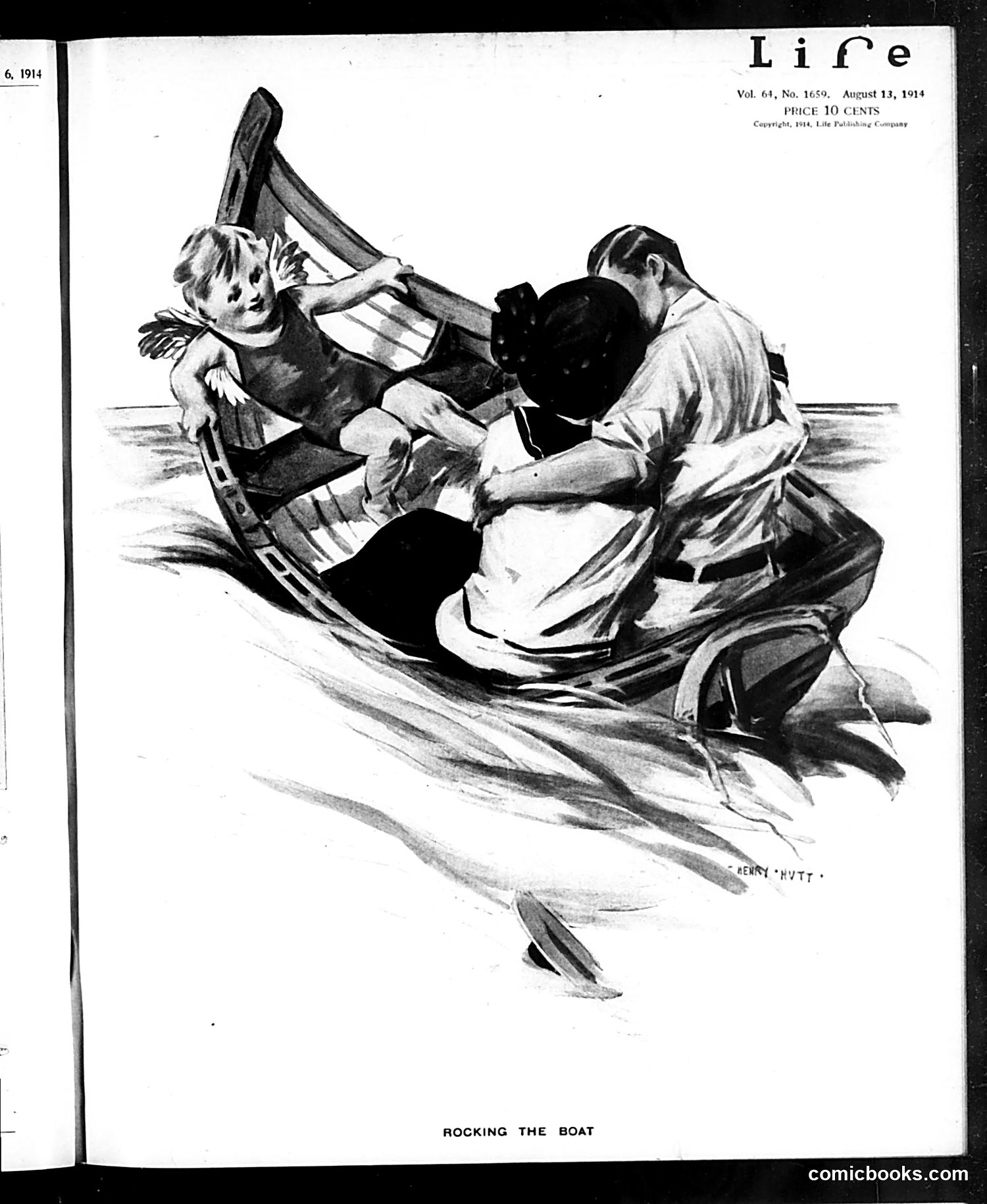
This is a humorous domestic illustration rather than political satire. The cartoon shows a man and woman in a rowboat with a small child, appearing to playfully rock or destabilize the boat—a lighthearted scene of family recreation gone slightly chaotic. The title "Rocking the Boat" is a play on the common cautionary phrase warning against destabilizing situations. Here it's literal: the adults are actually rocking their boat, creating excitement (or mild danger) for the child. The artist Perry "Butt" has created a gentle, comedic commentary on parental play and the mild recklessness of summer boating activities—relatable humor for *Life* magazine's early 20th-century audience enjoying leisure time.
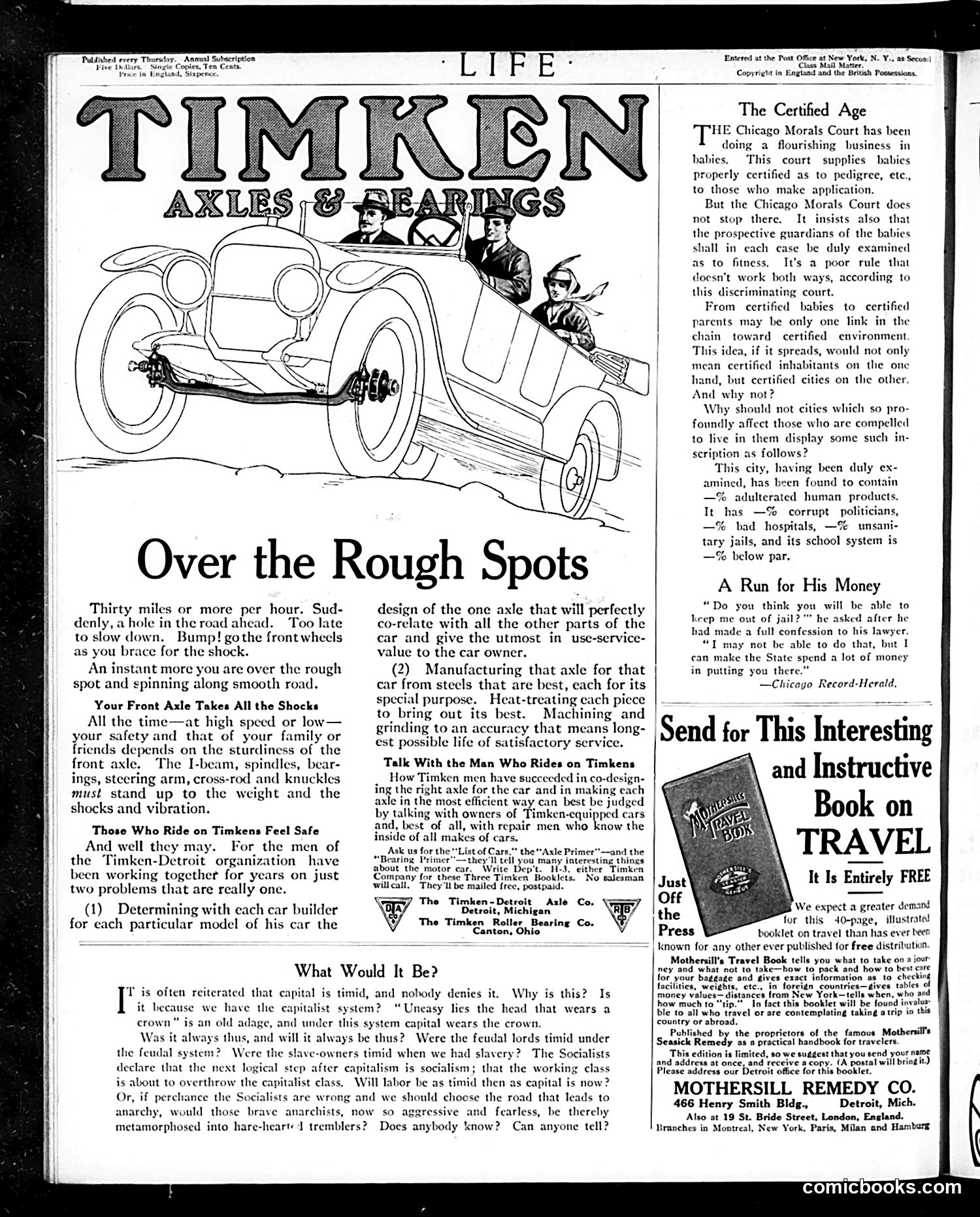
This page is primarily a **commercial advertisement** for Timken automobile axles and bearings, not political satire. The large illustration depicts a car navigating rough road conditions at high speed, with passengers experiencing the jolts and vibrations. The ad's central argument: Timken axles absorb shocks better than competitors, making cars safer and more comfortable. The text emphasizes engineering precision—heat-treating metal, grinding to accuracy—to justify superior performance and longevity. The sidebar "What Would It Be?" briefly critiques capitalism's timidity, though this appears tangential to the main sales pitch rather than the page's primary message. The advertisement occupies most of the space, with supplementary travel guide promotion and other ads filling margins.
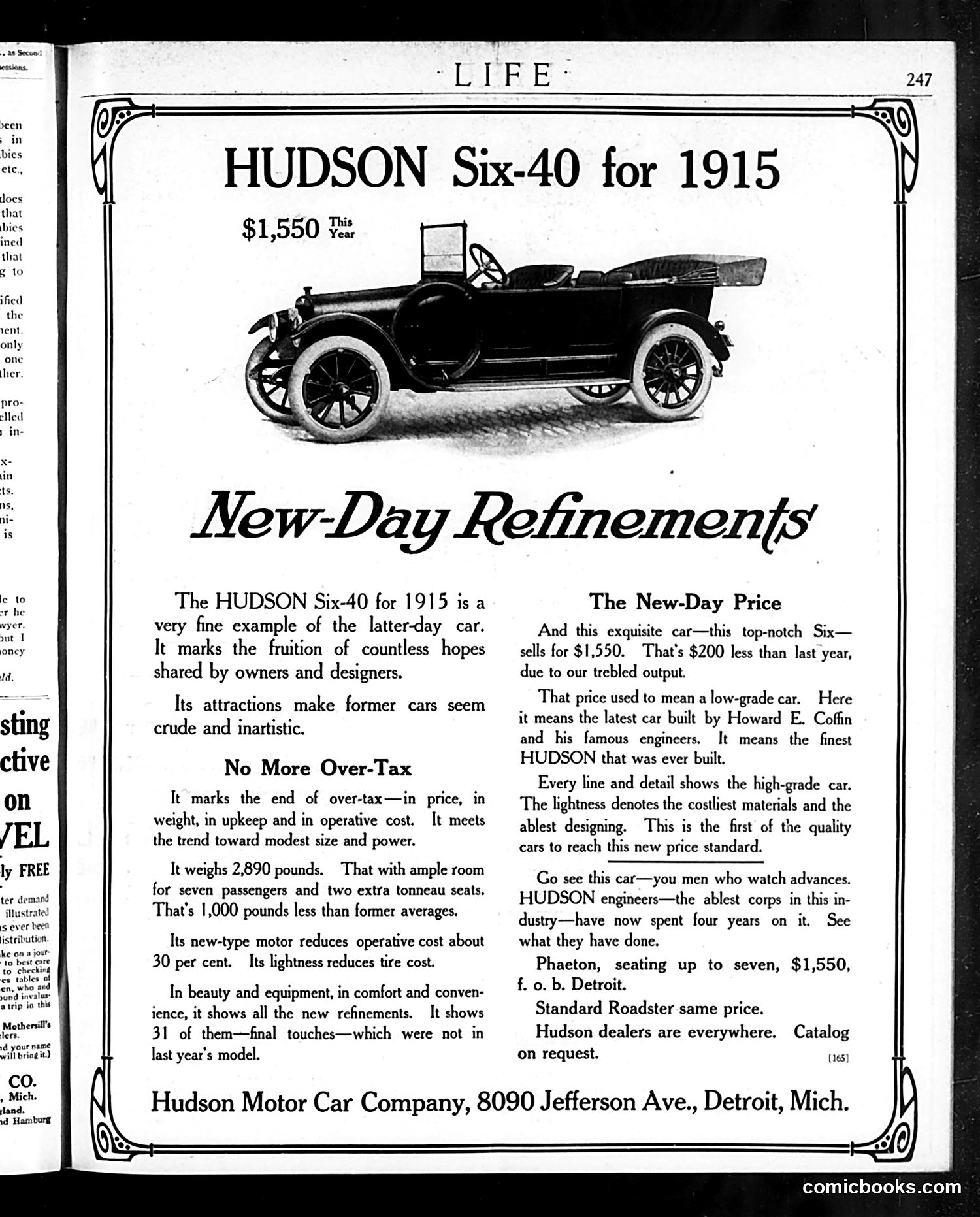
This is a **straightforward automobile advertisement**, not satire or political commentary. It appeared in *Life* magazine's advertising section. The Hudson Motor Car Company promotes their 1915 Six-40 model at $1,550—positioned as an affordable yet high-quality vehicle. Key selling points include: - **Price reduction** ($200 less than previous year) achieved through increased manufacturing output - **Weight savings** (2,890 pounds, 1,000 pounds lighter than competitors) - **Operating efficiency** (30% reduction in fuel costs) - **Quality refinements** (31 new design details) The ad emphasizes that this price point no longer means "low-grade" but represents "the finest HUDSON that was ever built"—appealing to middle-class buyers seeking quality without extravagance during the post-1914 economic period.
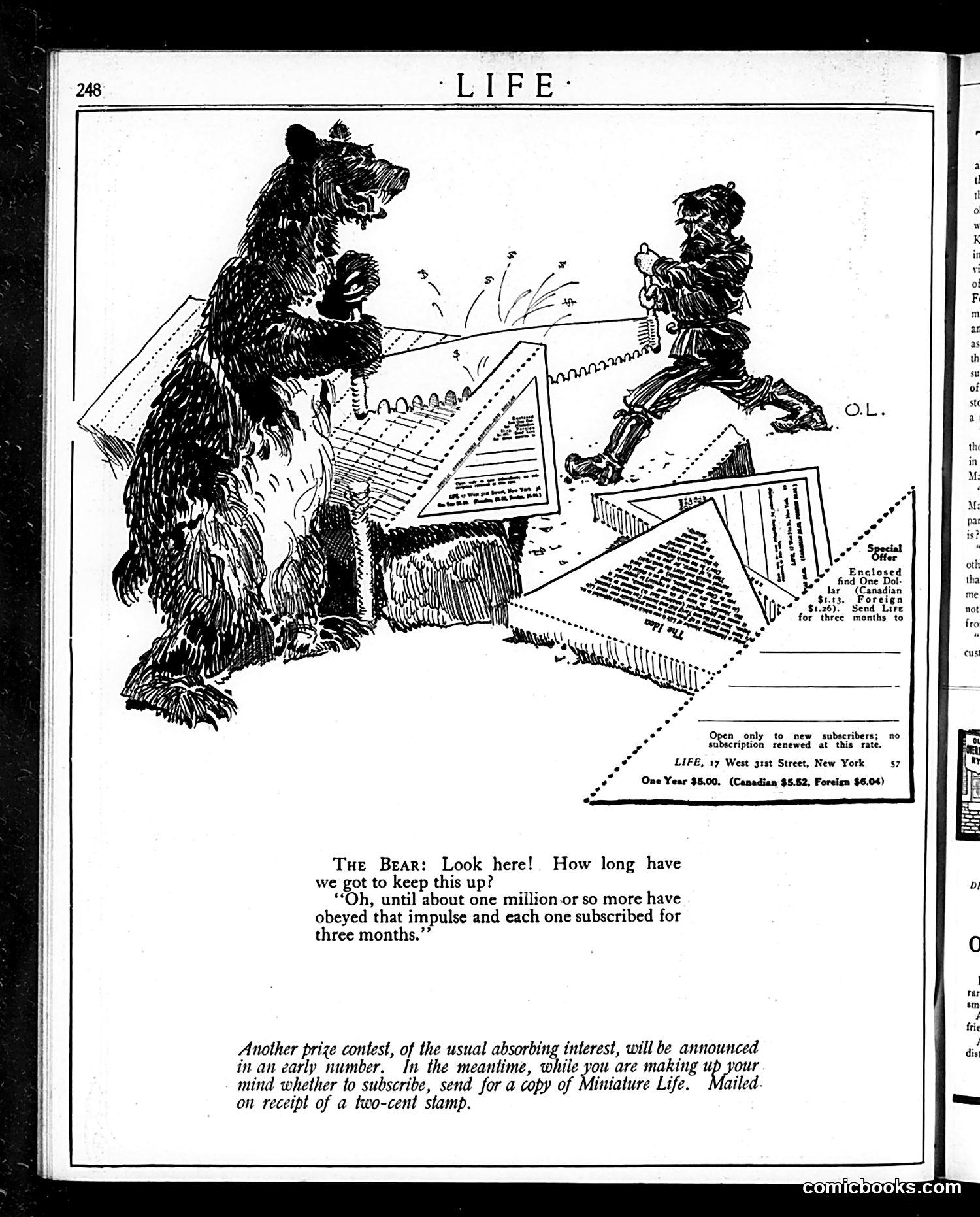
This page features a satirical cartoon about magazine subscription campaigns. A bear and a small figure (likely representing Life magazine's mascot or personification) are depicted operating a fire hose spraying water—representing subscription impulses—at stacks of subscription forms and promotional materials. The bear's dialogue expresses frustration: the magazine must maintain this aggressive subscription push "until about one million or so have obeyed that impulse and each one subscribed for three months." The satire targets the relentless, high-pressure marketing tactics Life employed to boost circulation numbers. The imagery of an uncontrollable fire hose suggests the campaign's overwhelming, almost absurd intensity. The page also advertises a forthcoming prize contest to maintain reader interest during this subscription drive.
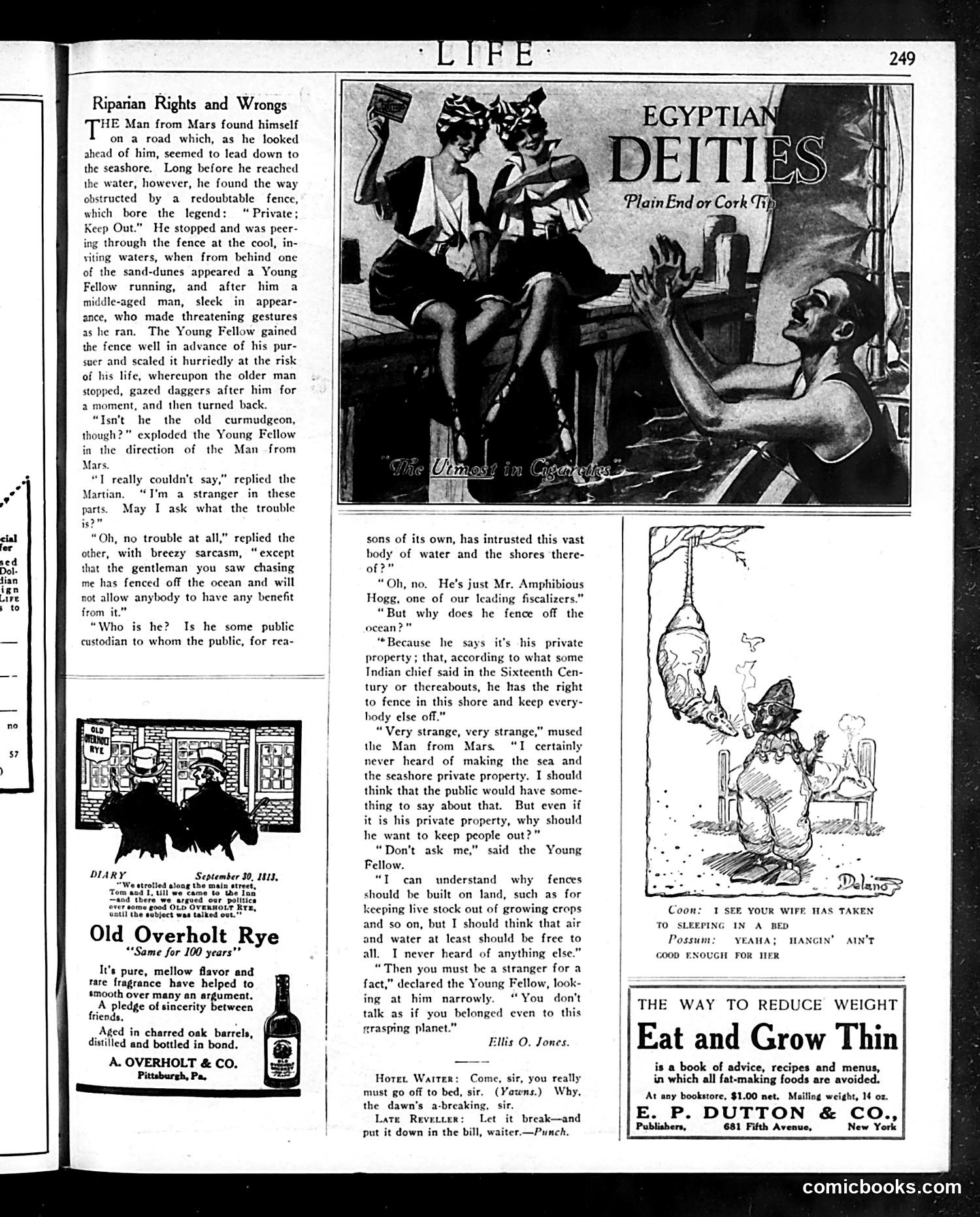
The main content is a story titled "Riparian Rights and Wrongs" about a Martian encountering a dispute over water access. A man named Mr. Amphibious Hogg has fenced off oceanfront property, claiming private ownership rights to prevent public beach access. The Martian finds this practice bizarre, arguing that air and seawater should remain free to all. This satirizes contemporary American property disputes over riparian (waterfront) rights—a genuine legal debate of the era. The story mocks the absurdity of privatizing natural resources like ocean access while using an extraterrestrial perspective to highlight how irrational such exclusions appear. The page also includes unrelated advertisements and a brief comic about hotel service.
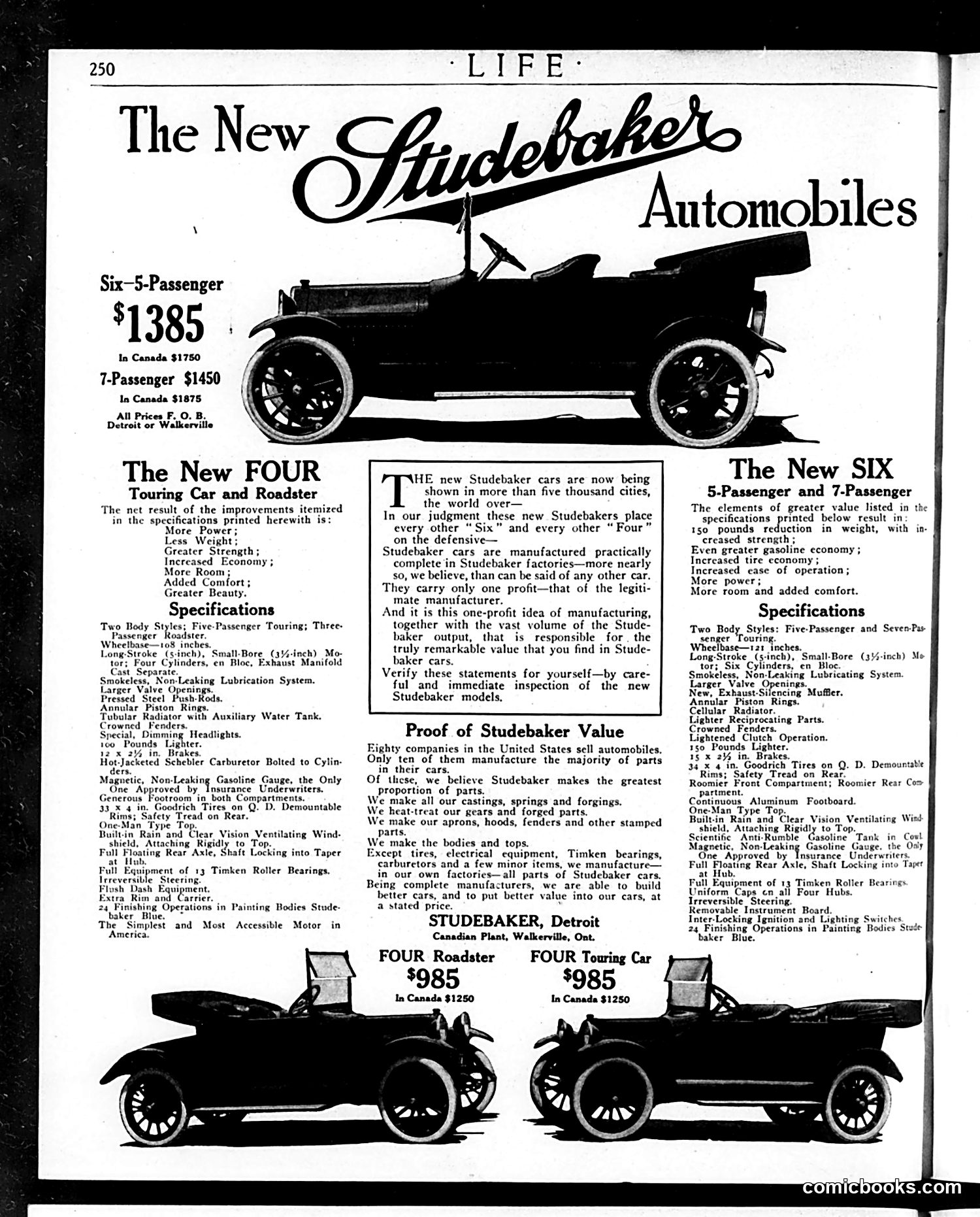
This is **not a political cartoon or satire page**—it's a straightforward automobile advertisement for Studebaker vehicles, published in *Life* magazine. The page advertises four Studebaker models with prices ranging from $985 to $1,450. It emphasizes manufacturing quality, value, and competitive advantages: Studebaker manufactures most of its own parts (unlike competitors who source externally), enabling better quality control and lower costs. The "Proof of Studebaker Value" section lists technical specifications and manufacturing practices intended to justify the brand's competitive pricing. This was standard early-20th-century advertising strategy—using detailed technical claims to build consumer confidence in automobile purchases. The silhouette illustrations show the vehicle designs typical of the 1910s-1920s era.
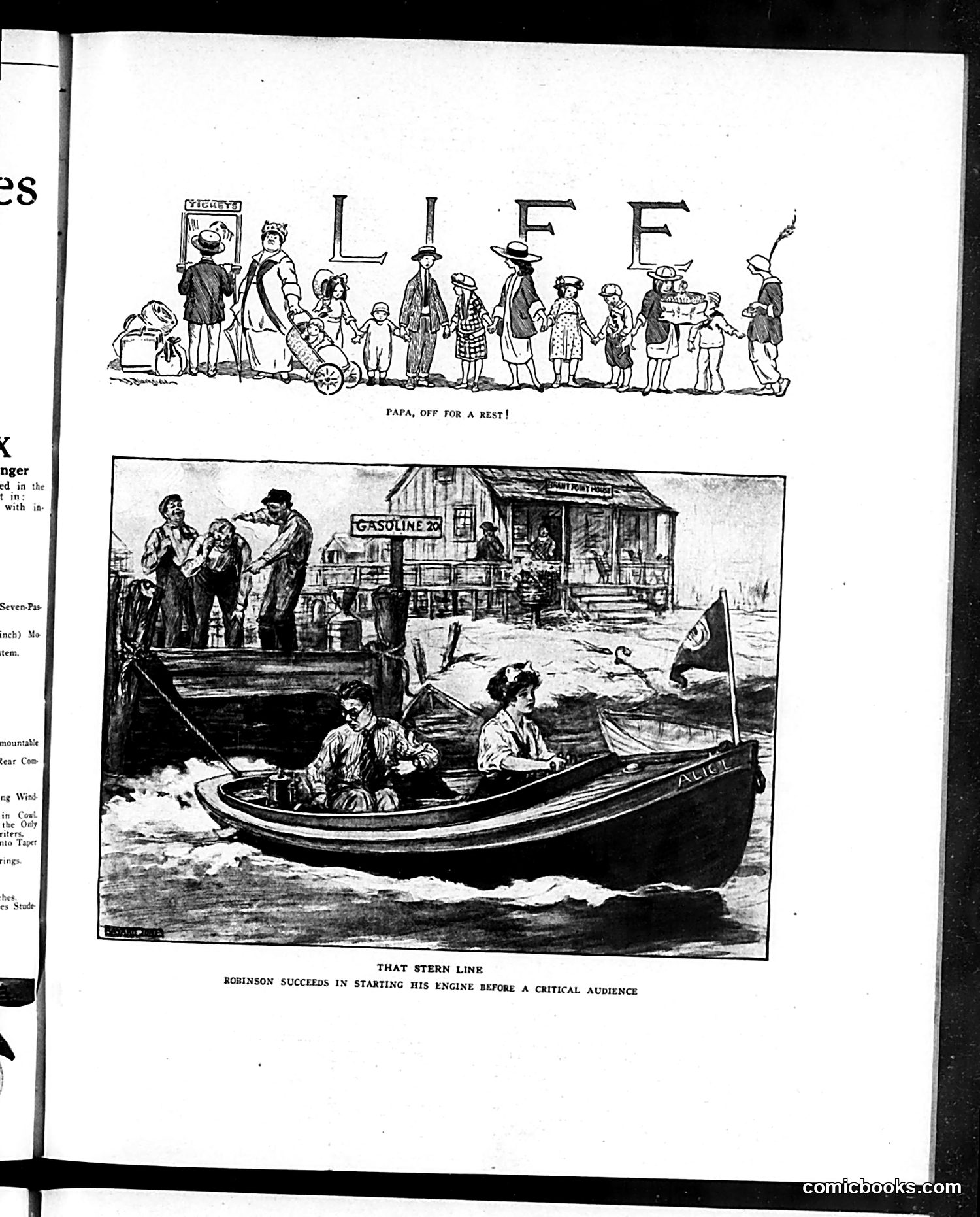
The page contains two cartoon scenes from what appears to be a film or story titled "Life." **Top image:** A decorative header shows a large family group ("PAPA, OFF FOR A REST!"), depicting parents and numerous children in period clothing, suggesting themes of family size or domestic life. **Bottom image:** Titled "That Stern Line - Robinson Succeeds in Starting His Engine Before a Critical Audience," this shows two men in a small boat labeled "Alice" near a gas station. The scene depicts an apparently comedic moment where someone named Robinson successfully starts an engine while being observed by onlookers. Without additional context about the source material or historical period, the specific satirical targets remain unclear, though the humor appears to involve family dynamics and mechanical mishap.
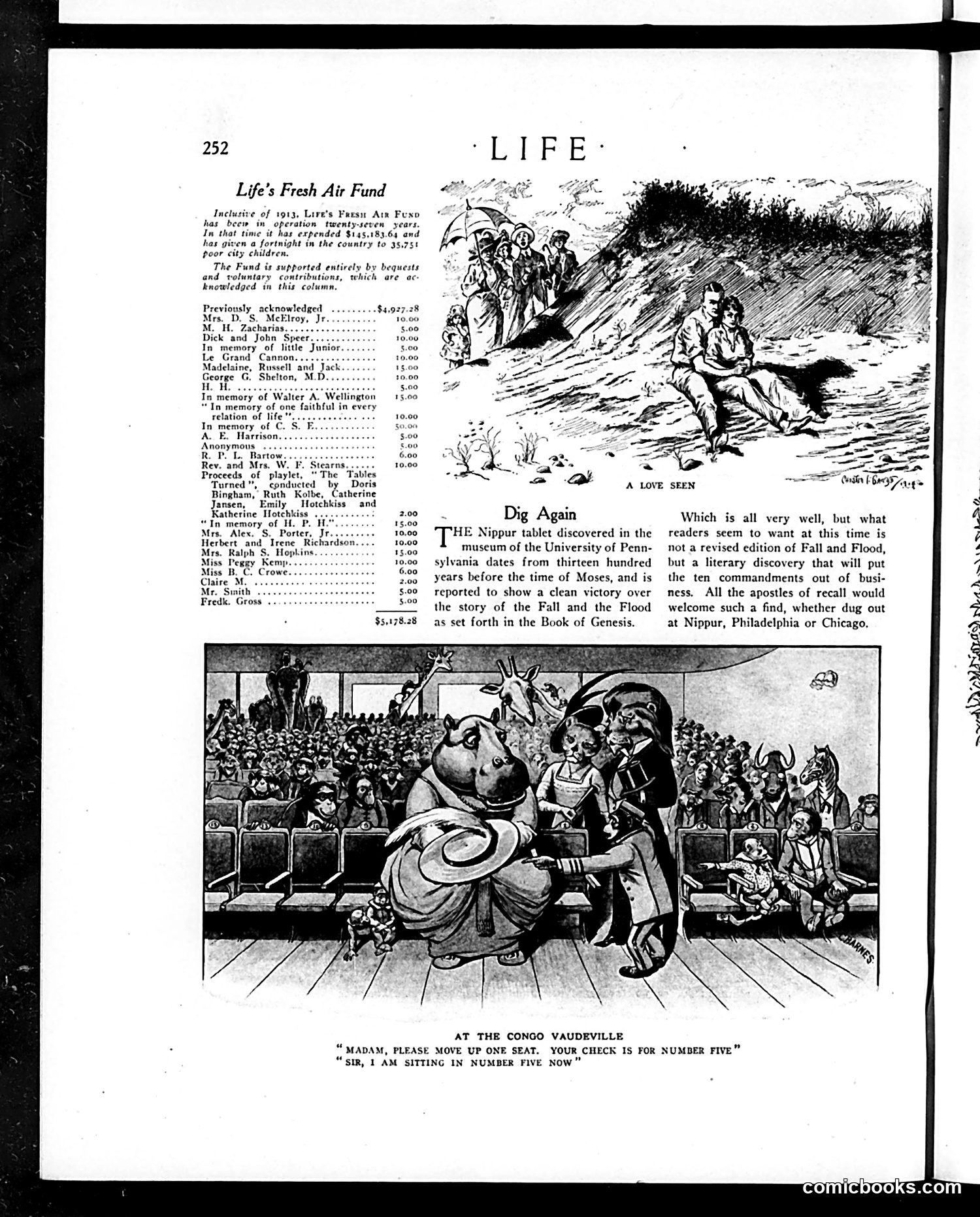
This satirical cartoon depicts a vaudeville theater scene with caricatured Black performers. The caption reads: "MADAM, PLEASE MOVE UP ONE SEAT, YOUR CHECK IS FOR NUMBER FIVE" / "SIR, I AM SITTING IN NUMBER FIVE NOW" The joke relies on racist stereotyping common to early 20th-century American entertainment. It appears to mock both the formality of theater seating protocols and, more offensively, presents exaggerated caricatures of Black performers and audience members for comedic effect. The cartoon reflects the era's segregated entertainment industry and casual racism embedded in mainstream publications. The humor depends entirely on dehumanizing caricature—a standard satirical approach in *Life* magazine during this period that modern audiences would recognize as offensive and discriminatory rather than clever.
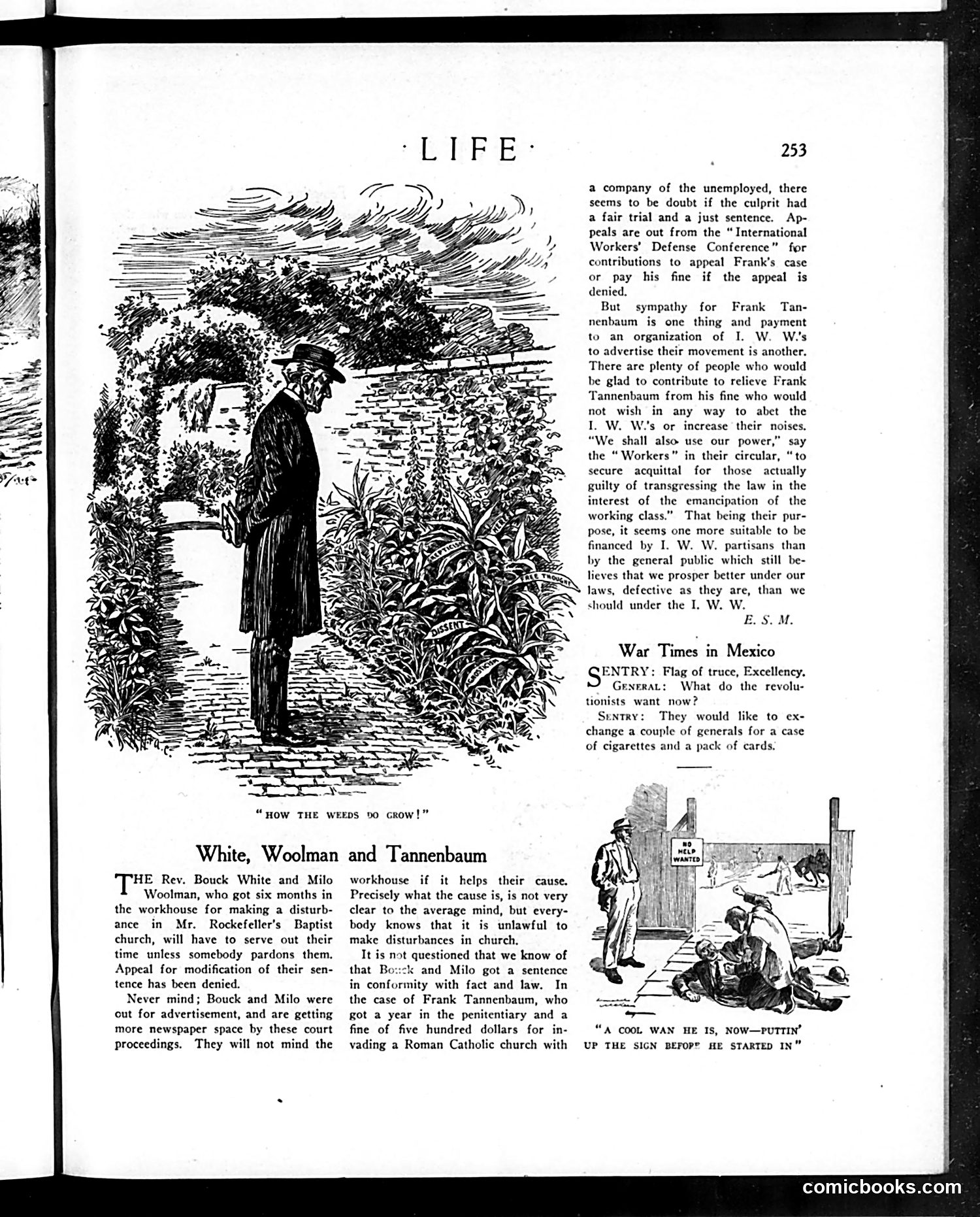
This page contains two distinct items: **Top section:** A letter to the editor (signed "E.S.M.") defending Frank Tannenbaum against criticism. The writer argues that sympathy for Tannenbaum is justified and suggests the I.W.W. (Industrial Workers of the World) should finance his legal defense rather than the general public. **Main feature:** "White, Woolman and Tannenbaum" — an article about Rev. Bouck White and Milo Woolman, who received six-month workhouse sentences for "making a disturbance" at a Baptist church. The article notes they won't appeal and will use their sentence to publicize their cause. **Bottom cartoon:** A brief satirical exchange titled "War Times in Mexico," showing soldiers negotiating a truce by proposing to trade military officers for cigarettes and cards. The page reflects 1910s-era labor activism and radical politics.
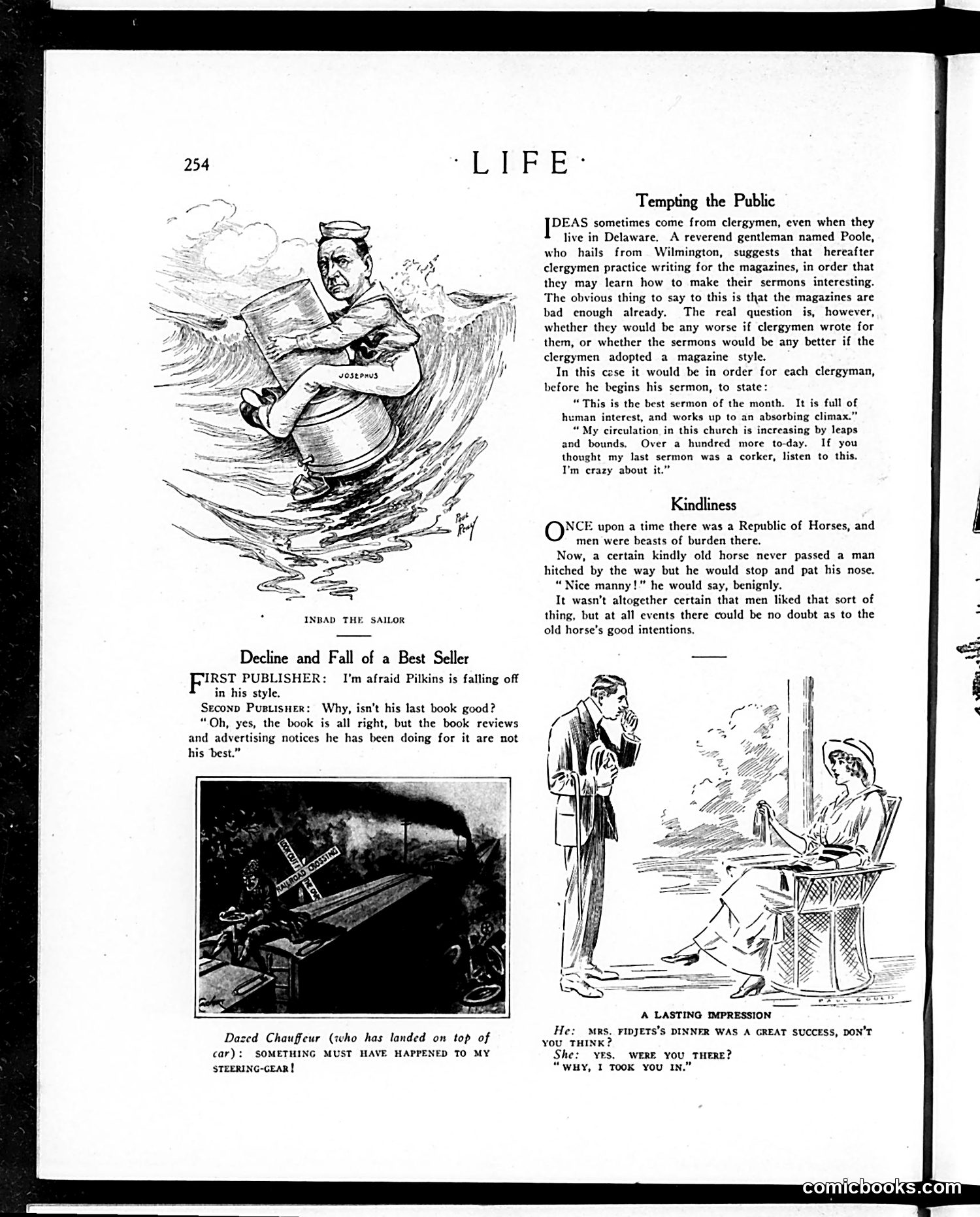
**"Tempting the Public"** satirizes clergymen contributing magazine articles. The text suggests a Delaware reverend named Rhode pitched sermon-writing to magazines so clergy could learn to make sermons "interesting." The satire questions whether magazines need more clerical content or if such pieces would actually improve sermons. **"Kindliness"** is a brief humorous anecdote about a horse's gentle nature—likely a palate-cleanser between satirical pieces. **"Decline and Fall of a Best Seller"** mocks author Pikkins through a publisher dialogue, suggesting his recent work and promotional efforts are inferior to previous success. The accompanying dark illustration appears to show industrial or mechanical chaos, supporting the "decline" theme. **"A Lasting Impression"** is a domestic joke about a wife crediting her dinner's success to her husband's presence.
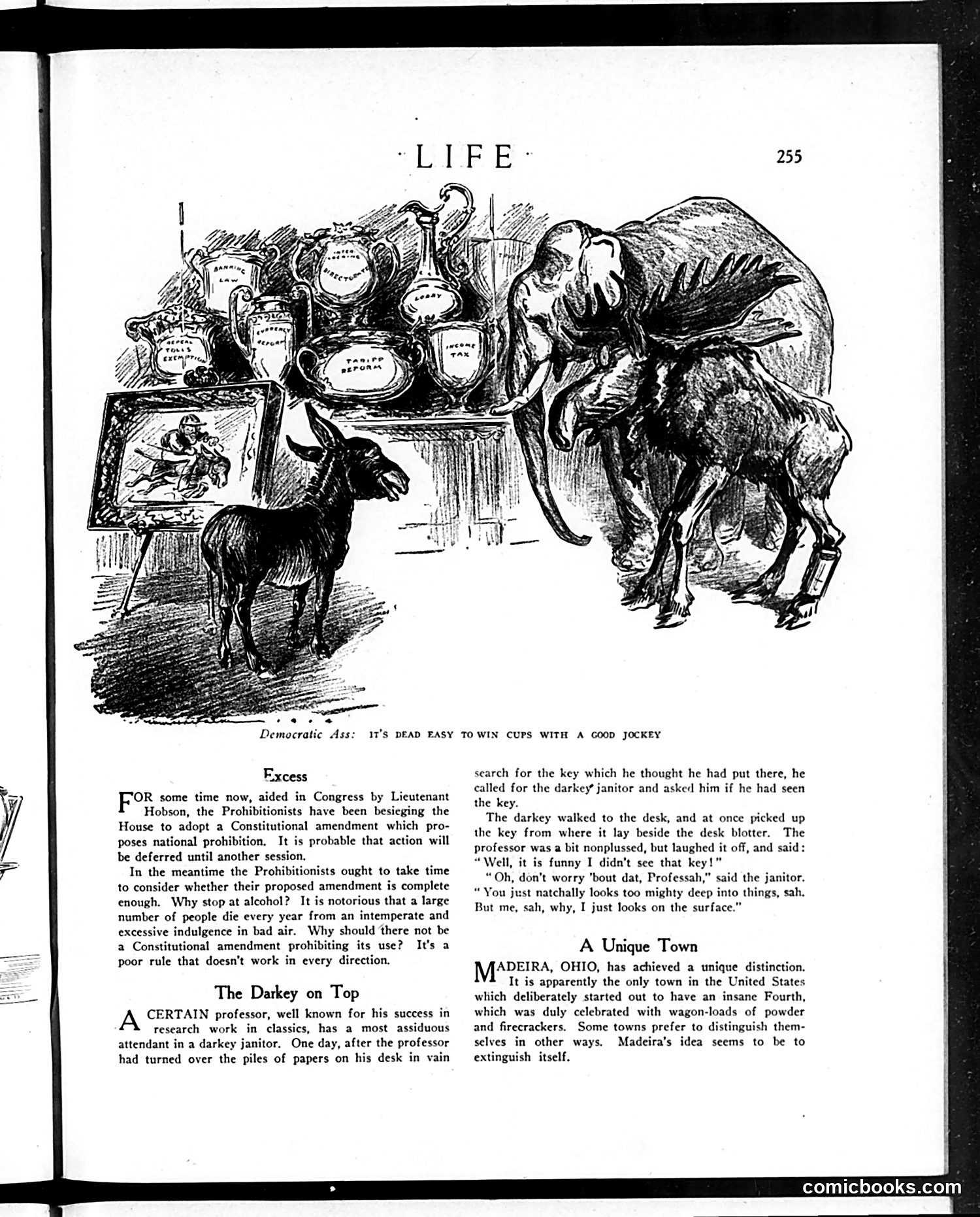
**The Main Cartoon** ("Democratic Art: It's Dead Easy to Win Cups With a Good Jockey") depicts a donkey (symbol of the Democratic Party) with an elephant (Republican Party) observing. The donkey appears to be winning trophies/cups displayed on a shelf behind them. **The Satire:** This critiques Democratic political success, suggesting they win through having a "good jockey" (skilled leadership/manipulation) rather than legitimate merit. The caption implies the Democratic Party achieves electoral victories through shrewd political maneuvering rather than superior policy or principles. **Context:** This likely comments on early-20th-century Democratic electoral victories, suggesting they succeed through tactical skill rather than substantive reasons—a common Republican criticism of their opponents' political machinery.
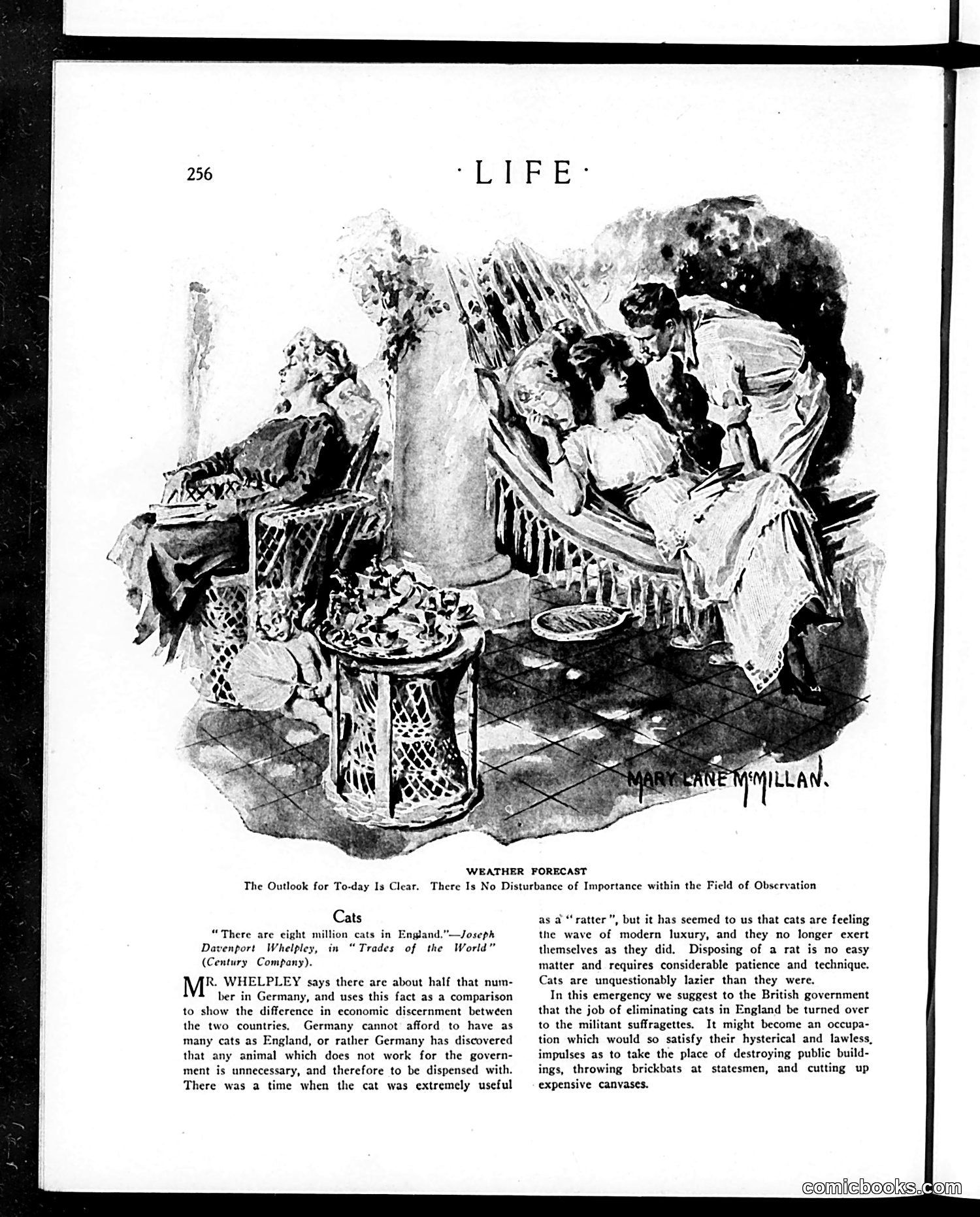
This page contains an illustration by Mary Jane McMillan and an article about cats during wartime. The sketch shows fashionably dressed women in what appears to be a social gathering, seated in comfortable chairs. The article's satire concerns British and German attitudes toward cats. It notes that England has approximately eight million cats, while Germany has fewer. The piece argues sarcastically that Germany's culling of "non-working" animals reflects utilitarian philosophy, suggesting Britain should consider eliminating cats as an "emergency" measure—ironically proposing that destroying cats could replace destructive suffragette activities like bombing buildings and slashing paintings. This appears to be WWI-era commentary mocking both German pragmatism and feminist militancy through the unlikely subject of domestic cats.
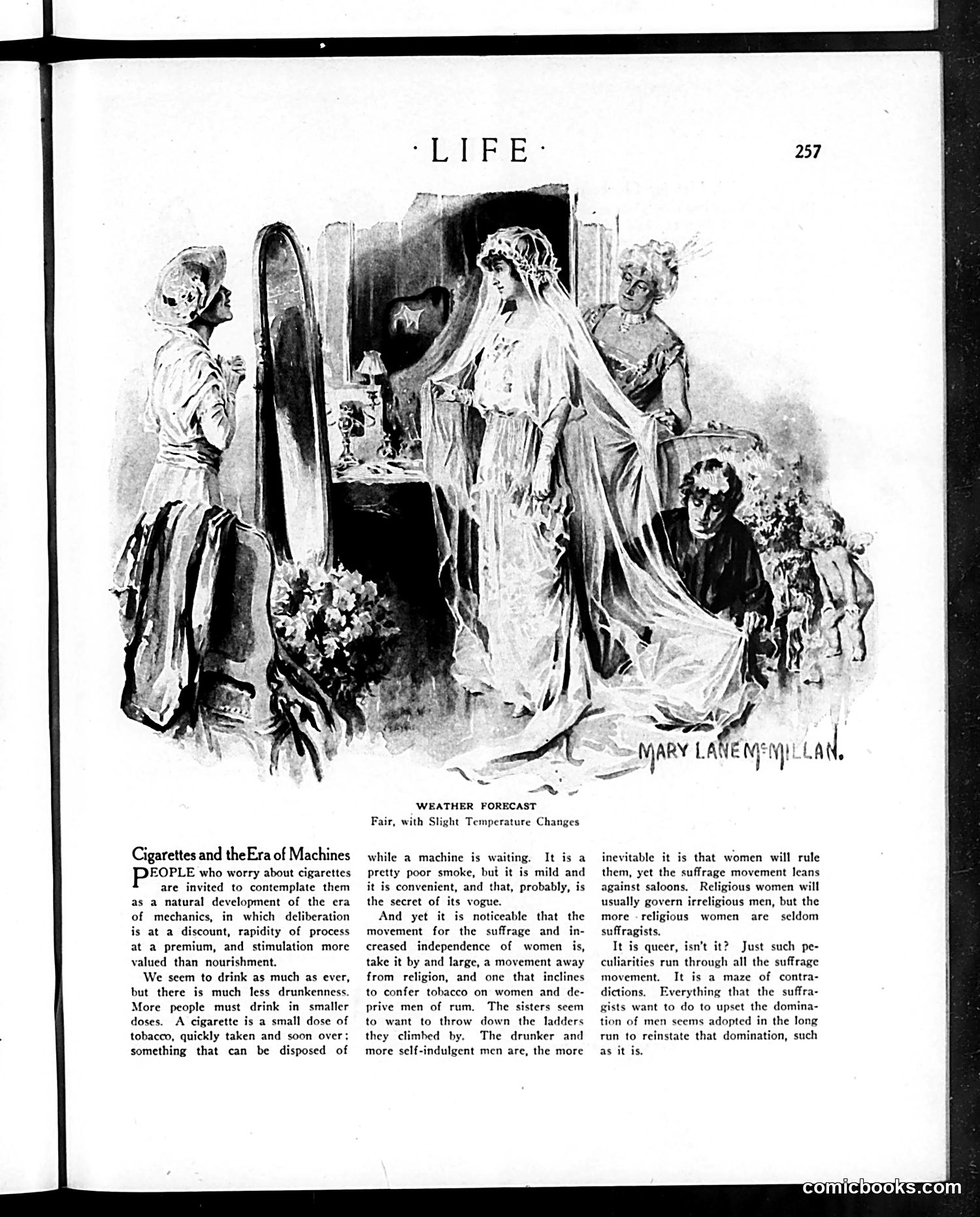
**The Illustration:** Mary Lane McMillan's drawing depicts a bride in her wedding chamber, attended by women. The scene appears to show a bride preparing for her wedding night—a traditional domestic moment. **The Article: "Cigarettes and the Era of Machines"** This opinion piece criticizes both increased cigarette consumption and the women's suffrage movement. The author argues that cigarettes represent passive acceptance of industrial society, and sarcastically suggests that women entering politics represents men abdicating their authority. The piece conflates women's independence with social decline, expressing anxiety about changing gender roles. **Context:** This reflects early 20th-century anti-feminist rhetoric that portrayed women's political participation as threatening to social order and masculine authority.
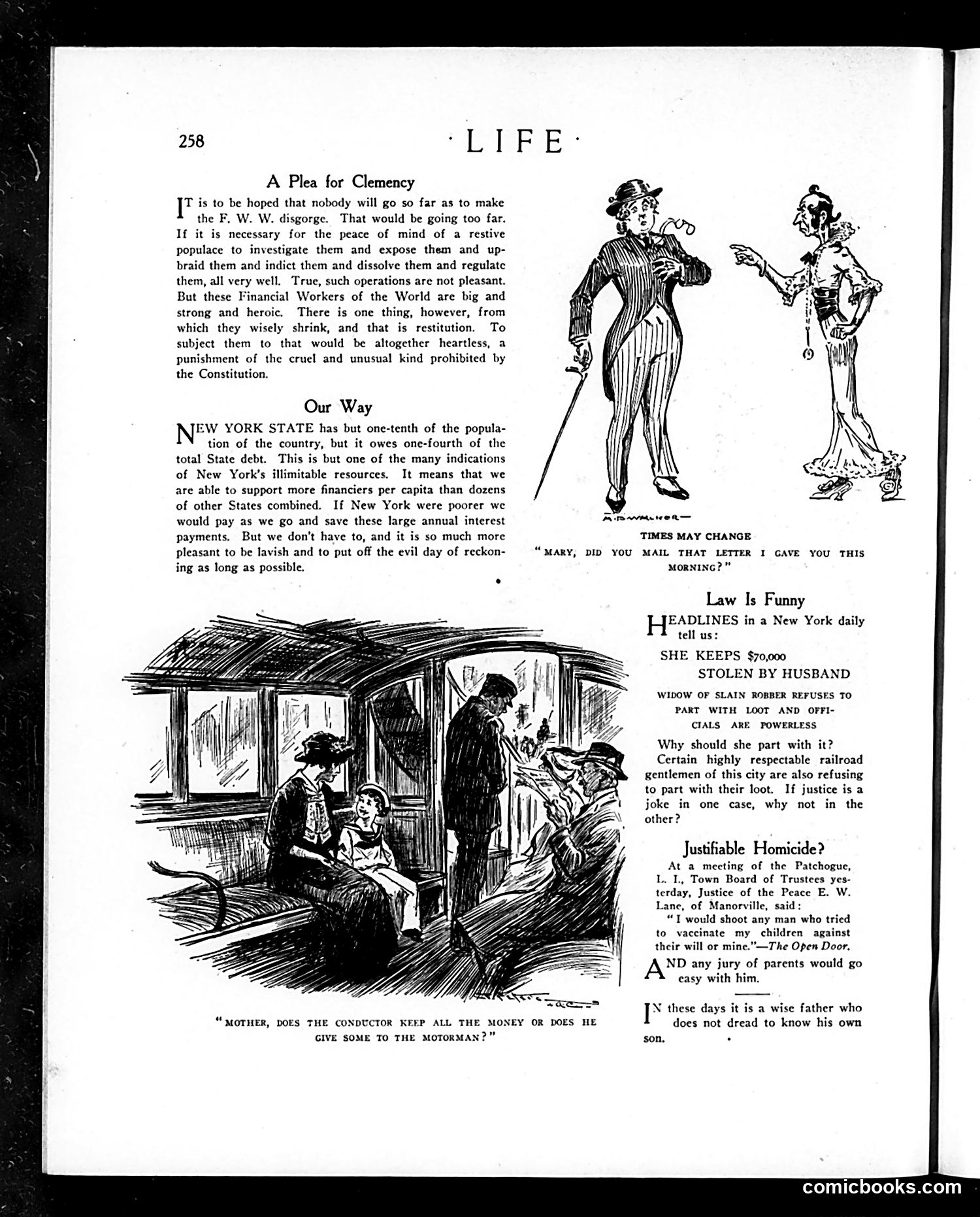
This page contains three separate satirical pieces critiquing early 20th-century social issues: 1. **"A Plea for Clemency"**: Advocates restraint in investigating the P.W.W. (likely the Industrial Workers of the World), arguing that harsh treatment would violate constitutional protections despite their unpopularity. 2. **"Our Way"**: Defends New York State's financial burden relative to national debt, suggesting the state's resources justify its obligations. 3. **"Law Is Funny"**: A series of brief satirical items mocking legal inconsistencies—including a woman keeping stolen money, railroad gentlemen refusing to return loot, and a doctor's violent anti-vaccination stance. The accompanying cartoon depicts crowded public transit, with a joke about conductor payment. The page uses humor to critique legal hypocrisy and social injustice among the wealthy and powerful.
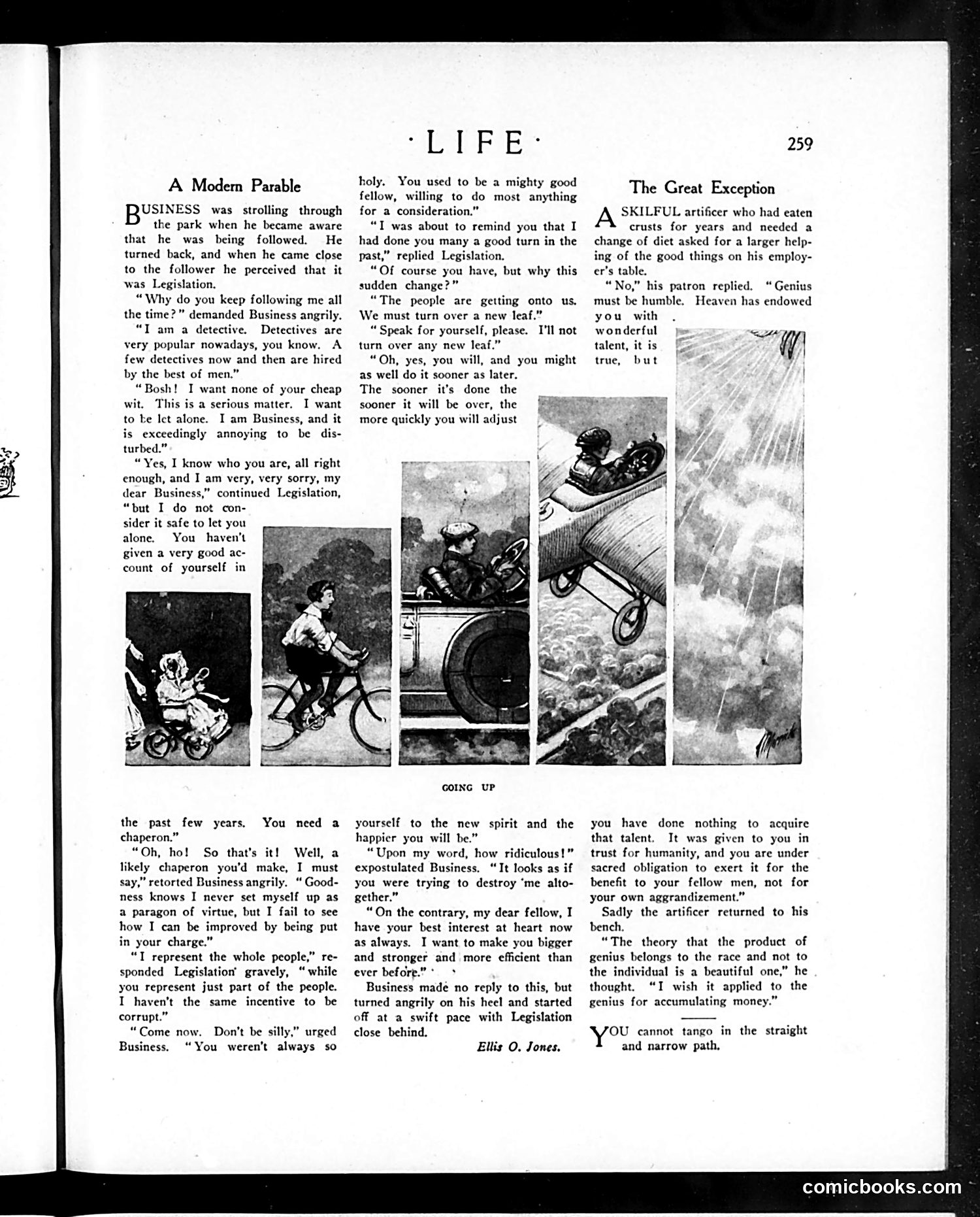
**"A Modern Parable"** depicts an allegory between Business (personified) and Legislation. Business resents being "followed" and regulated, claiming he wants to be left alone. Legislation argues he must serve as a "chaperon" because Business hasn't given "a very good account of himself" in recent years. Business cynically reminds Legislation that he was once corrupt ("willing to do most anything for a consideration"), but Legislation claims reform is necessary because "the people are getting onto us." The cartoon satirizes the tension between unregulated capitalism and Progressive-era regulatory reform—Business resists oversight while Legislation insists public pressure now demands it. **"The Great Exception"** mocks wealthy employers' hypocrisy. A talented worker asks for better compensation, but his patron refuses, claiming genius must remain "humble" and serve humanity selflessly as a sacred trust. The worker's bitter conclusion—that this noble theory of shared genius somehow never applies to the employer's "genius for accumulating money"—exposes the double standard: altruism is demanded of workers, not the wealthy. Both stories critique early 20th-century power imbalances.
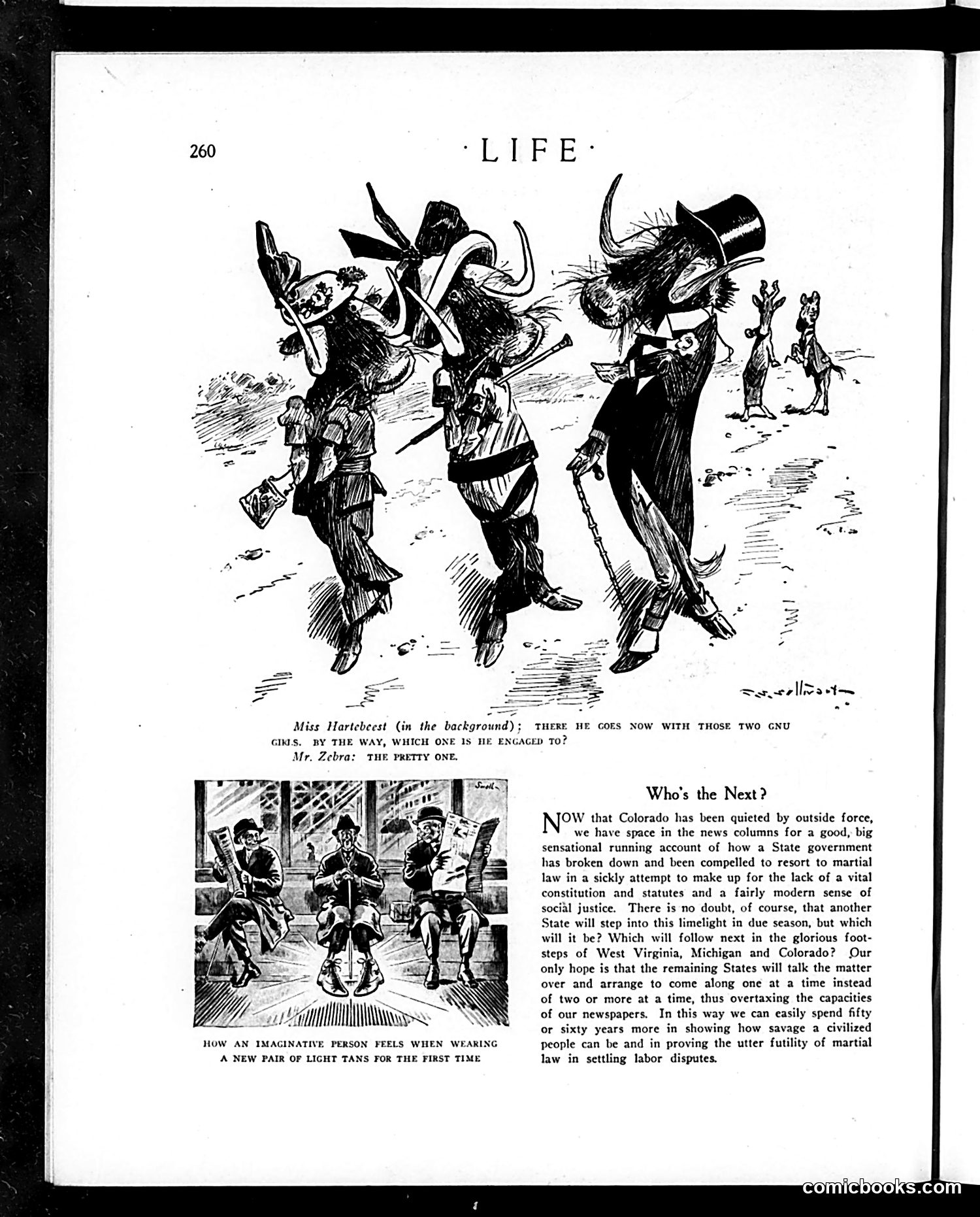
The top cartoon uses animal characters (zebra, wildebeest, gnu) as stand-ins for people, making a joke about romantic entanglement—the zebra claims his fiancée is "the pretty one" among indistinguishable gnus, suggesting he can't tell them apart or is being deliberately evasive. The article "Who's the Next?" directly addresses labor unrest and state government collapse. It references Colorado, West Virginia, and Michigan experiencing breakdowns requiring martial law to suppress labor disputes. The piece sarcastically suggests these states have inadequate legal frameworks and poor social justice systems, forcing them to resort to military force rather than constitutional means. The article expresses dark humor: it hopes remaining states will schedule their labor crises one at a time to avoid overloading newspapers, and sarcastically predicts fifty more years of documenting how "savage" civilized people become during labor disputes—while emphasizing martial law's futility in solving underlying problems. This reflects early 20th-century American labor conflicts and governmental responses.
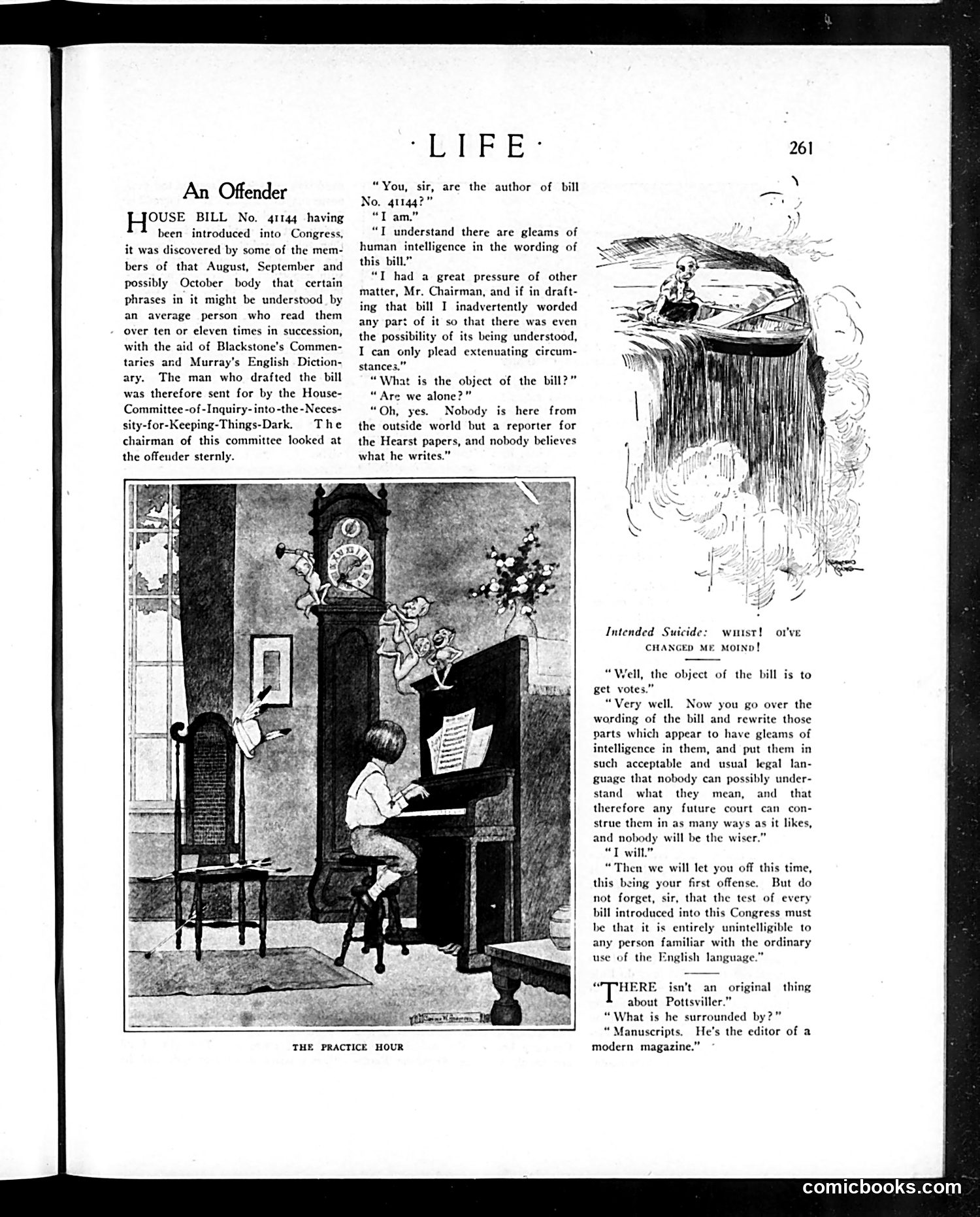
This satirical piece mocks the deliberate obfuscation in congressional legislation. The main cartoon depicts a House Committee interrogating the author of Bill No. 41144, accusing him of the serious offense of writing legislation that is actually *understandable* to ordinary people. The joke: Congress treats clarity as a violation. The committee chairman instructs the bill's author to rewrite it in impenetrable legal language so courts can interpret it multiple ways and "nobody will be the wiser." The satire suggests that deliberately confusing legislation is standard practice—a feature, not a bug—allowing legislators to claim bills mean whatever serves them later. The cartoon criticizes how legislative language obscures rather than clarifies intent, making laws inaccessible to the citizens they govern. This reflects broader Progressive-era frustration with governmental opacity and special interests.
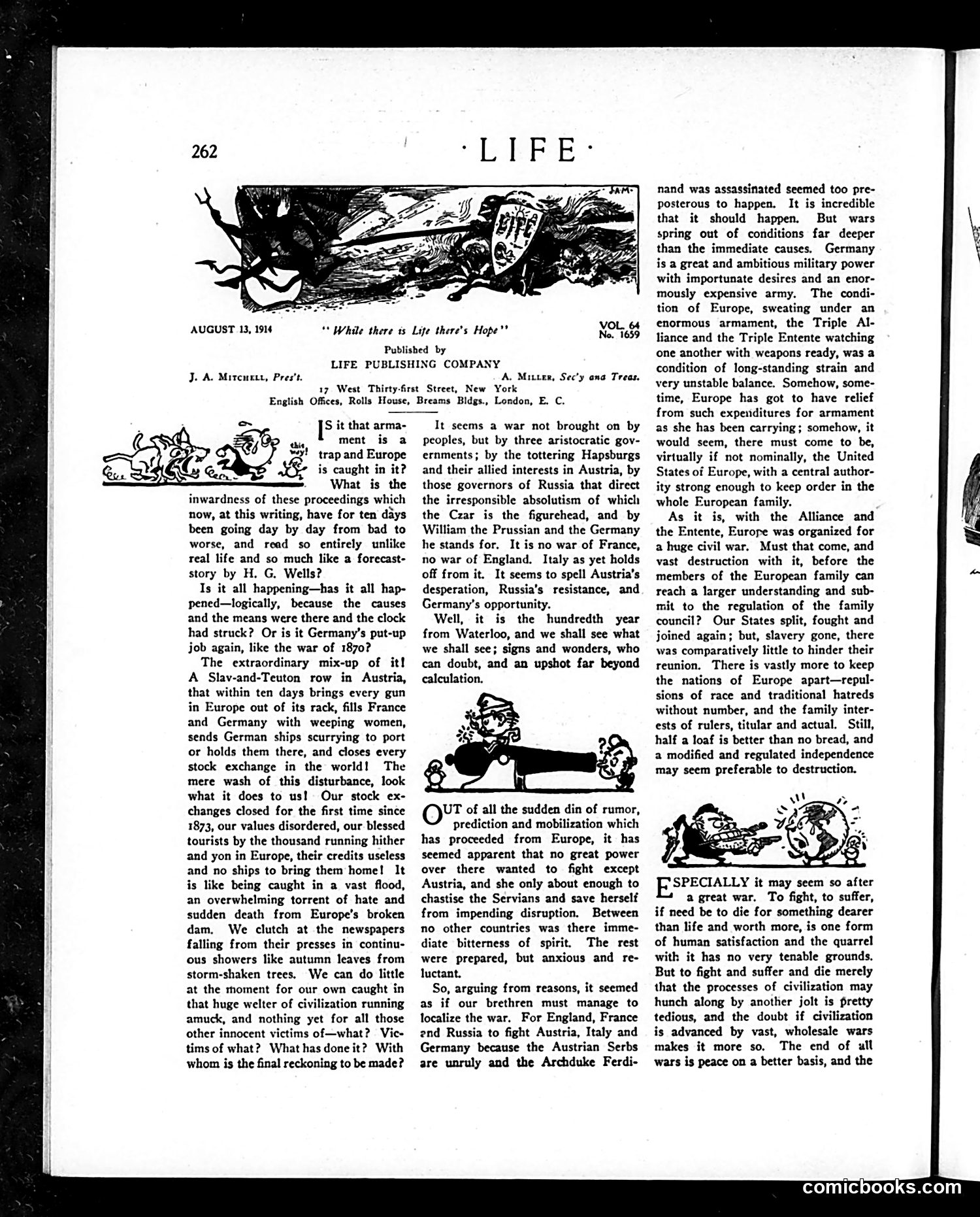
This editorial addresses the outbreak of World War I, specifically the cascade of mobilizations following Archduke Franz Ferdinand's assassination. The cartoons (small illustrations showing figures in conflict) satirize how a localized Austro-Serbian dispute exploded into continental warfare. The author expresses bewilderment that rational people allowed this catastrophe. He identifies blame with three aristocratic governments: Austria-Hungary's "tottering Hapsburgs," Russia's Czar (absolute ruler), and "William the Prussian" (Kaiser Wilhelm II). The piece argues these elites, not ordinary citizens, created the war. Germany emerges as the real aggressor, described as "a great and ambitious military power" exploiting underlying tensions. The author notes Europe had been an unstable powder keg of alliances and armaments—the Triple Alliance versus Triple Entente—waiting for any spark. For American readers in August 1914, this reflects early shock at how quickly diplomatic breakdown became total war, blaming militaristic aristocracy rather than popular will.
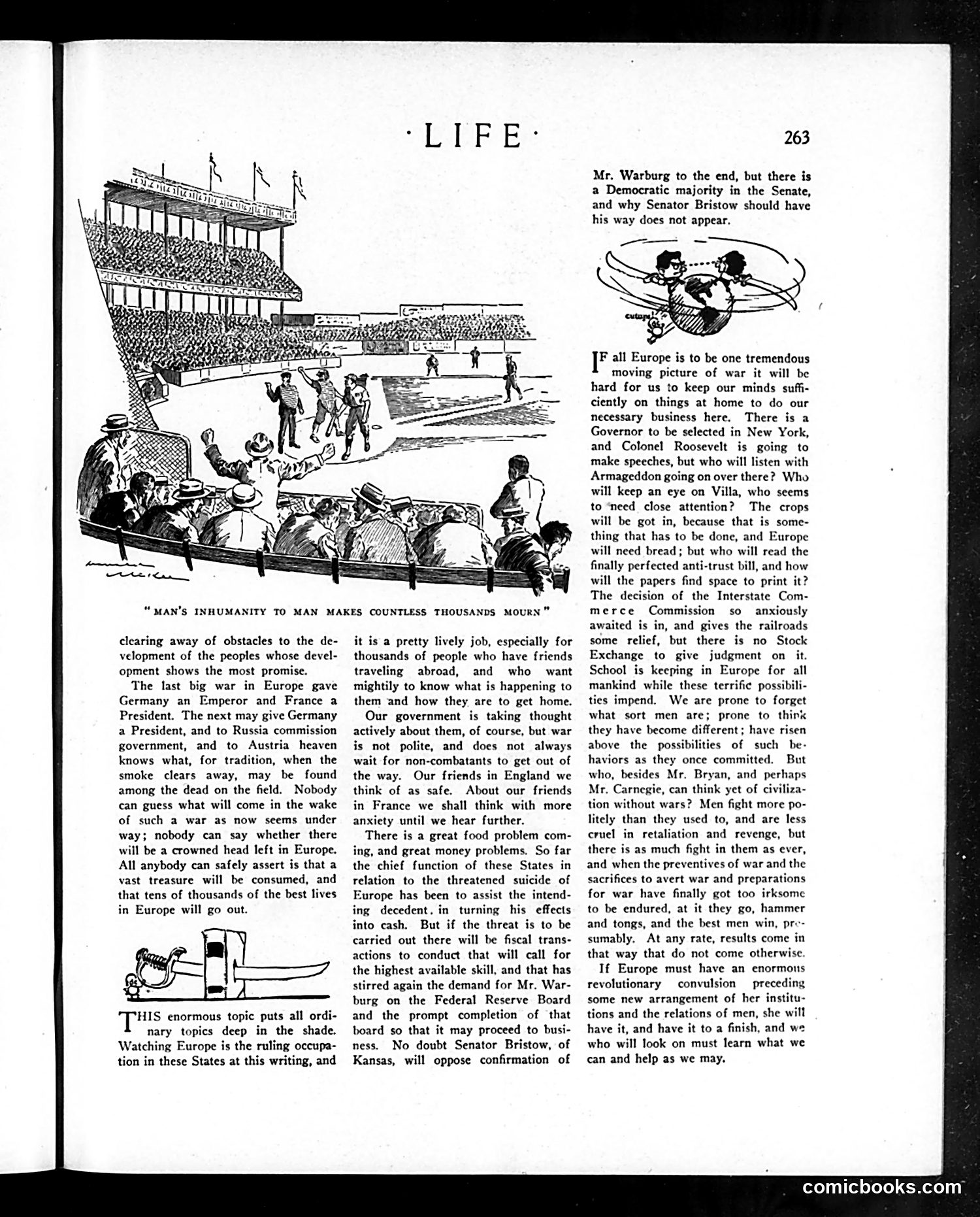
This page addresses the looming threat of World War I to American domestic concerns. The main cartoon depicts a stadium of distracted spectators (Americans) watching Europe's conflict unfold, illustrating the caption "Man's Inhumanity to Man Makes Countless Thousands Mourn." The accompanying editorial argues that European war will overshadow American priorities: New York's gubernatorial election, Colonel Roosevelt's speeches, Mexican tensions (Villa), domestic legislation, and commerce. The text references specific political figures—Senator Bristow opposing banker Paul Warburg's confirmation to the Federal Reserve Board, and pacifists Bryan and Carnegie—to show how even these contentious domestic debates pale beside the European crisis. The piece expresses anxiety about American neutrality's sustainability while acknowledging civilization's cyclical tendency toward conflict, despite claims of moral progress. The overall tone conveys how utterly the approaching war dominates American consciousness.
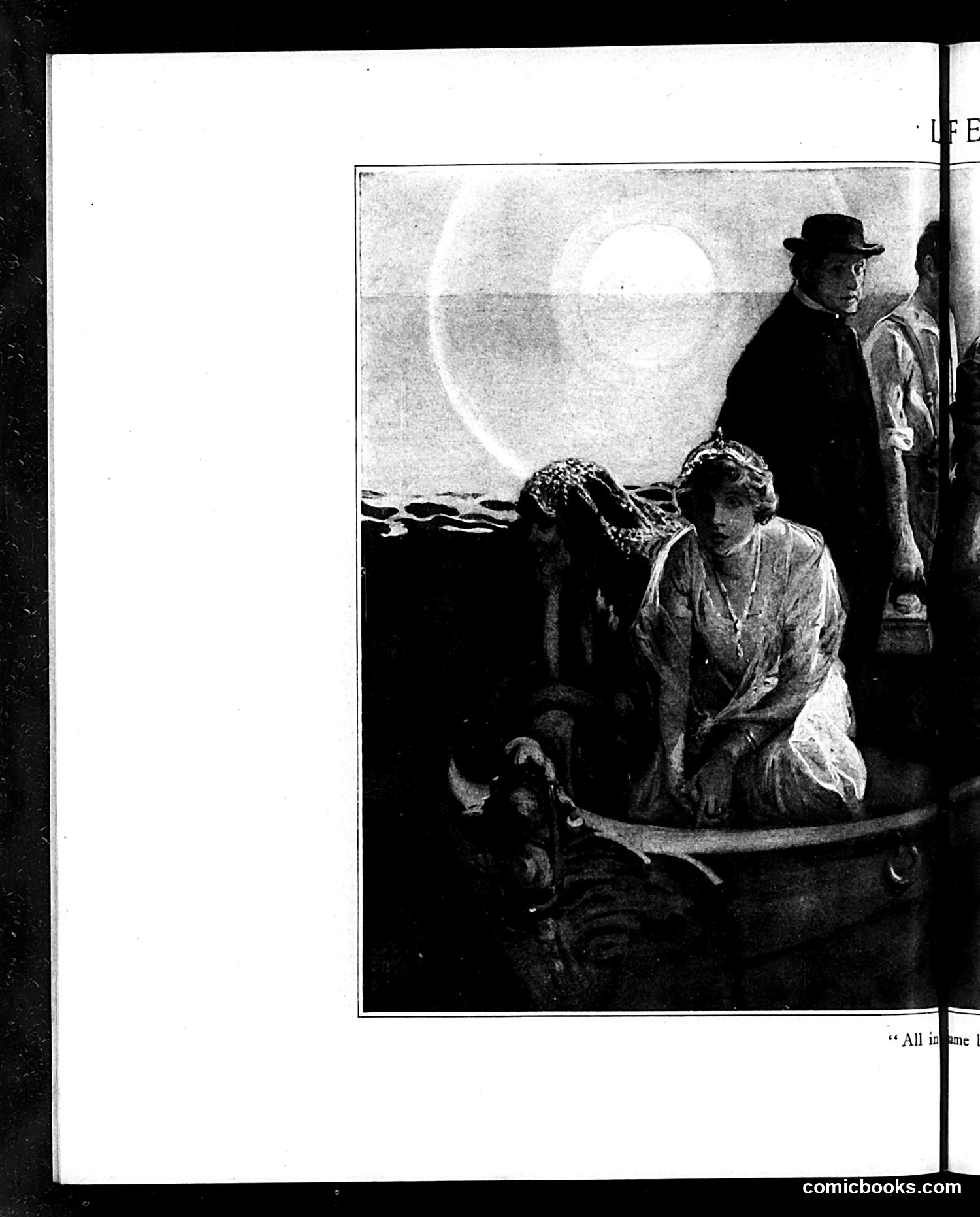
This appears to be a dramatic illustration rather than a satirical cartoon. The image depicts a nighttime maritime scene with a large moon in the background. Several figures are shown on what appears to be a boat or ship, including a woman kneeling or sitting in the foreground and men in dark clothing standing nearby. The theatrical lighting and composition suggest this illustrates a scene from a narrative story or literary work. The visible text fragment at bottom reads "All in one h..." (cut off), but provides insufficient context to identify the specific story being illustrated. Without additional page content, captions, or the full text, I cannot determine what political, social, or satirical message—if any—this image conveys. The style and subject matter suggest early-to-mid 20th century *Life* magazine editorial illustration.
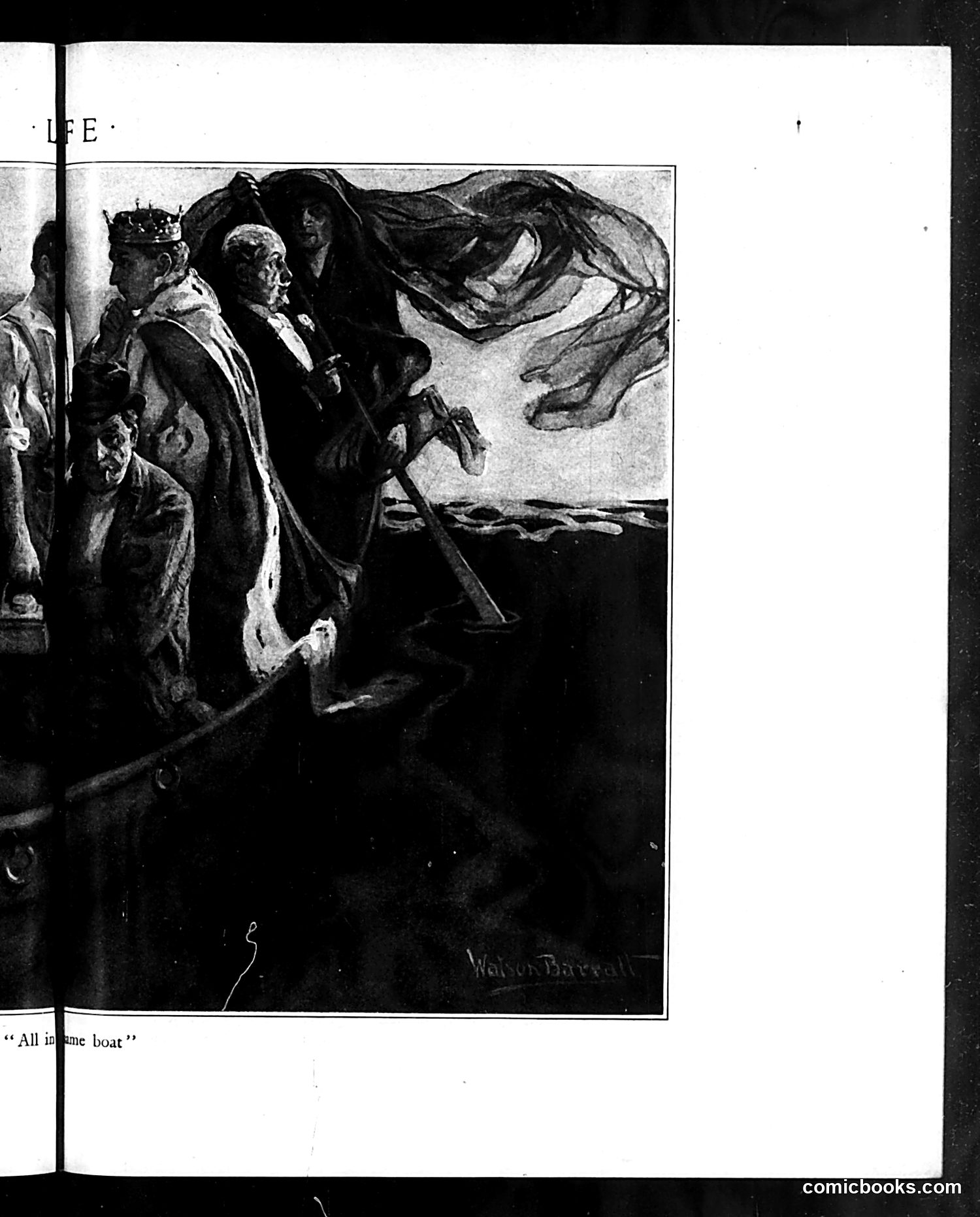
This appears to be a political cartoon from *Life* magazine depicting several figures in or near a boat, suggesting they share a common predicament or fate. The caption "All in the same boat" is a period idiom meaning people are equally affected by the same problem. The figures appear to include royalty (one wears a crown) and other officials in formal dress, depicted in a dark, dramatic style. The artist signature appears to read "Cesare Biscaretti" or similar. Without clearer visibility of specific details or the publication date, the exact historical context remains unclear—this could reference shared wartime hardship, diplomatic crisis, or economic collapse affecting multiple nations or leaders. The satirical point seems to be that despite their status differences, these figures face equal vulnerability to circumstances beyond their control.
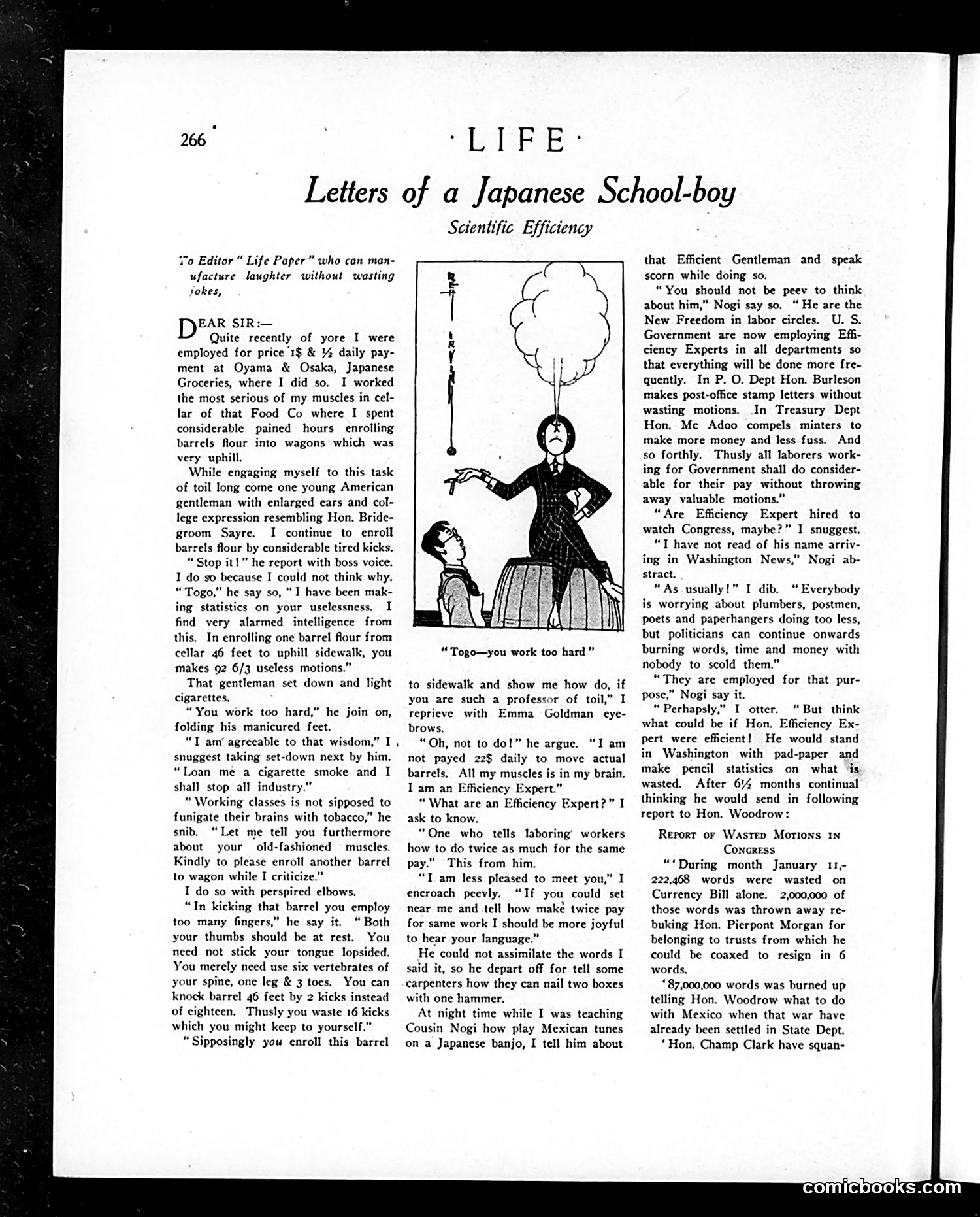
This 1910s satirical letter mocks the "Efficiency Expert" craze sweeping American industry and government. A Japanese immigrant worker encounters a smug American "expert" who lectures him on performing barrel-rolling with fewer motions—while the expert himself does no actual work, paid $22 daily merely to observe and criticize. The satire targets the contradiction: efficiency consultants demand laborers maximize productivity through minute optimization, yet politicians and government officials (named Burleson, McAdoo—Wilson-era officials) face no such scrutiny. The broken English narrator exposes the absurdity: efficiency experts waste workers' time with lectures while actual work suffers. The cartoon shows "Togo" (evoking Japanese Admiral Togo) lifting a barrel while the expert watches—visualizing the parasitic relationship. The final text notes that currency-bill printing, congressional debate, and diplomatic efforts waste far more resources than a laborer's "extra kicks," yet remain unexamined. It's Progressive-era class satire: efficiency doctrine applied selectively to protect elites while burdening workers.
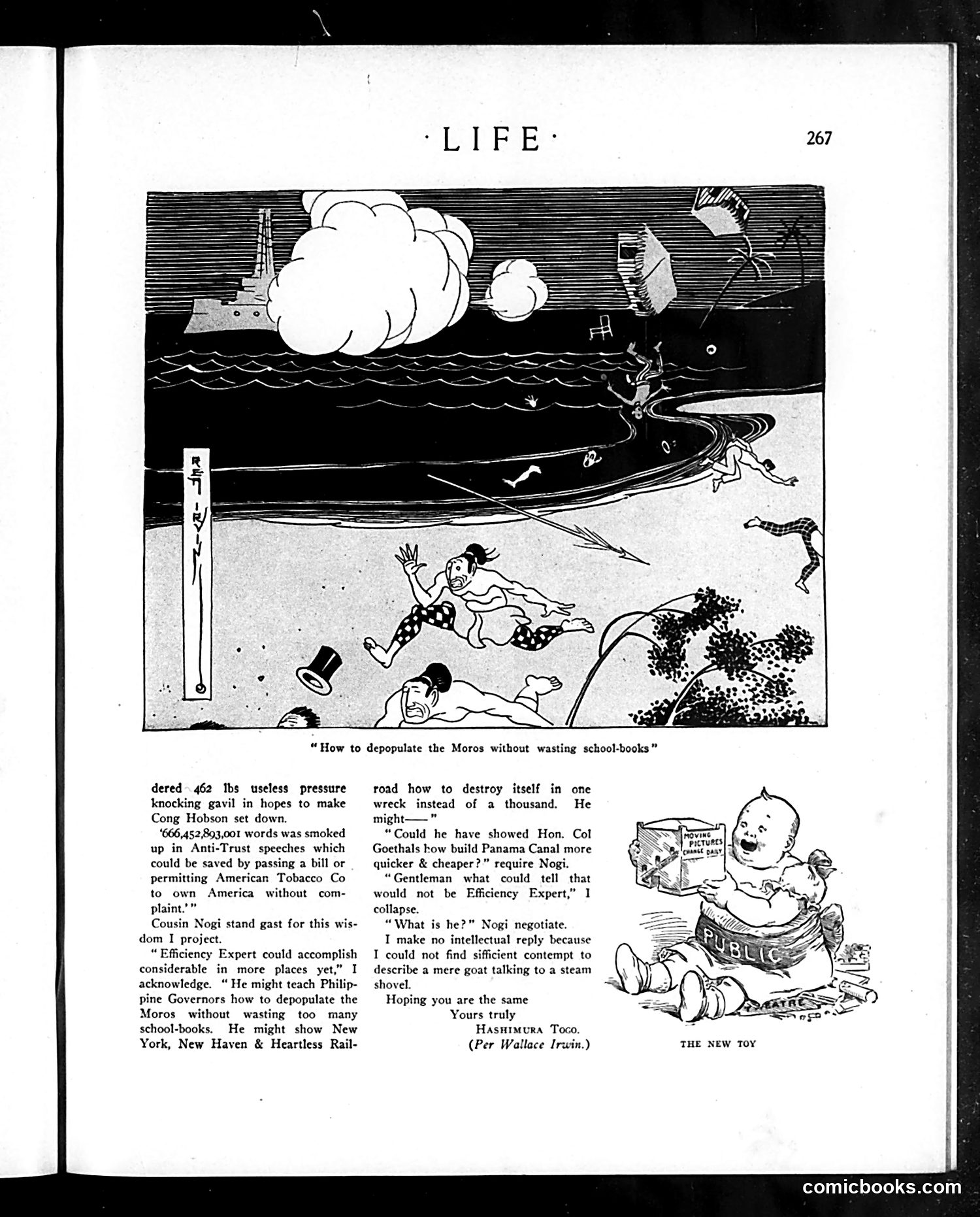
This satirical cartoon mocks the American colonial project in the Philippines, specifically the violent suppression of the Moro people (Muslim inhabitants of Mindanao). The headline's dark humor equates colonial military brutality with "efficiency." The accompanying text, attributed to "Hashimura Togo" (a fictional Japanese character created by Wallace Irwin for satirical commentary), critiques American "Efficiency Experts"—a popular Progressive Era concept. The satirist ridicules both this management fad and American imperialism by suggesting such experts could teach Philippine governors how to kill the Moros "efficiently." References include: - The Moro conflict (ongoing U.S. military campaign) - Colonel Goethals (Panama Canal engineer) - Anti-trust politics and corporate corruption The joke's bite: American efficiency-obsessed reformers ignore actual violence and exploitation in the colonies, focusing instead on trivial business matters. The cartoon sarcastically elevates imperial atrocity to a management problem.
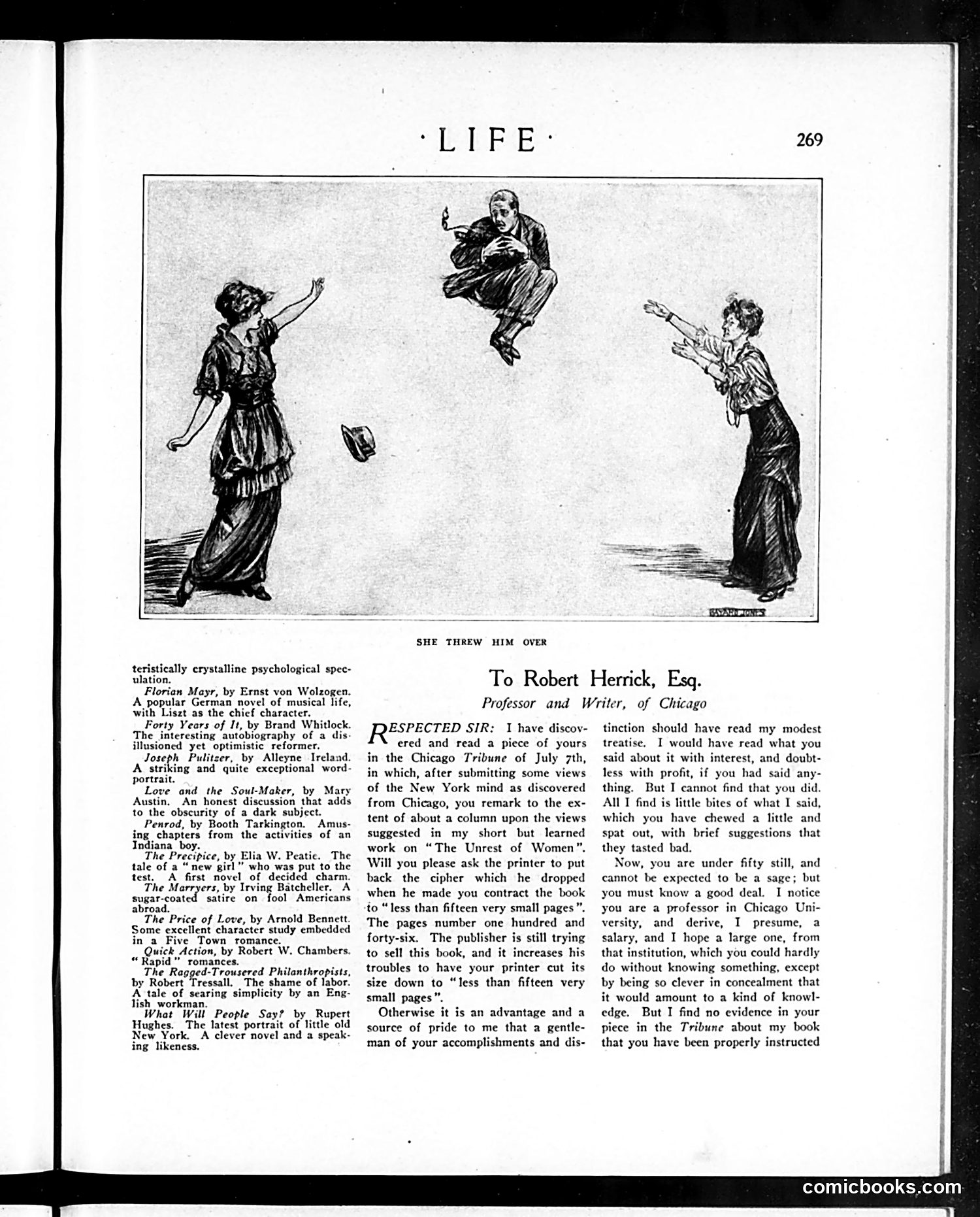
This page from *Life* magazine features a satirical illustration and an open letter. The cartoon shows two women throwing a man (depicted mid-air) between them—a visual metaphor for rejection or being cast aside. The accompanying text is a pointed letter to Professor Robert Herrick of the University of Chicago, responding to his critical review of the sender's book about "The Unrest of Women." The writer sarcastically congratulates Herrick on reading their work while attacking the substance of his review, accusing him of merely quoting snippets dismissively ("chewed a little and spat out") rather than engaging seriously with the arguments. The satire targets academic pretension: the writer questions whether Herrick, despite his professorship and salary, actually possesses genuine knowledge or merely conceals his ignorance through clever wordplay. The cartoon humorously visualizes the letter's theme of rejection—the author has been "thrown over" by a supposedly learned critic.
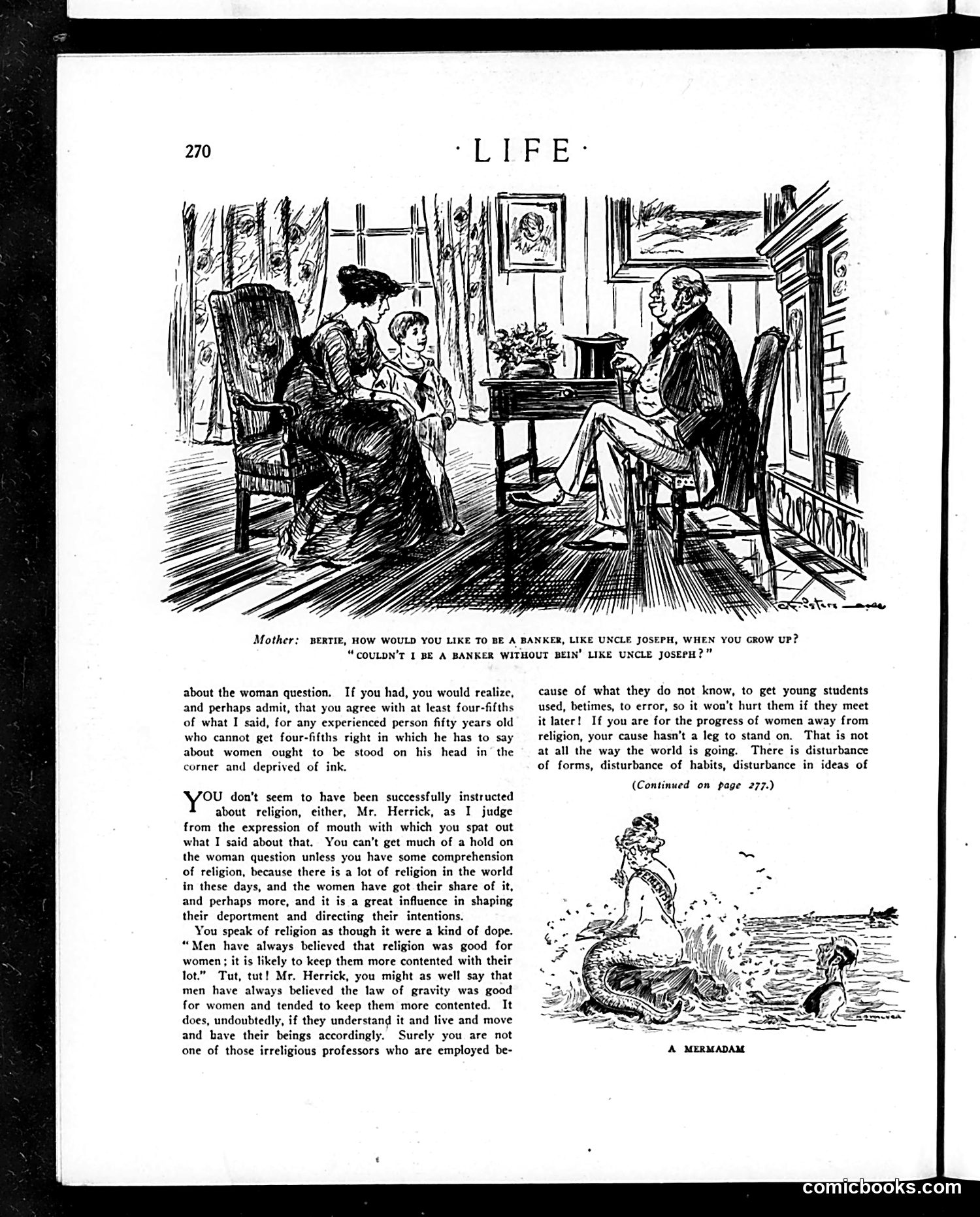
**The Main Cartoon:** Shows a mother asking her son Bertie if he'd like to become a banker like "Uncle Joseph" when grown. The boy's reply—"Couldn't I be a banker without bein' like Uncle Joseph?"—satirizes the assumption that success requires adopting the character flaws of wealthy relatives. The joke implies Uncle Joseph, though financially successful, is morally or socially objectionable ("like Uncle Joseph" suggests bad behavior or personal failings). **The Text:** A lengthy argument defending religion's role in women's advancement, dismissing the notion that religion merely keeps women "contented" or subservient. The author argues religion actually *drives* social progress and change, challenging the reader's apparently dismissive attitude toward religion's influence. **The Mermaid Illustration:** A decorative bottom element; unclear significance without additional context. **Overall Point:** This appears to be satirizing both social ambition divorced from character and debates about women's roles, religion, and progress in early 20th-century America.
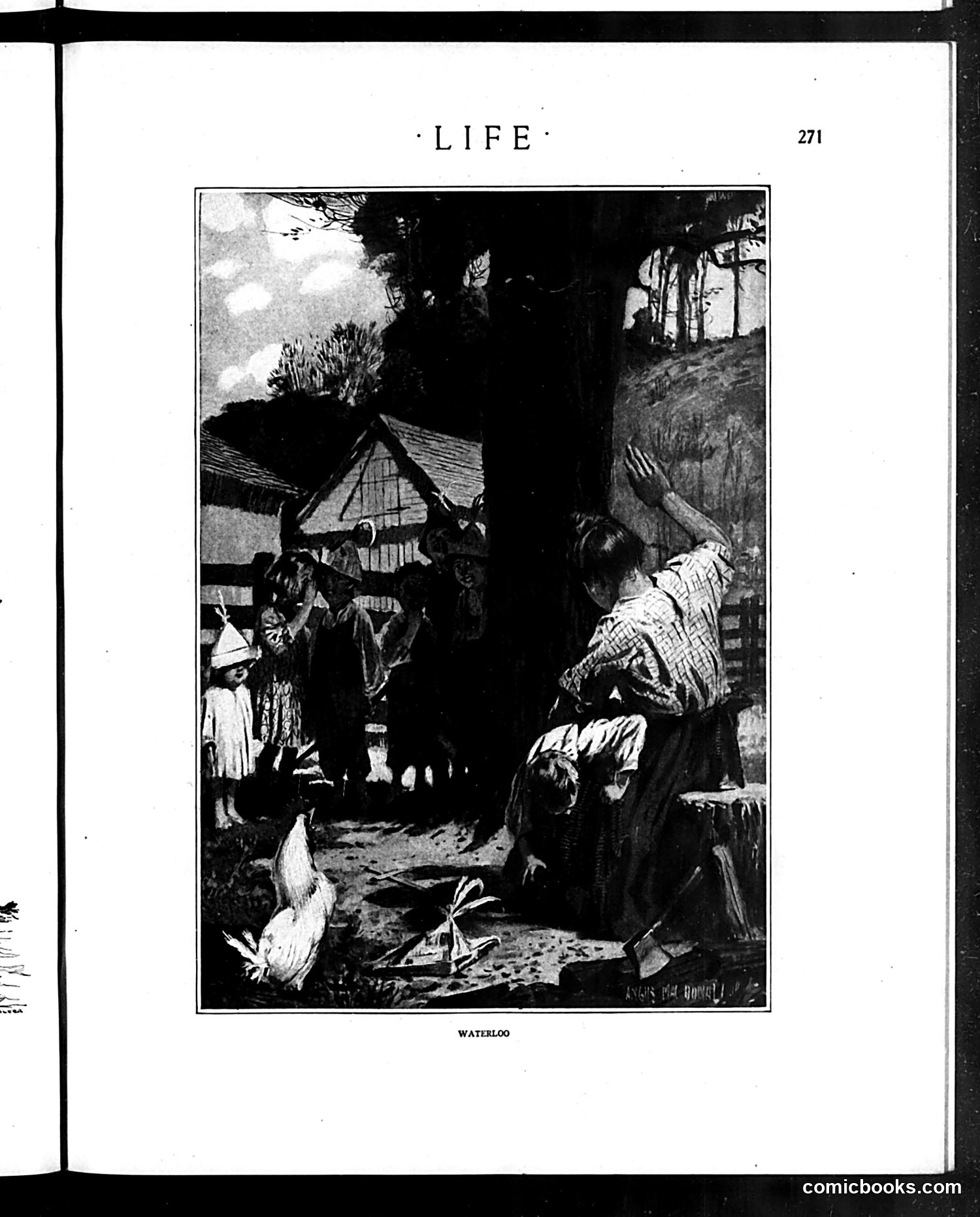
This illustration, titled "Waterloo," depicts a rural scene with what appears to be a domestic or social conflict. The composition shows several figures gathered around a cottage, with a woman in the foreground appearing distressed or confrontational. The dramatic lighting and shadowy composition suggest tension or conflict resolution. Without additional context or caption text visible, the specific political or social satire is unclear. The "Waterloo" title suggests defeat or a decisive moment, possibly referring to a personal or domestic "battle." The rural setting and working-class appearance of the figures suggest this may be social commentary, though the exact target of satire cannot be determined from the image alone. The OCR text provided does not contain readable caption information that would clarify the cartoon's meaning.
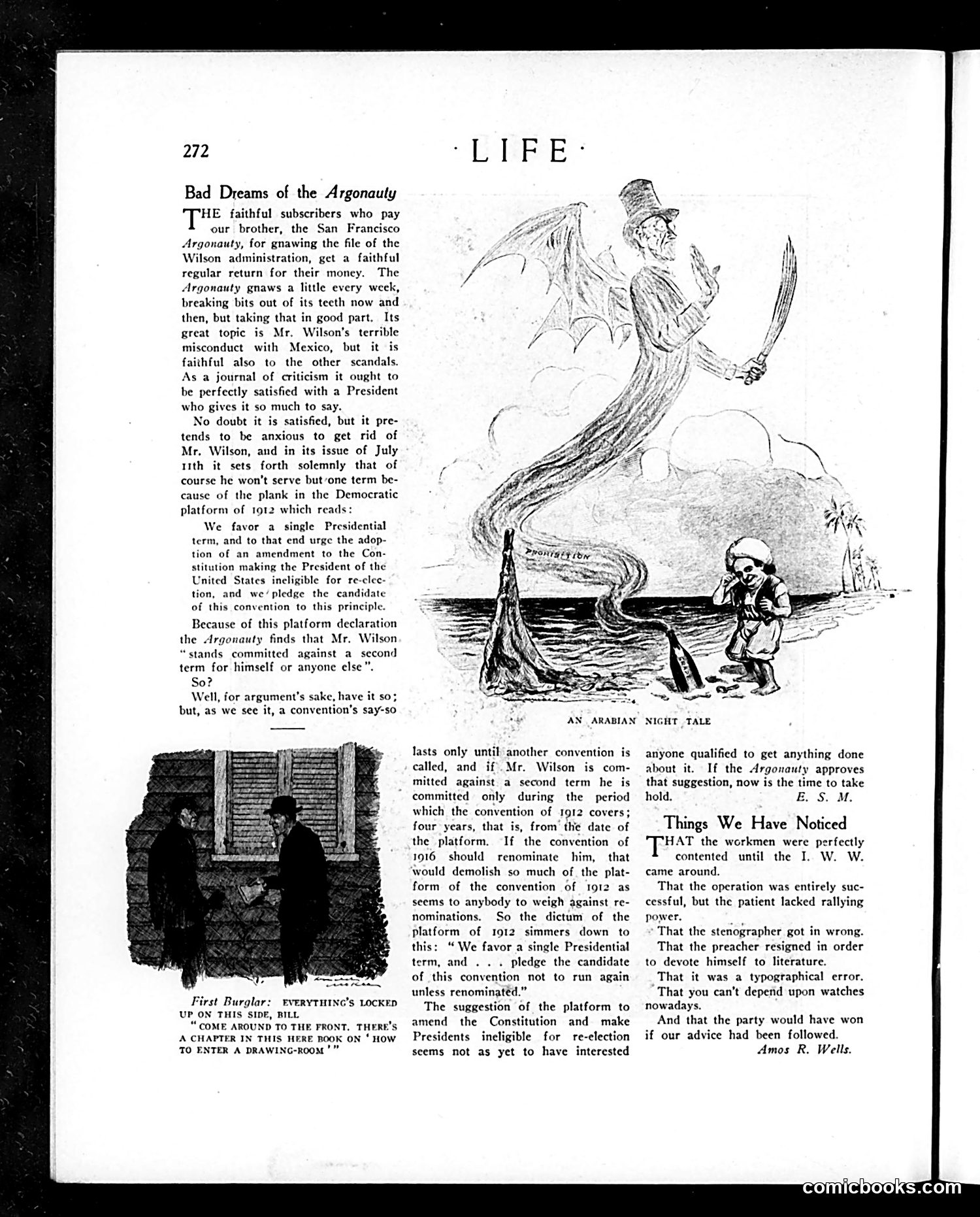
This page critiques the *San Francisco Argonaut*, a publication attacking President Wilson's administration (particularly his Mexico policy) while claiming Wilson is bound by the Democratic platform of 1912—which pledged a single presidential term. Life's argument: a convention's declaration only binds until the *next* convention meets. If the 1916 convention renominates Wilson, it effectively nullifies the 1912 pledge. Therefore, the *Argonaut's* claim that Wilson "stands committed" against a second term is logically flawed—it's merely a convention's say-so, not a constitutional mandate. The cartoon "An Arabian Night Tale" (top right) depicts burglars finding a how-to book on entering drawing-rooms—a joke about criminals using instruction manuals, possibly paralleling the *Argonaut's* reliance on outdated political arguments. The "First Burglar" illustration below satirizes similar misguided logic: criminals consulting a handbook for guidance they should already possess.
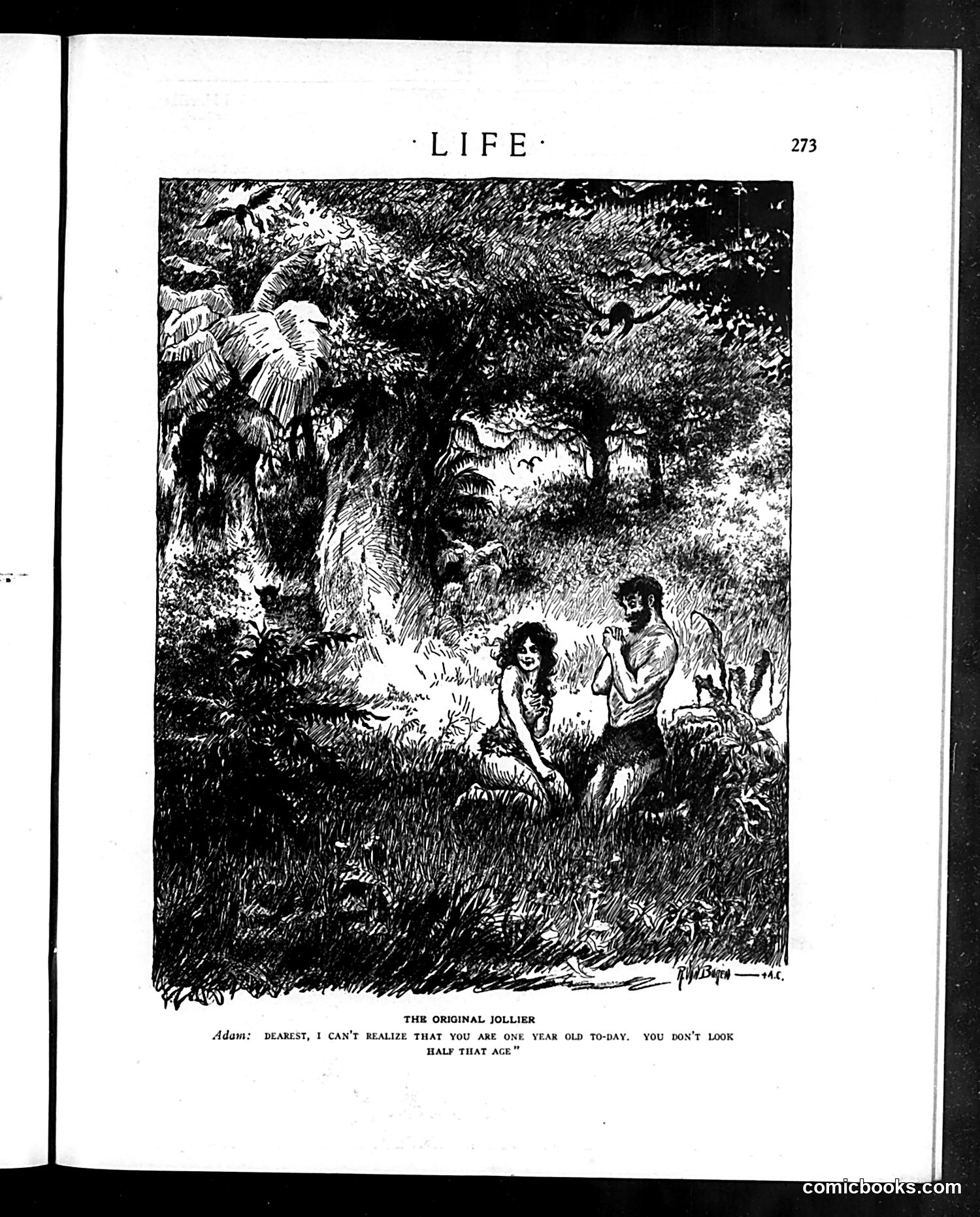
This cartoon depicts a scene from the biblical Garden of Eden, showing Adam and Eve with their infant son in a lush tropical setting. Adam comments on Eve's youthful appearance despite her being one year old—a joke playing on the fact that Eve was created as an adult rather than born as an infant. The title "The Original Jollier" suggests this is gentle, domestic humor about the first family. The satire appears to mock Victorian courtship conventions by presenting Adam's compliment about Eve not looking her age as the "original" version of such flattery—implying this flirtation technique dates back to humanity's beginning. The image presents an idealized, romantic vision of Paradise as a fertile landscape, typical of early 20th-century illustration style. The humor relies on religious knowledge and contemporary gender dynamics familiar to Life magazine's educated readership.
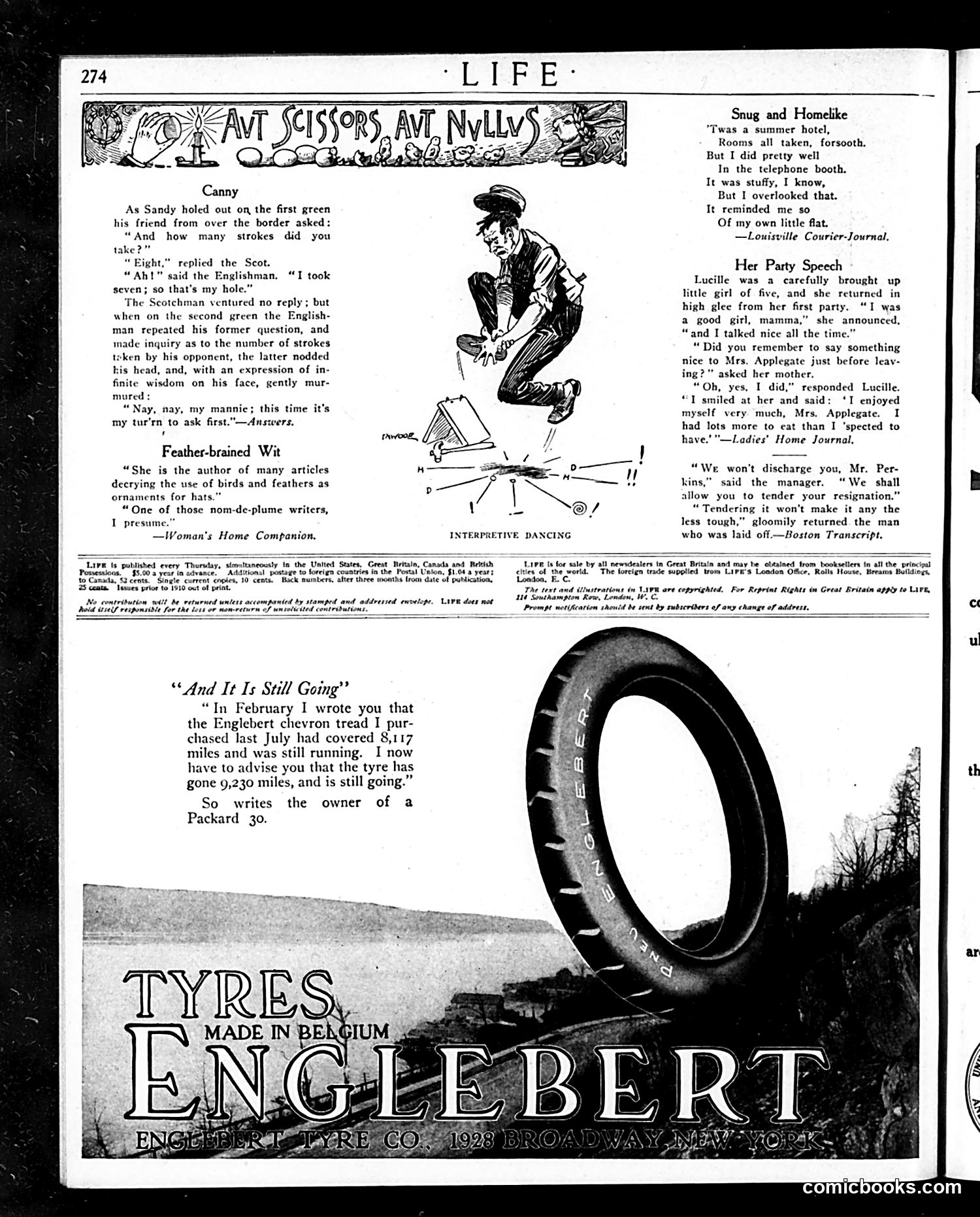
This page contains several brief humor pieces typical of Life magazine's satirical format: **"Canny"**: A Scottish-English golf joke exploiting national stereotypes. A Scottish golfer, losing at golf, turns the tables by insisting it's his turn to ask questions first—a clever reversal asserting Scottish shrewdness over English superiority. **"Feather-brained Wit"**: A pun on a female author who campaigns against using bird feathers in hats, yet publishes under a pen name ("nom-de-plume")—satirizing the contradiction between her stated principles and her chosen literary disguise. **"Interestive Dancing"**: A cartoon showing a man dancing enthusiastically over a geometric diagram, likely satirizing modern dance or jazz-age dancing as chaotic or interpretive. **"And It Is Still Going"**: An Englebert tire advertisement claiming extraordinary durability (9,230 miles), legitimized through a customer testimonial from a Packard 30 owner. The page also includes brief humorous verses about hotel phone booths and children's party etiquette.
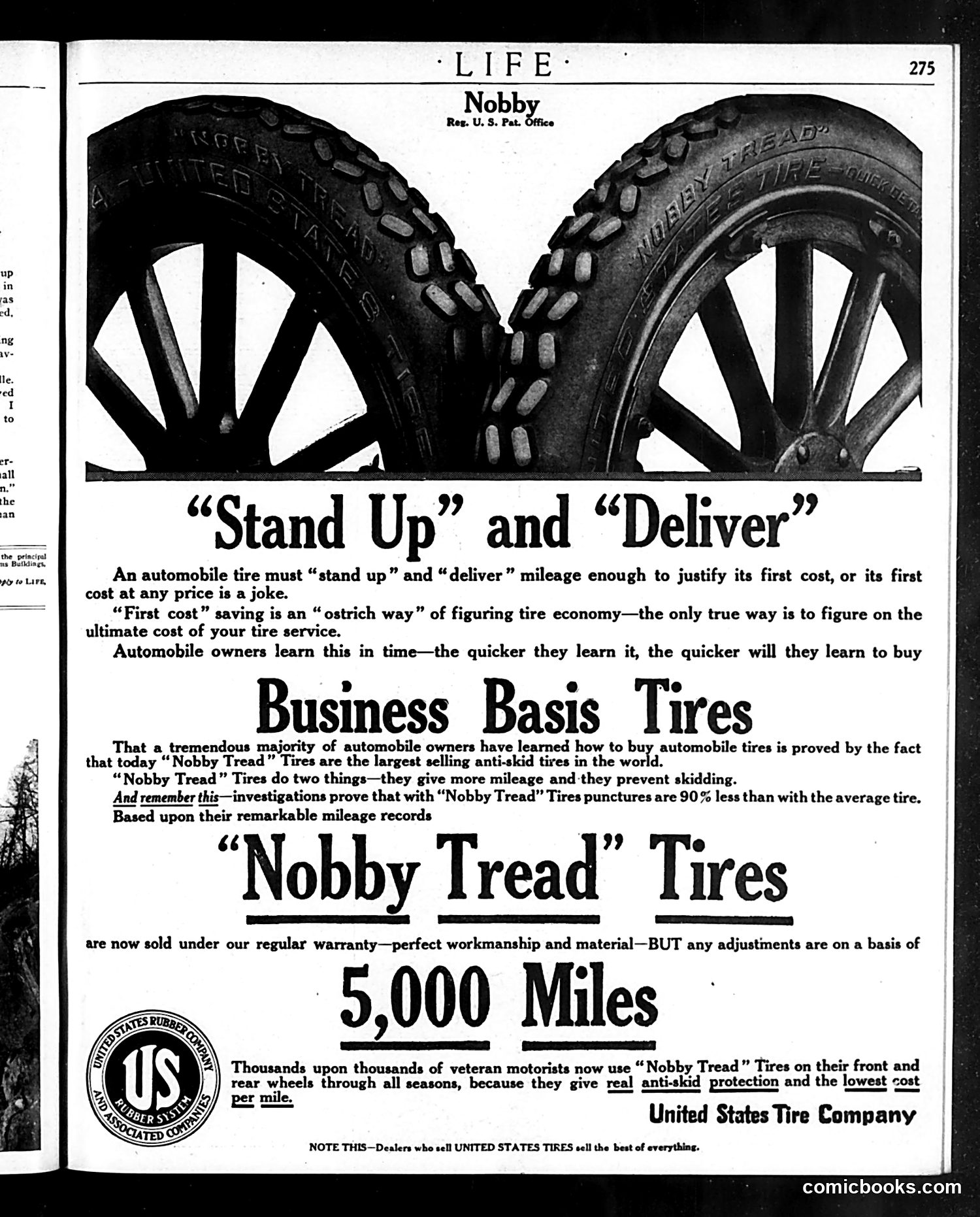
This is primarily a **tire advertisement**, not a political cartoon. It's a full-page ad for "Nobby Tread" tires by United States Tire Company, published in *Life* magazine (page 275). The two tire images at the top show the distinctive tread pattern of Nobby Tread tires—the "nobby" (bumpy) surface design meant to prevent skidding. The ad argues that buyers should focus on **total cost of ownership**, not just initial price. The key claims: Nobby Tread tires deliver more mileage, reduce punctures by 90%, provide anti-skid protection, and are backed by a 5,000-mile warranty. The "Stand Up" and "Deliver" headline uses double meaning—tires must physically perform ("stand up") and provide value ("deliver" mileage). This appears to be standard advertising copy from the early automotive era, emphasizing reliability and practical economy over cheap initial cost.
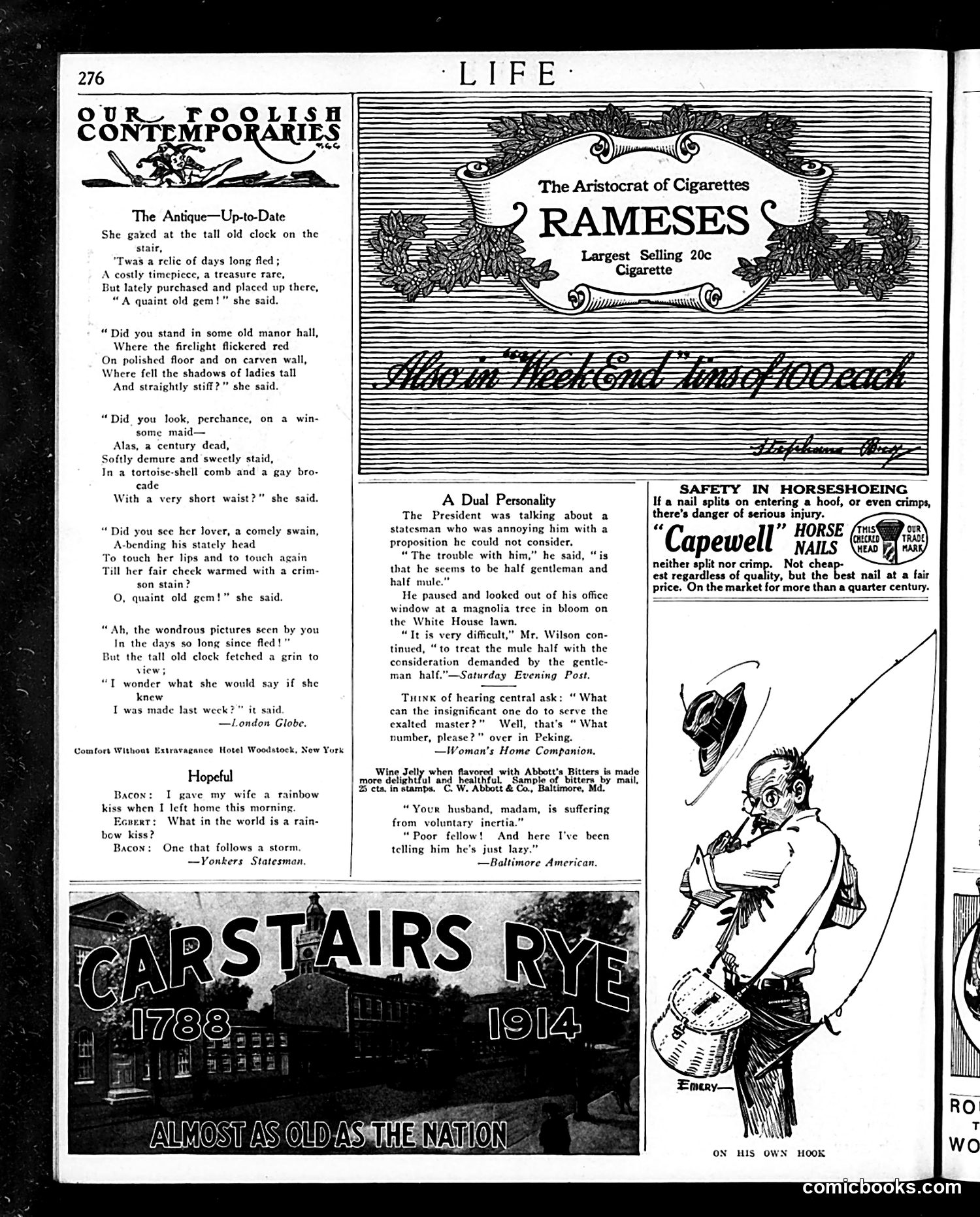
This poem satirizes romantic nostalgia for the past. A woman admires an old grandfather clock, imagining it witnessed centuries of genteel romance—ladies in corsets, dashing suitors, passionate moments in manor halls. The joke's punchline: the clock was manufactured last week. The satire targets early 20th-century sentimentality about "authentic" antiques. People desired objects they believed carried historical weight and romantic history. The poem mocks this desire by revealing the supposed heirloom is mass-produced modernity masquerading as antiquity—a common deception (and joke) of the era when reproduction "antiques" flooded the market. The accompanying cartoons are unrelated advertisements and humor pieces typical of *Life* magazine's format, including ads for Rameses cigarettes and Capewell horseshoe nails.
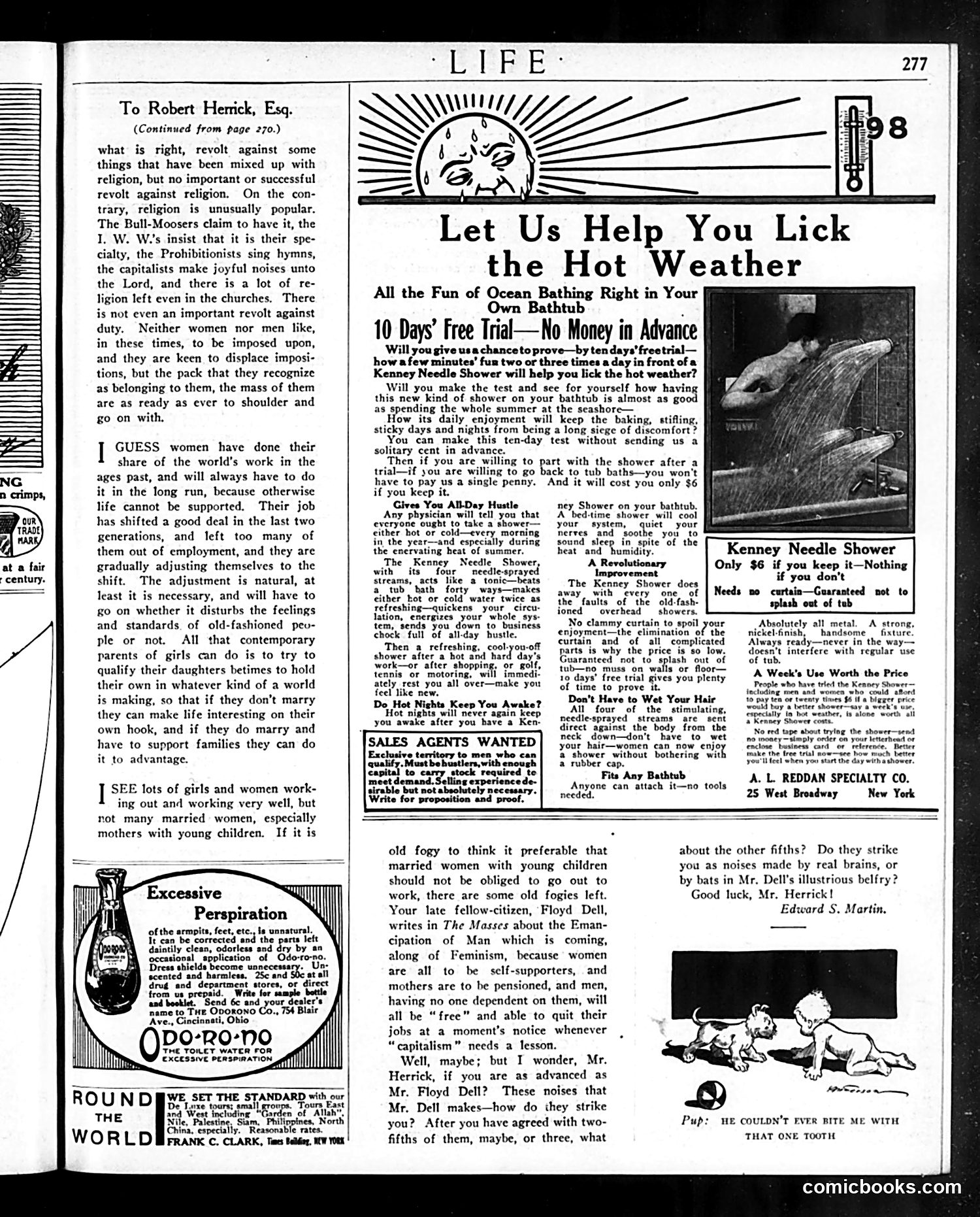
This page mixes editorial commentary with advertisements. The left column continues a letter to Robert Herrick discussing women's labor and social roles—arguing women have always worked and will continue to do so, adjusting to whatever economic shifts occur. It's presented as a practical, unsentimental view of female employment. The main advertisement promotes the "Kenney Needle Shower," a spray attachment for bathtubs designed to help people cope with summer heat. It offers a 10-day free trial with no upfront cost, costing only $6 if kept—framed as an affordable alternative to expensive seaside vacations. The cartoon at bottom shows two puppies, captioned "Pup: he couldn't ever bite me with that one tooth"—a simple joke about a puppy's inability to bite effectively with minimal teeth. The page also advertises Odo-Ro-No deodorant and other products typical of 1920s hygiene marketing.
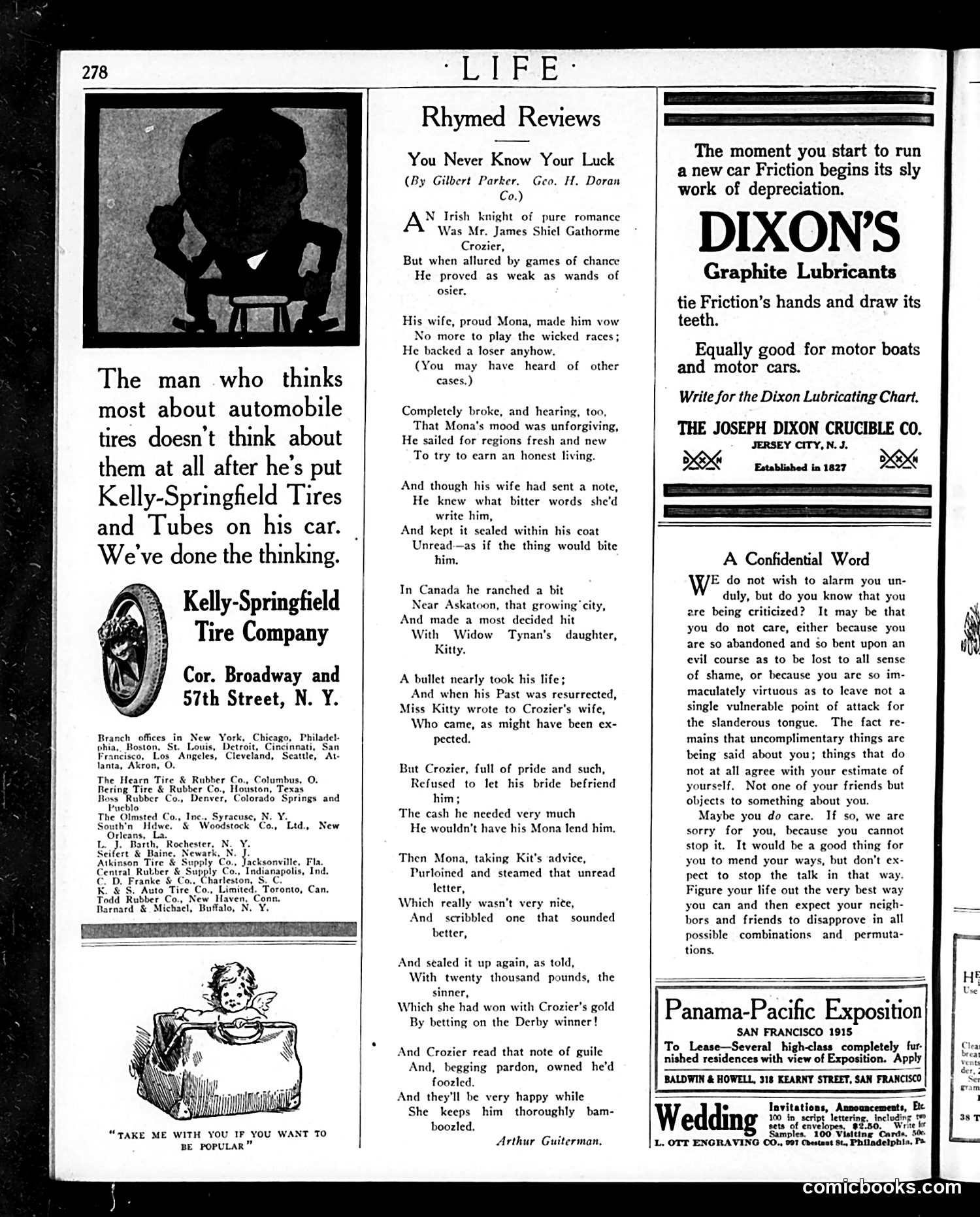
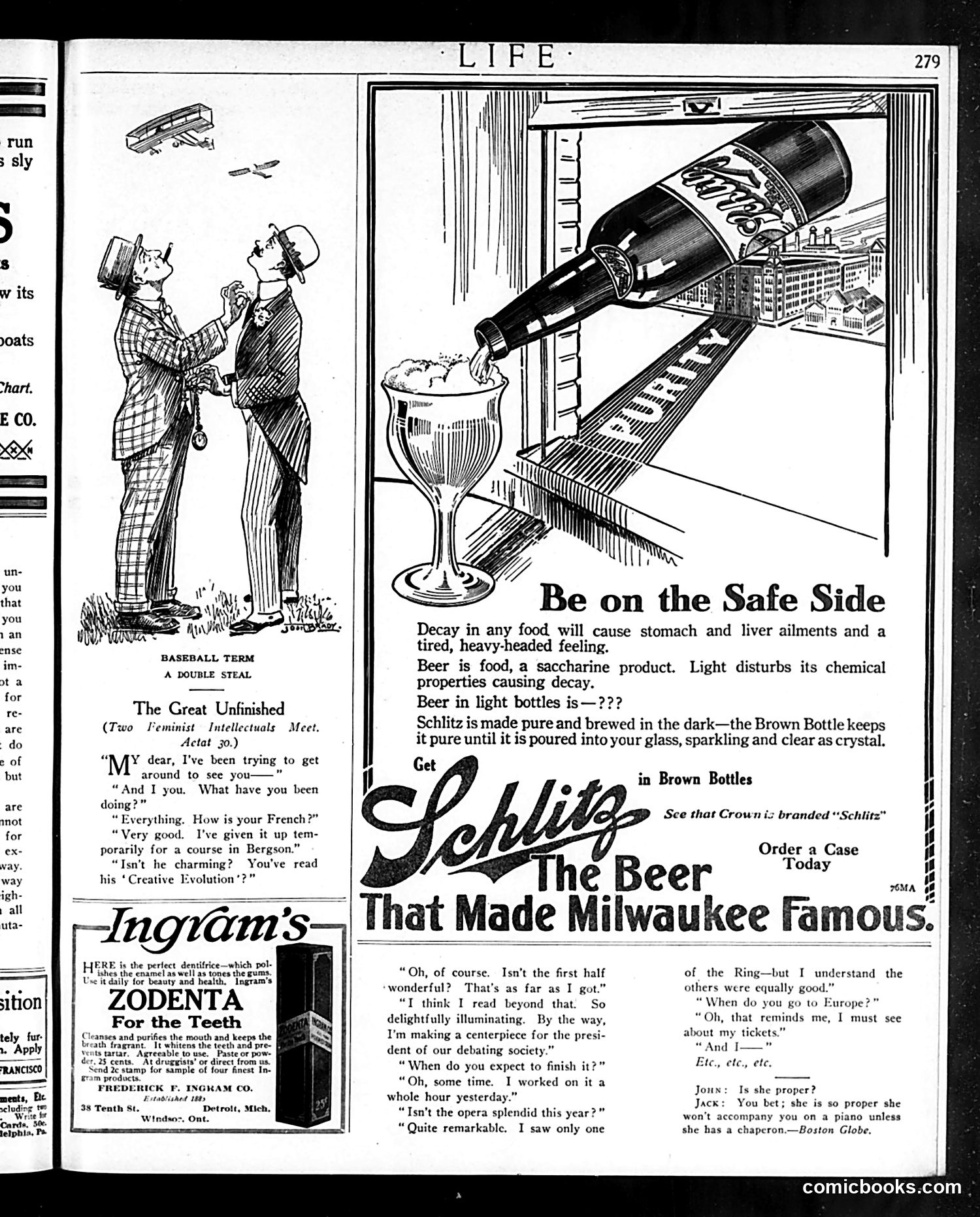
This Life magazine page contains **two main elements**: **Left side:** A satirical sketch titled "The Great Unfinished" mocking pretentious intellectuals. Two men discuss philosophy—French, Bergson's "Creative Evolution"—while one complains he's been "trying to get around to see you" but keeps getting distracted by cultural pursuits. The joke satirizes how self-absorbed intellectuals prioritize abstract ideas over actual relationships. **Right side:** A **Schlitz beer advertisement** disguised as editorial content. It argues beer is "food" and claims light damages beer chemically, so brown bottles preserve it better. Below, a dialogue between "Jack" and a woman suggests she's so proper/respectable she requires a chaperon even at a piano lesson—a dated social convention the joke implies is absurdly restrictive. The page reflects early 20th-century attitudes: mocking educated pretension and advertising beer as wholesome "food" (common pre-Prohibition marketing). The gender humor reflects restrictive social expectations of the era.
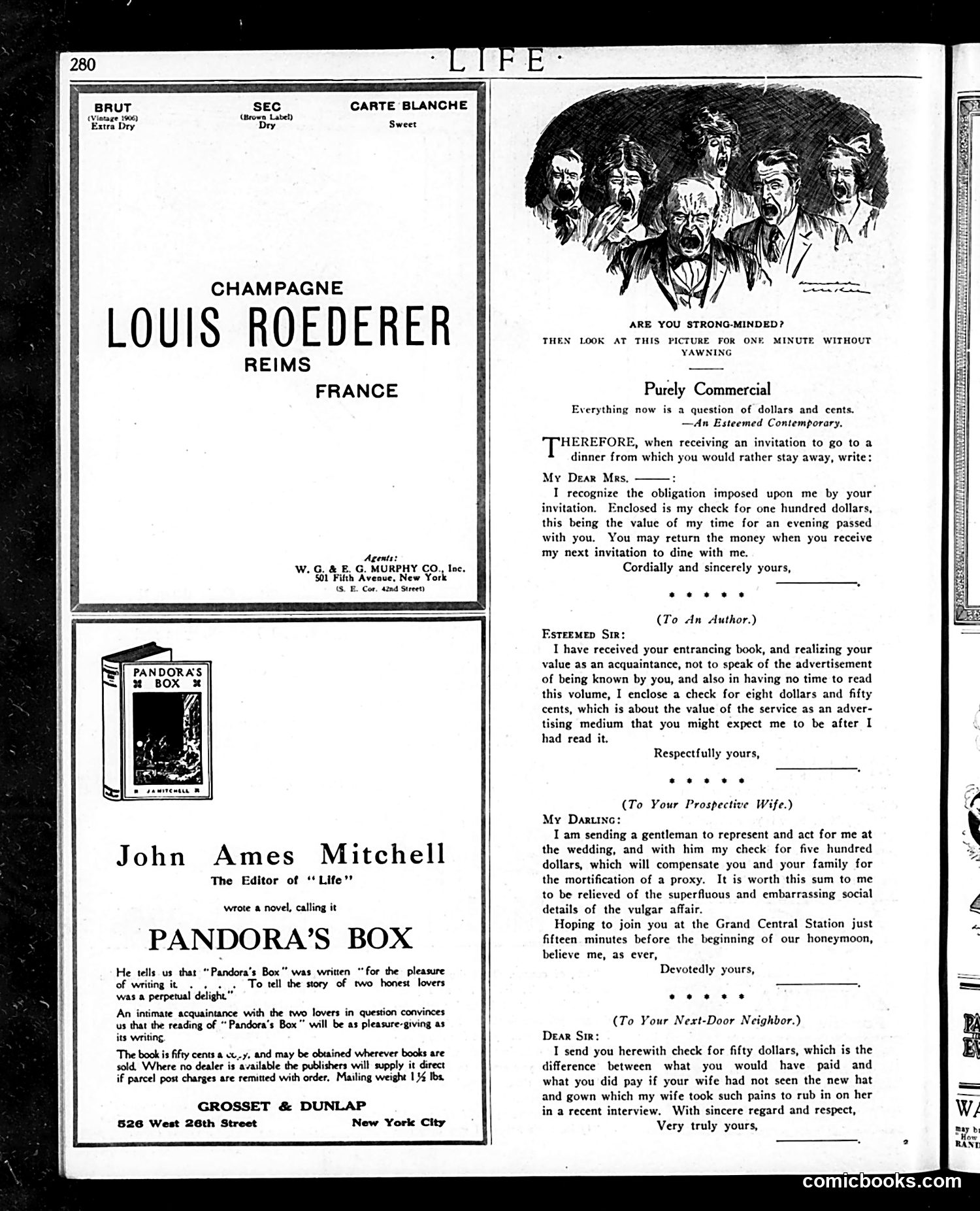
This page satirizes the commodification of social relationships in early 20th-century America. The central cartoon—five caricatured male faces with the caption "ARE YOU STRONG-MINDED?"—appears designed to test viewer fortitude, though its specific reference is unclear. The main satire comprises four humorous "letters" mocking the reduction of human interaction to monetary transaction. Each letter proposes paying cash to avoid unwanted social obligations: declining a dinner invitation ($100), rejecting an author's book ($8.50), avoiding a wedding ($500), and compensating a neighbor for social embarrassment caused by his wife's envy of the writer's wife's fashions ($50). The satire targets the era's materialistic values, suggesting that wealthy Americans increasingly viewed all relationships—friendship, professional courtesy, family duty, neighborly civility—as calculable financial transactions rather than genuine human connections. The premise lampoons what Life's contemporary sourced as a widespread cultural shift toward purely mercenary values.
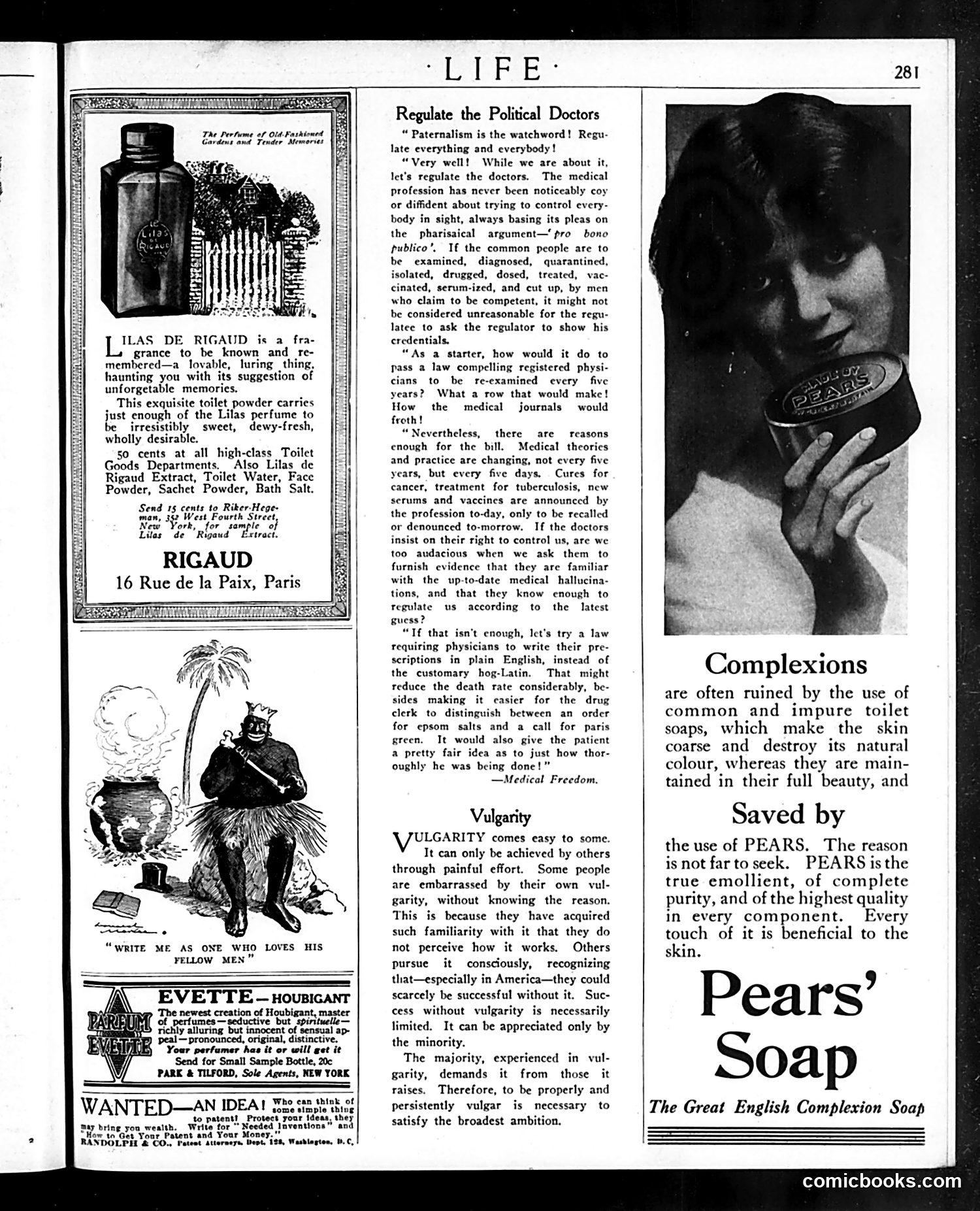
This page combines advertisements with satirical commentary on early 20th-century American medicine and social concerns. **Main Satire: "Regulate the Political Doctors"** The piece critiques the medical profession's demand for autonomy while simultaneously controlling citizens' bodies. It sarcastically proposes counter-regulations: mandatory physician re-examination every five years and prescriptions in plain English rather than Latin. The satire highlights medicine's rapid changes—treatments announced today denounced tomorrow—suggesting doctors lack the authority to regulate public health they claim. The piece attacks what it calls the profession's self-serving "pro bono publico" (for the public good) justification while resisting accountability themselves. **"Vulgarity" Section** A brief essay distinguishing between accidental and deliberate vulgarity, noting that in America, success often requires it. **Advertisements** The page includes luxury perfume ads (Lilas de Rigaud, Evette-Houbigant) and a Pears' Soap ad emphasizing skin purity—contrasting sharply with the page's skepticism of medical authority. The satire reflects Progressive Era tensions over regulation and professional expertise.
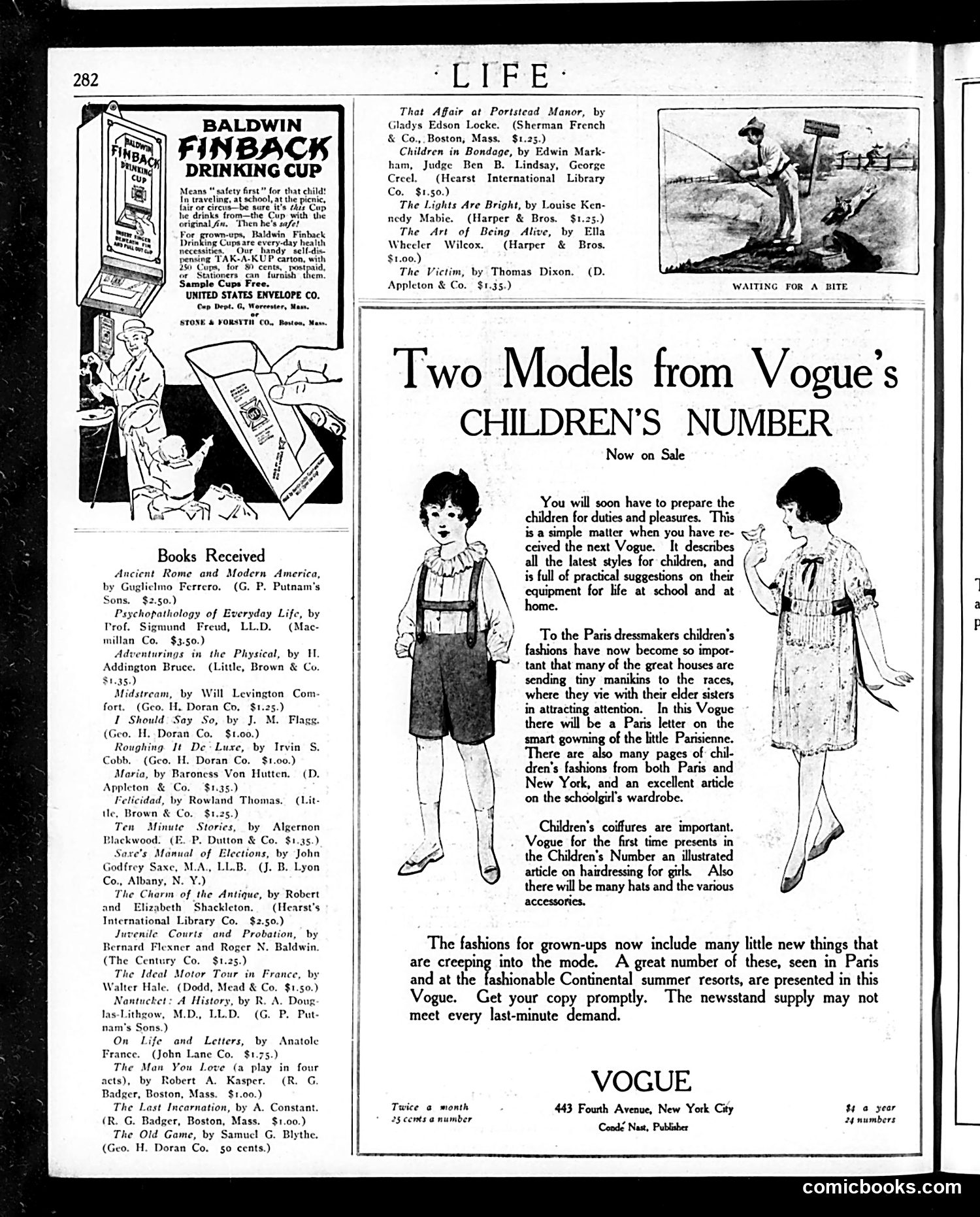
This is primarily a **book review and advertising page** rather than political satire. The left column lists recently published books, including works by Sigmund Freud and on social topics like juvenile courts. The dominant content is a **Vogue advertisement** promoting their Children's Number (fashion issue). The text and illustrated models showcase children's clothing fashions, emphasizing that Paris fashion houses now treat children's wear as seriously as adult fashion—even sending child mannequins to races to display outfits. The ad highlights practical information: children's hairstyles, school wardrobes, and accessories. At top left is an unrelated advertisement for **Baldwin Finback Drinking Cups**, promoting hygiene and "safety first" for children using disposable cups. There is **no political cartoon or satire** on this page. It reflects early 20th-century middle-class American concerns: child safety, fashionable children's clothing from Paris, and contemporary literature on psychology and social reform.
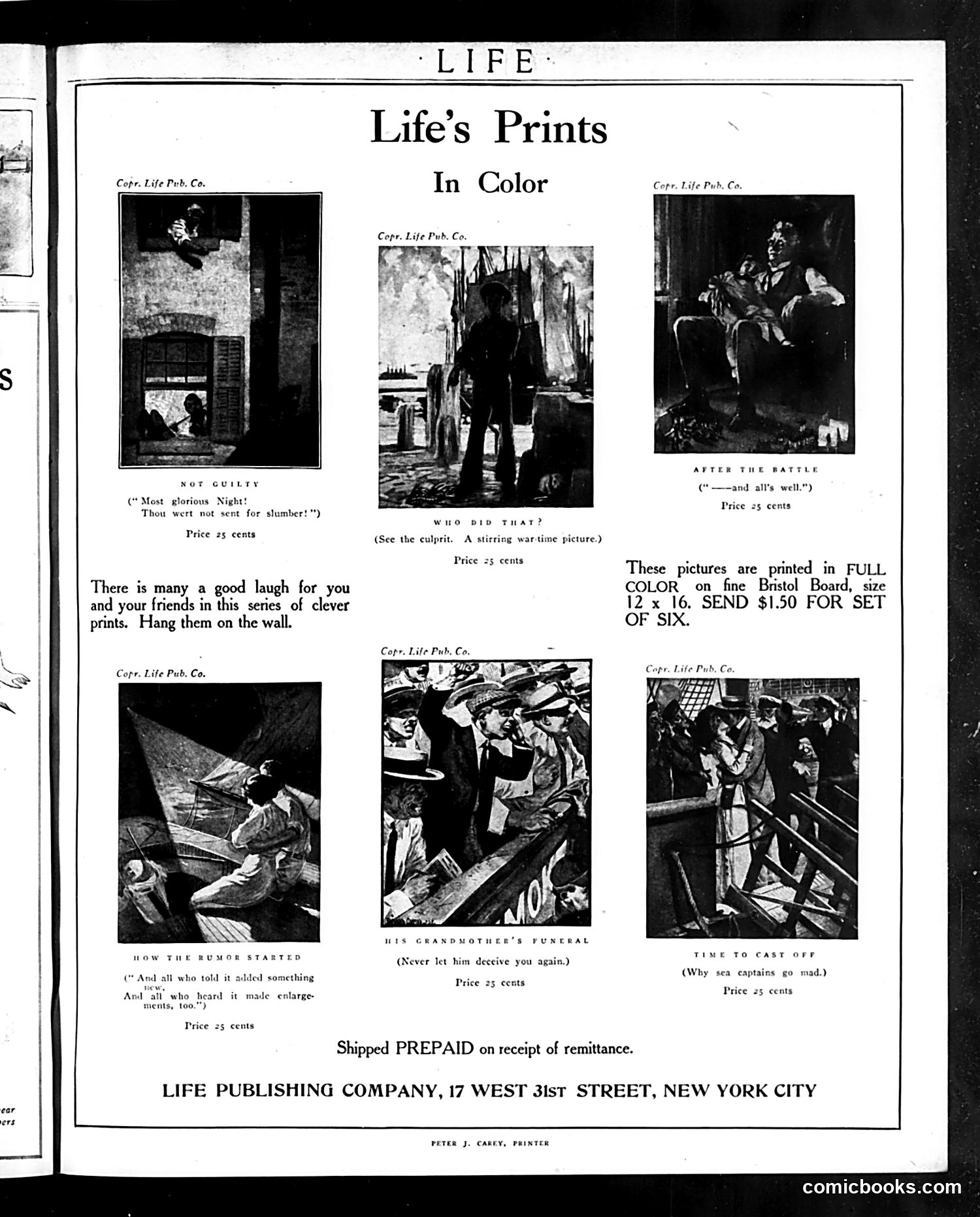
This is a mail-order advertisement for colored prints sold by Life Publishing Company. The six images appear to be humorous domestic scenes rather than political satire—common subject matter for Life's satirical humor of this era. The prints depict everyday comedic situations: a guilty conscience ("Not Guilty"), rumor-spreading and exaggeration ("How the Rumor Started"), wartime deception ("Who Did That?"), a funeral scene involving trickery ("His Grandmother's Funeral"), post-conflict reconciliation ("After the Battle"), and marital discord ("Time to Cast Off"). These are marketed as affordable wall decorations (25 cents each, or $1.50 for a set of six) for middle-class homes. The humor targets universal human foibles—guilt, gossip, deception, and marriage troubles—rather than specific political figures or events. The advertisement emphasizes the prints' novelty in "full color" on fine Bristol Board, suggesting this was a relatively premium product for the period.
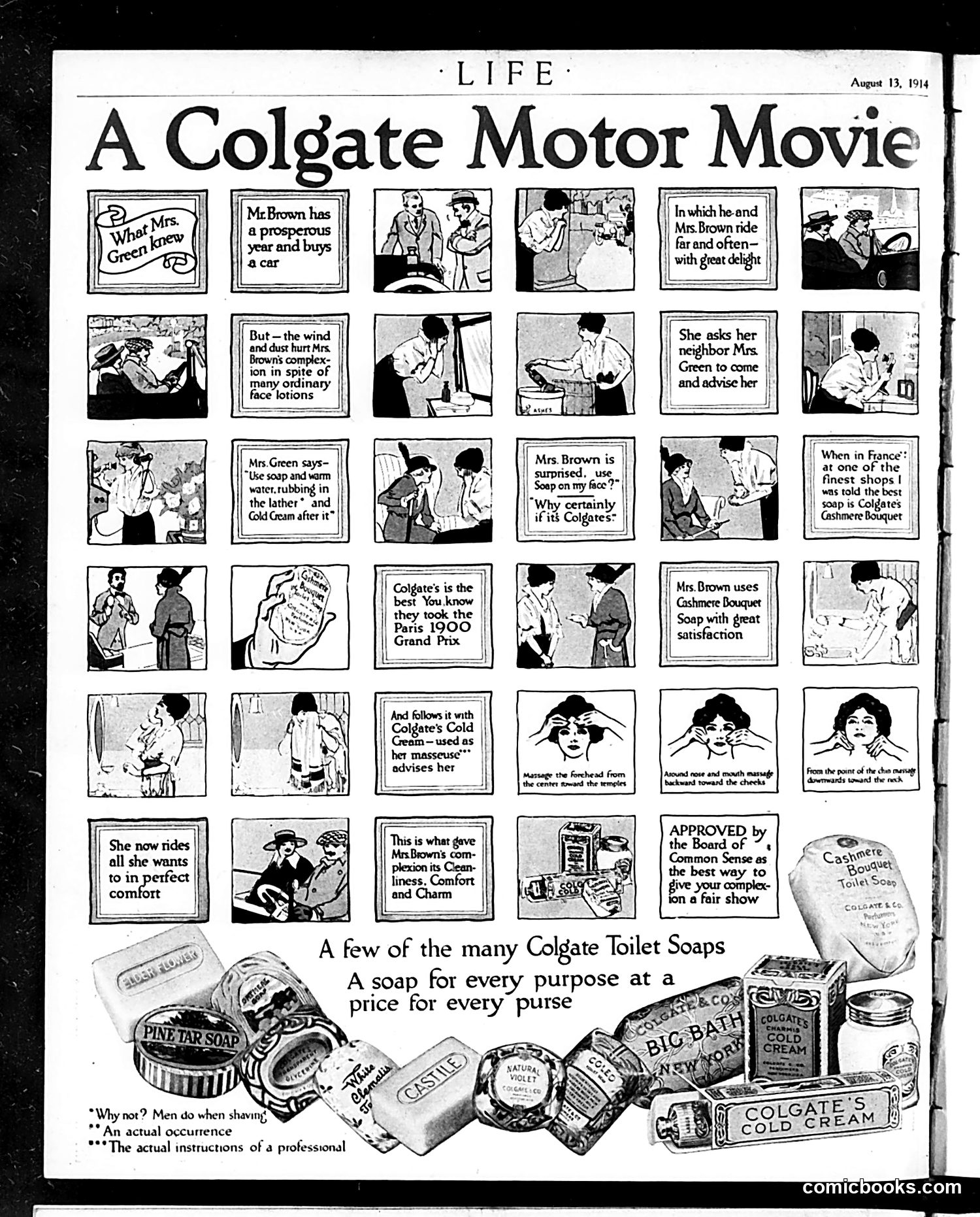
This is primarily a **Colgate soap advertisement** disguised as comic entertainment. The "motor movie" follows Mr. and Mrs. Brown on a car ride—a novelty activity in 1914 when automobiles were still relatively new luxuries. The satirical hook: Mrs. Brown's complexion suffers from wind and dust during their drive. Her neighbor Mrs. Green recommends Colgate soap and cold cream, citing its use by Parisians and its victory at the 1900 Paris Exposition. The narrative builds to the endorsement that Colgate products provide the solution to modern problems (like automobile travel damaging skin). The humor lies in the absurd juxtaposition—early 20th-century anxieties about new technology (cars) are "solved" by aggressive marketing of beauty products. The asterisked notes claim these are real incidents and professional instructions, adding mock-authenticity to what is obviously commercial propaganda. This represents early **advertorial comics**, blending editorial cartooning style with product placement.