
Life, 1914-08-13 · page 25 of 40
Life — August 13, 1914 — page 25: what you’re looking at
What you’re looking at
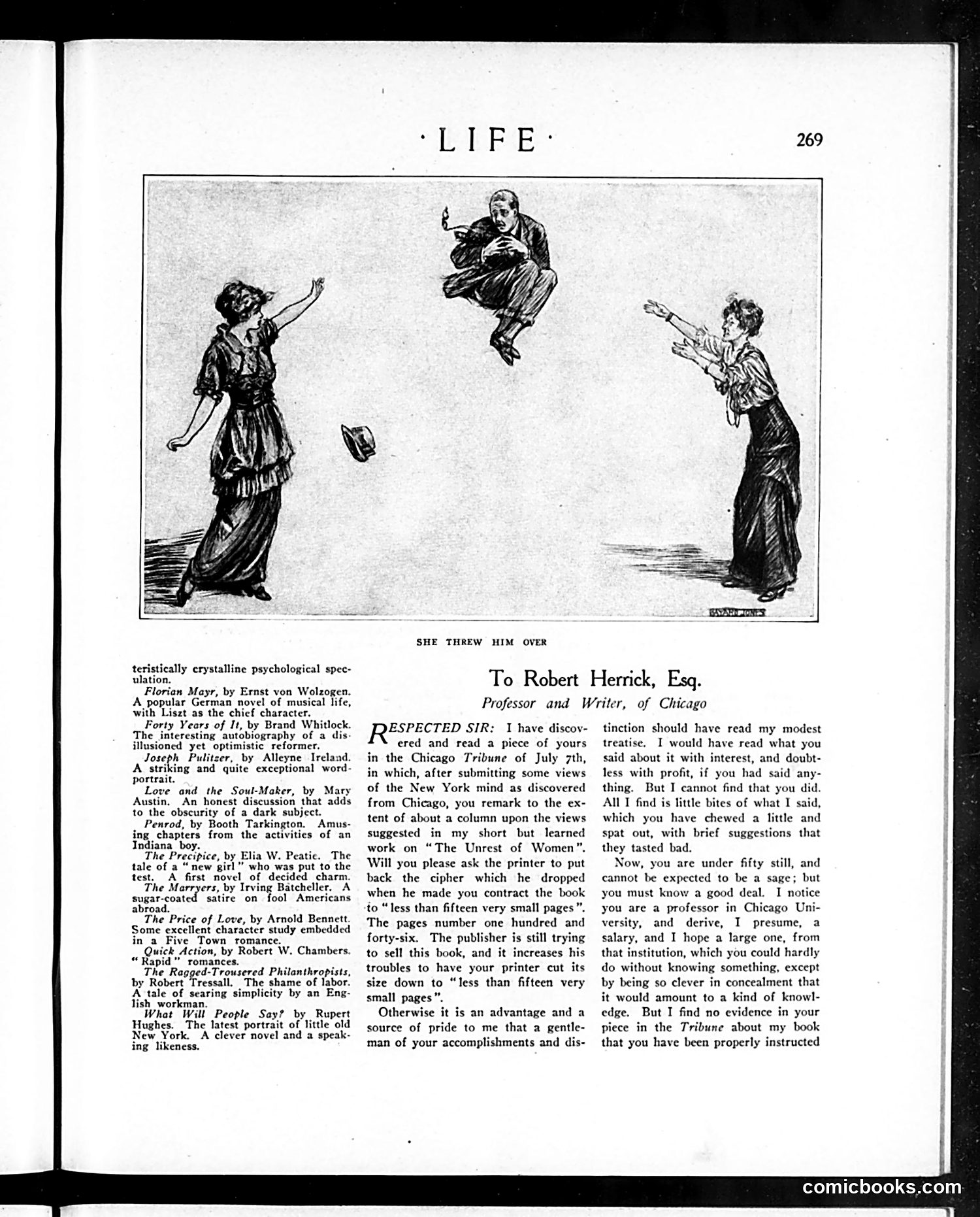
This page from *Life* magazine features a satirical illustration and an open letter. The cartoon shows two women throwing a man (depicted mid-air) between them—a visual metaphor for rejection or being cast aside. The accompanying text is a pointed letter to Professor Robert Herrick of the University of Chicago, responding to his critical review of the sender's book about "The Unrest of Women." The writer sarcastically congratulates Herrick on reading their work while attacking the substance of his review, accusing him of merely quoting snippets dismissively ("chewed a little and spat out") rather than engaging seriously with the arguments. The satire targets academic pretension: the writer questions whether Herrick, despite his professorship and salary, actually possesses genuine knowledge or merely conceals his ignorance through clever wordplay. The cartoon humorously visualizes the letter's theme of rejection—the author has been "thrown over" by a supposedly learned critic.
📄 Transcribed text from this page (OCR, searchable)
Machine-transcribed from the original scan — historical spelling and the odd misread are preserved.
teristically crystalline psychological spec- ulation. Florian Mayr, by Ernst von Wolzogen. A popular German novel of musical life, with Liszt as the chicf character. Forty Years of It, by Brand Whitlock. The interesting autobiography of a dis illusioned yet optimistic reformer. Joseph Pulitzer, by Alleyne Ireland. A striking and quite exceptional word- portrait. Love and the Soul-Maker, by Mary Austin, An honest discussion that adds to the obscurity of a dark subject. Penrod, by Booth Tarki ing chapters from the acti’ Indiana boy. The Precipice, by Elia W. Peatie. The tale of a “new girl” who was put to the test. A first novel of decided charm. The Mores, by Irving Batcheller. A Sugar-coat satire on fool Americans abroad. The Price of Love, by Arnold Bennett. Some excellent character study embedded in a Five Town romance. Quick Action, by Robert W. Chambers. “Rapid” romances. The Ragged-Trousered Philanthropists, by Robert Tressall. The shame of labor. A tale of searing simplicity by an Eng- lish workman. What Will People Say? by Rupert Hughes. The latest portrait of little old New York. A clever novel and a speak- ing likeness. SHE THREW HIM OVER To Robert Herrick, Esq. Professor and Writer, of Chicago ESPECTED SIR: 1 have discov- ered and read a piece of yours in the Chicago Tribune of July 7th, in which, after submitting some views of the New York mind as discovered from Chicago, you remark to the ex- tent of about a column upon the views suggested in my short but learned work on “The Unrest of Women”. Will you please ask the printer to put back the cipher which he dropped when he made you contract the book to “less than fifteen very small pages”. The pages number one hundred and forty-six. The publisher is still trying to sell this book, and it increases his troubles to have your printer cut its size down to “less than fifteen very small pages”. Otherwise it is an advantage and a source of pride to me that a gentle- man of your accomplishments and dis- tinction should have read my modest treatise. I would have read what you said about it with interest, and doubt- less with profit, if you had said any- thing. But I cannot find that you did. AILT find is little bites of what I said, which you have chewed a little and spat out, with brief suggestions that they tasted bad. Now, you are under fifty still, and cannot be expected to be a sage; but you must know a good deal. I notice you are a professor in Chicago Uni- versity, and derive, I presume, a salary, and I hope a large one, from that institution, which you could hardly do without knowing something, except by being so clever in concealment that it would amount to a kind of knowl- edge. But I find no evidence in your piece in the Tribune about my book that you have been properly instructed comicbooks.com