
Life, 1914-08-13 · page 18 of 40
Life — August 13, 1914 — page 18: what you’re looking at
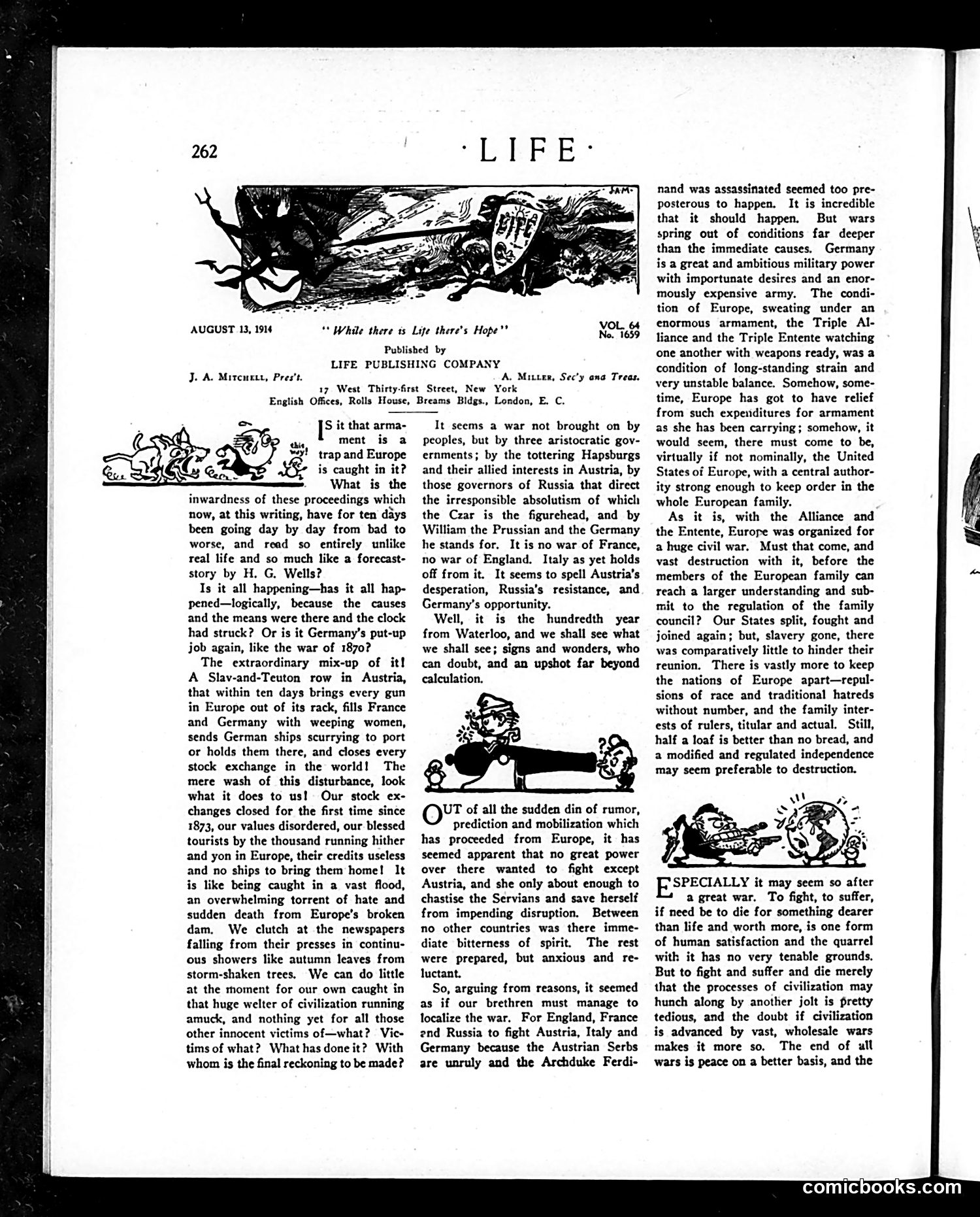
What you’re looking at
This editorial addresses the outbreak of World War I, specifically the cascade of mobilizations following Archduke Franz Ferdinand's assassination. The cartoons (small illustrations showing figures in conflict) satirize how a localized Austro-Serbian dispute exploded into continental warfare. The author expresses bewilderment that rational people allowed this catastrophe. He identifies blame with three aristocratic governments: Austria-Hungary's "tottering Hapsburgs," Russia's Czar (absolute ruler), and "William the Prussian" (Kaiser Wilhelm II). The piece argues these elites, not ordinary citizens, created the war. Germany emerges as the real aggressor, described as "a great and ambitious military power" exploiting underlying tensions. The author notes Europe had been an unstable powder keg of alliances and armaments—the Triple Alliance versus Triple Entente—waiting for any spark. For American readers in August 1914, this reflects early shock at how quickly diplomatic breakdown became total war, blaming militaristic aristocracy rather than popular will.
📄 Transcribed text from this page (OCR, searchable)
Machine-transcribed from the original scan — historical spelling and the odd misread are preserved.
AUGUST 13, 1914 ** While there ts Life there's Hope"? Published by LIFE PUBLISHING COMPANY J. A. Mircuntt, Pres't. A. Miter, Sec’y ana Treas. 17 West Thirty-first. Street, New York English Offices, Rolls House, Breams Bldgs., London, E. C. S it that arma- ‘ie ment is a vy! trap and Europe is caught in it? What is the inwardness of these proceedings which now, at this writing, have for ten days been going day by day from bad to worse, and read so entirely unlike real life and so much like a forecast- story by H. G. Wells? Is it all happening—has it all hap- pened—logically, because the causes and the means were there and the clock had struck? Or is it Germany’s put-up job again, like the war of 1870? The extraordinary mix-up of it! A Slav-and-Teuton row in Austria, that within ten days brings every gun in Europe out of its rack, fills France and Germany with weeping women, sends German ships scurrying to port or holds them there, and closes every stock exchange in the world! The mere wash of this disturbance, look what it does to us! Our stock ex- changes closed for the first time since 1873, our values disordered, our blessed tourists by the thousand running hither and yon in Europe, their credits useless and no ships to bring them home! It is like being caught in a vast flood, an overwhelming torrent of hate and sudden death from Europe’s broken dam, We clutch at the newspapers falling from their presses in continu- ous showers like autumn leaves from storm-shaken trees. We can do little at the moment for our own caught in that huge welter of civilization running amuck, and nothing yet for all those other innocent victims of—what? Vic- tims of what? What has done it? With whom is the final reckoning to be made? It seems a war not brought on by peoples, but by three aristocratic gov- ernments; by the tottering Hapsburgs and their allied interests in Austria, by those governors of Russia that direct the irresponsible absolutism of which the Czar is the figurehead, and by William the Prussian and the Germany he stands for. It is no war of France, no war of England. Italy as yet holds off from it. It seems to spell Austria’s desperation, Russia’s resistance, and Germany’s opportunity. Well, it is the hundredth year from Waterloo, and we shall see what we shall see; signs and wonders, who can doubt, and an upshot far beyond calculation. UT of all the sudden din of rumor, prediction and mobilization which has proceeded from Europe, it has seemed apparent that no great power over there wanted to fight except Austria, and she only about enough to chastise the Servians and save herself from impending disruption. Between no other countries was there imme- diate bitterness of spirit. The rest were prepared, but anxious and re- luctant. So, arguing from reasons, it seemed as if our brethren must manage to localize the war. For England, France end Russia to fight Austria, Italy and Germany because the Austrian Serbs are unruly and the Archduke Ferdi- nand was assassinated seemed too pre- posterous to happen. It is incredible that it should happen. But wars spring out of conditions far deeper than the immediate causes. Germany is a great and ambitious military power with importunate desires and an enor- mously expensive army. The condi- tion of Europe, sweating under an enormous armament, the Triple Al- liance and the Triple Entente watching one another with weapons ready, was a condition of long-standing strain and very unstable balance. Somehow, some- time, Europe has got to have relief from such expenditures for armament as she has been carrying; somehow, it would seem, there must come to be, virtually if not nominally, the United States of Europe, with a central author- ity strong enough to keep order in the whole European family. As it is, with the Alliance and the Entente, Europe was organized for a huge civil war. Must that come, and vast destruction with it, before the members of the European family can reach a larger understanding and sub- mit to the regulation of the family council? Our States split, fought and joined again; but, slavery gone, there was comparatively little to hinder their reunion. There is vastly more to keep the nations of Europe apart—repul- sions of race and traditional hatreds without number, and the family inter- ests of rulers, titular and actual. Still, half a loaf is better than no bread, and a modified and regulated independence may seem preferable to destruction. ESPECIALLY it may seem so after a great war. To fight, to suffer, if need be to die for something dearer than life and worth more, is one form of human satisfaction and the quarrel with it has no very tenable grounds. But to fight and suffer and die merely that the processes of civilization may hunch along by another jolt is pretty tedious, and the doubt if civilization is advanced by vast, wholesale wars makes it more so. The end of ull wars is peace on a better basis, and the comicbooks.com