
Life, 1914-08-13 · page 13 of 40
Life — August 13, 1914 — page 13: what you’re looking at
What you’re looking at
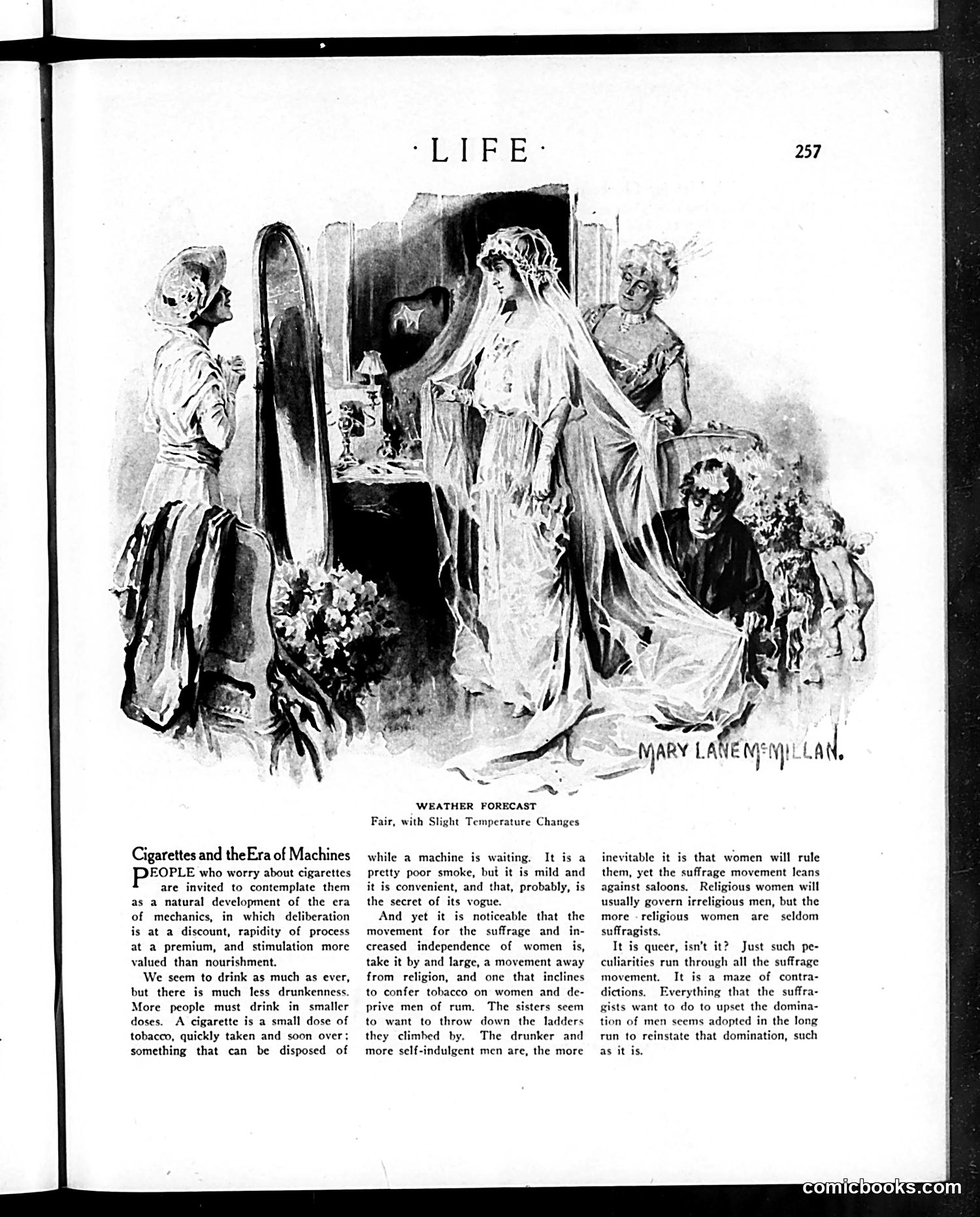
**The Illustration:** Mary Lane McMillan's drawing depicts a bride in her wedding chamber, attended by women. The scene appears to show a bride preparing for her wedding night—a traditional domestic moment. **The Article: "Cigarettes and the Era of Machines"** This opinion piece criticizes both increased cigarette consumption and the women's suffrage movement. The author argues that cigarettes represent passive acceptance of industrial society, and sarcastically suggests that women entering politics represents men abdicating their authority. The piece conflates women's independence with social decline, expressing anxiety about changing gender roles. **Context:** This reflects early 20th-century anti-feminist rhetoric that portrayed women's political participation as threatening to social order and masculine authority.
📄 Transcribed text from this page (OCR, searchable)
Machine-transcribed from the original scan — historical spelling and the odd misread are preserved.
Cigarettes and theEra of Machines PFOPLE who worry about cigarettes are invited to contemplate them as a natural development of the era of mechanics, in which deliberation is at a discount, rapidity of process at a premium, and stimulation more valued than nourishment. We seem to drink as much as ever, but there is much less drunkenness. More people must drink in smaller doses. A cigarette is a small dose of tobacco, quickly taken and soon over: something that can be disposed of —™ WEATHER FORECAST Fair, with Slight Temperature Changes while a machine is waiting. It is a pretty poor smoke, but it is mild and it is convenient, and that, probably, is the secret of its vogue. And yet it is noticeable that the movement for the suffrage and in- creased independence of women is, take it by and large, a movement away from religion, and one that inclines to confer tobacco on women and de- prive men of rum. The sisters seem to want to throw down the ladders they climbed by. The drunker and more self-indulgent men are, the more inevitable it is that women will rule them, yet the suffrage movement leans against saloons. Religious women will usually govern irreligious men, but the more - religious women are seldom suffragists. It is queer, isn’t it? Just such pe- culiarities run through all the suffrage movement. It is a maze of contra- dictions. Everything that the suffra- gists want to do to upset the domina- tion of men seems adopted in the long run to reinstate that domination, such as it is.