
Life, 1914-08-13 · page 24 of 40
Life — August 13, 1914 — page 24: what you’re looking at
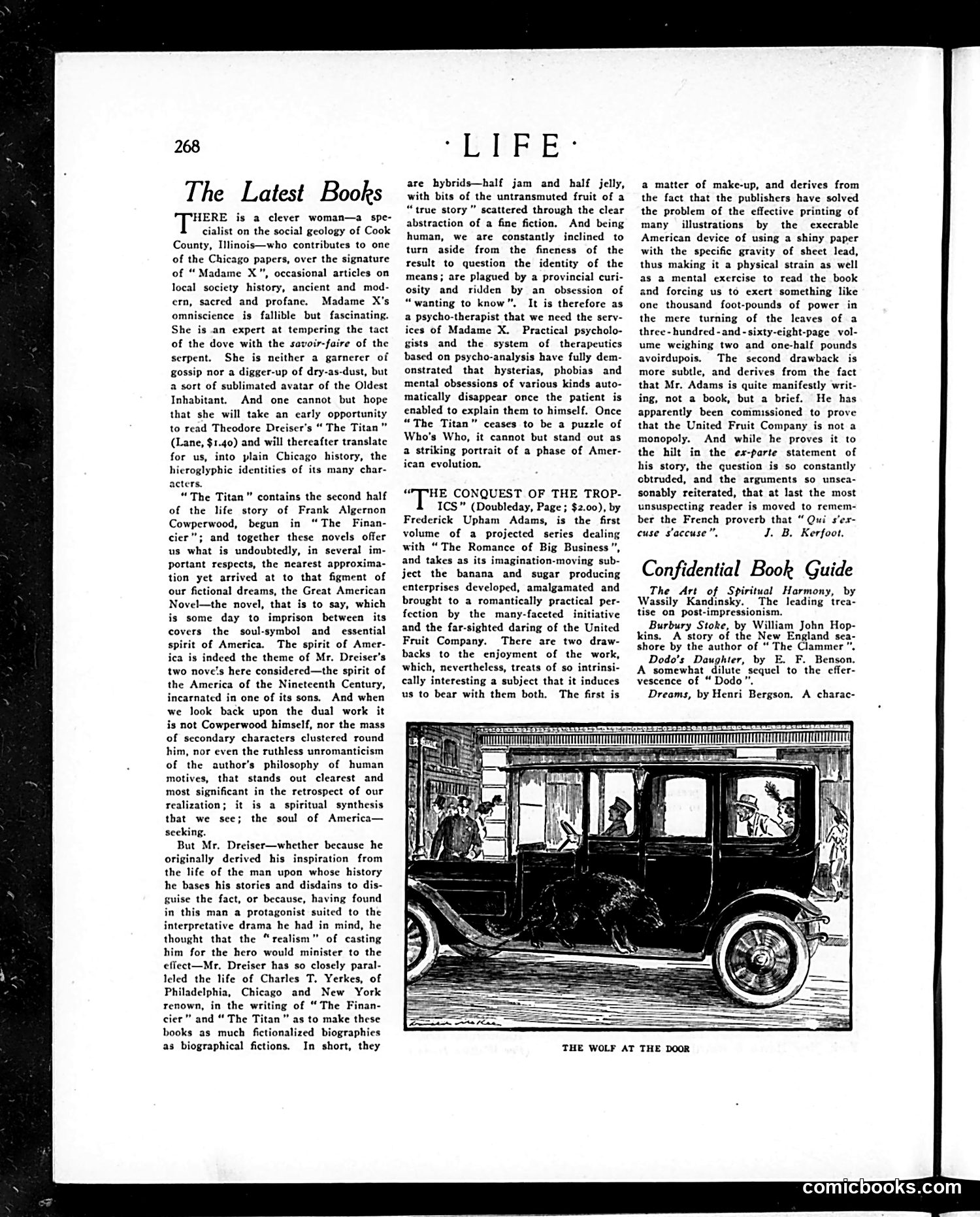
A restored page from Life, 1914-08-13. Page through the whole issue in the reader above.
📄 Transcribed text from this page (OCR, searchable)
Machine-transcribed from the original scan — historical spelling and the odd misread are preserved.
268 The Latest Books HERE is a clever woman—a spe- cialist on the social geology of Cook County, Ilinois—who contributes to one of the Chicago papers, over the signature of “ Madame X", occasional articles on local society history, ancient and mod- ern, sacred and profane. Madame X's omniscience is fallible but fascinating. She is an expert at tempering the tact of the dove with the savoir-faire of the serpent. She is neither a garnerer of gossip nor a digger-up of dry-as-dust, but a sort of sublimated avatar of the Oldest Inhabitant. And one cannot but hope that she will take an early opportunity to read Theodore Dreiser's “ The Titan” (Lane, $1.40) and will thereafter translate for us, into plain Chicago history, the hieroglyphic identities of its many char- acters. “The Titan” contains the second half of the life story of Frank Algernon Cowperwood, begun in “The Finan- cier”; and together these novels offer us what is undoubtedly, in several im- portant respects, the nearest approxima- tion yet arrived at to that figment of our fictional dreams, the Great American Novel—the novel, that is to say, which is some day to imprison between its covers the soul-symbol and essential spirit of America. The spirit of Amer- ica is indeed the theme of Mr. Dreiser's two nove's here considered—the spirit of the America of the Nineteenth Century, incarnated in one of its sons. And when we look back upon the dual work it is not Cowperwood himself, nor the mass of secondary characters clustered round him, nor even the ruthless unromanticism of the author's philosophy of human motives, that stands out clearest and most significant in the retrospect of our realization; it is a spiritual synthesis that we see; the soul of America— seeking. But Mr. Dreiser—whether because he originally derived his inspiration from the life of the man upon whose history he bases his stories and disdains to dis- guise the fact, or because, having found in this man a protagonist suited to the interpretative drama he had in mind, he thought that the “realism” of casting him for the hero would minister to the efiect—Mr. Dreiser has so closely paral- leled the life of Charles T. Yerkes, of Philadelphia, Chicago and New York renown, in the writing of “The Finan- cier” and “ The Titan” as to make these books as much fictionalized biographies as biographical fictions. In short, they LORE are hybrids—half jam and half jelly, with bits of the untransmuted fruit of a “true story” scattered through the clear abstraction of a fine fiction. And being human, we are constantly inclined to turn aside from the fineness of the result to question the identity of the means; are plagued by a provincial curi- osity and ridden by an obsession of “wanting to know”. It is therefore as a psycho-therapist that we need the serv- ices of Madame X. Practical psycholo- gists and the system of therapeutics based on psycho-analysis have fully dem- onstrated that hysterias, phobias and mental obsessions of various kinds auto- matically disappear once the patient is enabled to explain them to himself. Once “The Titan” ceases to be a puzzle of Who's Who, it cannot but stand out as a striking portrait of a phase of Amer- ican evolution. 'HE CONQUEST OF THE TROP- ICS” (Doubleday, Page ; $2.00), by Frederick Upham Adams, is the first volume of a projected series dealing with “The Romance of Big Business”, and takes as its imagination-moving sub- ject the banana and sugar producing enterprises developed, amalgamated and brought to a romantically practical per- fection by the many-faceted initiative and the far-sighted daring of the United Fruit Company. There are two draw- backs to the enjoyment of the work, which, nevertheless, treats of so intrinsi- cally interesting a subject that it induces us to bear with them both. The first is a matter of make-up, and derives from the fact that the publishers have solved the problem of the effective printing of many illustrations by the execrable American device of using a shiny paper with the specific gravity of shect lead, thus making it a physical strain as well as a mental exercise to read the book and forcing us to exert something like one thousand foot-pounds of power in the mere turning of the leaves of a three-hundred-and-sixty-eight-page vol- ume weighing two and one-half pounds avoirdupois. The second drawback is more subtle, and derives from the fact that Mr. Adams is quite manifestly writ- ing, not a book, but a brief. He has apparently been commissioned to prove that the United Fruit Company is not a monopoly. And while he proves it to the hilt in the ex-parte statement of his story, the question is so constantly obtruded, and the arguments so unsca- sonably reiterated, that at last the most unsuspecting reader is moved to remem- ber the French proverb that “Qui s’ex- cuse s'accuse”. J. B. Kerfoot. Confidential Book Guide The Art of Spiritual Harmony, by Wassily Kandinsky. The leading trea- tise on post-impressionism. Burbury Stoke, by William John Hop- kins. A story of the New England sea- shore by the author of “ The Clammer”. Dodo’s Daughter, by E. F. Benson. A somewhat dilute sequel to the effer- vescence of “ Dodo”. ‘Dreams, by Henri Bergson. A charac- ene 35: T THE WOLF AT THE DOOR comicbooks.com