
Life, 1914-08-13 · page 12 of 40
Life — August 13, 1914 — page 12: what you’re looking at
What you’re looking at
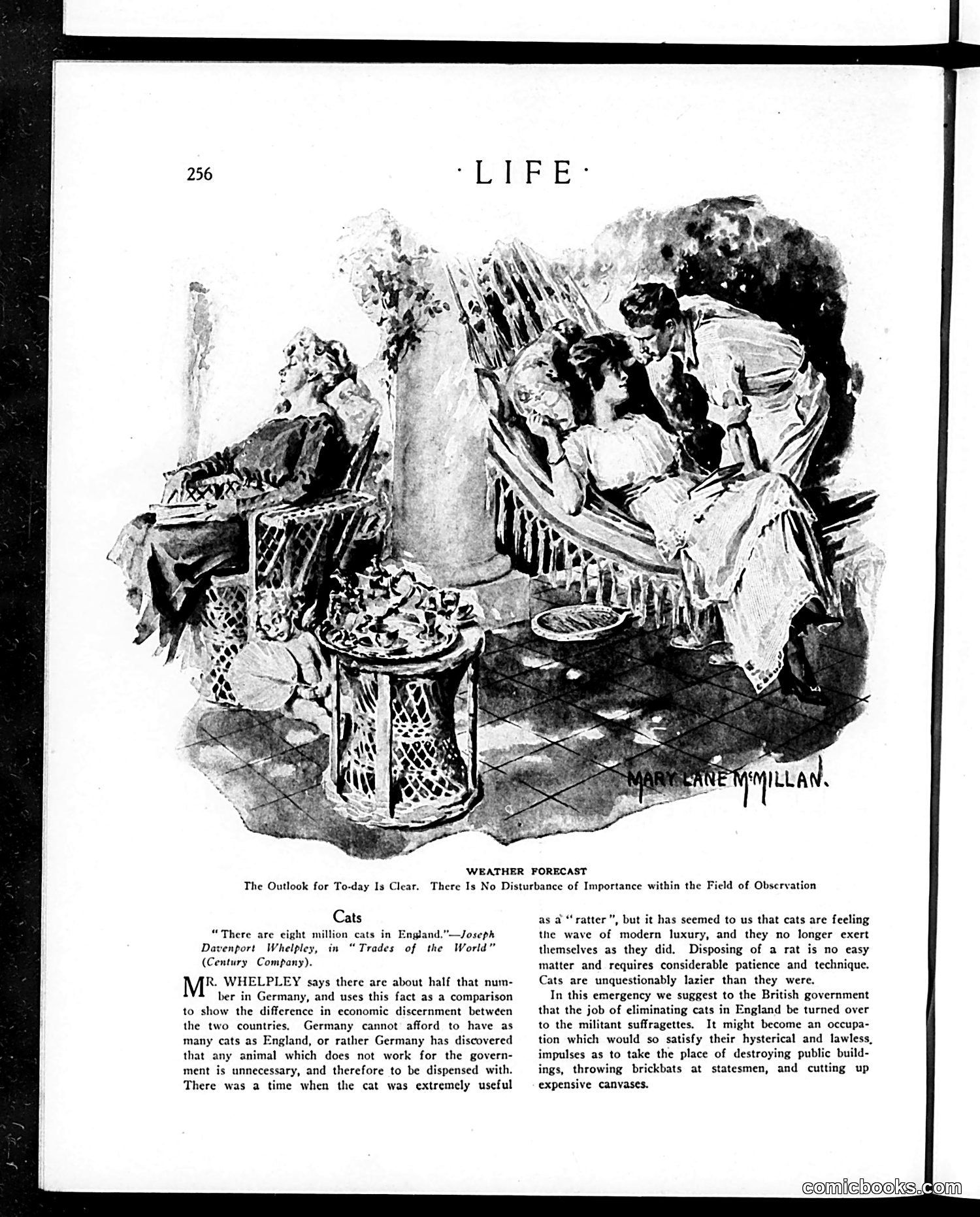
This page contains an illustration by Mary Jane McMillan and an article about cats during wartime. The sketch shows fashionably dressed women in what appears to be a social gathering, seated in comfortable chairs. The article's satire concerns British and German attitudes toward cats. It notes that England has approximately eight million cats, while Germany has fewer. The piece argues sarcastically that Germany's culling of "non-working" animals reflects utilitarian philosophy, suggesting Britain should consider eliminating cats as an "emergency" measure—ironically proposing that destroying cats could replace destructive suffragette activities like bombing buildings and slashing paintings. This appears to be WWI-era commentary mocking both German pragmatism and feminist militancy through the unlikely subject of domestic cats.
📄 Transcribed text from this page (OCR, searchable)
Machine-transcribed from the original scan — historical spelling and the odd misread are preserved.
WEATHER FORECAST The Outlook for To-day Is Clear. There Is No Disturbance of Importance within the Field of Observation Cats “There are eight million cats in England."—Joseph Davenport Whelpley, in “Trades of the World” (Century Company). M® WHELPLEY says there are about half that num- ber in Germany, and uses this fact as a comparison to show the difference in economic discernment between the two countries, Germany cannot afford to have as many cats as England, or rather Germany has discovered that any animal which does not work for the govern- ment is unnecessary, and therefore to be dispensed with. There was a time when the cat was extremely useful as a “‘ratter", but it has seemed to us that cats are feeling the wave of modern luxury, and they no longer exert themselves as they did. Disposing of a rat is no easy matter and requires considerable patience and technique. Cats are unquestionably lazier than they were. In this emergency we suggest to the British government that the job of eliminating cats in England be turned over to the militant suffragettes. It might become an occupa- tion which would so satisfy their hysterical and lawless, impulses as to take the place of destroying public build- ings, throwing brickbats at statesmen, and cutting up expensive canvases. comichooks.com