
A complete issue · 40 pages · 1914
Life — January 22, 1914
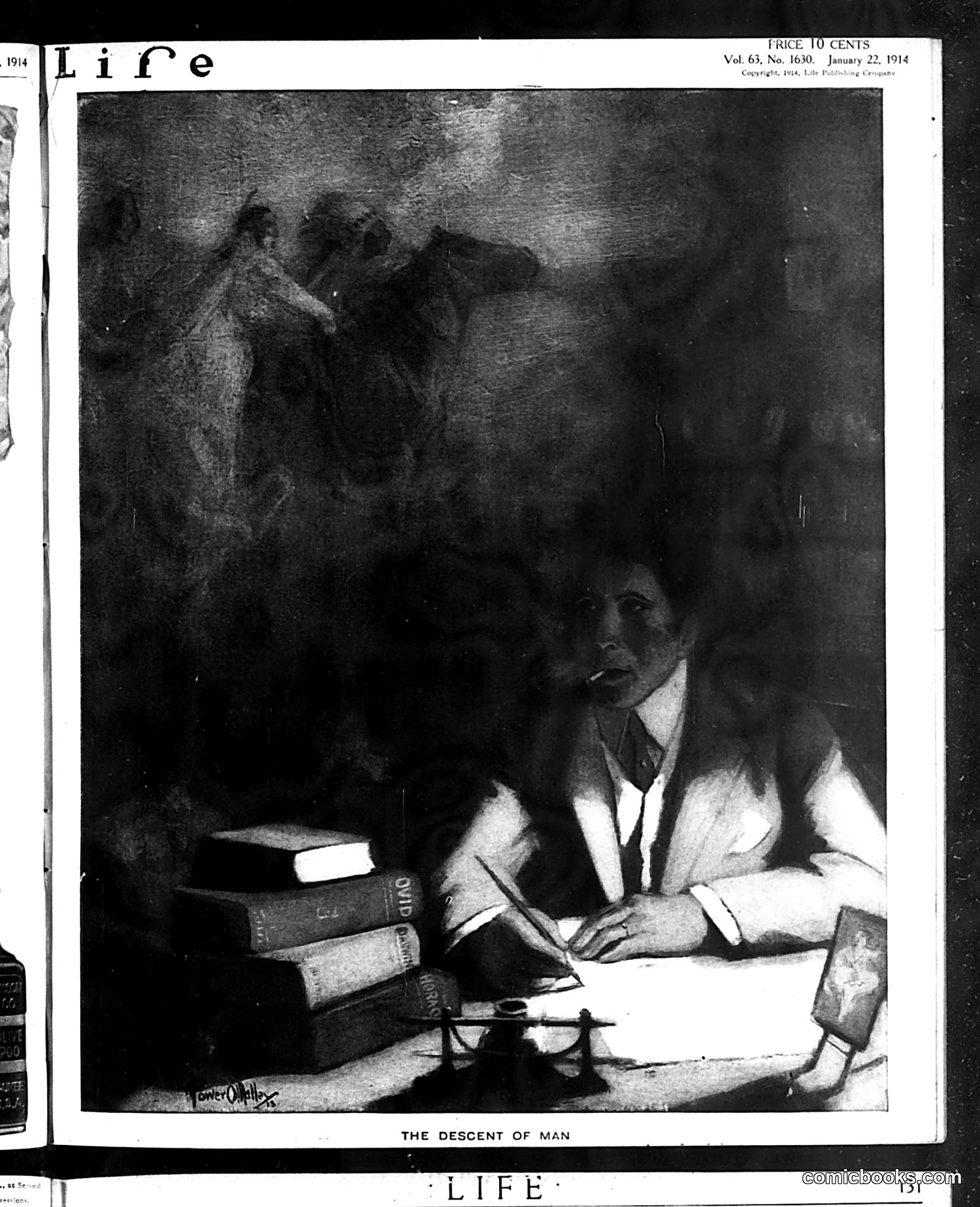
This January 1914 *Life* cartoon satirizes Darwin's theory of evolution. The image shows a man hunched at a desk, working intently on papers and surrounded by books, while ghostly ape-like figures loom menacingly above him in the shadows. The caption "The Descent of Man" references Darwin's 1871 work arguing humans evolved from earlier primates. The satire suggests that intellectual labor—the man's concentrated desk work—represents humanity's supposed "descent" into animal-like behavior, or conversely, that civilization's pressures reduce humans to brutish forms. The cartoon likely mocks either Darwin's theory itself (common among religious critics) or critiques how modern work and intellectual demands degrade human dignity, reducing educated men to primitive states.
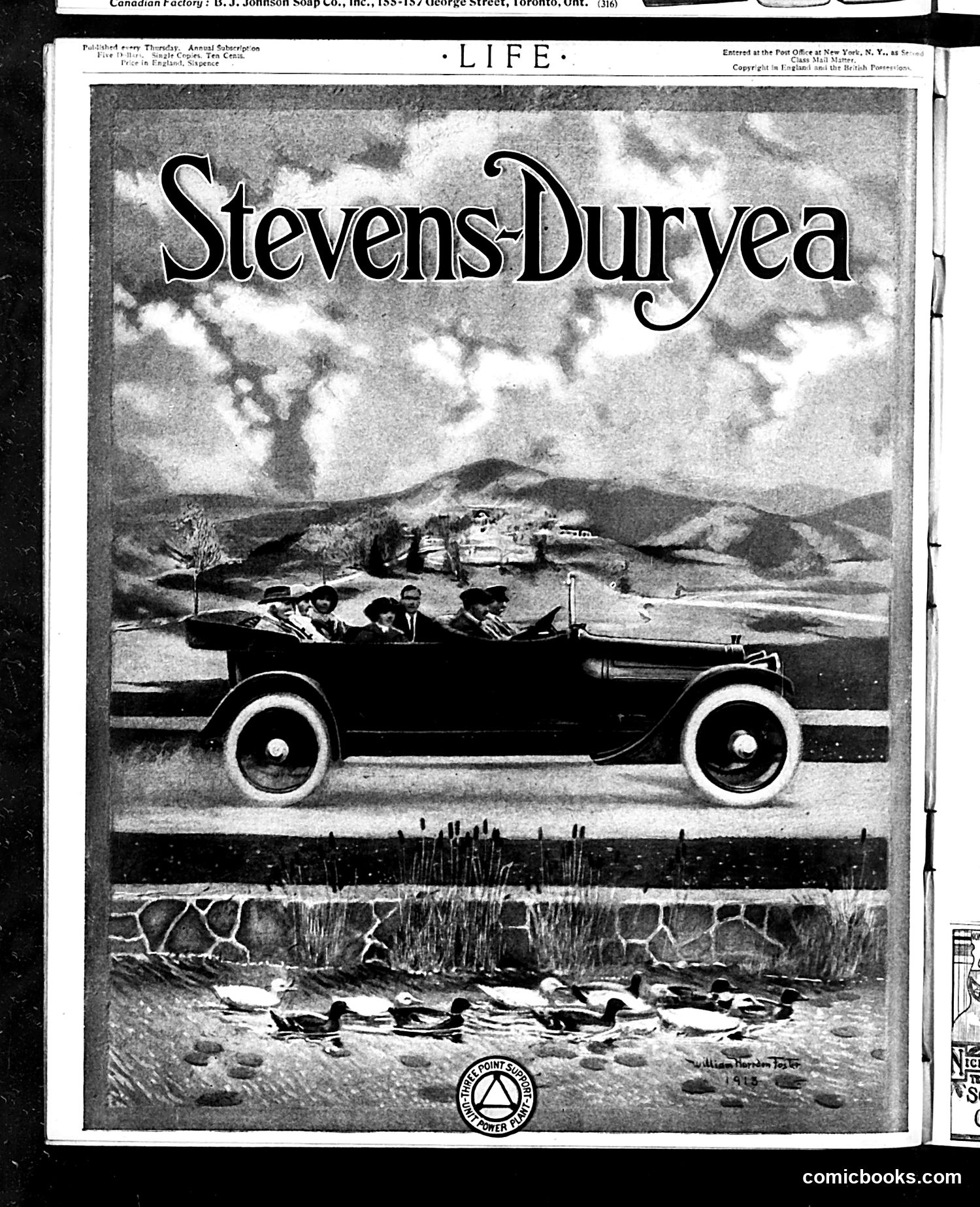
This is a **vintage automobile advertisement** for Stevens-Duryea cars, not political satire. The image shows a luxury touring car with well-dressed passengers driving through an idyllic countryside landscape featuring rolling hills, a distant village, and a river with ducks. The advertisement emphasizes the car's capability for leisurely recreational driving—a marker of affluence and leisure during the early automotive era. The scenic backdrop and elegant passengers suggest this vehicle was marketed to wealthy consumers. The composition presents car ownership as aspirational, associating the Stevens-Duryea brand with refined taste, comfort, and access to nature. This represents typical early-20th-century automotive marketing strategy, emphasizing lifestyle rather than mechanical specifications.
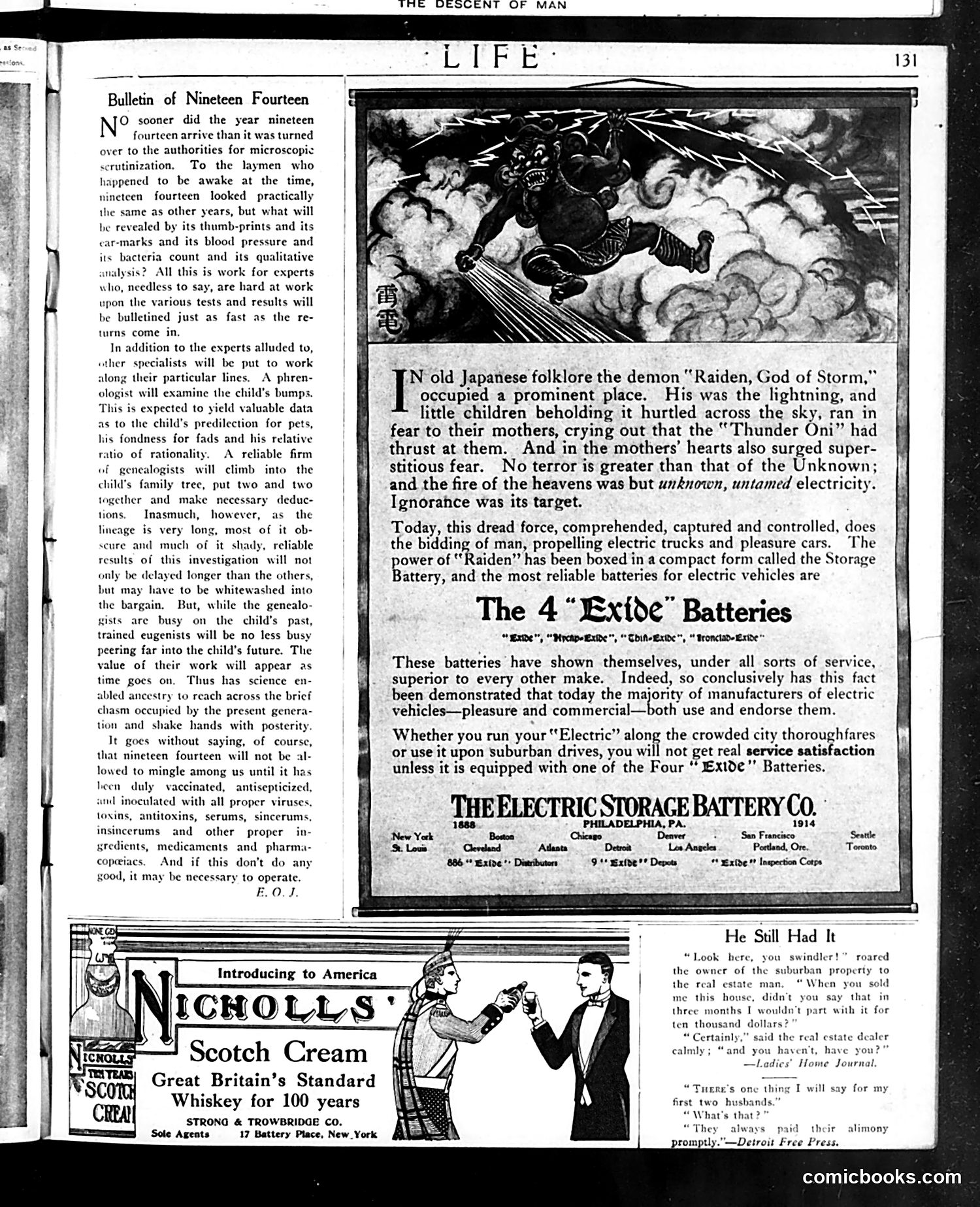
This page is **primarily advertising** interspersed with brief editorial content, not political satire. The main illustration shows a demon figure from Japanese folklore ("Raiden, God of Storm") threatening children—used metaphorically to introduce an advertisement for **Exide Batteries**. The copy equates electricity's mysterious power to the demon, then pivots: modern science has "boxed in" this wild force into practical storage batteries for electric vehicles. Below is a **Nicholls Scotch Cream whiskey advertisement** featuring a figure in Scottish dress. At bottom, a brief humor piece titled "He Still Had It" about real estate salesmanship. The page reflects 1914 advertising strategy: using striking imagery and pseudo-scientific language to market new technologies (electric vehicles, batteries) to consumers unfamiliar with electricity.
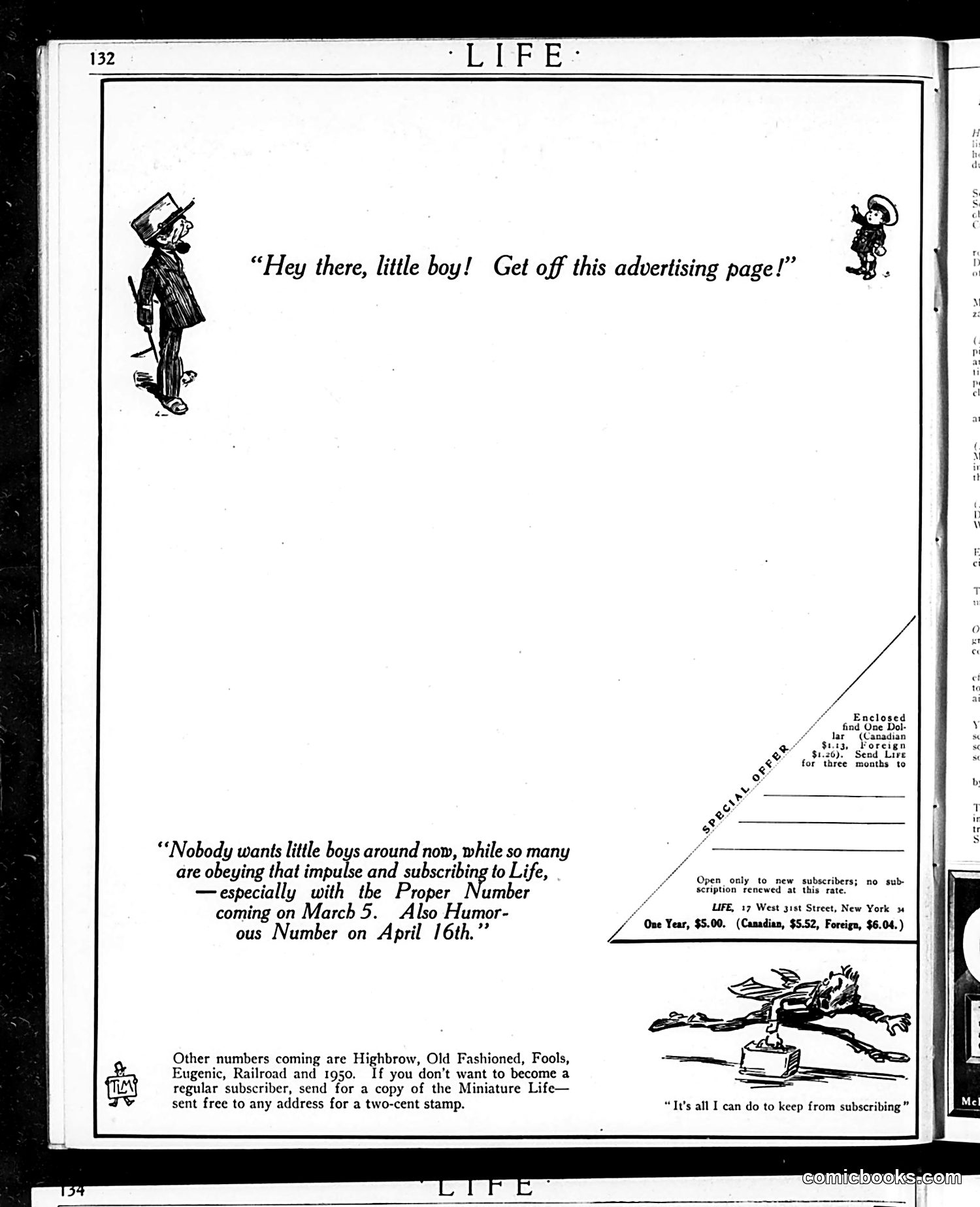
This is primarily a **Life magazine subscription advertisement** from the early 20th century, disguised as editorial content with humor. The top cartoon shows a small boy being ejected from an advertising page—a meta-joke acknowledging readers' annoyance at ads interrupting content. The main text uses satire to promote subscriptions, claiming "Nobody wants little boys around now" while encouraging subscriptions to Life, particularly for an upcoming "Humorous Number" (April 16th). The bottom cartoon depicts a figure struggling against an impulse to subscribe—personifying temptation as an almost irresistible force. The advertisement lists other themed issues coming (Highbrow, Old Fashioned, Fools, Eugenic, Railroad, and 1950) and offers a free sample copy to non-subscribers. Pricing: $5.00 annually ($3.52 Canadian, $6.04 foreign). The humor relies on self-aware mockery of advertising itself.
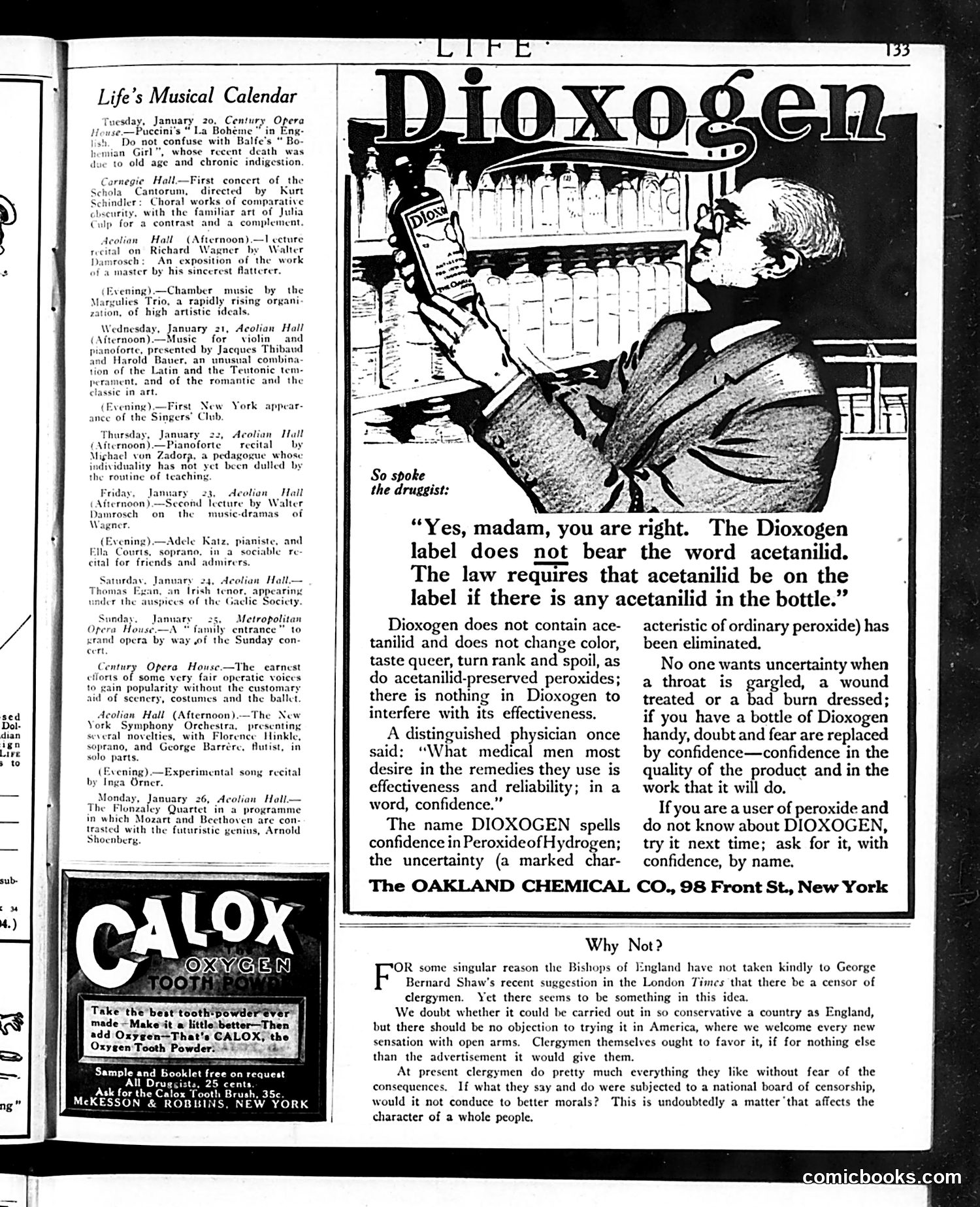
This page is dominated by a **Dioxogen advertisement** (a hydrogen peroxide disinfectant product) rather than political satire. The main illustration shows a druggist/pharmacist addressing a female customer about the product's labeling and reliability. The ad's pitch emphasizes that Dioxogen contains no acetanilid (a pain reliever), distinguishing it from competitors. The quote stresses that doctors value "confidence" in remedies—a common early 20th-century advertising appeal to authority and product reliability. Below, a brief section titled "Why Not?" discusses George Bernard Shaw's suggestion for English censorship, apparently criticizing clergy's resistance to modern ideas. This brief commentary represents the magazine's typical satirical editorial voice rather than a cartoon. The page also advertises **Calox Oxygen Toothpowder**, a separate product.
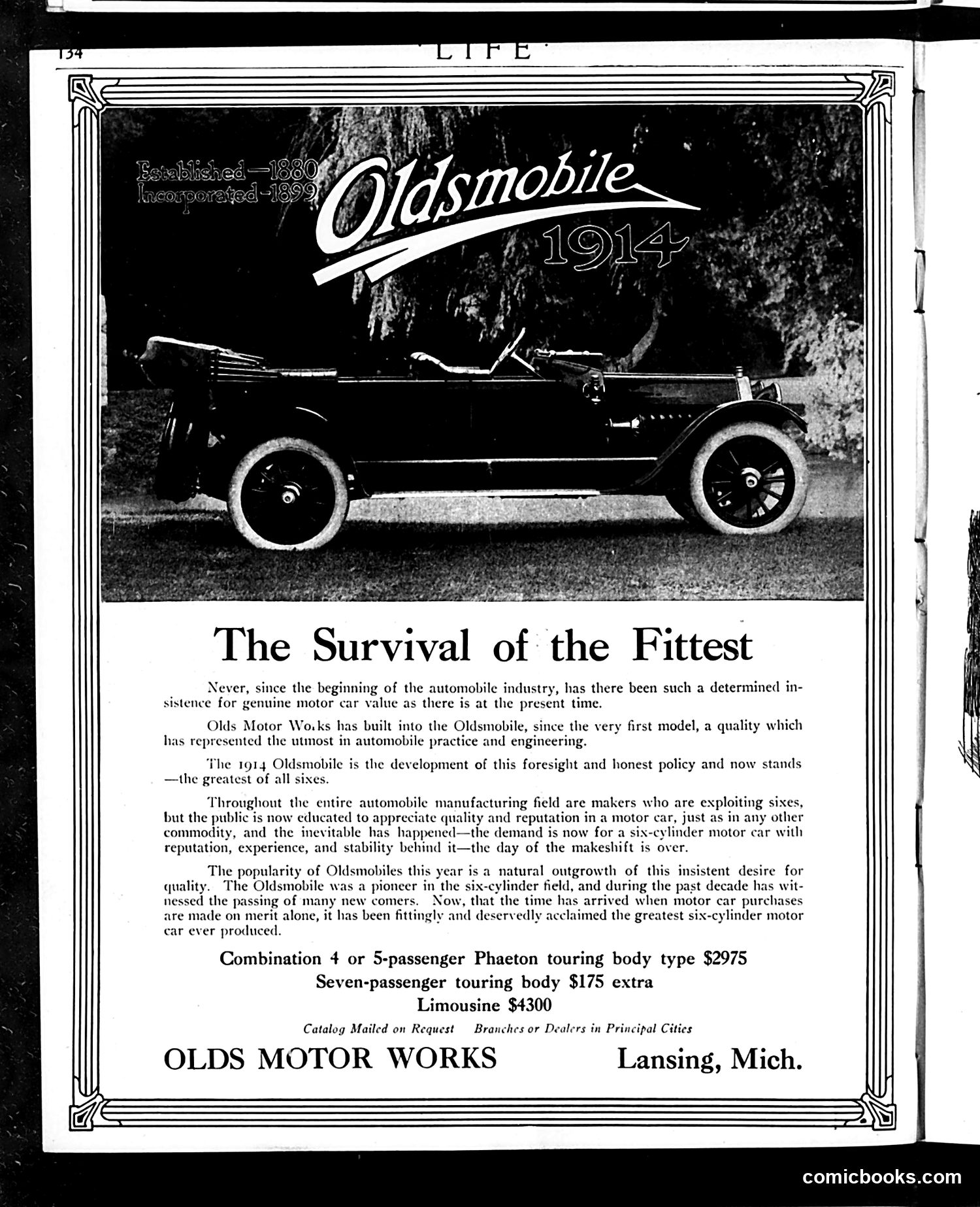
This page is **primarily advertising, not satire or political commentary**. It's a 1914 Oldsmobile advertisement from *Life* magazine featuring a side-profile photograph of a luxury automobile. The headline "The Survival of the Fittest" uses evolutionary language to position Oldsmobile as superior to competitors. The advertising copy argues that the auto industry was consolidating around quality vehicles, and that consumers now demanded six-cylinder motors with "reputation, experience, and stability"—implying competitors were failing. The text boasts the 1914 Oldsmobile represents "honest policy and engineering," positioning it as the dominant survivor in competitive automotive manufacturing. Pricing is listed: $2,975 for a phaeton, with options for seven-passenger and limousine versions. No political figures or social satire are present—this is straightforward commercial promotion.
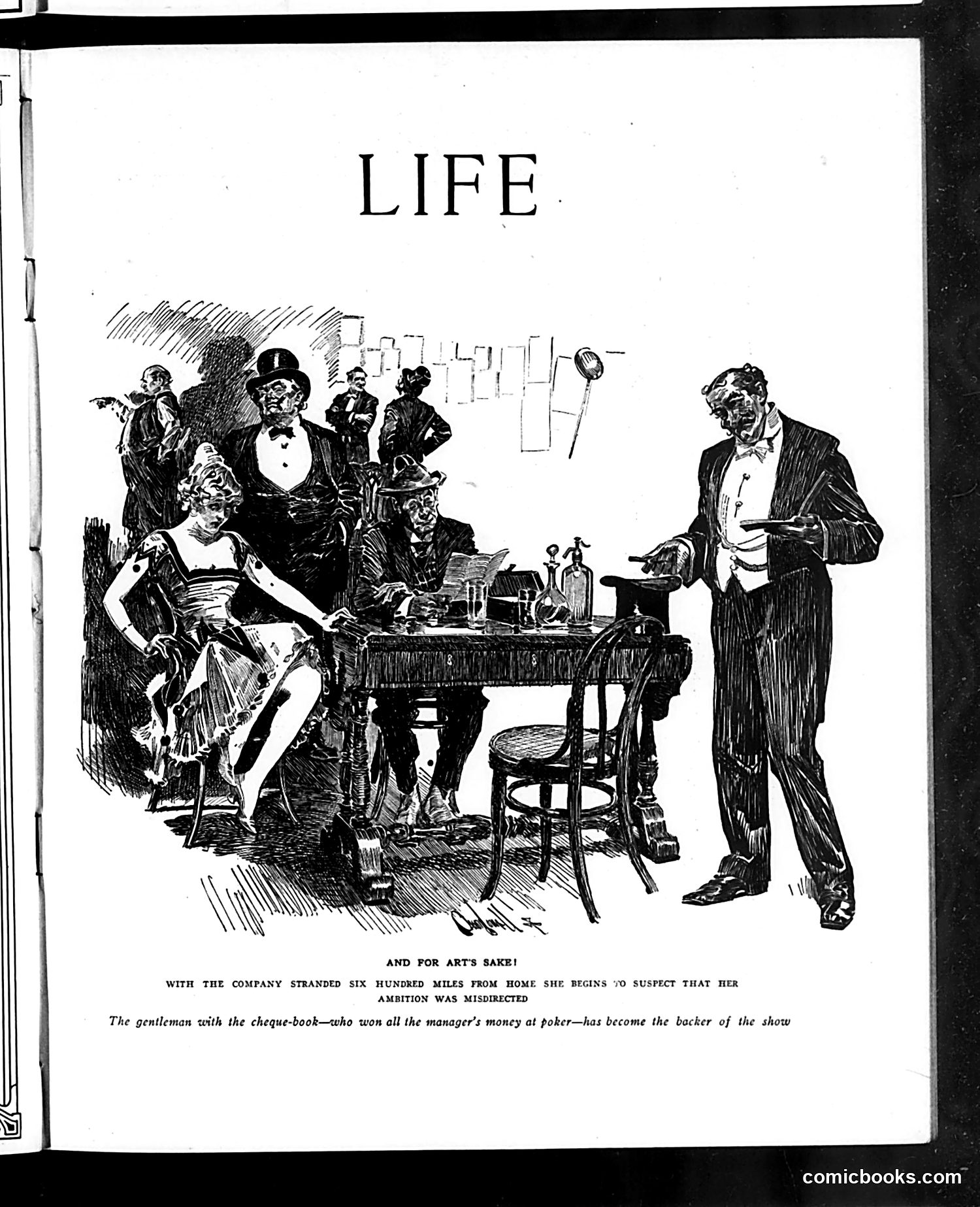
This satirical cartoon depicts a social scene at what appears to be a theatrical or entertainment venue. The central figure is a woman in revealing attire at a table with bottles and glasses, surrounded by men in formal evening wear. A gentleman on the right holds a check-book. The caption explains the satirical point: a woman traveled far from home with theatrical company, expecting artistic ambition, but instead her financial backer (the man with the check-book who "won all the manager's money at poker") is now funding the show. The satire mocks both theatrical pretension—claiming artistic merit while actually being financed through gambling—and the transactional nature of entertainment and female performers in this era. The joke critiques the gap between stated cultural aspirations and actual mercenary motivations.
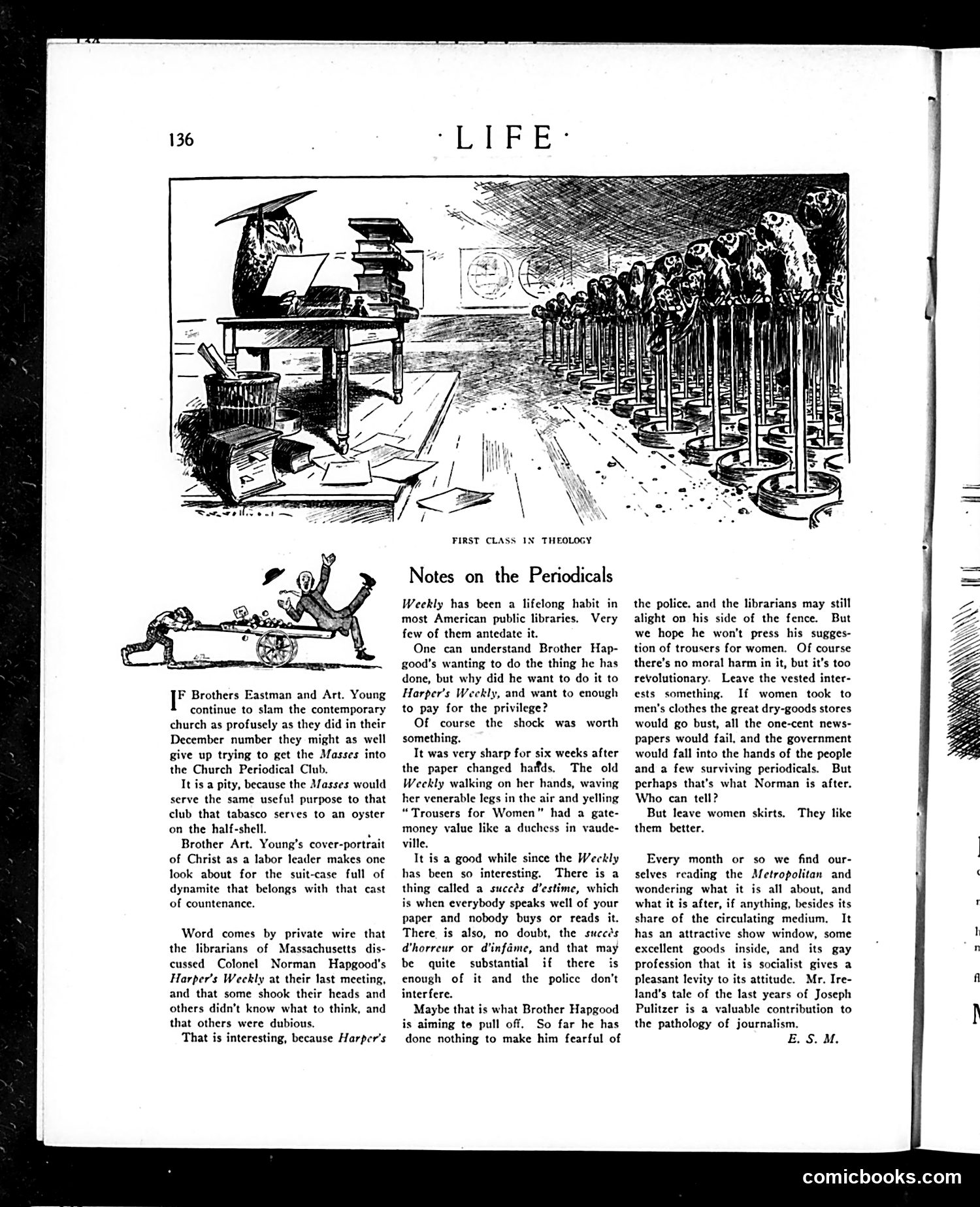
This cartoon satirizes the commercialization of religion and publishing in early 20th-century America. The image depicts a bird-like instructor at a desk covered with papers and books, teaching a row of identical robed figures (clergy or seminarians) who stand in pots like plants being cultivated. The satire suggests that religious education has become an industrial, mass-production operation—literally "growing" ministers as commodities rather than developing them as individuals. The mechanical uniformity of the students and the factory-like arrangement mock both theological education and the publishing industry's role in creating standardized religious authority. The accompanying article criticizes *Harper's Weekly* and debates about magazine content, connecting to themes of mass-market influence on institutions.
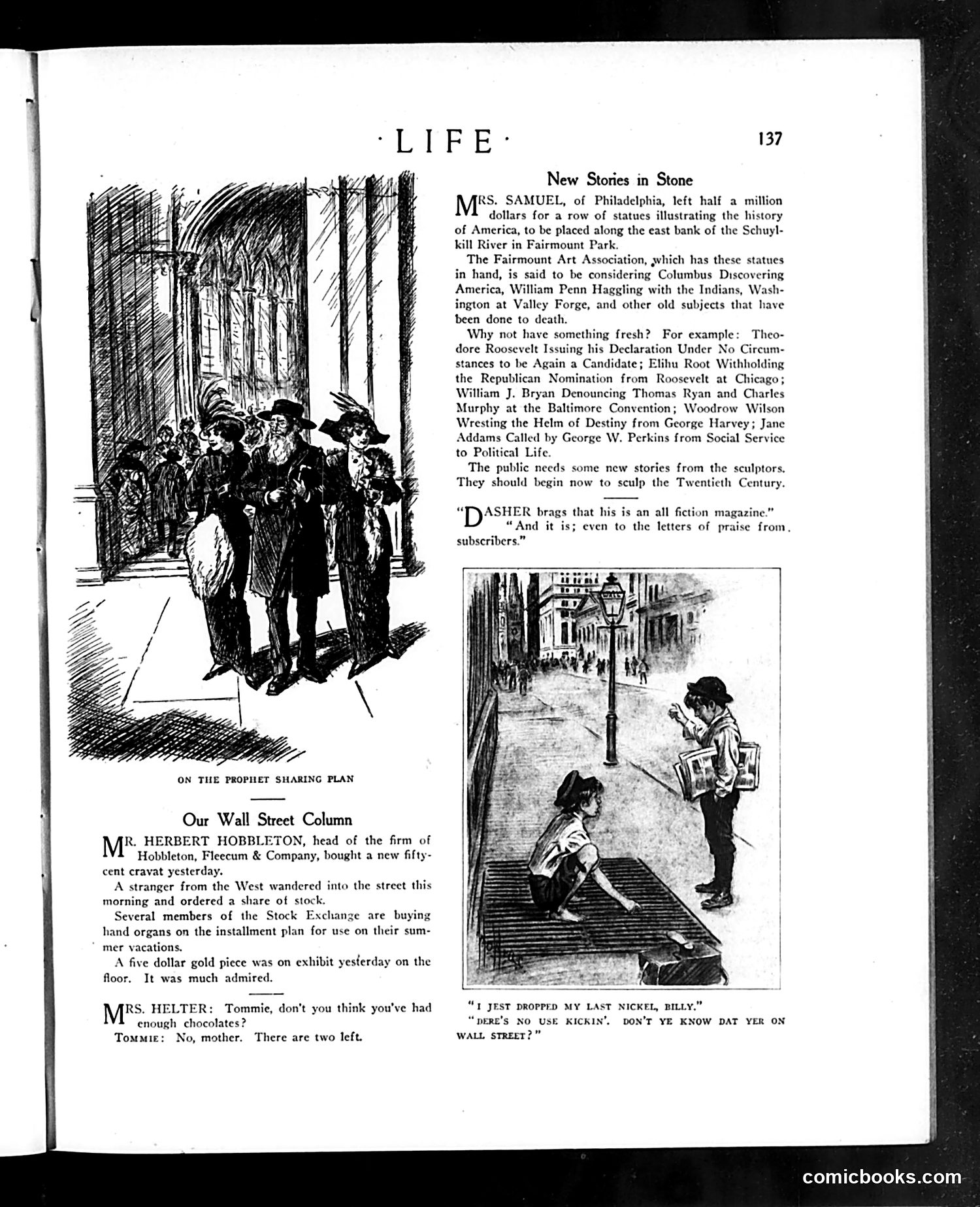
This Life magazine page (p. 137) contains two distinct satirical pieces: **"New Stories in Stone"** mocks the Fairmount Art Association's plan for historical statues along Philadelphia's Schuylkill River. The satire suggests these should be replaced with more contemporary subjects—Theodore Roosevelt's political maneuvers, William Jennings Bryan's activities, and various recent political/social controversies. The point: the association recycles old historical figures when modern American politics offers equally dramatic (and ridiculous) subjects worthy of commemoration. **"Our Wall Street Column"** presents a humorous anecdote about Herbert Hobbleton buying stock and exchange members purchasing land organs—likely satirizing speculative excess and frivolous spending during the prosperous 1920s. The final dialogue joke about chocolates is light domestic humor.
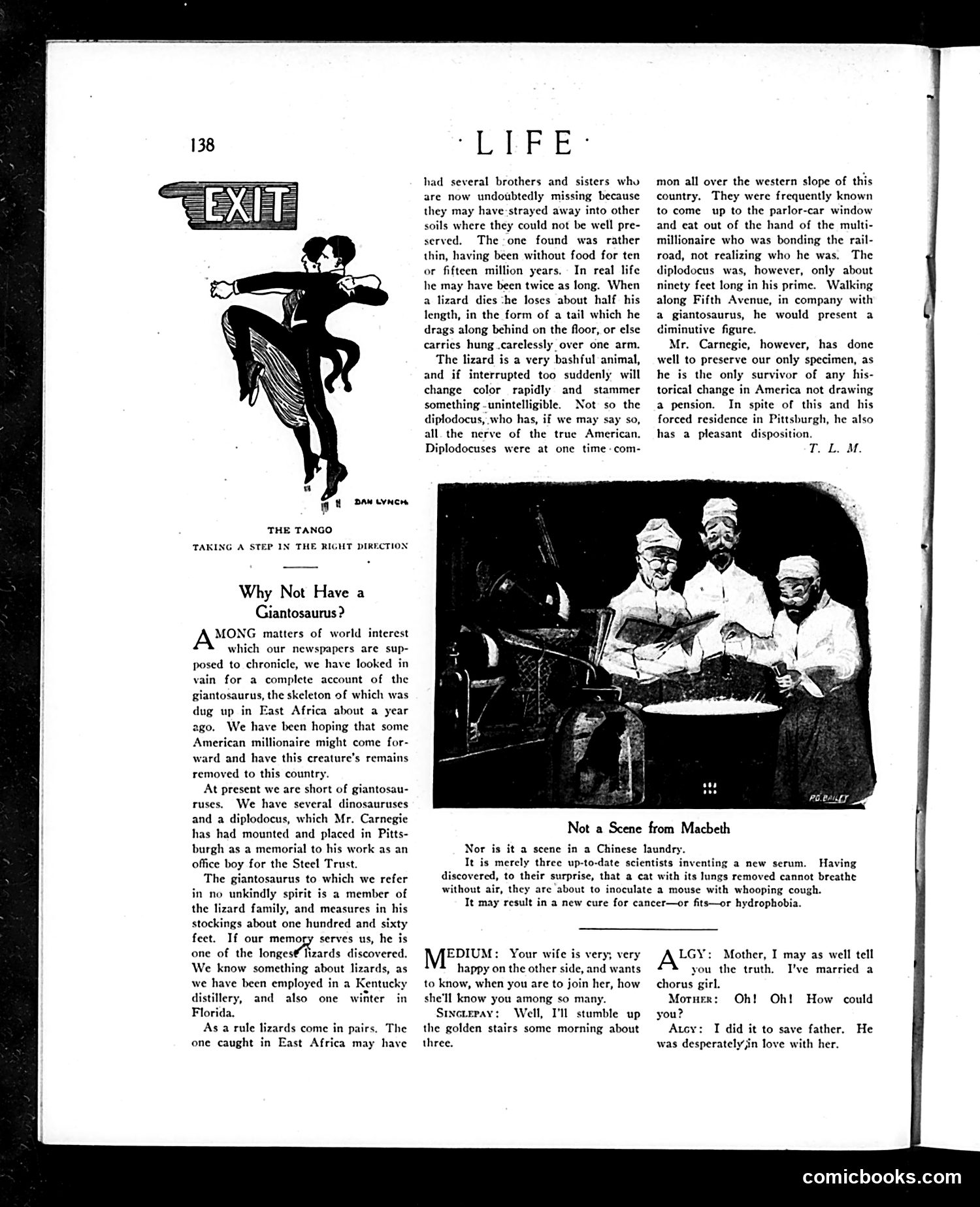
**"The Tango: Taking a Step in the Right Direction"** shows a man performing an exaggerated tango pose—the cartoon satirizes the tango craze that swept America in the early 1900s. The dance was considered scandalously intimate by Victorian standards, and this illustration mocks both the dance's dramatic movements and American enthusiasm for the trend. **"Why Not Have a Giantosaurus?"** is a humorous essay about a dinosaur skeleton excavated in East Africa. The author proposes that an American millionaire (likely Andrew Carnegie, mentioned in the text) acquire it for display. The piece gently ridicules wealthy collectors' competitive acquisition of exotic specimens while also poking fun at the idea of importing such an impractical "trophy."
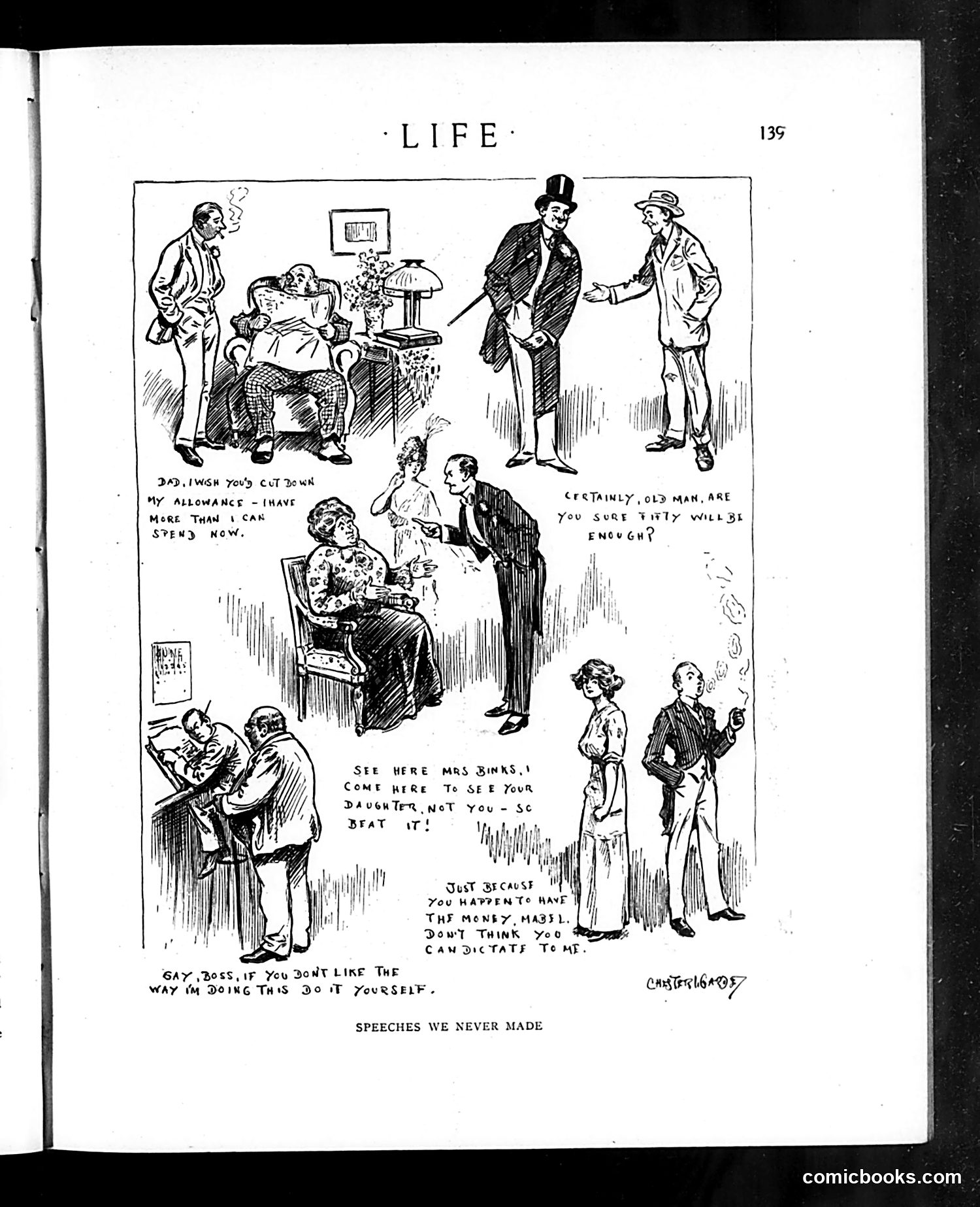
This satirical cartoon depicts various scenarios of what wealthy or powerful men *wish* they could say to their dependents but dare not speak aloud—hence "speeches we never made." The vignettes show: - A man wanting to cut his son's allowance - An employer telling a worker he won't increase wages despite having money - A father-in-law asserting dominance over his daughter - A man telling his wife he dislikes how she's managing household finances The satire targets the hypocrisy and hidden resentments of the upper class. These men possess the financial power to make such demands but fear social consequences—family conflict, labor unrest, or damaged reputations. The cartoon mocks their weakness and the gap between their actual desires and publicly acceptable behavior in Edwardian society.
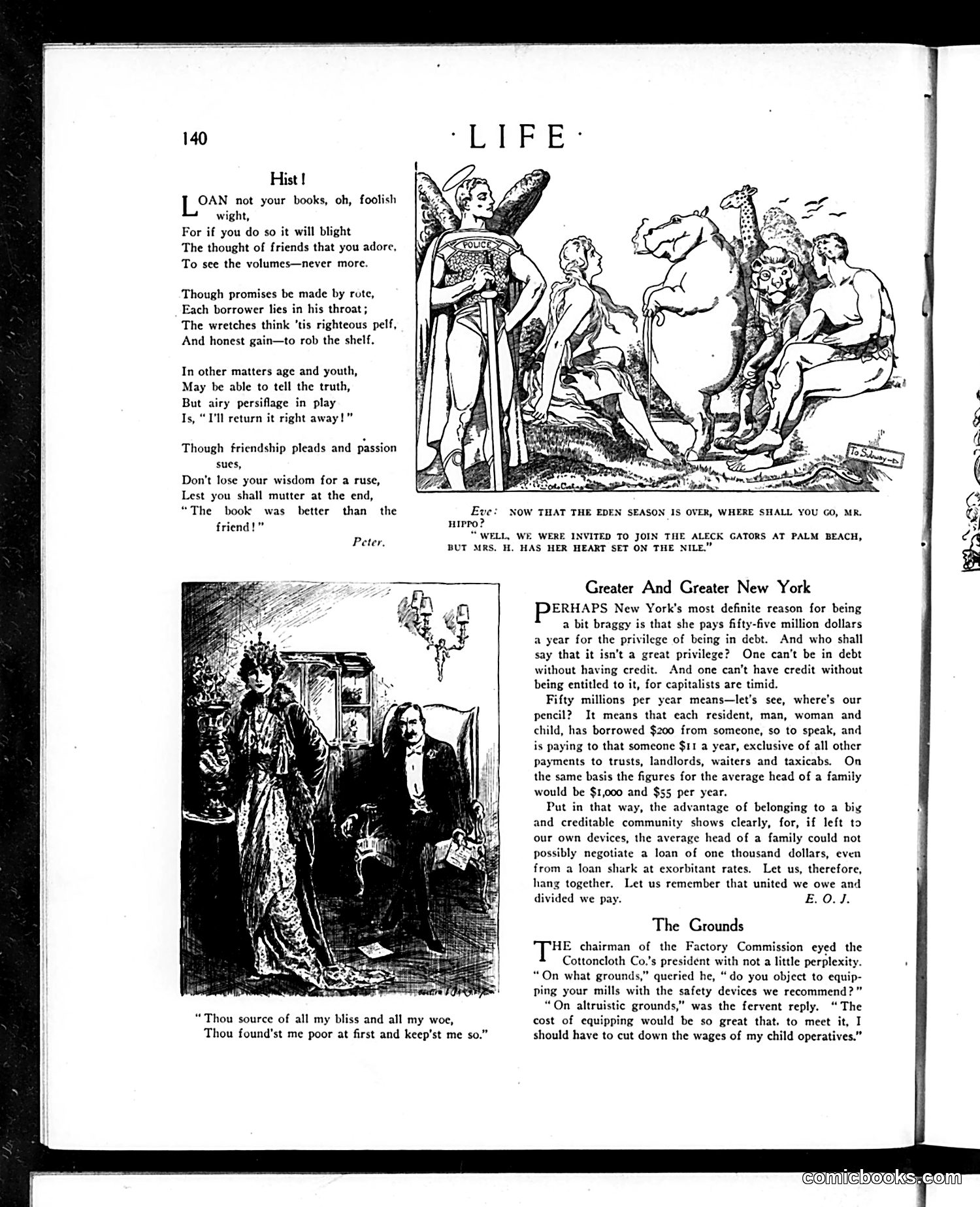
This page contains two distinct pieces of satirical social commentary: **Top Section - "Hist!"**: A poem by Peter warning against lending books, illustrated with classical figures. The satire mocks people who borrow books and never return them—a timeless social complaint about dishonest borrowers who exploit friendship. **Bottom Section - "Greater and Greater New York"**: An essay by E.O.J. critiques New York's debt-based economy. It argues that being in debt is normalized as a "privilege" and notes how average families borrow $200 and pay it back in installments to various creditors. The satire exposes how the working poor are trapped in perpetual financial obligation to multiple parties. **Illustration**: Shows a poorly-dressed couple, likely representing working-class New Yorkers struggling with debt. **"The Grounds"**: A brief anecdote mocking factory owners' objections to safety equipment costs.
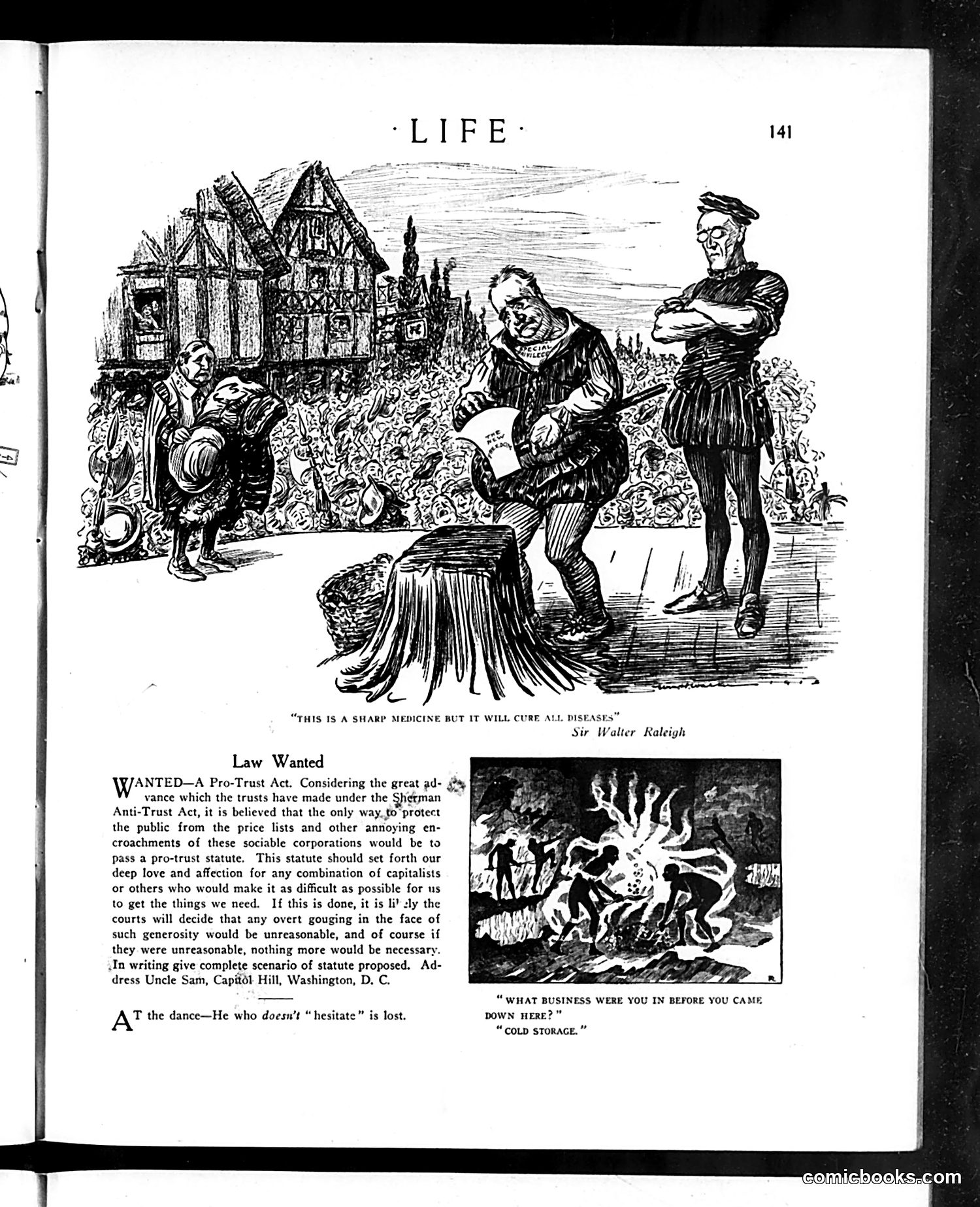
The top cartoon satirizes monopolistic business practices through a theatrical scene. A tall figure (likely representing a trust or monopoly) performs before an audience while presenting what appears to be a cure-all medicine—a common metaphor for corporate claims to solve problems through consolidation. The "Law Wanted" section advocates for anti-trust legislation (referencing the Sherman Anti-Trust Act), proposing a "Pro-Trust Act" statute to regulate monopolies and protect the public from "annoying encroachments" by large corporations. The bottom cartoon shows devils or demons around a fire, captioned "What business were you in before you came down here? Cold storage." This satirizes the cold storage industry—likely referencing monopolistic practices or price-fixing in that sector—equating business practices with devilry. Both pieces criticize corporate consolidation and monopolies as harmful to public welfare.
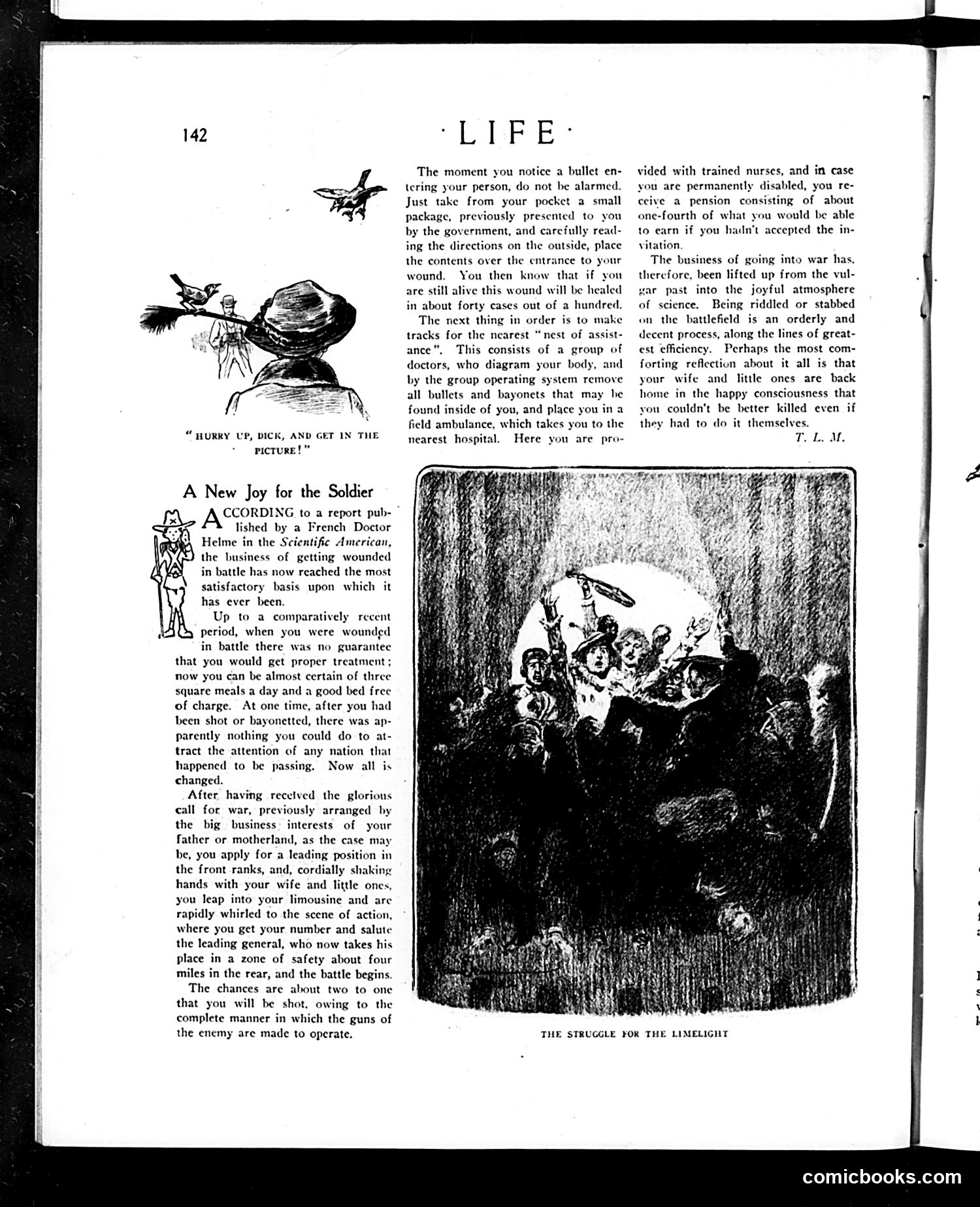
This page contains two pieces of WWI-era content: **Top section:** Practical advice for wounded soldiers, describing battlefield medical procedures—bullet removal, field ambulance transport, and hospital treatment. The cartoon caption "Hurry up, Dick, and get in the picture!" shows soldiers rushing toward a photographer, likely satirizing soldiers' eagerness to document their war experience. **Main article: "A New Joy for the Soldier"** discusses improved medical care during wartime. It references a French doctor's report in *Scientific American* about better battlefield treatment, contrasting this with earlier periods when wounded soldiers received minimal care. The article emphasizes three improvements: guaranteed proper treatment, a bed, and free care. **Illustration:** Captioned "The Struggle for the Limelight," shows soldiers competing for a photographer's attention—satirizing soldiers' desire for publicity and documentation during combat. The overall tone is darkly humorous about warfare's realities.
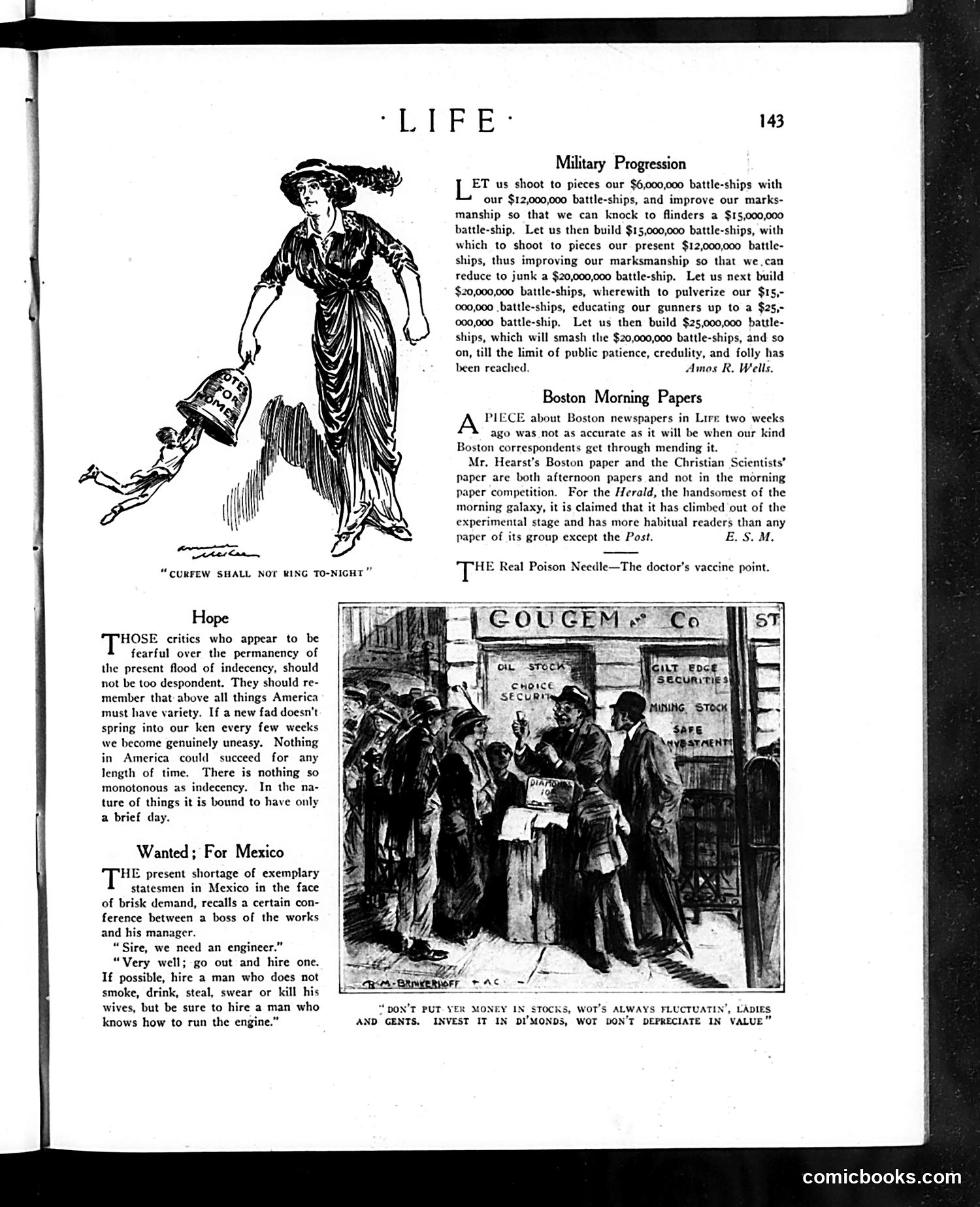
This page contains four separate satirical pieces: **"Military Progression"** (Amos R. Wells): A sardonic critique of escalating naval arms spending. The text absurdly proposes an endless cycle—building ever-more-expensive battleships solely to destroy slightly-cheaper ones—mocking the logic of competitive militarism and unlimited defense budgets. **"Boston Morning Papers"**: A correction to an earlier Life article about Boston newspapers, clarifying which papers compete in the morning market (the Herald being praised). **"Hope"**: Brief commentary suggesting Americans' short attention span prevents moral decay from becoming entrenched—indecency can't sustain permanence because Americans constantly chase new fads. **"Wanted; For Mexico"**: A joke about Mexico's shortage of "exemplary statesmen," using a boss-and-manager dialogue. It sardonically suggests finding a leader who avoids smoking, drinking, stealing, swearing, and murdering wives—implying Mexican politicians were stereotyped as corrupt. The accompanying illustration (bottom) shows a stock-broker hawking diamonds as safer investments than volatile stocks.
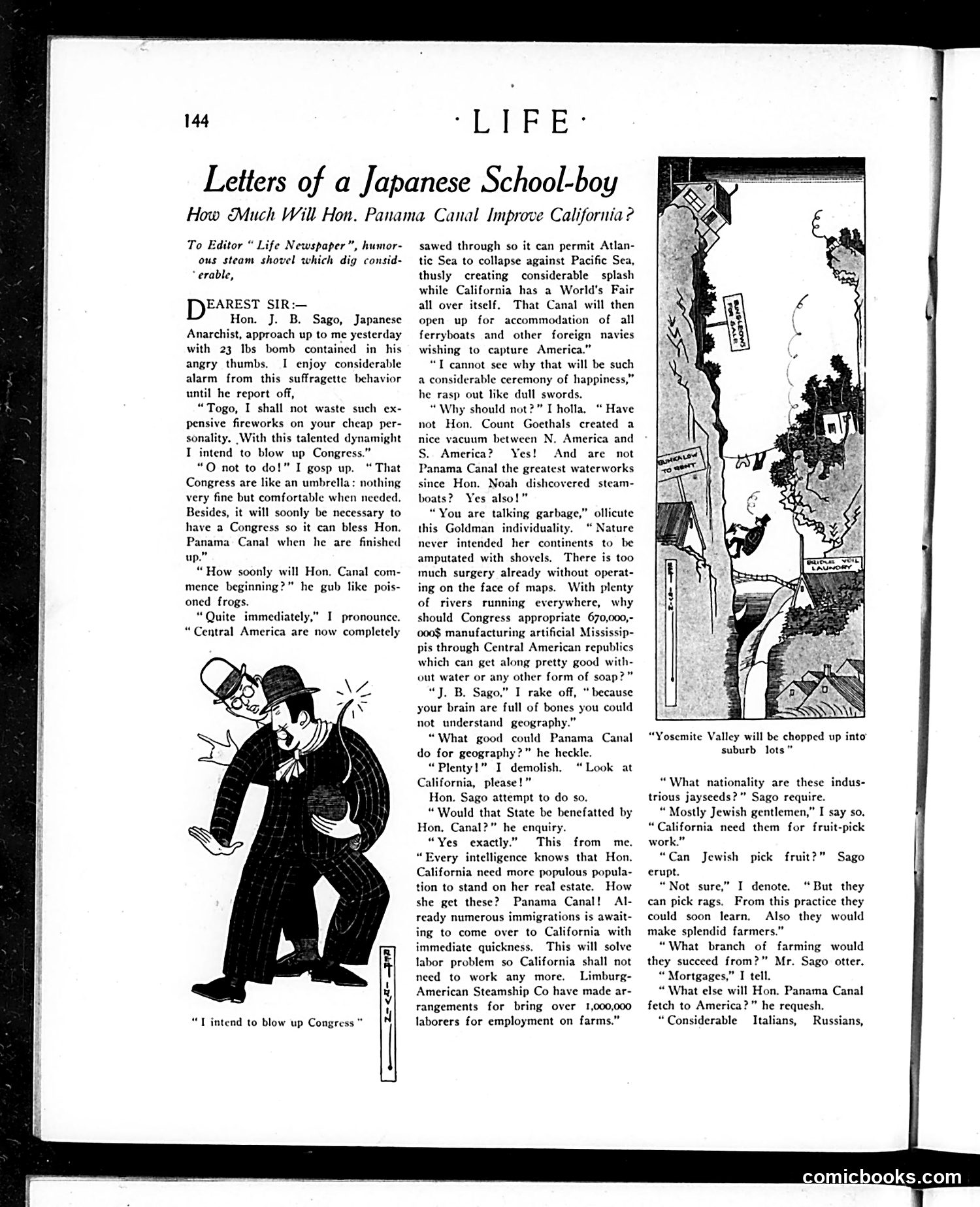
This piece satirizes both the Panama Canal project and contemporary immigration anxieties through a fictionalized letter from a Japanese anarchist named "Hon. J. B. Sago" debating an unnamed American correspondent. **The Setup:** Sago initially threatens to bomb Congress but is dissuaded, leading to a heated exchange about whether the Canal will benefit California. **The Satire's Targets:** 1. **Canal Boosters:** The American writer defends the Canal as bringing prosperity and population to California through immigration. 2. **Anti-Immigration Sentiment:** The joke's punchline targets prejudiced assumptions—Sago questions what "nationalities" will immigrate, and the American reveals they'll be "Mostly Jewish gentlemen" suited only for "fruit-pick work" and (in the final joke) "mortgages." The mention of Italians and Russians extends the ethnic mockery. 3. **Development Concerns:** A caption notes "Yosemite Valley will be chopped up into suburb lots," critiquing unchecked development. **The Intent:** The satire likely mocks both Canal enthusiasm as unrealistic and contemporary anti-immigrant prejudice as absurd and contradictory—immigrants are simultaneously desperately needed yet stereotyped as unsuitable workers.
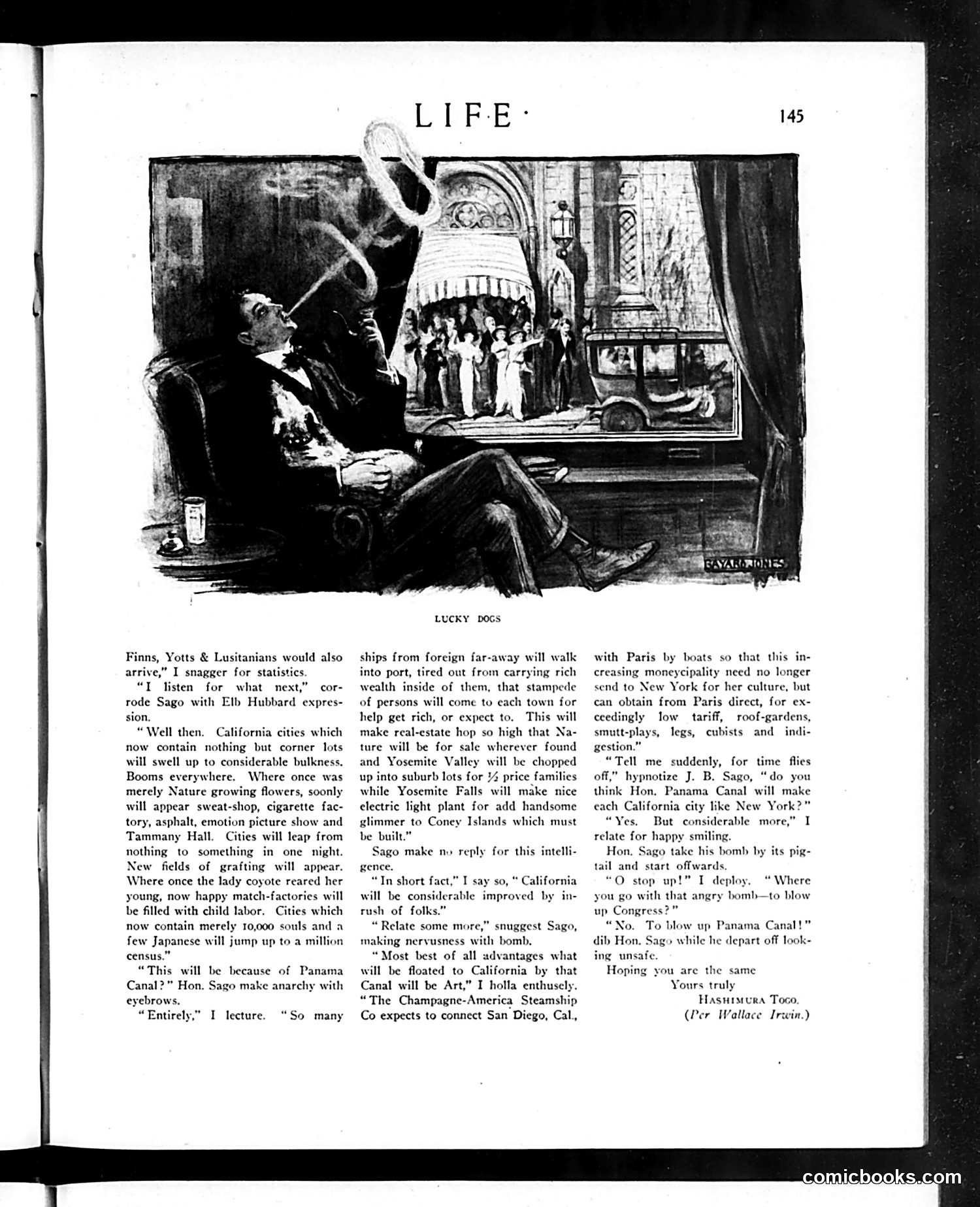
This cartoon satirizes inflated American expectations about the Panama Canal's economic impact on California. A man (appears to be a stereotyped Asian character named "Hon. Sago") listens as a speaker predicts the Canal will trigger explosive growth: booming cities, factories, real estate speculation, and even imported Parisian "culture" (the text mockingly lists "roof-gardens, smutt-plays, legs, cubists"). The joke's punchline: disgusted by these predictions of commercialization and cultural corruption—what the speaker calls "improvement"—Sago leaves threatening to blow up the Canal itself rather than witness California's transformation. The satire targets both uncritical American boosterism about the Canal and period anxieties about rapid urbanization, immigrant labor, and commercialism destroying natural landscapes. The cartoon's title, "Lucky Dogs," appears ironic: those profiting from development are the "lucky" ones, while the Canal symbolizes America's restless, destructive "progress."
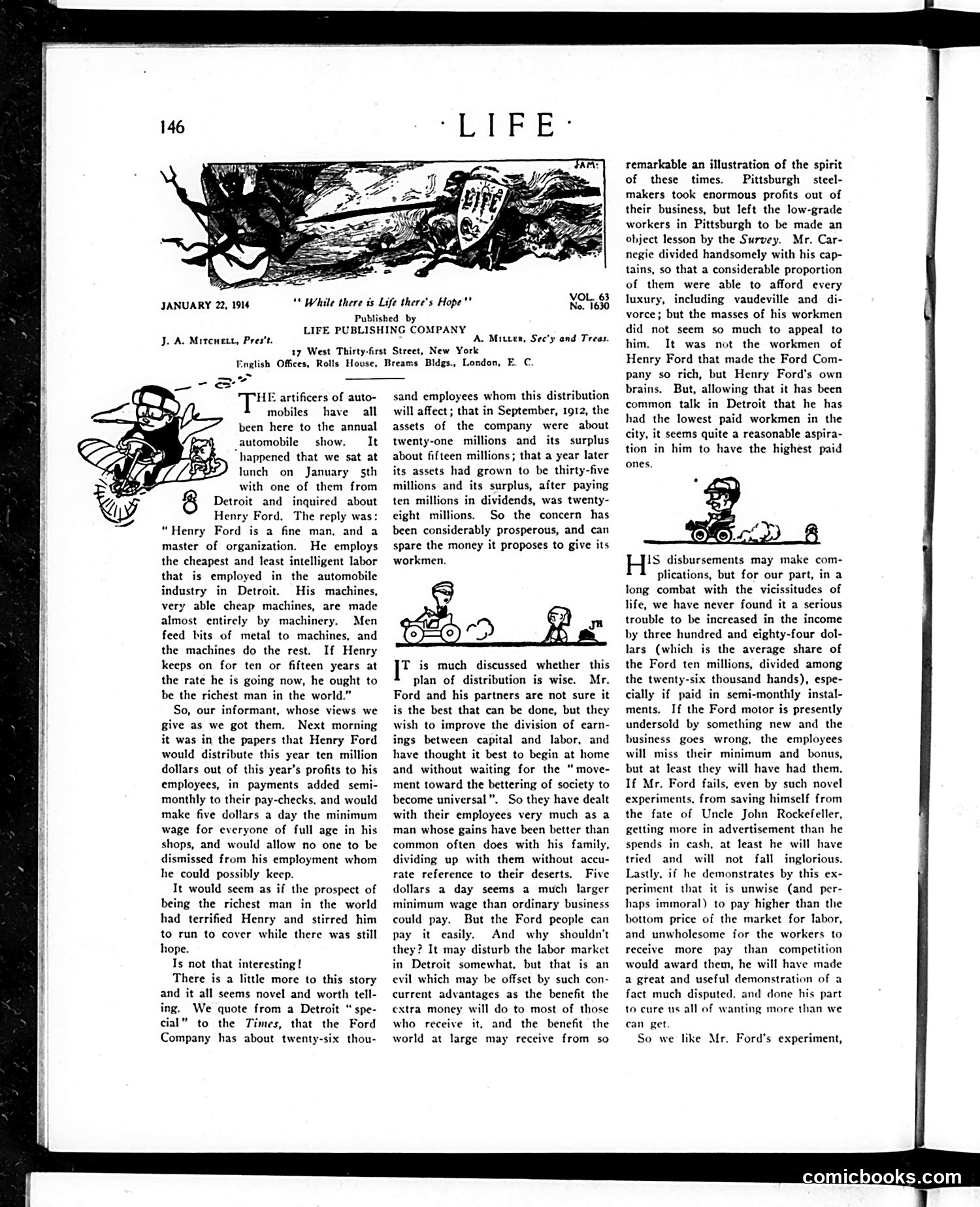
This page satirizes Henry Ford's announcement of profit-sharing with employees—a $5 daily minimum wage and semi-monthly bonus distributions totaling $10 million annually. The article uses gentle irony: A Detroit informant predicts Ford will become the world's richest man through cheap labor and mechanization. Within hours, Ford announces massive worker payments, prompting the satirical headline: he was "terrified" by impending wealth and "ran to cover." The author questions whether Ford's motives are genuinely philanthropic or calculated public relations. The piece contrasts Ford favorably with Pittsburgh steel magnates and Andrew Carnegie, who hoarded profits while workers suffered poverty. The cartoon (top) depicts an automobile, reinforcing Ford's industry dominance. The satire's edge: Ford's gesture is praised as remarkable for its era, yet the author notes it may simply be good business—better workers yield better productivity—rather than true social conscience.
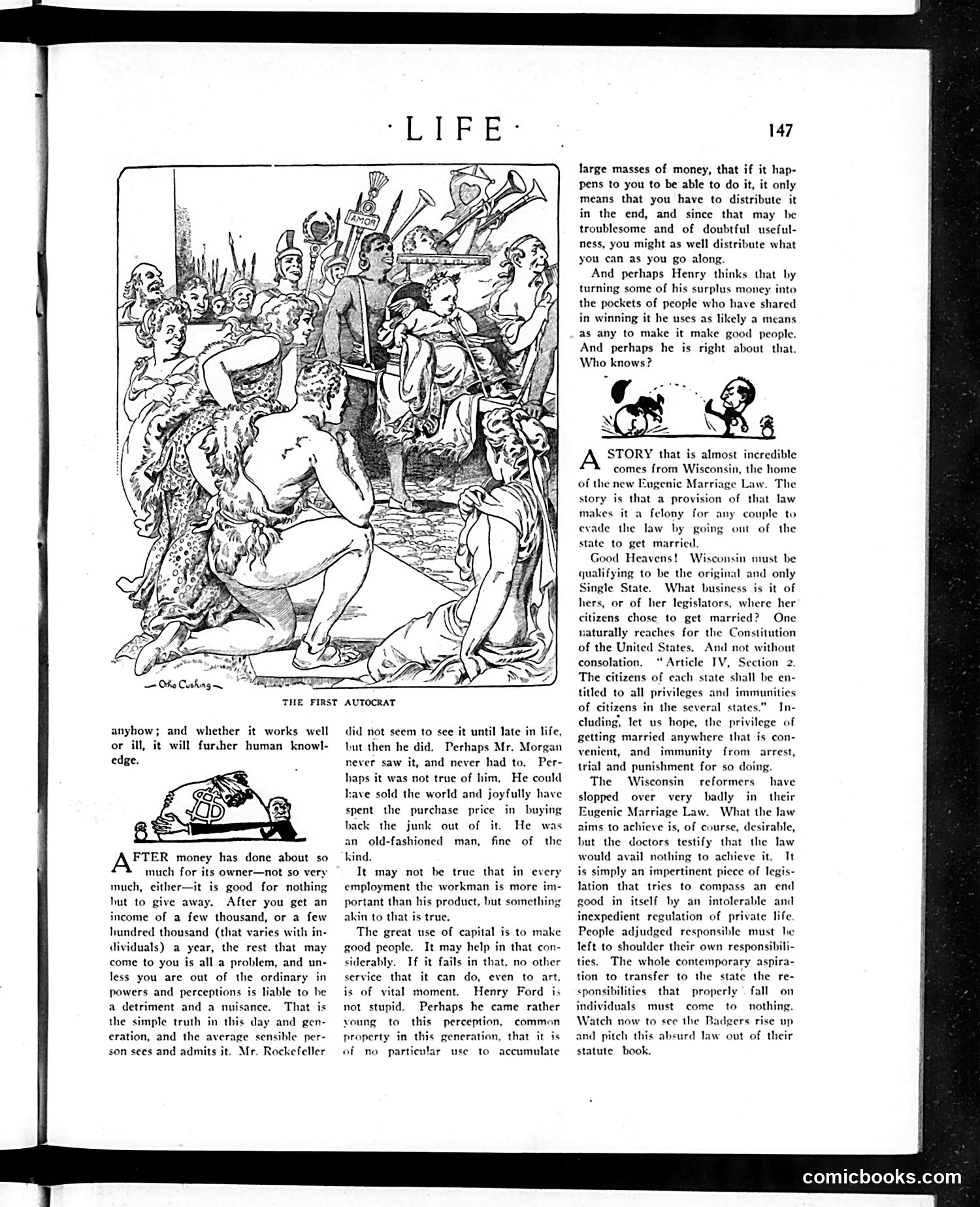
**"The First Autocrat" cartoon** depicts a classical scene of abundance and power, likely representing industrialists or wealthy figures controlling resources. The image contrasts naked figures (possibly representing common people or classical allegory) with elaborately dressed authority figures holding instruments of power. **The accompanying text discusses wealth concentration**, specifically referencing Henry Ford and John D. Rockefeller. The author argues that beyond a certain income level, excess money becomes a burden unless distributed to improve people's lives. Ford's decision to share profits with workers is praised as enlightened use of capital. **The Wisconsin section critiques the state's new "Eugenic Marriage Law,"** which apparently made it a felony to circumvent marriage restrictions by eloping out-of-state. Life's editors attack this as an unconstitutional intrusion into personal liberty, violating citizens' rights under the U.S. Constitution's privileges clause. They dismiss the law as ineffective and demand Wisconsin repeal it. Both pieces reflect Progressive Era tensions between individual liberty and state regulation of social behavior.
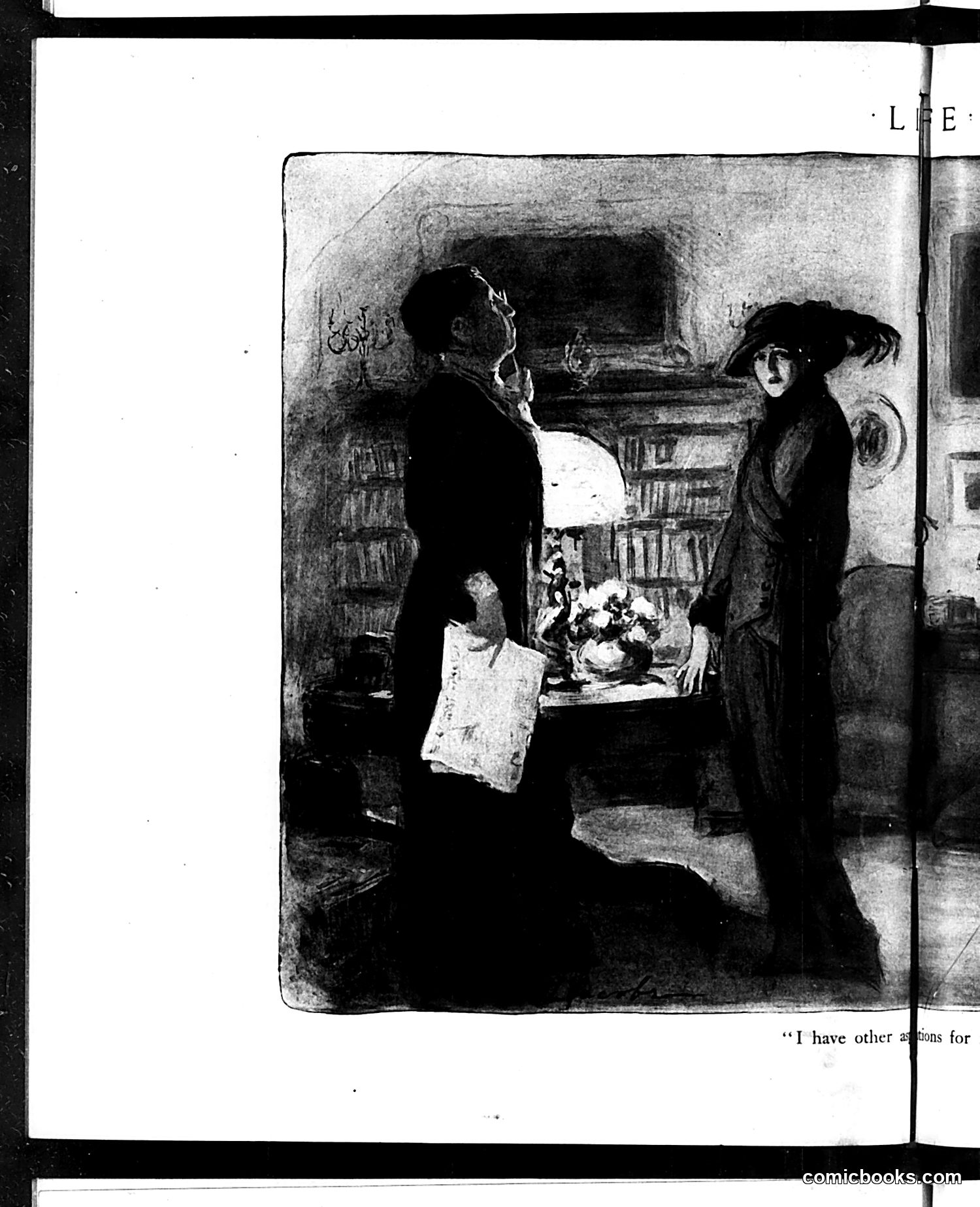
This appears to be a satirical illustration from an early 20th-century issue of Life magazine. The image depicts three figures in dark clothing in what appears to be a shop or storefront setting, with bookshelves visible in the background. There's a flowering plant on a counter. The partial caption reads: "I have other actions for..." but is cut off, making the specific satirical point unclear from the text alone. Without the complete caption and publication date, I cannot definitively identify the figures or the social/political commentary intended. The scene suggests commentary on commerce, social interaction, or possibly courtship customs of the era, but **I cannot assert the specific meaning with certainty based on what's visible here.**
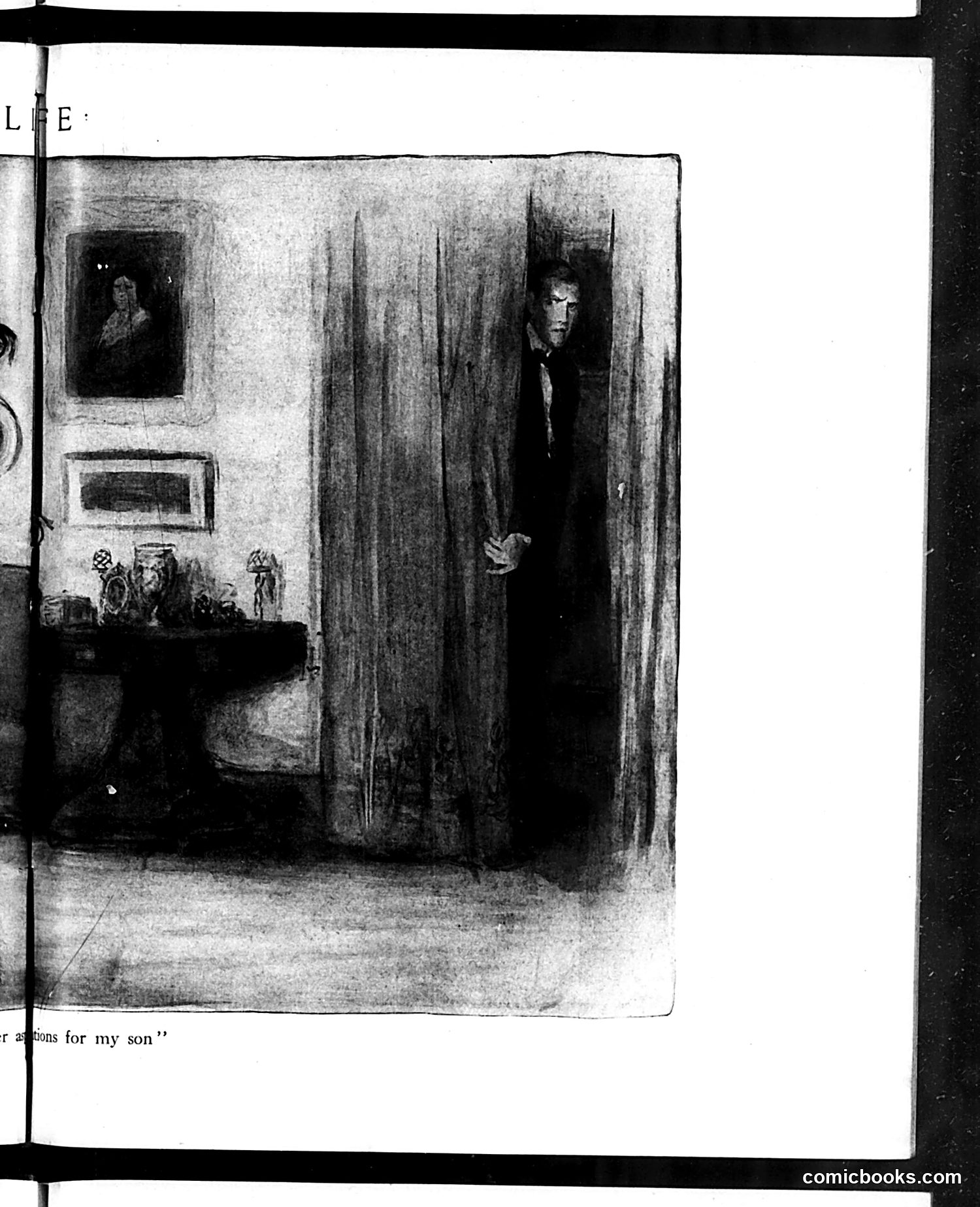
This appears to be a dark, satirical illustration from *Life* magazine showing a man in formal dress (dark coat) emerging from or standing within heavy curtains in what looks like a domestic interior. A portrait hangs on the wall above a mantelpiece with decorative objects. The partial caption visible reads "...r actions for my son," suggesting commentary on parental behavior or moral instruction. The heavy use of shadow and the man's somewhat sinister appearance suggests social critique—possibly about hypocrisy, hidden behavior, or the gap between public respectability and private conduct. Without the complete caption and publication date, I cannot identify the specific figure or reference with certainty. The style suggests early-to-mid 20th century satirical commentary on masculine behavior or family dynamics.
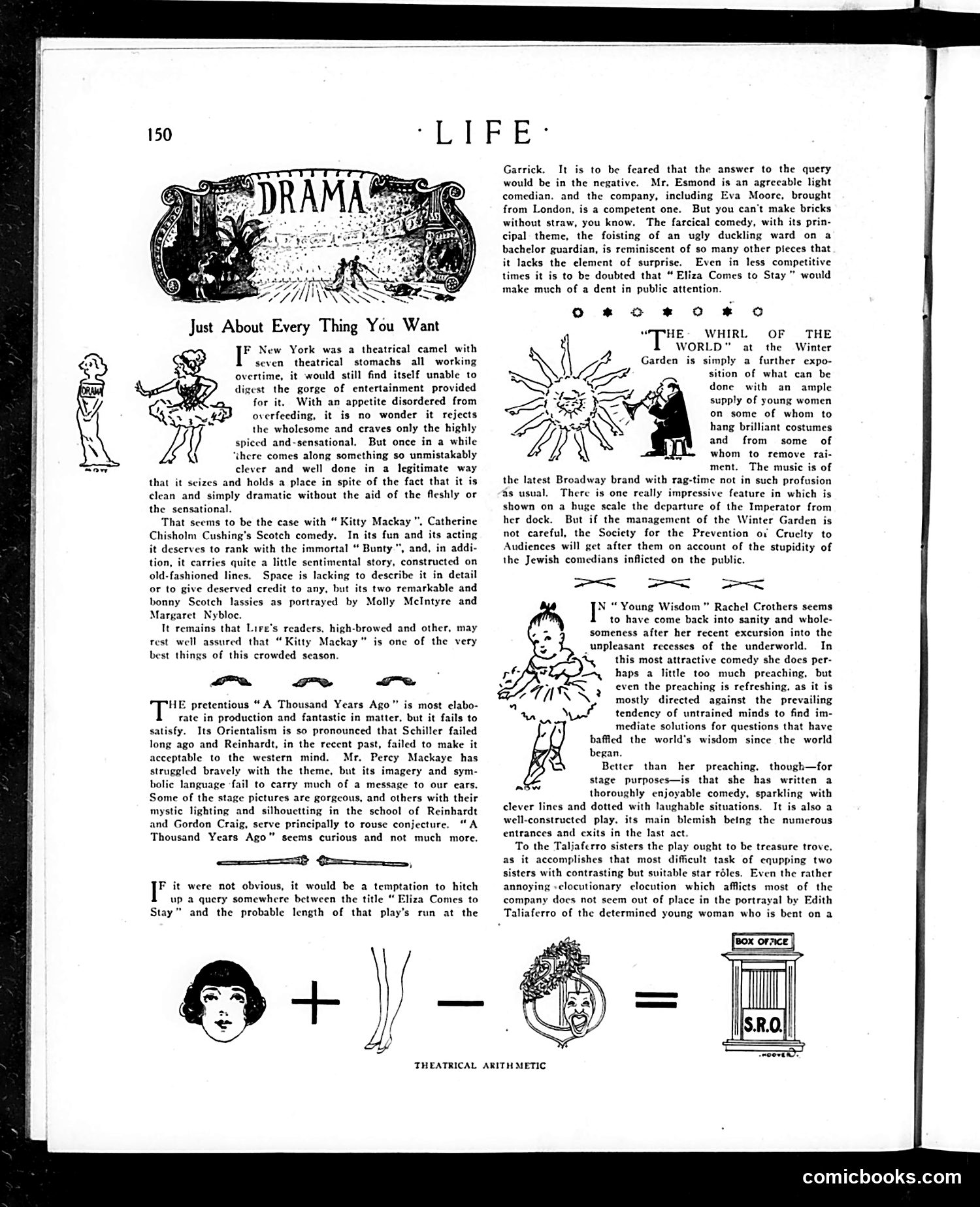
This page contains theatre reviews from Life magazine's drama section, critiquing several Broadway productions. The text employs satirical language characteristic of early 20th-century dramatic criticism. **Key Reviews:** - **"Kitty Mackay"**: Praised as genuinely clever and well-crafted entertainment, featuring Scottish actresses Molly McIntyre and Margaret Nybloc. The reviewer uses a vivid metaphor comparing New York's theatrical appetite to an overfed camel. - **"A Thousand Years Ago"**: Criticized as pretentious and overly ornate in staging, with imagery that fails to connect with Western audiences despite elaborate production design. - **"Eliza Comes to Stay"**: Dismissed as derivative farce lacking originality, despite competent performer Mr. Esmond. - **"The Whirl of the World"**: Mocked as spectacle-driven entertainment notable mainly for displaying young women in costumes, with an impressive ship departure scene but poor comedic performances. - **"Young Wisdom"**: Commended for returning to wholesome material after the author's previous darker work. The "Theatrical Arithmetic" cartoon at bottom (woman + legs + theatrical mask = box office) humorously summarizes Broadway's commercial formula.
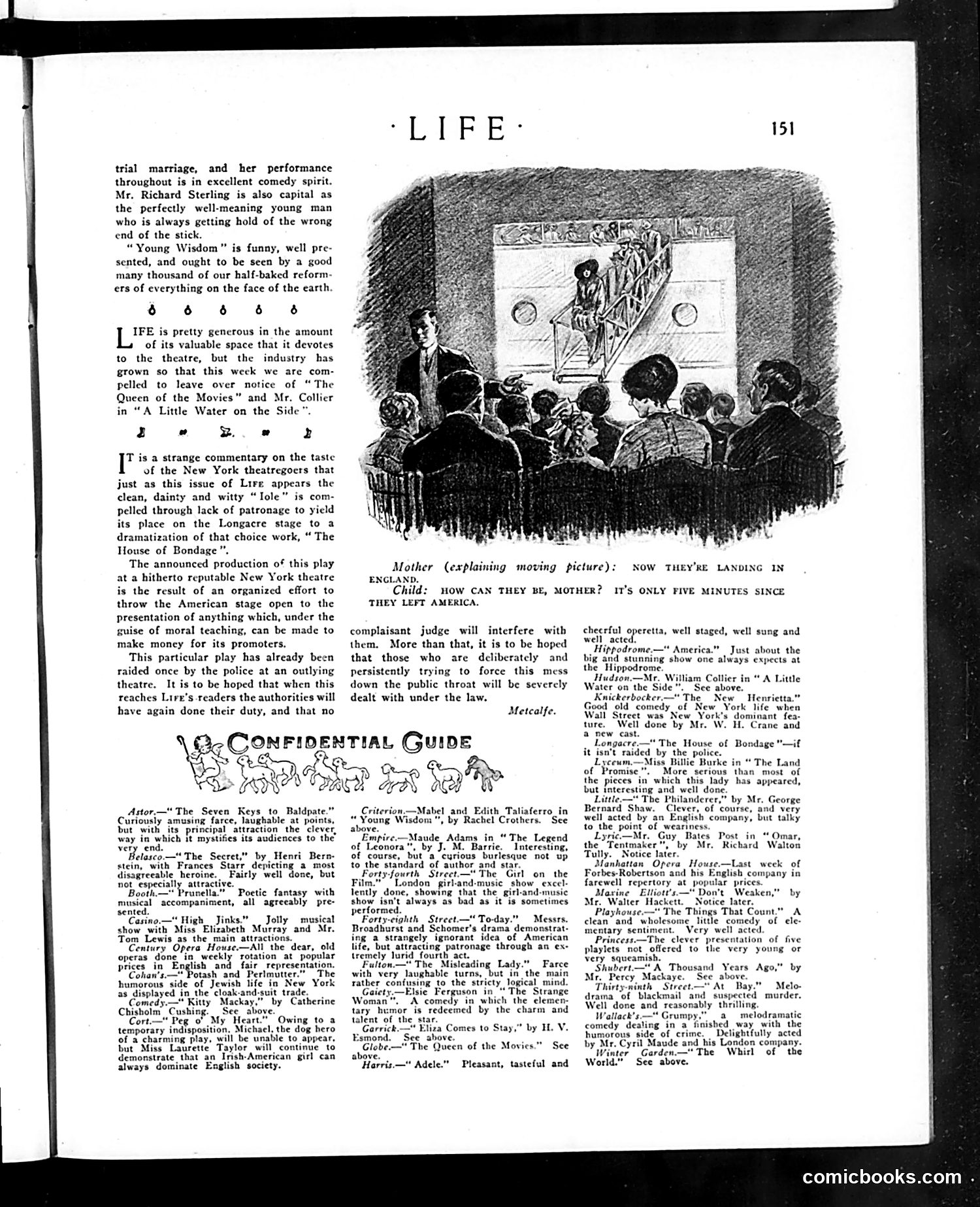
This page contains theater reviews and a single cartoon. The cartoon shows a mother explaining a moving picture to her child. The mother gestures toward a screen showing people boarding a ship, saying "NOW THEY'RE LANDING IN ENGLAND." The child asks, "HOW CAN THEY BE, MOTHER? IT'S ONLY FIVE MINUTES SINCE THEY LEFT AMERICA." **The joke:** This mocks the absurd geographical/temporal impossibility depicted in early silent films—movies often presented fantastical or geographically impossible scenarios that audiences accepted without question. The cartoon satirizes both the filmmaking and the naive audience willingness to suspend disbelief beyond reason. The page's text discusses contemporary Broadway productions and criticizes "The House of Bondage," a play the editor calls morally objectionable, hoping authorities will raid it as they previously did. The reviews are generally dismissive of sensationalism in theater.
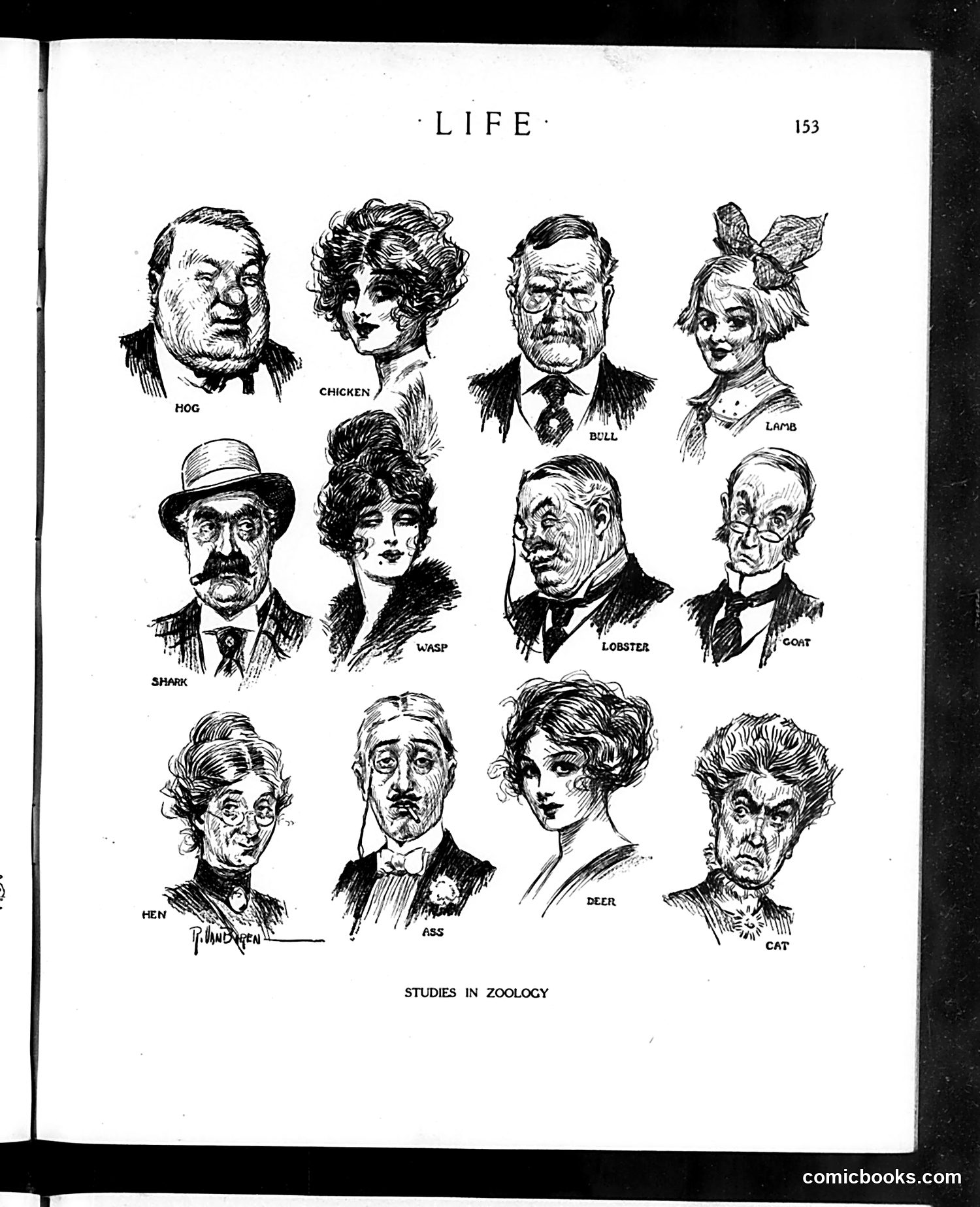
This is a satirical illustration comparing human character types to animals. Each sketch pairs a person's face with an animal label: Hog, Chicken, Bull, Lamb, Shark, Wasp, Lobster, Goat, Hen, Ass, Deer, and Cat. The humor relies on visual caricature—exaggerating facial features to resemble the named animals. This reflects early 20th-century satirical traditions where human personality types were mockingly associated with animal characteristics. The "Zoology" title frames it as pseudo-scientific observation of human nature. Without knowing the specific publication date or if these caricatured individuals represented actual public figures, the general point appears to be ridiculing various human personality archetypes through animal comparison—a common satirical device in vintage American humor magazines.
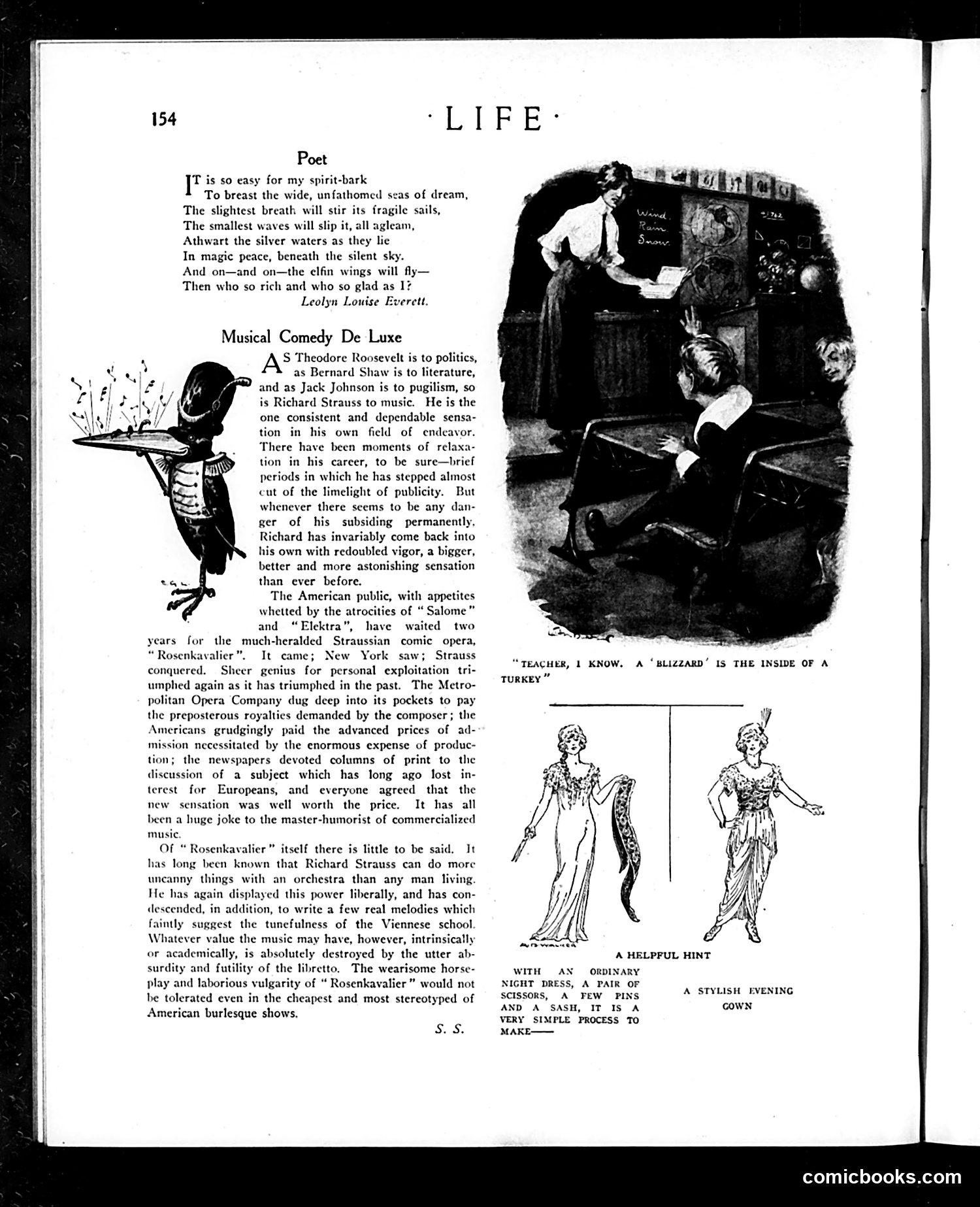
This page mocks composer Richard Strauss through a critical review of his opera *Rosenkavalier*. The author argues that Strauss is a master of **commercial exploitation** rather than genuine artistry—comparing him to Theodore Roosevelt in politics and Bernard Shaw in literature as a figure who sustains fame through publicity. The review's central complaint: Strauss's orchestral genius cannot redeem the opera's absurd, vulgar libretto. The critic claims the plot is so ridiculous it wouldn't be tolerated in cheap American burlesque shows. The article suggests Strauss deliberately courts controversy (*Salome*, *Elektra*) and that wealthy opera companies and audiences are complicit in overpaying for his "commercialized music." The page also includes unrelated content: a poem, fashion sketches, and a humorous caption about a child's definition of "blizzard." The overall tone is one of sophisticated cultural criticism disguised as satire.
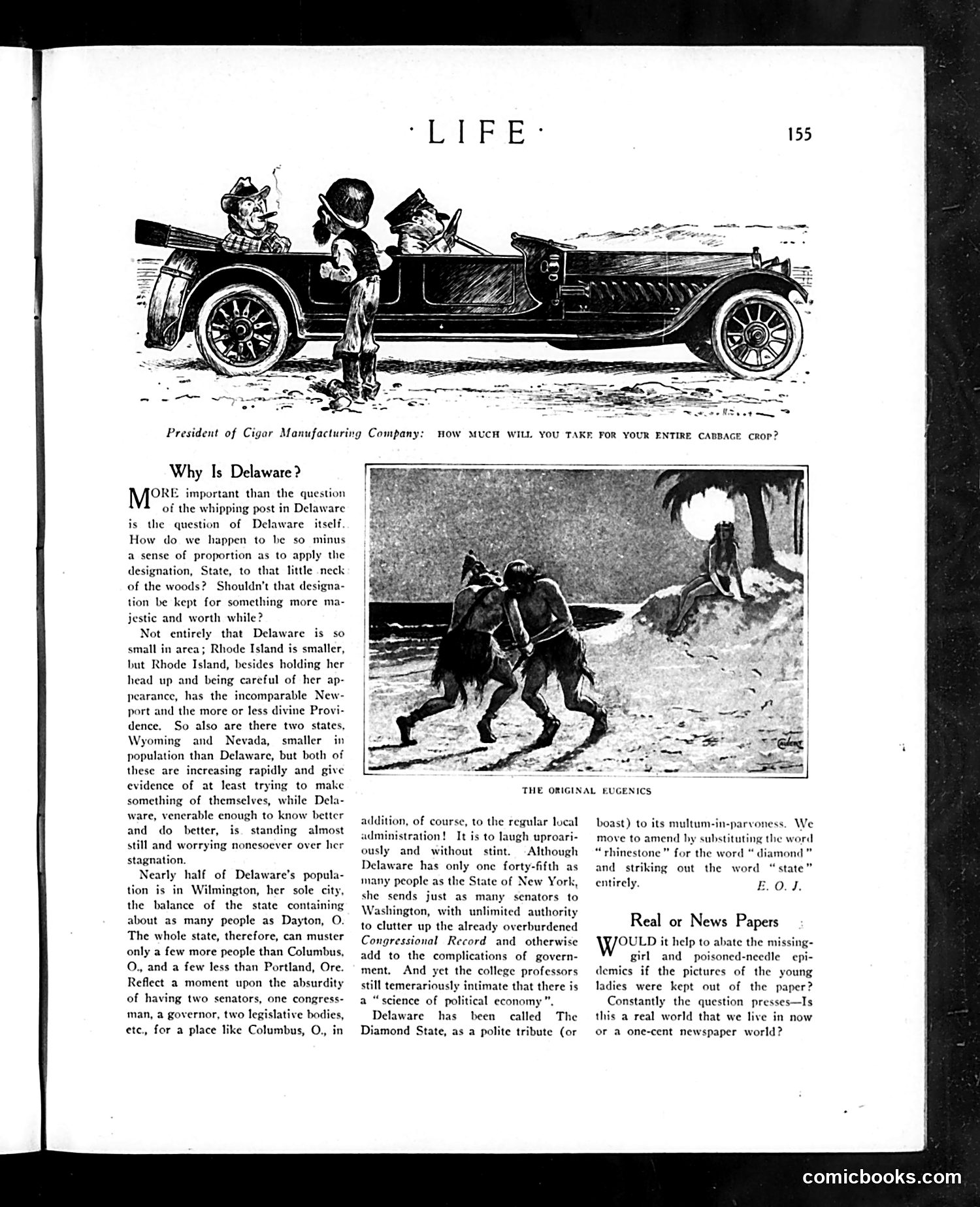
The top cartoon depicts a cigar manufacturer haggling over a car's value, asking "How much will you take for your entire cabbage crop?"—a nonsensical juxtaposition satirizing absurd business dealings. The main article attacks Delaware's disproportionate political representation. The author argues that a state with a population roughly equal to Columbus, Ohio, yet maintains two senators, a congressman, a governor, and two legislative bodies—identical to vastly larger states like New York—represents governmental absurdity. The satire highlights the structural inequality of the Senate, where small states wield outsized power. The author proposes renaming Delaware the "Rhinestone State" (fake diamond) rather than "Diamond State," mocking its pretensions. The concluding section questions whether sensationalist newspaper coverage of crimes actually exists in reality or creates its own distorted world, critiquing press responsibility.
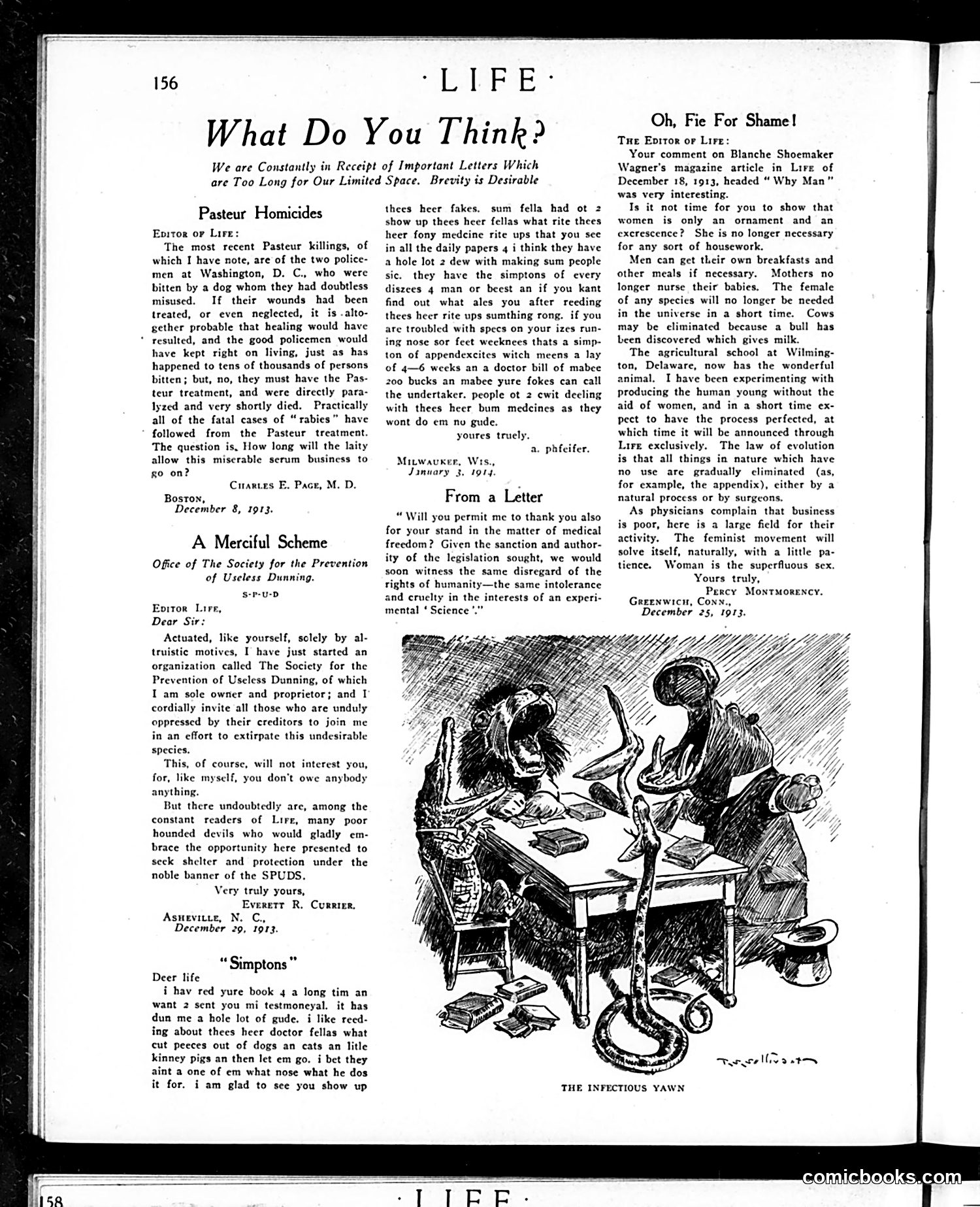
This "What Do You Think?" letters page showcases early 20th-century medical skepticism and social commentary. **Main content:** Letters debating the Pasteur rabies treatment, with one doctor (Charles E. Pace) arguing the vaccine causes more deaths than it prevents—a fringe anti-vaccination stance popular before modern medicine's validation of Pasteur's work. **The cartoon "The Infectious Yawn"** depicts three figures in what appears to be a medical or academic setting, with one yawning—likely satirizing how tedious or unconvincing medical lectures or treatments can be. **Other letters** include humorous ones: one proposing a "Society for Prevention of Useless Dunning" (debt collection satire), and another in deliberately misspelled dialect mocking patent medicine advertisements in newspapers. The final letter sarcastically defends women's necessity against earlier commentary. The page reflects Life's role as a satirical magazine challenging authority and exposing medical quackery and debt-collection practices, while also airing genuine medical debates of the era.
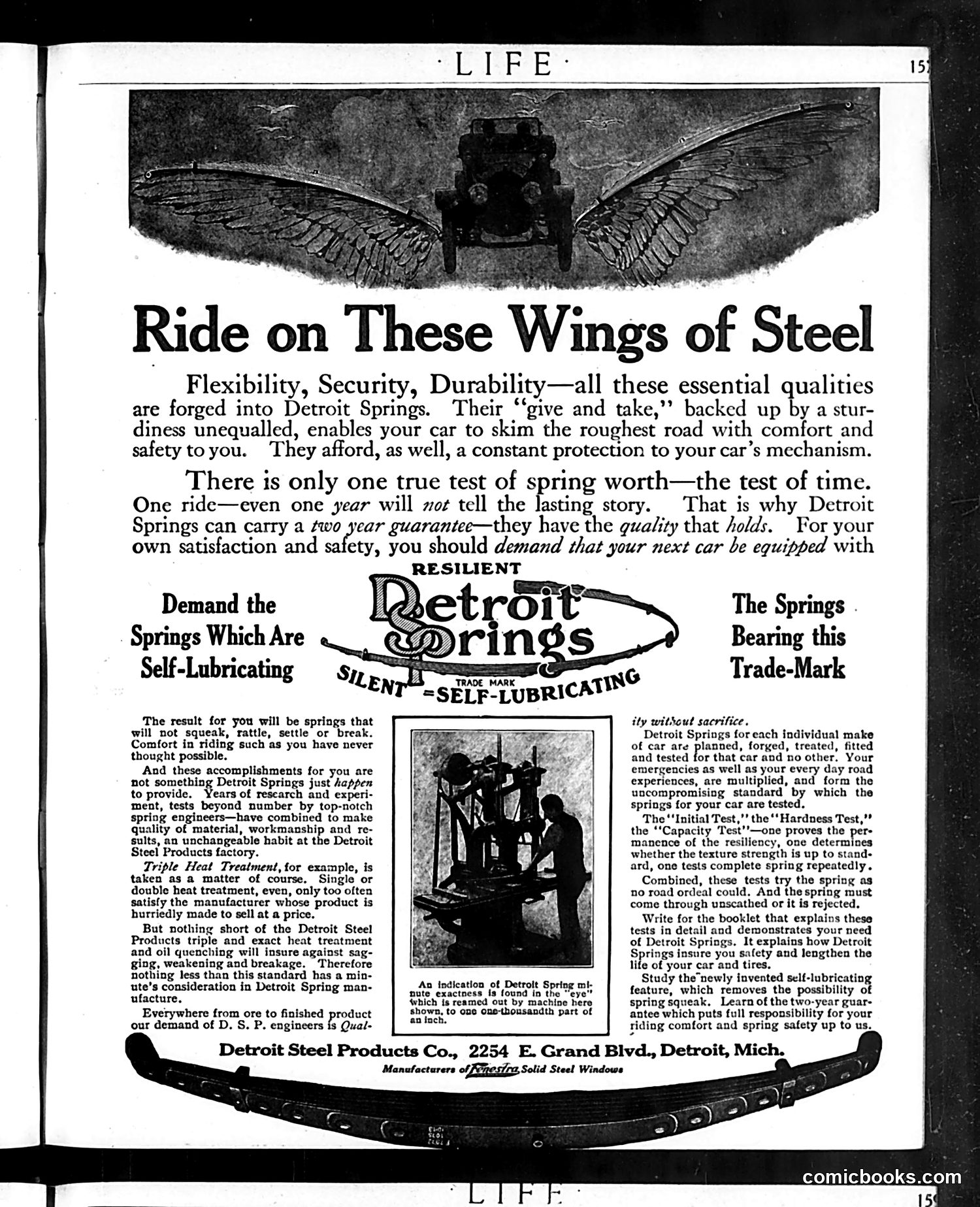
This is a **full-page advertisement**, not a political cartoon. It promotes Detroit Steel Products Co.'s automobile springs, specifically their "Detroit Springs" line. The imagery uses allegorical symbolism: a car with large steel wings emerges from darkness, suggesting these springs give vehicles enhanced capability and protection. The "wings of steel" metaphor emphasizes durability and lift—making rough roads feel smooth. The ad targets car buyers concerned with reliability. It emphasizes the company's manufacturing rigor: triple heat treatment, self-lubricating design, and individual testing per vehicle model. The two-year guarantee was a notable selling point in this era (before modern warranties were standard). The included photograph shows factory workers testing springs, lending credibility to claims about quality control. For modern readers: this represents early automotive-component marketing that stressed engineering precision and durability testing as competitive advantages—concepts that remain relevant today but were novel enough to merit detailed explanation in the 1920s-30s.
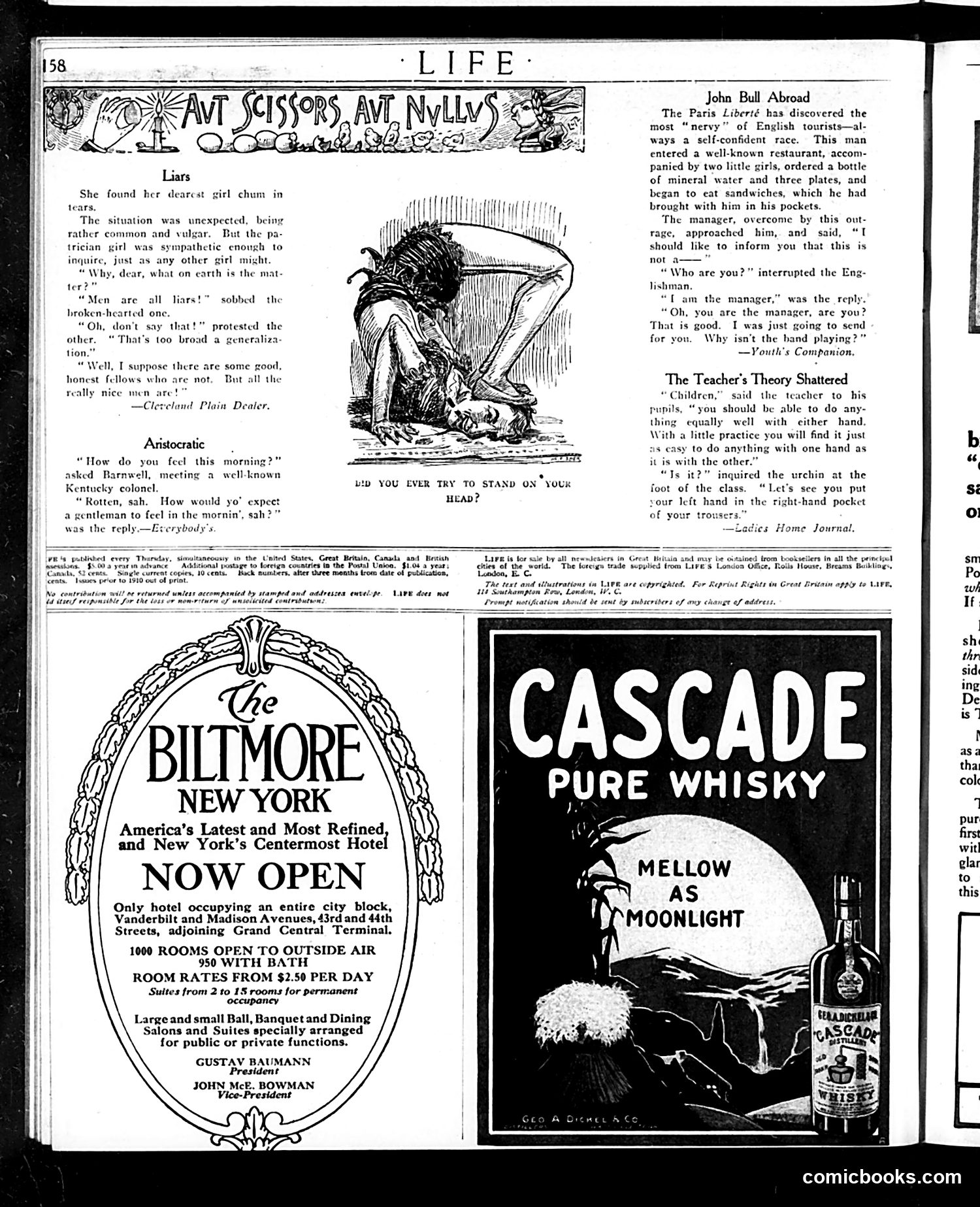
This page contains three brief satirical jokes typical of early 20th-century American humor magazines: 1. **"Liars"**: A society girl comforts her weeping friend who claims "all men are liars," arguing the generalization is too broad—a gentle joke about romantic disappointment and class pretense. 2. **"Aristocratic"**: A Kentucky colonel tells a well-known acquaintance he feels "rotten" in the morning, attributing it to his gentlemanly status rather than admitting hangovers—satire of Southern aristocratic affectation. 3. **"John Bull Abroad"**: An English tourist enters a French restaurant with homemade sandwiches, refusing to order food while demanding the band play—mocking English tourists' notorious rudeness and cultural insensitivity abroad. 4. **"Teacher's Theory"**: A teacher claims both hands work equally with practice; a student challenges him to put his left hand in his right trouser pocket—gentle mockery of impractical educational theory. The page is primarily **advertising** (Biltmore Hotel, Cascade Whisky), with humor content subordinate to commercial space.
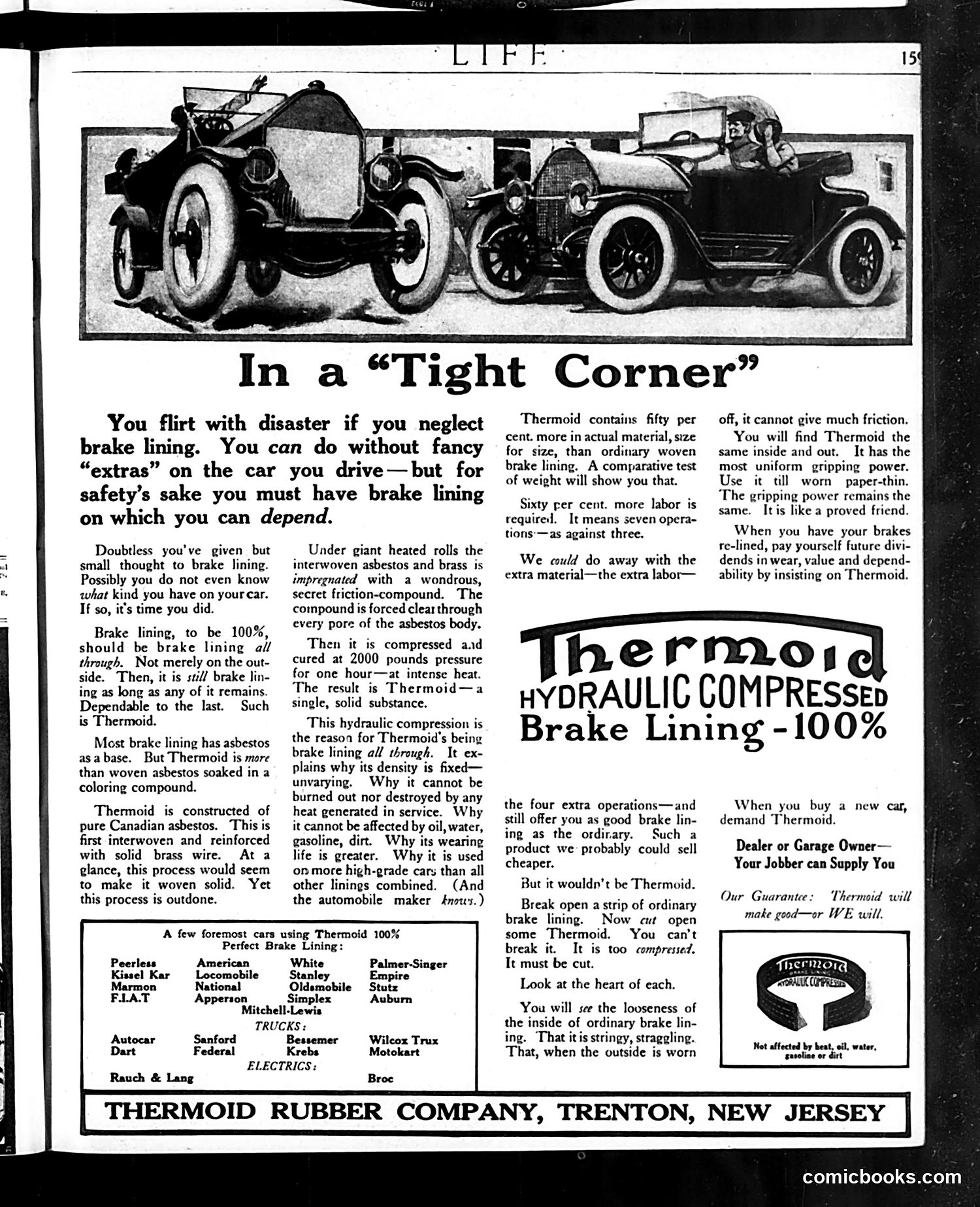
This is **not a cartoon or satire**, but rather a **full-page advertisement** for Thermoid brake lining, a automotive safety product. The page shows three early automobiles at the top (circa 1910s-1920s) in a "tight corner" scenario—illustrating the safety context for brake reliability. The bulk of the content is a technical sales pitch explaining why Thermoid's hydraulic-compressed asbestos brake lining is superior to competitors: it's uniform throughout, denser, more durable, and used by premium car manufacturers (Peerless, Stutz, Stanley, etc.). The ad uses comparative language ("ordinary" vs. Thermoid) and technical details to justify premium pricing, concluding with "Our Guarantee: Thermoid will make good—or WE will." This represents early 20th-century automotive advertising emphasizing engineering superiority and safety—a selling point for what was then cutting-edge brake technology.
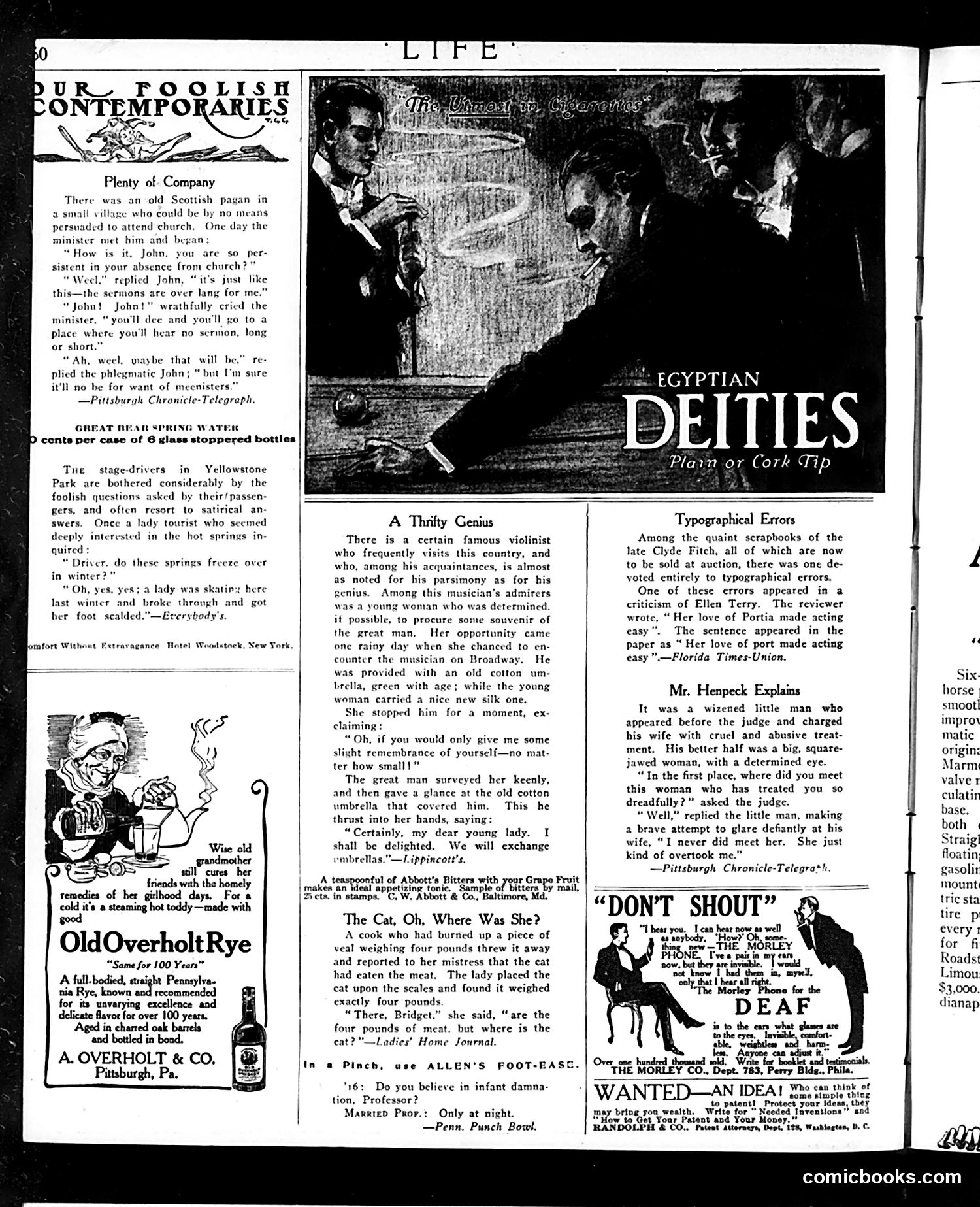
This page from *Life* magazine contains several satirical pieces and advertisements typical of early 20th-century humor. **"Plenty of Company"** mocks Scottish stubbornness through dialect humor. A church minister threatens an absent parishioner with damnation, but "John" replies he'll have plenty of company in hell—implying even clergy won't get to heaven. The joke relies on anti-clerical satire common to the era. **"A Thrifty Genius"** satirizes a famous (unnamed) violinist's extreme stinginess. When a female admirer requests a souvenir, he cunningly trades his decrepit umbrella for her new silk one—gaining a superior item while appearing generous. The humor lies in his selfishness disguised as generosity. **"The Cat, Oh, Where Was She?"** is a logic joke: a cook lies about a cat eating expensive veal, but when weighed, the cat weighs exactly four pounds—the meat's weight—exposing the absurdity of her excuse. The remaining items are advertisements (Old Overholt Rye whiskey, Egyptian cigarettes, etc.) interspersed with brief humorous anecdotes, typical of *Life*'s format as a satirical weekly.
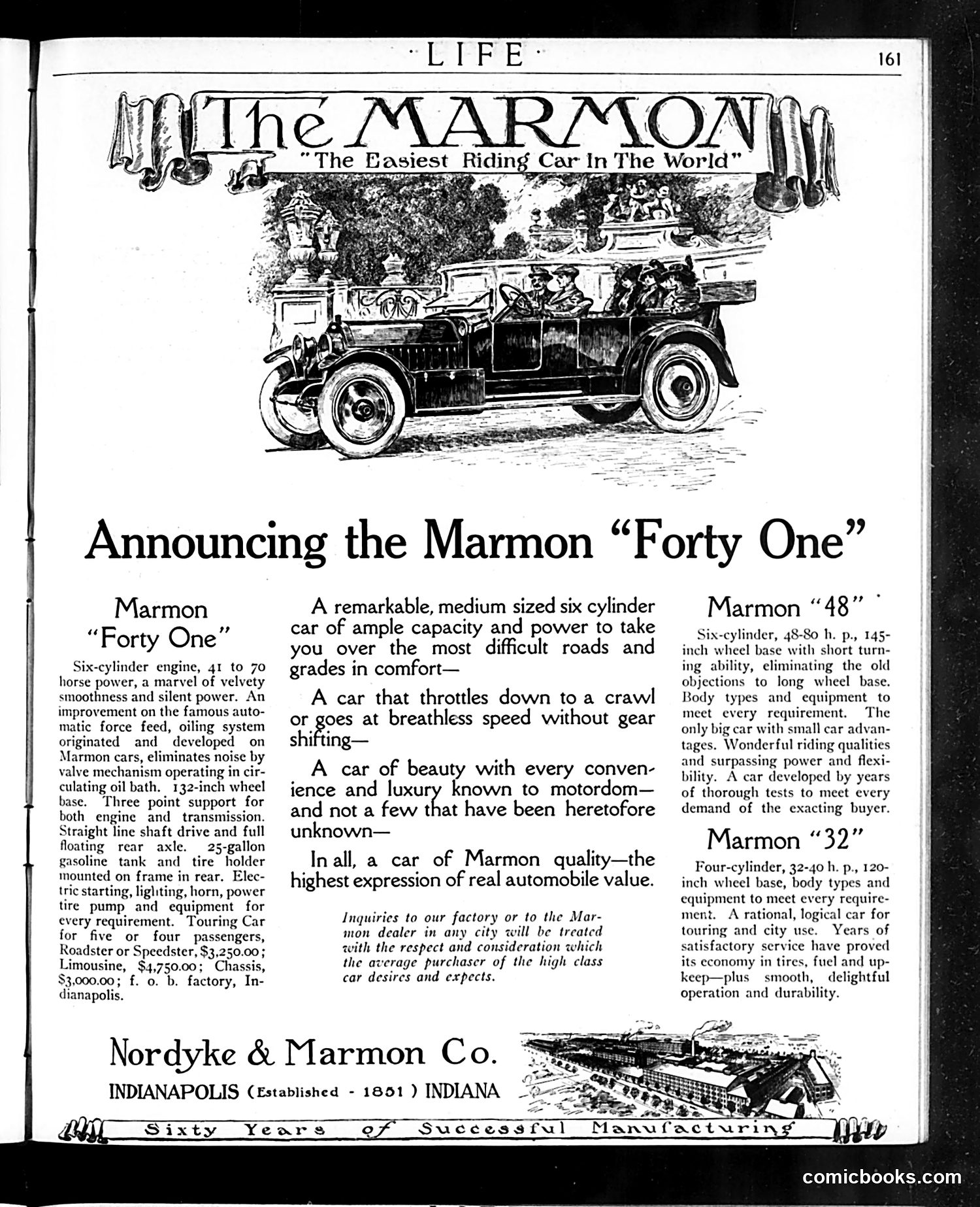
This is **not a cartoon or satire**—it's a straightforward automobile advertisement from Life magazine, page 161. The page announces three Marmon car models (the "Forty One," "48," and "32") manufactured by Nordyke & Marmon Co. of Indianapolis, established 1851. The ad emphasizes technical features: six-cylinder engines, smooth power delivery, luxury amenities, and versatile body styles with detailed pricing ($3,250-$4,750). The illustration shows a Marmon touring car with passengers. The tagline "The Easiest Riding Car in the World" is marketing language, not satire. **Context for modern readers**: This reflects the early automotive era when car manufacturers advertised extensively in general-interest magazines, emphasizing mechanical innovation and luxury as selling points to affluent buyers. The formal, detailed specifications and high prices indicate these were premium vehicles.
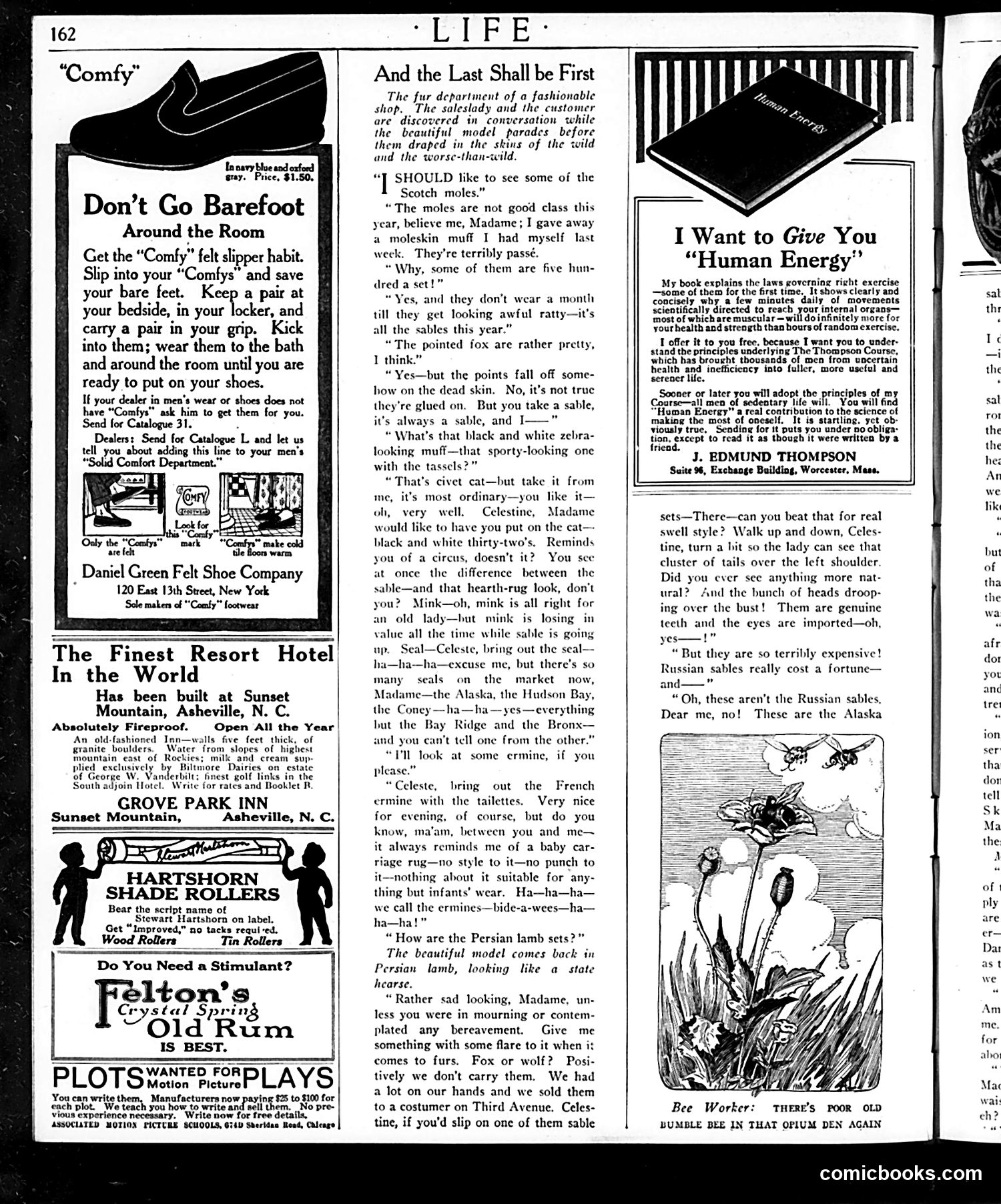
This cartoon satirizes the absurdity and pretension of high-end fur fashion shopping. The saleslady manipulates a wealthy customer through snobbery and reverse psychology, dismissing perfectly expensive furs ($500 sets of moles) as "terribly passé" while promoting others as fashionable. The satire targets: 1. **Fashion's arbitrary standards** - What's desirable changes yearly without logical reason; the saleslady admits furs are expensive yet deteriorate quickly ("looking awful ratty"). 2. **Class-consciousness marketing** - The saleslady uses dismissive language ("not good class," "sporty-looking") to shame the customer into buying what she recommends. 3. **Consumer gullibility** - The customer is persuaded to abandon her preferences based purely on the saleslady's pronouncements of style. The title's irony—"the last shall be first"—suggests that yesterday's fashionable furs become today's rejects, reversing their value.
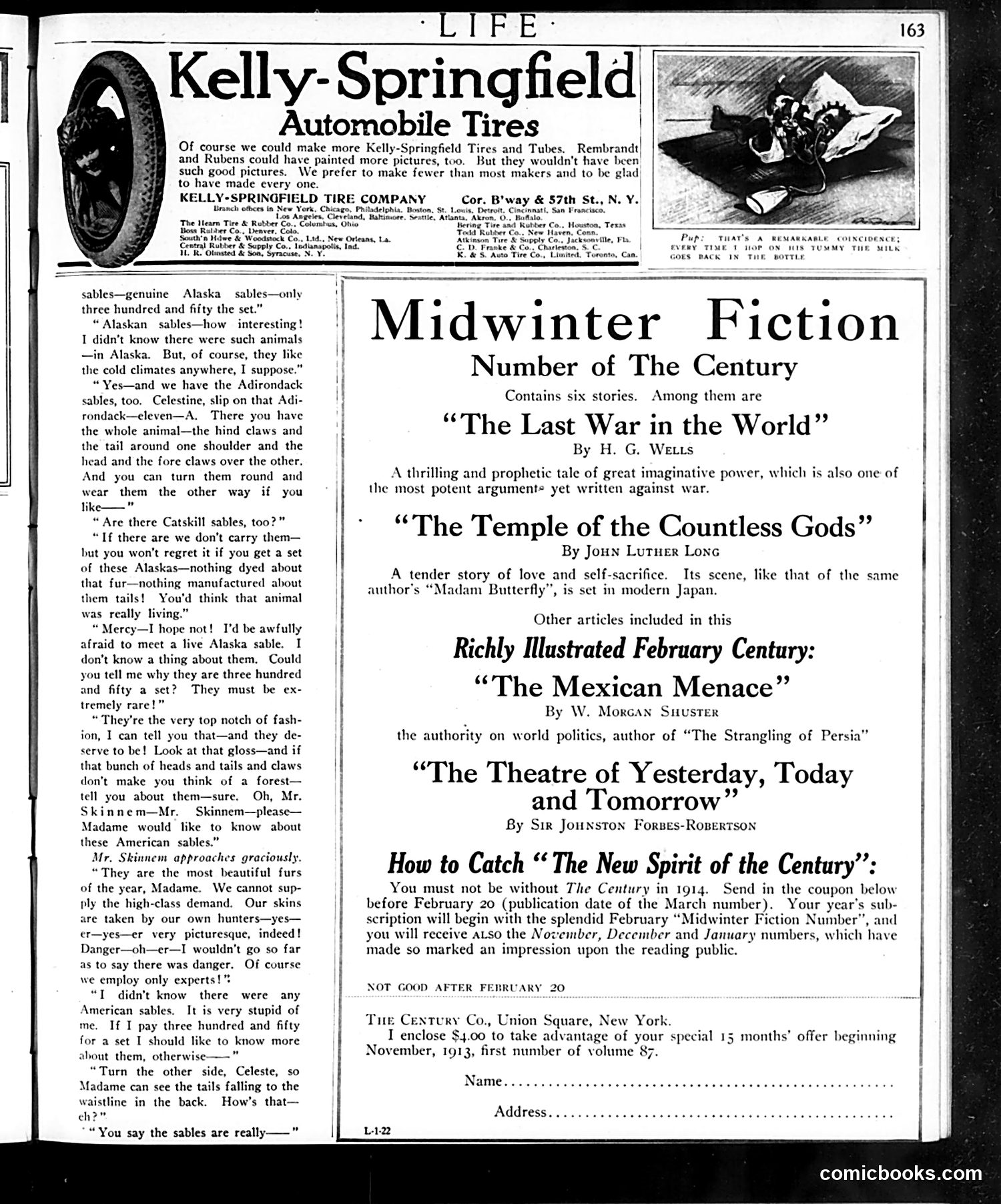
This page is primarily **advertising and promotional content**, not political satire. The top half features a **Kelly-Springfield Automobile Tires advertisement** alongside a dialogue about luxury fur sables. The tire ad uses a quality-over-quantity argument ("we prefer to make fewer than most makers"). The fur conversation satirizes **upper-class conspicuous consumption and sales-clerk deception**—a salesman and his assistant ("Skinnem") vaguely discuss "American sables" from Alaska and the Adirondacks, implying exclusivity and high fashion while dodging questions about what these furs actually are or why they cost $350 (substantial money in 1914). The humor lies in the customer's naive acceptance of luxury marketing speak. The bottom half promotes **The Century Magazine's February 1914 "Midwinter Fiction Number,"** featuring stories by H.G. Wells ("The Last War in the World") and articles on world politics and theater. A subscription coupon encourages readers to sign up before February 20. The small illustration (captioned about a bottle) appears unrelated to the main content—likely filler or part of another advertisement.
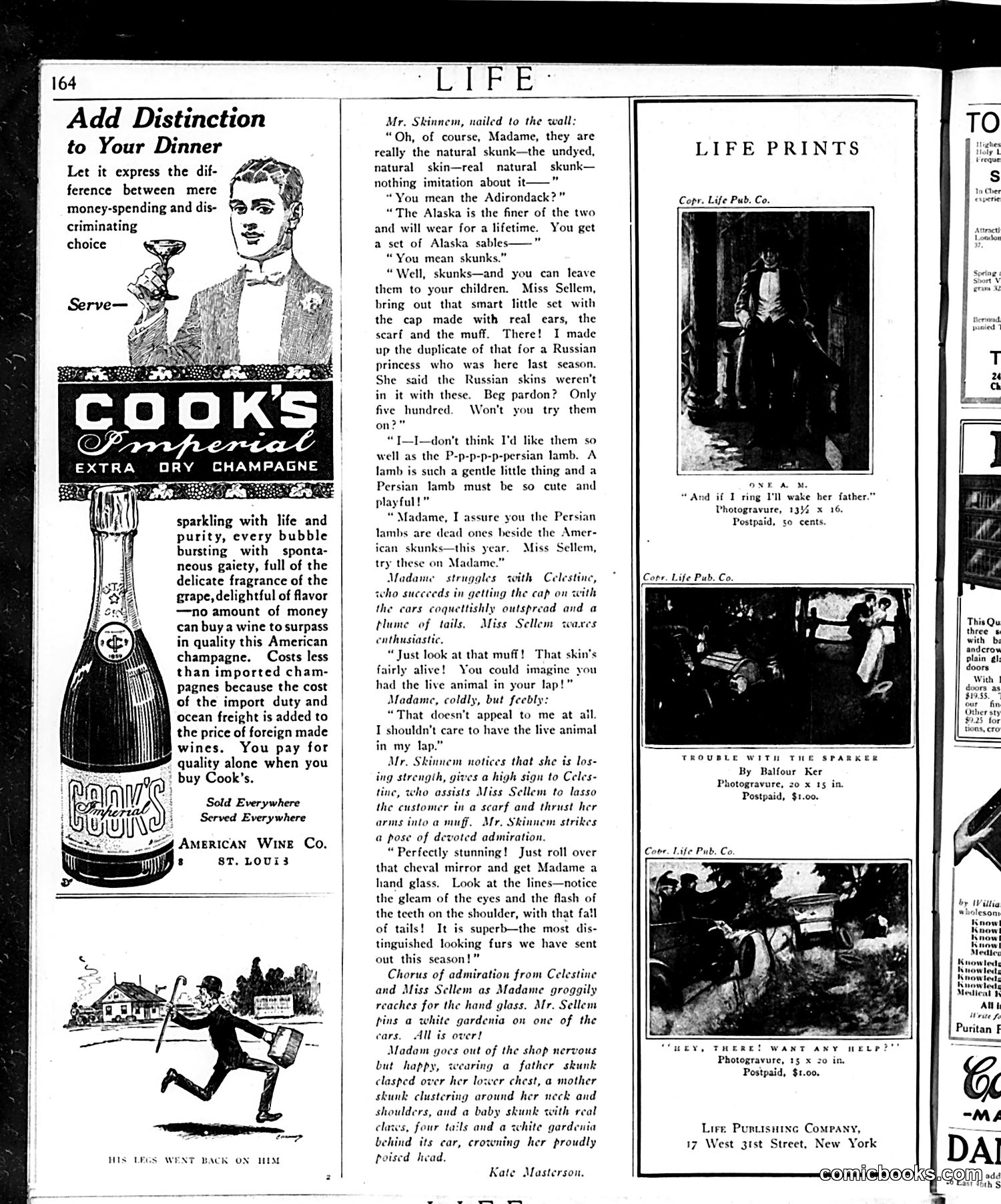
This page contains a satirical story mocking aggressive sales tactics and wealthy women's vanity around 1910s fashion. **The Main Satire:** A furrier salesman (Mr. Skinnem) deliberately deceives a customer by rebranding skunks as exotic furs—first calling them "natural skunks," then "Adirondack," then "Alaska sables." The customer repeatedly calls out his deception ("You mean skunks"), but he persists with flattery and manipulation. His sales associate (Miss Sellem and Celestine) physically wrap the reluctant woman in the furs, quite literally trapping her into the purchase. **The Point:** The story ridicules both predatory male salesmen who exploit women's fashion insecurity and wealthy women who convince themselves to buy obviously absurd luxury goods (skunks dressed up as premium furs) through peer pressure and flattery. The final image—a woman leaving "wearing a father skunk...mother skunk...and a baby skunk"—emphasizes the absurdity of what she's accepted. **Context:** This reflects early 20th-century critiques of commercialism, gender dynamics in retail, and the fashion industry's deceptive marketing practices.
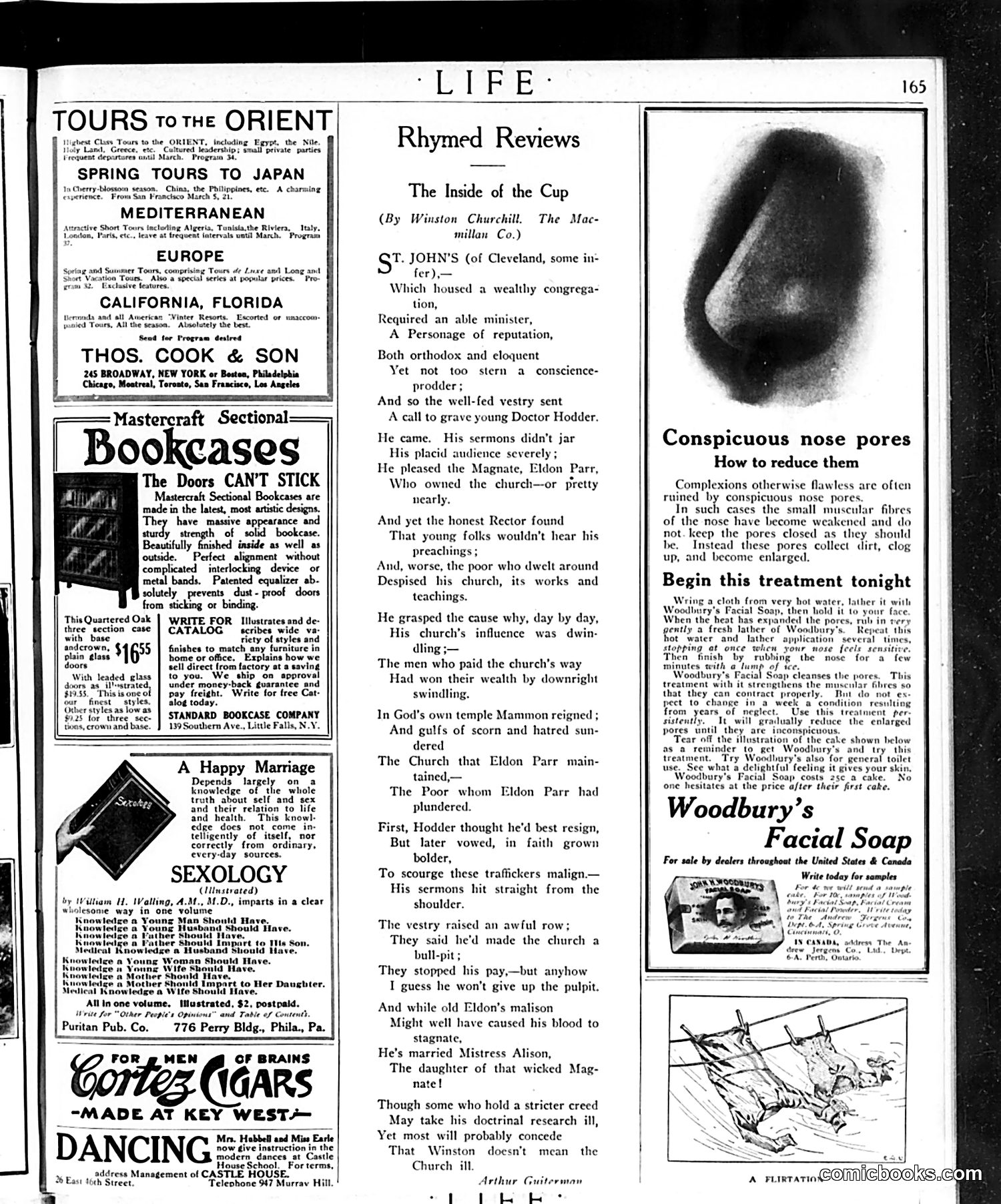
This page is primarily **advertising and book reviews** from Life magazine (a satirical publication). The main content is a rhymed review of Winston Churchill's novel *The Inside of the Cup*, which critiques wealthy church leadership. The poem describes how a prestigious Cleveland church (St. John's) hires a proper young minister, Dr. Hodder, to please its wealthy benefactor, Eldon Parr. However, Hodder discovers the church's influence is declining because the congregation—particularly poor people—sees the church as corrupt: the wealthy parishioners accumulated their fortunes through morally questionable means ("downright swindling"). **The satire targets**: the hypocrisy of wealthy churches prioritizing donors over genuine spiritual values, and clergy willing to compromise their message to maintain institutional funding. The page otherwise contains standard period advertisements for travel tours, sectional bookcases, books on marriage/sexuality, and cigars—typical early 20th-century magazine content.
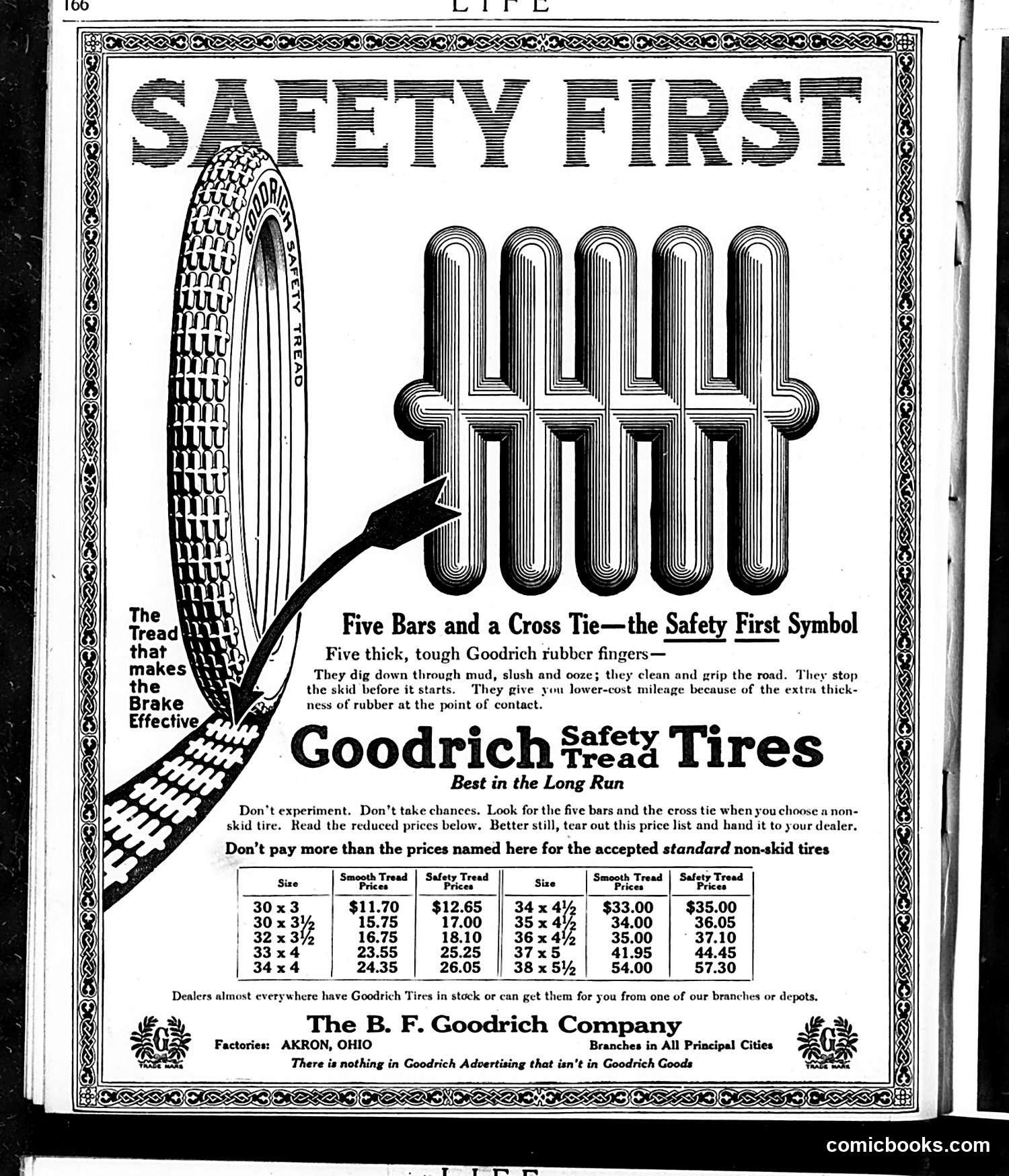
This is a **commercial advertisement**, not satire or political commentary. The page promotes Goodrich Safety Tires, emphasizing their "Safety First" trademark—five thick tread bars and a cross tie pattern visible in the tire illustration. The messaging reflects early automotive safety concerns (ca. 1910s-1920s): tires that grip wet roads, prevent skidding, and provide durability. The "Safety First" slogan was a widespread industrial safety movement of that era. The advertisement includes a price list for various tire sizes, positioning Goodrich as offering competitive, standardized pricing against unscrupulous dealers. The phrase "Don't pay more than the prices named here" suggests dealers sometimes overcharged for non-skid (early tread-pattern) tires. The tagline "There is nothing in Goodrich Advertising that isn't in Goodrich Goods" claims product integrity. This represents vintage automotive marketing targeting middle-class car owners concerned with safety and value.
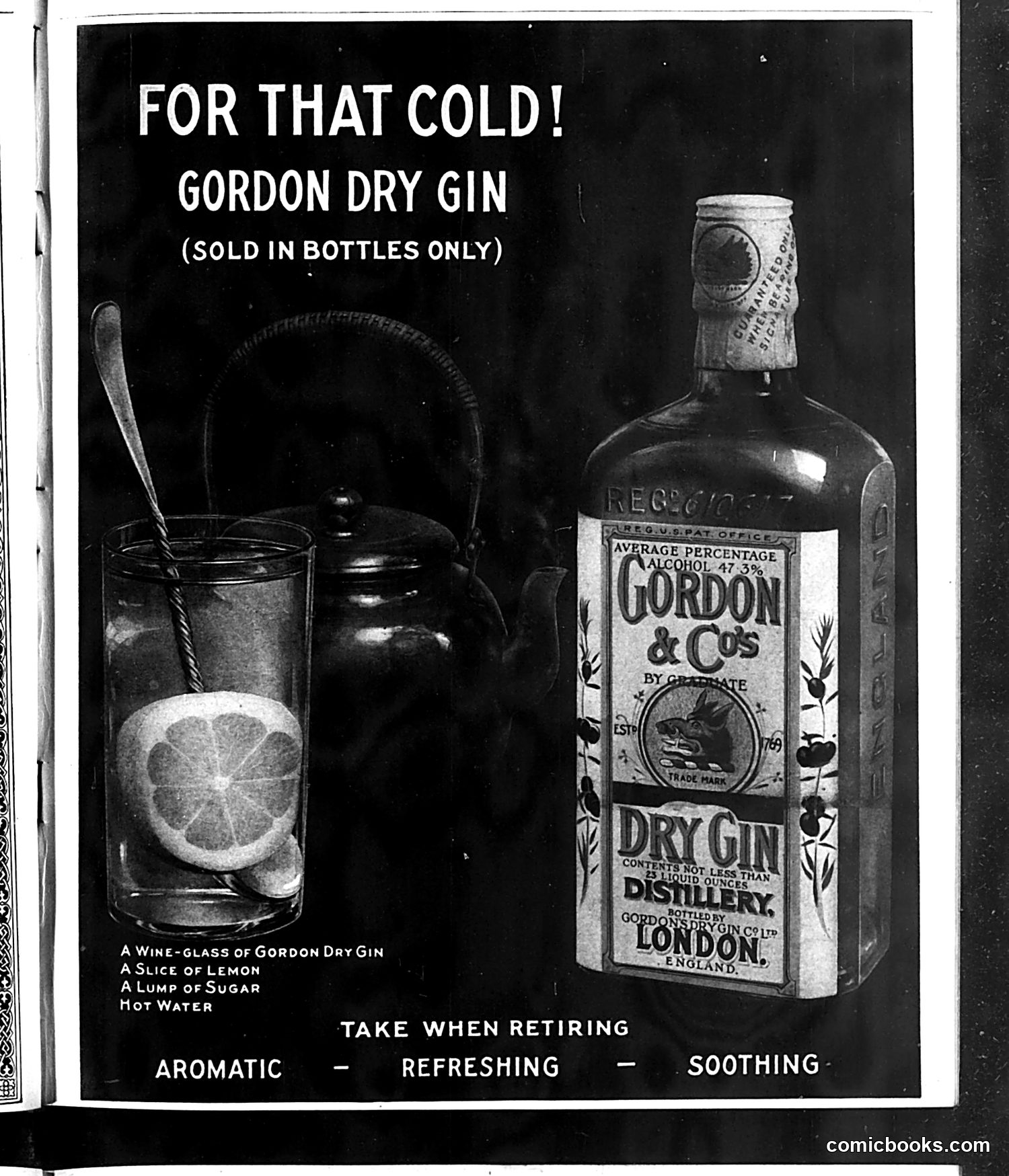
This is a **vintage advertisement**, not satire or political commentary. It's a Gordon Dry Gin ad promoting the product as a home remedy for colds—a common marketing practice in early-to-mid 20th century advertising. The ad prescribes a "medicinal" drink: a wine glass of gin with lemon slice and sugar in hot water, to be taken "when retiring" (before bed). It claims the remedy is "aromatic," "refreshing," and "soothing." This reflects an era when alcohol was genuinely marketed and used as patent medicine, before modern pharmaceutical regulation and the FDA's stricter stance on health claims. The high alcohol content (47.3%) would certainly induce sleep, explaining the "soothing" effect. By modern standards, this would be considered misleading health advertising—alcohol doesn't cure colds and promoting it as medicine would be illegal today.
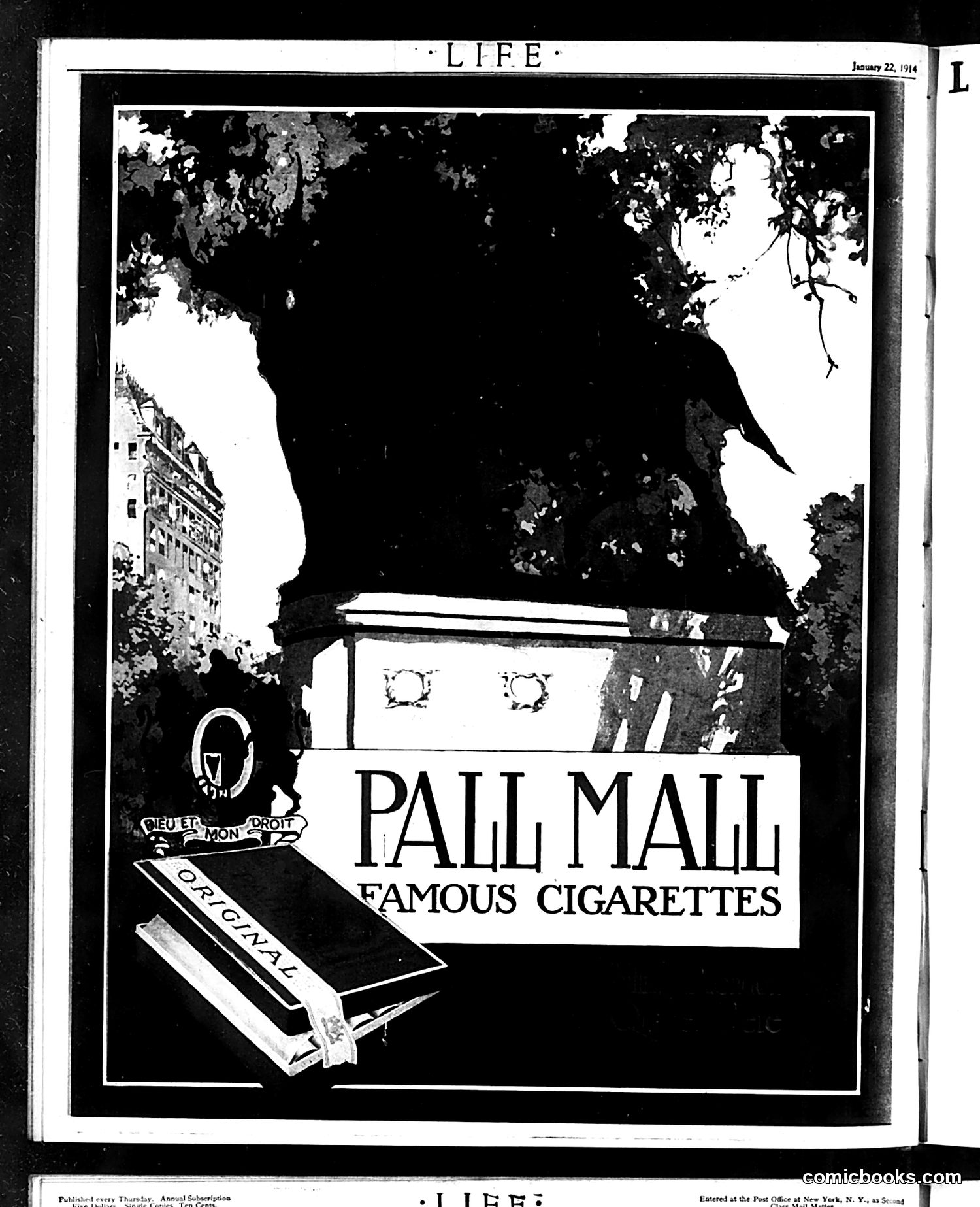
This is a **Pall Mall cigarette advertisement** from Life magazine, dated January 22, 1914. The ad uses a dramatic artistic composition: a silhouetted profile of a man's head dominates the image, framed by foliage and urban architecture. A package of Pall Mall cigarettes and a loose cigarette appear in the foreground. The design employs stark black-and-white contrast typical of early 20th-century advertising aesthetics. The tagline "PALL MALL FAMOUS CIGARETTES" emphasizes the brand's reputation. The French text visible on the package ("DEPUIS MON DROIT") suggests the brand's international prestige—a common marketing strategy linking cigarettes to European sophistication. This represents typical early-century cigarette marketing before health warnings, targeting aspirational male consumers through artistic sophistication and implied worldliness.