
Life, 1914-01-22 · page 18 of 40
Life — January 22, 1914 — page 18: what you’re looking at
What you’re looking at
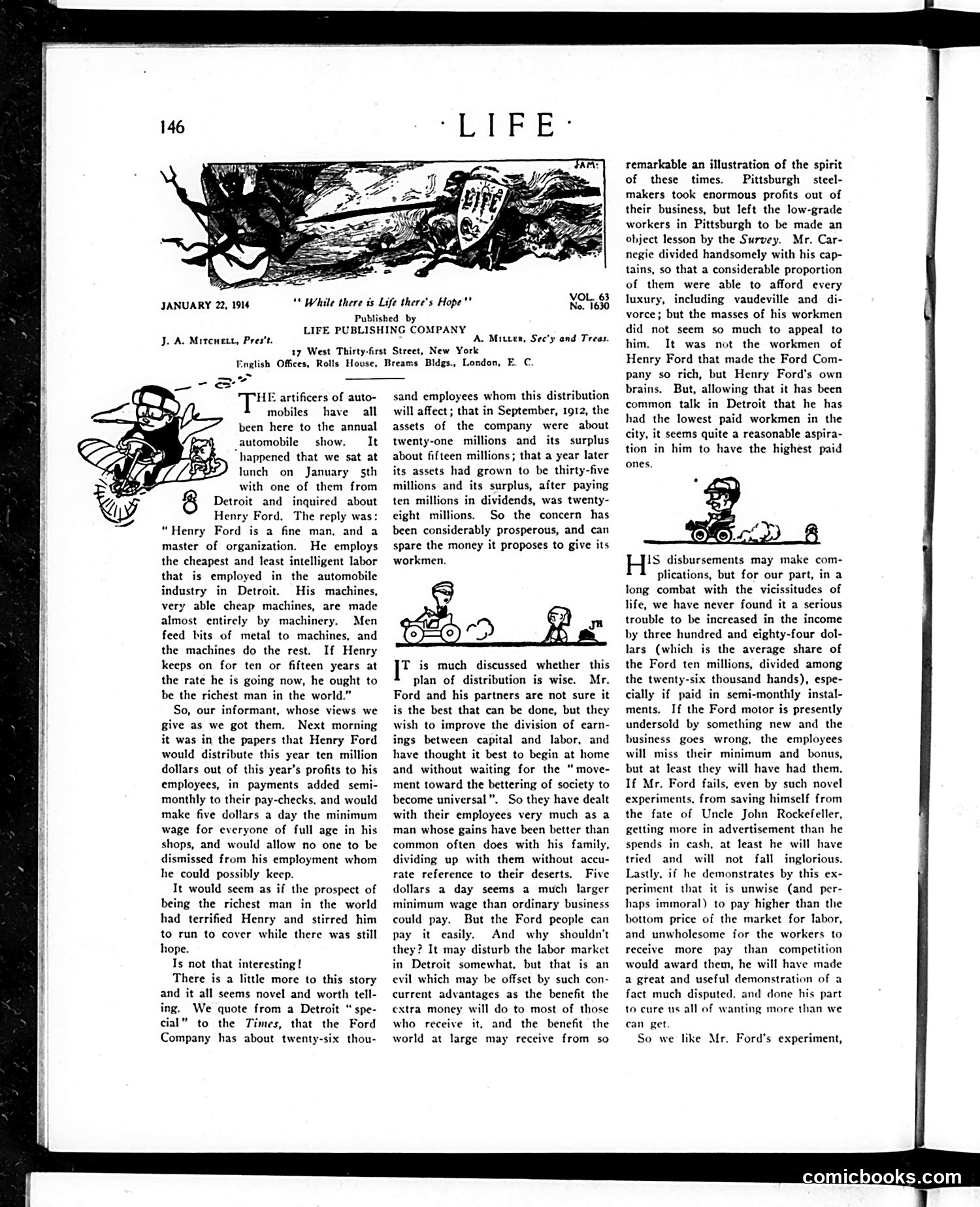
This page satirizes Henry Ford's announcement of profit-sharing with employees—a $5 daily minimum wage and semi-monthly bonus distributions totaling $10 million annually. The article uses gentle irony: A Detroit informant predicts Ford will become the world's richest man through cheap labor and mechanization. Within hours, Ford announces massive worker payments, prompting the satirical headline: he was "terrified" by impending wealth and "ran to cover." The author questions whether Ford's motives are genuinely philanthropic or calculated public relations. The piece contrasts Ford favorably with Pittsburgh steel magnates and Andrew Carnegie, who hoarded profits while workers suffered poverty. The cartoon (top) depicts an automobile, reinforcing Ford's industry dominance. The satire's edge: Ford's gesture is praised as remarkable for its era, yet the author notes it may simply be good business—better workers yield better productivity—rather than true social conscience.
📄 Transcribed text from this page (OCR, searchable)
Machine-transcribed from the original scan — historical spelling and the odd misread are preserved.
JANUARY 2, 191¢ “While there is Life there's Hope" Published by LIFE PUBLISHING COMPANY J. A. Mitcnett, Pres't. = T# 2 artificers of auto- mobiles have all been here to the annual automobile show. It “happened that we sat at lunch on January sth with one of them from Detroit and inquired about Henry Ford. The reply was: “Henry Ford is a fine man, and a master of organization. He employs the cheapest and least intelligent labor that is employed in the automobile industry in Detroit. His machines, very able cheap machines, are made almost entirely by machinery. Men feed bits of metal to machines, and the machines do the rest. If Henry keeps on for ten or fifteen years at the rate he is going now, he ought to be the richest man in the world.” So, our informant, whose views we give as we got them. Next morning it was in the papers that Henry Ford would distribute this year ten million dollars out of this year’s profits to his employees, in payments added semi- monthly to their pay-checks, and would make five dollars a day the minimum wage for everyone of full age in his shops, and would allow no one to be dismissed from his employment whom he could possibly keep. It would seem as if the prospect of being the richest man in the world had terrified Henry and stirred him to run to cover while there was still hope. Is not that interesting! There is a little more to this story and it all seems novel and worth tell- ing. We quote from a Detroit “ spe- cial” to the Times, that the Ford Company has about twenty-six thou- A. Minter, Sec'y and Treas. 17 West Thirty-first Street, New York English Offices, Rolls House, Breams Bldgs., London, E. C. sand employees whom this distribution will affect; that in September, 1912, the assets of the company were about twenty-one millions and its surplus about fifteen millions; that a year later its assets had grown to be thirty-five millions and its surplus, after paying ten millions in dividends, was twenty- eight millions. So the concern has been considerably prosperous, and can spare the money it proposes to give its workmen. T is much discussed whether this plan of distribution is wise. Mr. Ford and his partners are not sure it is the best that can be done, but they wish to improve the division of earn- ings between capital and labor, and have thought it best to begin at home and without waiting for the “move- ment toward the bettering of society to become universal”. So they have dealt with their employees very much as a man whose gains have been better than common often does with his family, dividing up with them without accu- rate reference to their deserts. Five dollars a day seems a much larger minimum wage than ordinary business could pay. But the Ford people can pay it easily. And why shouldn't they? It may disturb the labor market in Detroit somewhat, but that is an evil which may be offset by such con- current advantages as the benefit the extra money will do to most of those who receive it, and the benefit the world at large may receive from so remarkable an illustration of the spirit of these times. Pittsburgh steel- makers took enormous profits out of their business, but left the low-grade workers in Pittsburgh to be made an object lesson by the Survey. Mr. Car- negie divided handsomely with his cap- tains, so that a considerable proportion of them were able to afford every luxury, including vaudeville and di- vorce; but the masses of his workmen did not seem so much to appeal to him. It was not the workmen of Henry Ford that made the Ford Com- pany so rich, but Henry Ford’s own brains. But, allowing that it has been common talk in Detroit that he has had the lowest paid workmen in the city, it seems quite a reasonable aspira- tion in him to have the highest paid ones. 1S disbursements may make com- plications, but for our part, in a long combat with the vicissitudes of life, we have never found it a serious trouble to be increased in the income by three hundred and eighty-four dol- lars (which is the average share of the Ford ten millions, divided among the twenty-six thousand hands), espe- cially if paid in semi-monthly instal- ments, If the Ford motor is presently undersold by something new and the business goes wrong, the employees will miss their minimum and bonus, but at least they will have had them. If Mr. Ford fails, even by such novel experiments, from saving himself from the fate of Uncle John Rockefeller, getting more in advertisement than he spends in cash, at least he will have tried and will not fall inglorious. Lastly, if he demonstrates by this ex- periment that it is unwise (and per- haps immoral) to pay higher than the bottom price of the market for labor, and unwholesome for the workers to receive more pay than competition would award them, he will have made a great and useful demonstration of a fact much disputed. and done his part to cure us all of wanting more than we can get So we like Mr. Ford’s experiment, comicbooks.com