
Life, 1914-01-22 · page 24 of 40
Life — January 22, 1914 — page 24: what you’re looking at
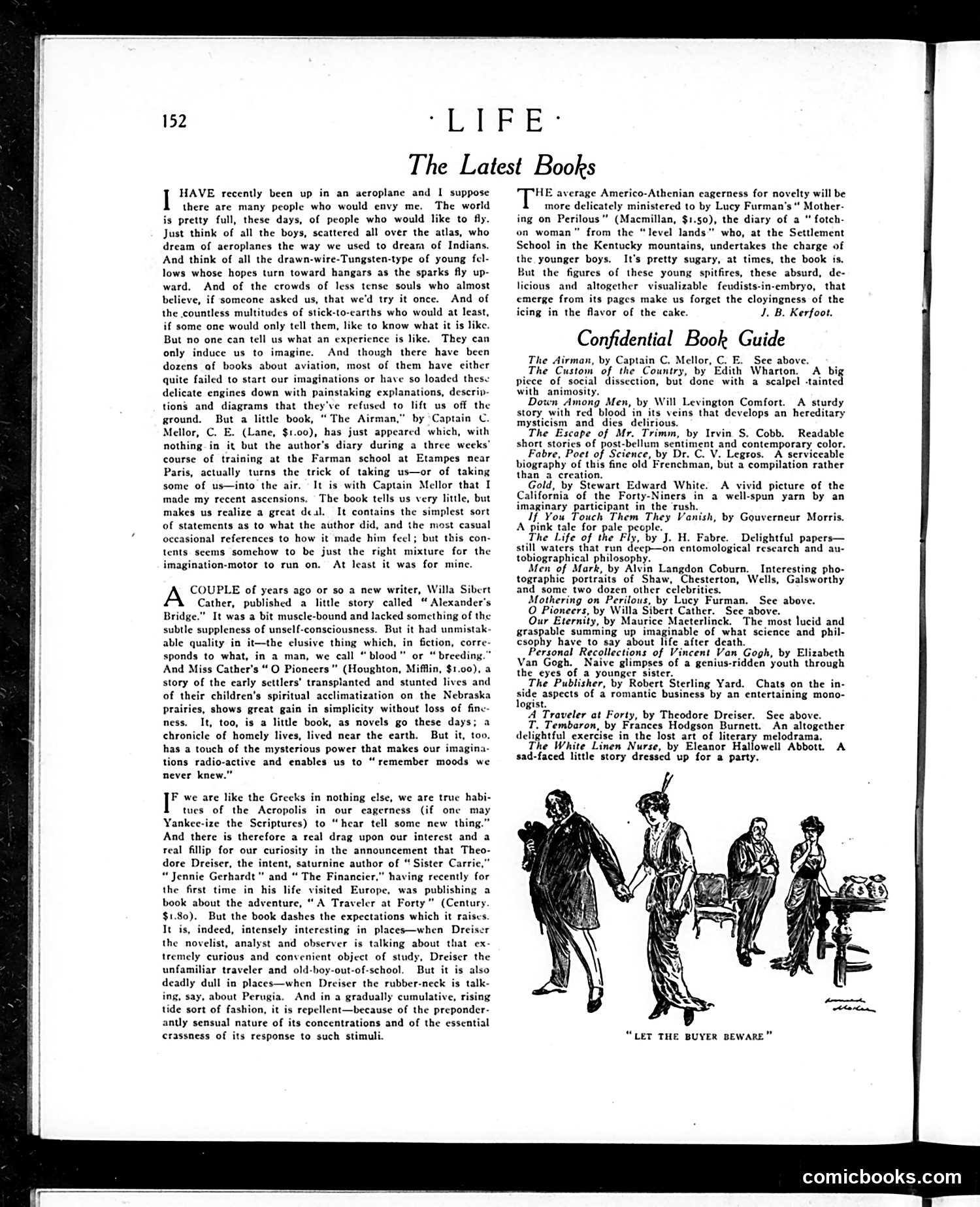
A restored page from Life, 1914-01-22. Page through the whole issue in the reader above.
📄 Transcribed text from this page (OCR, searchable)
Machine-transcribed from the original scan — historical spelling and the odd misread are preserved.
“TE TAPSE: * The Latest Books HAVE recently been up in an aeroplane and I suppose there are many people who would envy me. The world is pretty full, these days, of people who would like to fly. Just think of all the boys, scattered all over the atlas, who dream of aeroplanes the way we used to dream of Indians, And think of all the drawn-wire-Tungsten-type of young fcl- lows whose hopes turn toward hangars as the sparks fly up- ward. And of the crowds of less tense souls who almost believe, if someone asked us, that we'd try it once. And of the countless multitudes of stick-to-earths who would at least, if some one would only tell them, like to know what it is like. But no one can tell us what an experience is like. They can only induce us to imagine. And though there have been dozens af books about aviation, most of them have either quite failed to start our imaginations or have so loaded these delicate engines down with painstaking explanations, descrip- tions and diagrams that they've refused to lift us off the ground. But a little book, “ The Airman,” by Captain C. Mellor, C. E. (Lane, $1.00), has just appeared which, with nothing in it but the author's diary during a three weeks’ course of training at the Farman school at Etampes near Paris, actually turns the trick of taking us—or of taking some of us—into the air. It is with Captain Mellor that I made my recent ascensions, The book tells us very little, but makes us realize a great deal. It contains the simplest sort of statements as to what the author did, and the most casual occasional references to how it made him feel; but this con- tents seems somehow to be just the right mixture for the imagination-motor to run on. At least it was for mince. COUPLE of years ago or so a new writer, Willa Sibert Cather, published a little story called “ Alexander's Bridge.” It was a bit muscle-bound and lacked something of the subtle suppleness of unself-consciousness. But it had unmistak- able quality in it—the elusive thing which, in fiction, corr: sponds to what, in a man, we call “ blood" or “ breeding.” And Miss Cather’s “O Pioneers” (Houghton, Mifflin, $1.00), a story of the early scttlers’ transplanted and stunted lives and of their children’s spiritual acclimatization on the Nebraska prairies, shows great gain in simplicity without loss of fine- ness, It, too, is a little book, as novels go these days; a chronicle of homely lives, lived near the earth. But it, too, has a touch of the mysterious power that makes our imagina- tions radio-active and enables us to “remember moods we never knew.” F we are like the Greeks in nothing else, we are true habi- tues of the Acropolis in our eagerness (if one may Yankee-ize the Scriptures) to “hear tell some new thing.” And there is therefore a real drag upon our interest and a real fillip for our curiosity in the announcement that Theo- dore Dreiser, the intent, saturnine author of “ Sister Carrie, “ Jennie Gerhardt" and “ The Financier,” having recently for the first time in his life visited Europe, was publishing a book about the adventure, “A Traveler at Forty” (Century $1.80), But the book dashes the expectations which it raises. It is, indeed, intensely interesting in places—when Dreiser the novelist, analyst and observer is talking about that ex- tremely curious and convenient object of study, Dreiser the unfamiliar traveler and old-boy-out-of-school. But it is also deadly dull in places—when Dreiser the rubber-neck is talk- ing, say, about Peru: And in a gradually cumulative, rising tide sort of fashion, it is repellent—because of the preponder- antly sensual nature of its concentrations and of the essential crassness of its response to such stimuli. HE average Americo-Athenian eagerness for novelty will be more delicately ministered to by Lucy Furman’s “ Mother- ing on Perilous” (Macmillan, $1.50), the diary of a “ fotch- on woman" from the “level lands" who, at the Settlement School in the Kentucky mountains, undertakes the charge of the younger boys. It's pretty sugary, at times, the book is. But the figures of these young spitfires, these absurd, de- licious and altogether visualizable feudists-in-embryo, that emerge from its pages make us forget the cloyingness of the icing in the flavor of the cake. J. B. Kerfoot. Confidential Book Guide The Airman, by Captain C, Mellor, C. E. See above. The Custom of the Country, by Edith Wharton. A big piece of social dissection, but done with a scalpel -tainted with animosity. De Among Men, by Will Levington Comfort. A sturdy story with red blood in its veins that develops an hereditary mysticism and dies delirious. The Escape of Mr. Trimm, by Irvin S. Cobb. Readable short stories of post-bellum sentiment and contemporary color. Fabre, Poet of Science, by Dr. C. V. Legros. A serviceable biography of this fine old’ Frenchman, but a compilation rather than a creation. Gold, by Stewart Edward White. A vivid picture of the California of the Forty-Niners in a well-spun yarn by an imaginary participant in the rush. If You Touch Them They Vanish, by Gouverneur Morris. A pink tale for pale people, The Life of the Fly, by J. H. Fabre. Delightful papers— still waters that run deep—on entomological research and au- tobiographical philosophy. Men of Mark, by Alvin Langdon Coburn. Interesting pho- tographic portraits of Shaw, Chesterton, Wells, Galsworthy and some two dozen other celebrities. Mothering on Perilous, by Lucy Furman. Sce above. O Pioneers, by Willa Sibert Cather. See above. Our Eternity, by Maurice Maeterlinck. The most lucid and graspable summing up imaginable of what science and phil- csophy have to say about life after death. Personal Recollections of Vincent Van Gogh, by Elizabeth Van Gogh. Naive glimpses of a genius-ridden youth through the eyes of a younger sister. _ The Publisher, by Robert Sterling Yard. Chats on the in- side aspects of a romantic business by an entertaining mono- logist. A Traveler at Forty, by Theodore Dreiser. T. Tembaron, by Frances Hodgson Burnett. An altogether delightful exercise in the lost art of literary melodrama. The White Linen Nurse, by Eleanor Hallowell Abbott. A sad-faced little story dressed up for a party. See above. “LeT THE BUYER BEWARE” comicbooks.com