
Life, 1914-01-22 · page 8 of 40
Life — January 22, 1914 — page 8: what you’re looking at
What you’re looking at
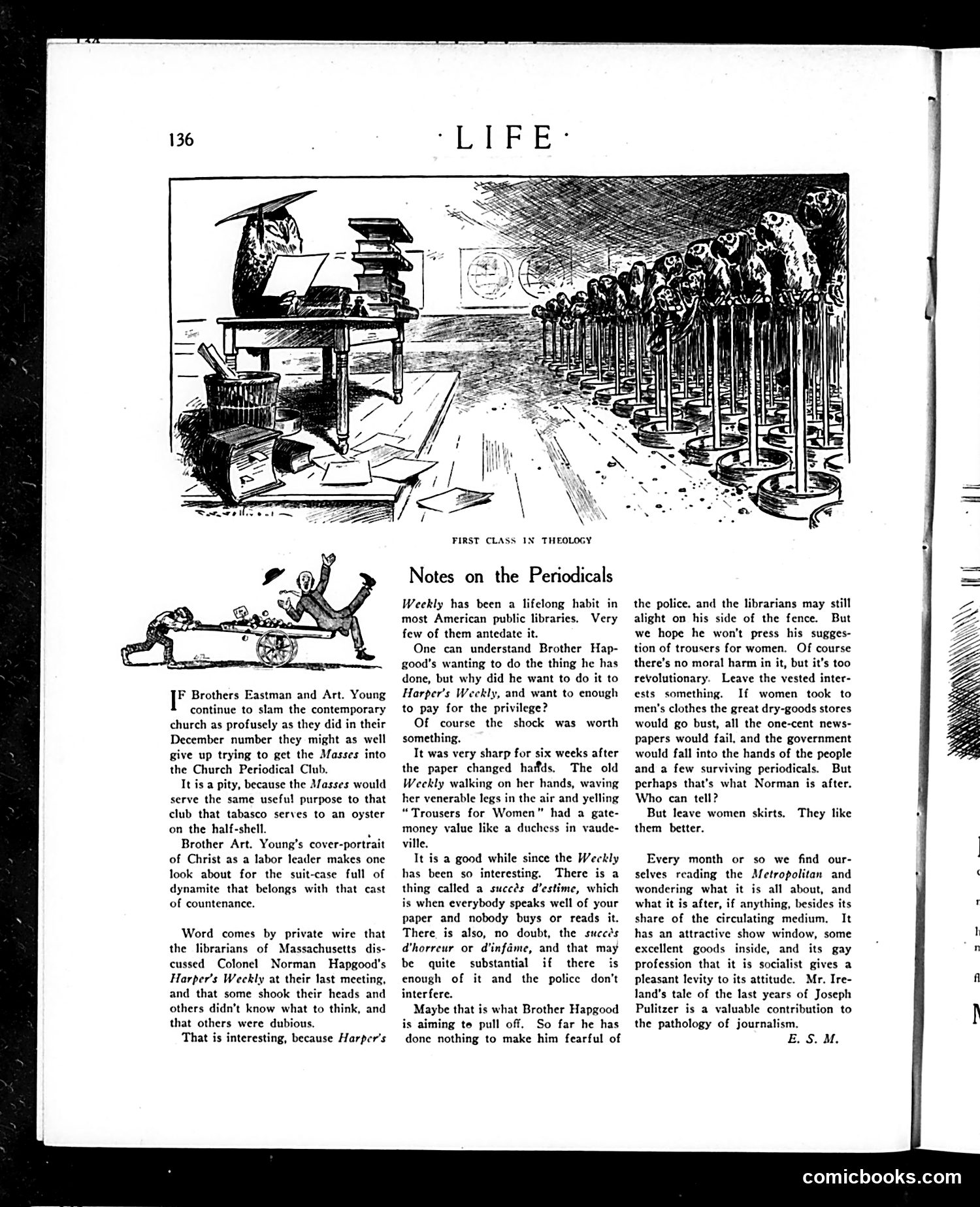
This cartoon satirizes the commercialization of religion and publishing in early 20th-century America. The image depicts a bird-like instructor at a desk covered with papers and books, teaching a row of identical robed figures (clergy or seminarians) who stand in pots like plants being cultivated. The satire suggests that religious education has become an industrial, mass-production operation—literally "growing" ministers as commodities rather than developing them as individuals. The mechanical uniformity of the students and the factory-like arrangement mock both theological education and the publishing industry's role in creating standardized religious authority. The accompanying article criticizes *Harper's Weekly* and debates about magazine content, connecting to themes of mass-market influence on institutions.
📄 Transcribed text from this page (OCR, searchable)
Machine-transcribed from the original scan — historical spelling and the odd misread are preserved.
F Brothers Eastman and Art. Young continue to slam the contemporary church as profusely as they did in their December number they might as well give up trying to get the Masses into the Church Periodical Club. It is a pity, because the Masses would serve the same useful! purpose to that club that tabasco serves to an oyster on the half-shell. . Brother Art. Young’s cover-portrait of Christ as a labor leader makes one look about for the suit-case full of dynamite that belongs with that cast of countenance. Word comes by private wire that the librarians of Massachusetts dis- cussed Colonel Norman Hapgood's Harper's Weekly at their last meeting, and that some shook their heads and others didn’t know what to think, and that others were dubious. That is interesting, because Harper's FIRST CLASS IN THEOLOGY Notes on the Periodicals Weekly has been a lifelong habit in most American public libraries. Very few of them antedate it. One can understand Brother Hap- good’s wanting to do the thing he has done, but why did he want to do it to Harper's Weekly, and want to enough to pay for the privilege? Of course the shock was worth something. Tt was very sharp for six weeks after the paper changed harfds. The old Weekly walking on her hands, waving her venerable legs in the air and yelling “Trousers for Women" had a gate- money value like a duchess in vaude- ville. It is a good while since the Weekly has been so interesting. There is a thing called a succes d’estime, which is when everybody speaks well of your paper and nobody buys or reads it. There. is also, no doubt, the suecés d'horreur or d'infame, and that may be quite substantial if there i enough of it and the police don't interfere. Maybe that is what Brother Hapgood. is aiming te pull off. So far he has done nothing to make him fearful of the police, and the librarians may still alight on his side of the fence. But we hope he won't press his sugges- tion of trousers for women. Of course there’s no moral harm in it, but it's too revolutionary. Leave the vested inter- ests something. If women took to men’s clothes the great dry-goods stores would go bust, all the one-cent news- papers would fail, and the government would fall into the hands of the people and a few surviving periodicals. But perhaps that’s what Norman is after. Who can tell? But leave women skirts. them better. They like Every month or so we find our- selves reading the Metropolitan and wondering what it is all about, and what it is after, if anything, besides its share of the circulating medium. It has an attractive show window, some excellent goods inside, and its gay profession that it is socialist gives a pleasant levity to its attitude. Mr. Ire- land’s tale of the last years of Joseph Pulitzer is a valuable contribution to the pathology of journalism. E. S. M. comicbooks.com