
Life, 1914-01-22 · page 22 of 40
Life — January 22, 1914 — page 22: what you’re looking at
What you’re looking at
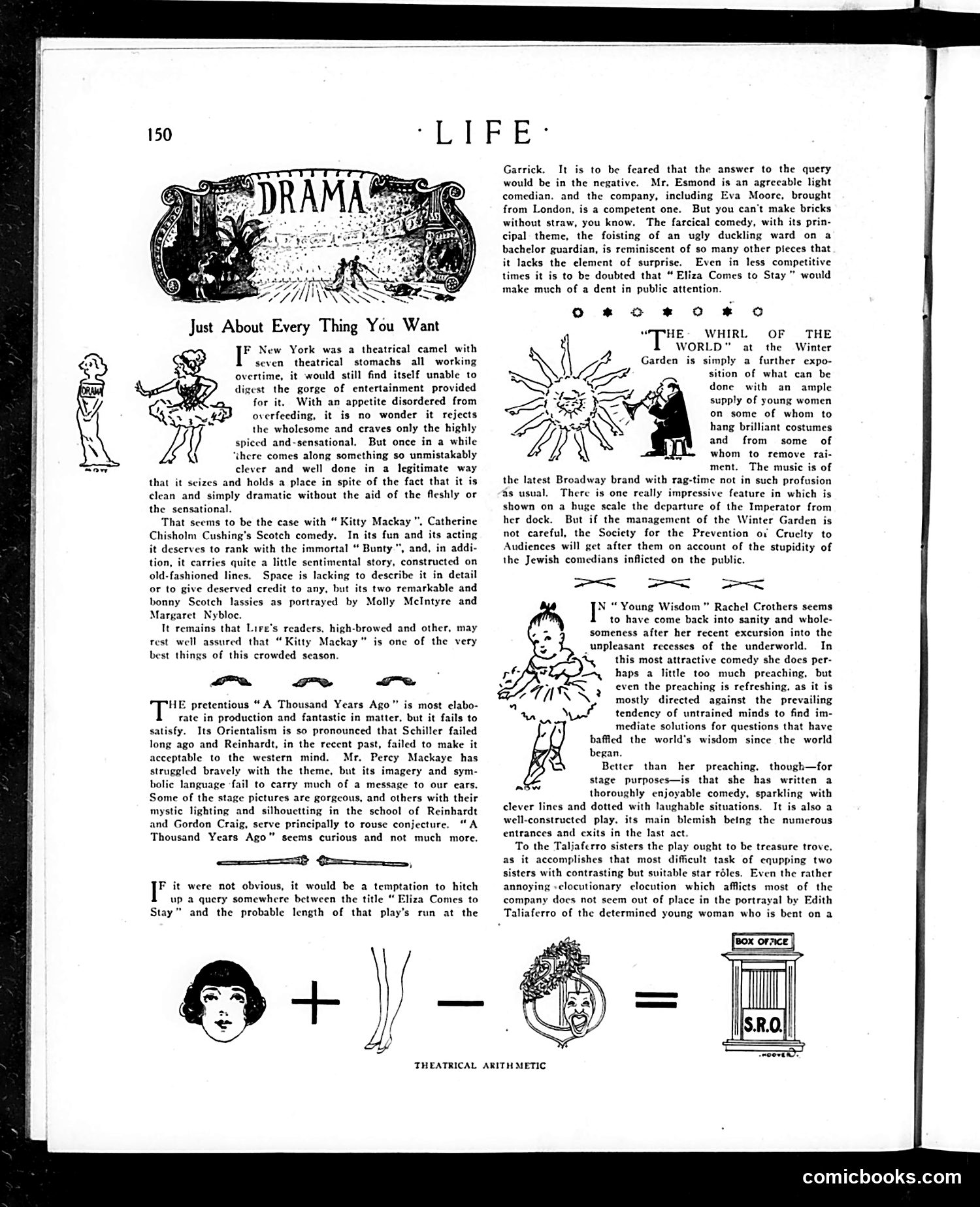
This page contains theatre reviews from Life magazine's drama section, critiquing several Broadway productions. The text employs satirical language characteristic of early 20th-century dramatic criticism. **Key Reviews:** - **"Kitty Mackay"**: Praised as genuinely clever and well-crafted entertainment, featuring Scottish actresses Molly McIntyre and Margaret Nybloc. The reviewer uses a vivid metaphor comparing New York's theatrical appetite to an overfed camel. - **"A Thousand Years Ago"**: Criticized as pretentious and overly ornate in staging, with imagery that fails to connect with Western audiences despite elaborate production design. - **"Eliza Comes to Stay"**: Dismissed as derivative farce lacking originality, despite competent performer Mr. Esmond. - **"The Whirl of the World"**: Mocked as spectacle-driven entertainment notable mainly for displaying young women in costumes, with an impressive ship departure scene but poor comedic performances. - **"Young Wisdom"**: Commended for returning to wholesome material after the author's previous darker work. The "Theatrical Arithmetic" cartoon at bottom (woman + legs + theatrical mask = box office) humorously summarizes Broadway's commercial formula.
📄 Transcribed text from this page (OCR, searchable)
Machine-transcribed from the original scan — historical spelling and the odd misread are preserved.
“LIFE: Just About Every Thing You Want F New York was a theatrical camel with seven theatrical stomachs all working overtime, it would still find itself unable to digest the gorge of entertainment provided for it. With an appetite disordered from overfeeding, it is no wonder it rejects the wholesome and craves only the highly spiced and-sensational. But once in a while ‘there comes along something so unmistakably clever and well done in a legitimate way that it seizes and holds a place in spite of the fact that it is clean and simply dramatic without the aid of the fleshly or the sensational. That scems to be the case with “ Kitty Mackay ", Catherine Chisholm Cushing's Scotch comedy. In its fun and its acting it deserves to rank with the immortal “ Bunty”, and, in addi- tion, it carries quite a little sentimental story, constructed on old-fashioned lines. Space is lacking to describe it in detail or to give deserved credit to any, but its two remarkable and bonny Scotch lassies as portrayed by Molly McIntyre and Margaret Nybloc. It remains that Lire’s readers, high-browed and other, may rest well assured that “Kitty Mackay” is one of the very best things of this crowded season. un Fe Ks HE pretentious “A Thousand Years Ago” is most elabo- rate in production and fantastic in matter, but it fails to satisfy. Its Orientalism is so pronounced that Schiller failed long ago and Reinhardt, in the recent past, failed to make it acceptable to the western mind. Mr. Percy Mackaye has struggled bravely with the theme, but its imagery and sym- bolic language ‘fail to carry much of a message to our ears. Some of the stage pictures are gorgeous, and others with their mystic lighting and silhouetting in the school of Reinhardt and Gordon Craig, serve principally to rouse conjecture. “A Thousand Years Ago” seems curious and not much more. SS fe, were not obvious, it would be a temptation to hitch a query somewhere between the title “Eliza Comes to and the probable length of that play’s run at the Ge Garrick. It is to be feared that the answer to the query would be in the negative. Mr. Esmond is an agrecable light comedian. and the company, including Eva Moore, brought from London, is a competent one. But you can't make bricks without straw, you know. The farcical comedy, with its prin- cipal theme, the foisting of an ugly duckling ward on a bachelor guardian, is reminiscent of so many other pieces that it lacks the element of surprise. Even in less competitive times it is to be doubted that “ Eliza Comes to Stay" would make much of a dent in public attention. o* 0 ® 0 # 0 “CHE WHIRL OF THE WORLD" at the Winter Garden is simply a further expo- sition of what can be done with an ample supply of young women on some of whom to hang brilliant costumes and from some of whom to remove rai- ment. The music is of the latest Broadway brand with rag-time not in such profusion as usual. There is one really impressive feature in which is shown on a huge scale the departure of the Imperator from her dock. But if the management of the Winter Garden is not careful, the Society for the Prevention of Cruelty to Audiences will get after them on account of the stupidity of the Jewish comedians inflicted on the public. >= OOS ee I* “Young Wisdom” Rachel Crothers seems to have come back into sanity and whole- someness after her recent excursion into the unpleasant recesses of the underworld. In this most attractive comedy she does per- haps a little too much preaching, but even the preaching is refreshing, as it is mostly directed against the prevailing tendency of untrained minds to find im- mediate solutions for questions that have baffied the world's wisdom since the world began. ae Better than her preaching, though—for stage purposes—is that she has written a thoroughly enjoyable comedy, sparkling with clever lines and dotted with laughable situations. It is also a well-constructed play. main blemish being the numerous entrances and exits in the last act. To the Taljaferro sisters the play ought to be treasure trove, as it accomplishes that most difficult task of equpping two sisters with contrasting but suitable star rdles. Even the rather annoying »clocutionary elocution which afflicts most of the company docs not scem out of place in the portrayal by Edith > Taliaferro of the determined young woman who is bent on a THEATRICAL ARITHMETIC comicbooks.com