
Life, 1914-01-22 · page 19 of 40
Life — January 22, 1914 — page 19: what you’re looking at
What you’re looking at
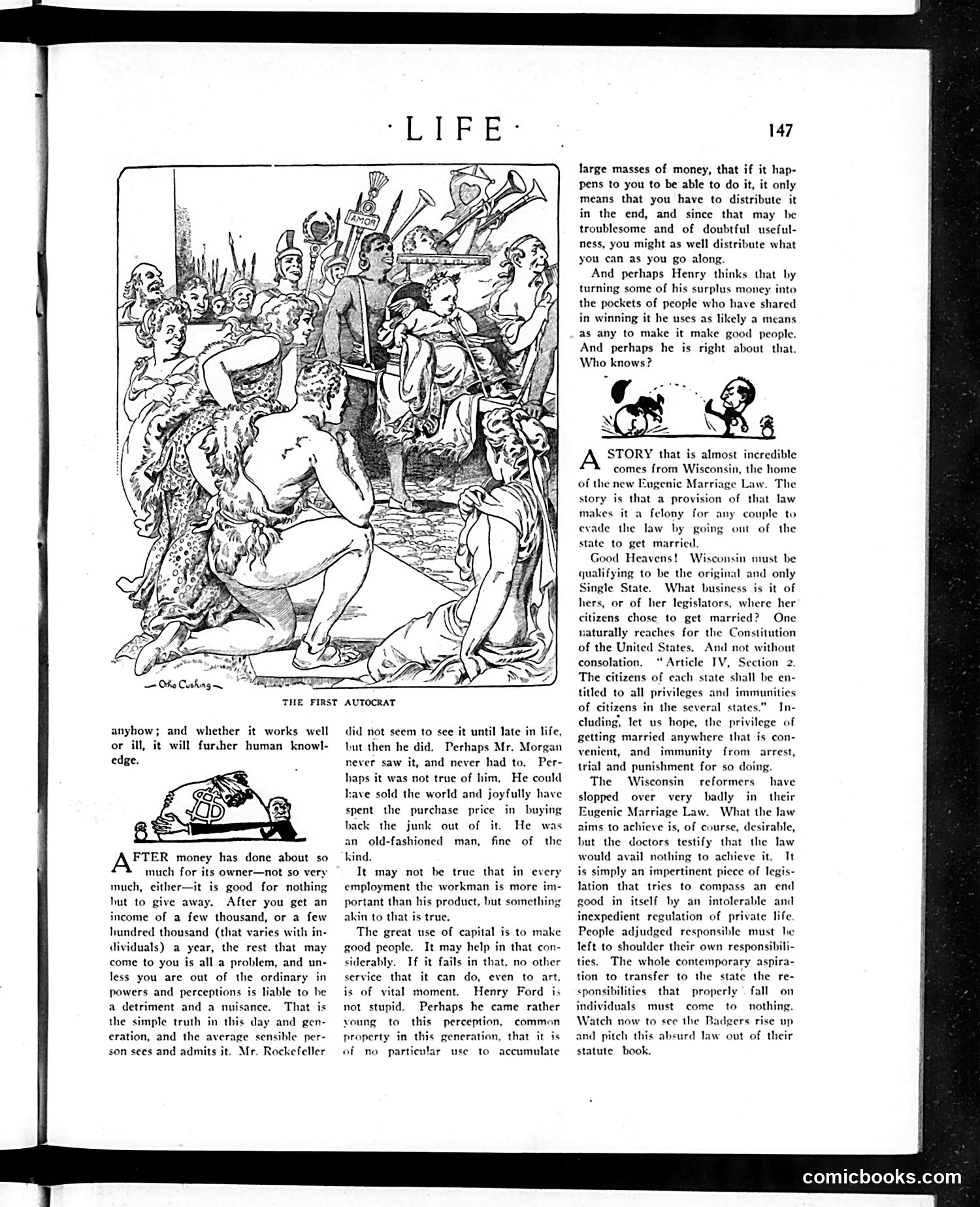
**"The First Autocrat" cartoon** depicts a classical scene of abundance and power, likely representing industrialists or wealthy figures controlling resources. The image contrasts naked figures (possibly representing common people or classical allegory) with elaborately dressed authority figures holding instruments of power. **The accompanying text discusses wealth concentration**, specifically referencing Henry Ford and John D. Rockefeller. The author argues that beyond a certain income level, excess money becomes a burden unless distributed to improve people's lives. Ford's decision to share profits with workers is praised as enlightened use of capital. **The Wisconsin section critiques the state's new "Eugenic Marriage Law,"** which apparently made it a felony to circumvent marriage restrictions by eloping out-of-state. Life's editors attack this as an unconstitutional intrusion into personal liberty, violating citizens' rights under the U.S. Constitution's privileges clause. They dismiss the law as ineffective and demand Wisconsin repeal it. Both pieces reflect Progressive Era tensions between individual liberty and state regulation of social behavior.
📄 Transcribed text from this page (OCR, searchable)
Machine-transcribed from the original scan — historical spelling and the odd misread are preserved.
THE FIRST AUTOCRAT anyhow; and whether it works well or ill, it will furcher human knowl- ASTER money has done about so much for its owner—not so very much, cither—it is good for nothing but to give away. After you get an income of a few thousand, or a few hundred thousand (that varies with in- dividuals) a year, the rest that may come to you is all a problem, and un- less you are out of the ordinary in powers and perceptions is liable to be a detriment and a nuisance. That is the simple truth in this day and gen- eration, and the average sensible per- son sees and admits it. Mr. Rockefeller did not seem to see it until late in life, but then he did. Perhaps Mr. Morgan never saw it, and never had to. Per- haps it was not true of him, He could lave sold the world and joyfully have spent the purchase price in buying back the junk out of it. He was an old-fashioned man, fine of the kind. It may not be true that in every employment the workman is more im- portant than his product, but something akin to that is true. The great use of capital is to make good people. It may help in that con- siderably. If it fails in that, no other service that it can do, even to art. is of vital moment. Henry Ford is not stupid. Perhaps he came rather young to this perception, common property in this generation, that it is of no particular use to accumulate 147 large masses of money, that if it hap- pens to you to be able to do it, it only means that you have to distribute it in the end, and since that may be troublesome and of doubtful useful- ness, you might as well distribute what you can as you go along. And perhaps Henry thinks that by turning some of his surplus money into the pockets of people who have shared in winning it he uses as likely a means as any to make it make good people. And perhaps he is right about that. Who knows? STORY that is almost incredible comes from Wisconsin, the home of the new Eugenic Marriage Law. The story is that a provision of that law makes it a felony for any couple to evade the law by going out of the state to get married. Good Heavens! Wisconsin must be qualifying to be the original and only Single State. What business is it of hers, or of her legislators, where her citizens chose to get married? One naturally reaches for the Constitution of the United States. And not without consolation. “Article IV, ion 2, The citizens of cach state shall be en- titled to all privileges and immunities of citizens in the several states.” In- cluding, let us hope, the privilege getting married anywhere that is con- venient, and immunity from arrest, trial and punishment for so doing. The Wisconsin reformers have slopped over very badly in their Eugenic Marriage Law. What the law aims to achieve is, of course, desirable, but the doctors testify that the law would avail nothing to achieve it. It is simply an impertinent piece of legis- lation that tries to compass an end good in itself by an intolerable and inexpedient regulation of private life. People adjudged responsible must he left to shoulder their own responsibili. ties. The whole contemporary aspira- tion to transfer to the state the re- sponsibilities that properly | fall on individuals must come to nothing. Watch now to see the Badgers rise up and pitch this absurd Jaw out of their statute book. comicbooks.com