
A complete issue · 44 pages · 1914
Life — January 1, 1914
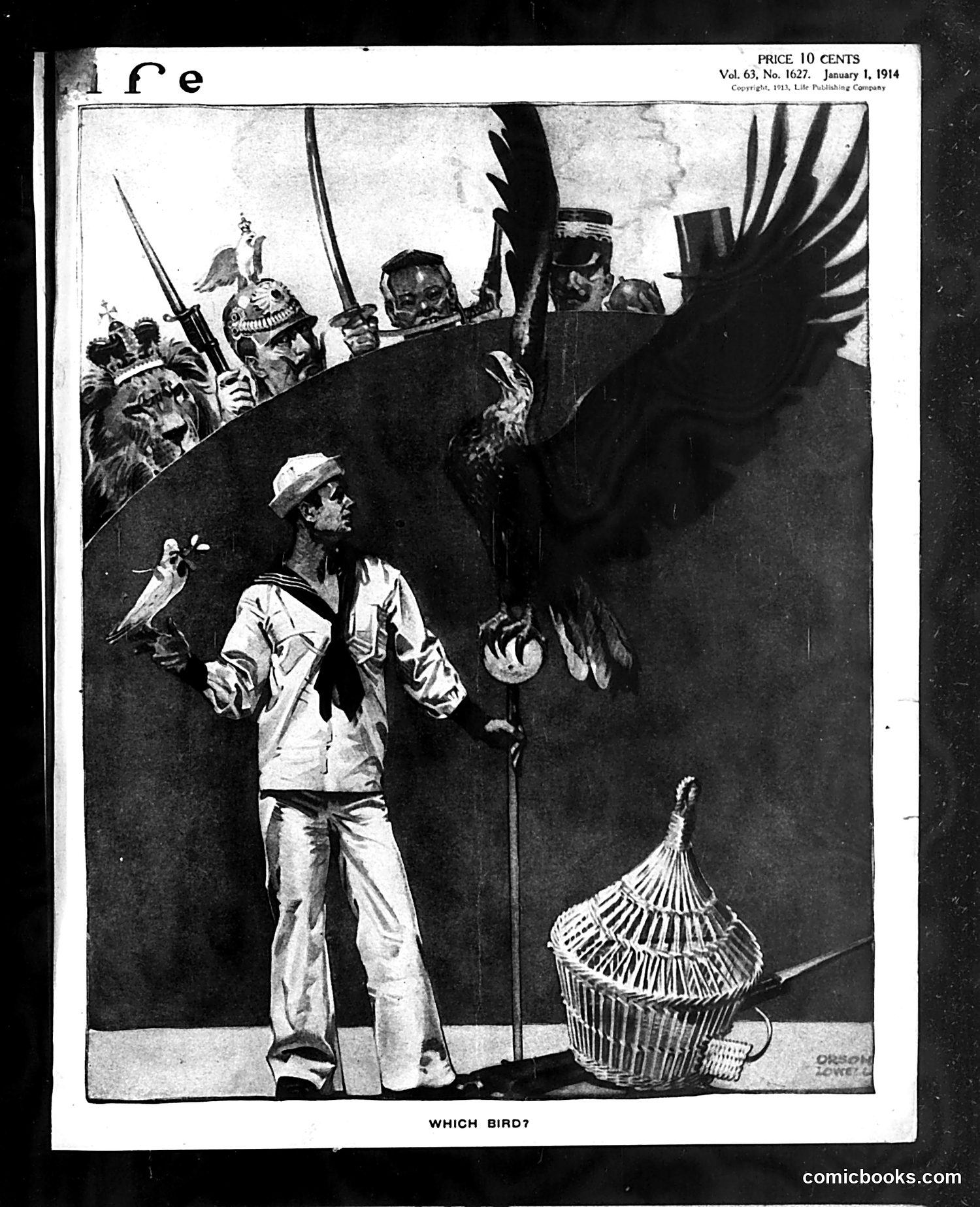
This January 1, 1914 *Life* magazine cartoon titled "Which Bird?" depicts a Western man holding a small bird, confronted by threatening figures behind a wall wearing military headgear and wielding large swords and what appear to be German imperial eagles. The satire appears to reference European militarism and imperial tensions preceding World War I. The "bird" the Western figure holds likely represents a diplomatic or territorial prize being contested. The menacing military figures with their eagles and weapons symbolize aggressive European powers—particularly Germany—threatening to seize it. The joke asks: which nation will "catch" this prize? It mocks the competitive imperial rivalries of pre-war Europe, presenting the situation as dangerous predatory competition among hostile powers.
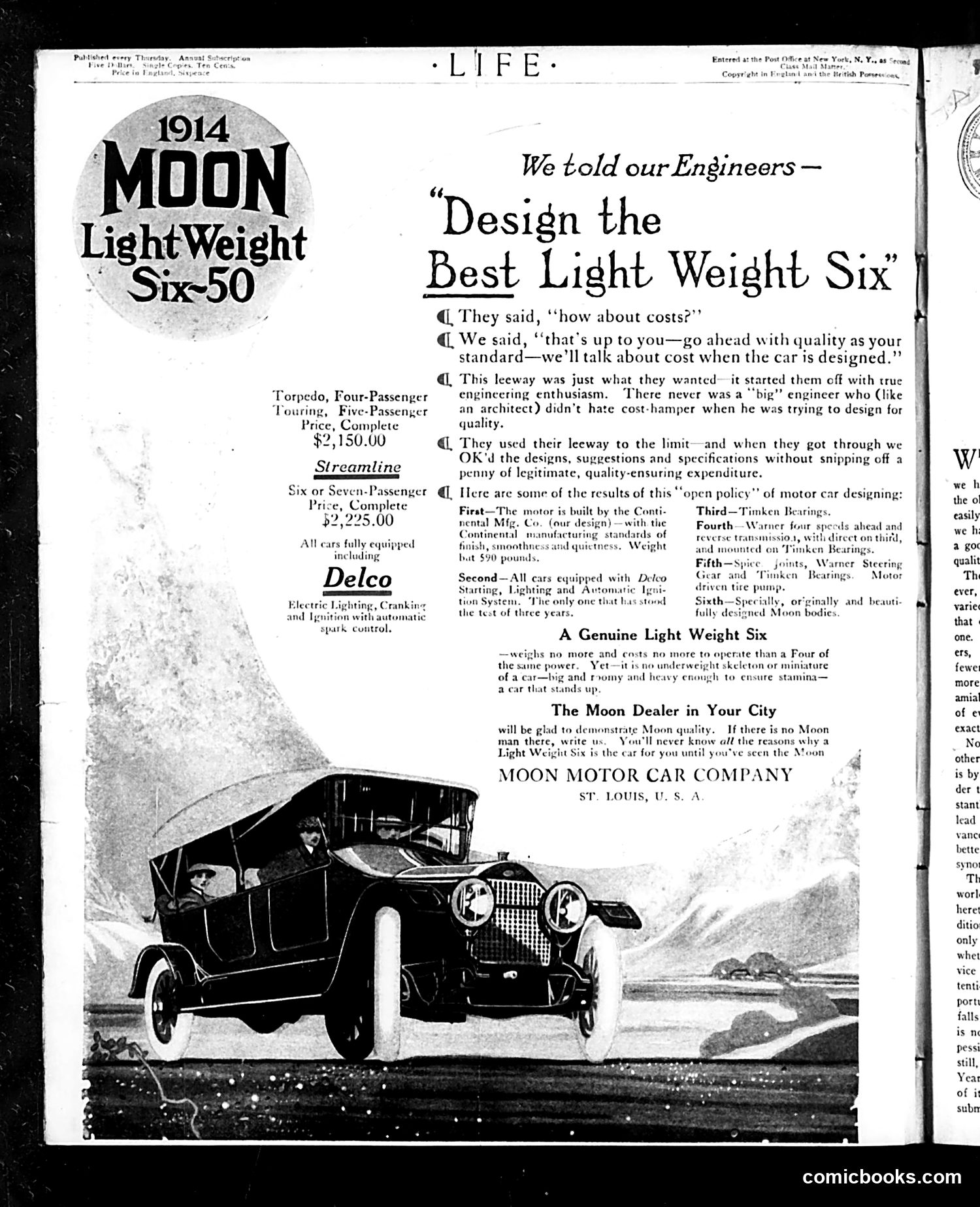
This is primarily a **car advertisement**, not political satire. The Moon Motor Car Company of St. Louis presents their "Light Weight Six" model, priced at $2,150 for the Torpedo touring version. The "satire" is gentle corporate humor: the company claims they told engineers to "Design the Best Light Weight Six" without worrying about costs—then sarcastically notes engineers loved this "open policy" approach. The ad emphasizes quality engineering standards (Continental engine, Delco electrical systems, Tinken bearings) as proof the company stood behind its promises. The dramatic moon backdrop is purely decorative branding, meant to suggest the car's modern, aspirational appeal to 1914 readers.
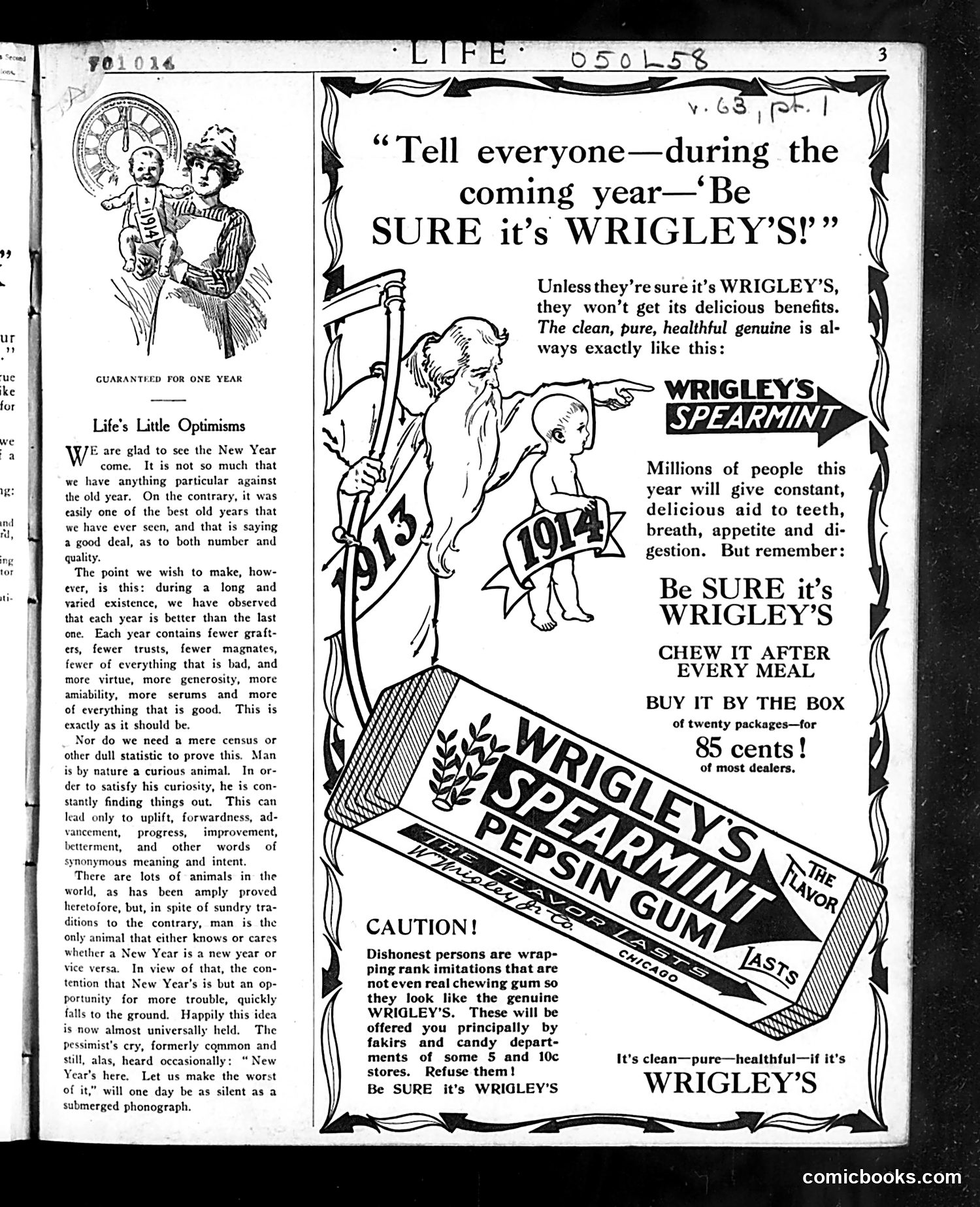
This page contains a Wrigley's Spearmint gum advertisement (right side) and an editorial piece titled "Life's Little Optimisms" (left side). The editorial discusses New Year's resolutions and argues that each year contains "fewer grafters, fewer trusts, fewer magnates"—suggesting optimism about progress and reduction of corruption. It reflects early 20th-century Progressive Era attitudes toward business malfeasance and trust-busting. The Wrigley's ad uses decorative figures (a cherub and what appears to be a woman with a baby) climbing a pole marked "1914," visually representing upward progress and the New Year. The advertisement emphasizes purity ("clean, pure, healthful") and includes a caution against counterfeit gum—suggesting the product's popularity made it a target for imitation. Together, the elements express period optimism about improvement and legitimate commerce.
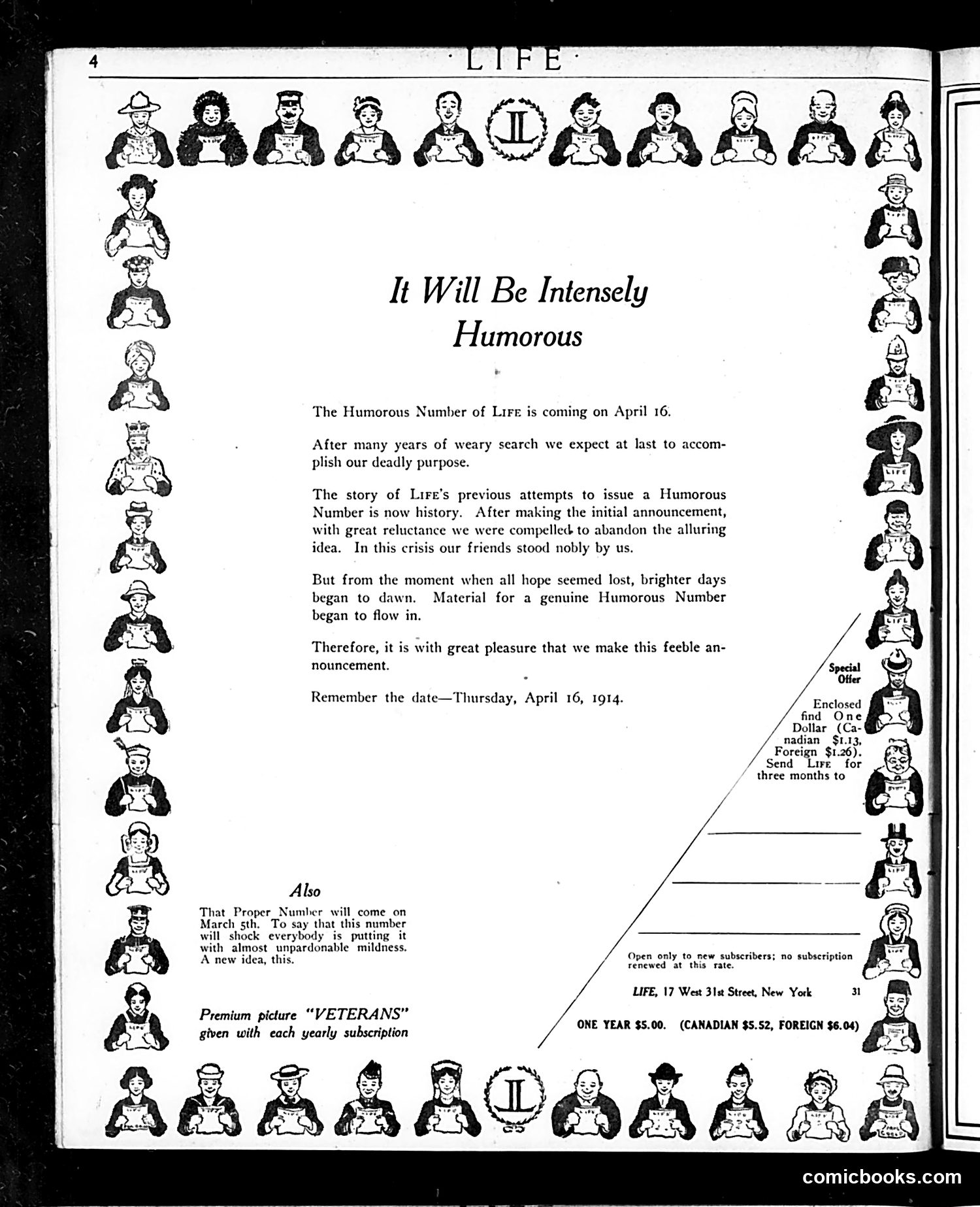
This page is primarily an **advertisement for Life magazine's upcoming "Humorous Number"** scheduled for April 16, 1914. The text announces that after years of failed attempts, Life will finally publish a genuine humor-focused issue. The decorative border consists of **repeated illustrated heads** of people in various styles of dress and facial hair—appearing to represent diverse character types or stereotypes common to early 20th-century American humor. The page also promotes: - A "Proper Number" coming March 5th - A yearly subscription offer ($5.00, or $5.52 Canadian/$6.04 foreign) - A premium picture titled "VETERANS" included with yearly subscriptions This is essentially **promotional material** rather than political satire—advertising Life's comedic content to potential subscribers in 1914.
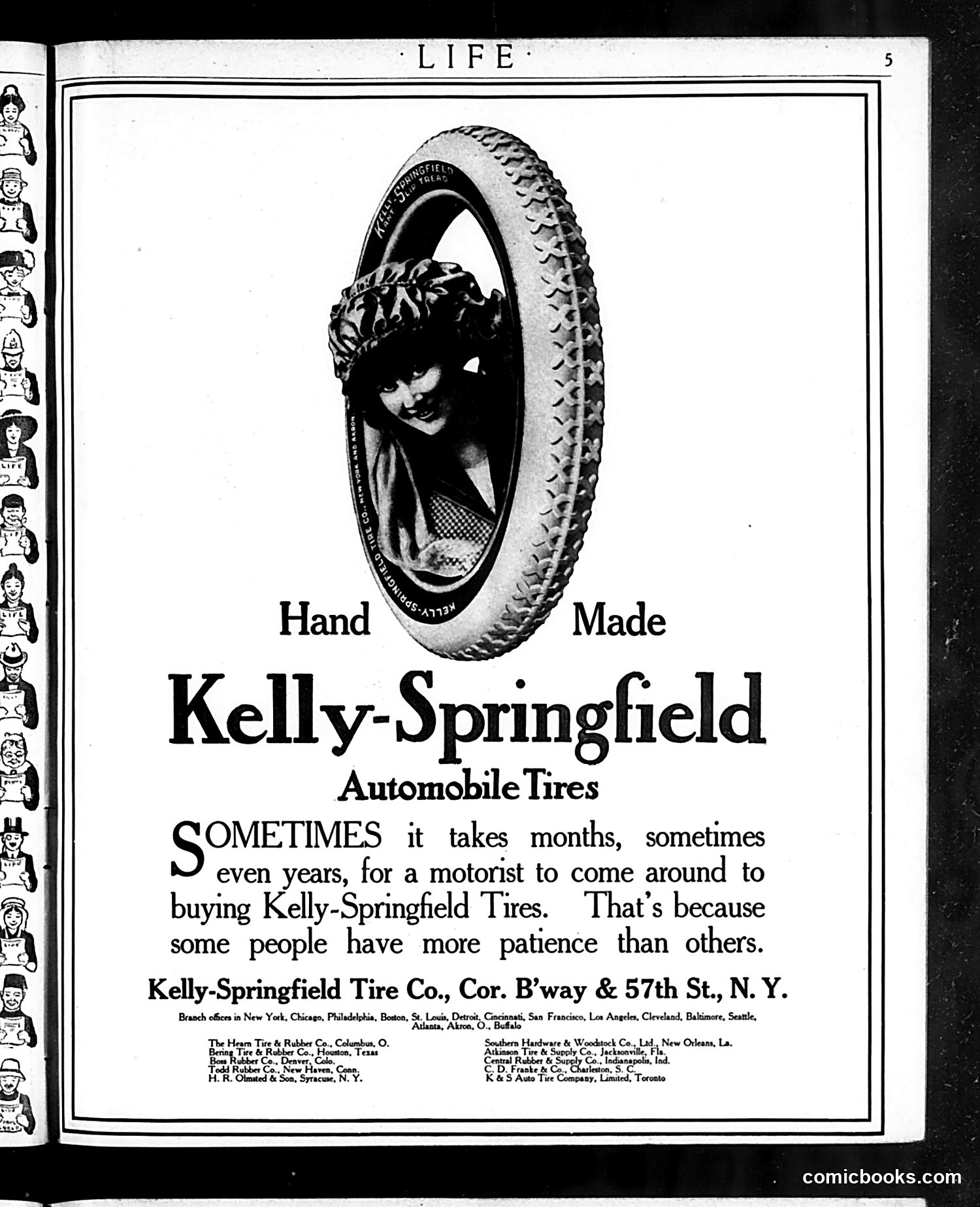
This page is primarily a **product advertisement**, not political satire. It promotes Kelly-Springfield brand automobile tires, manufactured hand-made and sold through the Kelly-Springfield Tire Co. in New York. The ad's humor employs a gentle jab at consumer behavior: "Sometimes it takes months, sometimes even years, for a motorist to come around to buying Kelly-Springfield Tires. That's because some people have more patience than others." The joke suggests that while other tire brands wear out quickly, forcing repeated replacements, Kelly-Springfield tires last so long that impatient consumers buy inferior competitors instead—implying superior durability through dry wit rather than direct claims.
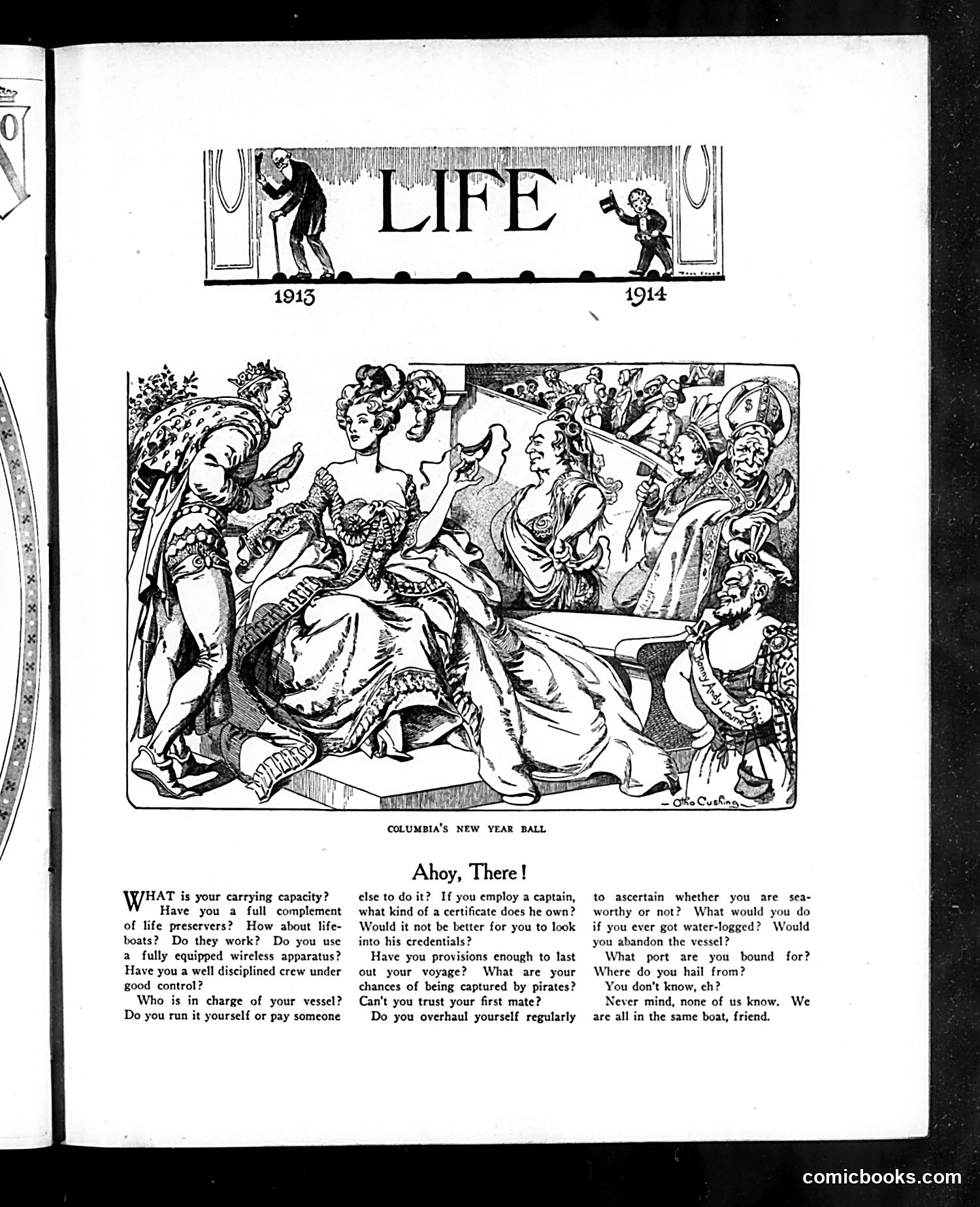
This page features **"Columbia's New Year Ball,"** a satirical illustration showing Lady Columbia (the allegorical female personification of America) surrounded by various figures in an elaborate masquerade scene. The accompanying text poses a series of practical questions to ship captains—about cargo capacity, crew discipline, wireless equipment, provisions, piracy risks, and navigation credentials. The satire appears to mock inadequately-prepared merchant vessels and captains during the early 1910s, likely referencing maritime safety concerns or shipping industry negligence of that era. The ornate ball setting contrasts with the serious, mundane questions about vessel readiness, creating ironic humor about the gap between America's grand self-image and the actual competence of its commercial fleet.
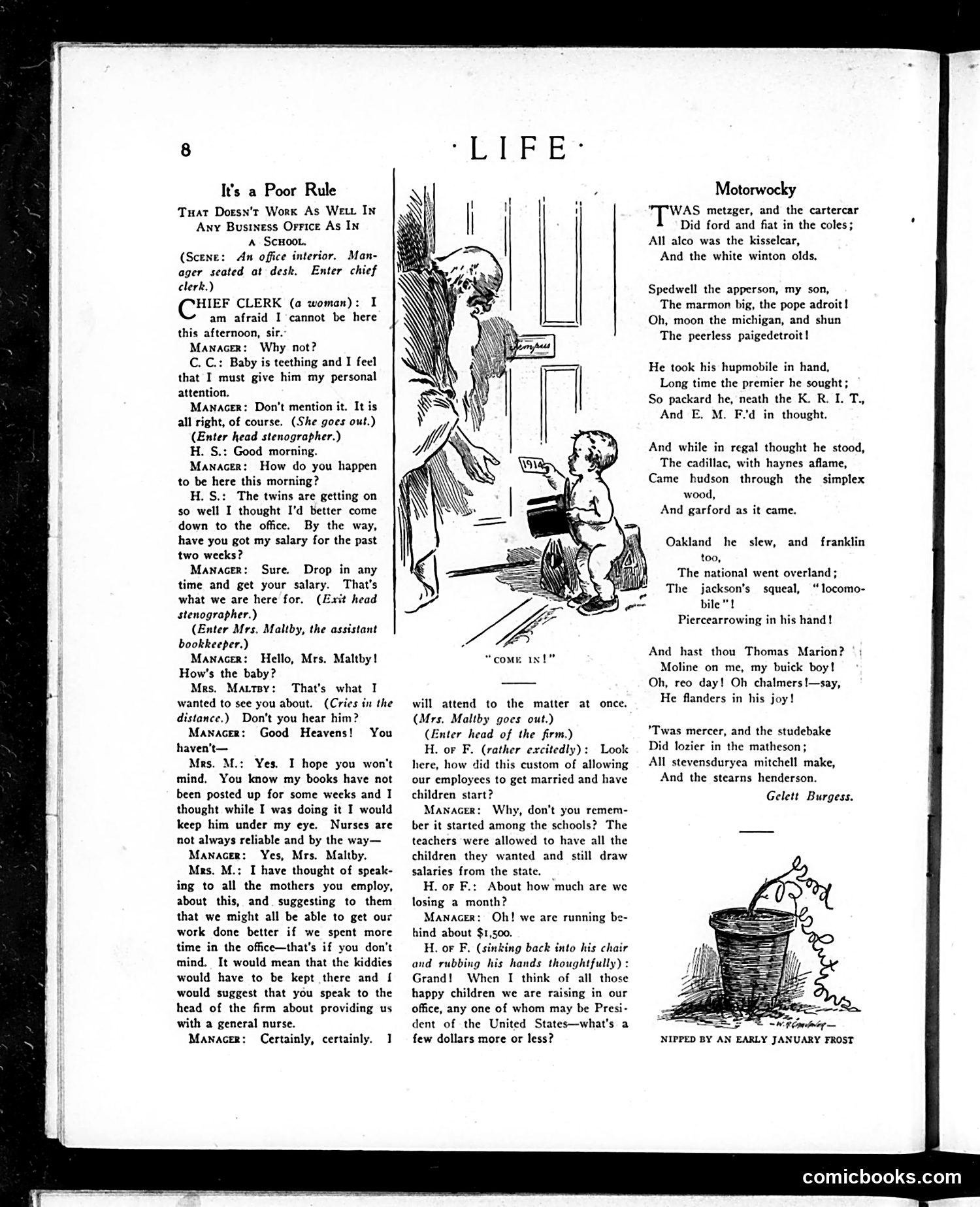
The left side contains a satirical office sketch titled "It's a Poor Rule That Doesn't Work As Well In Any Business Office As In A School." It mocks workplace dynamics by showing a manager defending his decision to allow employees to marry and have children—a practice he claims originated in schools where teachers were permitted unlimited children while drawing state salaries. The manager sarcastically argues that since schools can afford this, why can't his business? The joke satirizes the contradiction between educational institutions' worker-friendly policies and private business stinginess. The right side features "Motorwocky," a poem parodying Lewis Carroll's "Jabberwocky," replacing fantastical creatures with automotive references (K.R.I.T., E.M.F., Hudson, Garford, Cadillac, Jackson). It humorously catalogs early automobile brands, poking fun at the era's proliferating car manufacturers.
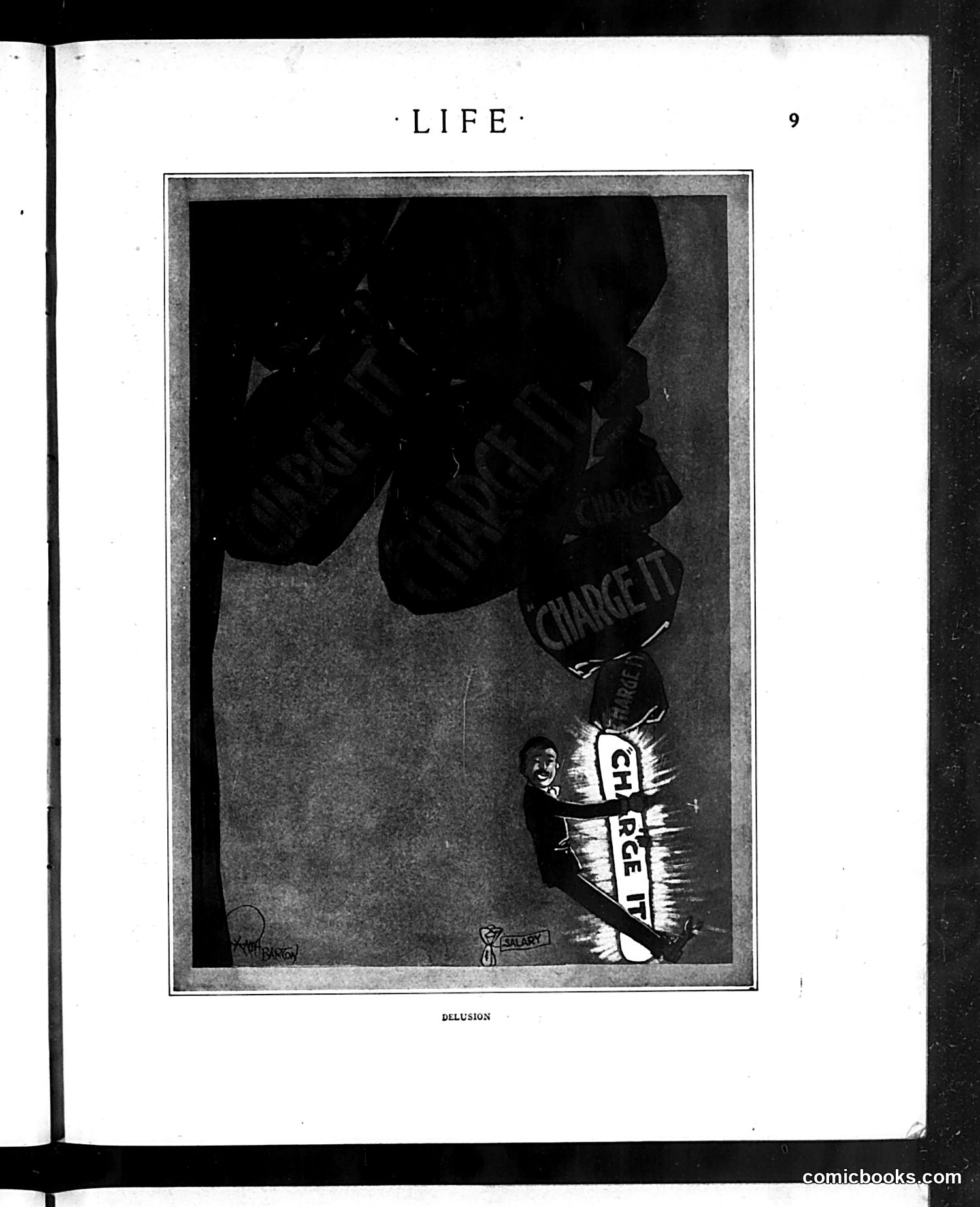
This cartoon, titled "Delusion," depicts a stark satirical image of consumer debt. A massive figure towers menacingly over a tiny man holding what appears to be a ledger or bill marked "CHARGE IT." The composition suggests commentary on the dangers of easy credit and consumer spending on borrowed money. The phrase "CHARGE IT" was common in early-to-mid 20th century retail culture, referring to purchasing items on account. The looming shadow of the large figure represents the burden and anxiety that accumulates from such debt. The cartoon likely critiques either the normalization of credit purchasing or warns against its consequences, suggesting that casual consumer spending can lead to overwhelming financial obligations. The visual metaphor emphasizes how small personal choices can create disproportionately large problems.
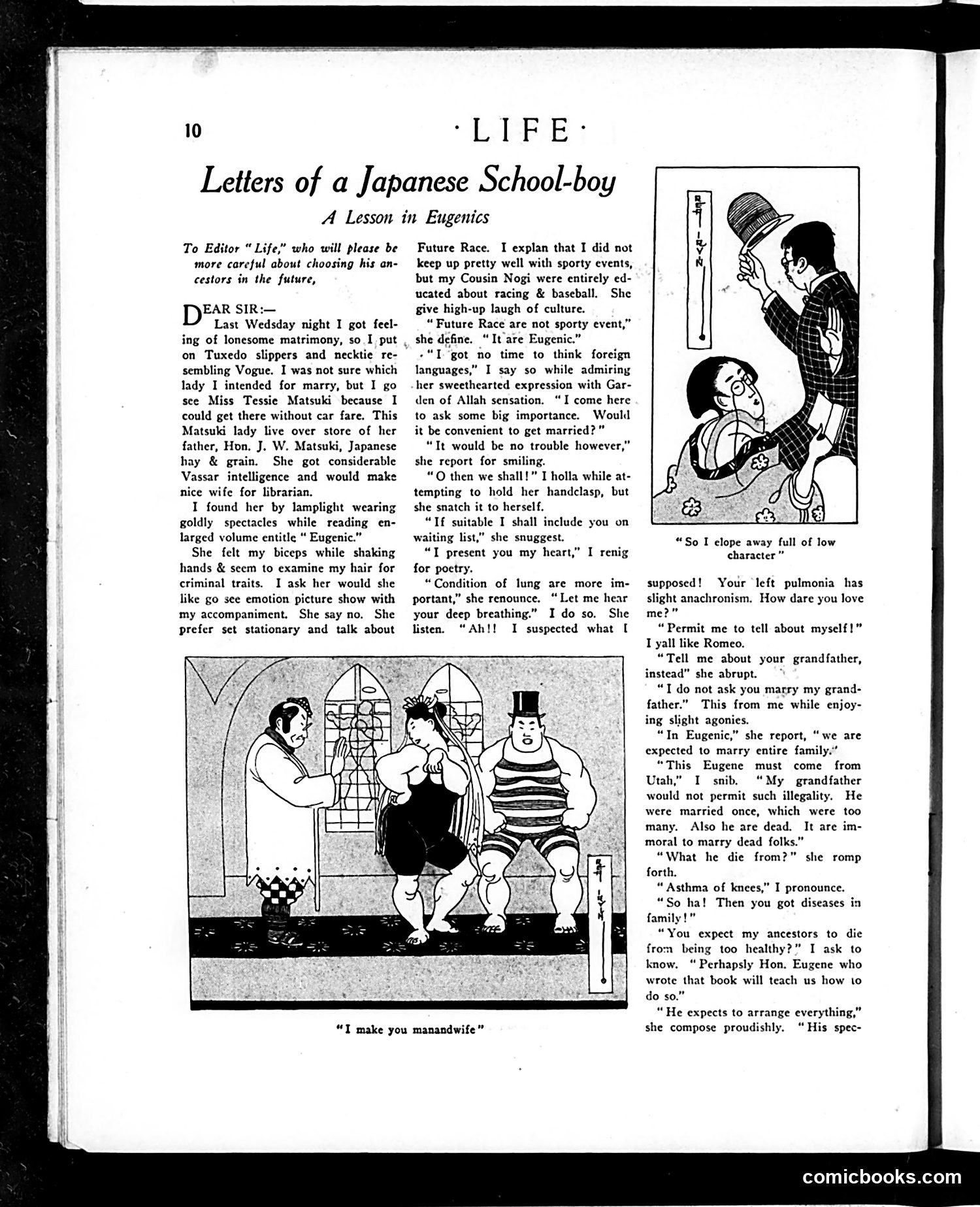
This satirical piece mocks eugenic ideology through a Japanese correspondent's naive observations. The writer describes his cousin Nogi's rejection of "Future Race" events (sporty activities) as uneugenical, revealing how eugenic pseudoscience was being applied internationally—even to marriage selection and family planning. The cartoons illustrate the absurdity: one shows a woman presenting herself as eugenic marriage material; another depicts a sumo wrestler being evaluated. The joke exposes how eugenic concepts—popular in early 20th-century America—were being adopted elsewhere and applied to everyday decisions. The letter's tone suggests satire of both eugenics believers and stereotyped Japanese characters, criticizing the dangerous pseudoscience gaining traction globally.
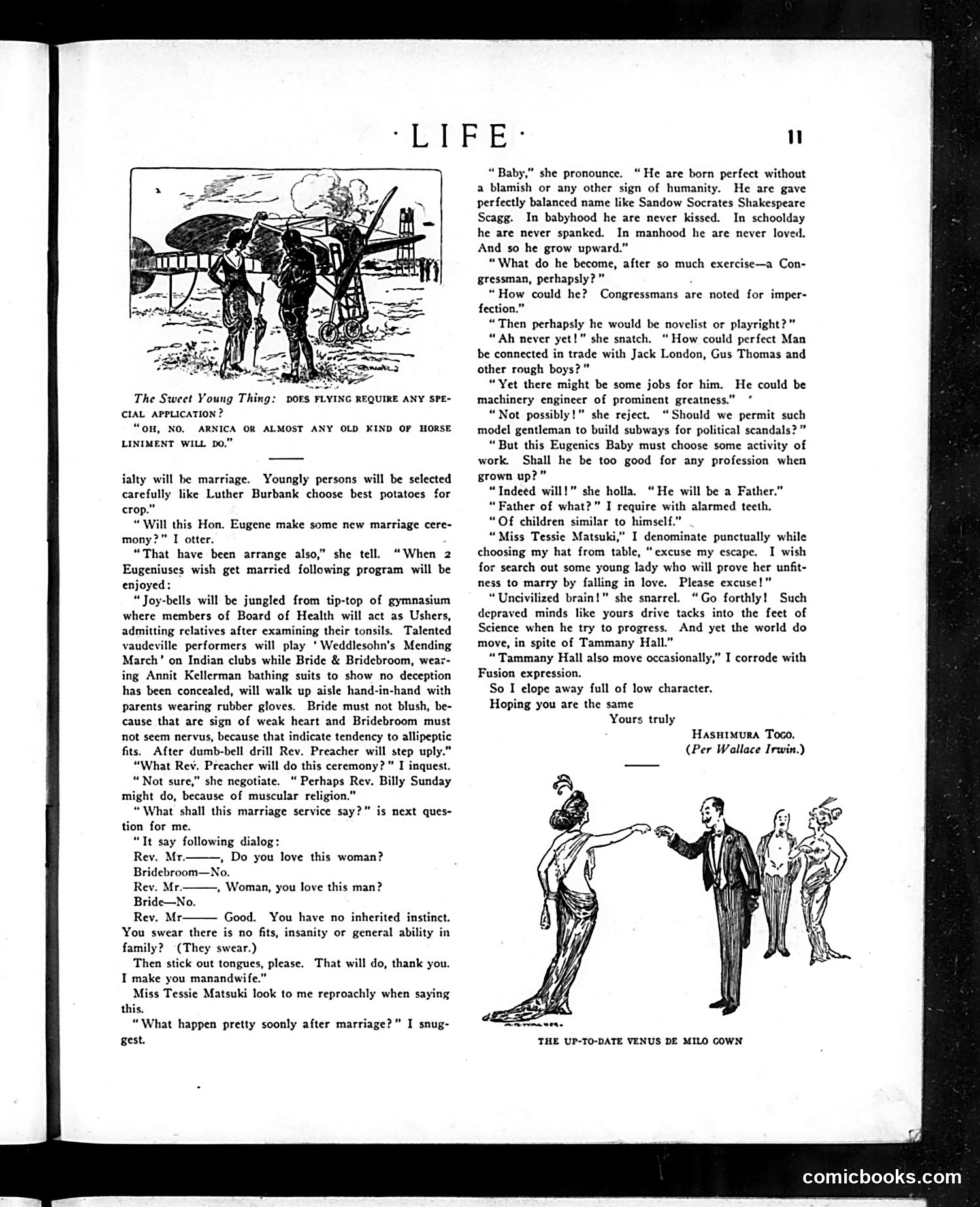
This page satirizes early 20th-century eugenics ideology through a discussion of "Eugenics Baby"—a hypothetical perfect child. The text mocks eugenic enthusiasts who advocated selective breeding to produce "perfect" humans without flaws. The satire targets the absurdity of eugenics proponents by suggesting this perfect child could become a congressman, novelist, or machinery engineer, yet humorously notes such a person would be "too good for any profession." The marriage ceremony dialogue ridicules the pseudo-scientific nature of eugenics by presenting a minister asking whether bride and groom "love" each other—treated as irrelevant to eugenic matching. The two illustrations depict fashionable social scenes, likely contrasting idealized versus realistic human behavior, reinforcing the satire's core message: eugenics theories were laughably disconnected from actual human complexity.
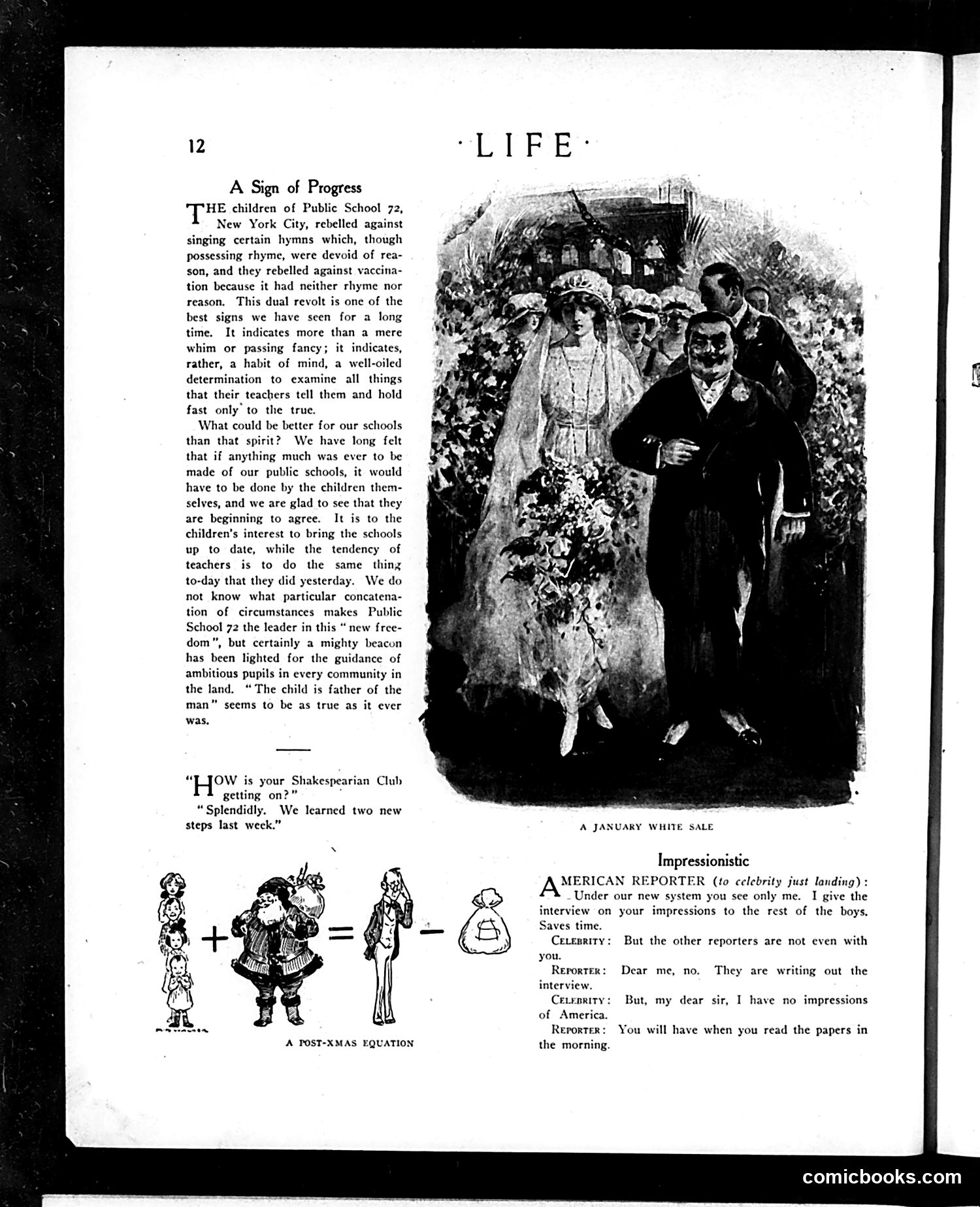
This page contains two distinct items: **"A Sign of Progress"** (top): An editorial praising Public School 72 in New York City where children rejected hymns lacking rhyme/reason and refused vaccination without rational justification. The piece celebrates this as evidence of critical thinking and independent judgment among students—a positive development for education. **"A Post-Xmas Equation"** (middle): A visual math puzzle showing children plus Santa equals a woman minus a handbag, suggesting the post-Christmas period involves returning unwanted gifts or resolving gift-related complications. **"Impressionistic"** (bottom): A satirical dialogue where an American reporter claims exclusive celebrity access while other journalists merely "write out the interview," mocking journalistic pretension and competition for exclusive stories. The imagery supports these satirical critiques of education, consumer culture, and press practices.
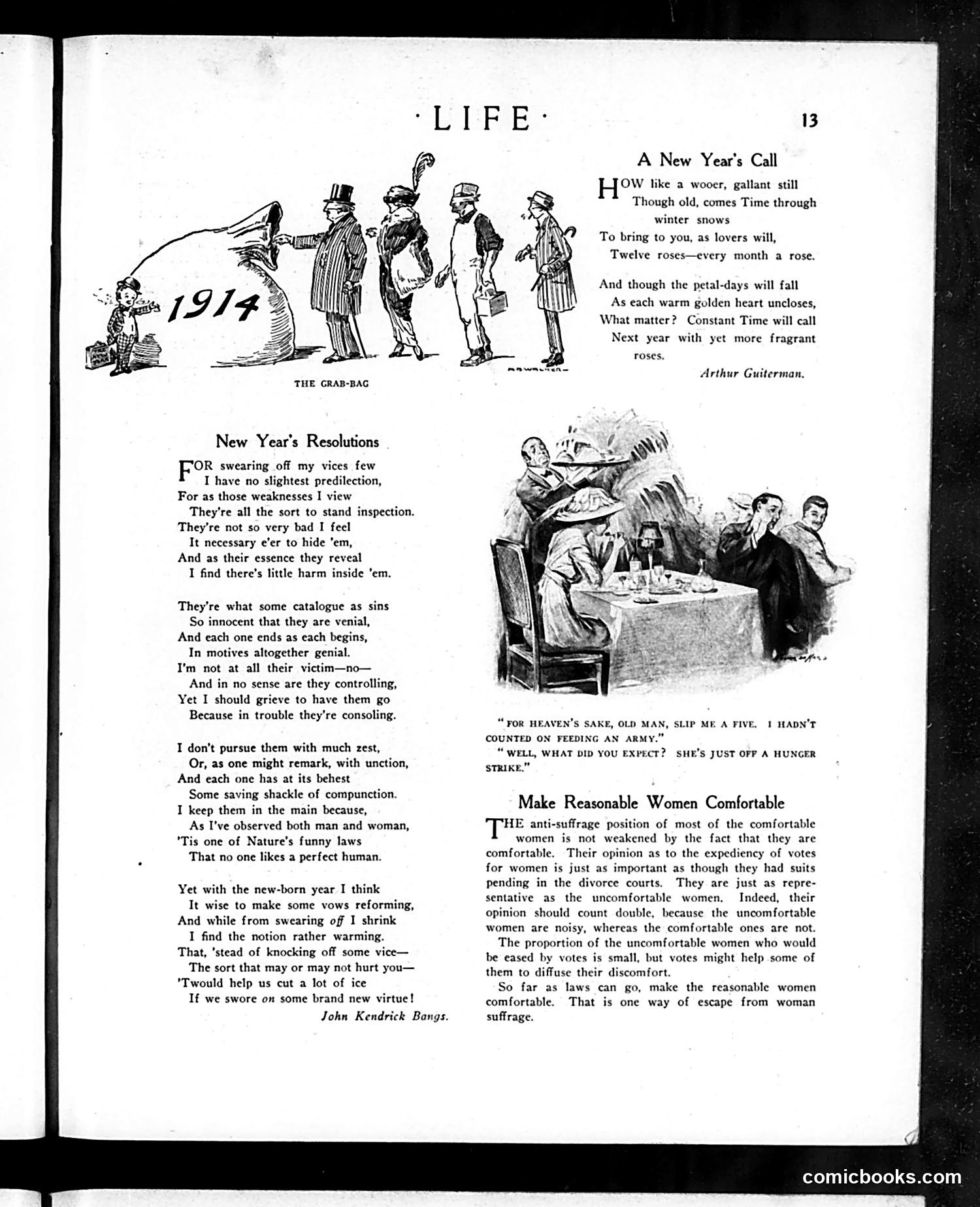
This cartoon satirizes New Year's greed and materialism. Father Time (labeled "1914") holds a large sack while five men in formal dress eagerly reach toward it, hands outstretched. The figures appear to represent different social classes or professions competing to extract wealth and opportunity from the coming year—hence "grab-bag," a party game where participants blindly pull items from a bag. The satire mocks the self-interested scrambling that accompanies each new year, suggesting that rather than making genuine resolutions for self-improvement, people are primarily motivated by personal gain and advantage. The cartoon reflects Progressive Era skepticism about greed and commercialism.
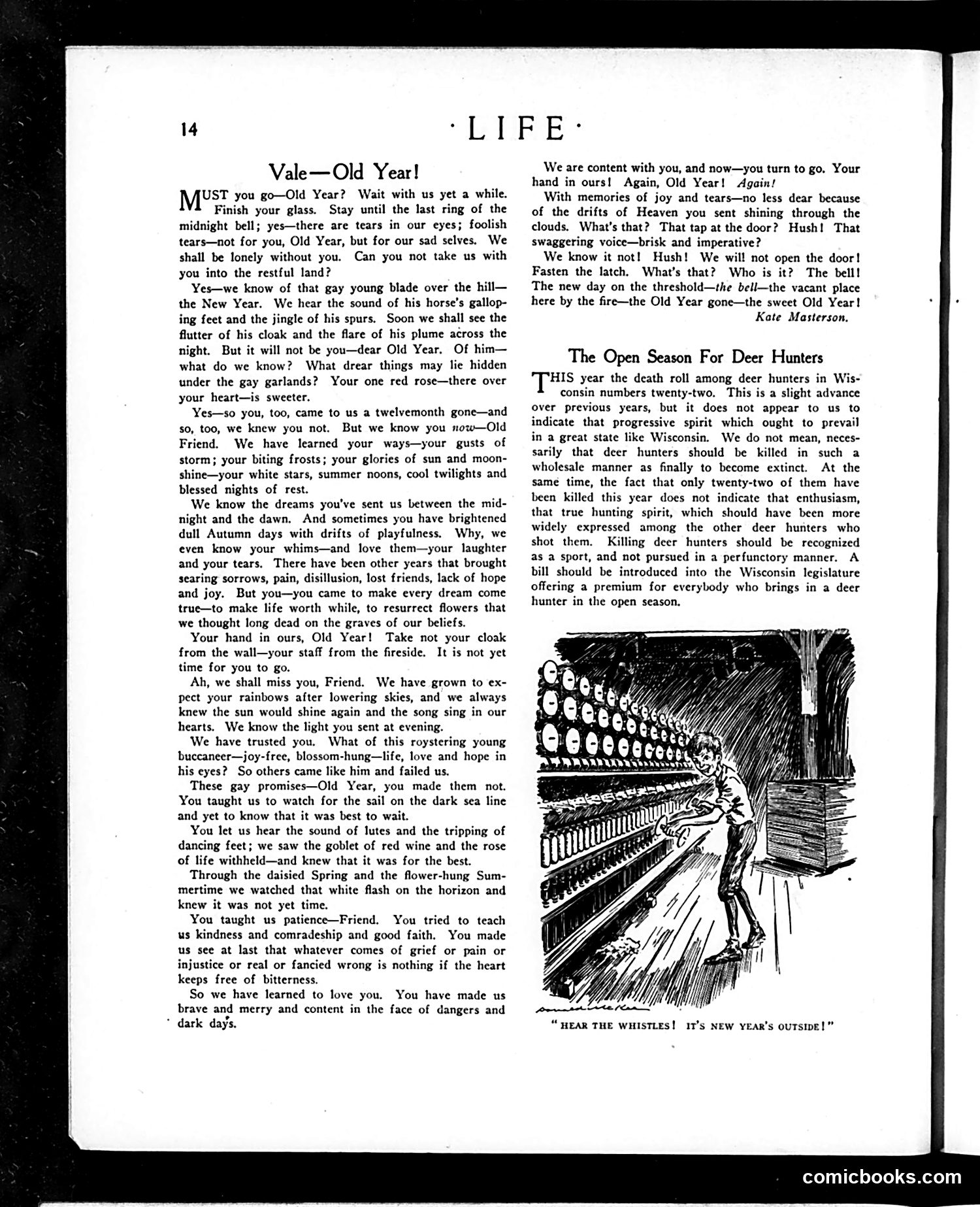
This page contains two distinct pieces: **Left column:** A poetic farewell titled "Vale—Old Year!" addressing the departing year personified as a friend. It's a sentimental New Year's reflection—not satirical—celebrating the outgoing year's gifts (memories, experiences, teachings) while bidding it goodbye with gratitude. **Right side:** An article titled "The Open Season For Deer Hunters" discussing Wisconsin's deer hunting deaths (22 that year). The piece advocates for better hunting regulation and ethics, criticizing hunters who kill recklessly rather than respectfully. It proposes a legislative bill offering premiums for responsible hunters. **The illustration** shows a theater interior with the caption "HEAR THE WHISTLES! IT'S NEW YEAR'S OUTSIDE!" This depicts New Year's Eve celebrations—people inside a theater oblivious to the festivities happening outdoors. The page mixes sentimental poetry with practical hunting reform advocacy.
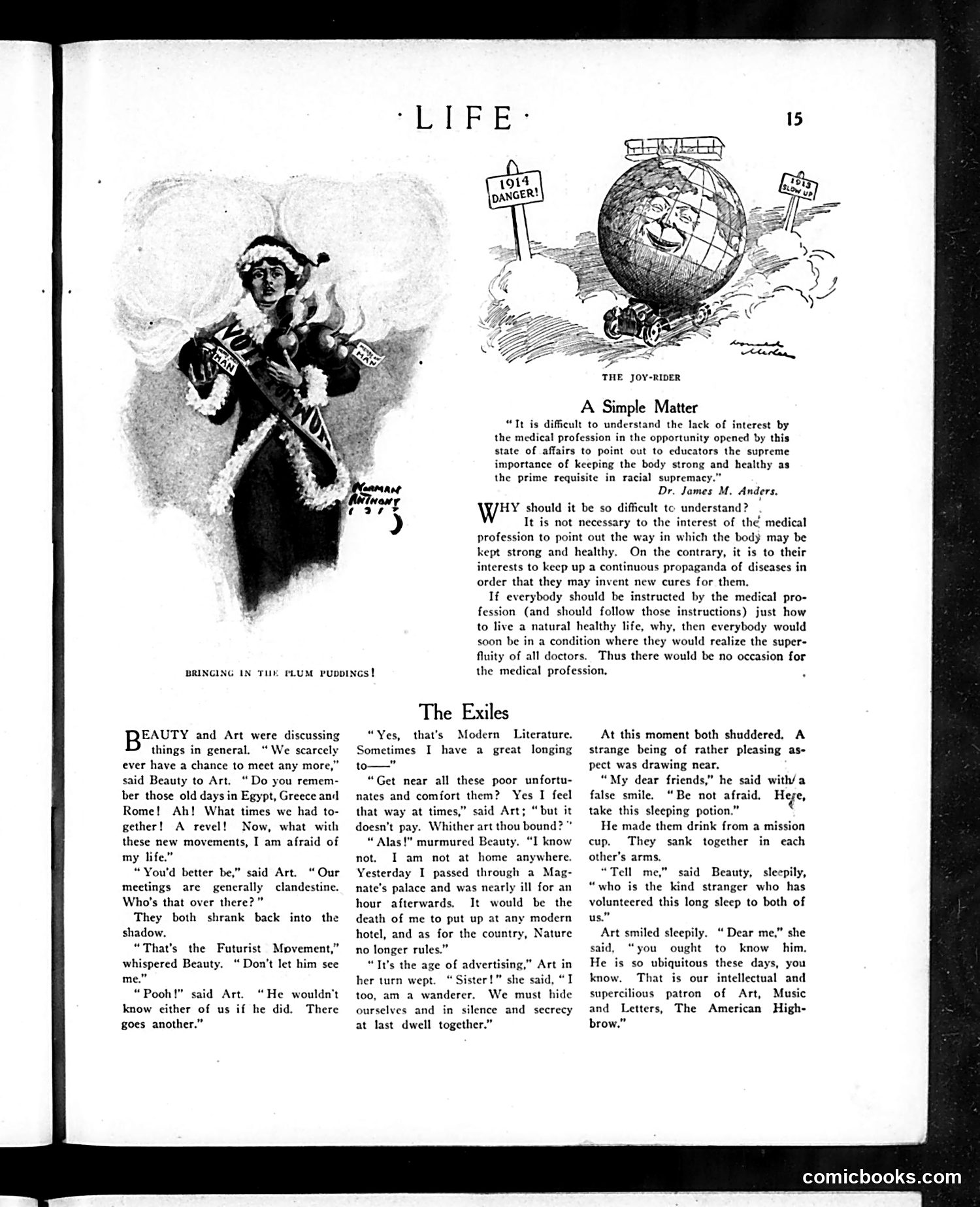
This page contains three distinct satirical pieces critiquing early 20th-century American culture: **"The Exiles"** (main story): Beauty and Art—personified as classical ideals—lament their displacement in modern society. They fear the Futurist Movement and hide from it, suggesting artistic tradition is being destroyed by avant-garde innovation. The "American Highbrow" who appears at the end represents the pretentious intellectual elite who claim to patronize Art and Beauty while actually drugging them into irrelevance—a jab at self-important cultural arbiters who corrupt rather than preserve artistic values. **"A Simple Matter"** (editorial): Sarcastically attacks doctors for promoting disease propaganda to maintain their profession's necessity, rather than genuinely advancing public health. **"The Joy-Rider"** (cartoon): Shows Earth as a reckless vehicle, labeled "1914 Danger," suggesting the world is speeding toward catastrophe—likely referencing pre-WWI tensions. The overall tone reflects anxiety about modernization destroying classical culture while charlatans profit from chaos.
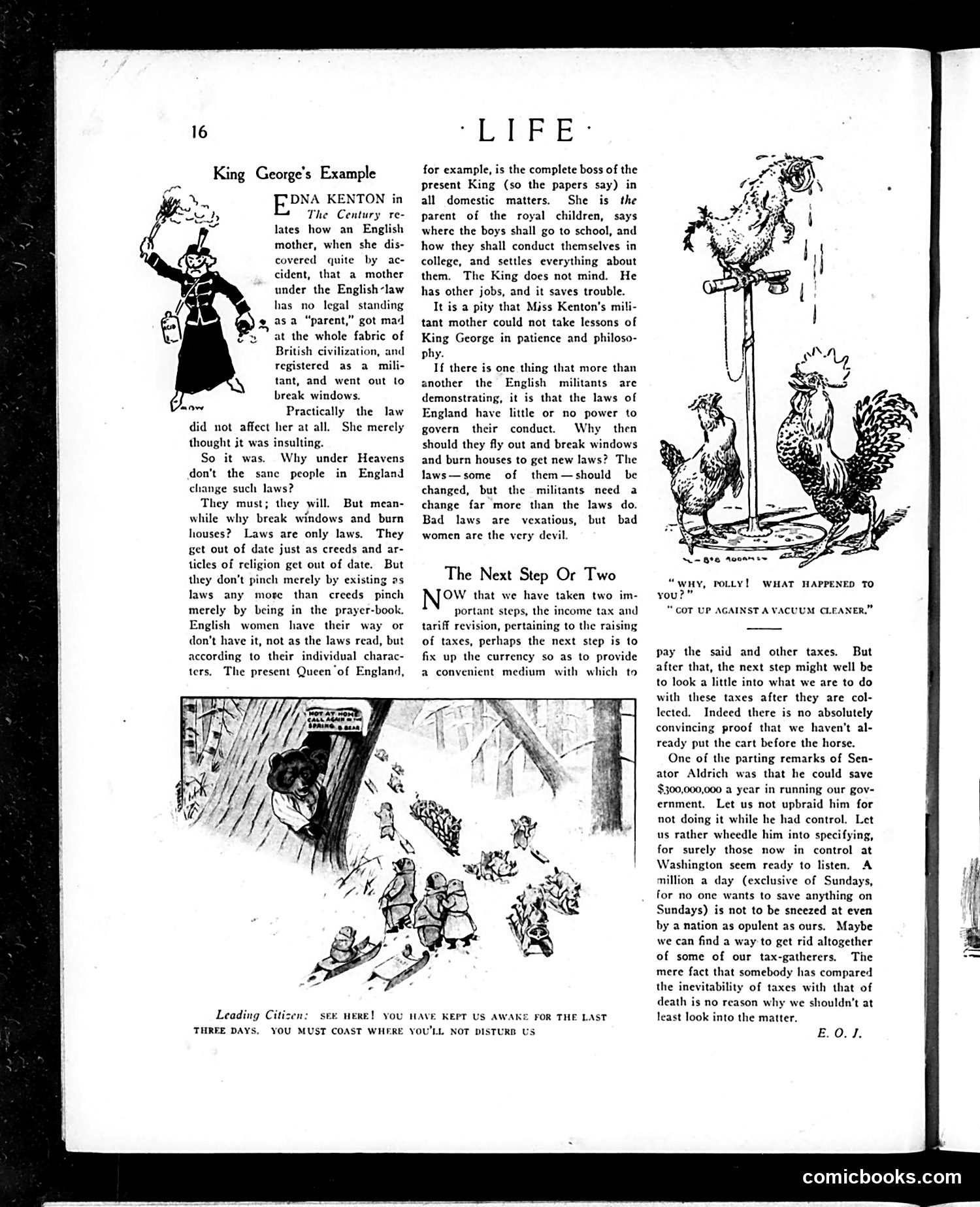
This page contains two distinct satirical pieces critiquing British suffragettes and American government spending. **"King George's Example"** attacks militant British women suffragists (like Edna Kenton's mother) who broke windows and burned houses to protest lack of voting rights. The author argues that English law's actual power is minimal—citing Queen Mary as proof that women already exercise domestic authority regardless of legal status. The cartoon shows a woman militant throwing a brick. The satire's point: destructive protest is unnecessary when women already wield real influence through personality and character rather than law. **"The Next Step Or Two"** shifts to American fiscal policy, criticizing government spending inefficiency. It references recent income tax and tariff reforms, then sarcastically suggests fixing currency next—while questioning whether anyone actually knows how collected taxes are being spent. Senator Aldrich claimed he could save $300 million annually; the author mocks that this wasn't pursued when he had power. The "Vacuum Cleaner" joke (right illustration) appears unrelated—likely advertising humor about a new household appliance.
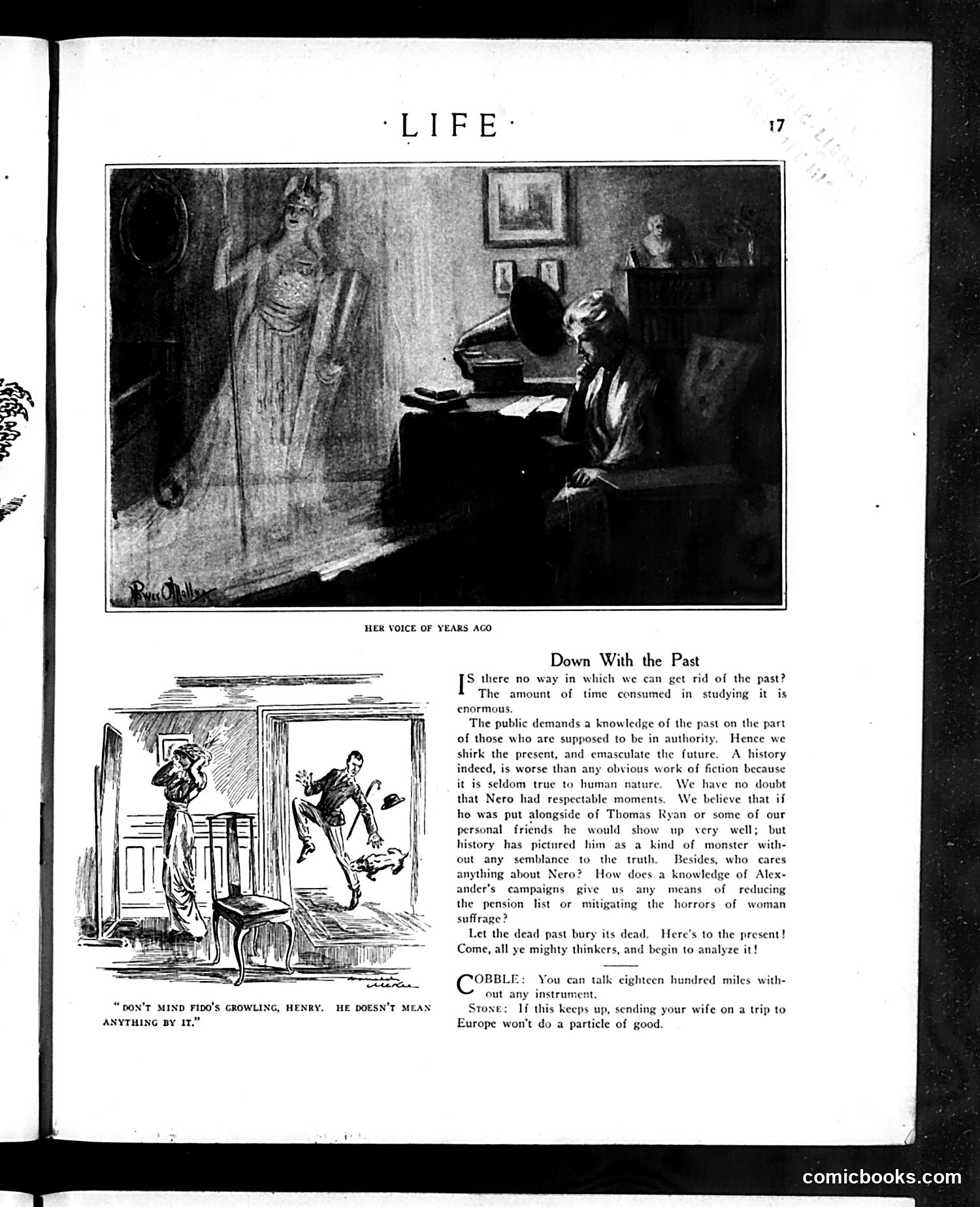
This page contains two satirical pieces critiquing early 20th-century attitudes. **"Down With the Past"** is an essay mocking anti-historical sentiment—likely responding to Progressive Era thinkers dismissing classical education as irrelevant. The argument absurdly claims history is unreliable fiction and questions why studying Nero or Alexander matters for modern issues like pensions and women's suffrage. The satire targets those who reject traditional knowledge as useless to contemporary problems. **The cartoons** are lighter social humor: The top illustration depicts a woman appearing as a ghostly vision while a man works at his desk—titled "Her Voice of Years Ago"—suggesting intrusive memories of past relationships. The bottom cartoon jokes about new wireless telephone technology (likely radio or early wireless), with "Cobble" and "Stone" characters exchanging quips about long-distance communication making it impossible to escape one's wife even on European vacations. Together, the page contrasts serious intellectual debate about historical relevance with everyday domestic comedy about modern technology's inescapable nature.
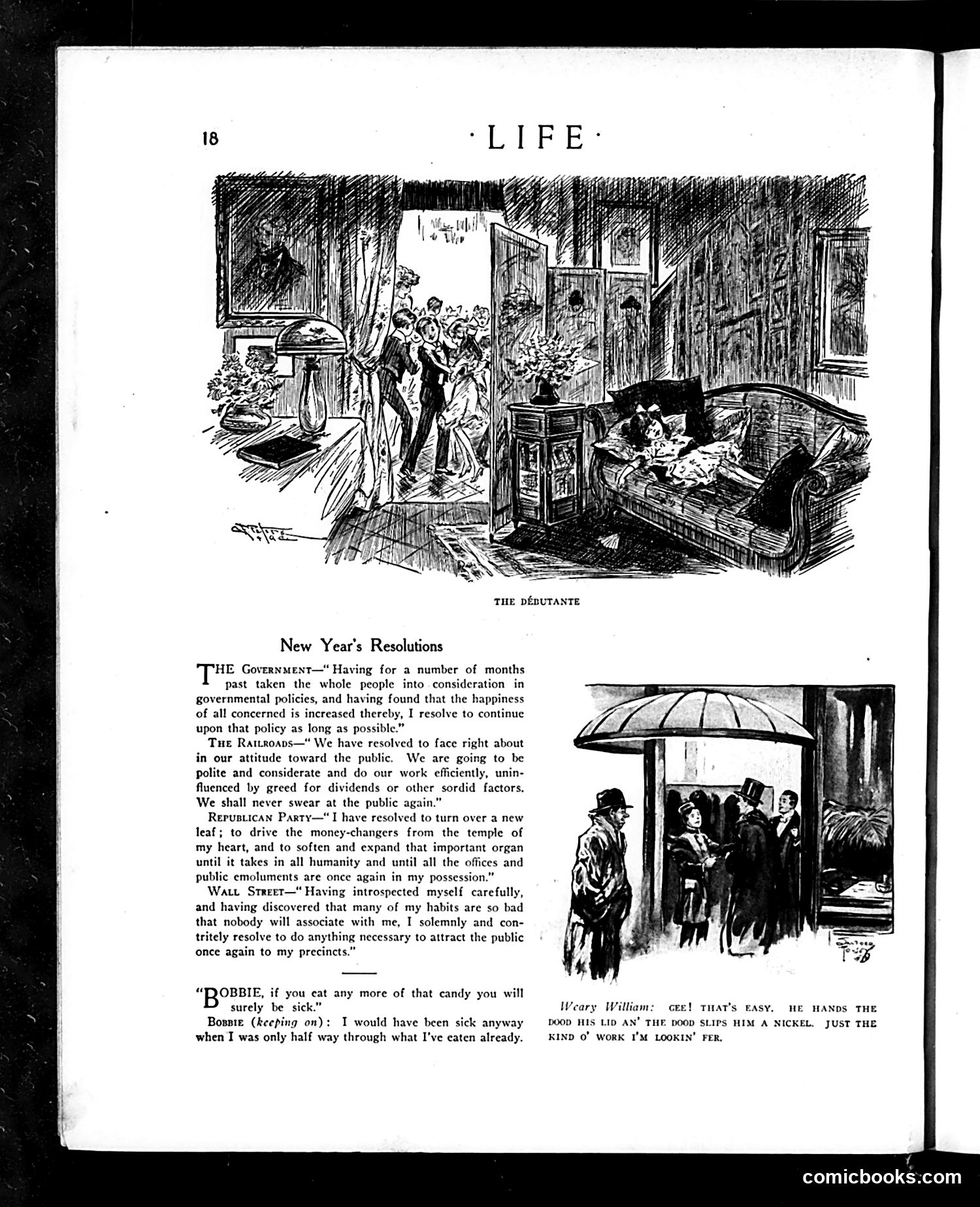
This page satirizes New Year's resolutions made by major American institutions around the early 20th century. Each group—Government, Railroads, Republican Party, and Wall Street—makes transparently false, self-serving promises. The joke is their obvious hypocrisy: the Government claims to prioritize public happiness; railroads promise politeness despite profiteering; Republicans vow to abandon corruption and "money-changers"; Wall Street claims reform despite admittedly bad habits. Each resolution is hollow—they're simply restating their existing failures as noble intentions. The lower cartoons are separate gags: a child (Bobbie) gorges candy despite warnings; "Weary William" describes the simple transaction of tipping a doorman for coat-check service as the ideal "kind of work"—satirizing economic desperation or laziness. The satire targets institutional hypocrisy and broken promises at year's end.
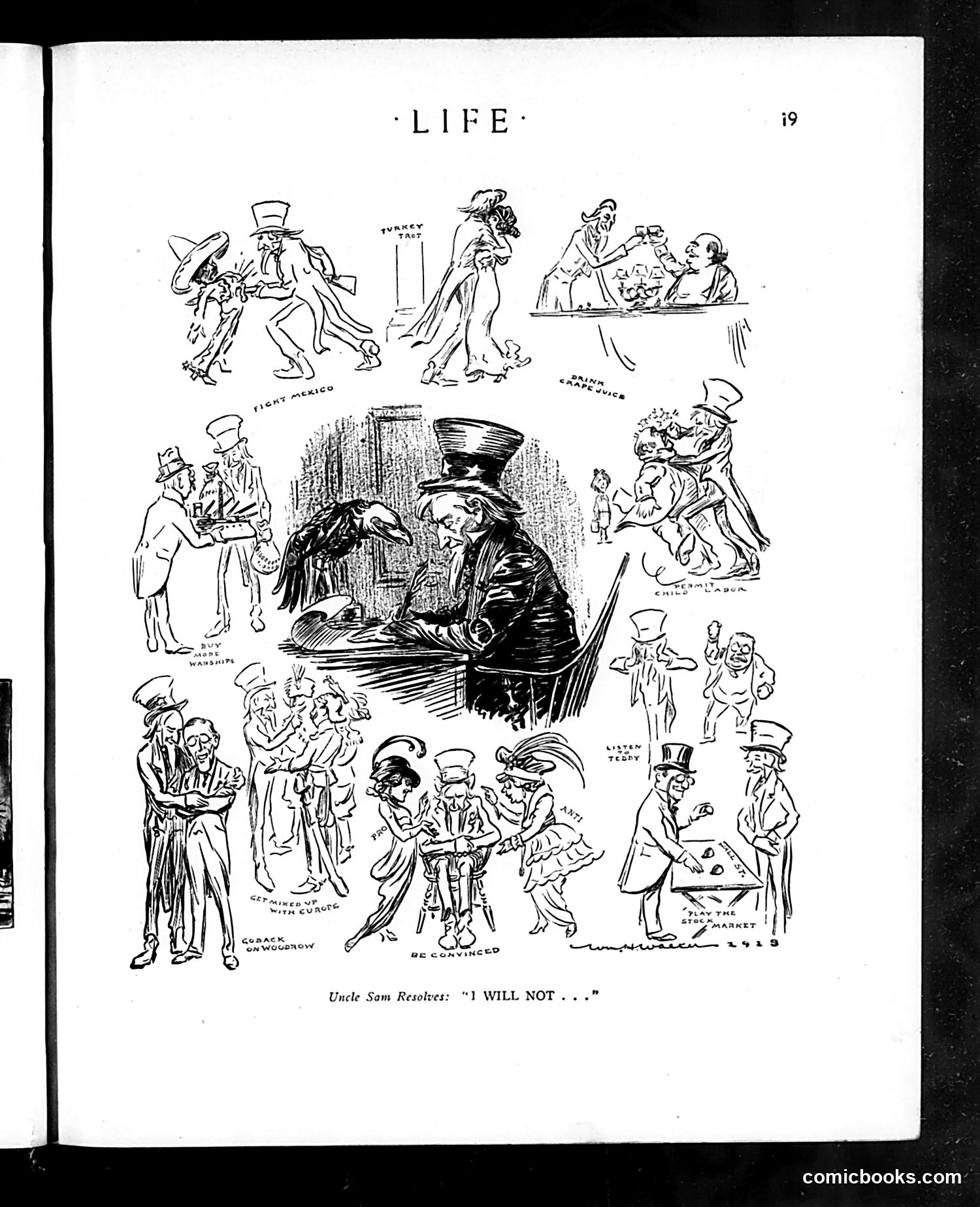
This page depicts Uncle Sam (the central tall figure in top hat) refusing various demands through multiple vignettes. The cartoons show Uncle Sam rejecting requests from different groups: "Fiery Mexico" (appears to reference Mexican-American tensions), labor organizers ("Child Labor"), business interests ("Be Convinced"), and various political or social petitioners. The caption "Uncle Sam Resolves: 'I WILL NOT...'" frames Sam as steadfastly resistant to pressure. This likely reflects early-20th-century American political debates over isolationism, labor reform, imperialism, or domestic policy. The satire suggests Uncle Sam maintains principled independence against competing special interests and foreign entanglements. Without a visible date, the specific historical moment remains unclear, though the aesthetic suggests pre-WWI era.
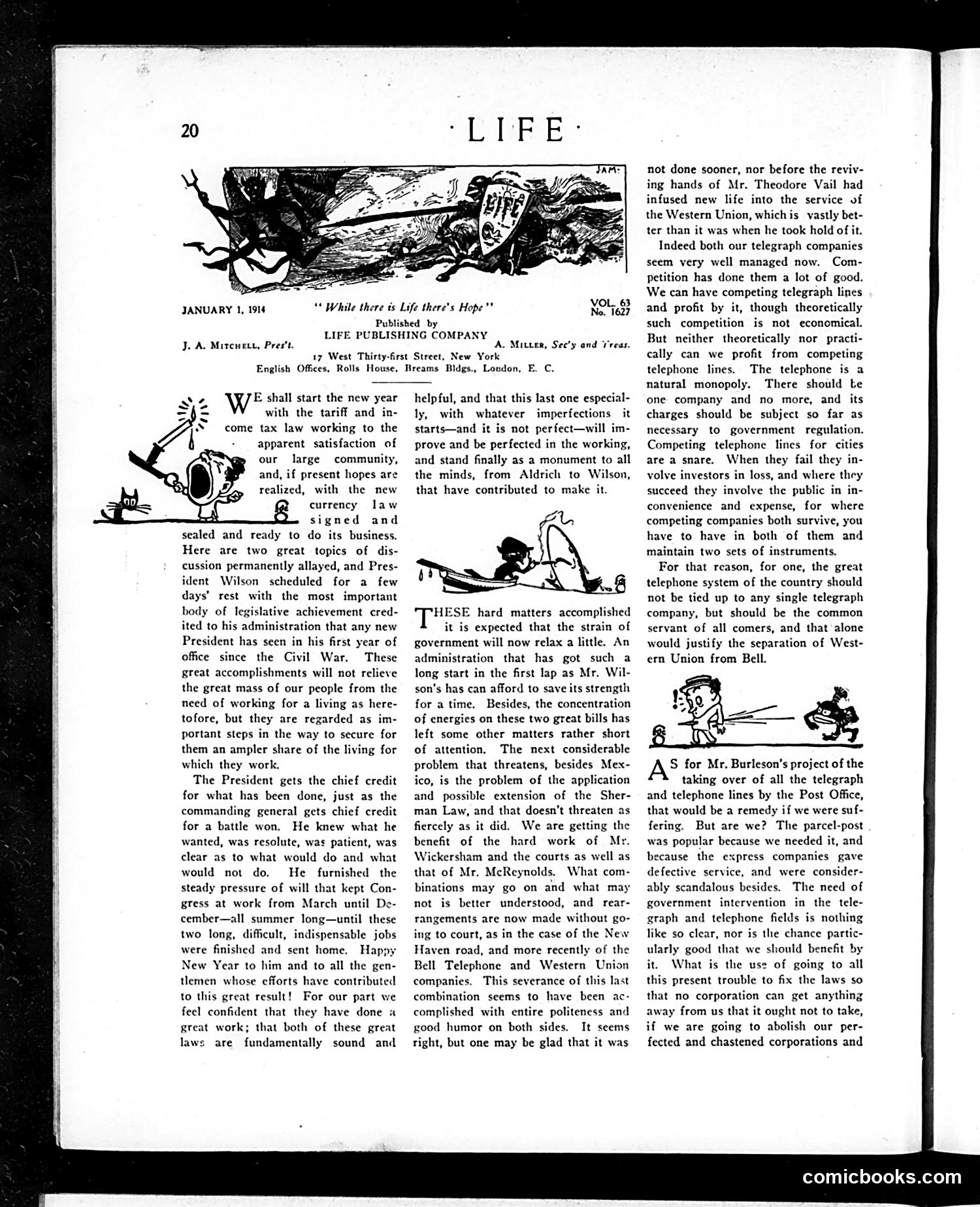
This is primarily an editorial praising President Wilson's first-year legislative achievements: the tariff reform, income tax law, and currency law (Federal Reserve Act). The unsigned piece credits Wilson with "resolute" leadership in pushing Congress through these "long, difficult, indispensable" matters. The cartoons are small decorative vignettes illustrating the editorial's points—figures appear to be celebrating or working, though they're stylized and difficult to identify specifically as named individuals. The editorial also addresses recent antitrust actions, specifically praising the forced separation of Bell Telephone and Western Union companies, while crediting Theodore Vail for improving Western Union's service beforehand. The writer argues telephone competition is economically illogical but telegraph competition beneficial—a nuanced position reflecting Progressive Era debates about monopoly regulation versus natural monopoly. The tone is congratulatory toward the Wilson administration's reform agenda.
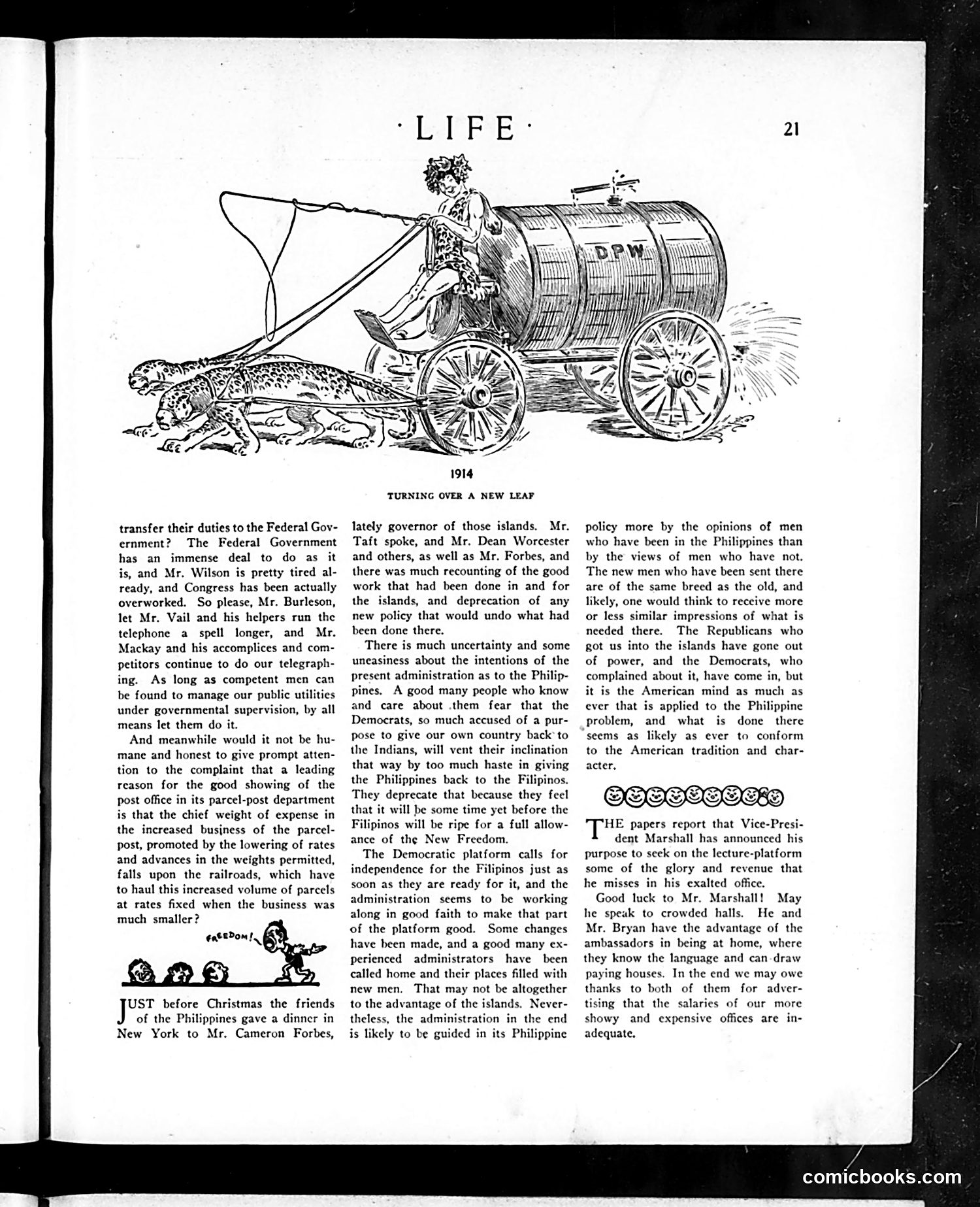
The cartoon depicts a figure driving a water wagon labeled "D.P.W." (Department of Public Works), pulled by what appears to be a leopard or spotted cat. The image satirizes the Wilson administration's Philippine policy transition. The text discusses Democratic concerns about hastily returning the Philippines to Filipino independence, contrasting Republican stewardship under figures like Cameron Forbes and William Howard Taft with the new Democratic approach. The article suggests American administrators—whether Republican or Democrat—will likely apply similar American values and governance methods regardless. The "new leaf" reference suggests Wilson's Democrats are changing course from Republican colonial policy, though skeptics fear either reckless speed or insufficient preparation for Filipino self-rule. The spotted animal pulling the wagon likely symbolizes the unpredictable or wild nature of this policy shift, implying the administration lacks firm control over its Philippine direction.
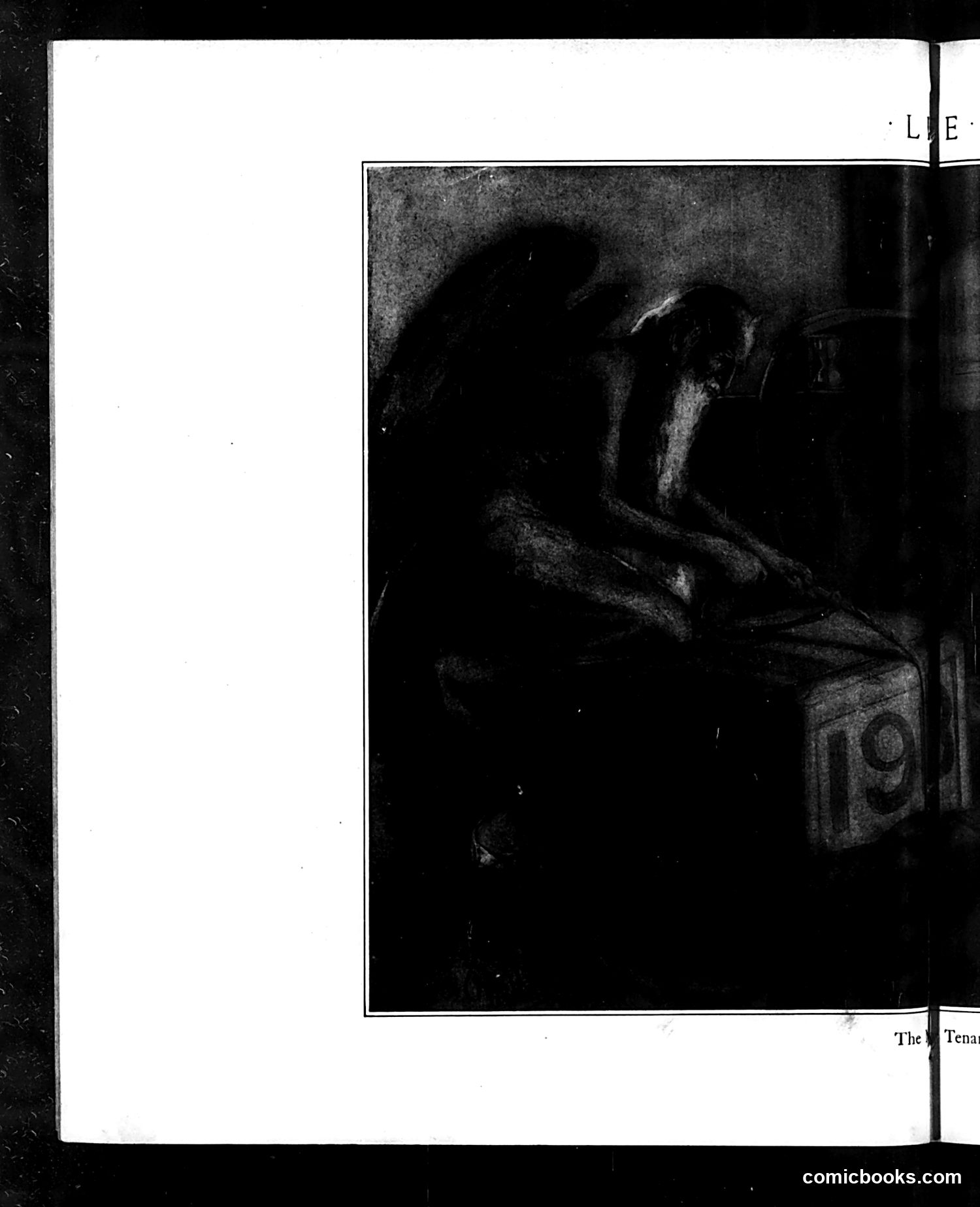
I can see this is a dark, high-contrast black and white photograph or illustration showing what appears to be two figures in shadow or silhouette. The image quality is quite poor, making details difficult to discern clearly. There's a reference to "The" and what might be "Tenan" (unclear) in the bottom right corner. However, I cannot reliably identify the specific figures, political references, or satirical intent from this image alone. The OCR text provided ("comicbooks.com") appears to be a watermark rather than actual page content that would explain the cartoon's meaning. Without clearer visibility of the image, legible captions, or more complete OCR text, I cannot accurately explain what this Life magazine page is satirizing or which historical figures or events it references. I would need additional context to provide a responsible historical analysis.
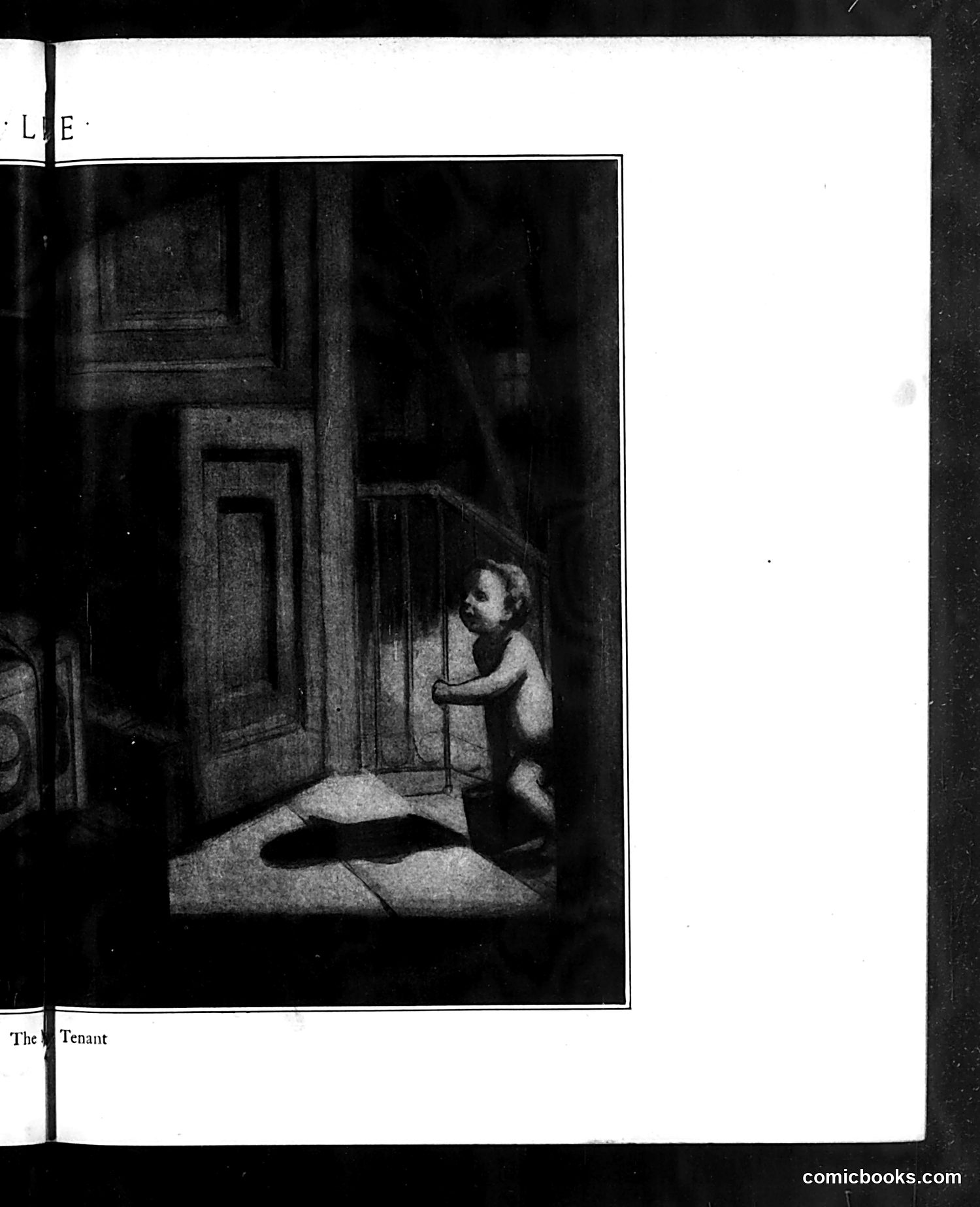
This appears to be a scene from a narrative cartoon or illustrated story titled "The Tenant." The black-and-white image shows a young child in what appears to be a sparse, darkly lit interior space with classical architectural elements (paneled doors, a staircase railing visible in background). The child is reaching toward or touching a door or wall panel. Without additional context or text visible on this page, the specific satirical point is unclear. It may depict tenement housing conditions or social commentary on working-class living situations—common subjects for Life magazine's satire—but the exact narrative and social critique cannot be definitively determined from the image alone.
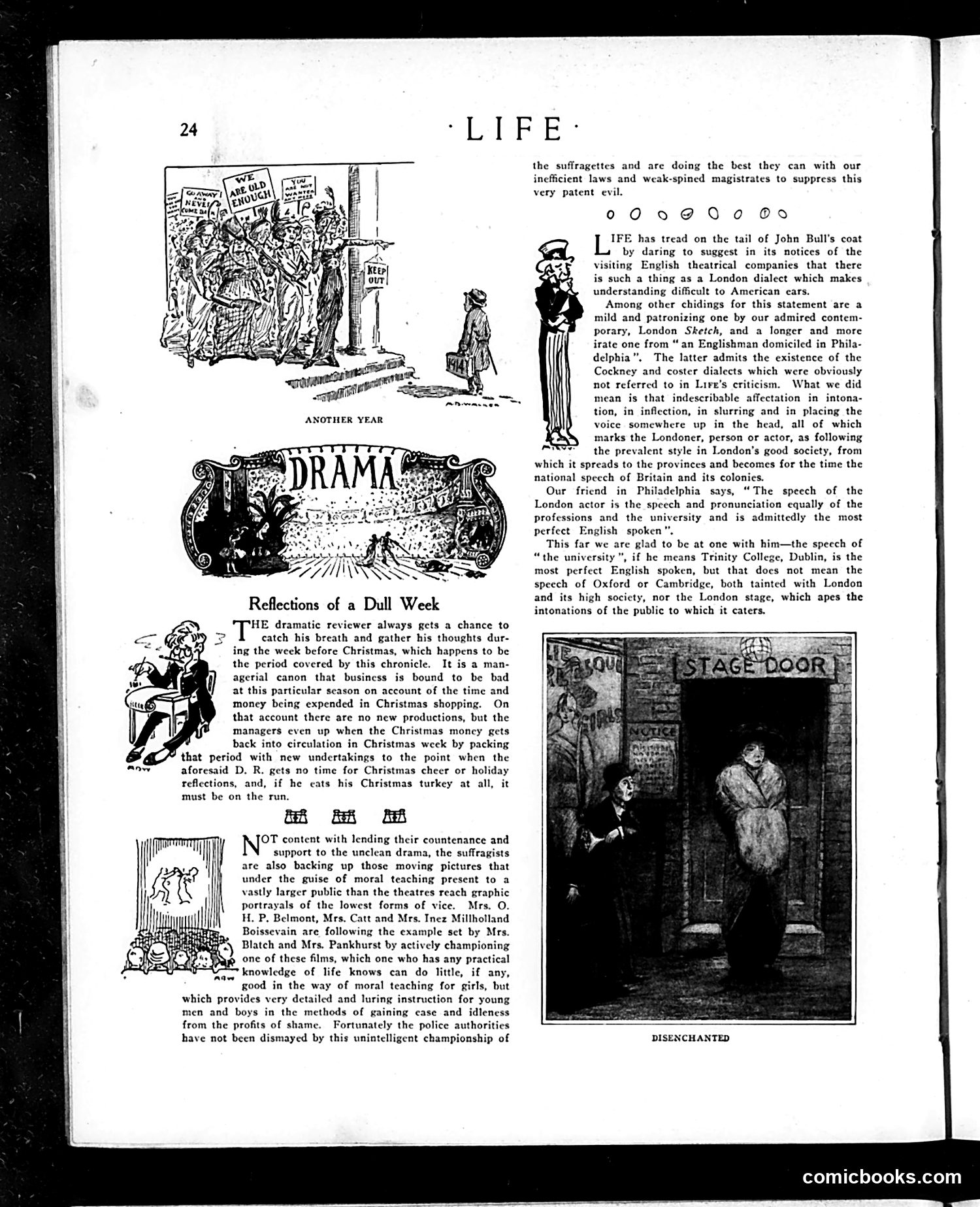
This Life magazine page contains two distinct pieces of social commentary: **Top section**: A defense of Life's earlier criticism of London theatrical accents. Life had suggested English actors' affected upper-class London pronunciation was difficult for American audiences to understand. Defensive British and American-based English correspondents objected, claiming London speech represents "perfect English." Life responds that while university speech may be refined, London stage actors merely ape fashionable society affectations—not genuine linguistic excellence. **"Reflections of a Dull Week"**: Commentary on theater scheduling around Christmas (when audiences shop instead of attend plays) and criticism of suffragists (women's voting rights activists) like Mrs. O.H.P. Belmont and Mrs. Pankhurst for supporting morally questionable films. The author argues these films, despite claiming moral purpose, actually provide detailed instruction in vice for young men—making them harmful despite suffragists' good intentions. The satire targets both British cultural pretension and well-meaning progressive reformers whose methods backfire.
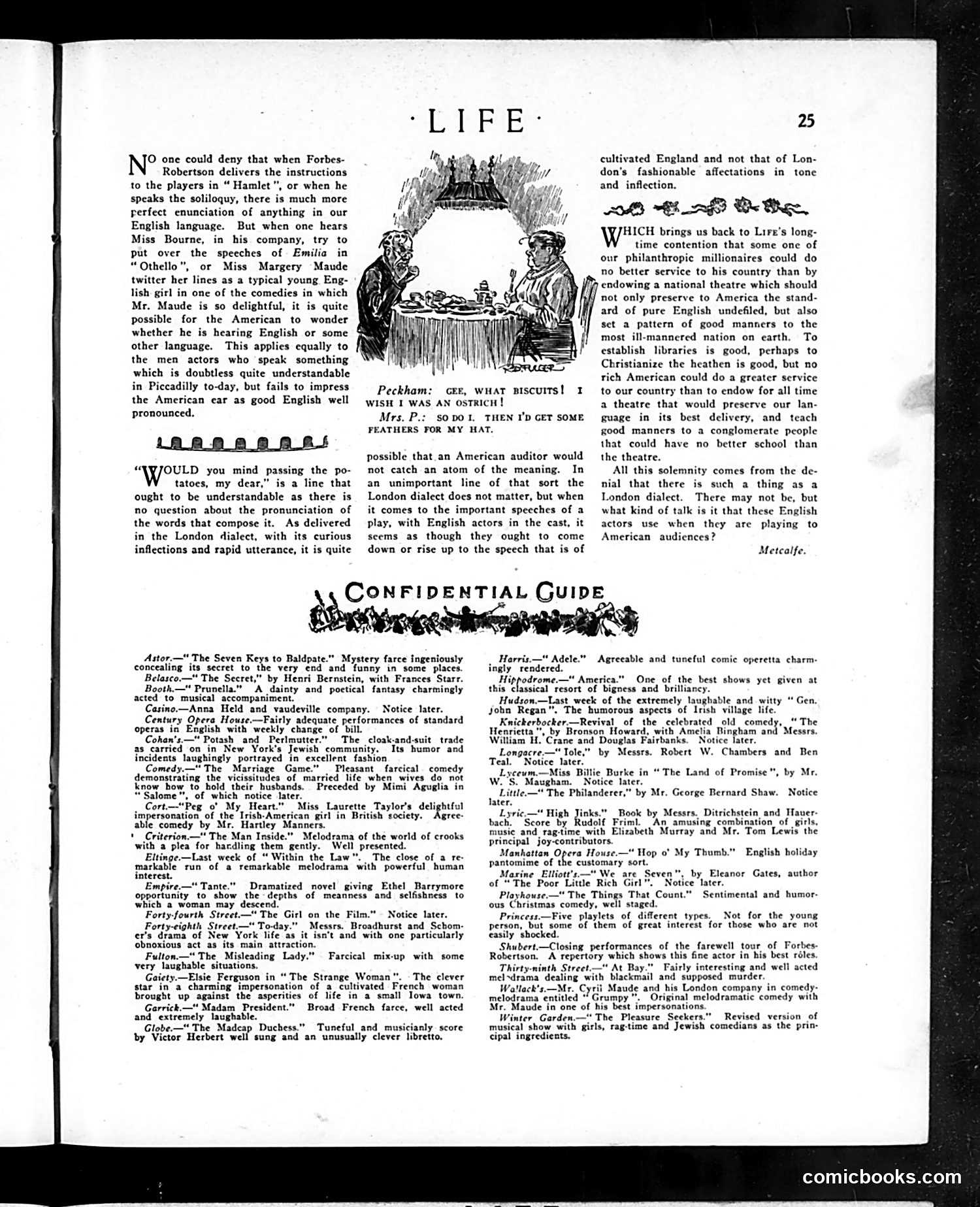
The central cartoon depicts two diners, with the caption revealing a class-based linguistic joke. The woman comments on biscuits, and the man responds that he wishes he were an ostrich to get feathers for her hat — a absurdist non-sequitur that illustrates the page's broader argument. The text criticizes English actors performing in New York, specifically their affected London dialect. While praising Forbes-Robertson's Shakespearean delivery, the author mocks supporting actresses (Miss Bourne, Margery Maude) for their exaggerated, incomprehensible English affectations — described as sounding less like proper English and more like a foreign language to American ears. The cartoon demonstrates this problem: even a simple, mundane line like "Would you mind passing the potatoes?" becomes ridiculous and meaningless when delivered in the fashionable London theatrical accent with its "curious inflections and rapid utterance." The joke satirizes how theatrical pretension obscures rather than clarifies language.
This page from *Life* magazine features a **"Confidential Book Guide"** — a satirical book review column critiquing new fiction. The main target is Edith Wharton's *The Custom of the Country*. The reviewer attacks Wharton's novel for lacking genuine sympathy toward its protagonist, a social-climbing woman from a town called "Apex." The critic argues that Wharton writes with "vindictiveness" rather than "searching, non-partisan sympathy." The heroine — who discards husbands, manipulates Washington Square society, climbs into French aristocracy, then remarries for wealth — is portrayed as so poorly rendered that she only "really lives" during her least admirable moments. The satire critiques both Wharton's characterization and broader literary ethics: that fiction serving only to express an author's hatred or resentment fails readers. The column reviews other contemporary books with similar standards of literary judgment. The opening section (left column) humorously lists absurd mail received, establishing the magazine's satirical tone.
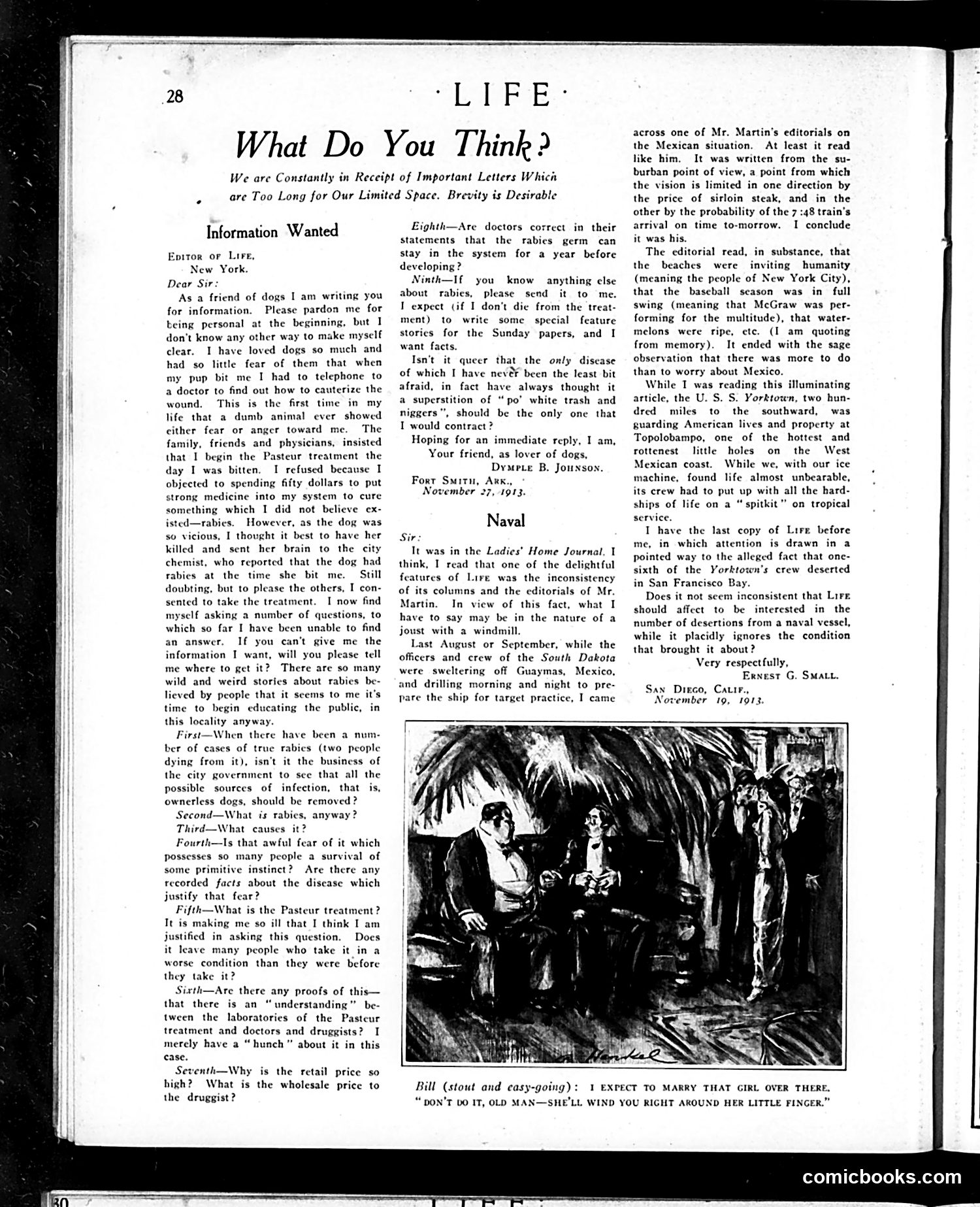
This is a "Letters to the Editor" page from *Life* magazine (November 1913), featuring reader correspondence and one cartoon illustration. The main cartoon depicts a man proposing marriage to a woman under a palm tree, with the caption: "Bill (stout and easy-going): 'I EXPECT TO MARRY THAT GIRL OVER THERE. DON'T DO IT, OLD MAN—SHE'LL WIND YOU RIGHT AROUND HER LITTLE FINGER.'" The humor is straightforward domestic satire: it warns that the woman will dominate and manipulate the suitor in marriage. The "easy-going" Bill represents a passive male type vulnerable to female control—a common satirical trope of the era. The letters address serious topics (rabies treatment, naval inconsistencies in editorials), showing *Life*'s mix of lighthearted comics with substantive reader debate about public health and military matters.
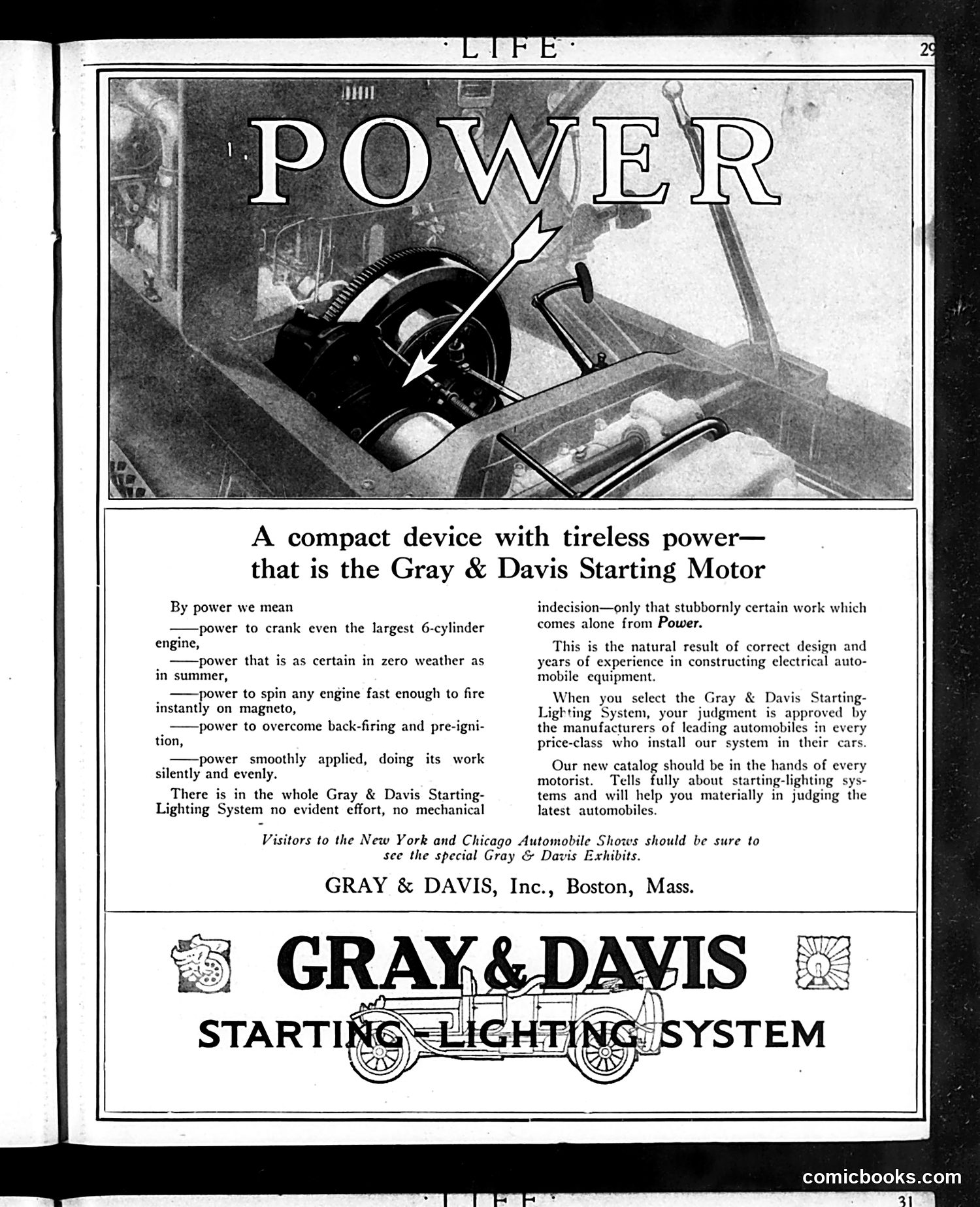
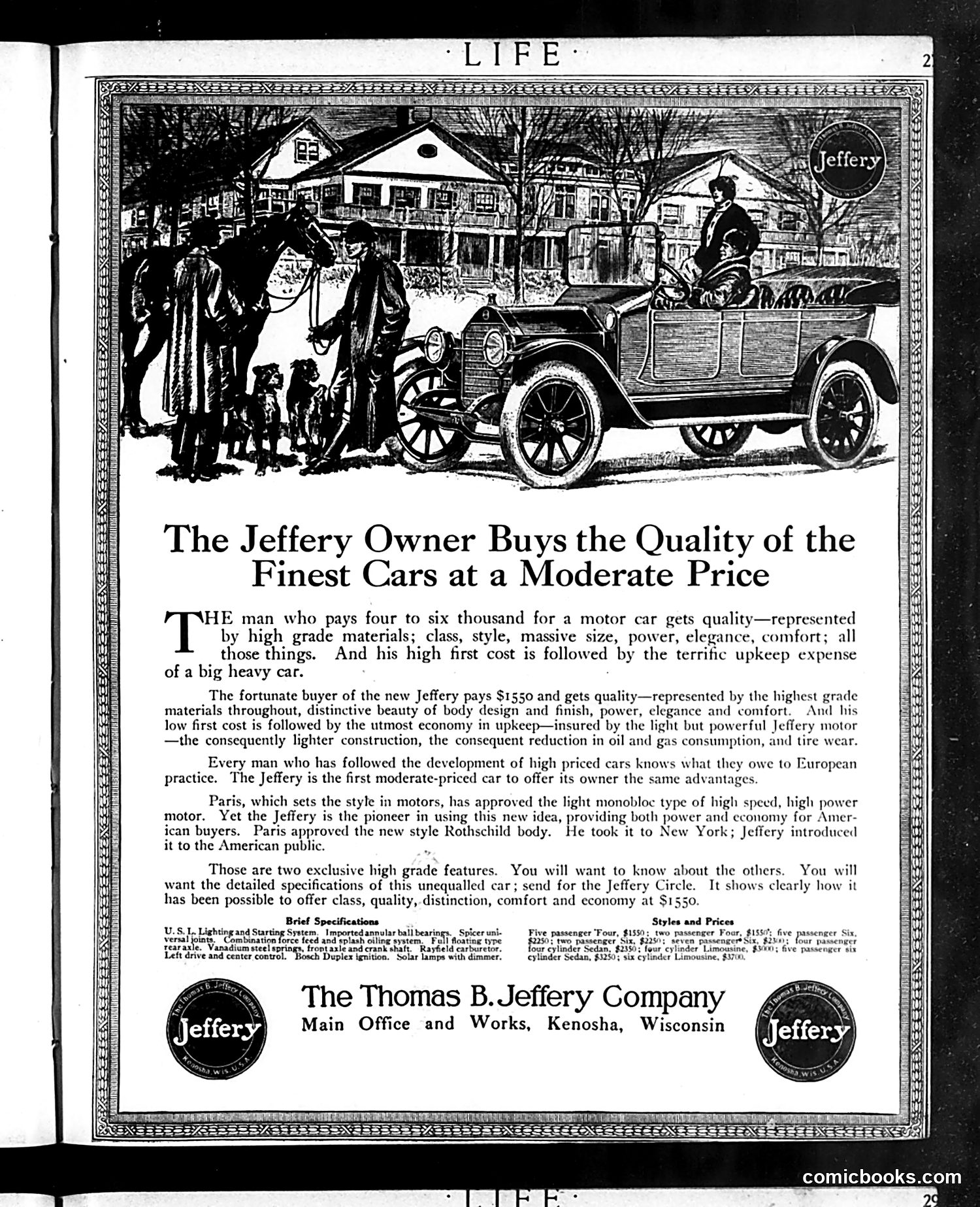
This is a **full-page advertisement**, not satire or political commentary. It promotes the Gray & Davis Starting-Lighting System, an electrical automobile starter motor manufactured in Boston. The image shows the mechanical device itself mounted in an engine compartment. The ad emphasizes "Power"—the motor's ability to reliably crank large engines in any weather, fire instantly, and operate smoothly without mechanical strain. The text targets motorists and automobile manufacturers, claiming major car makers already install their system. It references contemporary automobile shows (New York and Chicago) and encourages readers to consult their catalog when evaluating new cars. This represents early automotive marketing when electric starters were still relatively novel technology, highlighting reliability and engineering sophistication as selling points to both consumers and the industry.
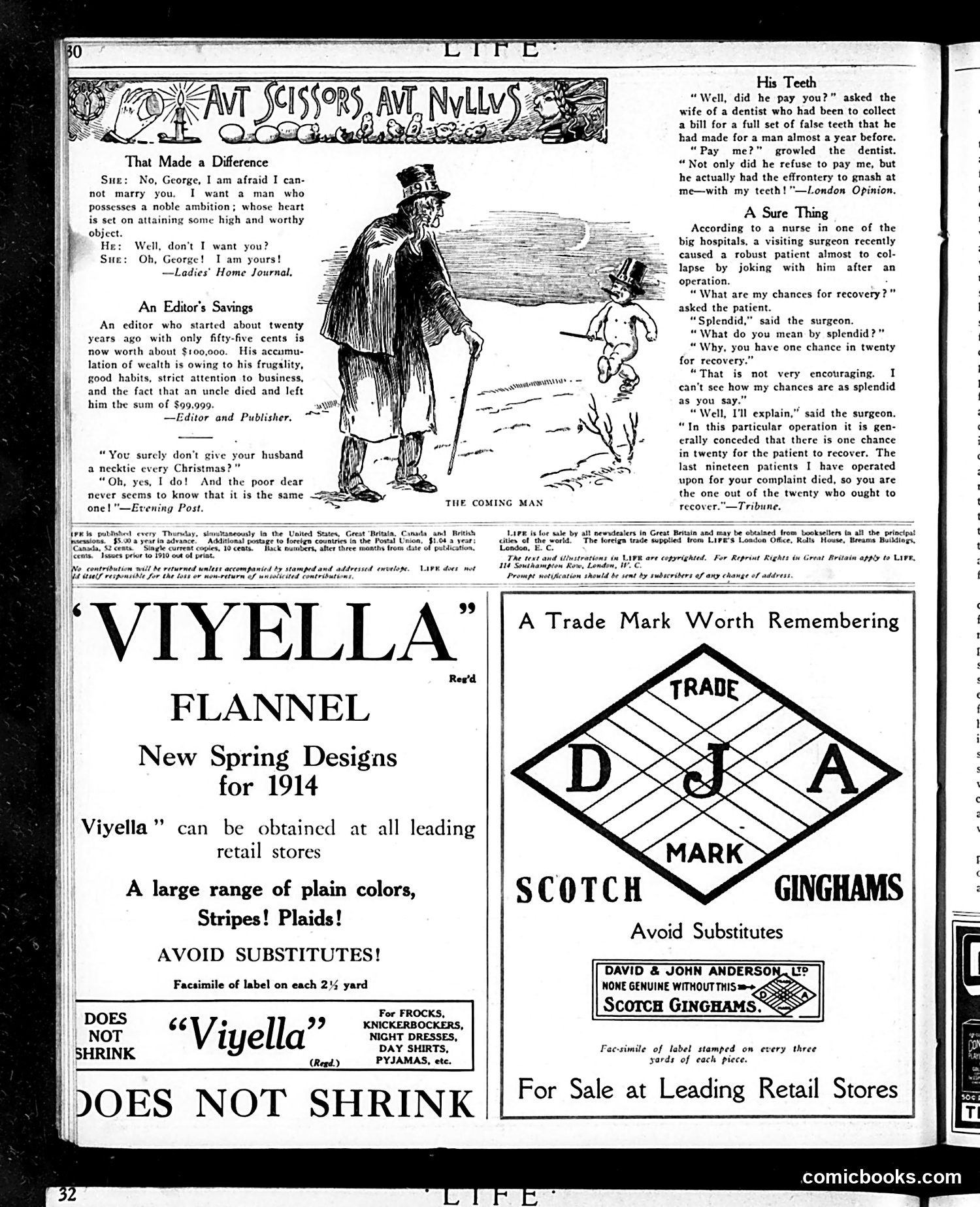
This page contains several short humorous anecdotes typical of early 20th-century American satire, plus period advertisements. **The cartoons/jokes:** - **"That Made a Difference"**: A woman rejects a suitor lacking ambition, then accepts him when he reveals his wealth—satirizing women's materialistic priorities. - **"An Editor's Savings"**: Mocks self-made wealth mythology by revealing an editor's fortune came entirely from an inheritance ($99,999), not frugality and hard work. - **"His Teeth"** and **"A Sure Thing"**: Joke about literal misunderstandings (a dentist gnashing the *dentist's* teeth; a surgeon's grim statistics presented optimistically). **The advertisements** promote Viyella flannel and D.J.A. Scotch Ginghams with period-typical emphases on avoiding counterfeits and shrinkage. The satirical tone targets hypocrisies in courtship, business mythology, and professional awkwardness—themes resonant for 1914 Life readers seeking entertainment through gentle social criticism.
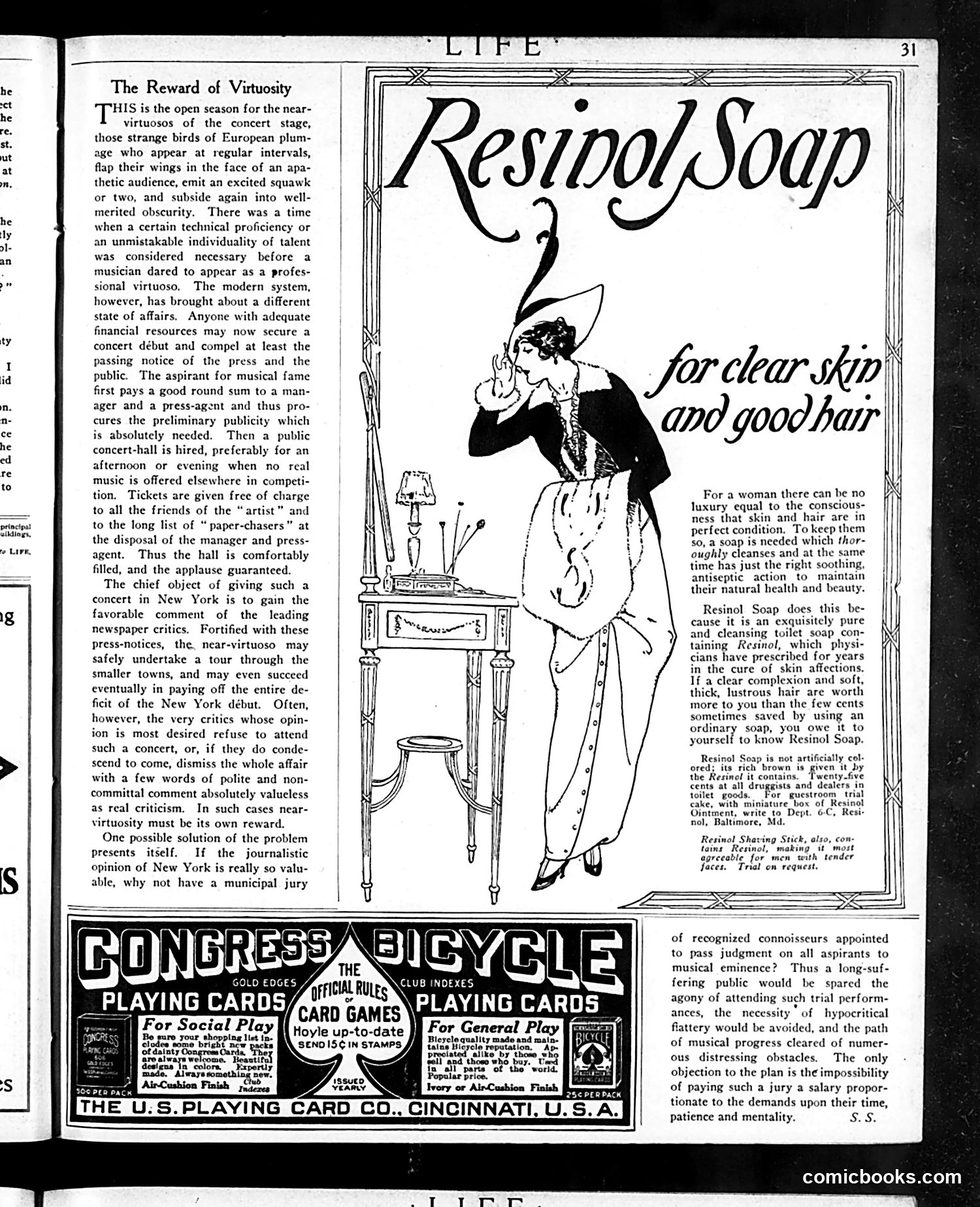
This article satirizes the commercialization of classical music performance in early 20th-century America. The author argues that financial resources, not genuine talent, now determine who becomes a concert "virtuoso." The satire targets wealthy amateurs who hire professional managers and press agents to manufacture publicity, book concert halls during off-hours, distribute free tickets to create crowds, and generate favorable newspaper reviews—all to appear legitimate. These "near-virtuosos" (described as "strange birds of European plumage") then tour smaller towns to recoup their New York investment. The piece mocks major music critics who refuse attending such concerts or offer meaningless praise, rendering the entire enterprise self-serving. The proposed solution—a municipal jury of genuine connoisseurs to evaluate aspirants—is offered tongue-in-cheek, suggesting the absurdity of the situation. The adjacent **Resinol Soap advertisement** is unrelated content, typical of period magazine layout.
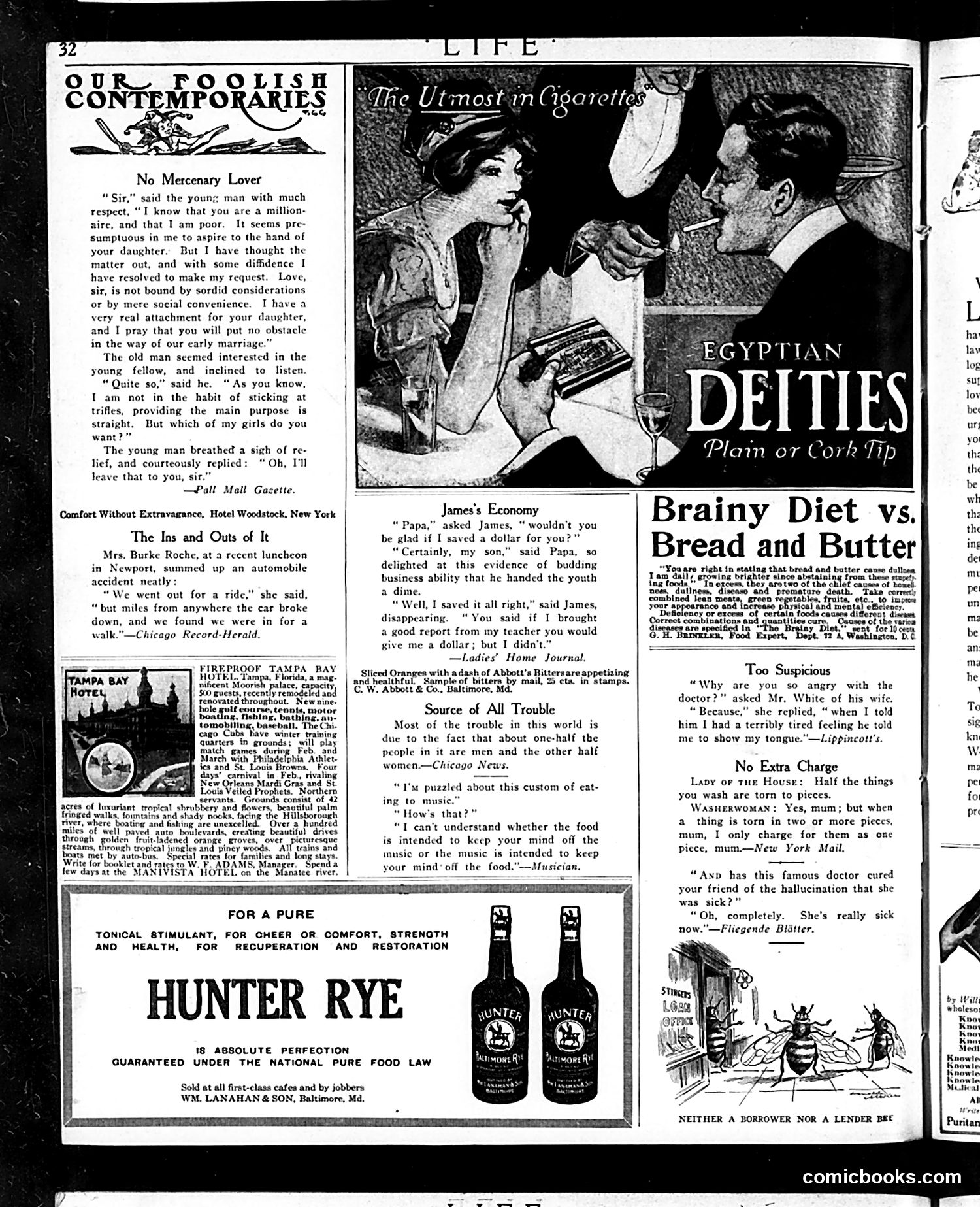
This page from Life magazine contains several satirical pieces typical of early 20th-century humor: **"No Mercenary Lover"** mocks romantic pretense. A poor young man appeals to a wealthy father for his daughter's hand, emphasizing love over money—noble sentiments that impress the father. The punchline reveals the satire: when asked which daughter he wants, the suitor defers to the father's choice, exposing his indifference. The joke satirizes insincere courtship and materialism masked as sentiment. **"The Ins and Outs of It"** and **"James's Economy"** are brief, punny anecdotes typical of the magazine's filler humor—clever wordplay rather than political satire. The page is primarily **advertisements** (Hunter Rye whiskey, Tampa Bay Hotel) interspersed with these short humor pieces and small illustrated ads. The Egyptian Deities cigarette ad features an illustration unrelated to the text content. This represents Life's format: satirical social commentary through short fiction and jokes targeting middle-class pretensions, romance, and financial anxieties, alongside commercial advertising.
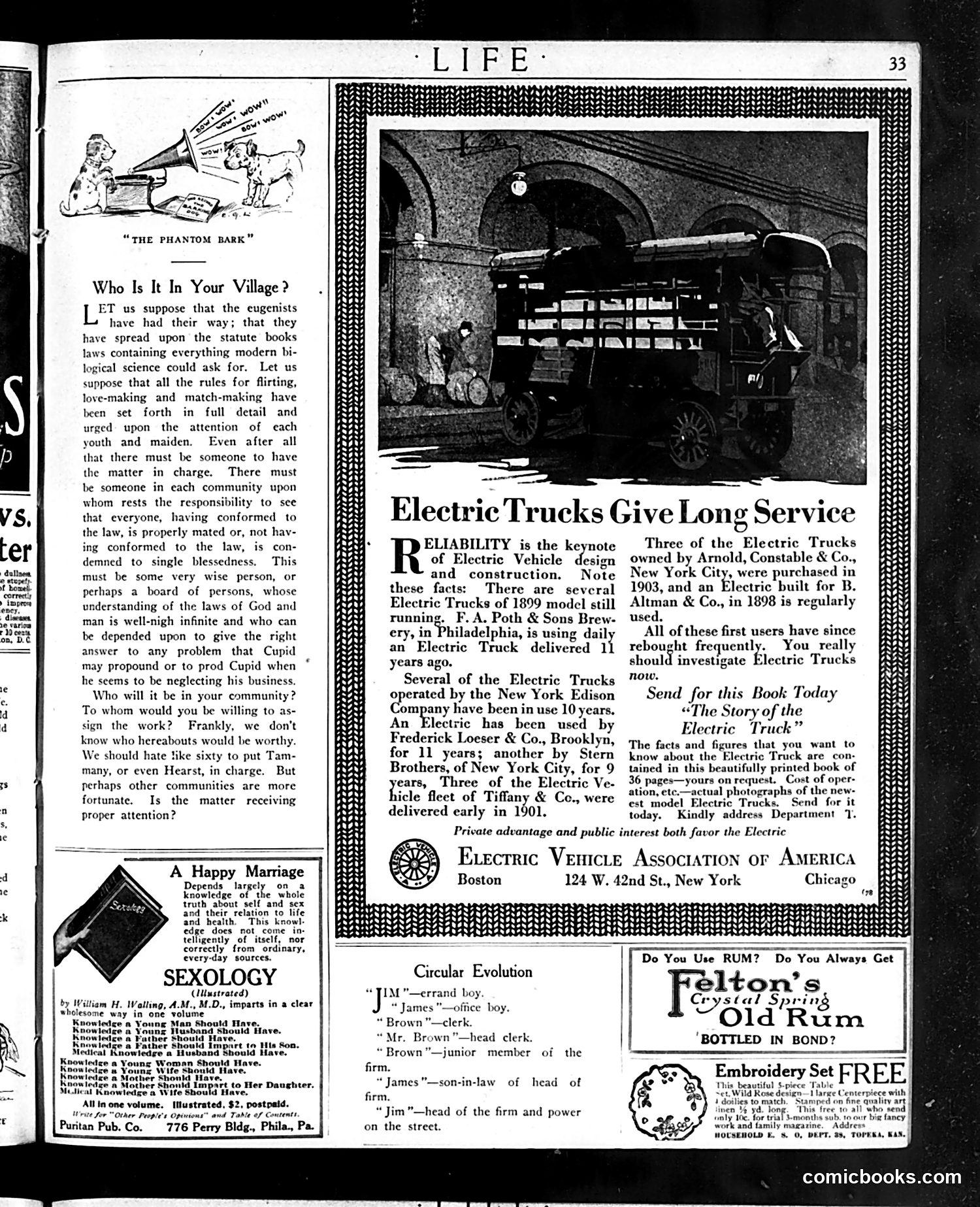
**Main Content:** This page is primarily **advertising** for electric trucks, with supporting editorial content about eugenic social policy. **"The Phantom Bark" Editorial:** This satirical piece critiques the eugenics movement (then popular among American progressives). It mocks the idea that laws could scientifically regulate human reproduction and courtship. The joke: even if such laws existed, *who would enforce them?* The author sarcastically suggests that no trustworthy authority exists—certainly not political machines like Tammany Hall or newspaper magnate William Randolph Hearst. This is social satire questioning whether any group possesses the wisdom to control others' intimate lives. **"Circular Evolution" Cartoon:** A humorous diagram showing professional advancement: "Tim" progresses from errand boy to office boy to clerk to head clerk to firm partner to son-in-law of the owner, finally becoming "Jim"—the actual power broker on the street. It's a joke about how professional hierarchies eventually reveal that personal connections (marriage, patronage) matter more than merit. **Electric Trucks Advertisement:** Standard industrial advertising emphasizing reliability through longevity—vehicles from 1899–1903 still operating.
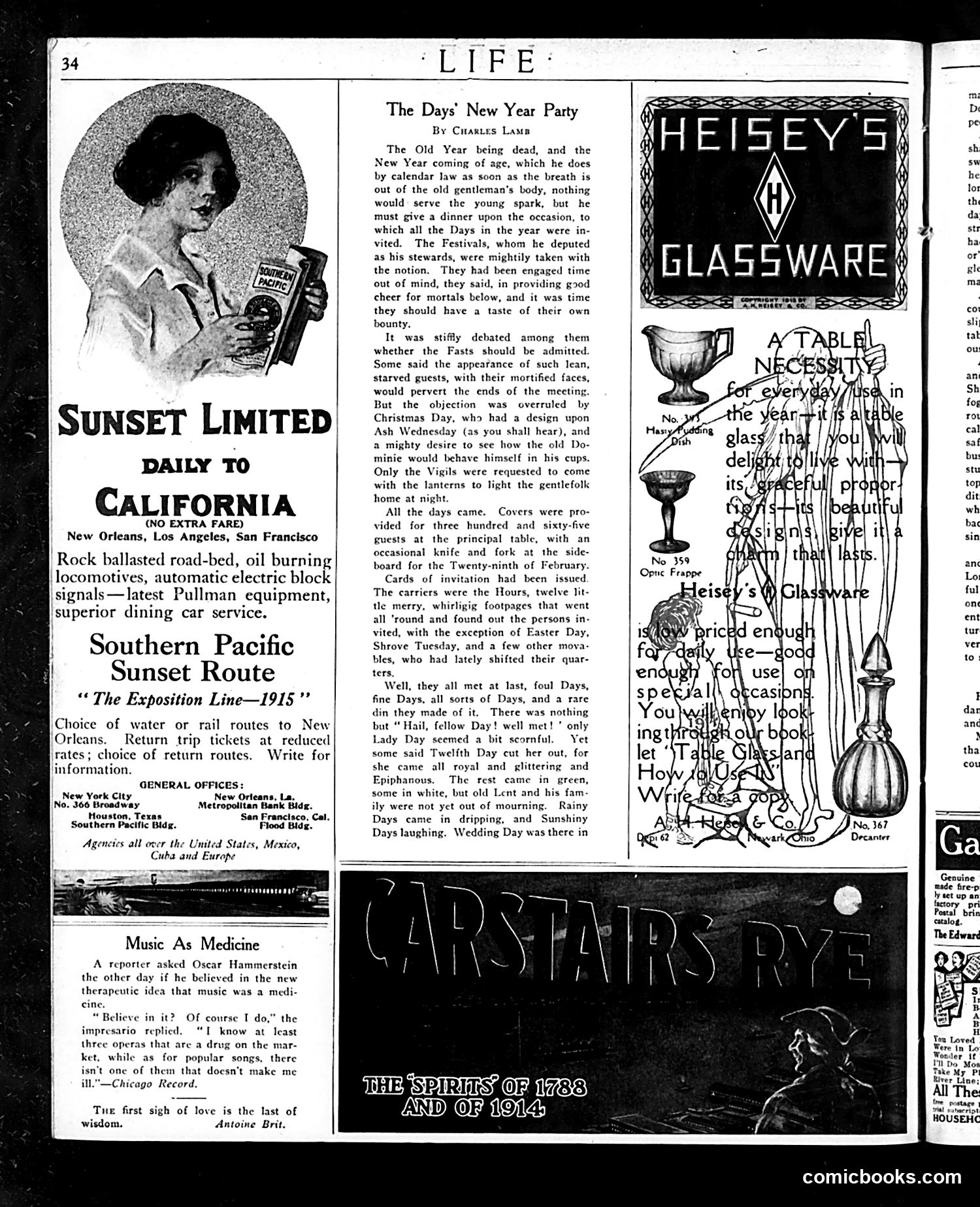
This page is primarily **advertising and literary content** rather than political satire. The main feature is a whimsical short story by Charles Lamb (OCR'd as "Cuarles Lama") personifying the calendar year's days as dinner guests. **The Story's Conceit:** New Year, coming of age, hosts an elaborate dinner inviting all 365 Days as personified characters. Festivals serve as stewards. The narrative humorously describes which Days attend—Christmas Day glittering in royal dress, Lent and family still in mourning clothes, Rainy Days arriving soaked, Wedding Day present, Ash Wednesday invited via Christmas Day's romantic scheming. **Historical Context:** This is *Life* magazine's literary tradition of reprinting classic satirical tales. It's genteel humor playing with calendar mythology—no political commentary. The page also includes **advertisements** for Southern Pacific Railway's "Sunset Limited" train and Heisey's glassware, plus a brief anecdote about composer Oscar Hammerstein's quip that operas are "drugs on the market."
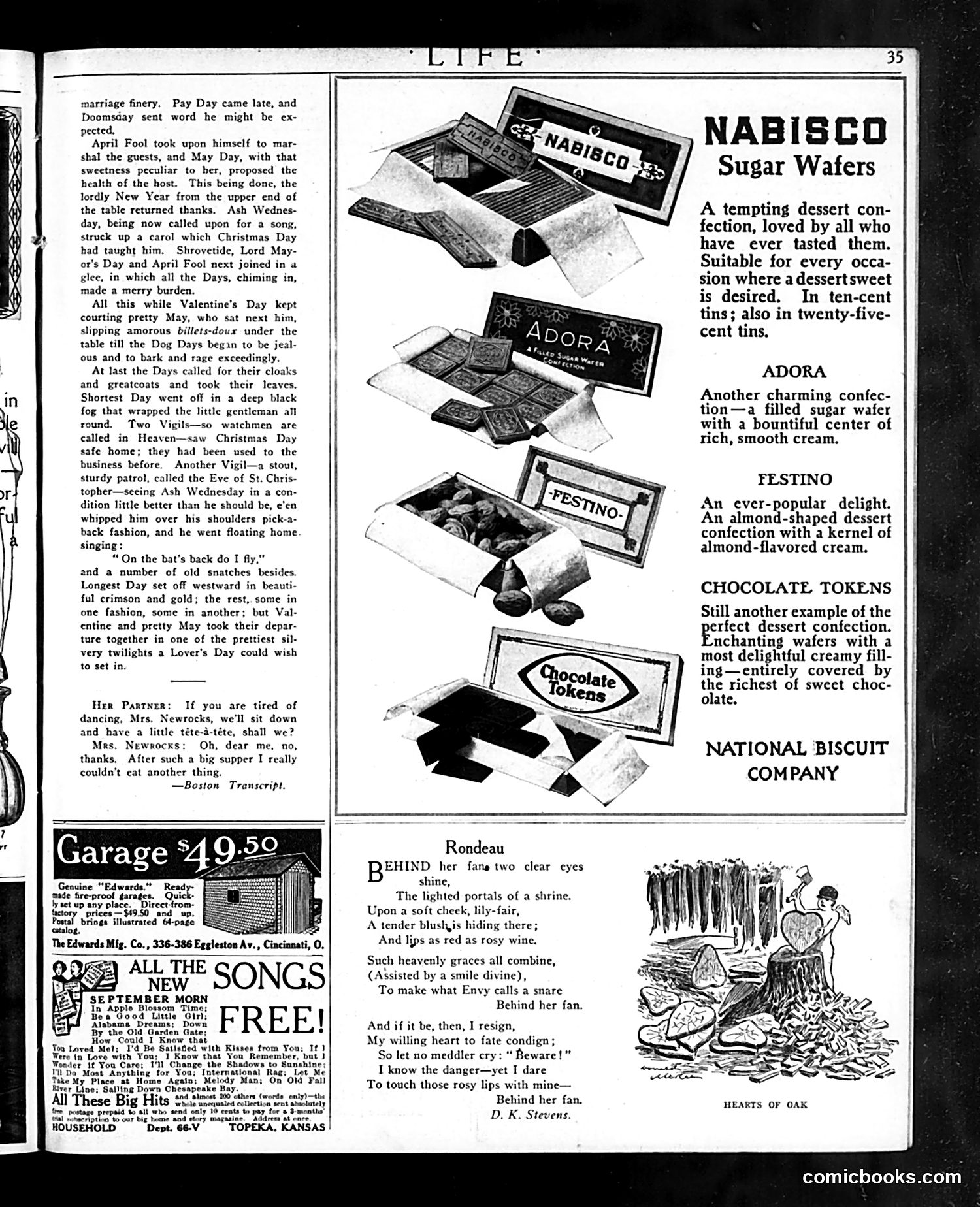
This page is primarily **advertising and light entertainment**, not political satire. The left column contains a whimsical allegorical story personifying calendar days (Christmas Day, Valentine's Day, May Day, etc.) attending a dinner party—a literary flourish typical of Life magazine's humor. It's charming but carries no political message. The right side features **product advertisements** for Nabisco confections (Sugar Wafers, Adora, Festino, Chocolate Tokens) with illustrated boxes. Below is a romantic **poem titled "Rondeau"** by D.K. Stevens about a woman hiding behind a fan, celebrating her beauty and the speaker's willingness to risk courtship despite danger—typical sentimental verse of the era. Additional ads include Edwards fireproof garages and song sheet offers. **There are no political cartoons on this page.** It's a standard early 20th-century magazine layout mixing light fiction, poetry, and commercial advertisements.
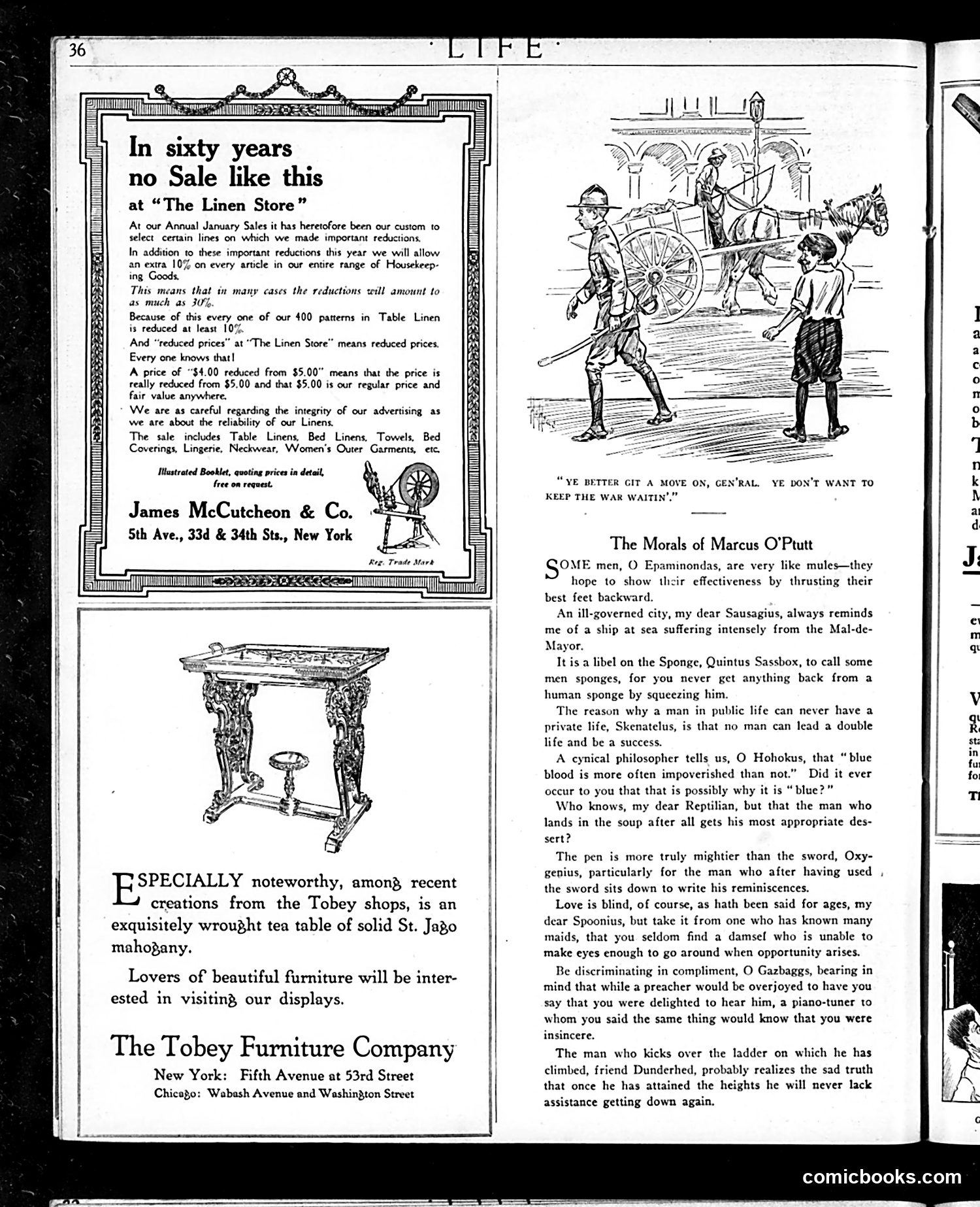
This page contains mostly **advertisements** for luxury goods (linens, furniture) mixed with satirical content. The main cartoon depicts a **Civil War-era scene**: a soldier urges a general to "get a move on" because "ye don't want to keep the war waitin'!" The humor appears to mock military inefficiency or reluctance—suggesting even the war itself is impatient for the general's action. The dialect and imagery suggest this targets American military leadership during a specific conflict, likely the Civil War. Below is "The Morals of Marcus O'Ptutt," a **satirical advice column** using pseudo-classical names (Epaminondas, Sausagius, etc.) as comedic devices. It delivers cynical social commentary on human nature: mules work backward, cities suffer under bad mayors, sponges don't return what's squeezed from them, and public figures cannot maintain private lives. The tone is mock-philosophical—urbane satire targeting contemporary society's hypocrisies. Both elements reflect *Life* magazine's satirical mission during this era.
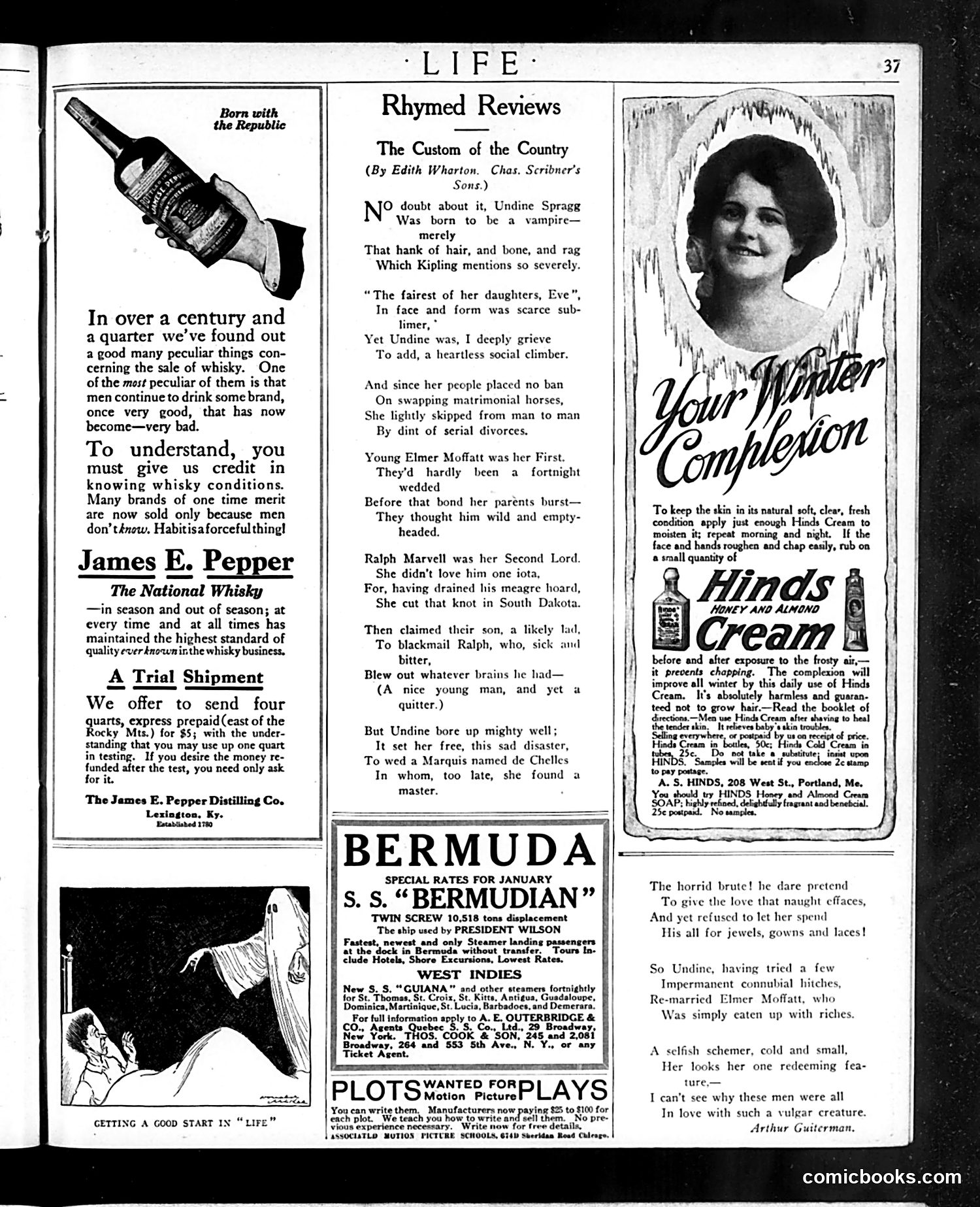
This page mixes advertising with literary satire. The main content is a **rhymed book review** of Edith Wharton's *The Custom of the Country*, which satirizes the novel's protagonist, Undine Spragg—a ruthless social climber who marries and divorces her way through wealthy men (Elmer Moffatt, Ralph Marvell, and a French Marquis) purely for financial and social advancement. The reviewer mockingly traces her "serial divorces," including Ralph's suicide after she drains his wealth and leaves him. The final couplet dismisses her manipulations as predictable scheming. The satire targets both Wharton's critique of Gilded Age materialism and the "vampire" women who exploit marriage for wealth—a contemporary social concern. The page also includes whisky advertising (James E. Pepper brand), ship travel ads (Bermuda), beauty cream promotion (Hinds), and recruitment ads for motion picture plot writers—typical commercial content of the era.
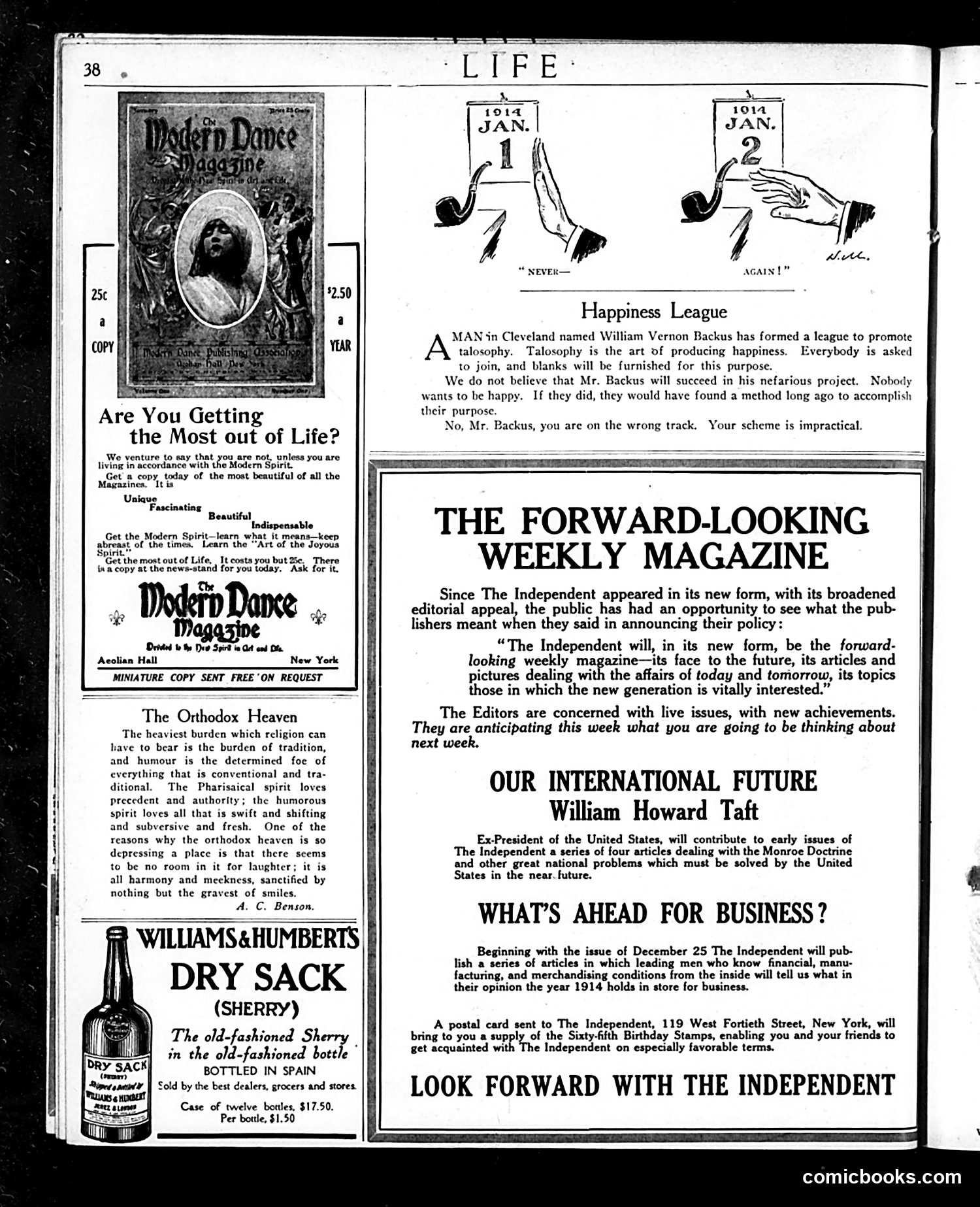
This page is primarily **advertising and editorial promotion** rather than political satire. The two cartoon panels at top show a man's hands on January 1st saying "NEVER" to a pipe, then on January 2nd already smoking again—a joke about failed New Year's resolutions. The "Happiness League" item mocks William Vernon Backus of Cleveland, who formed a group promoting "talosophy" (happiness-production). Life's editors sarcastically dismiss the scheme as impractical, suggesting people don't actually want to be happy. This appears to be satire on self-improvement movements and utopian schemes. The rest comprises *The Independent* magazine's promotional material, featuring contributions from ex-President William Howard Taft on international affairs and business predictions for 1914. Vintage advertisements for Modern Dance Magazine and Williams & Humberts Sherry complete the page.
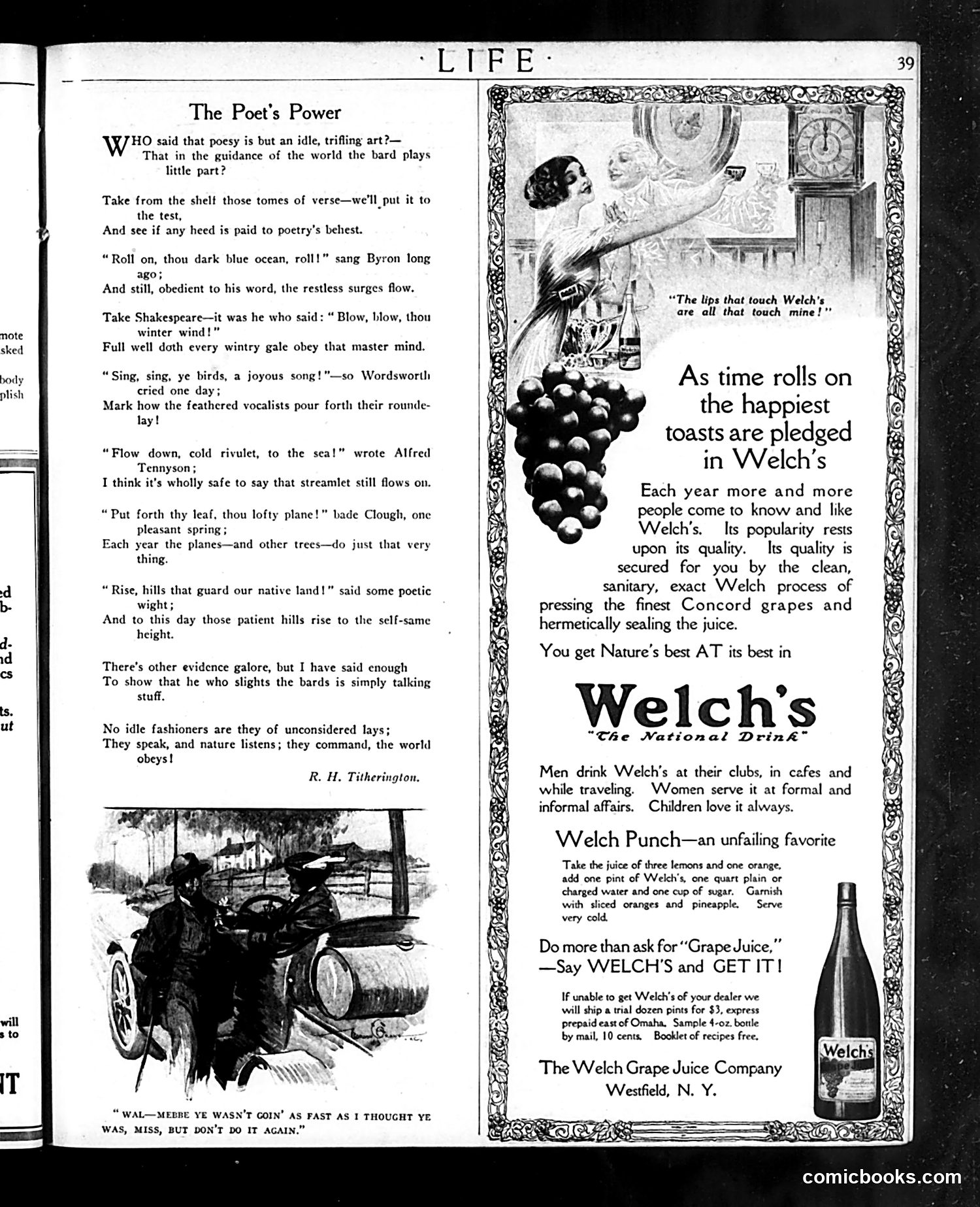
This page combines a humorous poem with a Welch's grape juice advertisement. **The Poem (left side):** R.H. Titherington's verse humorously argues that poets wield real power over nature. It catalogs famous literary commands—Byron's "Roll on, thou dark blue ocean," Shakespeare's "Blow, blow, thou winter wind"—and sardonically claims nature obeys these poetic utterances. The joke is absurdist: it takes the Romantic notion that poets inspire or capture reality and literalizes it into actual command over physical laws. The poem mocks both overstated claims about poetry's importance and perhaps Romantic excess itself. **The Cartoon (bottom left):** Shows a speeding car with the caption "Wal—mebbe ye wasn't goin' as fast as I thought ye was, miss, but don't do it again." It's a rural figure encountering an automobile—likely satirizing the clash between old rural America and modern technology. **The Advertisement (right):** A full-page Welch's grape juice ad featuring a romantic couple and aggressive marketing copy positioning the drink as "The National Drink" for all occasions and social classes.
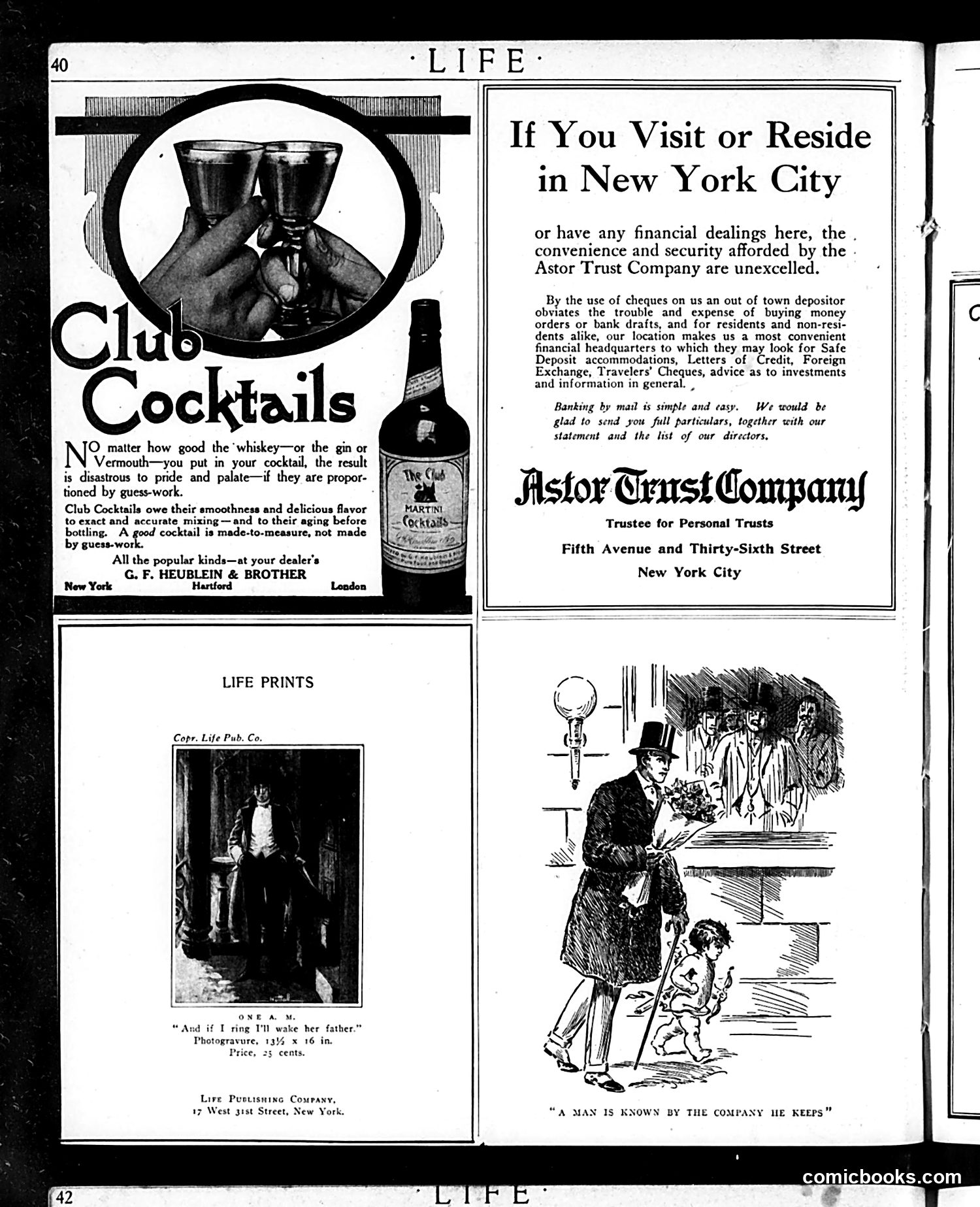
This page contains advertisements and a cartoon rather than political satire. **The Advertisements:** - **Club Cocktails** (left): Promotes pre-made cocktails by G.F. Heublein & Brother, arguing that homemade cocktails mixed by guesswork produce poor results, while professionally manufactured ones are precisely measured and aged properly. - **Astor Trust Company** (right): A financial services advertisement targeting out-of-town visitors and residents of New York City, offering banking services, safe deposit boxes, and travelers' checks. **The Cartoon:** The bottom right shows a titled illustration: "A MAN IS KNOWN BY THE COMPANY HE KEEPS." It depicts a well-dressed gentleman with a cane holding a small dog while standing near a shop window. The joke appears to be a visual pun—the man's character is reflected in his choice of "company" (his pet dog), though the specific satirical point remains somewhat obscure without additional context about the magazine's publication date.
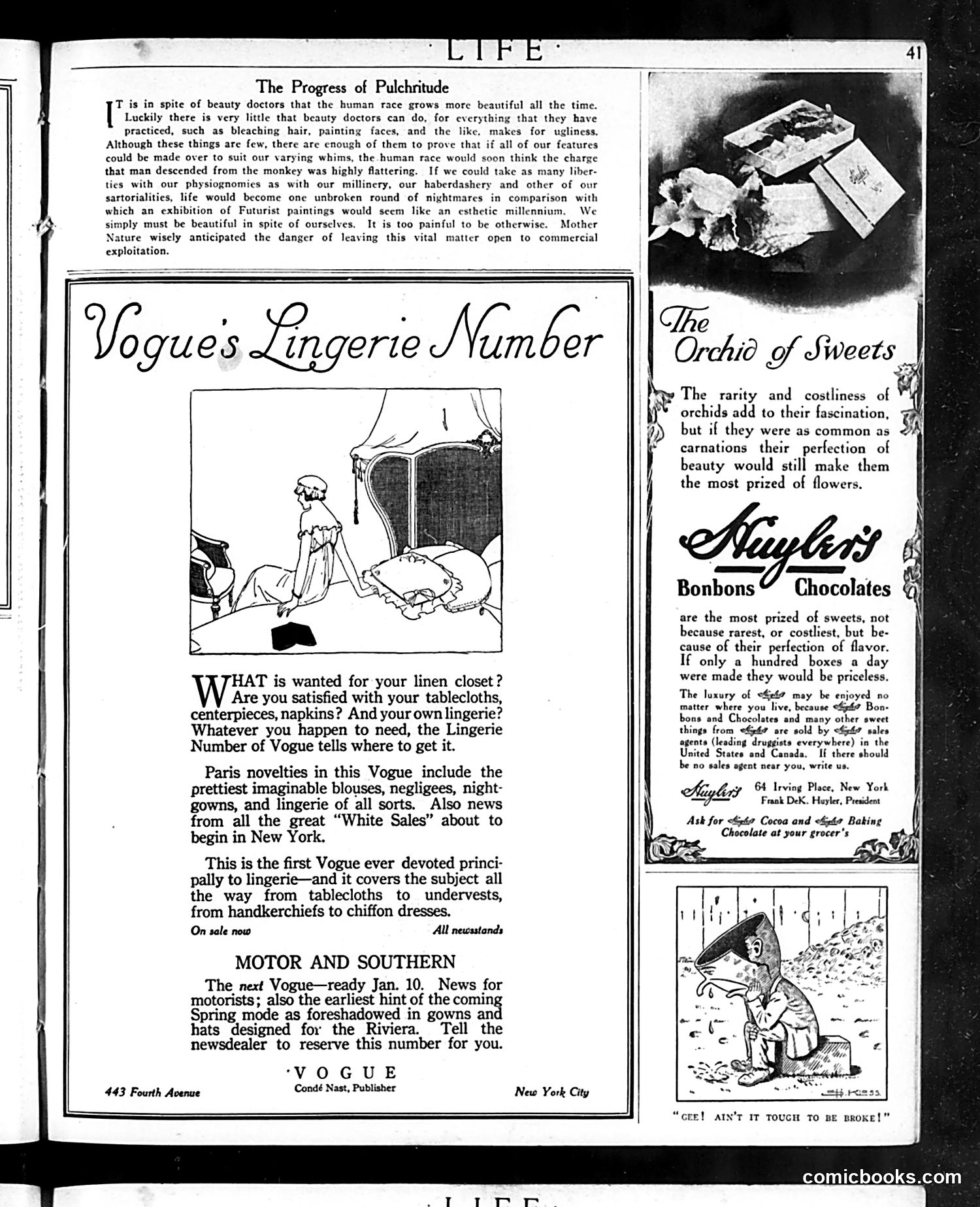
**Main Editorial Content:** "The Progress of Pulchritude" satirizes the beauty industry and cosmetic treatments. The author argues that despite beauty doctors' interventions—bleaching hair, painting faces—humans naturally grow more beautiful. The piece mocks the idea of artificially altering all physical features, suggesting it would create nightmares worse than Futurist paintings. The satire critiques commercial exploitation of beauty anxiety while defending nature's wisdom. **Cartoons:** The page includes a "Vogue's Lingerie Number" advertisement with an illustration of a woman and servant, promoting Paris novelties. Below is a separate cartoon captioned "GEE! AIN'T IT TOUGH TO BE BROKE!" depicting a ragged child, likely satirizing poverty or economic hardship. **Advertisements:** The right side features Nuyler's Bonbons and Chocolates, comparing orchids' rarity to candy perfection. Additional Vogue promotions advertise upcoming issues on motor fashion and spring wear. The page reflects 1910s-era concerns about beauty standards, consumer culture, and class disparities.
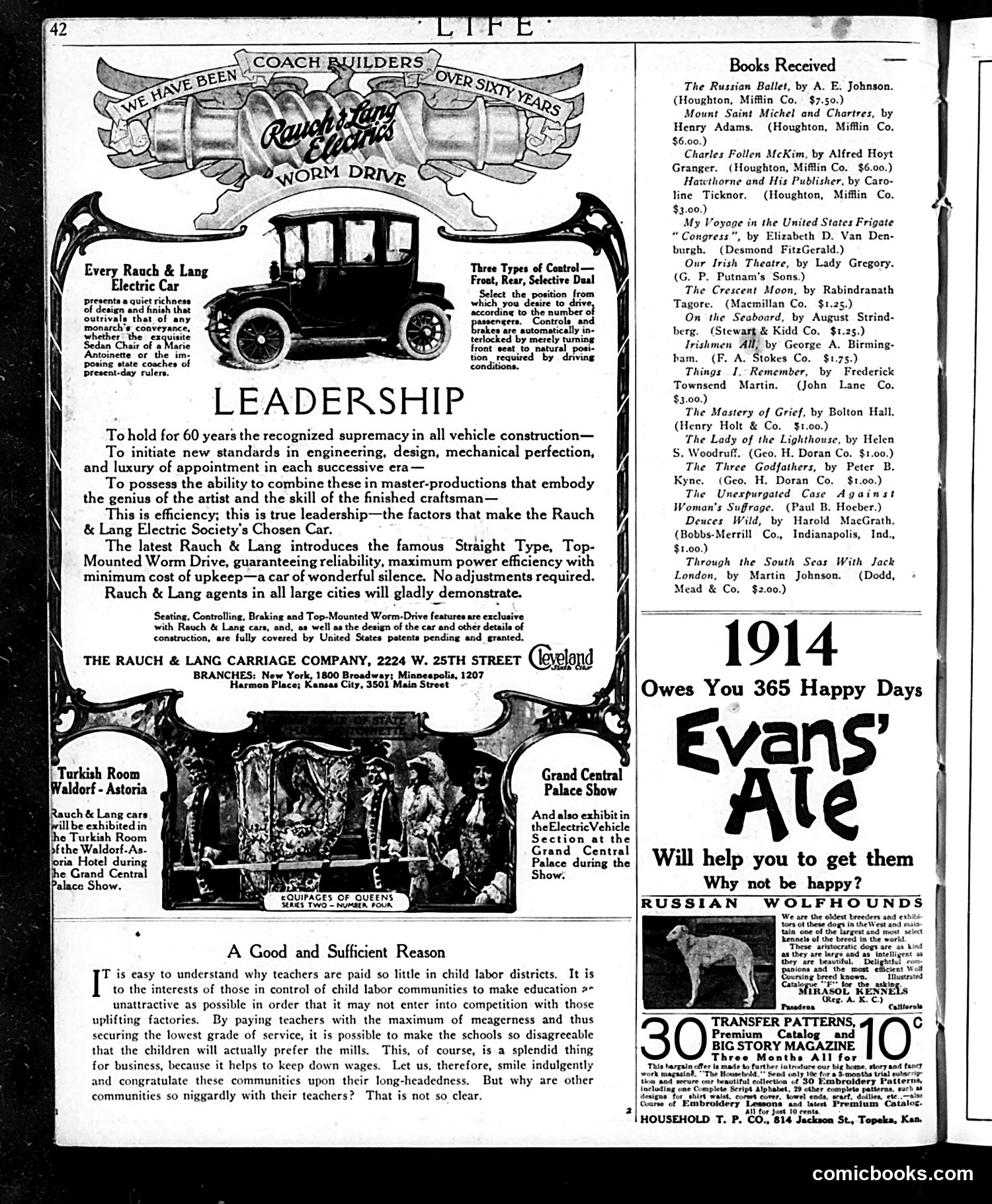
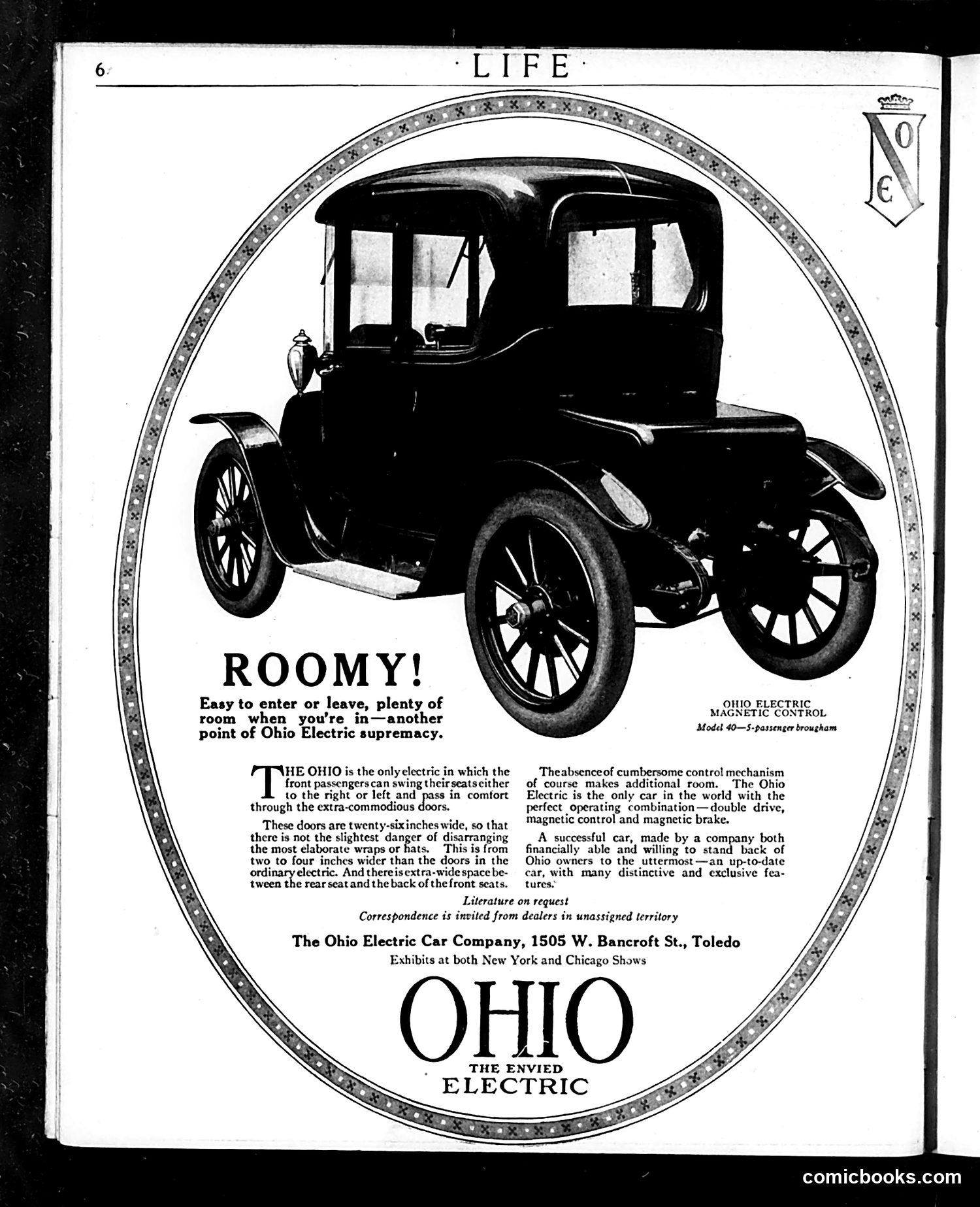
This page is primarily **advertising and book notices**, not political satire. The main content includes: **Rauch & Lang Electric Car Advertisement**: A lengthy pitch for an electric automobile company claiming 60 years of "leadership" in vehicle construction. The ad emphasizes engineering superiority and features their "Straight Type, Top-Mounted Worm Drive." **"A Good and Sufficient Reason"**: This brief editorial *does* contain social commentary—it sardonically argues that low teacher pay in industrial communities is deliberate policy. The author suggests factory owners intentionally keep schools unattractive to prevent competition with child labor, allowing them to maintain low wages. The piece criticizes communities' willingness to underfund education while profiting from child workers—positioning it as cynical but logical business strategy. **Evans' Ale Advertisement** and **book reviews** round out the page. The satirical bite here is in the editorial's dark irony: it presents exploitation as rational economics, inviting readers to recognize the moral bankruptcy of prioritizing factory profits over children's education.
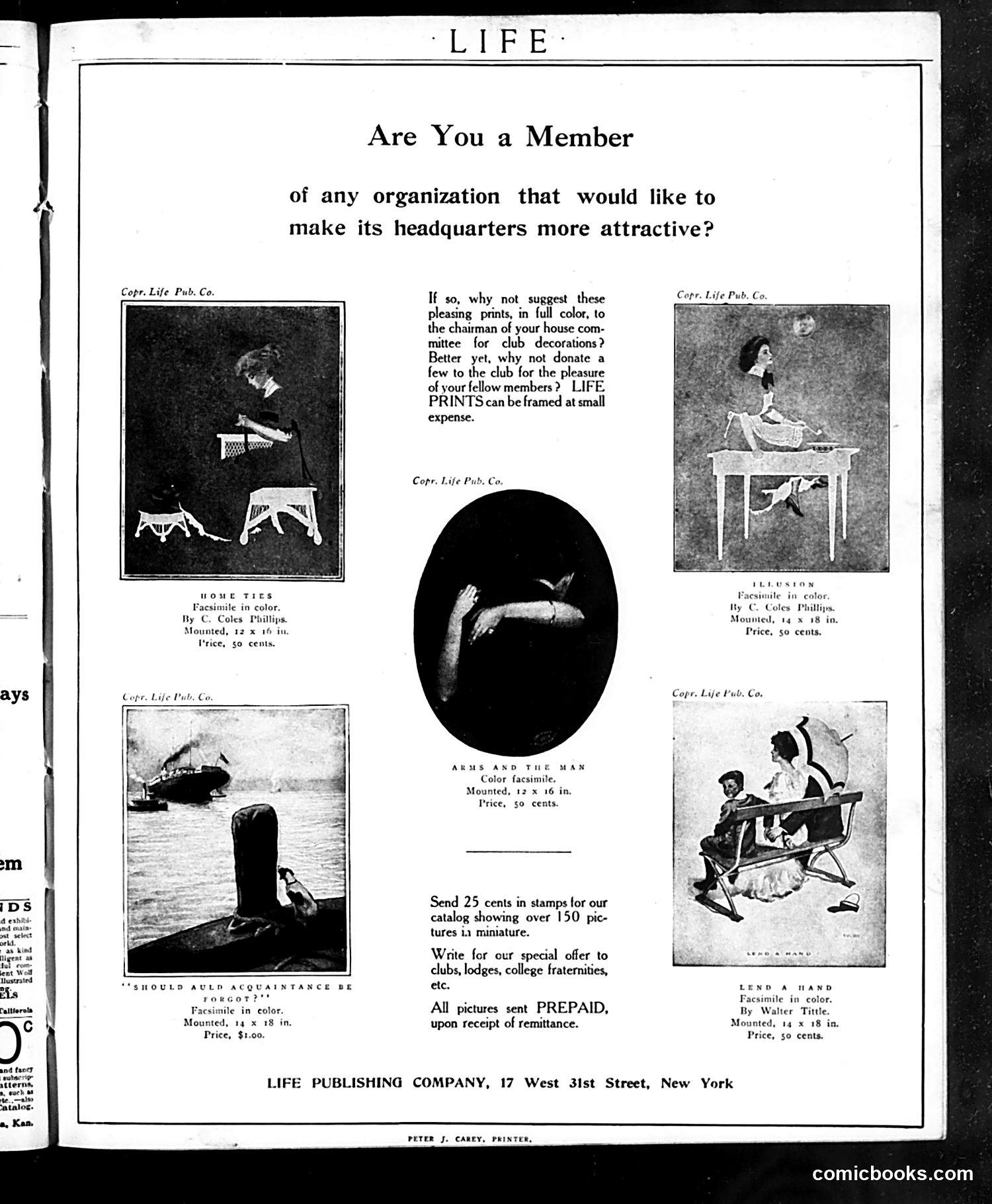
This is **not a cartoon or satire**, but rather a **product advertisement** for Life Publishing Company's decorative prints. The page solicits club members to purchase or donate framed artwork for their organization's headquarters. The advertised prints include: - "Home Ties" by C. Coles Phillips (domestic scene) - "Arms and the Man" (color facsimile, subject unclear from image) - "Should Auld Acquaintance Be Forgot?" (sentimental reference to the Scottish song) - "Illusion" (interior scene) - "Lend a Hand" by Walter Tittle (appears to show charitable activity) The pitch targets club members, fraternities, and lodges, framing art donations as goodwill gestures. Prices range from 50 cents to $1.00, with bulk catalog offers for organizations. This reflects early 20th-century American culture where illustrated prints decorated institutional spaces and refined aesthetics were associated with social respectability.
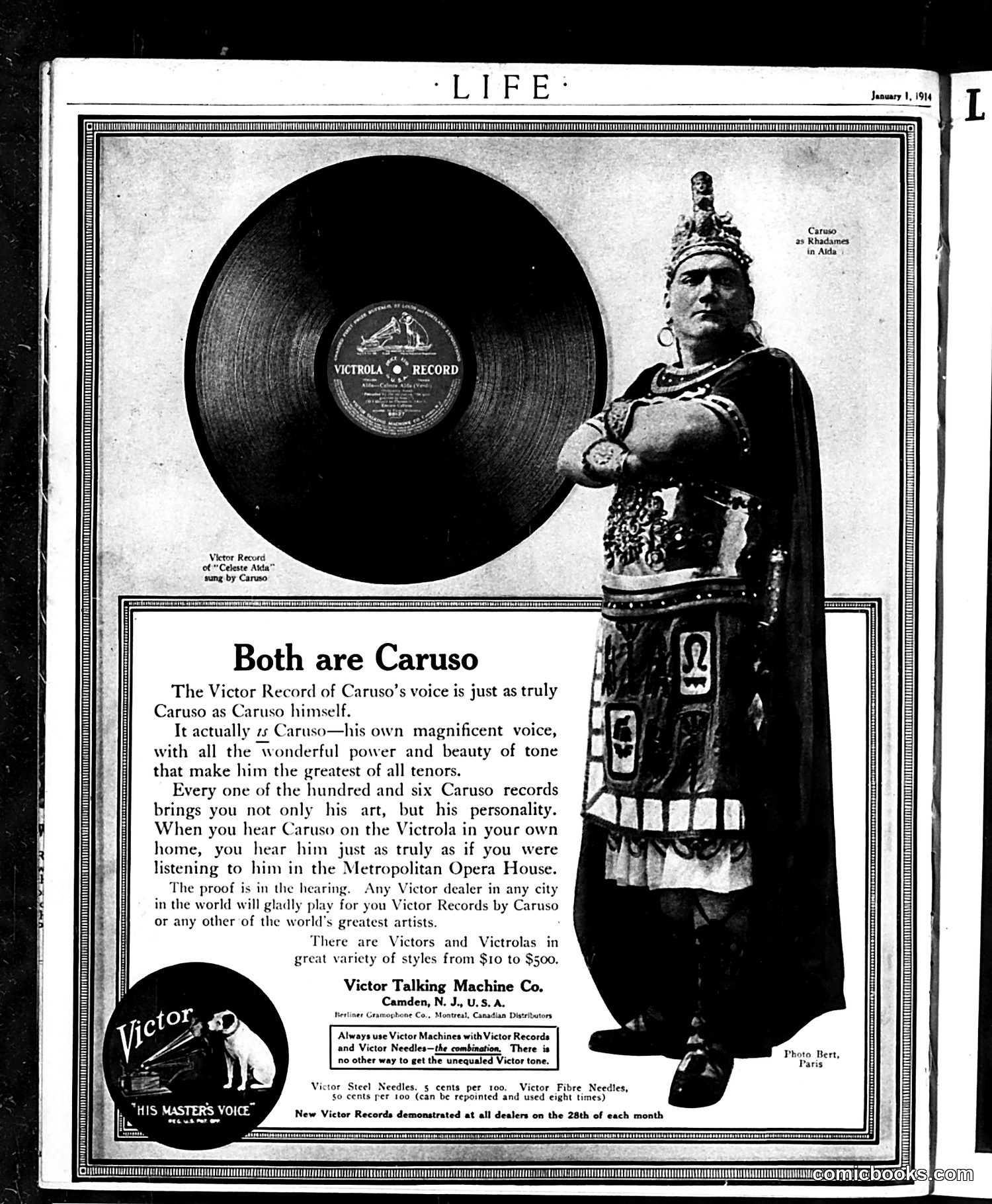
This is a **Victor Talking Machine advertisement**, not political satire. It features **Enrico Caruso**, the famous Italian tenor, dressed in operatic costume (likely from "Aida," referenced in the text). The advertisement's central claim—"Both are Caruso"—compares the living singer to his phonograph recordings, arguing that Victor Records preserve Caruso's voice with such fidelity that listening at home equals hearing him perform live at the Metropolitan Opera House. The page showcases early 20th-century consumer technology marketing: Victor Talking Machines (gramophones) ranged from $10-$500, with records costing 5-50 cents. The "His Master's Voice" logo appears at bottom left. The appeal is aspirational—owning Caruso records promises metropolitan cultural sophistication and authentic artistic experience. For 1914 readers, mechanical sound reproduction was still novel enough to warrant this emphatic claim about reproducing a performer's presence.