
Life, 1914-01-01 · page 24 of 44
Life — January 1, 1914 — page 24: what you’re looking at
What you’re looking at
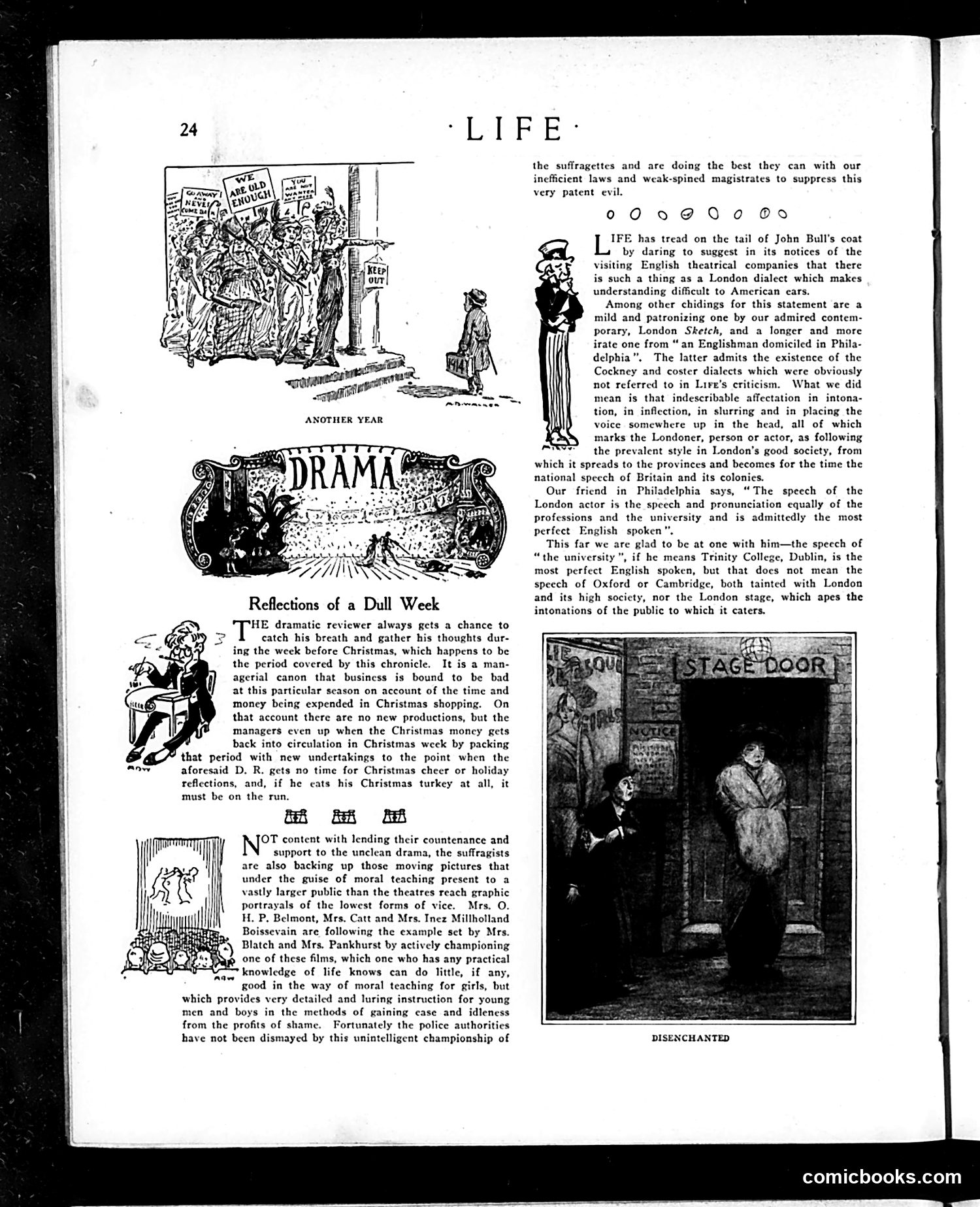
This Life magazine page contains two distinct pieces of social commentary: **Top section**: A defense of Life's earlier criticism of London theatrical accents. Life had suggested English actors' affected upper-class London pronunciation was difficult for American audiences to understand. Defensive British and American-based English correspondents objected, claiming London speech represents "perfect English." Life responds that while university speech may be refined, London stage actors merely ape fashionable society affectations—not genuine linguistic excellence. **"Reflections of a Dull Week"**: Commentary on theater scheduling around Christmas (when audiences shop instead of attend plays) and criticism of suffragists (women's voting rights activists) like Mrs. O.H.P. Belmont and Mrs. Pankhurst for supporting morally questionable films. The author argues these films, despite claiming moral purpose, actually provide detailed instruction in vice for young men—making them harmful despite suffragists' good intentions. The satire targets both British cultural pretension and well-meaning progressive reformers whose methods backfire.
📄 Transcribed text from this page (OCR, searchable)
Machine-transcribed from the original scan — historical spelling and the odd misread are preserved.
*LIFE* the suffragettes and are doing the best they can with our inefficient laws and weak-spined magistrates to suppress this very patent evil. 0009000 009 IFE has tread on the tail of John Bull's coat by daring to suggest in its notices of the visiting English theatrical companies that there is such a thing as a London dialect which makes understanding difficult to American ears. Among other chidings for this statement are a mild and patronizing one by our admired contem- porary, London Sketch, and a longer and more irate one from “an Englishman domiciled in Phila- delphia”, The latter admits the existence of the Cockney and coster dialects which were obviously not referred to in Lire’s criticism. What we did mean is that indescribable affectation in intona- tion, in inflection, in slurring and in placing the voice somewhere up in the head, all of which marks the Londoner, person or actor, as following the prevalent style in London’s good society, from which it spreads to the provinces and becomes for the time the national speech of Britain and its colonics. Our friend in Philadelphia says, “The speech of the London actor is the speech and pronunciation equally of the professions and the university and is admittedly the most perfect English spoken", This far we are glad to be at one with him—the speech of “the university", if he means Trinity College, Dublin, is the most perfect English spoken, but that docs not mean the speech of Oxford or Cambridge, both tainted with London 9 and its high society, nor the London stage, which apes the Reflections of a Dull Week intonations of the public to which it caters, HE dramatic reviewer always gets a chance to catch his breath and gather his thoughts dur- ing the week before Christmas, which happens to be the period covered by this chronicle. It is a man- agerial canon that busincss is bound to be bad at this particular season on account of the time and money being expended in Christmas shopping. On that account there are no new productions, but the managers even up when the Christmas moncy gets back into circulation in Christmas week by packing that period with new undertakings to the point when the aforesaid D, R. gets no time for Christmas cheer or holiday reflections, and, if he cats his Christmas turkey at all, it must be on the run. Si i A Mica ‘OT content with lending their countenance and id | | | support to the unclean drama, the suffragists | are also backing up those moving pictures that i Wi under the guise of moral teaching present to a vastly larger public than the theatres reach graphic portrayals of the lowest forms of vice. Mrs. O. H. P. Belmont, Mrs. Catt and Mrs. Inez Millholland Boissevain are following the example set by Mrs. Blatch and Mrs. Pankhurst by actively championing one of these films, which one who has any practical knowledge of life knows can do little, if any, good in the way of moral teaching for girls, but which provides very detailed and luring instruction for young men and boys in the methods of gaining case and idleness from the profits of shame. Fortunately the police authorities have not been dismayed by this unintelligent championship of DISENCHANTED comicbooks.com