
Life, 1914-01-01 · page 21 of 44
Life — January 1, 1914 — page 21: what you’re looking at
What you’re looking at
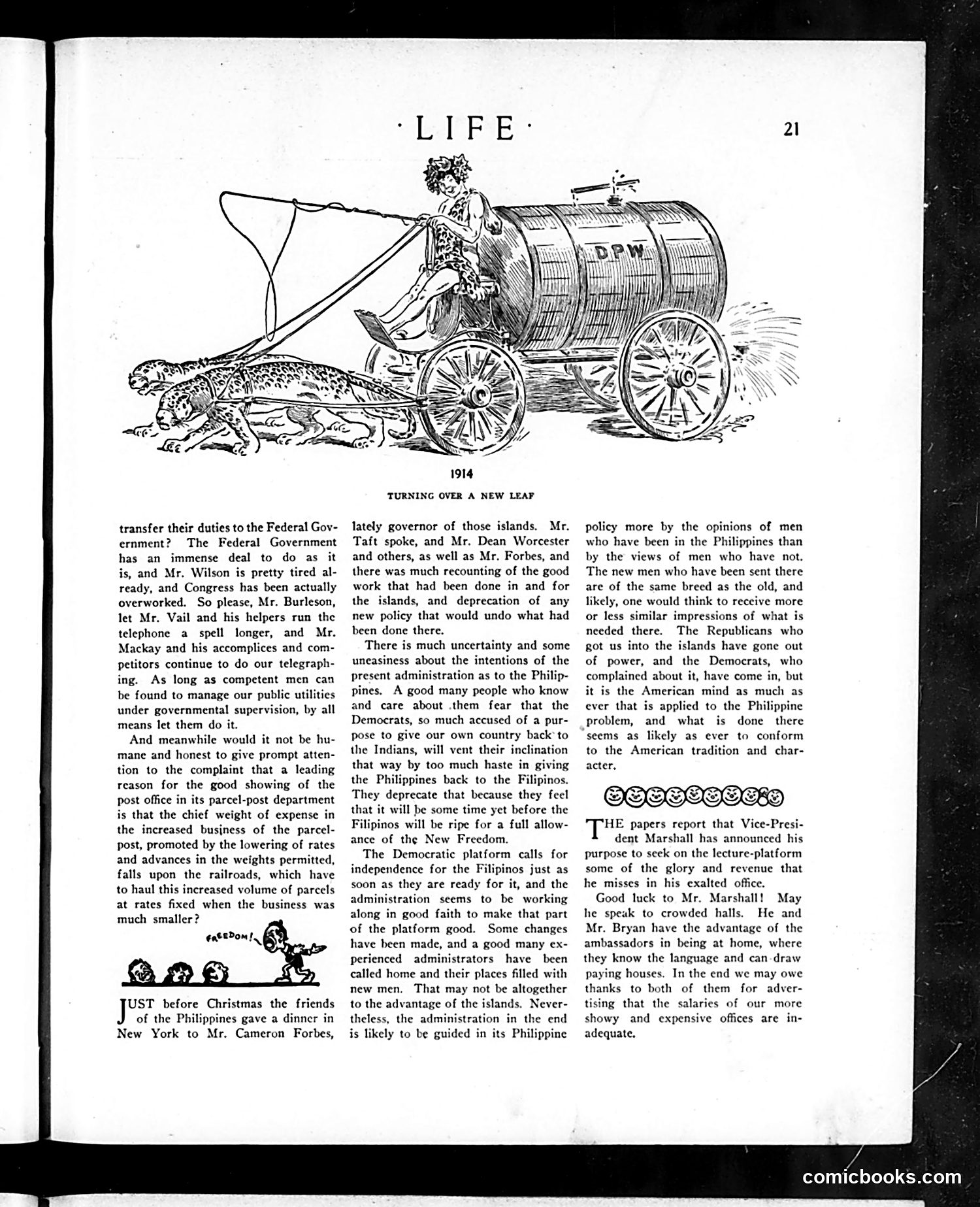
The cartoon depicts a figure driving a water wagon labeled "D.P.W." (Department of Public Works), pulled by what appears to be a leopard or spotted cat. The image satirizes the Wilson administration's Philippine policy transition. The text discusses Democratic concerns about hastily returning the Philippines to Filipino independence, contrasting Republican stewardship under figures like Cameron Forbes and William Howard Taft with the new Democratic approach. The article suggests American administrators—whether Republican or Democrat—will likely apply similar American values and governance methods regardless. The "new leaf" reference suggests Wilson's Democrats are changing course from Republican colonial policy, though skeptics fear either reckless speed or insufficient preparation for Filipino self-rule. The spotted animal pulling the wagon likely symbolizes the unpredictable or wild nature of this policy shift, implying the administration lacks firm control over its Philippine direction.
📄 Transcribed text from this page (OCR, searchable)
Machine-transcribed from the original scan — historical spelling and the odd misread are preserved.
transfer their duties to the Federal Gov- ernment? The Federal Government has an immense deal to do as it is, and Mr. Wilson is pretty tired al- ready, and Congress has been actually overworked. So please, Mr. Burleson, let Mr. Vail and his helpers run the telephone a spell longer, and Mr. Mackay and his accomplices and com- petitors continue to do our telegraph- ing. As long as competent men can be found to manage our public utilities under governmental supervision, by all means let them do it. And meanwhile would it not be hu- mane and honest to give prompt atten- tion to the complaint that a leading reason for the good showing of the post office in its parcel-post department is that the chief weight of expense in the increased business of the parcel- post, promoted by the lowering of rates and advances in the weights permitted, falls upon the railroads, which have to haul this increased volume of parcels at rates fixed when the business was much smaller? ea 2D0m I | UST before Christmas the friends of the Philippines gave a dinner in New York to Mr. Cameron Forbes, TURNING OVER A NEW LEAF lately governor of those islands. Mr. Taft spoke, and Mr. Dean Worcester and others, as well as Mr. Forbes, and there was much recounting of the good work that had been done in and for the islands, and deprecation of any new policy that would undo what had been done there. There is much uncertainty and some uneasiness about the intentions of the present administration as to the Philip- pines, A good many people who know and care about .them fear that the Democrats, so much accused of a pur- pose to give our own country back to the Indians, will vent their inclination that way by too much haste in giving the Philippines back to the Filipinos. They deprecate that because they feel that it will be some time yet before the Filipinos will be ripe for a full allow- ance of the New Freedom. The Democratic platform calls for independence for the Filipinos just as soon as they are ready for it, and the administration seems to be working along in good faith to make that part of the platform good. Some changes have been made, and a good many ex- perienced administrators have been called home and their places filled with new men. That may not be altogether to the advantage of the islands. Never- theless, the administration in the end is likely to be guided in its Philippine policy more by the opinions of men who have been in the Philippines than by the views of men who have not. The new men who have been sent there are of the same breed as the old, and likely, one would think to receive more or less similar impressions of what is needed there. The Republicans who got us into the islands have gone out of power, and the Democrats, who complained about it, have come in, but it is the American mind as much as ever that is applied to the Philippine problem, and what is done there seems as likely as ever to conform to the American tradition and char- acter, SSCOSOSEss 'HE papers report that Vice-Presi- dent Marshall has announced his purpose to seek on the lecture-platform some of the glory and revenue that he misses in his exalted office. Good luck to Mr. Marshall! May he speak to crowded halls. He and Mr. Bryan have the advantage of the ambassadors in being at home, where they know the language and can-draw paying houses. In the end we may owe thanks to both of them for adver- tising that the salaries of our more showy and expensive offices are in- adequate. / comicbooks.com