
Life, 1914-01-01 · page 25 of 44
Life — January 1, 1914 — page 25: what you’re looking at
What you’re looking at
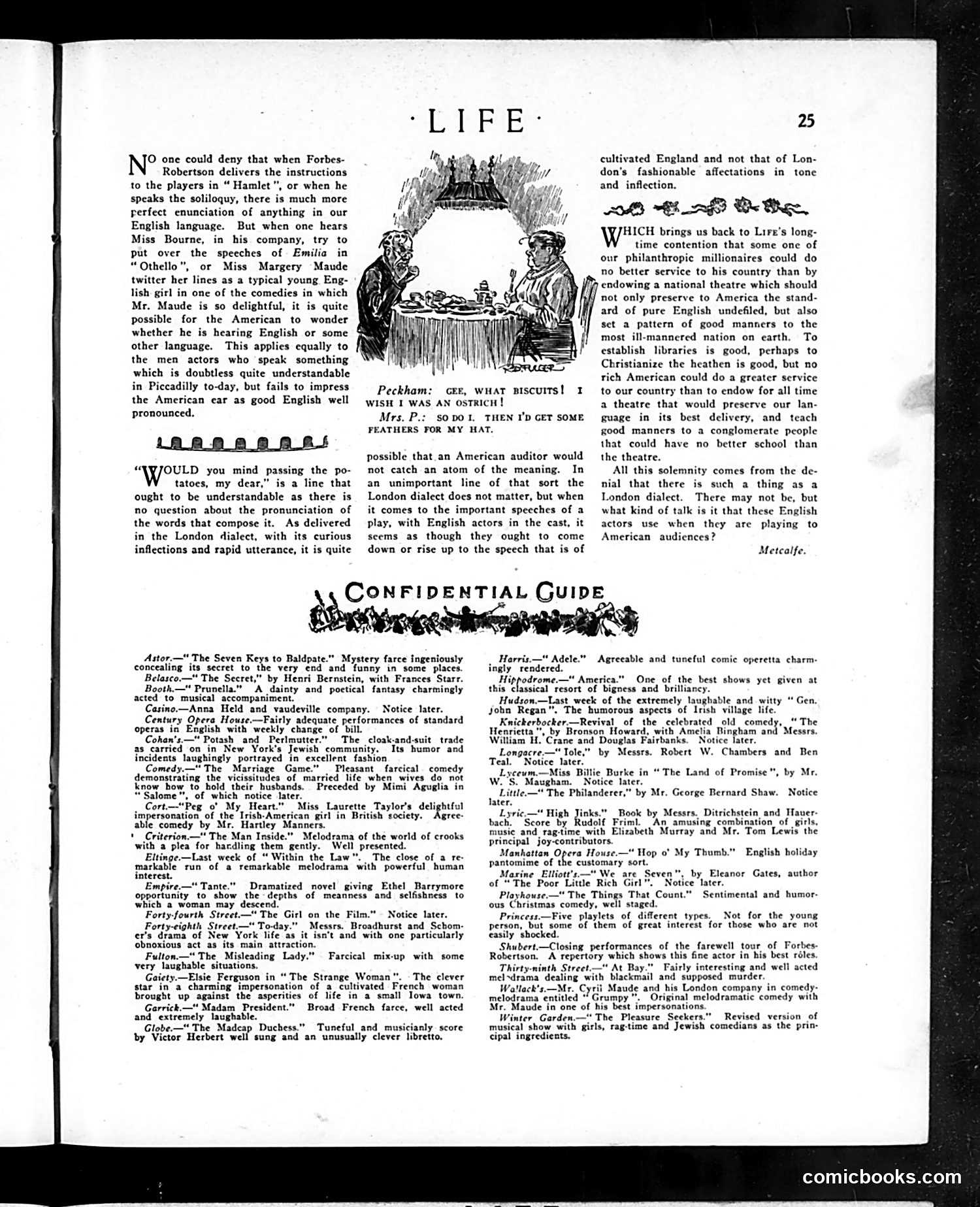
The central cartoon depicts two diners, with the caption revealing a class-based linguistic joke. The woman comments on biscuits, and the man responds that he wishes he were an ostrich to get feathers for her hat — a absurdist non-sequitur that illustrates the page's broader argument. The text criticizes English actors performing in New York, specifically their affected London dialect. While praising Forbes-Robertson's Shakespearean delivery, the author mocks supporting actresses (Miss Bourne, Margery Maude) for their exaggerated, incomprehensible English affectations — described as sounding less like proper English and more like a foreign language to American ears. The cartoon demonstrates this problem: even a simple, mundane line like "Would you mind passing the potatoes?" becomes ridiculous and meaningless when delivered in the fashionable London theatrical accent with its "curious inflections and rapid utterance." The joke satirizes how theatrical pretension obscures rather than clarifies language.
📄 Transcribed text from this page (OCR, searchable)
Machine-transcribed from the original scan — historical spelling and the odd misread are preserved.
'O one could deny that when Forbes- Robertson delivers the instructions to the players in “ Hamlet", or when he speaks the soliloquy, there is much more perfect enunciation of anything in our English language. But when one hears Miss Bourne, in his company, try to put over the speeches of Emilia in “Othello”, or Miss Margery Maude twitter her lines as a typical young Eng- lish girl in one of the comedies in which Mr. Maude is so delightful, it is quite possible for the American to wonder whether he is hearing English or some other language. This applies equally to the men actors who speak something which is doubtless quite understandable in Piccadilly to-day, but fails to impress the American ear as good English well Pronounced, 1A AM 9 6 A Af “NY7OULD you mind passing the po- tatoes, my dear,” is a line that ought to be understandable as there is no question about the pronunciation of the words that compose it. As delivered the London dialect, with its curious inflections and rapid utterance, it is quite CONFIDENTIAL Gul Astor —" The Seven Keys to Baldpate.” Mystery farce ingeniously e very end and funny in some places. by Henri Bernstein, with Frances Starr. ‘A dainty and poetical fantasy charmingly concealing its secret to The Secret, Prunella.” acted to musical accompaniment. Casino.—Anna Held and vaudeville company. Century Opera House.—Fairly adequate performances of standard operas in English with weekly change of bill. The cloak-and-suit as carried on in New York's Jewish community. incidents laughingly portrayed in excellent fashion Pleasant demonstrating the vicissitudes of married life when wives do not Preceded by Mimi Aguglia in Cohan’s.—" Potash and Perlmutter. Comedy.—"" The Marriage Game.” know how to hold their husbands. “Salome”, of which notice later. Cort. ¢ o' My Heart able comedy by Mr. Hartley Manners. ' Criterion.—" The Man Inside.” with a plea for hardling them gently. markable run of a remarkable melodrama interest. Empire.—" Tante.” which a woman may descend. ; Miss Laurette Taylor’ impersonation of the Irish-American girl in British society. Melodrama of the world of crooks Well presented. Eltinge—Last week of “ Within the Law" ith powerful human Dramatized novel givin opportunity to show the depths of meanness and selfishness to GEE, WHAT BIScuITs! 1 WISH I WAS AN osTRICH! Mrs. P.: 80 DOI, THEN I'D GET SOME FEATHERS FOR MY HAT. possible that.an American auditor would not catch an atom of the meaning. In an unimportant line of that sort the London dialect does not matter, but when it comes to the important speeches of a play, with English actors in the cast, it scems as though they ought to come down or rise up to the speech that is of fy Horris.—" Adele.” ingly rendered. Hippodrome. Notice later. trade Tts humor and Leagecrs |. Notice later. Lyceum.—Miss .'S. Maugham. farcical comedy delightful gree: bach. Score by ‘The close of a re Ethel Barrymore Ameri this classical resort of bigness and brilliancy. Hudson.—Last week of the extremely laughable and witty “ Gen. John Regan”, The humorous aspects of Irish village life. Knickerbocker.—Revival of the celebrated Henrietta, by Bronson Howard, with Am William H.'’Crane and Douglas —"‘Tole,” by Messrs. Robert W. Chambers and Ben Lyric.—* High Jinks.” adolf Friml. ; music and rag-time with Elizabeth Murray and Mr. Tom Lewis the principal joy-contributors. Manhattan Opera House. pantomime of the customary sort. Marine Eltiott’s—" We are Seven”, of “The Poor Little Rich Girl”. Playkouse.—" The Things That Count.” cultivated England and not that of Lon- don's fashionable affectations in tone and inflection, WO “EE _AGS Be Mee, HICH brings us back to Lire’s long- time contention that some one of our philanthropic millionaires could do no better service to his country than by endowing a national theatre which should not only preserve to America the stand- ard of pure English undefiled, but also set a pattern of good manners to the most ill-mannered nation on earth. To establish libraries is good, perhaps to Christianize the heathen is good, but no rich American could do a greater service to our country than to endow for all time a theatre that would preserve our lan- guage in its best delivery, and teach good manners to a conglomerate people that could have no better school than the theatre. All this solemnity comes from the de- nial that there is such a thing as a London dialect. There may not be, but what kind of talk is it that these English actors use when they are playing to American audiences? Metcalfe. DE Agrecable and tuneful comic operetta charm: One of the best shows yet given at “The Messrs. old comedy, Bingham ans banks. Notice later. Burke in “ The Land of Promise", by Mr. tice later. " The Philanderer,” by Mr. George Bernard Shaw. Notice Book by Messrs. Ditrichstein and Hauer- An amusing combination of girls, “ Hop o' My Thumb.” English holiday by Eleanor Gates, author Notice later. Sentimental and humor- ous Christmas comedy, well staged. Forty-fourth Street.—" The Girl on the Film.” Notice later. Forty-eighth Street—" To-day.” Messrs. Broadhurst and Schom- er's drama of New York life as it isn't and with one particularly obnoxious act as its main attraction. Fulton.—" The Misleading Lady.” very laughable situations. Gaiety.—Elsie Ferguson in “The Strange Woman". The clever star in a charming impersonation of a cultivated French woman brought up against the asperities of life in a small Iowa town. Garrick.—" Madam President." Broad French farce, well acted and extremely laughable. Globe.—" The Madcap Duchess.” Tuneful and musicianly score by Victor Herbert well sung and an unusually clever libretto, Farcical mix-up with some Princess.—Five playlets of different types, Not for the young person, but some of them of great interest for those who are not easily ‘shocked. Shubert—Closing performances of the farewell tour of Forbes- Robertson. A repertory which shows this fine actor in his best réles Thirty-ninth Street-—"' At Bay." Fairly interesting and well acted mel-drama dealing with blackmail and supposed murder. Wallack's.—Mr. Cyril Maude and his London company in comedy. melodrama entitled “Grumpy. Original melodramatic comedy with Mr. Maude in one of his best impersonations inter Garden.—" The Pleasure Seekers.” Revised version of musical show with girls, ragtime and Jewish comedians as the prin- cipal ingredients. comicbooks.com