
Life, 1914-01-01 · page 20 of 44
Life — January 1, 1914 — page 20: what you’re looking at
What you’re looking at
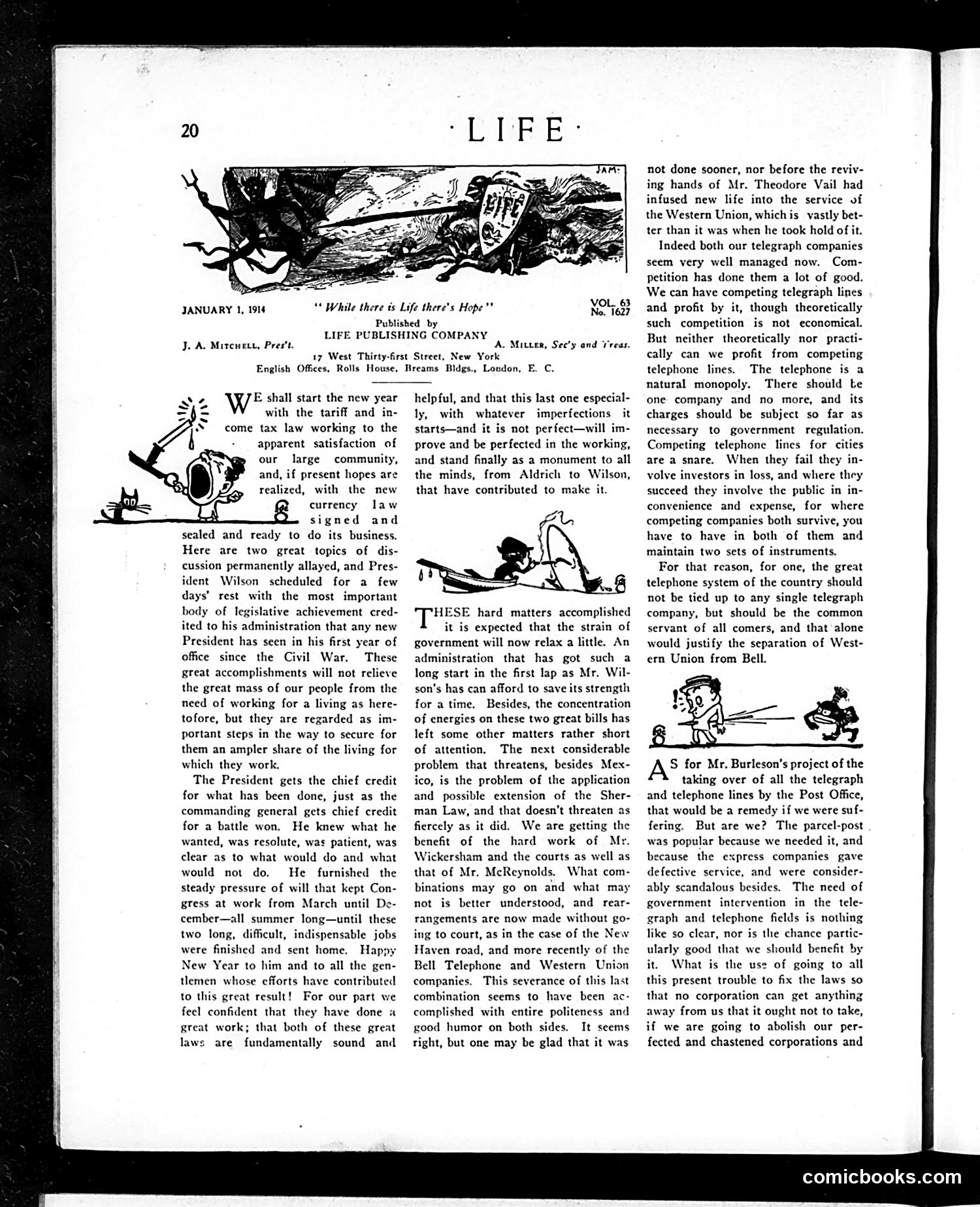
This is primarily an editorial praising President Wilson's first-year legislative achievements: the tariff reform, income tax law, and currency law (Federal Reserve Act). The unsigned piece credits Wilson with "resolute" leadership in pushing Congress through these "long, difficult, indispensable" matters. The cartoons are small decorative vignettes illustrating the editorial's points—figures appear to be celebrating or working, though they're stylized and difficult to identify specifically as named individuals. The editorial also addresses recent antitrust actions, specifically praising the forced separation of Bell Telephone and Western Union companies, while crediting Theodore Vail for improving Western Union's service beforehand. The writer argues telephone competition is economically illogical but telegraph competition beneficial—a nuanced position reflecting Progressive Era debates about monopoly regulation versus natural monopoly. The tone is congratulatory toward the Wilson administration's reform agenda.
📄 Transcribed text from this page (OCR, searchable)
Machine-transcribed from the original scan — historical spelling and the odd misread are preserved.
JANUARY 1, 1914 “* While there ts Life there's Hope"’ Published by J. A. Mitcwete, Pres’t. LIFE PUBLISHING COMPANY Mutter, Sec’y and ‘reas. 17 West Thirty-first Street, New York English Offices, Rolls House, Breams Bldgs., London, E. C. E shall start the new year with the tariff and in- come tax law working to the apparent satisfaction of our large community and, if present hopes are realized, with the new currency law signed and sealed and ready to do its business. Here are two great topics of dis- cussion permanently allayed, and Pres- ident Wilson scheduled for a few days’ rest with the most important body of legislative achievement cred- ited to his administration that any new President has seen in his first year of office since the Civil War. These great accomplishments will not relieve the great mass of our people from the need of working for a living as here- tofore, but they are regarded as im- portant steps in the way to secure for them an ampler share of the living for which they work. The President gets the chief credit for what has been done, just as the commanding general gets chief credit for a battle won. He knew what he wanted, was resolute, was patient, was clear as to what would do and what would not do. He furnished the steady pressure of will that kept Con- gress at work from March until De- cember—all summer long—until these two long, difficult, indispensable jobs were finished and sent home. Happy New Year to him and to all the gen- tlemen whose efforts have contributed to this great result! For our part we feel confident that they have done a great work; that both of these great laws are fundamentally sound and helpful, and that this last one especial- ly, with whatever imperfections it starts—and it is not perfect—will im- prove and be perfected in the working, and stand finally as a monument to all the minds, from Aldrich to Wilson, that have contributed to make it. HESE hard matters accomplished it is expected that the strain of government will now relax a little. An administration that has got such a long start in the first lap as Mr. Wil- son’s has can afford to save its strength for a time. Besides, the concentration of energies on these two great bills has left some other matters rather short of attention, The next considerable problem that threatens, besides Mex- ico, is the problem of the application and possible extension of the Sher- man Law, and that doesn’t threaten as fiercely as it did. We are getting the benefit of the hard work of Mr. Wickersham and the courts as well as that of Mr. McReynolds. What com- binations may go on and what may not is better understood, and re; rangements are now made without go- ing to court, as in the case of the New Haven road, and more recently of the Bell Telephone and Western Union companies, This severance of this last combination seems to have been ac- complished with entire politeness and good humor on both sides. It seems right, but one may be glad that it was not done sooner, nor before the reviv- ing hands of Mr. Theodore Vail had infused new life into the service of the Western Union, whichis vastly bet- ter than it was when he took hold of it. Indeed both our telegraph companies seem very well managed now. Com- petition has done them a lot of good. We can have competing telegraph lines and profit by it, though theoretically such competition is not economical. But neither theoretically nor practi- cally can we profit from competing telephone lines. The telephone is a natural monopoly, There should te one company and no more, and its charges should be subject so far as necessary to government regulation. Competing telephone lines for cities are a snare. When they fail they in- volve investors in loss, and where they succeed they involve the public in in- convenience and expense, for where competing companies both survive, you have to have in both of them and maintain two sets of instruments. For that reason, for one, the great telephone system of the country should not be tied up to any single telegraph company, but should be the common servant of all comers, and that alone would justify the separation of West- ern Union from Bell. S for Mr. Burleson’s project of the taking over of all the telegraph and telephone lines by the Post Office, that would be a remedy if we were suf- fering. But are we? The parcel-post was popular because we needed it, and because the express companies gave defective service, and were consider- ably scandalous besides. The need of government intervention in the tele- graph and telephone fields is nothing like so clear, nor is the chance partic- ularly good that we should benefit by What is the use of going to all this present trouble to fix the laws so that no corporation can get anything away from us that it ought not to take, if we are going to abolish our per- fected and chastened corporations and comicbooks.com