
Life, 1914-01-01 · page 26 of 44
Life — January 1, 1914 — page 26: what you’re looking at
What you’re looking at
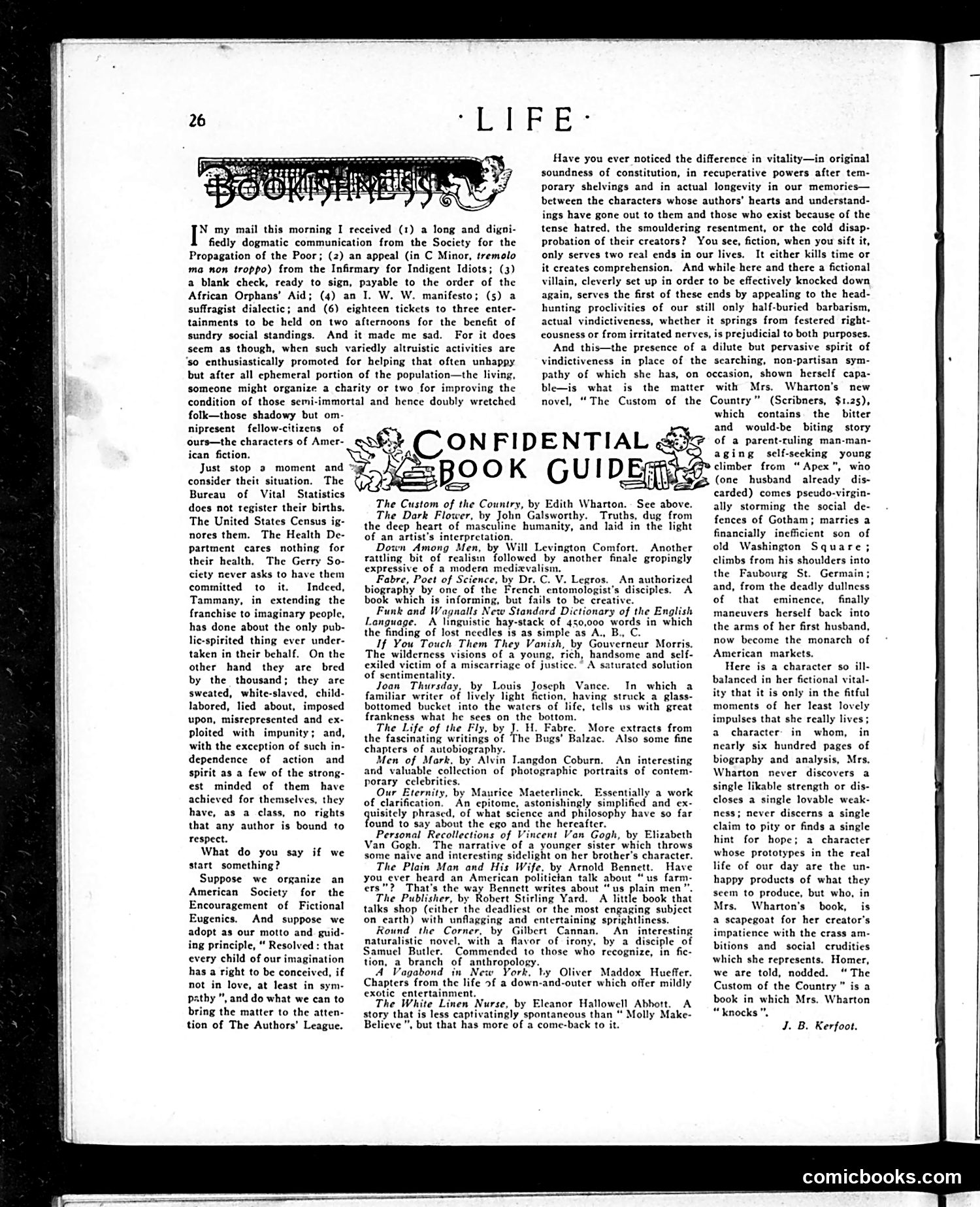
This page from *Life* magazine features a **"Confidential Book Guide"** — a satirical book review column critiquing new fiction. The main target is Edith Wharton's *The Custom of the Country*. The reviewer attacks Wharton's novel for lacking genuine sympathy toward its protagonist, a social-climbing woman from a town called "Apex." The critic argues that Wharton writes with "vindictiveness" rather than "searching, non-partisan sympathy." The heroine — who discards husbands, manipulates Washington Square society, climbs into French aristocracy, then remarries for wealth — is portrayed as so poorly rendered that she only "really lives" during her least admirable moments. The satire critiques both Wharton's characterization and broader literary ethics: that fiction serving only to express an author's hatred or resentment fails readers. The column reviews other contemporary books with similar standards of literary judgment. The opening section (left column) humorously lists absurd mail received, establishing the magazine's satirical tone.
📄 Transcribed text from this page (OCR, searchable)
Machine-transcribed from the original scan — historical spelling and the odd misread are preserved.
of an artist's interpretation. Joan Thursday, by familiar writer bottomed bucket into ti frankness what he The Life of the the fascinating writings of CONFIDENTIAL BOOK GUIDEg: The Custom of the Country, by Edith Wharton. See above. The Dark Flower, by John Galsworthy. the deep heart of masculine humanity, and laid in the light Down Among Men, by Will Levington Comfort. rattling bit of realisin followed by another finale gropingly expressive of a modern medixvalism. the Fabre, Poet of Science, by Dr. C. V. Legros. biography by one of the French entomologist’s disciples. A fails to be creative. of wv Standard Dictionary of the English A linguistic hay-stack of 450,000 words in which the finding of lost needles is as simple as A., B., C. If You Touch Them They Vanish, by Gouverneur Morris. The wilderness visions of a young, exiled victim of a miscarriage of justice. which is informing, but Louis Joseph Vance. lively light fiction, having struck a glass- he waters of life, on the bottom. ‘he Bugs’ Balzac. Have you ever noticed the difference in vitality—in original soundness of constitution, in recuperative powers after tem- porary shelvings and in actual longevity in our memories— between the characters whose authors’ hearts and understand- ings have gone out to them and those who exist because of the tense hatred, the smouldering resentment, or the cold disap- probation of their creators? You see, fiction, when you sift it, only serves two real ends in our lives. It cither kills time or it creates comprehension, And while here and there a fictional villain, cleverly set up in order to be effectively knocked down again, serves the first of these ends by appealing to the head- hunting proclivities of our still only half-buried barbarism, actual vindictiveness, whether it springs from festered right- cousness or from irritated nerves, is prejudicial to both purposes. And this—the presence of a dilute but pervasive spirit of vindictiveness in place of the searching, non-partisan sym- pathy of which she has, on occasion, shown herself capa- what is the matter with Mrs. Wharton's new “The Custom of the Country” (Scribners, $1.25), which contains the bitter oS) x > ble—is novel, and would-be biting story of a parent-ruling man-man- aging self-secking young climber from “ Apex", wao (one husband already dis- carded) comes pseudo-virgin- ally storming the social de- fences of Gotham; marries a financially inefficient son of old Washington Square; climbs from his shoulders into Faubourg St. Germain; and, from the deadly dullness that eminence, _ finally maneuvers herself back into the arms of her first husband, now become the monarch of American markets. Here is a character so ill- balanced in her fictional vital- ity that it is only in the fitful moments of her least lovely impulses that she really lives; a character in whom, in Truths, dug from Another An authorized ich, handsome and self- A saturated solution In which a tells us with great Fabre. More extracts from Also some fine N my mail this morning I received (1) a long and digni- fiedly dogmatic communication from the Society for the Propagation of the Poor; (2) an appeal (in C Minor, tremolo ma non troppo) from the Infirmary for Indigent Idiots; (3) a blank check, ready to sign, payable to the order of the African Orphans’ Aid; (4) an I. W. W. manifesto; (5) a suffragist dialectic; and (6) eighteen tickets to three enter- tainments to be held on two afternoons for the benefit of sundry social standings. And it made me sad. For it does seem as though, when such variedly altruistic activities are “so enthusiastically promoted for helping that often unhappy but after all ephemeral portion of the population—the living, someone might organize a charity or two for improving the condition of those semi-immortal and hence doubly wretched folk—those shadowy but om- nipresent fellow-citizens of ours—the characters of Amer- ook ican fiction, cy Just stop 2 moment and ~ gS consider theit situation. The Bureau of Vital Statistics does not register their births. The United States Census ig- nores them. The Health De- partment cares nothing for their health, The Gerry So- ciety never asks to have them committed to it. Indeed, Tammany, in extending the book franchise to imaginary people, Funk and Wagnalls N has done about the only pub- Language. lic-spirited thing ever under- taken in their behalf. On the other hand they are bred by the thousand; they are sweated, white-slaved, child- labored, lied about, imposed upon, misrepresented and ex- ploited with impunity; and, with the exception of such in- dependence of action and spirit as a few of the strong- est minded of them have achieved for themselves, they have, as a class, no rights that any author is bound to respect. What do you say if we start something? Suppose we organize an American Society for the Encouragement of Fictional Eugenics. And suppose we adopt as our motto and guid- ing principle, “ Resolved: that every child of our imagination has a right to be conceived, if not in love, at least in sym- pathy ", and do what we can to bring the matter to the atten- tion of The Authors’ League. chapters of autobiography. Men of Mark. by Alvin Langdon Coburn. An interesting and valuable collection of photographic portraits of contem- porary celebrities. Our Eternity, by Maurice Maeterlinck. Essentially a work of clarification. An epitome, astonishingly simplified and ex- uisitely phrased, of what science and philosophy have so far found to say about the ego and the hereafter. Personal Recollections of Vincent Van Gogh, by Elizabeth Van Gogh. The narrative of a younger sister which throws some naive and interesting sidclight on her brother's character. The Plain Man and His Wife, by Arnold Bennett. Have you ever heard an American politician talk about “us farm- ers”? That's the way Bennett writes about “us plain men”. The Publisher, by Robert Stirling Yard. A little book that talks shop (cither the deadliest or the most engaging subject on earth) with unflagging and entertaining sprightliness. Round the Corner, by Gilbert Cannan. An interesting naturalistic novel, with a flavor of irony, by a disciple of Samuel Butler. Commended to those who recognize, in fic- tion, a branch of anthropology. A Vagabond in New Fork hy Oliver Maddox Hueffer. Chapters from the life of a down-and-outer which offer mildly exotic entertainment. The White Linen Nurse, by Eleanor Hallowell Abbott. A story that is less captivatingly spontaneous than “ Molly Make- Believe ", but that has more of a come-back to it. nearly six hundred pages of biography and analysis, Mrs. Wharton never discovers a single likable strength or dis- closes a single lovable weak- ness; never discerns a single claim to pity or finds a single hint for hope; a character whose prototypes in the real life of our day are the un- happy products of what they seem to produce, but who, in Mrs. Wharton's book, is a scapegoat for her creator's impatience with the crass am- bitions and social crudities which she represents. Homer, we are told, nodded. “ The Custom of the Country” is a book in which Mrs. Wharton “knocks ", J. B. Kerfoot. comicbooks.com