
A complete issue · 48 pages · 1913
Life — May 1, 1913
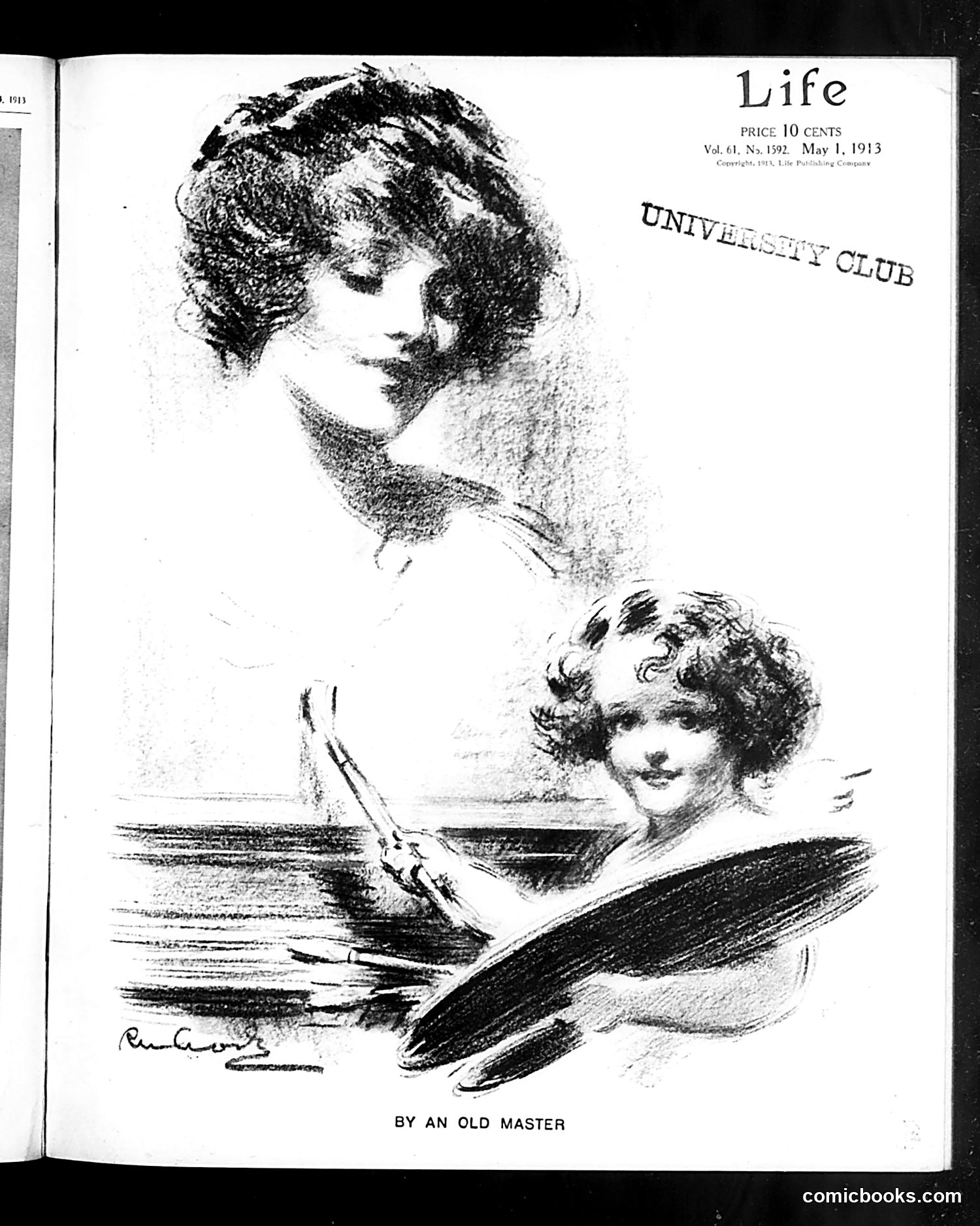
This cover illustration by an artist (signed, likely "Randolph") depicts two figures engaged in artistic creation. The upper portrait shows a woman's face in classical style, while below, a younger figure (possibly a child or student) holds painting implements, appearing to study or copy the work. The title "BY AN OLD MASTER" suggests this is satirizing art instruction, artistic imitation, or the relationship between established and emerging artists. Given the 1913 date and the "University Club" reference, this likely comments on formal art training, academic instruction, or debates about traditional versus modern artistic methods that were prominent in early 20th-century artistic circles. The sketch quality emphasizes the drawing process itself as the subject matter.
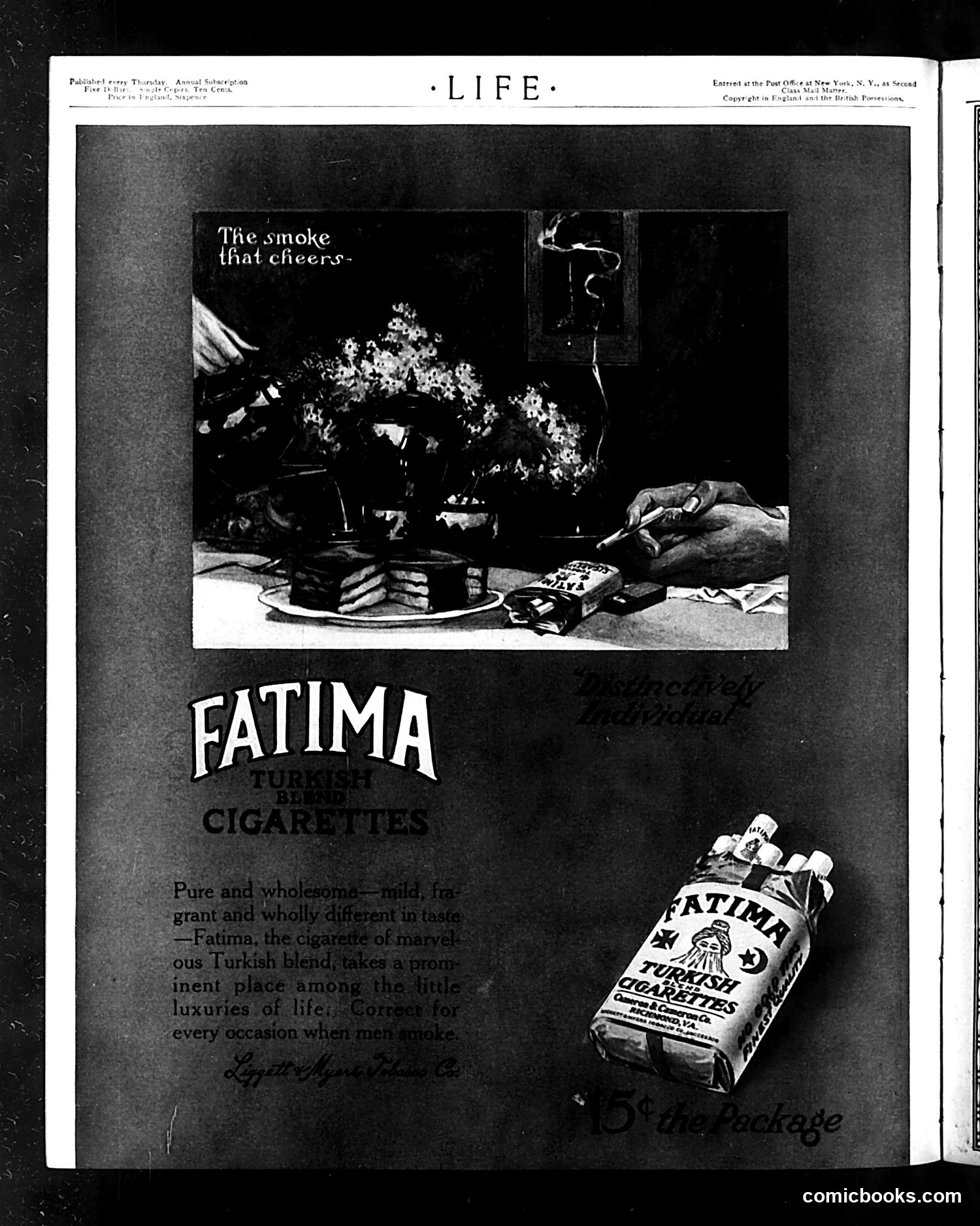
This is a commercial advertisement for Fatima Turkish cigarettes, not political satire. The page features: **Main image**: "The smoke that cheers" — a dramatic photograph showing a fireplace with decorative flowers and a hand holding a cigarette, evoking luxury and leisure. **Product pitch**: The ad emphasizes Fatima's "pure and wholesome" Turkish blend as "correct for every occasion when men smoke," positioning it as a refined luxury item. **Visual marketing**: A package of Fatima cigarettes is displayed prominently below. The phrase "the smoke that cheers" suggests an aspirational lifestyle associated with the product. This reflects early 20th-century cigarette marketing that targeted male consumers by associating smoking with sophistication and social status.
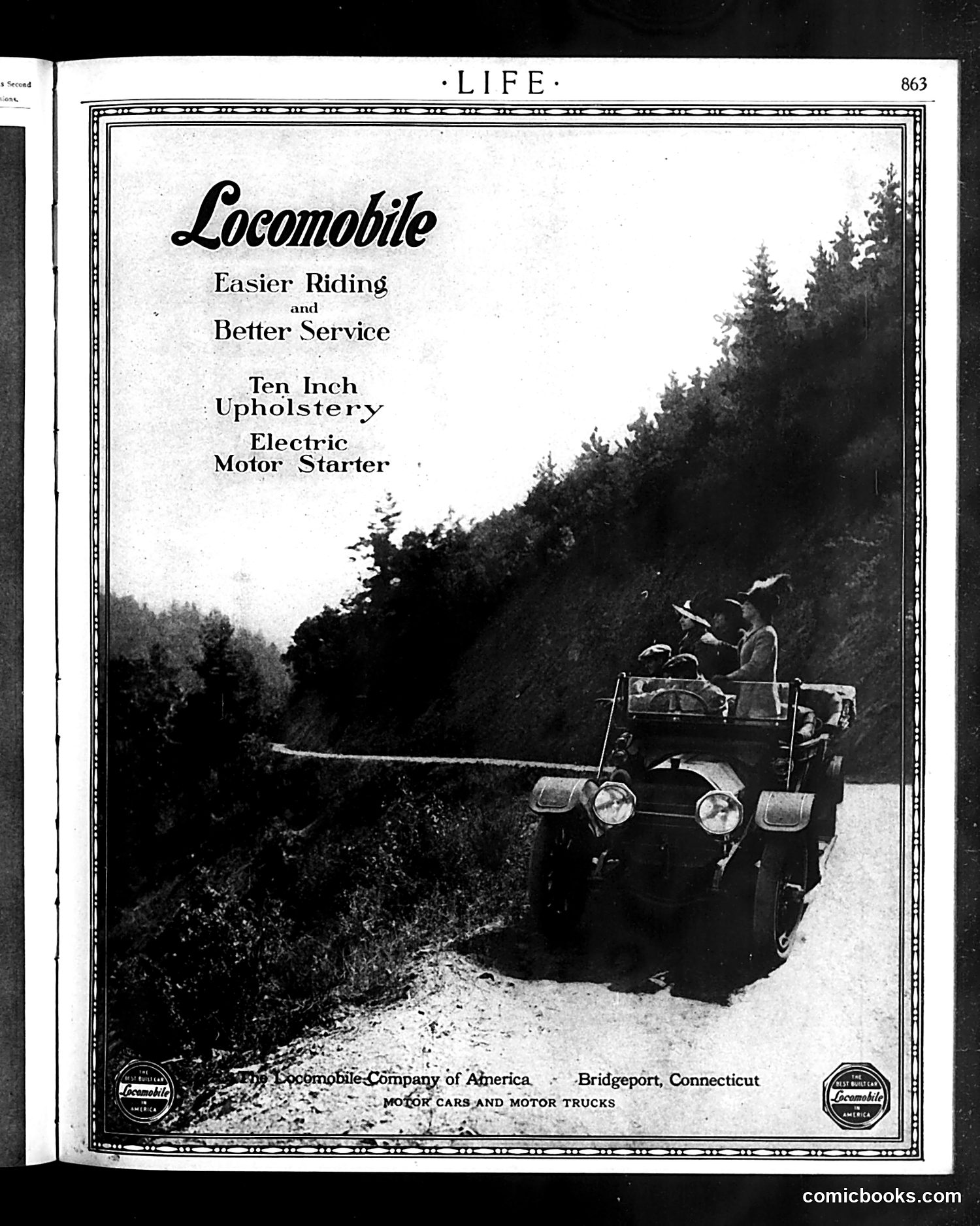
This page is **an advertisement, not editorial content or satire**. It's a full-page ad for the Locomobile automobile company, promoting their vehicles' features: easier riding, better service, ten-inch upholstery, and electric motor starter. The image shows a Locomobile car on a rural mountain road with two occupants, emphasizing the vehicle's capability for leisure driving through scenic terrain. The photograph is styled to suggest comfort and reliability rather than to satirize or critique anything. There are no political figures, caricatures, or satirical commentary present. This is straightforward early automotive advertising placed in *Life* magazine, likely from the 1910s-1920s era.
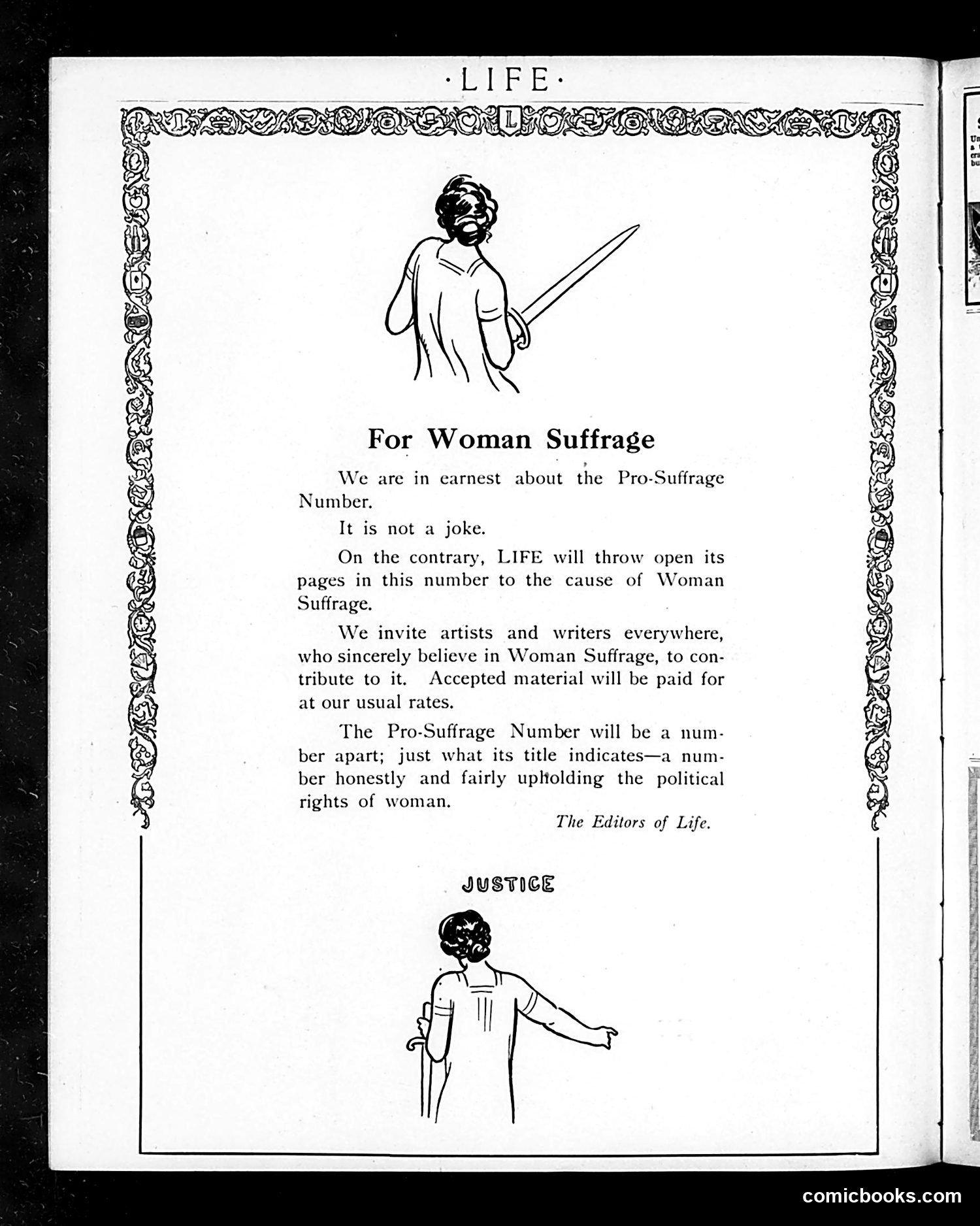
This page announces Life magazine's "Pro-Suffrage Number," supporting women's right to vote. The two illustrated figures represent allegorical concepts rather than specific individuals. The top figure labeled "For Woman Suffrage" depicts a woman holding a sword—likely representing female strength, activism, or militancy in the suffrage movement. Below, "Justice" shows a female figure in classical style, traditionally symbolizing the legal and moral righteousness of the cause. The editors declare they will dedicate an issue to woman suffrage, inviting contributions from artists and writers who support it. They emphasize this is serious advocacy ("It is not a joke"), not entertainment. This reflects the early 20th-century American suffrage movement's struggle for voting rights, which ultimately succeeded with the 19th Amendment (1920).
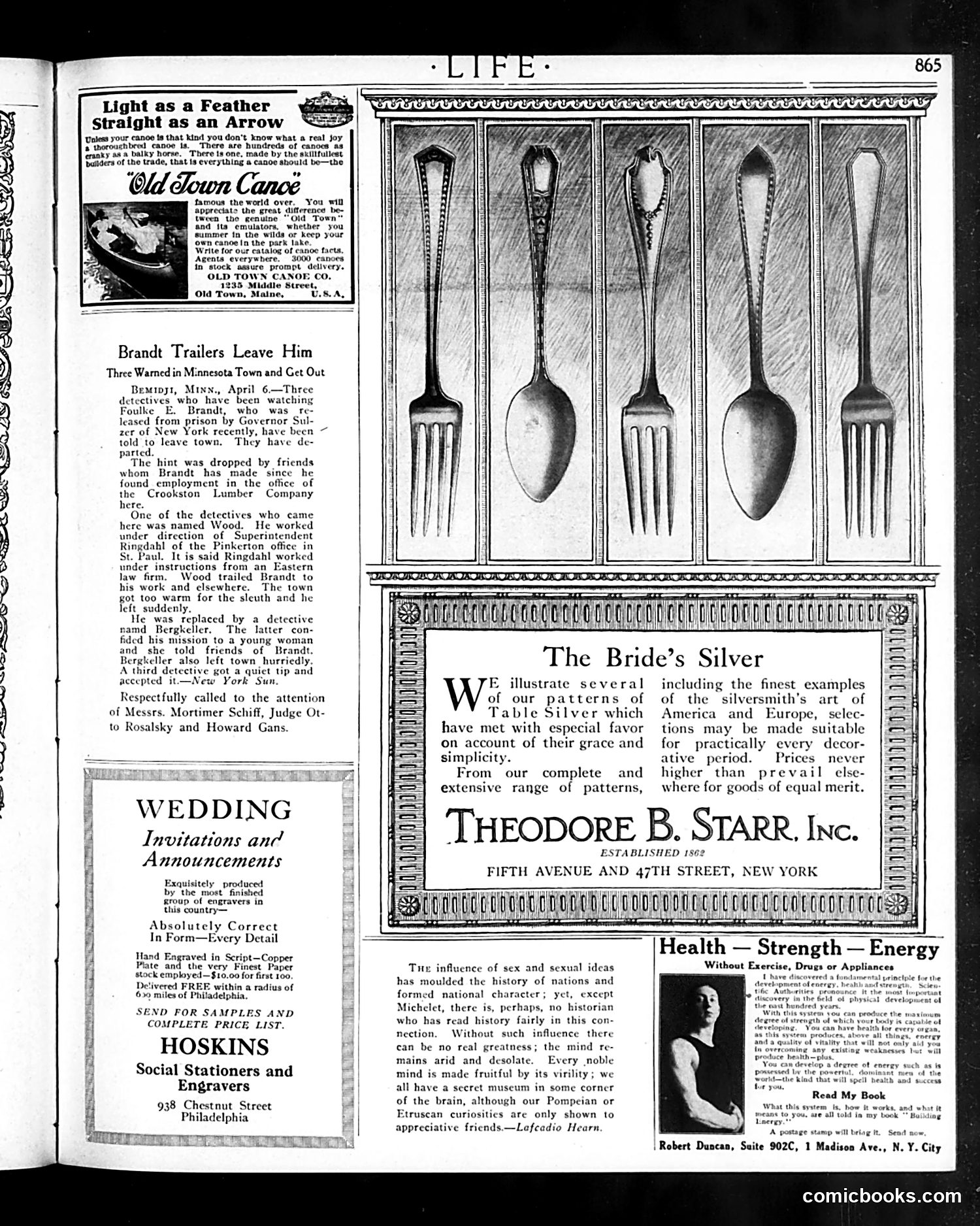
This page contains primarily **advertising and editorial content rather than political satire**. The main visual elements are: - An advertisement for "Old Town Canoe" featuring a photograph - An illustration of decorative silver flatware (forks and spoons) for Theodore B. Starr, Inc., a silversmith - A "Health—Strength—Energy" advertisement featuring a photograph of a woman The only editorial content is a brief article titled "Brandt Trailers Leave Him," discussing the departure of detectives who had been observing E. Brandt, a prisoner recently released by Governor Sulzer of New York. The piece appears to be straightforward crime reporting rather than satire. **This page does not contain political cartoons or satirical commentary** worthy of historical analysis—it's a typical early 20th-century magazine page mixing news items with luxury goods advertising.
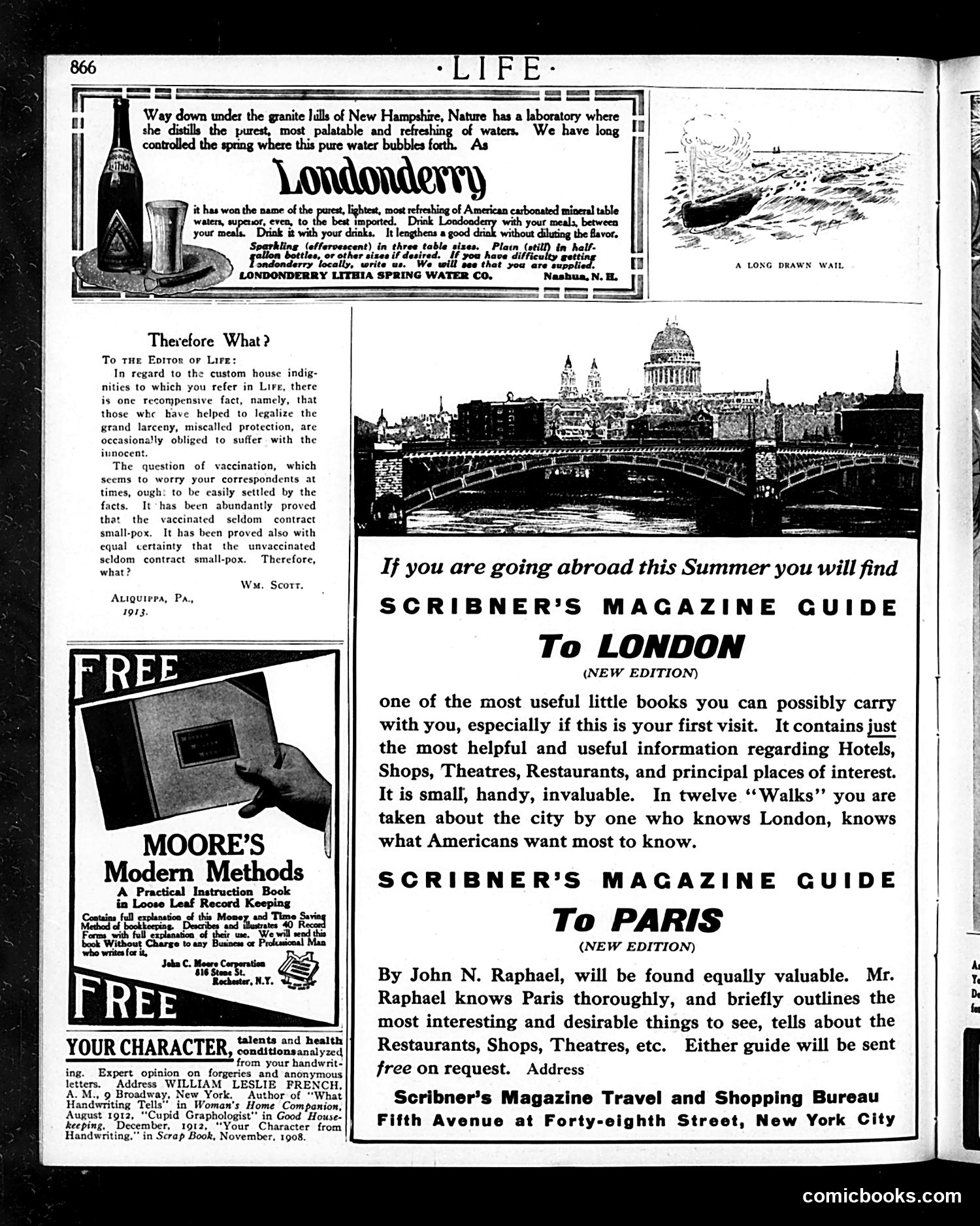
This page is primarily **advertising and travel content** from a 1913 Life magazine issue, not political satire. The top features a **Londonderry mineral water advertisement**, describing it as America's finest carbonated water source from New Hampshire springs. Below is a reader's letter titled "Therefore What?" from Aliquippa, PA, debating **vaccination and smallpox protection**—arguing that vaccinated populations contract smallpox as readily as unvaccinated ones, questioning the procedure's necessity. This reflects early-1900s anti-vaccination skepticism. The remaining space advertises **Scribner's Magazine travel guides** to London and Paris, presented as essential resources for American travelers—with Paris guide authored by John N. Raphael. A free offer for "Moore's Modern Methods" bookkeeping guide appears at bottom left.
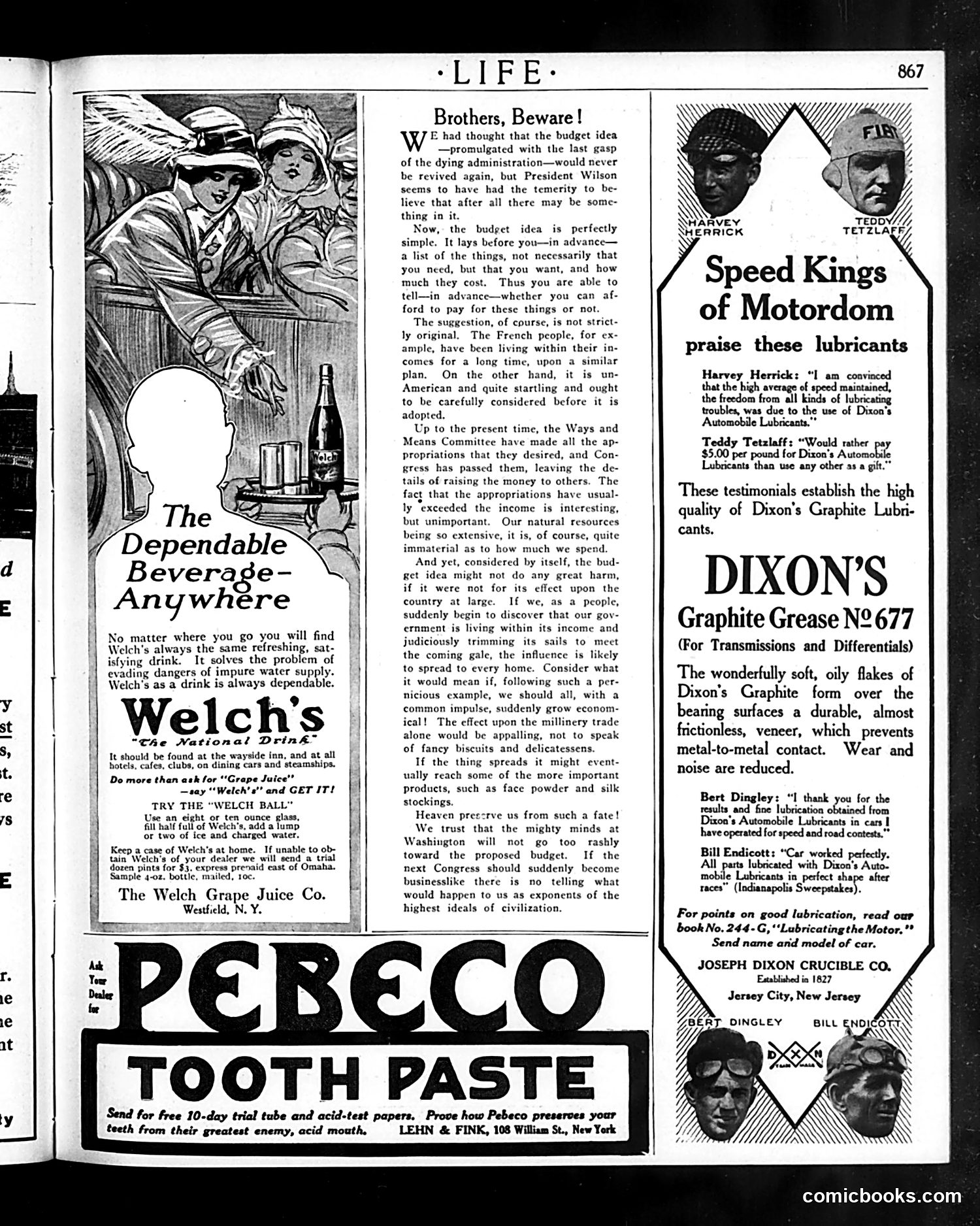
The main article "Brothers, Beware!" appears to be political satire addressing budget concerns during what seems to be the Wilson administration. The text warns against adopting a French budgeting system, arguing instead for an American approach that itemizes desired expenditures rather than simply cutting costs across the board. The piece argues that following the French model uncritically could harm the country's economy and social structure. It advocates for transparent, detailed budget planning where Congress carefully considers each expenditure rather than indiscriminately slashing the budget. The remainder of the page consists of period advertisements for Welch's grape juice, Dixon's lubricants, and Pebeco toothpaste—typical commercial content from this era of Life magazine.
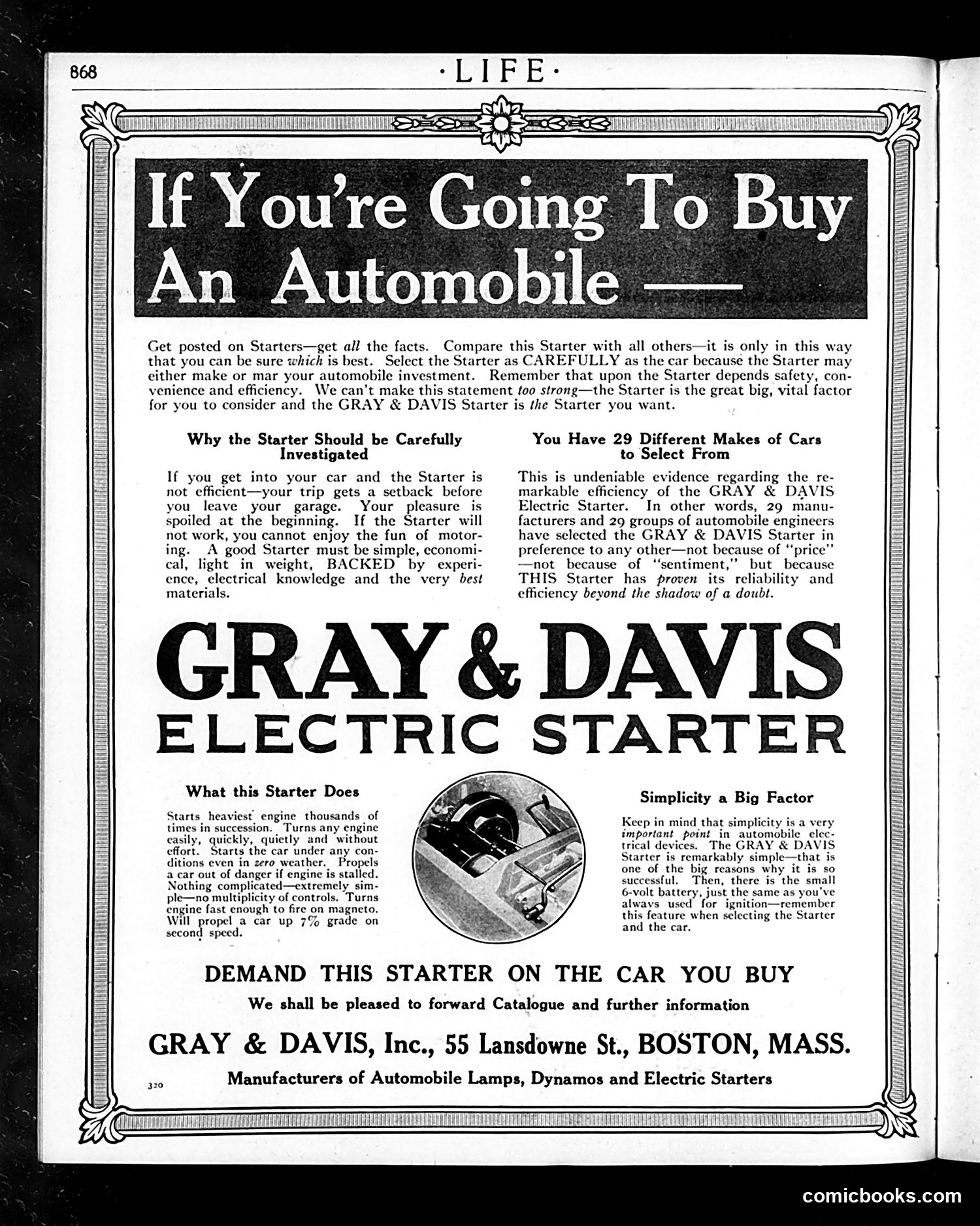
This is **not a cartoon or satire page** — it's a **full-page advertisement** for the Gray & Davis Electric Starter, a car component manufacturer based in Boston. The ad targets automobile buyers of the era (likely 1910s-1920s) by arguing that the electric starter is a crucial safety feature to investigate before purchase. It emphasizes the starter's reliability and simplicity, claims 29 car manufacturers use it, and urges consumers to "demand this starter on the car you buy." The small technical illustration shows the mechanical starter mechanism. The text uses persuasive marketing language typical of the period—emphasizing efficiency, safety, and engineering superiority—rather than satire or political commentary.
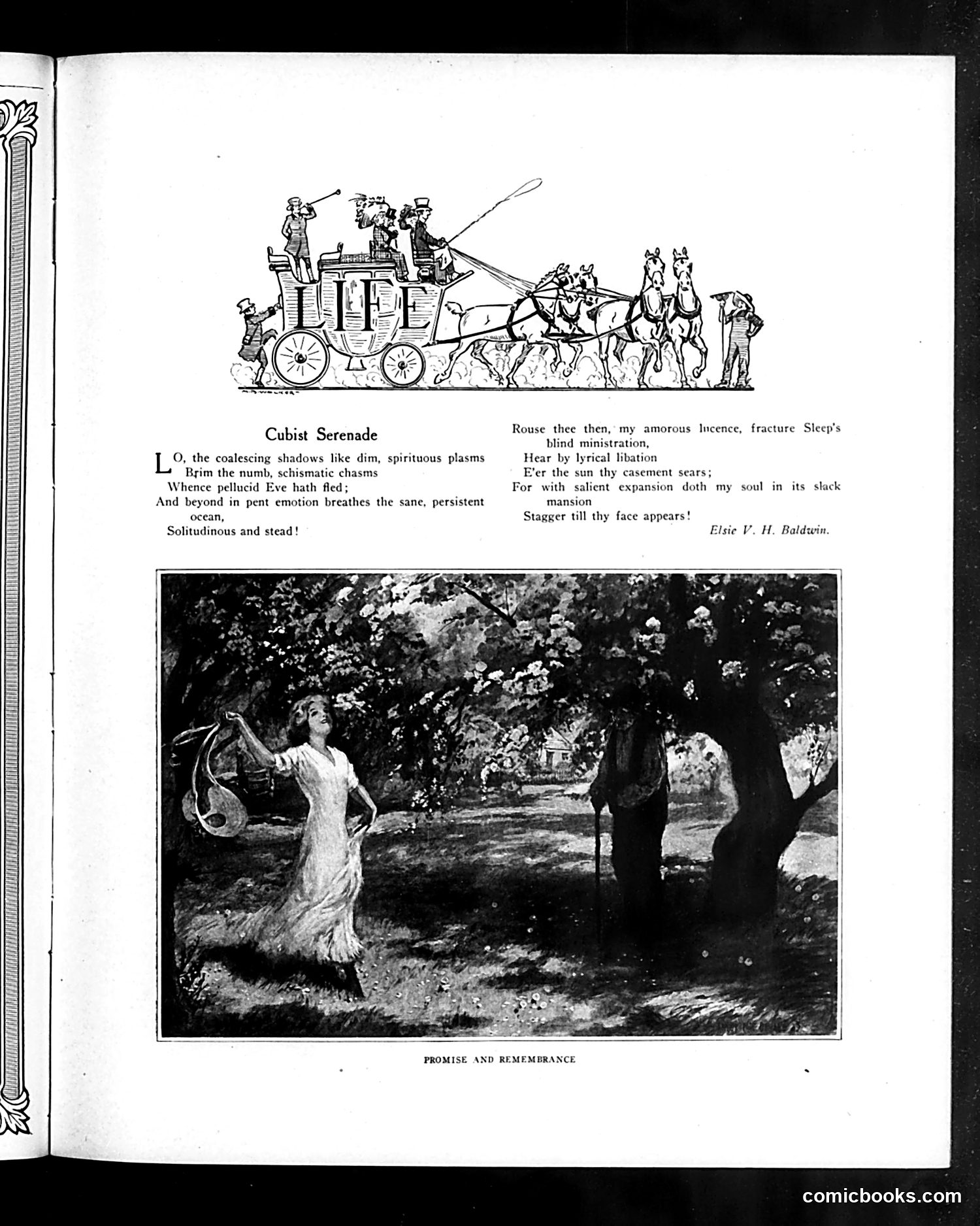
This page contains two artworks. The top illustration is a satirical engraving titled "Cubist Serenade," depicting an ornate carriage drawn by multiple horses with figures perched atop it—likely mocking Cubism, the avant-garde art movement. The exaggerated, fragmented composition of the carriage itself appears to parody Cubist aesthetics. Below is a romantic photograph titled "Promise and Remembrance," showing a woman in classical dress gesturing expressively in a wooded garden setting. The accompanying poem by Elsie V. H. Baldwin uses flowery, sentimental language addressing an "amorous Innocence." The juxtaposition suggests *Life* magazine is satirizing the contrast between modernist artistic experimentation (Cubism) and conventional romantic sentimentality—a common theme in early 20th-century American humor magazines criticizing artistic pretension.
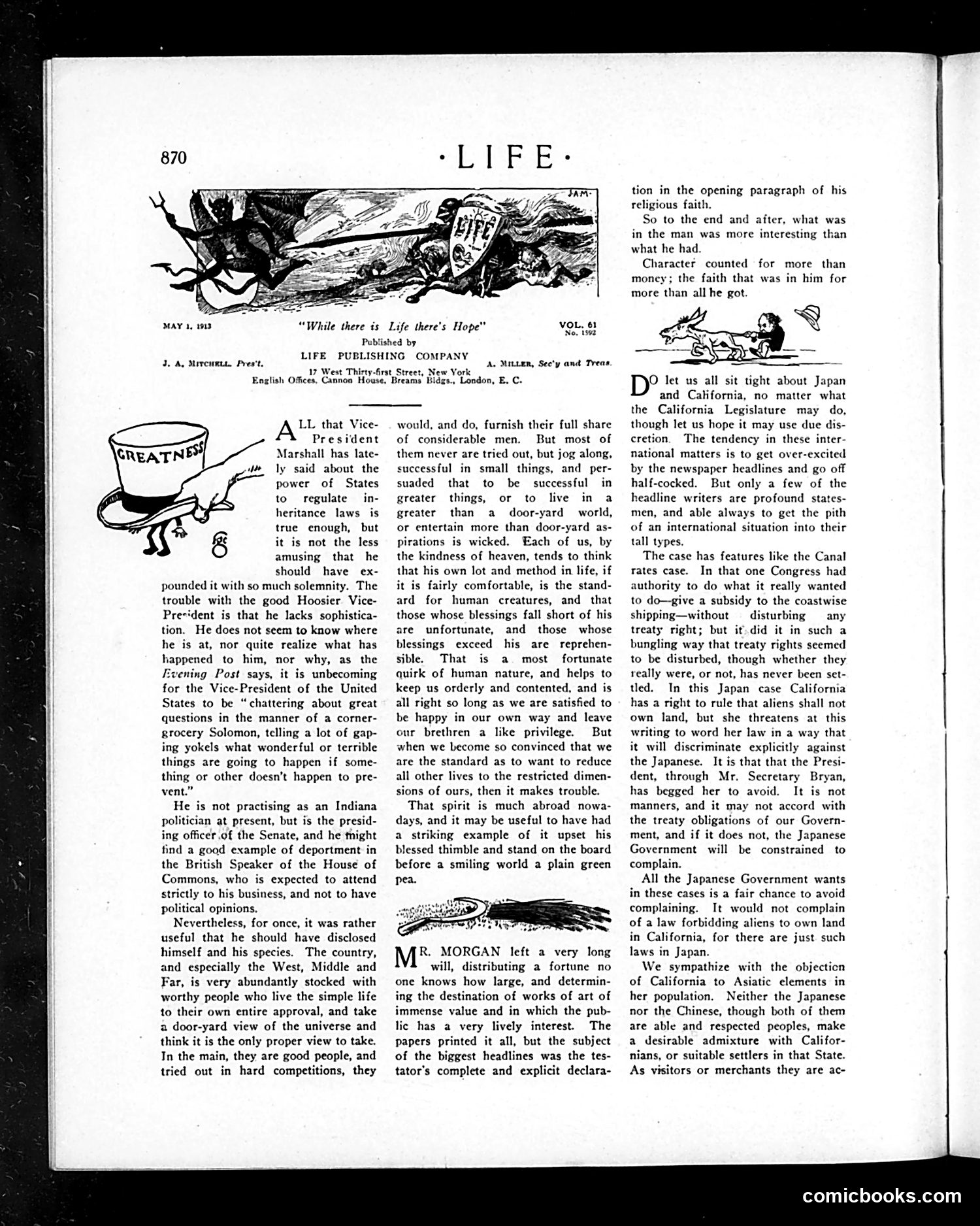
This page from *Life* (May 1, 1913) contains editorial commentary criticizing Vice-President James Sherman's vague political positioning. The text sarcastically notes Sherman "lacks sophistication" and hasn't clearly disclosed his ambitions, comparing him unfavorably to the British Speaker of the House of Commons. The left margin features an illustration of a figure labeled "GREATNESS" climbing into an oversized hat—likely satirizing Sherman's inflated self-regard or unclear grasp of the presidency. The accompanying editorial mocks Sherman for simultaneously denying political ambitions while positioning himself for higher office, suggesting his evasiveness and lack of decisive character rendered him unfit for national leadership.
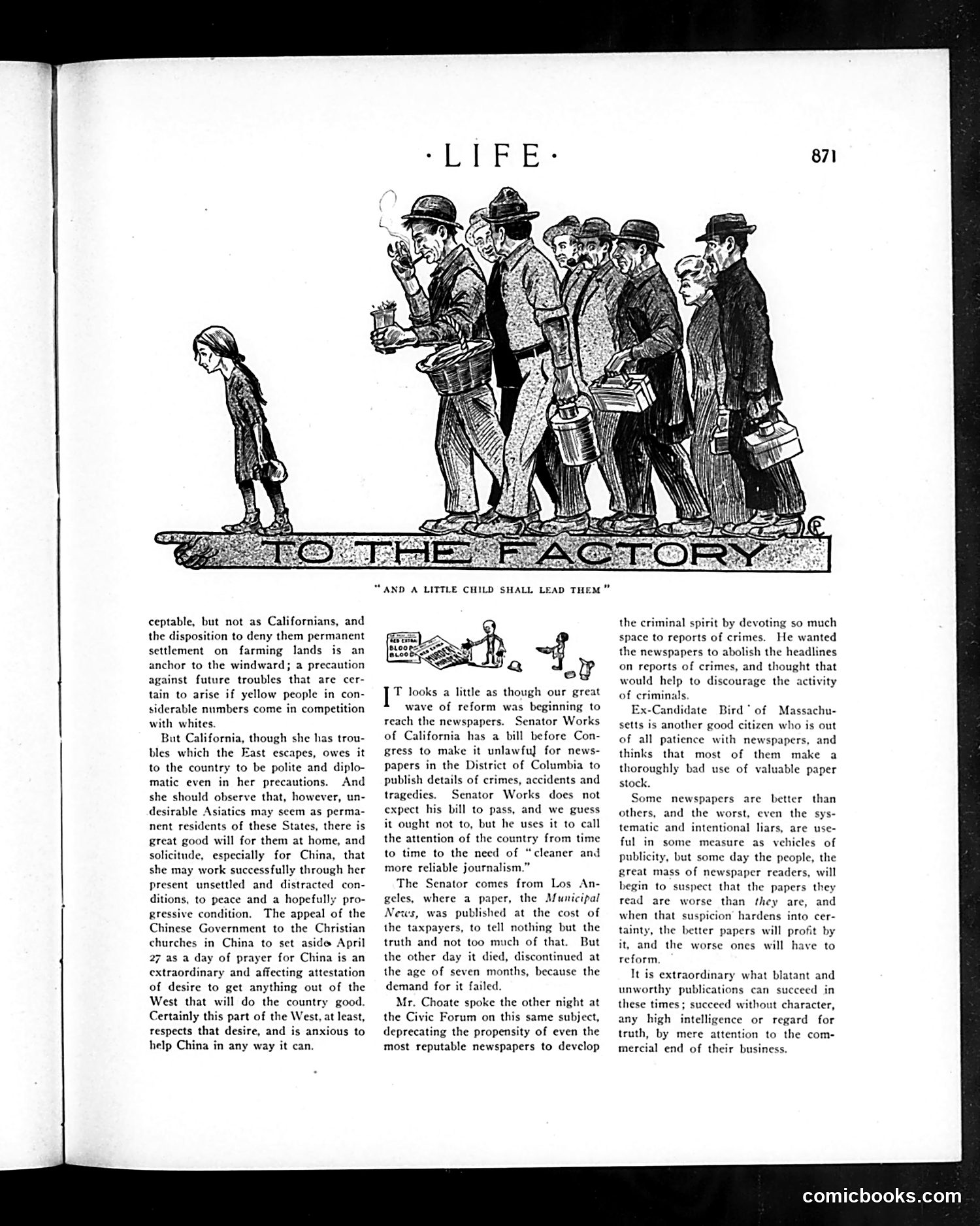
The satirical cartoon depicts a small child leading a line of well-dressed men toward a factory. The caption quotes Isaiah 11:6 ("and a little child shall lead them"), inverting the biblical passage's hopeful meaning. The accompanying article discusses Senator Works's proposed bill to make crime reporting unlawful in Washington D.C. newspapers. The text argues that while some newspapers sensationalize crime, suppressing reporting isn't the answer—instead, honest journalism and "cleaner and more reliable" reporting would better serve public interest. The cartoon sarcastically critiques this reform proposal by showing a child leading industrialists to the factory, suggesting that well-intentioned reforms may paradoxically enable exploitation rather than prevent it. The juxtaposition highlights tension between controlling media narratives and actually addressing systemic problems like child labor.
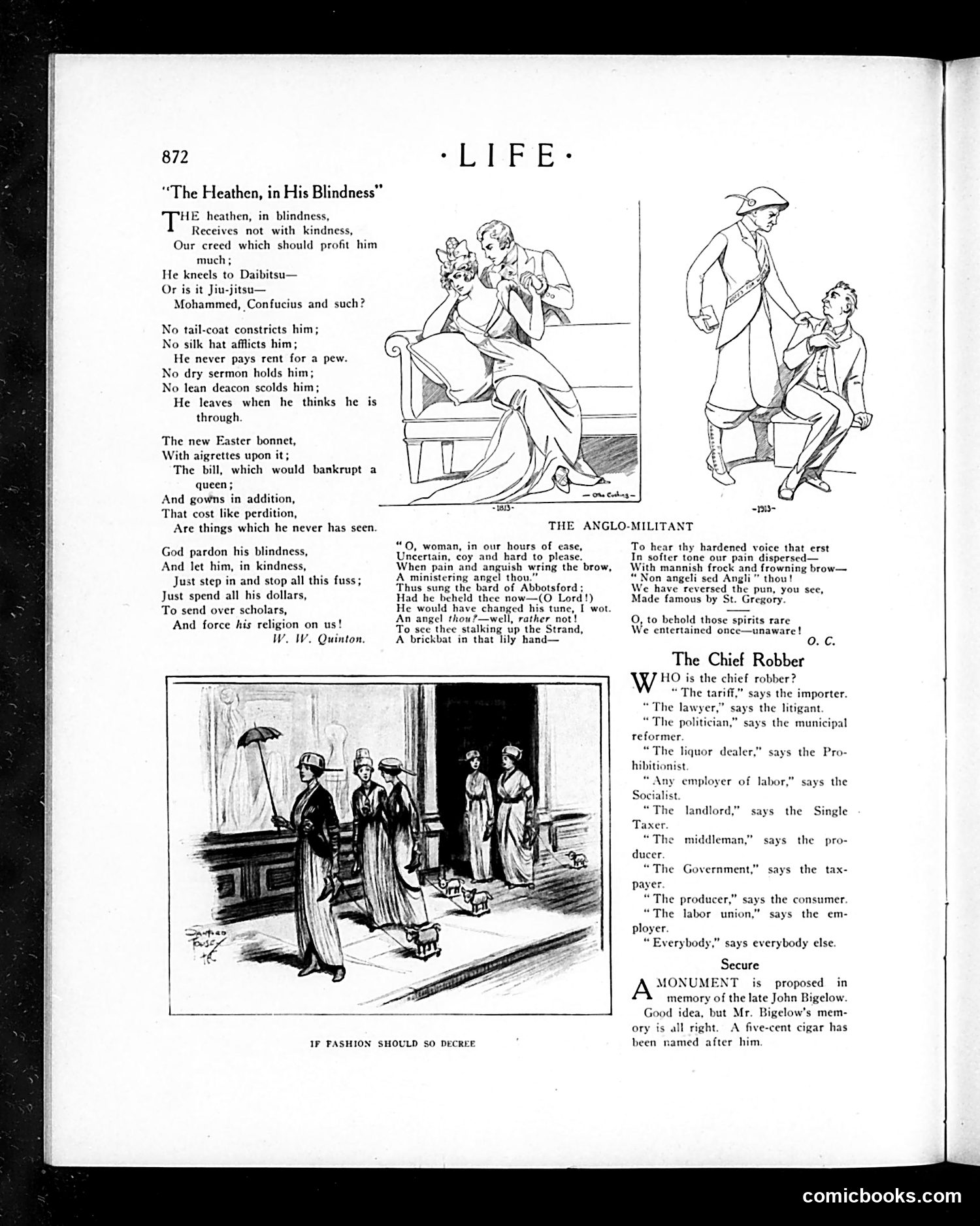
This page contains three satirical pieces: **"The Heathen, in His Blindness"** (poem by W.W. Quinton): Mocks religious hypocrisy—a supposedly pious Christian criticizes non-Christian practices while himself engaging in materialism and vanity (Easter bonnets, worldly goods). The satire suggests Western Christian superiority claims ring hollow given actual moral behavior. **"The Anglo-Militant"** (poem, author D.C.): Satirizes British imperial violence, depicting a woman defending aggressive military actions while posturing as civilized and maternal. **"The Chief Robber"** (prose satire): Lists competing claims about who the "chief robber" is—tariff interests, lawyers, politicians, employers, landlords, governments, and others—suggesting systematic exploitation pervades society, with blame distributed across institutions. **"If Fashion Should So Decree"** (cartoon): Shows fashionable women in impractical dress, mocking fashion's absurd demands.
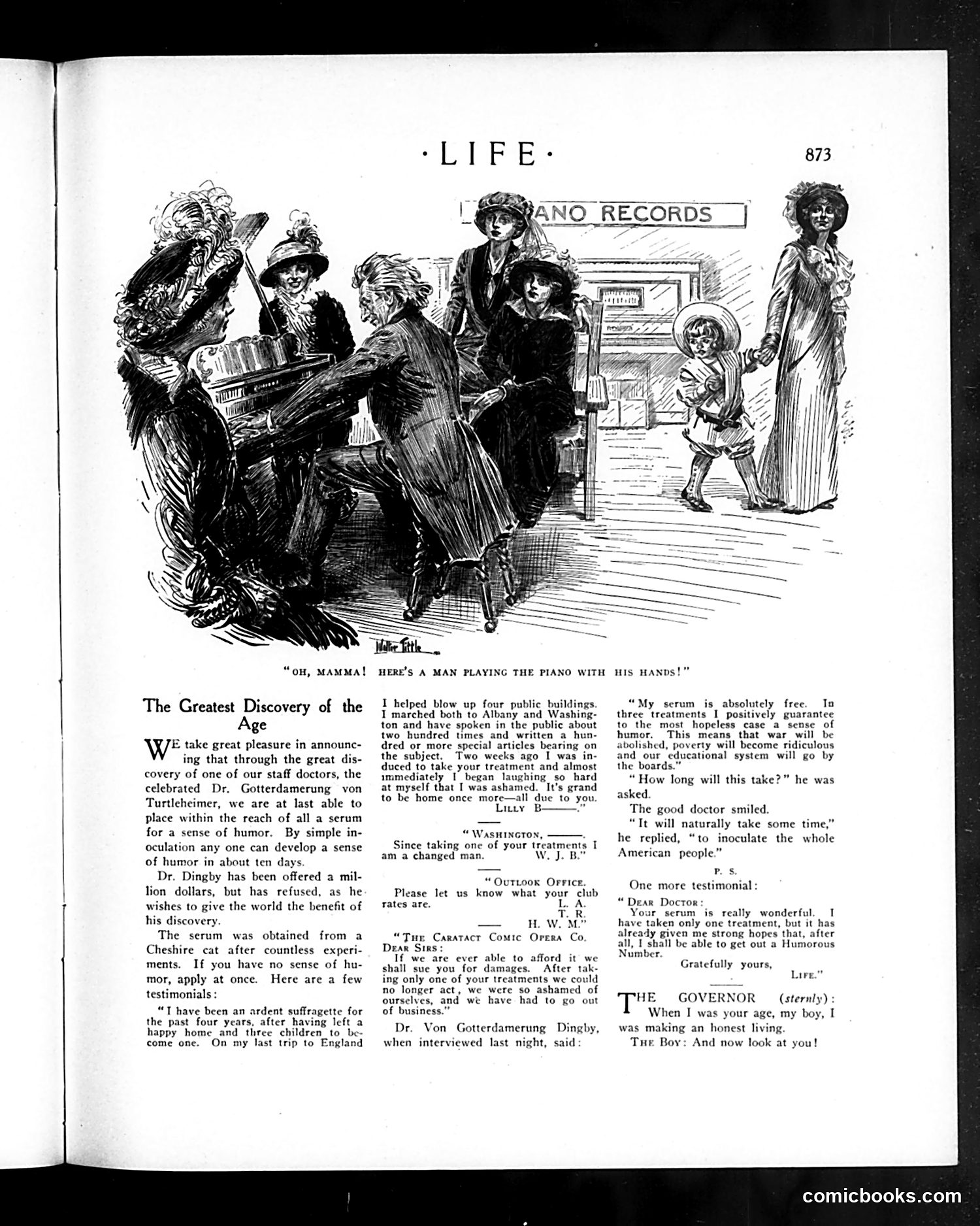
This cartoon satirizes Dr. Gotterdamerung von Turtleheimer, who claims to have discovered a "serum for a sense of humor" derived from a Cheshire cat. The joke mocks both medical quackery and the absurdity of commercializing humor itself. The visual gag works on two levels: the cartoon shows fashionable people amazed at someone playing piano *normally* (with hands), suggesting they've become so dependent on artificial stimulation or unusual entertainment that ordinary activity seems remarkable. The testimonials below reinforce this satire—people claim the serum cured their sense of humor through ridiculous pseudoscientific claims. Life magazine thus ridicules both dubious medical treatments popular in this era and society's gullibility toward them.
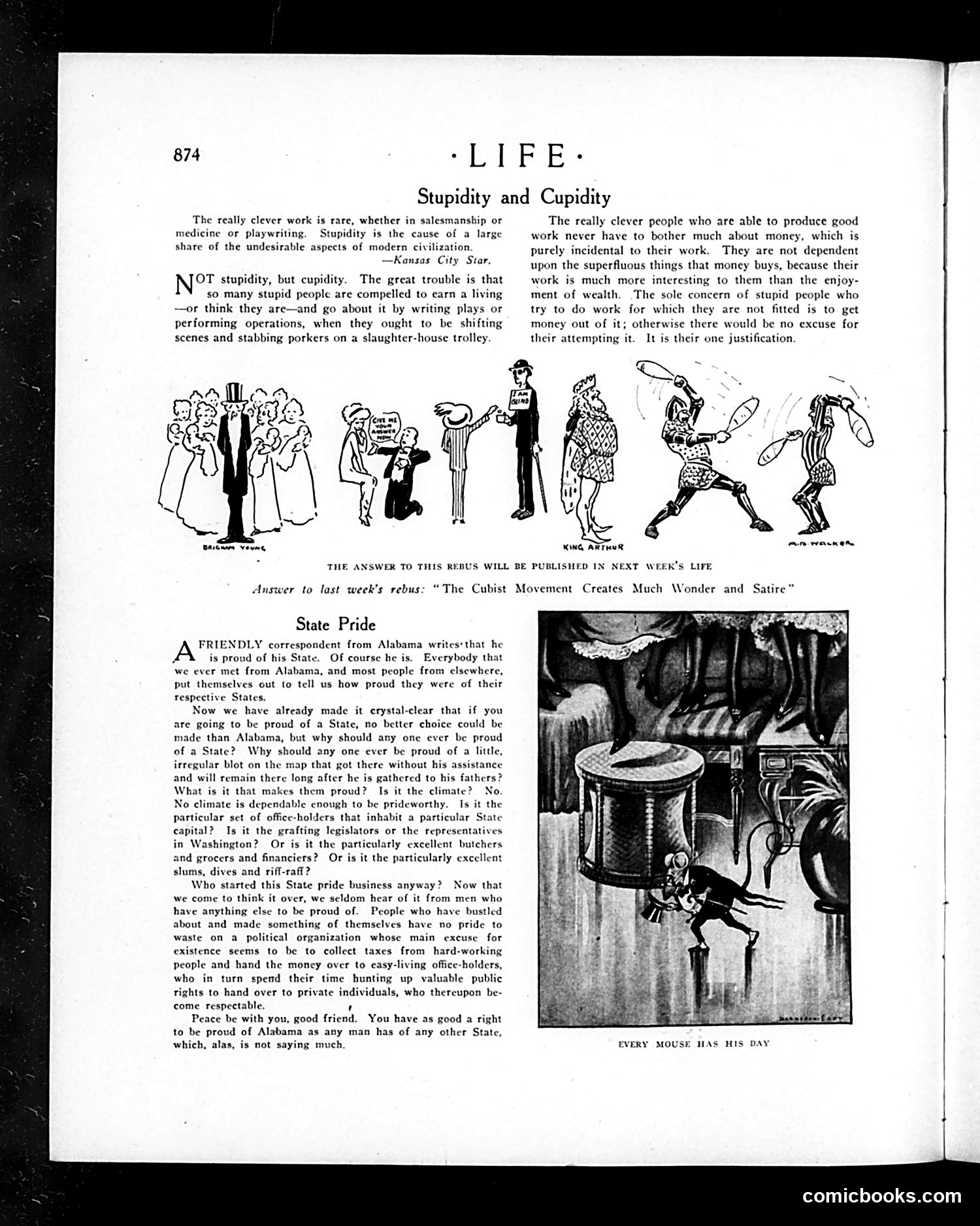
This page contains two distinct sections: **"Stupidity and Cupidity"** (top): A satirical commentary arguing that truly clever people pursue lucrative work rather than unstable careers like playwriting or theater. The accompanying cartoons illustrate various professions—businessmen, performers, and athletes—suggesting the contrast between financial success and artistic ambition. **"State Pride"** (bottom): A critique of state pride generally. The writer challenges an Alabama correspondent's state patriotism, questioning what actually warrants pride: climate? politicians? resources? The piece sarcastically suggests pride in one's state is misplaced when based on geography rather than genuine accomplishment, while those who *build* something rarely waste energy on civic boasting. The photograph captioned "Every Mouse Has His Day" (right) appears illustrative but its specific reference is unclear from context alone.
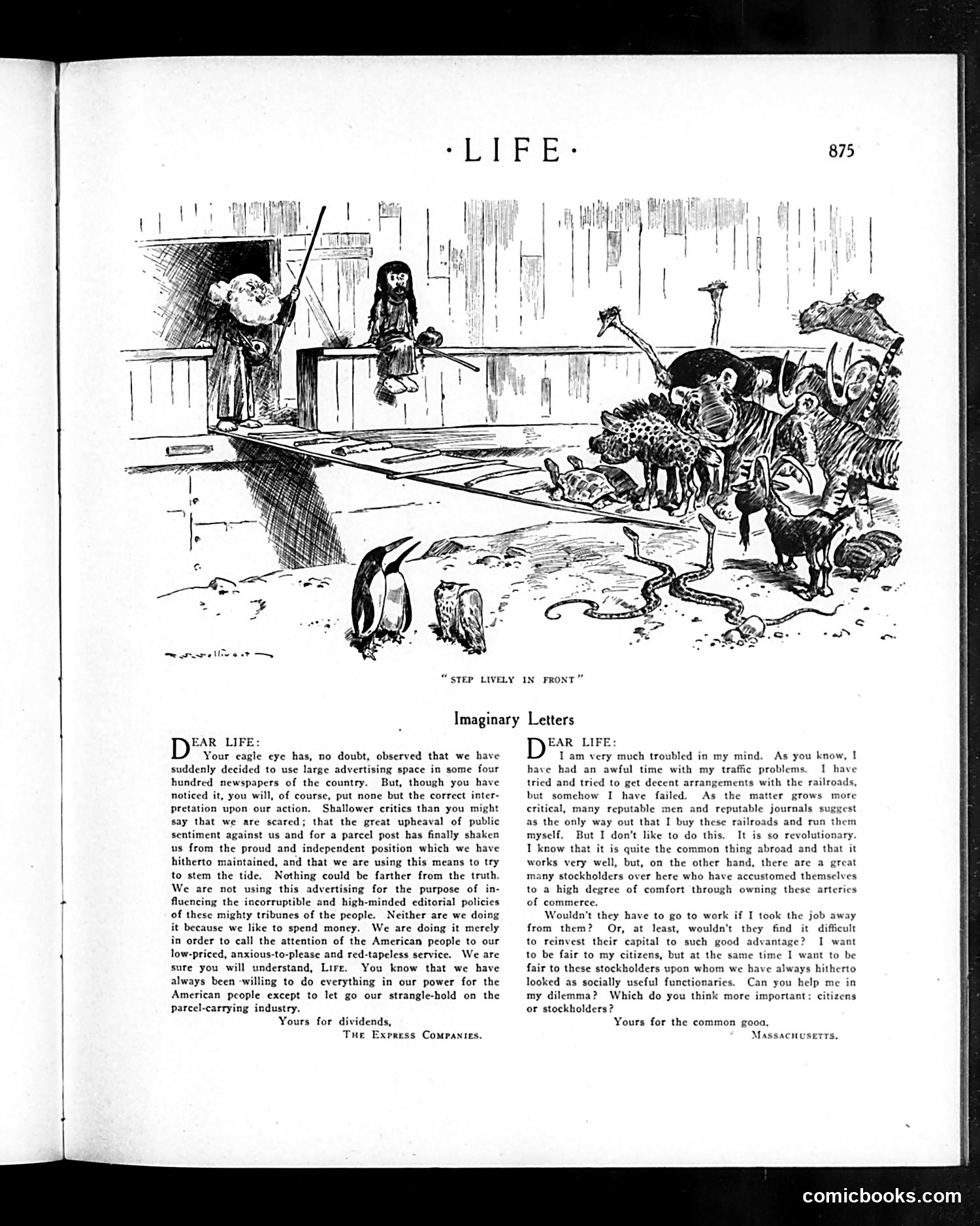
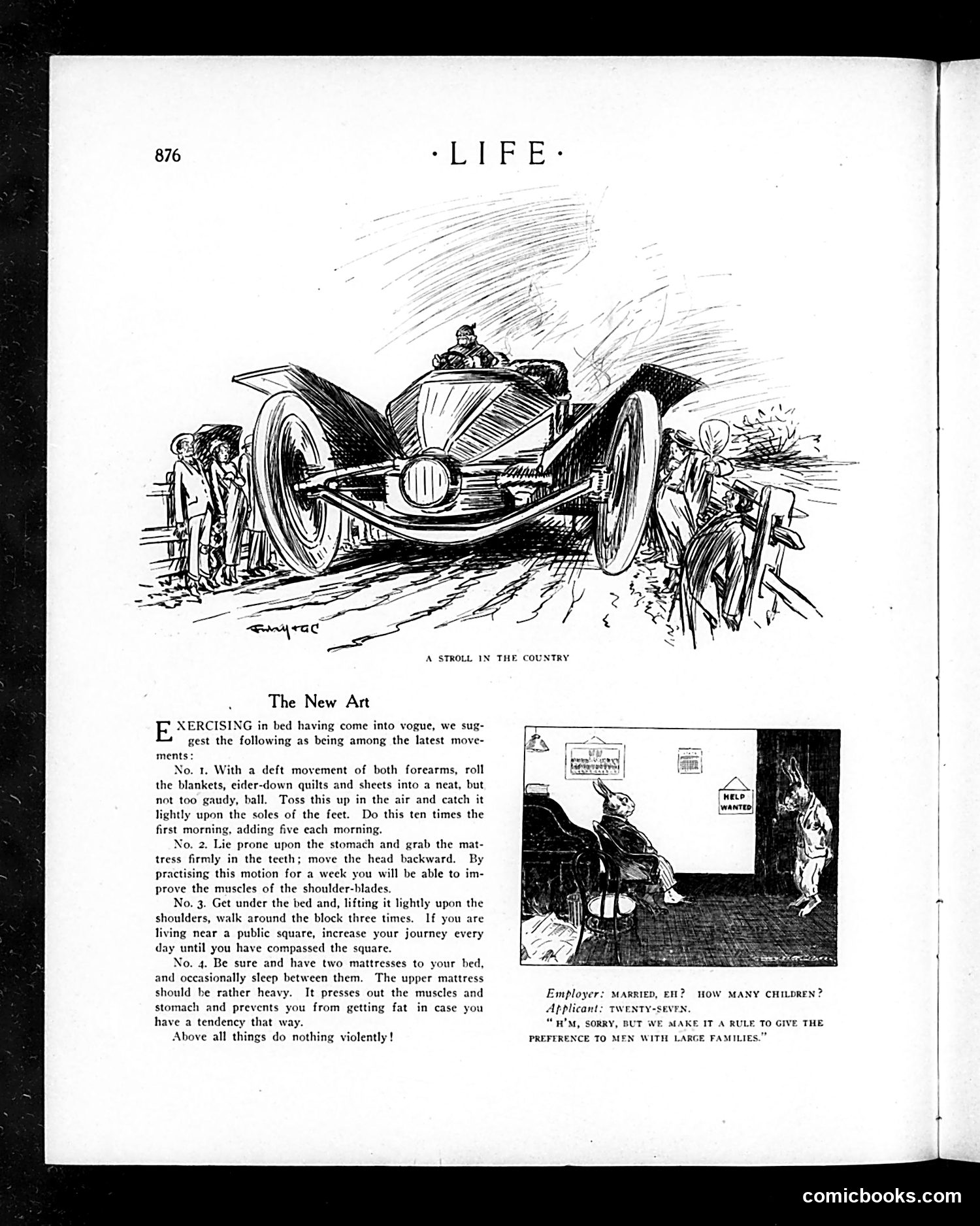
This page satirizes the early 20th-century "physical culture" movement—the newly fashionable obsession with exercise and fitness. The top illustration shows a speeding automobile with figures watching, labeled "A Stroll in the Country," mocking how modern transportation has replaced traditional walks. The main text parodies fitness advice manuals with absurd "bed exercises": rolling blankets into balls, grabbing mattresses with your teeth, lifting entire beds onto your shoulders. The humor lies in the ridiculous exaggeration—these "movements" are nonsensical and impossible, mocking the era's pseudoscientific exercise fads. The small cartoon below shows a job interview where an employer asks an applicant about children, stating they "make it a rule to give the preference to men with large families"—satirizing paternalistic hiring practices and the era's assumptions about family obligations and male employment. Together, the page humorously critiques modern obsessions: exercise crazes, automotive culture, and rigid social/employment norms.
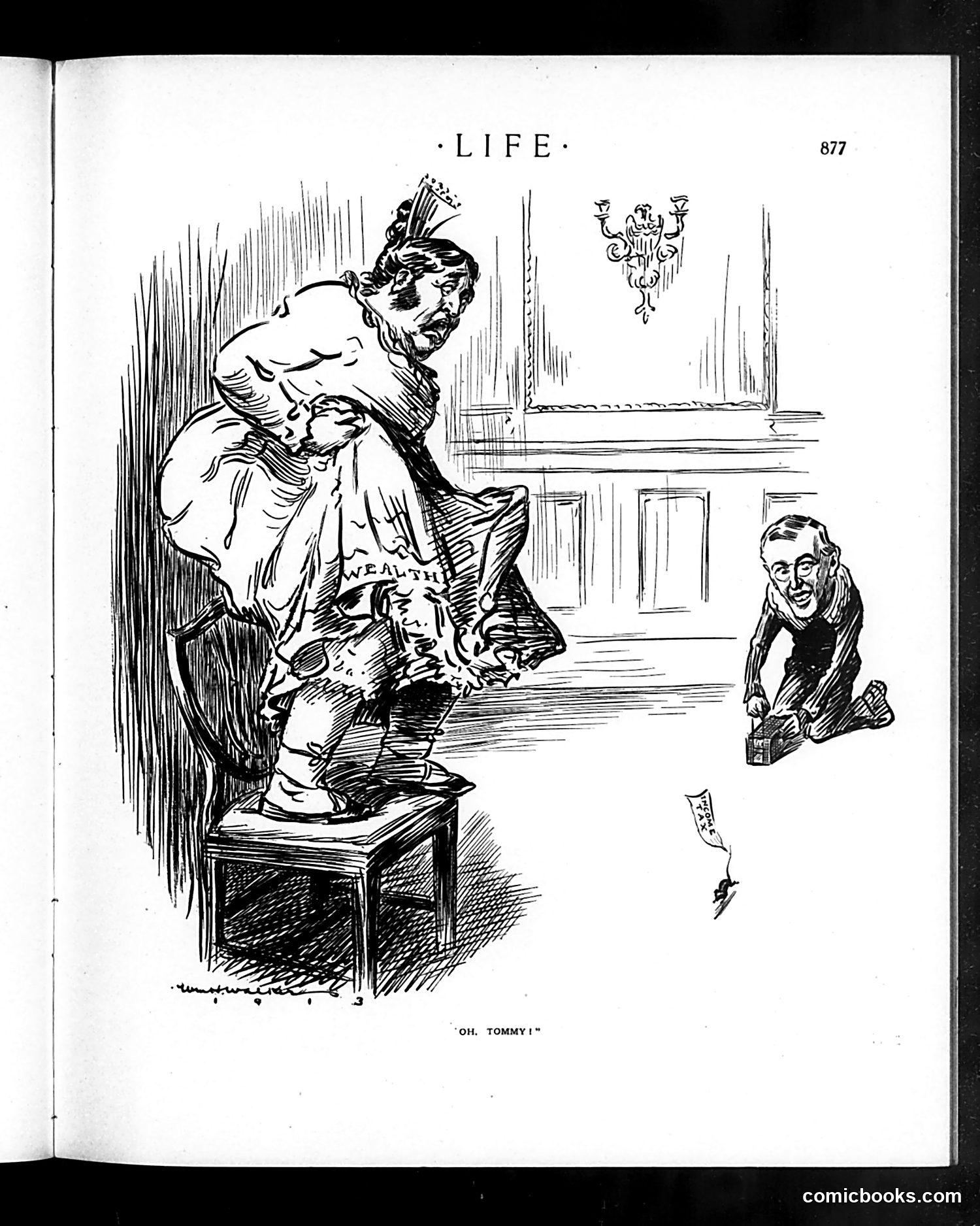
This Life magazine cartoon satirizes wealth distribution and child labor during the Gilded Age. A rotund, crowned figure labeled "Wealth" sits on a pedestal, holding a small child marked "Wealth" while an impoverished boy kneels before them with empty pockets—literally a "poor box." The caption "Oh, Tommy!" suggests a parent indulgently addressing a spoiled child. The satire is clear: while the wealthy hoard riches and coddle their privileged offspring, poor children are left destitute, reduced to begging. The ornate candelabra on the wall emphasizes the contrast between luxury and deprivation. This reflects Progressive Era concerns about economic inequality, child poverty, and the concentration of wealth among the elite—issues that would fuel reform movements throughout the early 1900s.
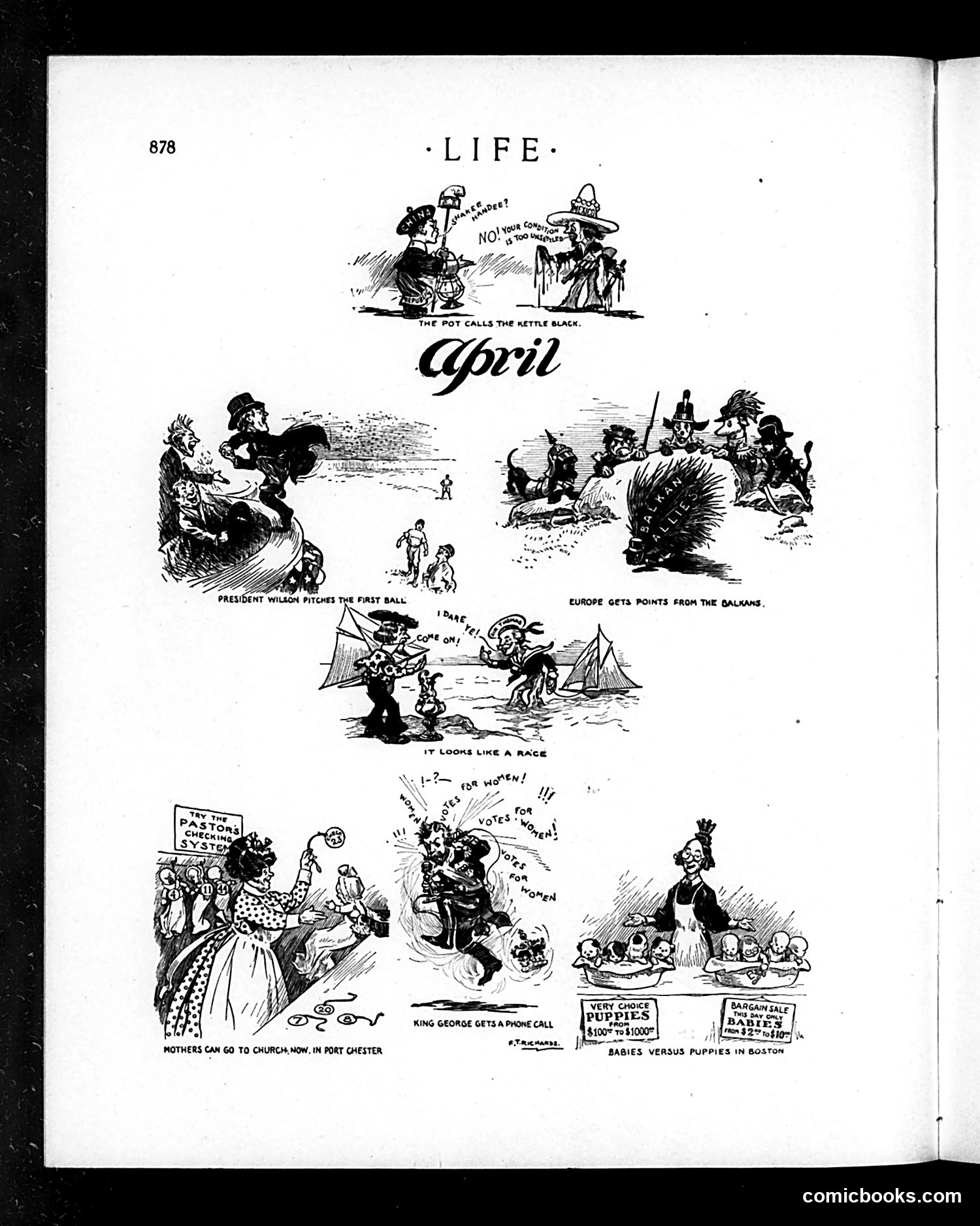
This page contains six satirical cartoons commenting on April 1918 events: **Top cartoon** depicts two figures arguing—likely about war hypocrisy, with one calling the other out (matching the "pot calls kettle black" caption). **Middle cartoons** reference World War I: "President Wilson Pitches First Ball" shows baseball season opening; "Europe Gets Points from the Balkans" depicts military conflict. **Lower section** addresses domestic issues: - Women's suffrage cartoon shows mothers advocating for voting rights in Port Chester - "King George Gets a Phone Call" appears to reference British royalty - "Babies Versus Puppies in Boston" compares a commercial baby-selling scheme to dog breeding, likely satirizing both commercialism and social priorities during wartime The cartoons collectively mock war profiteering, gender inequality, and consumer excess during WWI, typical of Life magazine's progressive satirical stance of that era.
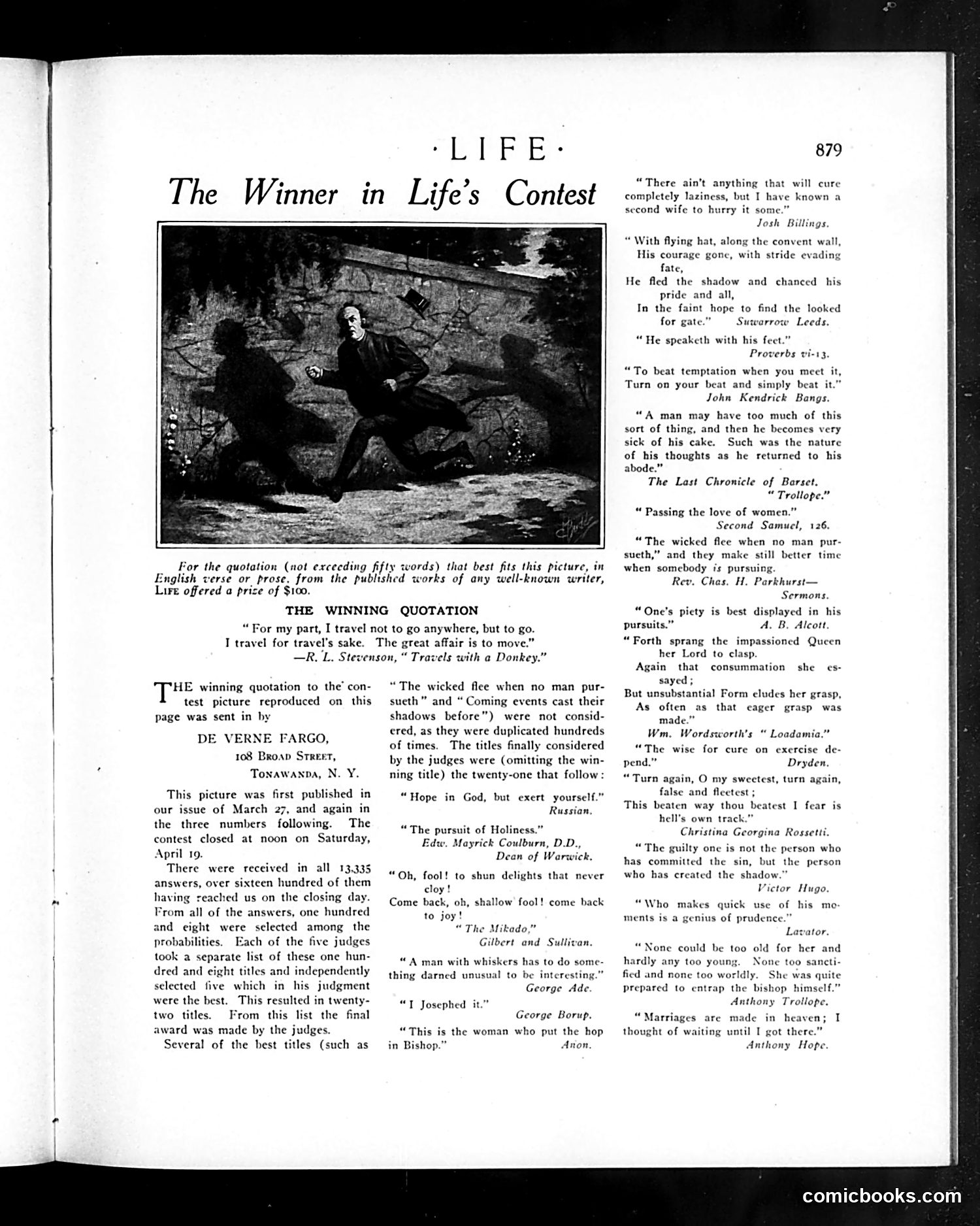
This page documents Life magazine's contest for the best literary quotation accompanying a photograph. The winning entry, submitted by De Verne Fargo of Tonawanda, New York, was a fifty-word passage from R.L. Stevenson's *Travels with a Donkey*: "For my part, I travel not to go anywhere, but to go. I travel for travel's sake. The great affair is to move." The image shows a man in dark clothing positioned against a stone wall in what appears to be a moment of physical exertion or escape. The Stevenson quotation about travel and movement perfectly captures this dynamic action. The page lists twenty-one runner-up quotations from well-known writers including Dickens, Shakespeare, and contemporary authors like George Ade. The contest received 13,335 total submissions, demonstrating Life's significant readership and cultural influence in this era.
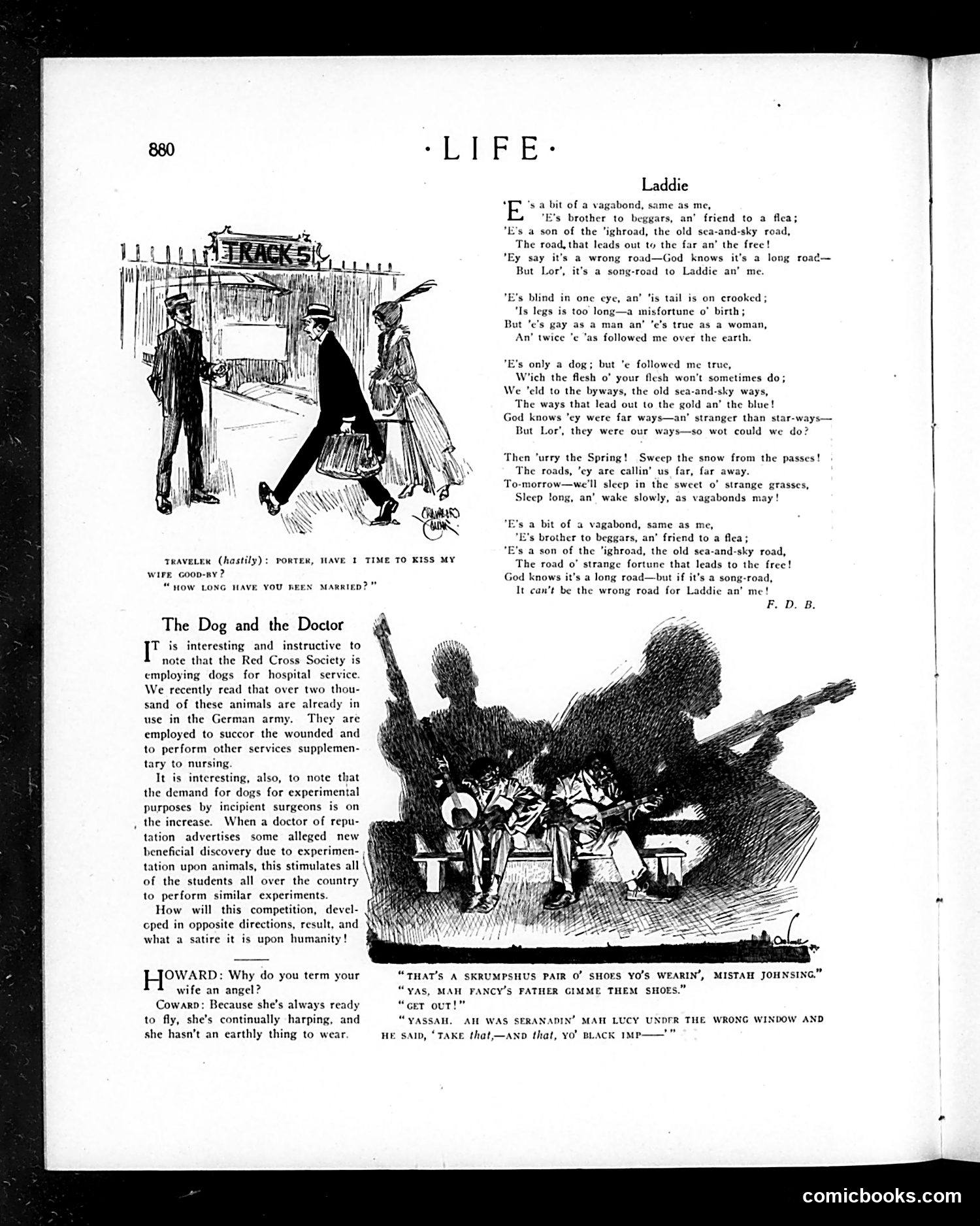
**"Laddie"** (poem with illustration): This sentimental verse celebrates a vagabond traveler and his loyal dog companion. The speaker romanticizes the vagrant life—traveling "old sea-and-sky roads," sleeping in "strange grasses"—emphasizing the dog's faithful devotion. The accompanying sketch shows three figures at what appears to be a train station, with the caption joking about a hasty traveler asking a porter for time to kiss his wife goodbye. The satire contrasts the poem's celebration of carefree wandering with the mundane married life. **"The Dog and the Doctor"**: This editorial commentary notes the Red Cross uses dogs for hospital service, while military surgeons increasingly demand dogs for experimental purposes. The piece satirizes this contradiction: dogs are simultaneously valued as healers and sacrificed as research subjects. The author questions humanity's moral logic in this "competition developed in opposite directions." **"Hoiward" jokes**: Brief dialect humor about wives and shoes appear unrelated to the main content.
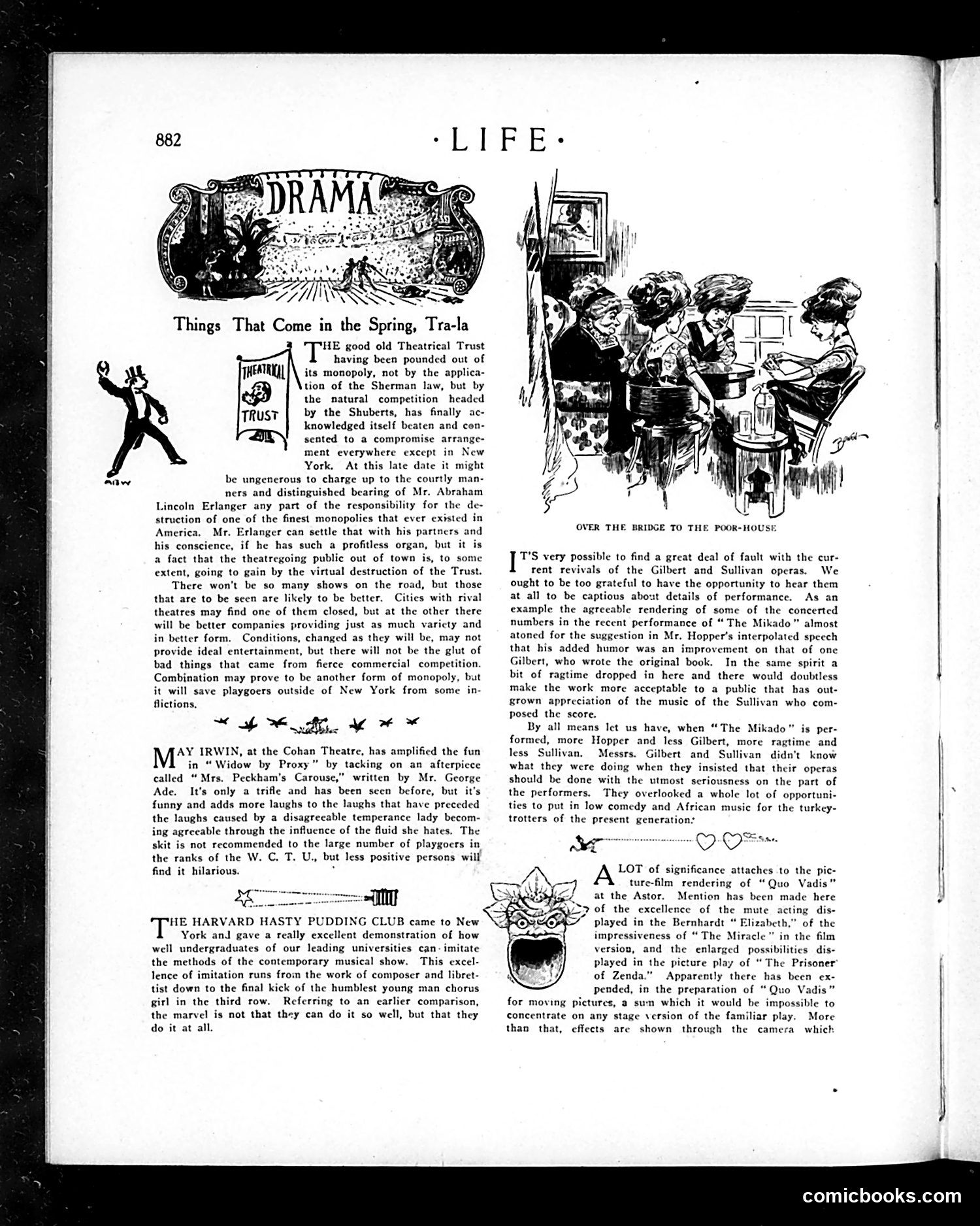
This page satirizes theatrical industry changes and contemporary stage performances circa early 1900s. **Main Articles:** The lead article discusses the **Theatrical Trust's collapse**—a monopoly headed by **Abraham Lincoln Erlanger** that controlled theater bookings. The **Shuberts** broke this monopoly through competition (not legal action), which Life celebrates as beneficial for provincial audiences, though it mocks Erlanger's "courtly manners." **Performance Reviews:** - **May Irwin** in "Widow by Proxy" receives praise for added comedy - **Harvard Hasty Pudding Club** is commended for skillfully imitating professional musical theater - **Gilbert and Sullivan revivals** (particularly "The Mikado") are critiqued for being overly reverent; the piece sarcastically suggests adding ragtime and low comedy would improve them, mocking both modernizers and purists The page's illustrations show theatrical scenes. The satire targets both theatrical monopolies and debates over whether classic operettas should remain faithful or adapt to contemporary taste.
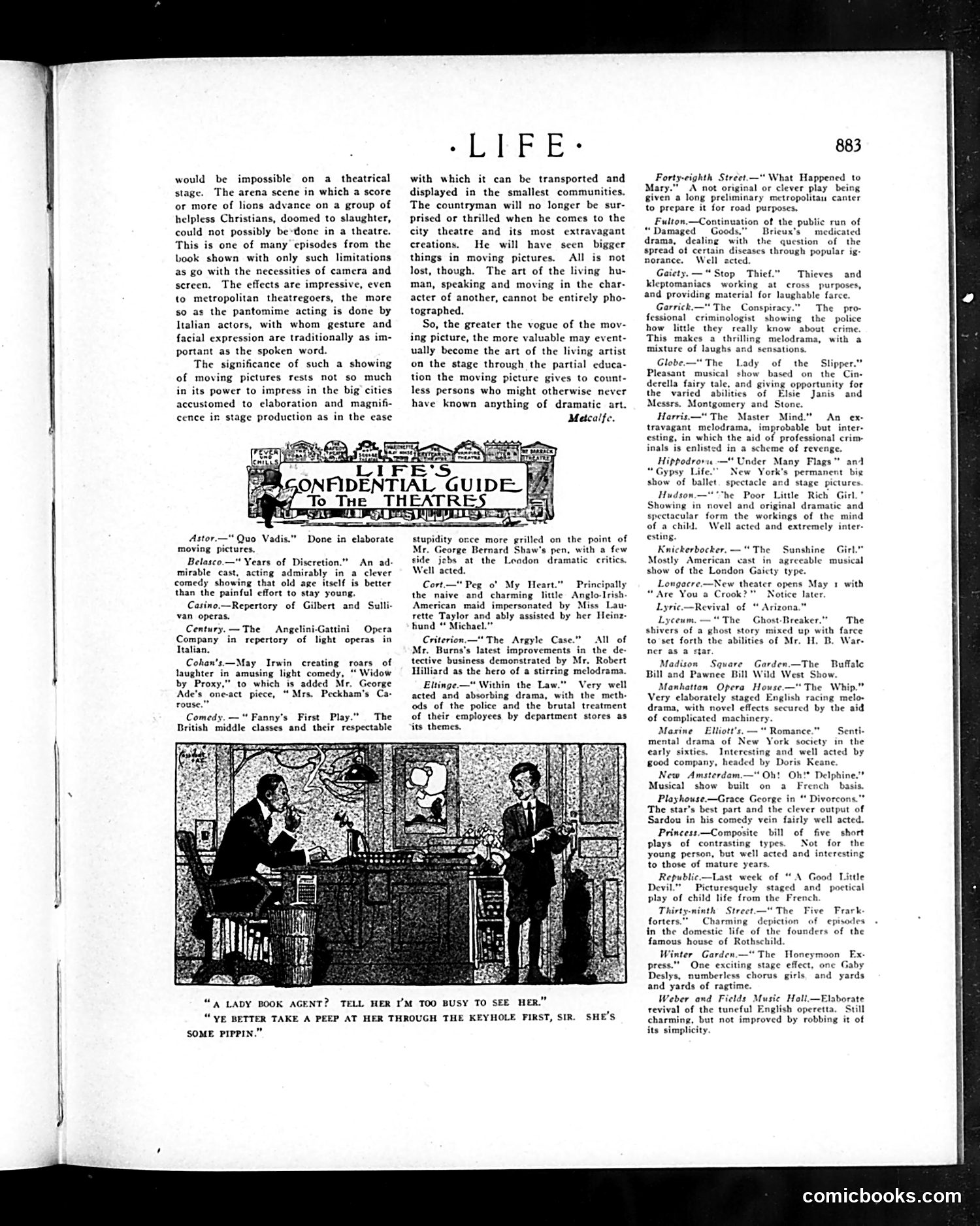
This cartoon satirizes the sexual double standard of early 20th-century society. A man dismisses a female book agent as a nuisance, too busy to see her. His servant suggests he "take a peep at her through the keyhole first, sir. She's some pippin"—implying the man should reconsider if she's attractive. The joke relies on the contrast between polite refusal and crude male behavior: the servant's suggestion to spy on a woman contradicts proper conduct, yet the implication is that male interest in women's appearance overrides business courtesy. The term "pippin" (an attractive woman) reinforces the reduction of the agent to her looks rather than her professional purpose. This reflects contemporary attitudes about women in professional roles and society's expectation that female appearance matters more than female competence.
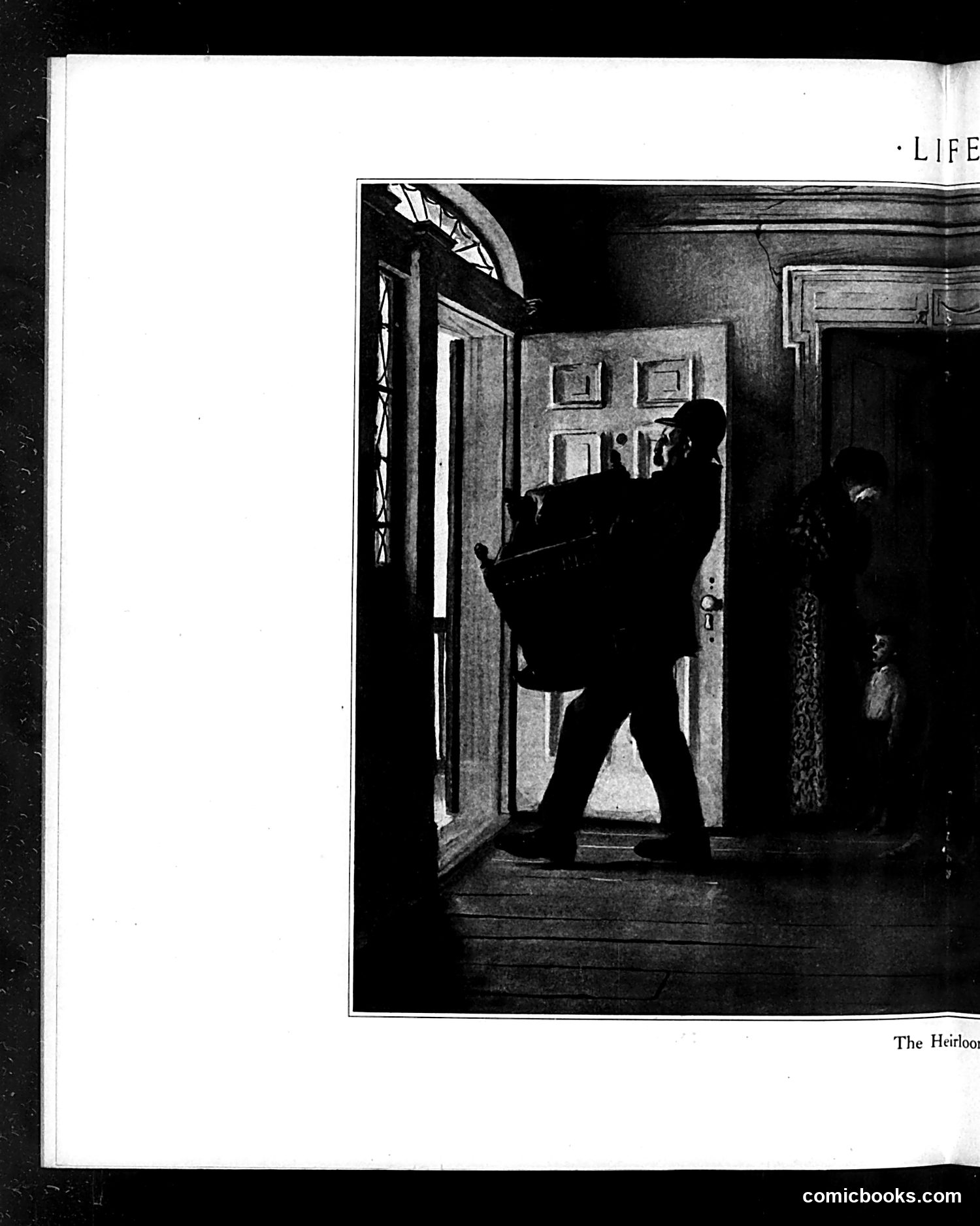
This page shows a black and white photograph titled "The Heirloom" depicting a man in dark clothing entering through a doorway while other figures observe from inside. The image appears to be from Life magazine's satirical content. Without additional context or caption text visible on this page, I cannot definitively identify the specific figures or political/social reference intended. The photograph's dramatic lighting and composition suggest it illustrates a narrative moment—possibly depicting an intrusion or arrival of significance—but the precise satirical point remains unclear from the image alone. The dramatic silhouetting and doorway framing suggest this comments on some social or political situation, but I cannot responsibly specify which without risking inaccuracy. More context would be needed to explain the satire to a modern reader.
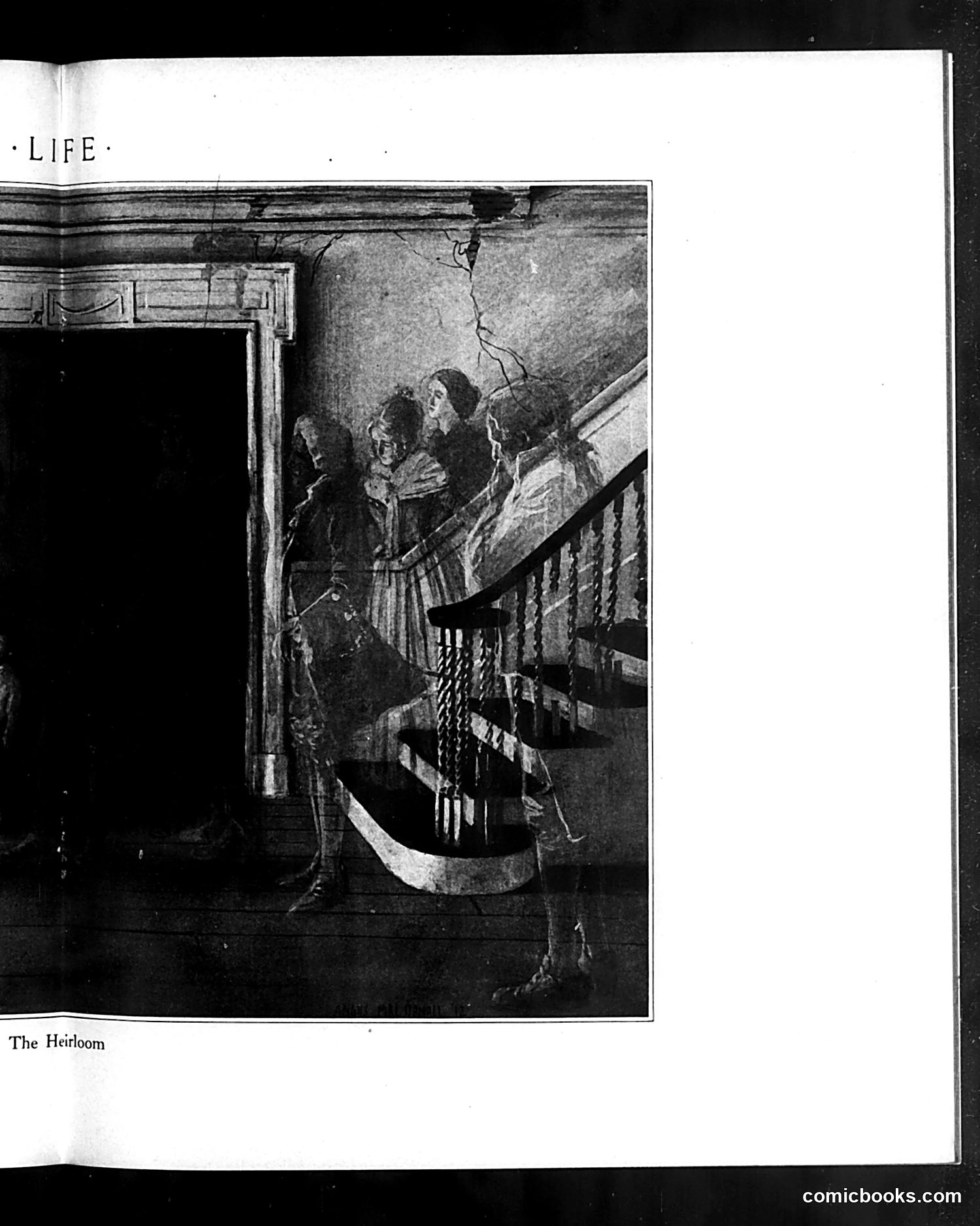
This illustration depicts figures on a staircase in what appears to be a grand interior, with the caption "The Heirloom." The image shows several people in period dress ascending or positioned on the stairs, with dramatic lighting and shadows characteristic of early 20th-century satirical illustration. Without additional context or visible text explaining the specific satire, the exact political or social reference remains unclear. The title suggests commentary on inherited wealth, family legacy, or tradition being passed down. The formal architectural setting and the deliberate positioning of figures suggest this may be satirizing upper-class pretension or the preservation of familial status symbols, but the precise target of the satire cannot be determined from the image alone.
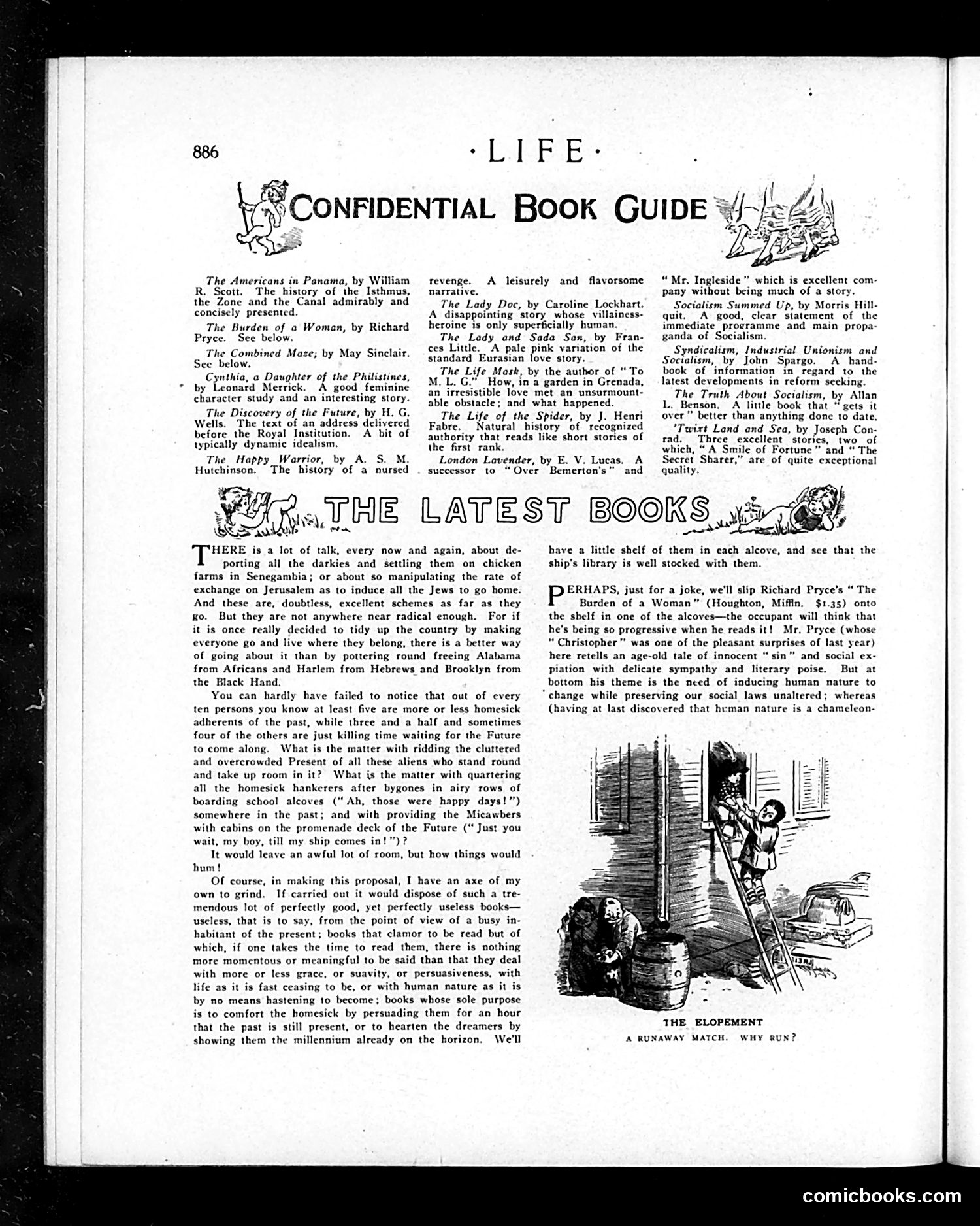
This single-panel cartoon illustrates a domestic crisis: a young couple elopes through a window while an adult (likely a parent) below reaches up desperately trying to stop them. The caption reads "A RUNAWAY MATCH. WHY RUN?" The satire targets early 20th-century social conventions around courtship and parental authority. The "why run?" question is rhetorical—couples eloped precisely *because* they needed to escape parental disapproval, typically due to class differences, religious objections, or age concerns. By asking "why run?" the cartoonist mocks the futility of such elopements and, implicitly, the outdated social restrictions forcing young people to defy their elders. The accompanying text discusses disposing of "homesick" people nostalgic for the past, suggesting the cartoon critiques rigid traditionalists clinging to restrictive social norms that younger generations increasingly reject. The humor lies in exposing the absurdity of circumstances that make secret escape necessary.
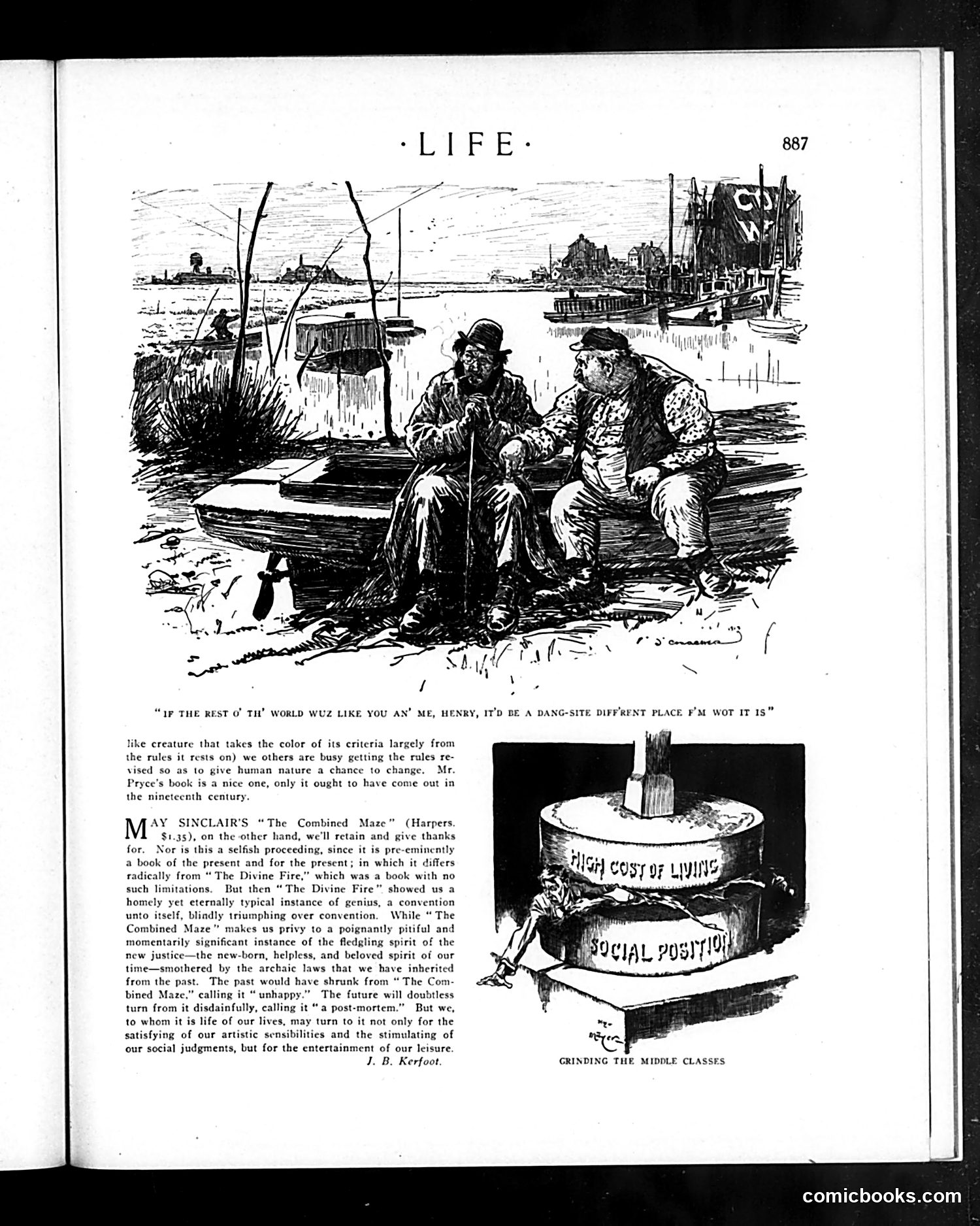
The top illustration shows two working-class men sitting by a waterfront, with industrial cityscape behind them. The caption quotes one saying to the other that if the world were like his companion, it would be "a dang-site different place" — suggesting commentary on poverty or working-class conditions. Below is a cartoon titled "Grinding the Middle Classes," depicting a massive grinding wheel or mill labeled "High Cost of Living" and "Social Position," crushing a figure beneath it. This is social satire about the economic and social pressures crushing the middle class. The text discusses recent novels by May Sinclair and others, praising works that address contemporary social justice issues and modern life over older literature. The reviewer argues such current, socially-engaged fiction matters more to present readers than timeless classics. Together, the page satirizes how industrial capitalism and social hierarchies economically squeeze ordinary people while celebrating literature that honestly depicts these modern struggles.
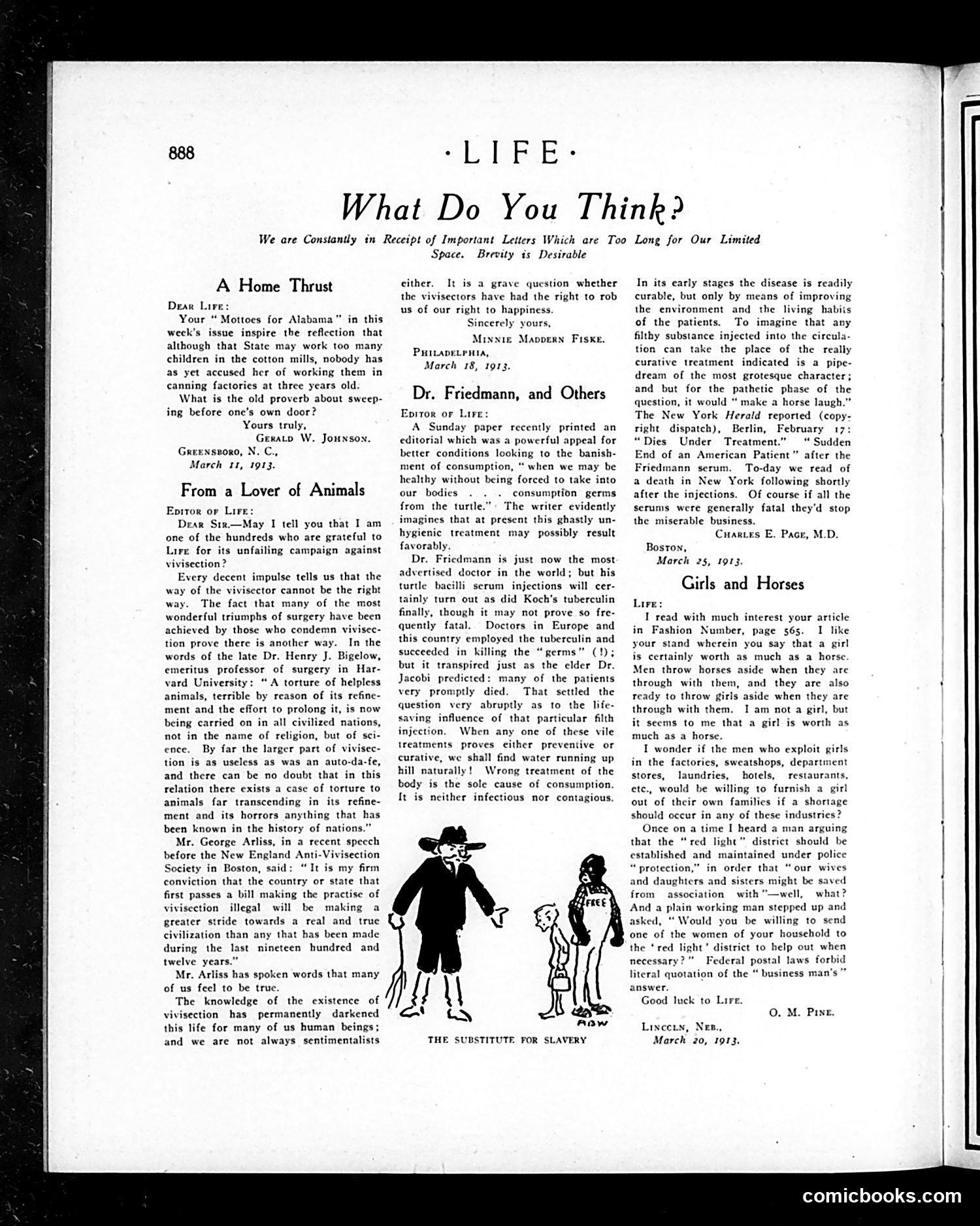
This cartoon responds to a letter praising children's labor in mills. The image shows a man in a top hat (representing wealthy factory owners or society's complicity) offering coins to a small child, with another child already marked "FREE" nearby—a darkly ironic label. The satire compares child labor in factories and mills to slavery. The title "The Substitute for Slavery" argues that although slavery was abolished, exploitative child labor serves the same economic function: extracting labor from the powerless for profit. The coin-exchange imagery echoes slave auctions, suggesting legalized child labor is essentially slavery under a different name. The cartoon attacks the contradiction in the letter-writer's defense: while condemning certain practices, he defends others equally exploitative—revealing moral blindness about contemporary injustices.
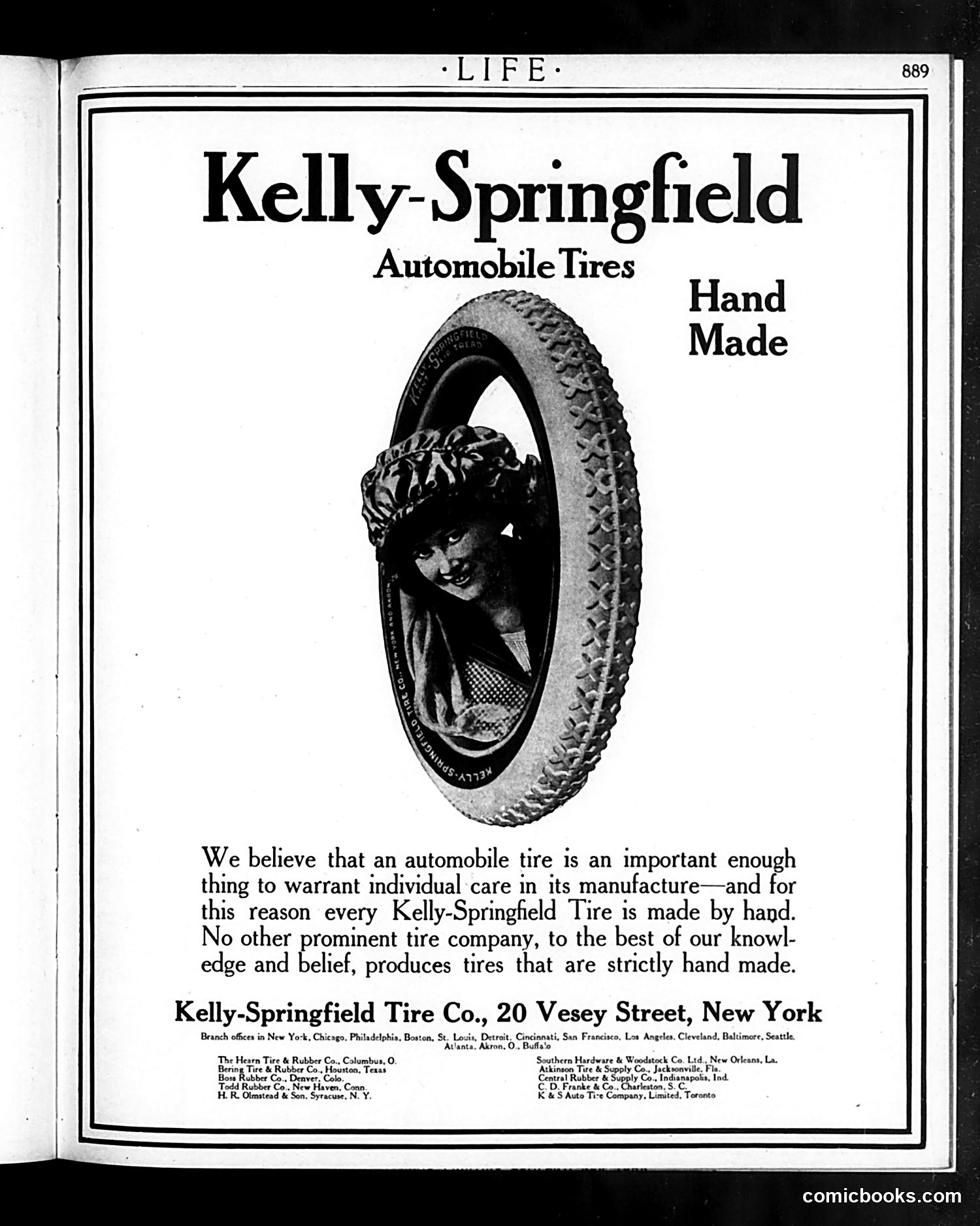
This is a **product advertisement**, not a cartoon or satire. It promotes Kelly-Springfield Automobile Tires, emphasizing their "Hand Made" manufacturing as a competitive advantage. The central image shows a classical female figure (likely representing quality or craftsmanship) emerging from or framed by an automobile tire. The ad's appeal rests on the claim that Kelly-Springfield uniquely hand-manufactures tires, implying superior quality compared to competitors who use industrial processes. For modern readers: this reflects early 20th-century manufacturing marketing, when "handmade" signified quality and care—the opposite of today's messaging, where industrial precision and automation typically indicate reliability. The classical imagery dignifies the product, and the emphasis on individual craftsmanship would have resonated with consumers skeptical of mass production.
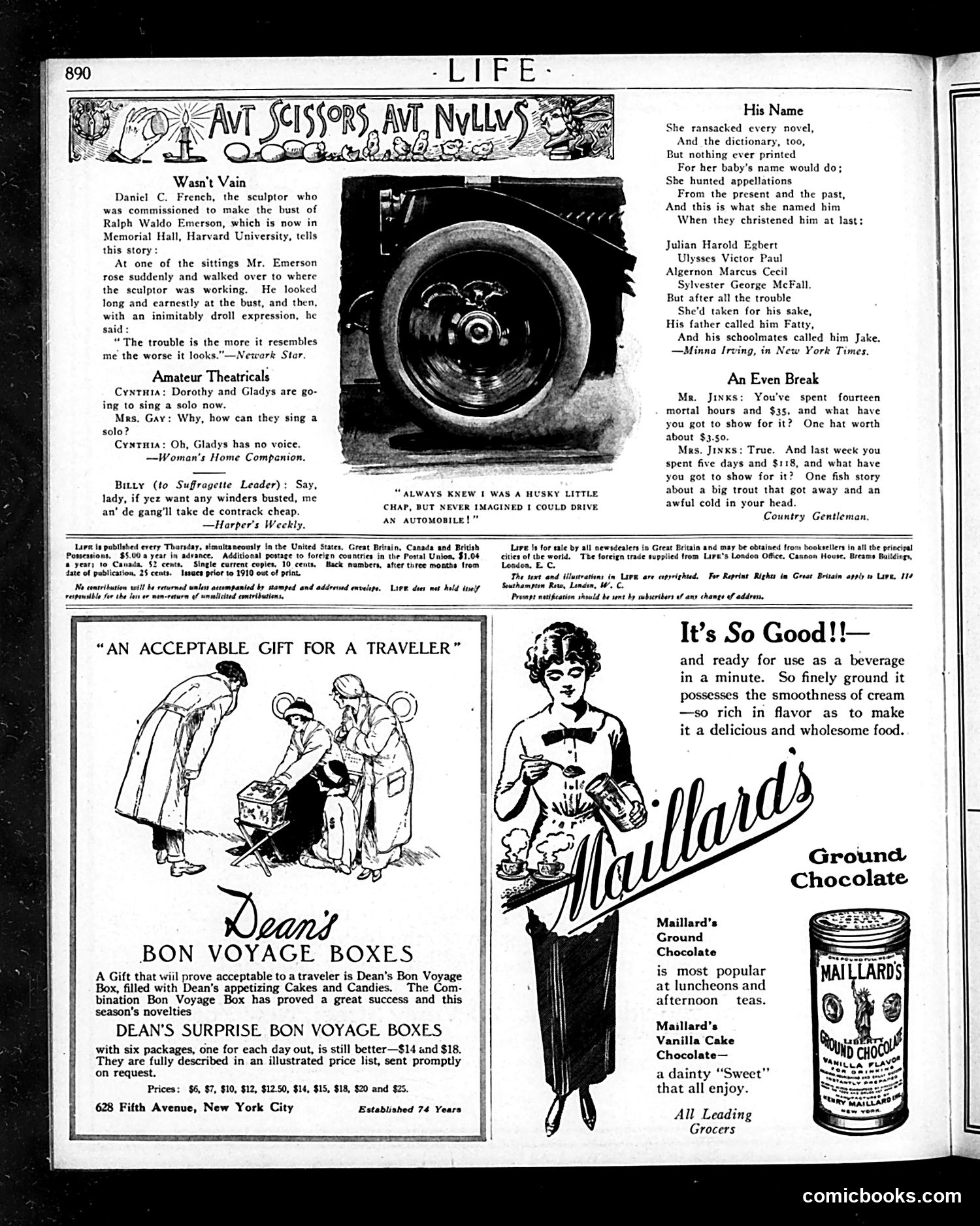
This page mixes humor columns with advertisements, typical of early 20th-century Life magazine. The satirical content includes: **"Wasn't Vain"**: A anecdote about sculptor Daniel C. French and philosopher Ralph Waldo Emerson. When Emerson views his own bust, he jokes that the more accurate it becomes, the worse it looks—self-deprecating humor about his appearance. **"Amateur Theatricals"** and **"Billy"**: Brief joke exchanges mocking amateur singers and suffragettes, reflecting contemporary attitudes toward women's activism. **"His Name"**: Satirizes mothers who obsessively search literature for "original" baby names, only to have fathers and peers use nicknames anyway—poking fun at Victorian parental pretension. **"An Even Break"**: A marital squabble where a wife justifies her expensive hat shopping by noting her husband wasted money on fishing trips and came home sick—gender commentary on spending habits. The page is otherwise dominated by period advertisements for travel boxes, chocolate, and confections, reflecting Life's role as both satirical publication and commercial vehicle.
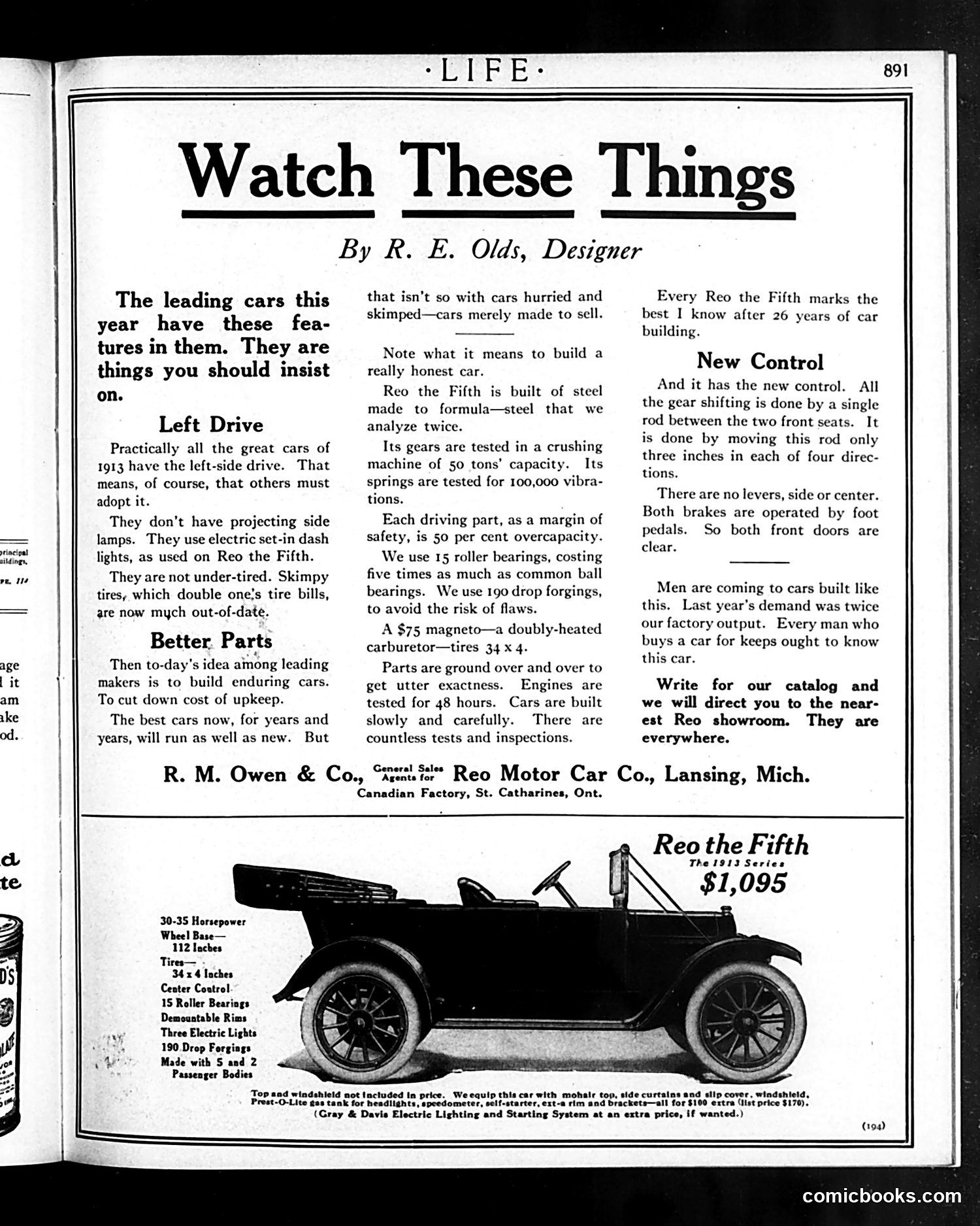
This is **not a cartoon but an automobile advertisement** from Life magazine's 1913 issue. R.E. Olds, designer of the Reo Motor Car Company, uses the page to highlight technical features that should distinguish quality cars from inferior competitors. The piece contrasts honest, durable engineering ("built slowly and carefully") against rushed manufacturing "merely made to sell." Key selling points include left-side drive (becoming standard), electric dash lights, proper tire sizing, and extensive testing protocols (50-ton crushing tests, 48-hour engine tests, 190 drop forgings). The accompanying illustration shows the Reo the Fifth touring car priced at $1,095, listing specifications like 30-35 horsepower and 112-inch wheelbase. **Context for modern readers**: This reflects early automotive industry standardization debates and manufacturers' appeals to quality-conscious buyers in a rapidly competitive market.
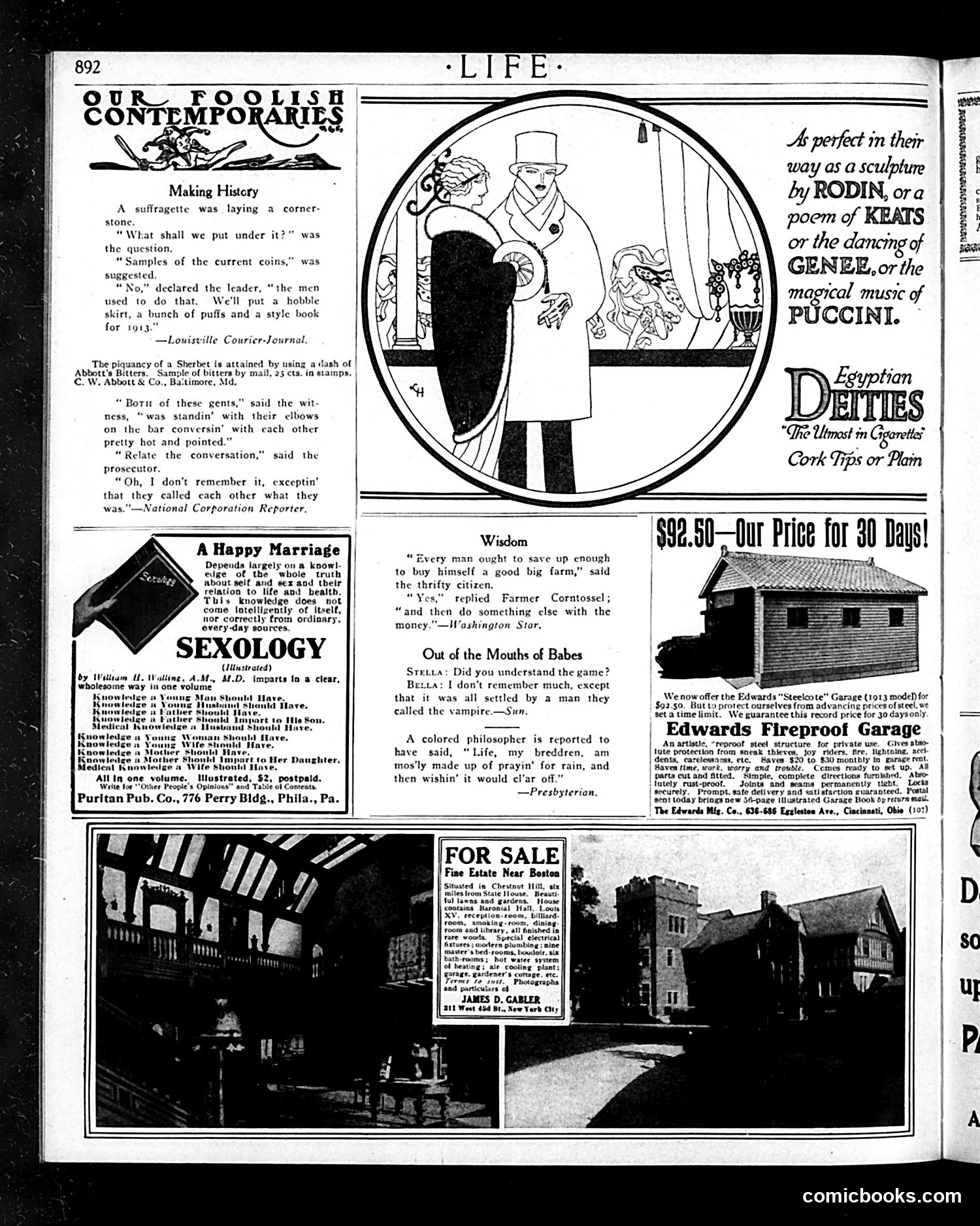
This Life magazine page (page 892) contains several brief satirical items rather than a single cartoon: **"Making History"** mocks suffragettes by imagining one laying a cornerstone. When asked what should go under it, the leader suggests using "the men used to do that"—sarcastically implying women should use men as a foundation, playing on anti-suffrage stereotypes about women's roles. **"A Happy Marriage"** and **"Sexology"** are advertisements for educational books, not satire. The **"Wisdom"** section contains three brief joke-quotes typical of Life's humor: a farmer's practical advice about farms, a child mishearing "vampire" as a game rule, and a racial stereotype joke about a "colored philosopher." The rest of the page is advertising: cigarettes (Egyptian Deities), a garage (Edwards Fireproof), and real estate. The suffragette joke is the only clearly political content—reflecting the early 1900s debate over women's voting rights through mockery.
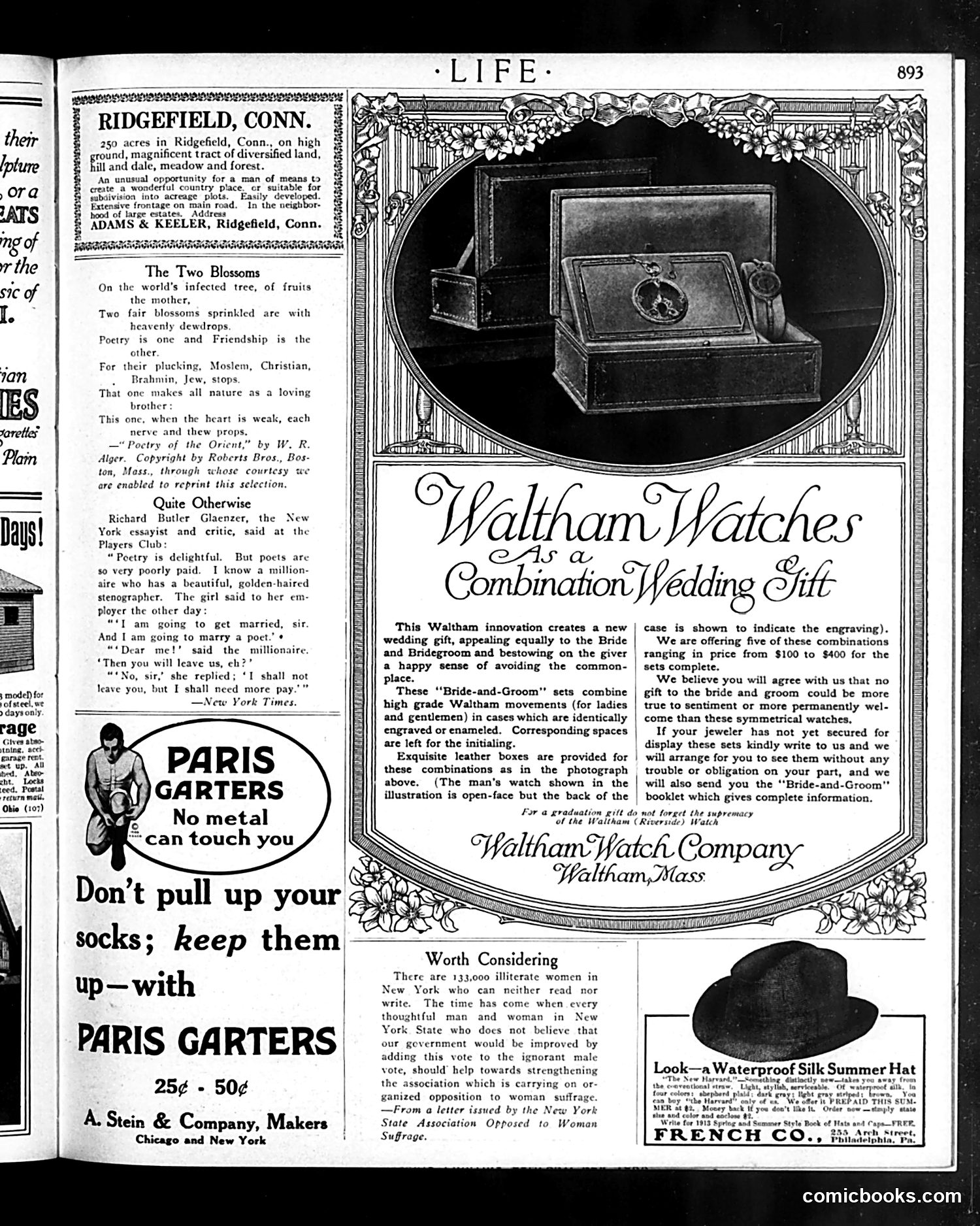
This page is primarily **advertisements and literary content** rather than political cartoons. Key elements: **Literary Content:** - "The Two Blossoms," a poem about Poetry and Friendship as virtues - "Quite Otherwise," a humorous anecdote by Richard Butler Glaenzer about a millionaire's stenographer who demands a raise upon marrying a poorly-paid poet—satirizing the economic struggles of poets **Advertisements:** - **Waltham Watches**: Markets matching "Bride-and-Groom" watch sets as wedding gifts ($100-$400), appealing to both newlyweds equally - **Paris Garters**: Promises garters won't slip down - **French Co.**: Advertises waterproof silk summer hats - **Ridgefield, Conn. real estate**: Promotes a 250-acre property **Political Content:** One small section titled "Worth Considering" opposes women's suffrage, citing a New York organization "Opposed to Woman Suffrage" and questioning whether adding women voters would improve governance. The page reflects early 20th-century concerns: gender roles in marriage, women's political rights, and consumer goods marketing.
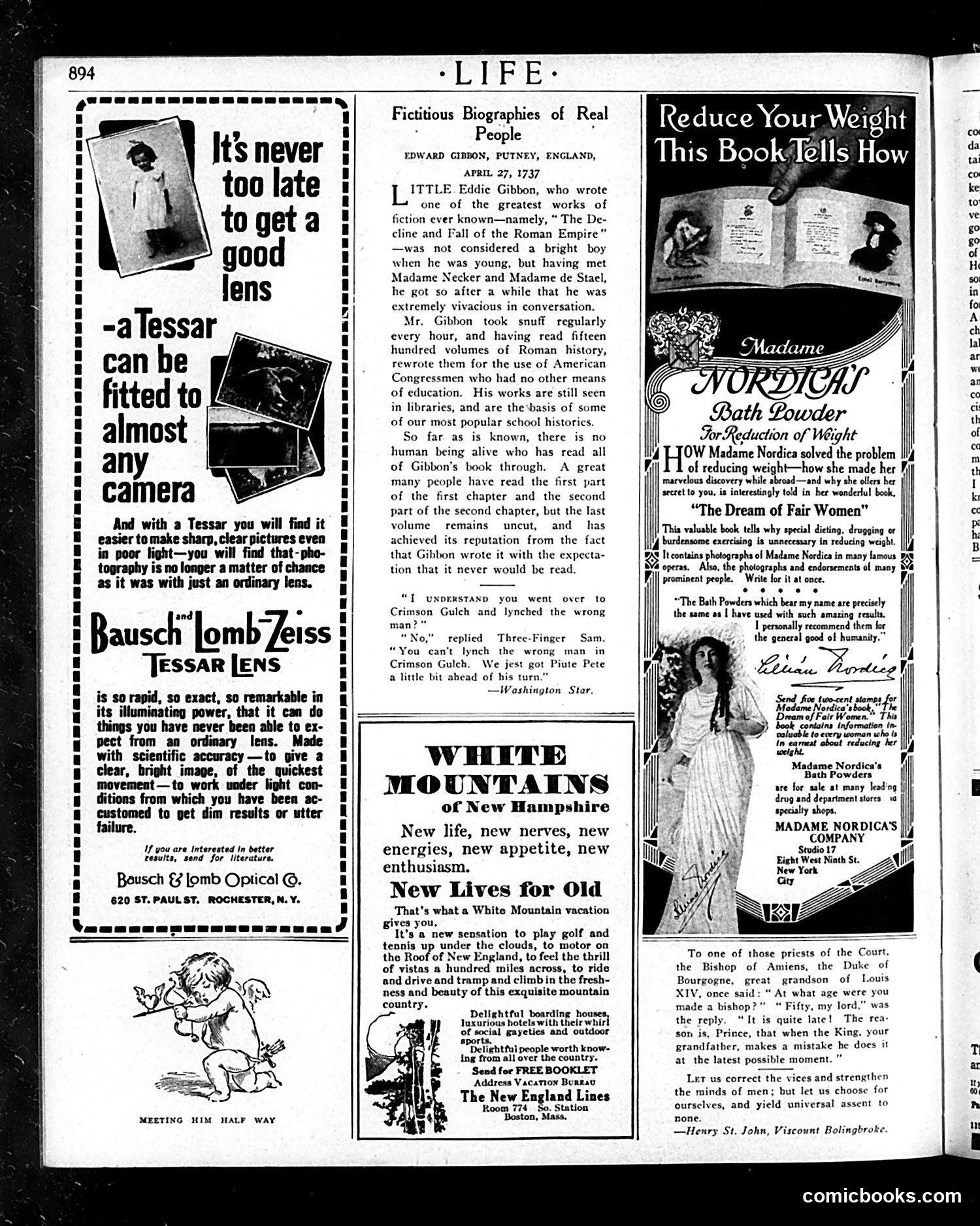
This is primarily an **advertising page** from Life magazine (page 894), with some satirical content interspersed. **Main Advertisements:** - Bausch & Lomb camera lenses (left column) - Madame Nordica's Bath Powder for weight reduction (right column) - White Mountains of New Hampshire tourism (center) **Satirical Content:** The "Fictitious Biographies of Real People" section mocks Edward Gibbon's famous *Decline and Fall of the Roman Empire*, suggesting that while Gibbon read 1,500 volumes of Roman history, no living person has actually read his entire work—it's valued precisely because nobody expects to finish it. A second anecdote jokes about frontier justice in "Crimson Gulch," where you "can't lynch the wrong man" because executions happen regardless. **Historical Context:** These satirize pretentious intellectual achievement and frontier lawlessness—both common targets of early 20th-century American humor. The weight-loss powder advertisement features opera singer Madame Nordica's endorsement, reflecting period obsessions with appearance and celebrity testimonials as marketing.
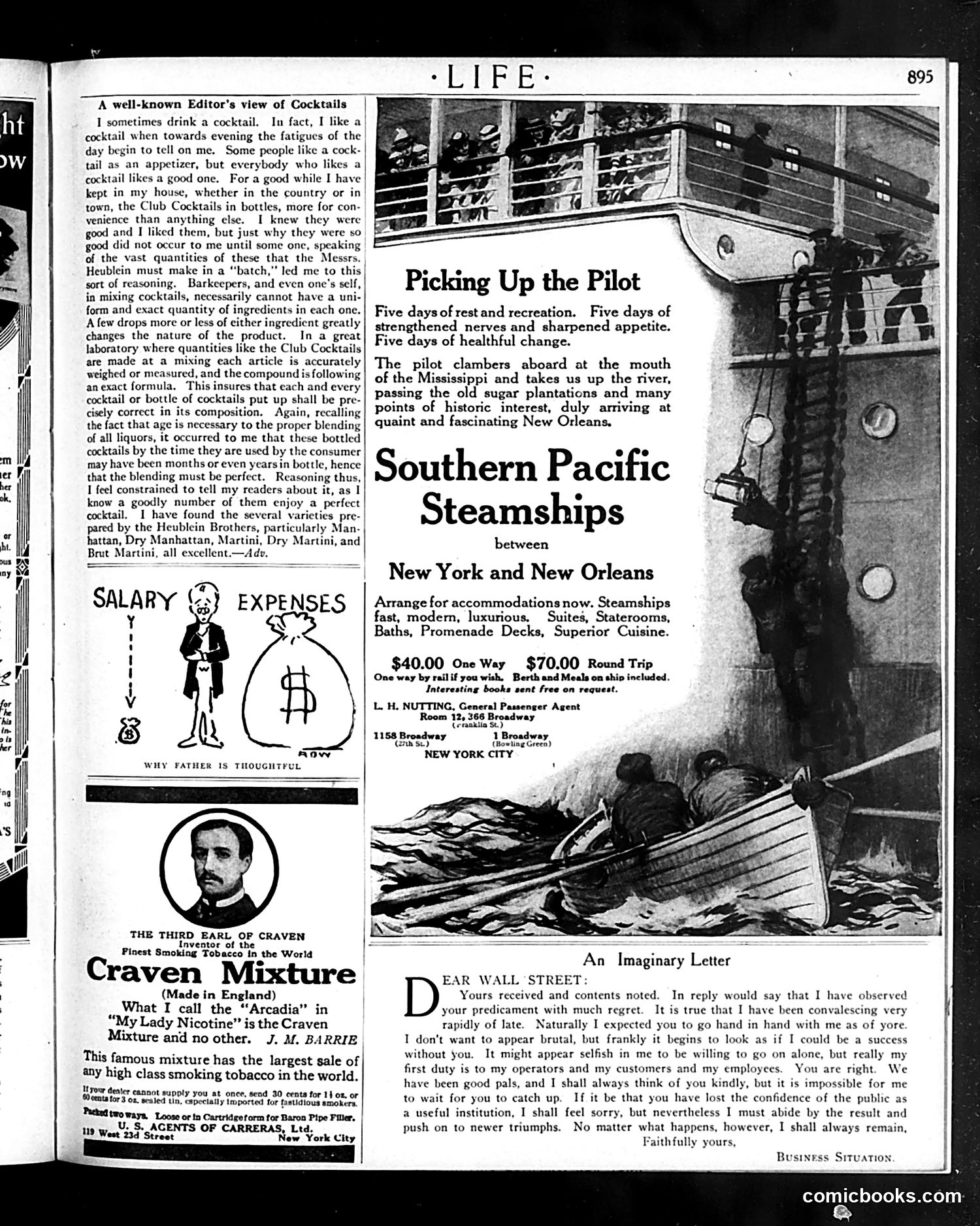
This page contains primarily **advertisements** interspersed with editorial content, typical of early 20th-century magazine format. **Key Content:** The "Salary vs. Expenses" cartoon ("Why Father Is Thoughtful") is a simple domestic humor piece showing a father figure between representations of his salary (small) and expenses (large money bag)—a universal joke about financial strain with no specific political reference. **Advertisements featured:** - Heublein Bros. cocktails (endorsed by an unnamed "well-known editor") - Craven Mixture tobacco, endorsed by J.M. Barrie - The Third Earl of Craven as tobacco inventor - Southern Pacific Steamships service between New York and New Orleans **Bottom section:** An "Imaginary Letter" from an unnamed writer to Wall Street, expressing regret about Wall Street's economic troubles and suggesting they've "convalesced" (recovered) separately—likely referencing post-financial crisis recovery, though the specific year and context are unclear from this fragment alone. The page is primarily commercial rather than satirical.
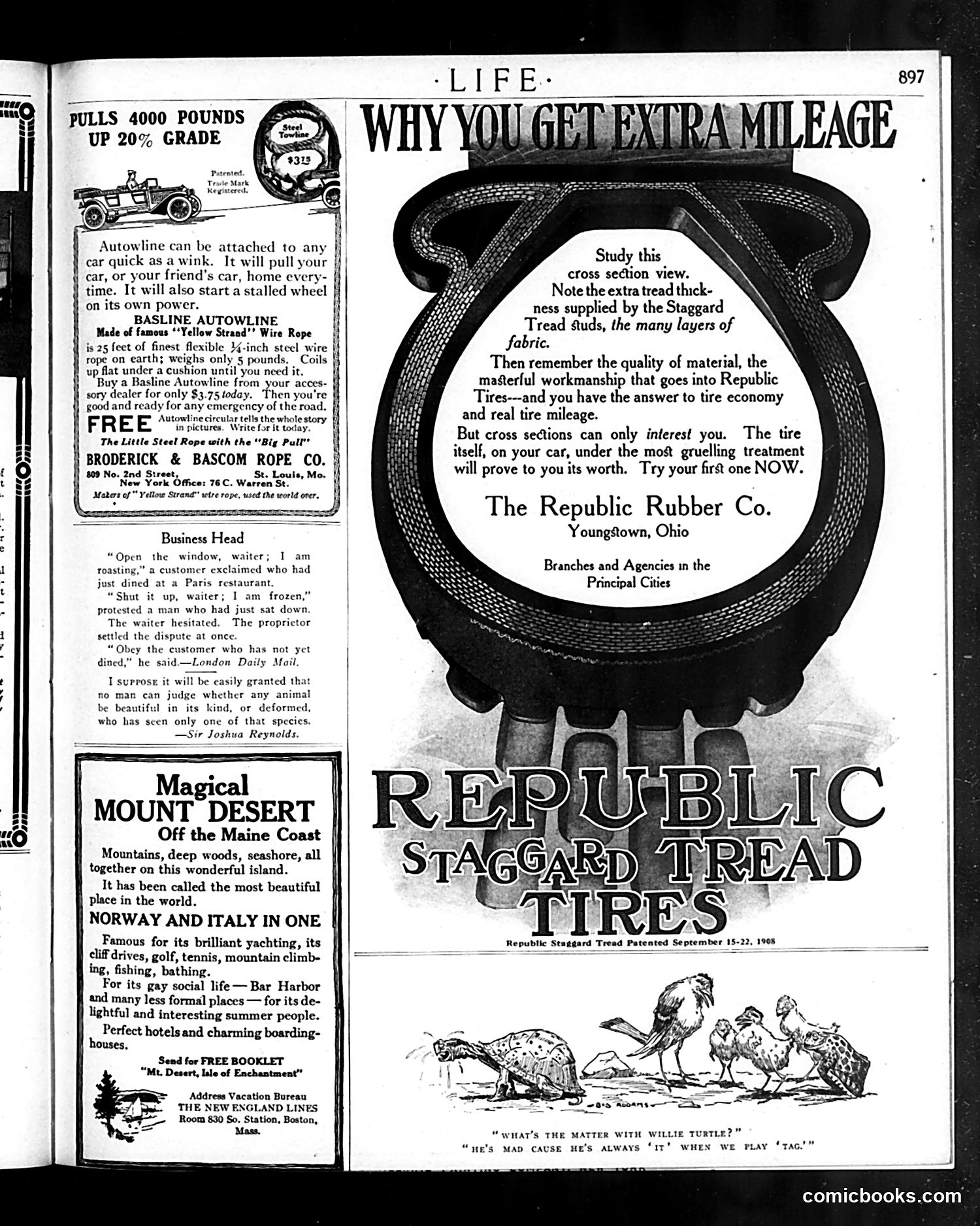
This page is primarily **advertising** with minor editorial content. The dominant feature is a full-page advertisement for **Republic Rubber Co.'s "Staggard Tread Tires,"** showing a cross-sectional diagram of a tire emphasizing its layered construction and tread thickness as selling points for durability and mileage. Supporting advertisements include: - **Basline Autowline** (a steel cable tow rope for automobiles) - **Mount Desert, Maine** (vacation destination) The editorial content consists of brief anecdotes: a humorous restaurant dialogue about conflicting customer comfort demands, and a philosophical quote about judging beauty. At the bottom is a small cartoon caption about "Willie Turtle" always being "it" in tag—a lighthearted joke about childhood games, not political satire. **Overall:** This is a commercial magazine page from 1908 showcasing automobile-related products and services, reflecting the early automotive era when such equipment was novel consumer goods.
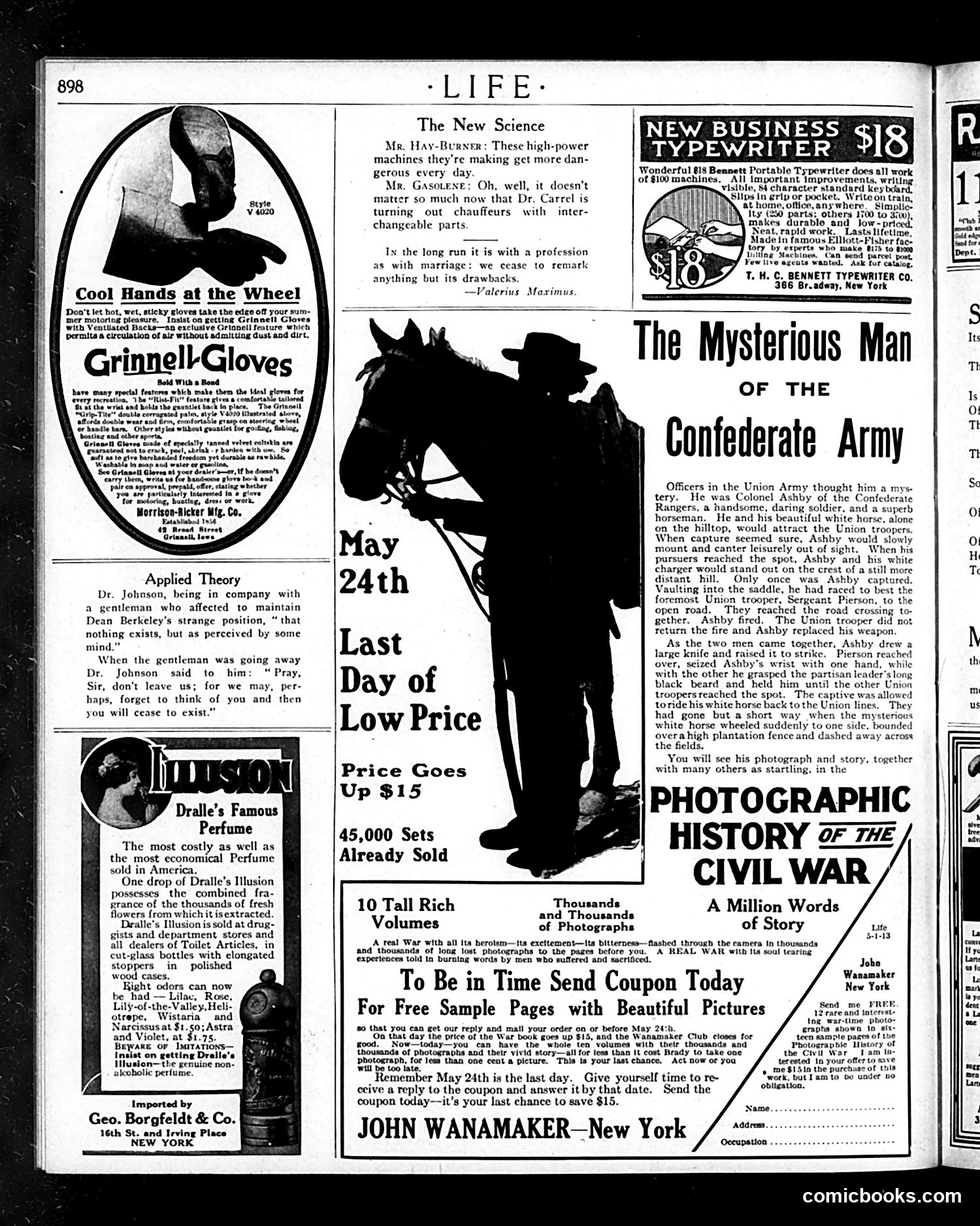
This page is primarily **advertisements and filler content**, not political satire. It includes: **The satire present:** "The New Science" is a brief joke about dangerous automobiles and Dr. Carrel's (likely Alexis Carrel, a real surgeon) medical advances—the humor lies in suggesting chauffeurs can be mass-produced with interchangeable parts like machines, darkly commenting on both automotive danger and industrial mechanization. **The main content:** The bulk of the page features **commercial advertising** (Grinnell Gloves, typewriters, perfume, a Civil War history book) and a reprinted classical anecdote about Dr. Johnson refuting Berkeley's philosophical idealism. The illustration of a Confederate cavalry officer on horseback advertises a photographic history of the Civil War—not commentary, but period entertainment marketing. **For modern readers:** This reflects early 1900s Life as a mixed publication combining light humor, classical literature excerpts, and heavy advertising rather than sustained political cartooning.
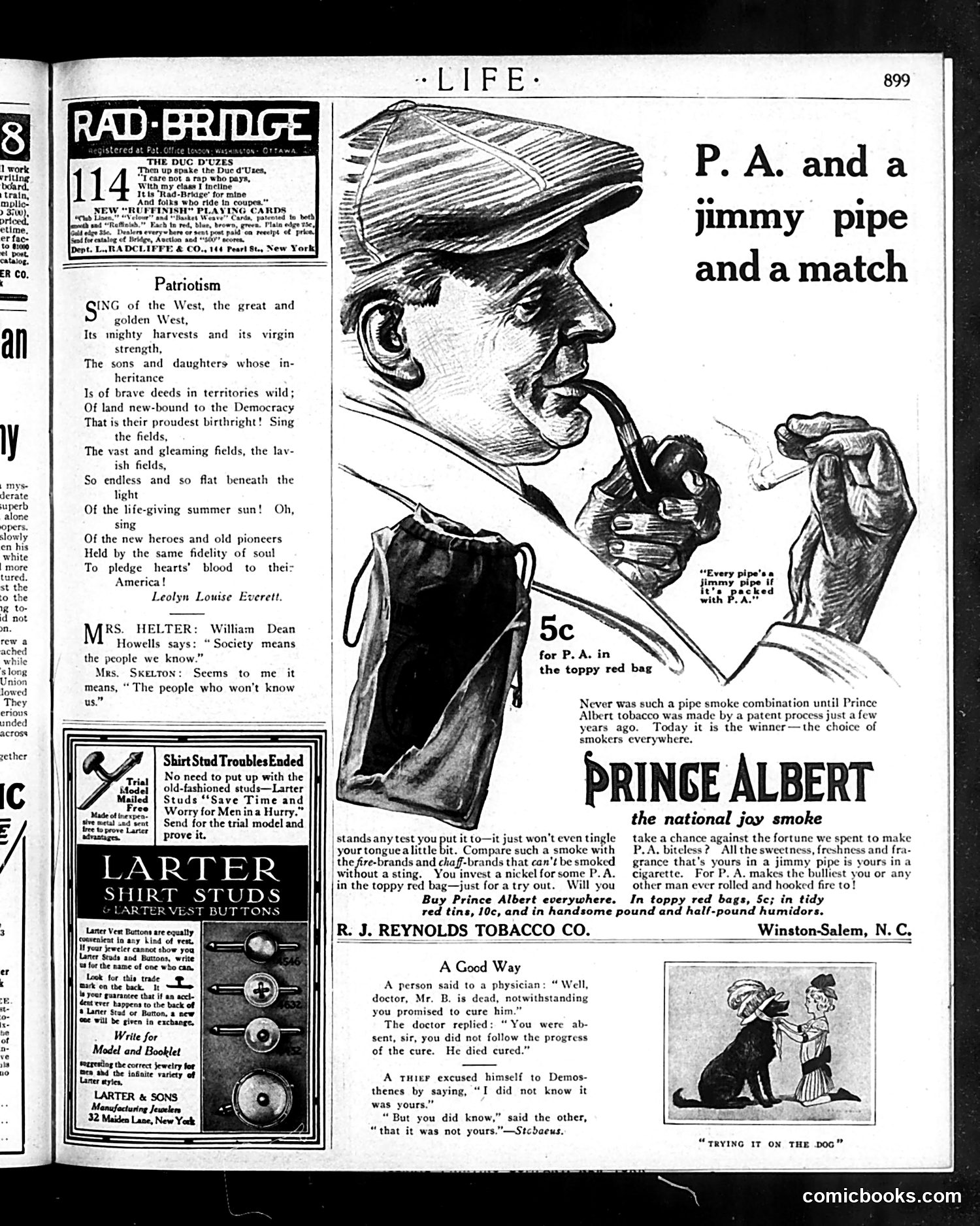
This page mixes advertisements with satirical content typical of Life magazine's format. **"Rad-Bridge" Cartoon (top left):** A brief satirical piece about the "Duc d'Uzès" (a French aristocrat), mocking class pretension. The duc claims indifference to who pays, preferring "Rad-Bridge" (likely a luxury item or affectation) because it suits his class status—satirizing European aristocratic snobbery. **"Patriotism" Poem:** A sentimental celebration of American Western settlement and democratic ideals, seemingly sincere rather than satirical. **Social Commentary:** Two brief exchanges mock social hypocrisy—one about who constitutes "society" (the known vs. the knowing), another a classical anecdote about thievery and self-deception. **Advertisements:** The page features substantial ads for Larter shirt studs and Prince Albert tobacco, including an illustration of a man smoking a pipe. These are genuine period advertisements, not satire. The page reflects early 20th-century American magazine conventions: mixing light satire, patriotic sentiment, and commercial advertising.
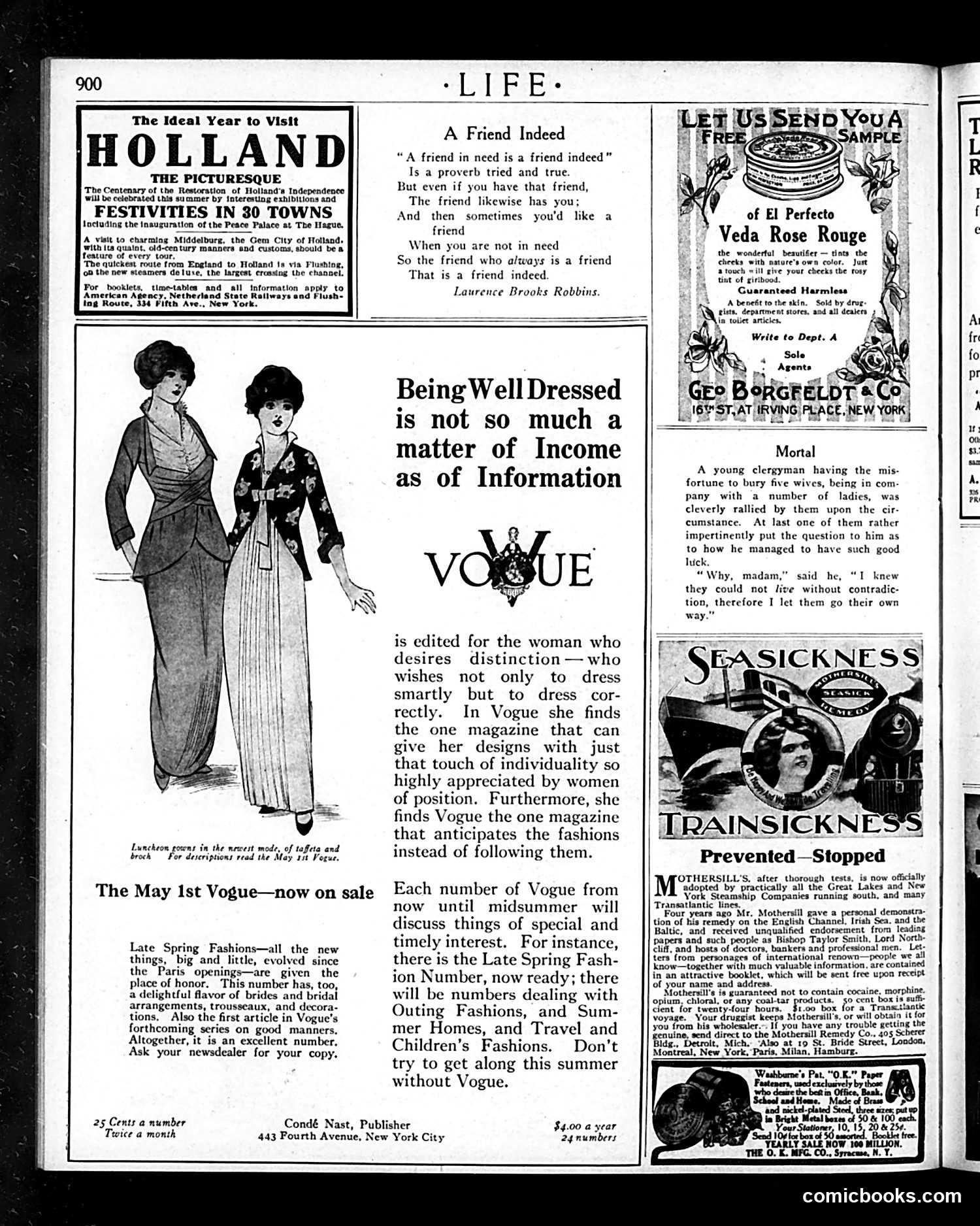
This page from *Life* magazine (undated but early 20th century based on style) contains mixed content: advertisements, poetry, and editorial material rather than political cartoons. **Main content:** A Vogue magazine advertisement dominates the center, promoting fashion's appeal to women of "distinction" and "position." Two illustrated women model fashions described as "luncheon gowns." **Satirical elements:** The poem "A Friend Indeed" by Laurence Brooks Robbins explores friendship pragmatically. A brief joke titled "Mortal" mocks clergymen: a widower of five wives claims he let them "go their own way" rather than contradict them—satirizing both clerical celibacy expectations and period attitudes toward women's obedience. **Other ads** promote cosmetics (Veda Rose Rouge), seasickness remedies (Mothersill's), and Holland tourism. The page reflects early 1900s concerns: fashion as social status marker, gender dynamics in marriage, and travel as leisure for the wealthy.
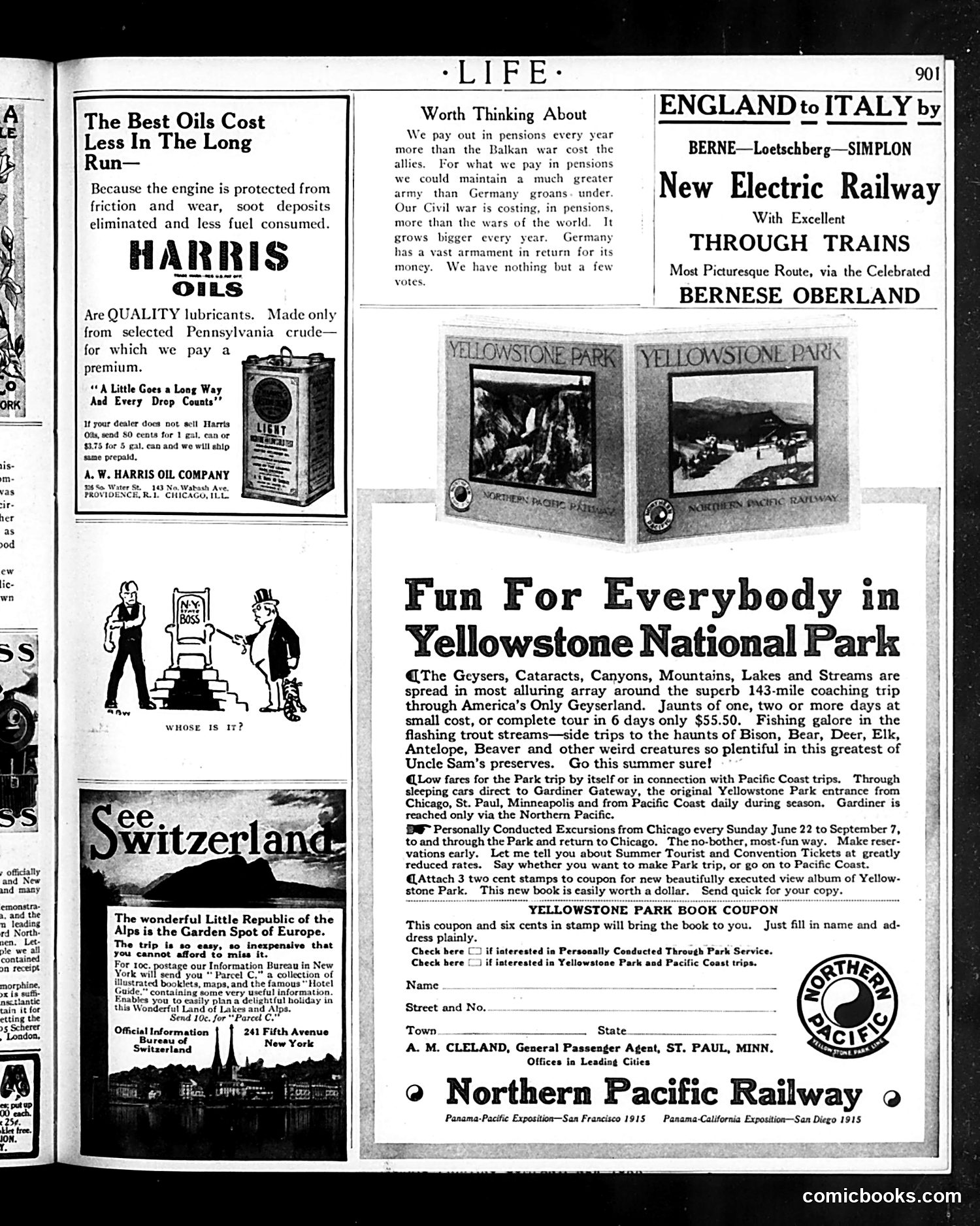
This page contains **no political cartoons**—it is primarily advertising and travel promotion, typical of Life's commercial content circa 1915. The one editorial element is a brief opinion piece titled "Worth Thinking About" that critiques U.S. military spending. The author argues that annual pension costs from past wars (particularly the Civil War) exceed what America spends maintaining its army, and exceed what Germany spent on its entire military buildup. The implicit point: America wastes resources on veteran pensions while Germany invests in armament—a concern voiced as WWI raged in Europe and America remained officially neutral. The rest of the page advertises Harris Oils, Swiss tourism, Yellowstone National Park trips, and Northern Pacific Railway service—typical leisure and consumer products marketed to middle-class readers of the era.
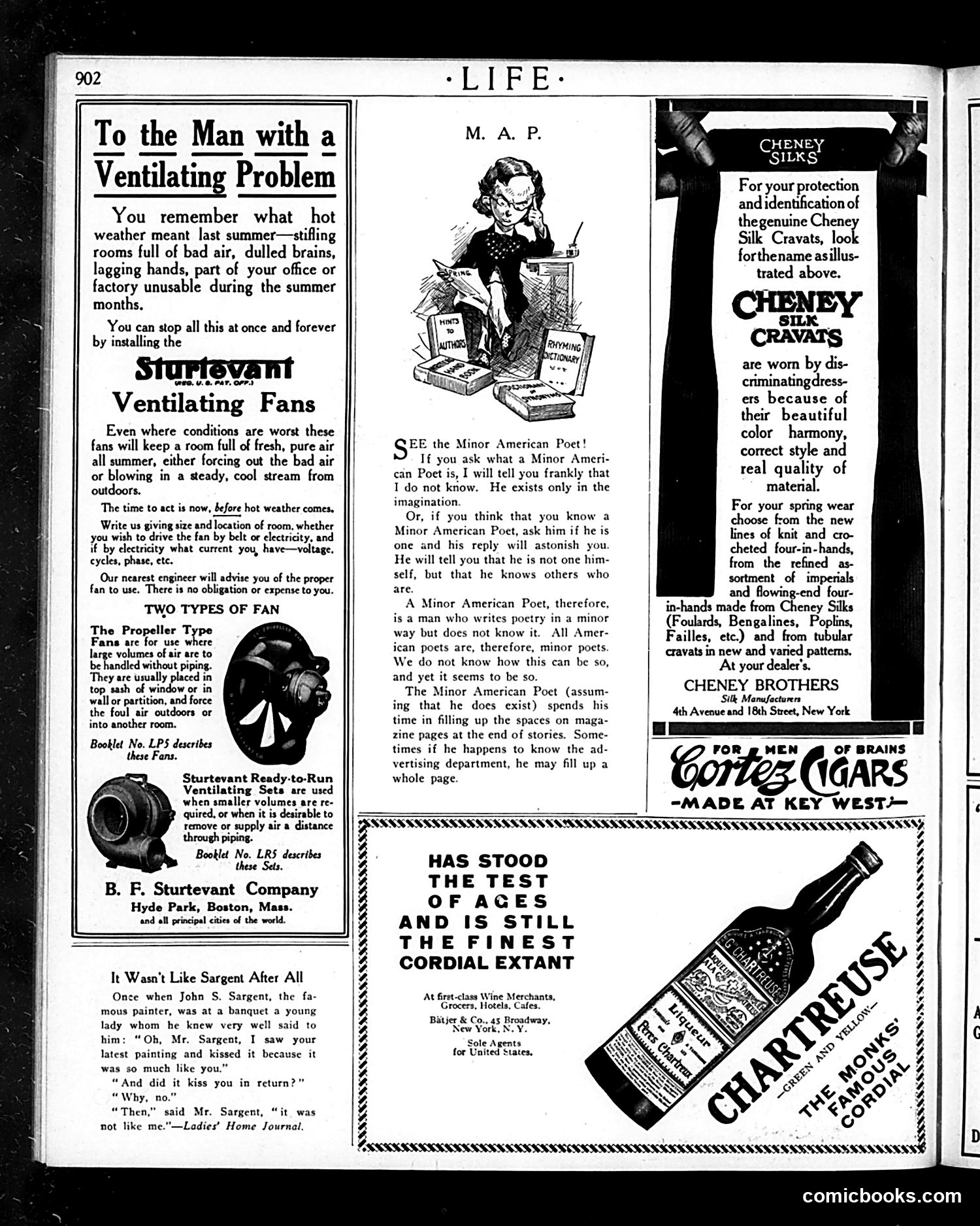
This page from *Life* magazine is primarily **advertising with one satirical article**. The main content is a humorous essay about the "Minor American Poet"—a fictional literary type who writes forgettable filler material for magazine pages. The satire targets aspiring American poets who claim others are "minor poets" while denying the label themselves, suggesting all such poets are minor but won't admit it. It's gentle mockery of literary pretension and the publishing industry's practice of filling space with mediocre verse. The page is dominated by period advertisements: ventilating fans for summer heat relief, Cheney silk cravats, Cortez cigars, and Chartruse cordial. A brief anecdote about painter John Singer Sargent concludes the page—a witty comeback joke about artistic vanity. The content reflects early 20th-century concerns: summer heat in offices without air conditioning, and self-published aspiring poets padding magazine pages.
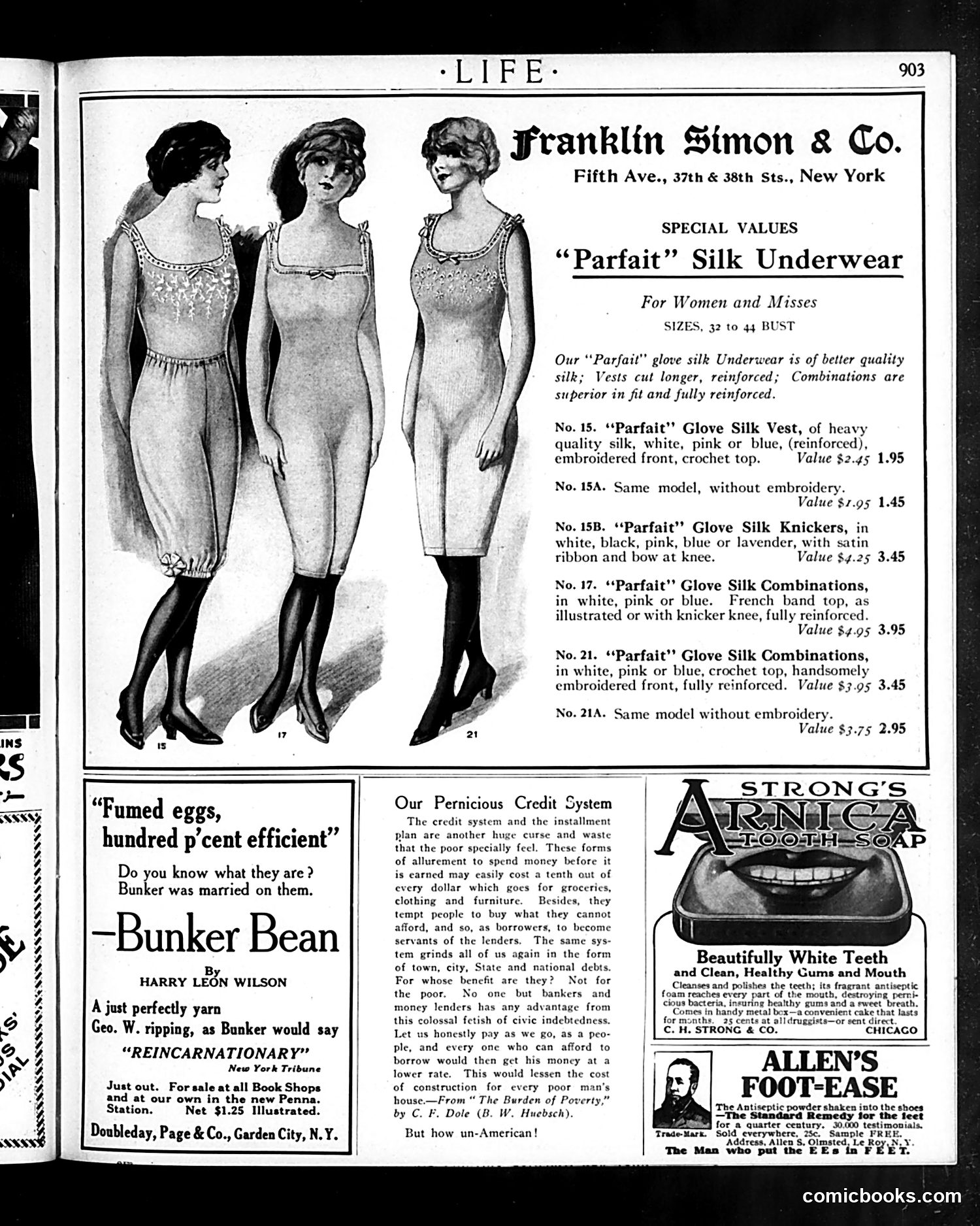
This page is primarily **advertising**, not political satire. It features fashion and consumer product ads typical of early 20th-century magazines. The top two-thirds showcases **Franklin Simon & Co.'s "Parfait" silk underwear** for women, with illustrated models displaying various styles of vests, knickers, and combinations (one-piece garments). Prices range from $1.45 to $3.95—presented as "special values" with original prices crossed out. Below are ads for: - **"Bunker Bean,"** a novel by Harry Leon Wilson about reincarnation - A critique of **installment buying and credit systems**, arguing they exploit poor people and increase debt - **Strong's Arnica Tooth Soap** and **Allen's Foot-Ease** powder The credit system commentary is the page's only editorial content, satirizing consumer debt as financially ruinous—a relevant concern during the early industrial era when installment plans were becoming common.
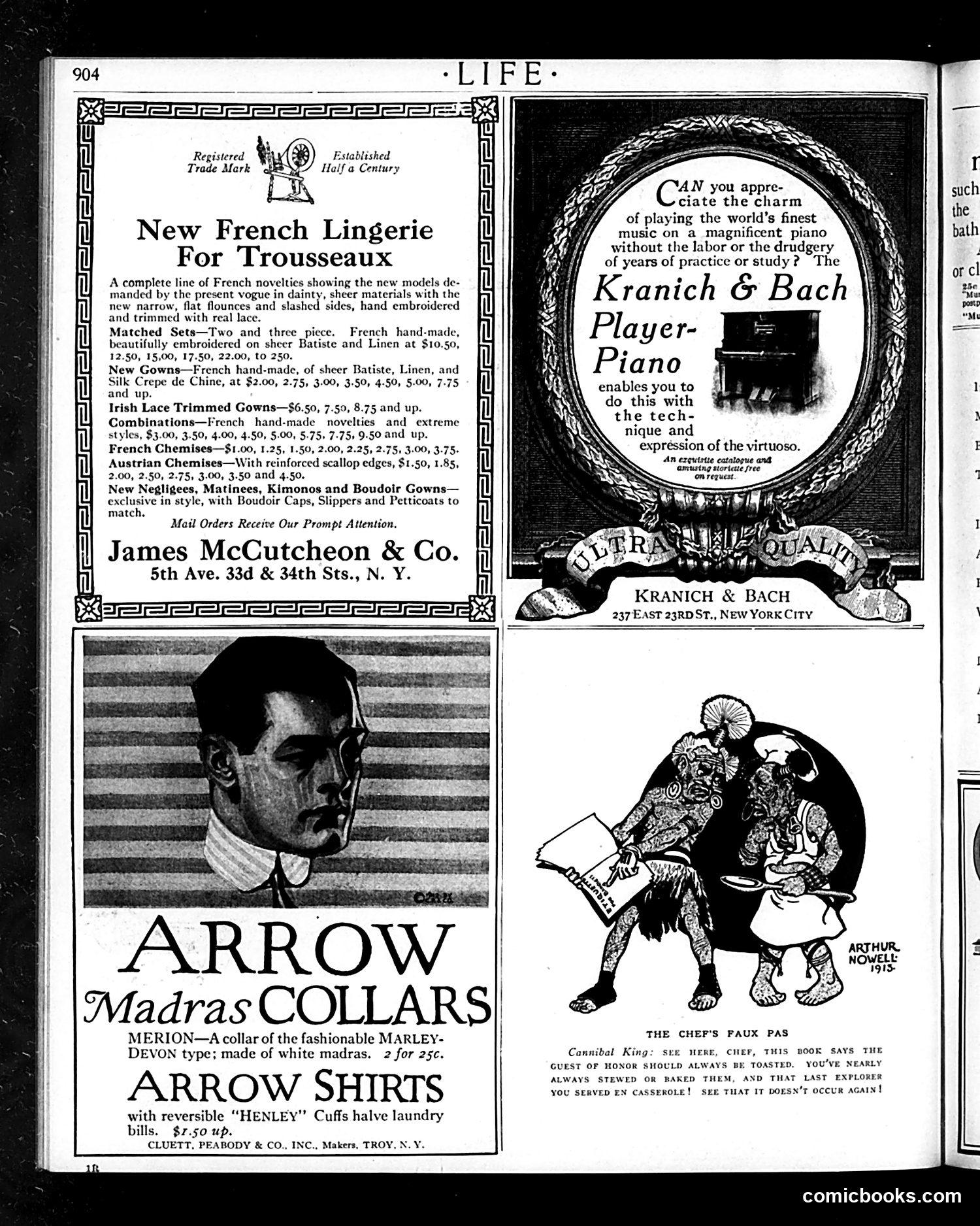
This page is primarily **advertising** for luxury goods (French lingerie, piano, shirts, collars) with one small satirical cartoon. ## The Cartoon: "The Chef's Faux Pas" The cartoon depicts a **Cannibal King** scolding his chef. The joke plays on the "proper etiquette" concept: the king criticizes the chef for *stewing* and *baking* previous dinner guests instead of *toasting* them—the "correct" way to prepare an honored guest according to a book on dining etiquette. **The satire**: This is darkly humorous racial stereotype humor typical of early 20th-century American publications. It mocks both: (1) cannibal stereotypes of African peoples, and (2) the rigid, often absurd rules of upper-class dining etiquette, suggesting the "civilized" concern with proper preparation methods is as ridiculous when applied to cannibalism as cannibalism itself is to the reader. The humor relies entirely on period racial caricature conventions that modern readers would recognize as offensive rather than funny.
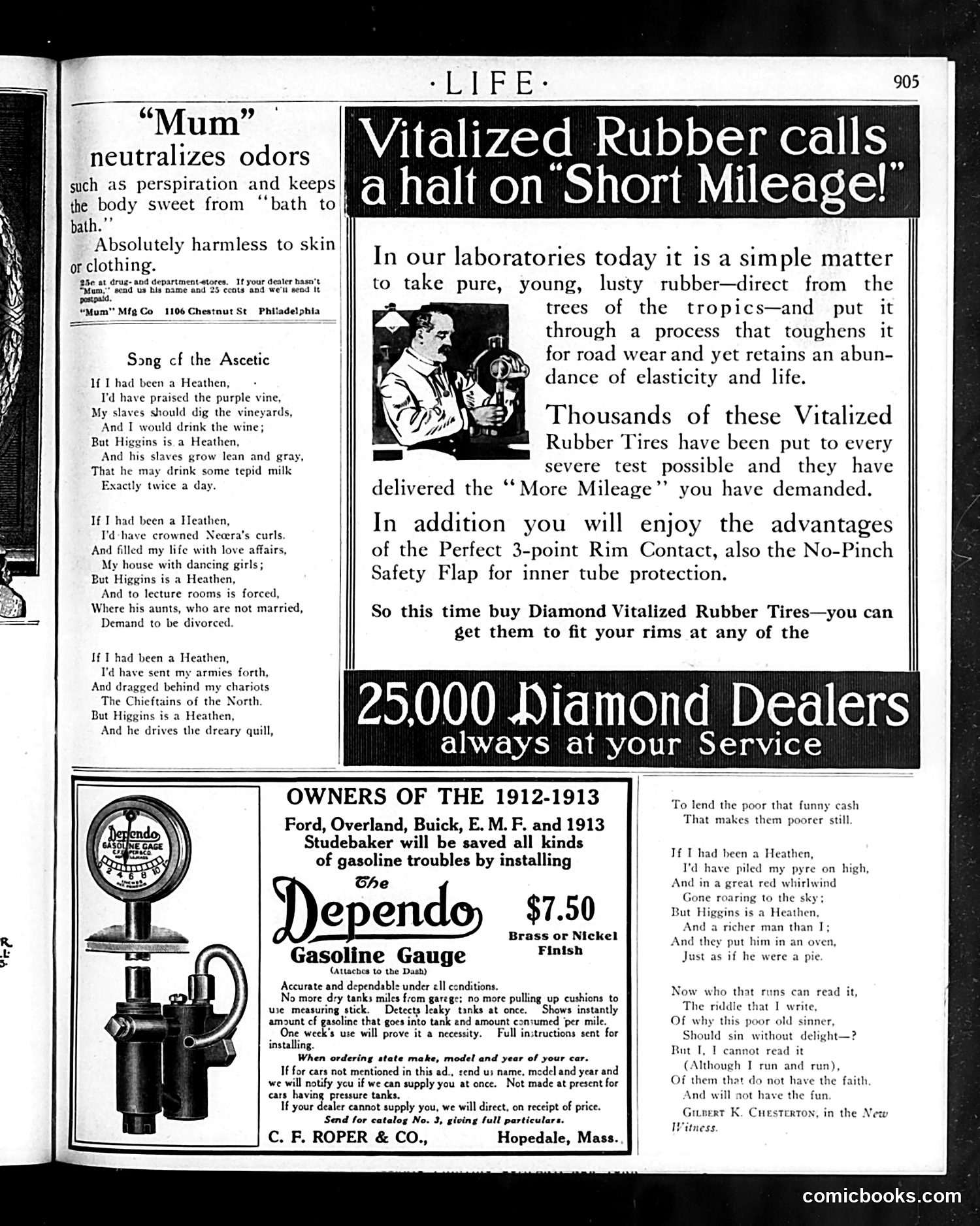
This page contains **primarily advertisements** interspersed with poetry, not political cartoons. The main content includes: - A "Mum" deodorant ad (neutralizes body odor) - A large Diamond Vitalized Rubber Tires advertisement claiming improved mileage - A Dependо Gasoline Gauge ad for early automobiles (Ford, Buick, Studebaker models from 1912-1913) The poetry is **"Song of the Ascetic"** by Gilbert K. Chesterton, a satirical piece contrasting how a pagan "heathen" would live luxuriously versus the speaker's austere, constrained life under Christian asceticism. The poem critiques religious self-denial through ironic longing for pagan excess. **Context for modern readers:** This reflects early 20th-century consumer culture advertising to automobile owners, plus Chesterton's Catholic social commentary mocking rigid puritanism—a common theme in his writing.
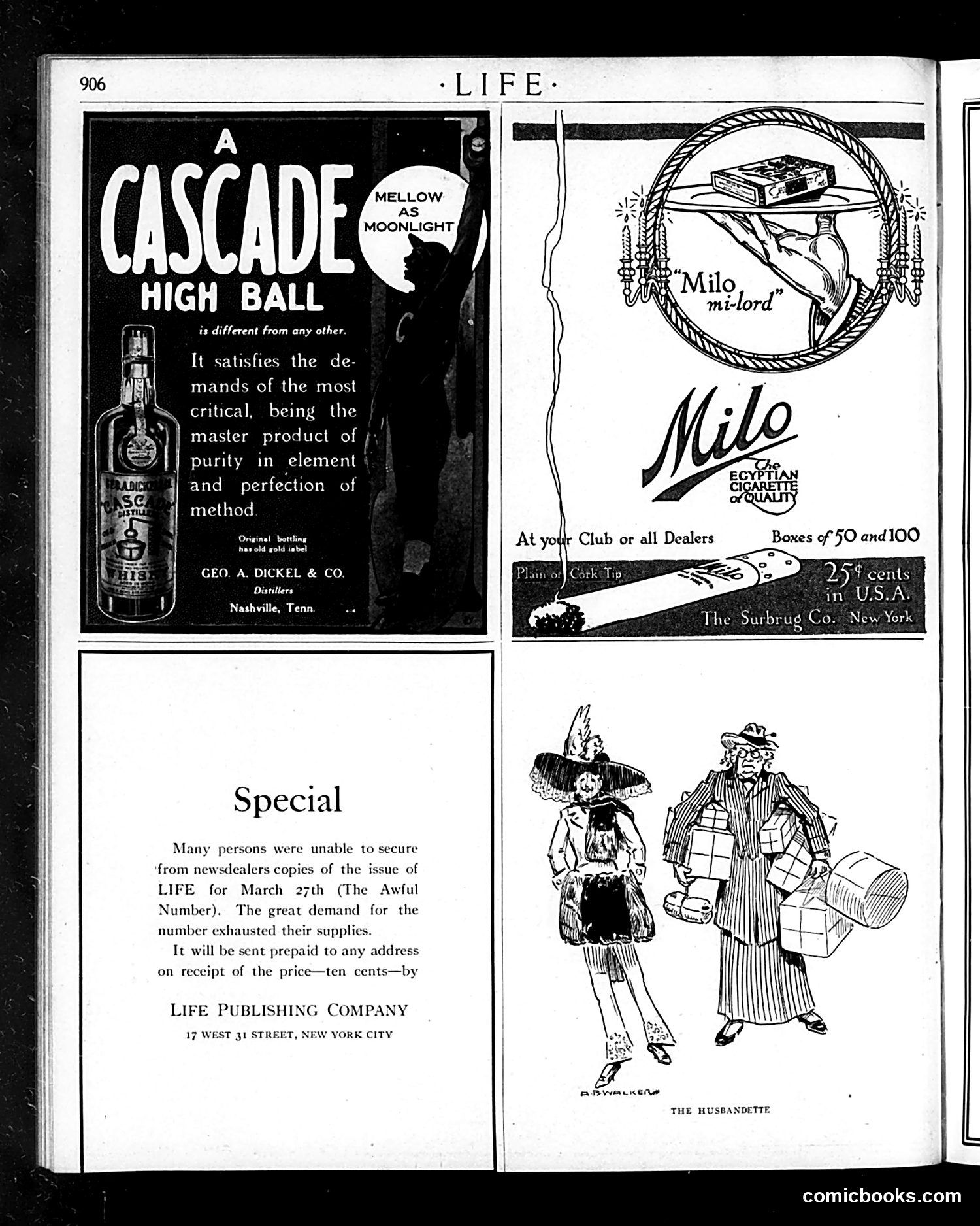
This page is primarily **advertising and administrative content** rather than political satire. The ads promote **Cascade High Ball** whiskey (Nashville distiller) and **Milo cigarettes** (25 cents per box). Both use period-typical marketing language emphasizing quality and refinement. The only cartoon appears at bottom right, titled "**The Husbandette**"—a sketch showing a woman and man in exaggerated dress carrying various household items and luggage. The joke appears to reference a newly married woman ("husbandette") managing domestic responsibilities, likely a mild gender-role satire common to the era. The "Special" notice announces that Life's March 27th issue (called "The Awful Number") sold out due to demand, offering reprints for ten cents. Without seeing the March 27th issue itself, the specific satire it contained remains unclear.
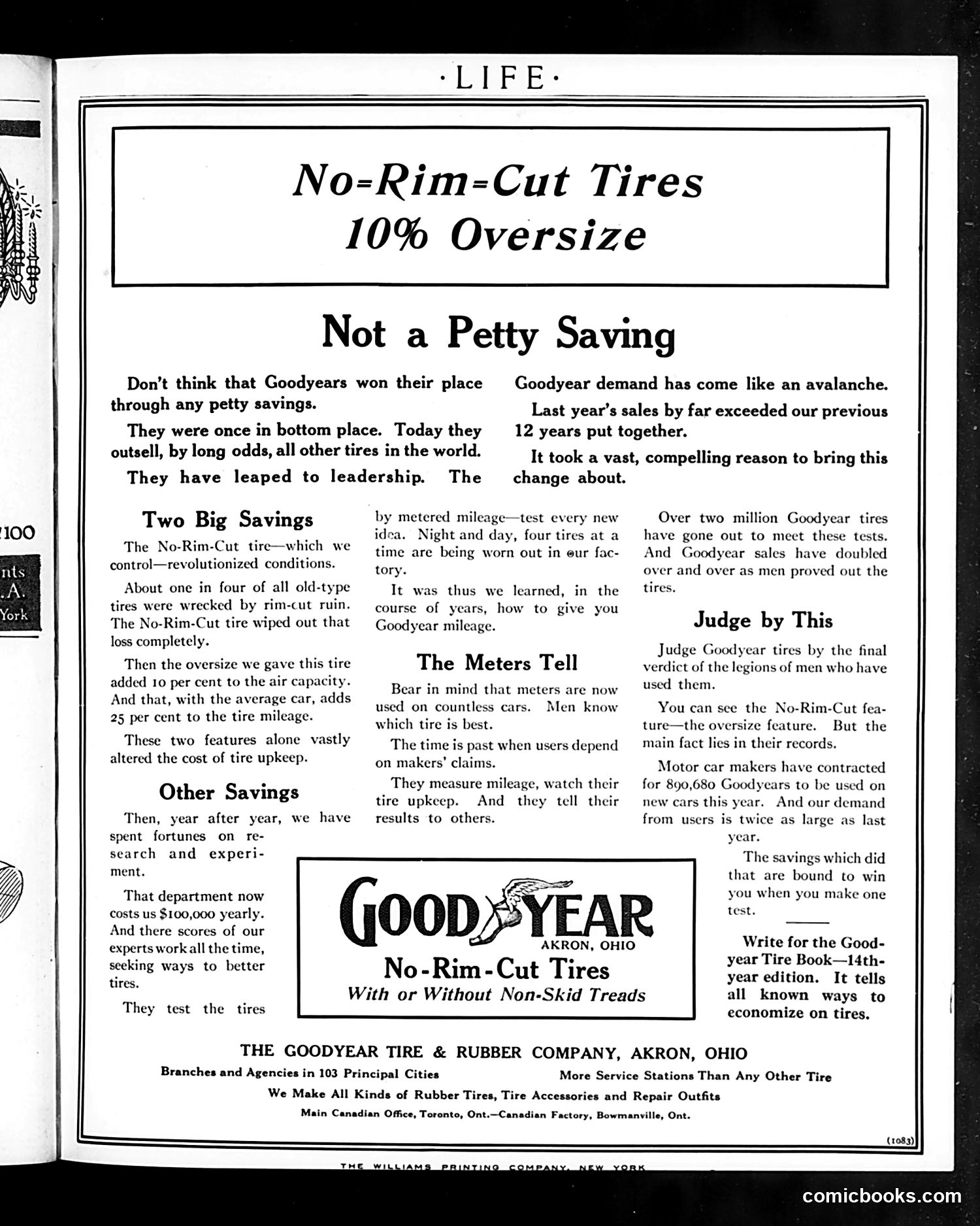
This is a **full-page advertisement**, not satire or cartoon content. It promotes Goodyear's No-Rim-Cut tires, emphasizing their market dominance and technological innovations. The ad argues Goodyear's success stems not from "petty savings" but from two major innovations: the No-Rim-Cut design (eliminating a common tire failure mode affecting 25% of old tires) and 10% oversizing (adding 25% more mileage). The company claims to spend $100,000 yearly on research, testing tires continuously at their factory. The pitch pivots to objective proof: meters now used on many cars allow drivers to measure actual mileage, creating transparent competition based on real performance rather than manufacturer claims. Sales evidence supports superiority—motor manufacturers contracted for 890,680 Goodyears for new cars, with consumer demand doubling yearly. The tone is pragmatic corporate boasting dressed as honest engineering testimony, typical of early 20th-century industrial advertising.
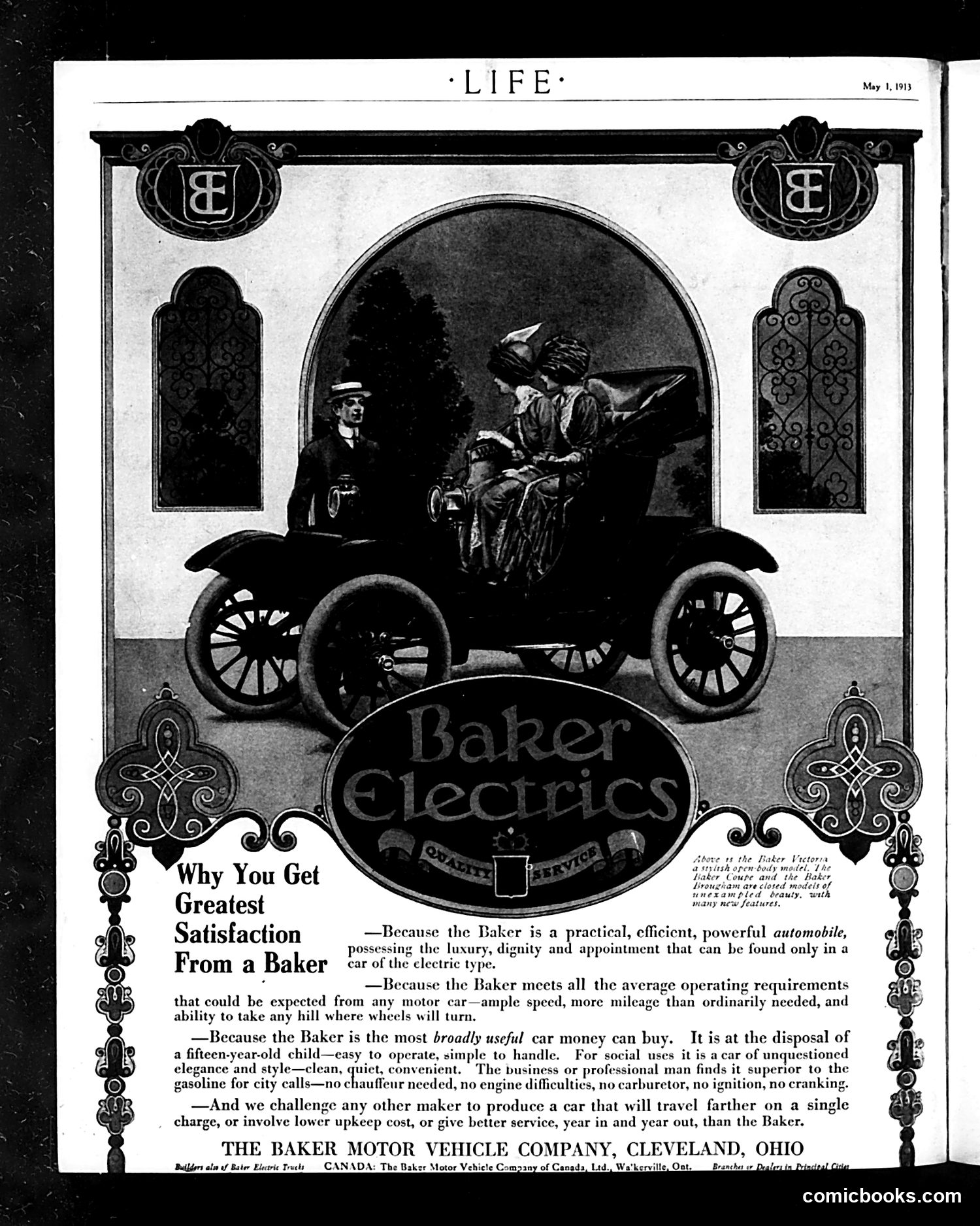
This is **not a cartoon or satire**—it's a straightforward automobile advertisement for the Baker Electric Motor Vehicle Company of Cleveland, Ohio. The image shows a well-dressed couple in an early electric automobile, arriving at what appears to be an upscale venue (note the ornate doors and architectural details). The advertisement emphasizes the Baker's practical advantages: ease of operation ("a fifteen-year-old child" could drive it), reliability, luxury appointments, and suitability for both business and social use. The specific appeal to electric vehicles is historically significant: in 1913, electric cars competed seriously with gasoline automobiles, particularly among affluent urban drivers who valued quiet, clean operation without hand-cranking or engine maintenance. The ad's boasts about range and low upkeep reflect genuine competitive concerns of the era. This represents pre-mass-production automotive marketing, when different power sources were still viable commercial options.