
Life, 1913-05-01 · page 27 of 48
Life — May 1, 1913 — page 27: what you’re looking at
What you’re looking at
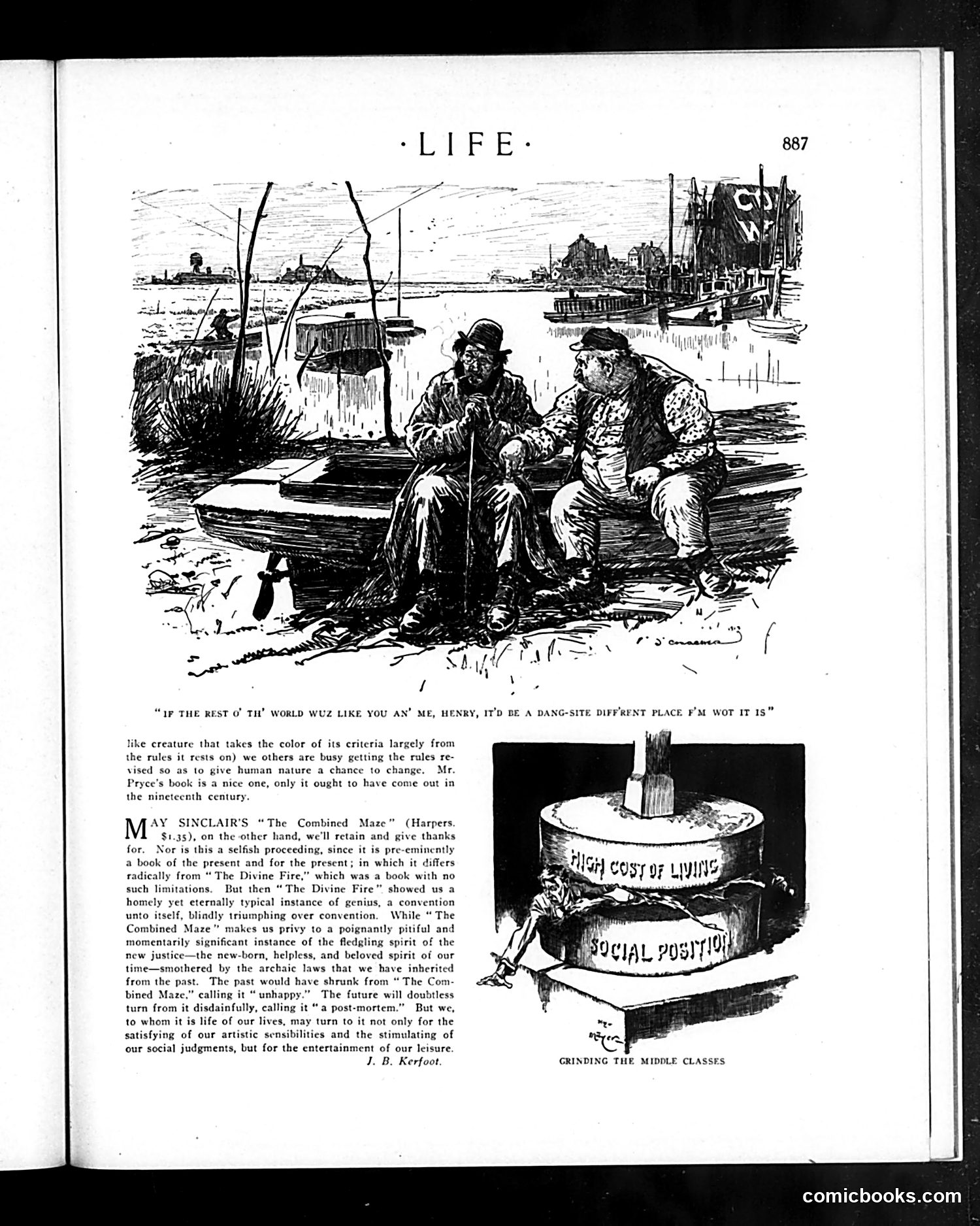
The top illustration shows two working-class men sitting by a waterfront, with industrial cityscape behind them. The caption quotes one saying to the other that if the world were like his companion, it would be "a dang-site different place" — suggesting commentary on poverty or working-class conditions. Below is a cartoon titled "Grinding the Middle Classes," depicting a massive grinding wheel or mill labeled "High Cost of Living" and "Social Position," crushing a figure beneath it. This is social satire about the economic and social pressures crushing the middle class. The text discusses recent novels by May Sinclair and others, praising works that address contemporary social justice issues and modern life over older literature. The reviewer argues such current, socially-engaged fiction matters more to present readers than timeless classics. Together, the page satirizes how industrial capitalism and social hierarchies economically squeeze ordinary people while celebrating literature that honestly depicts these modern struggles.
📄 Transcribed text from this page (OCR, searchable)
Machine-transcribed from the original scan — historical spelling and the odd misread are preserved.
like creature that takes the color of its criteria largely from the rules it rests on) we others are busy getting the rules re- vised so as to give human nature a chance to change. Mr. Pryce’s book is a nice one, only it ought to have come out in the nineteenth century. AY SINCLAIR'S “The Combined Maze” (Harpers $1.35), on the other hand, we'll retain and give thanks for. Nor is this a selfish proceeding, since it is pre-eminently a book of the present and for the present; in which it differs radically from “ The Divine Fire,” which was a book with no such limitations. But then “The Divine Fire” showed us a homely yet eternally typical instance of genius, a convention unto itself, blindly triumphing over convention. While “ The Combined Maze” makes us privy to a poignantly pitiful and momentarily significant instance of the fledgling spirit of the new justice—the new-born, helpless, and beloved spirit of our time—smothered by the archaic laws that we have inherited from the past. The past would have shrunk from “The Com- bined Maze,” calling it “unhappy.” The future will doubtless turn from it disdainfully, calling it “a post-mortem.” But we, to whom it is life of our lives, turn to it not only for the satisfying of our artistic sensibilities and the stimulating of our social judgments, but for the entertainment of our leisure. J. B. Kerfoot. GRINDING THE MIDDLE CLASSES comicbooks.com