
Life, 1913-05-01 · page 10 of 48
Life — May 1, 1913 — page 10: what you’re looking at
What you’re looking at
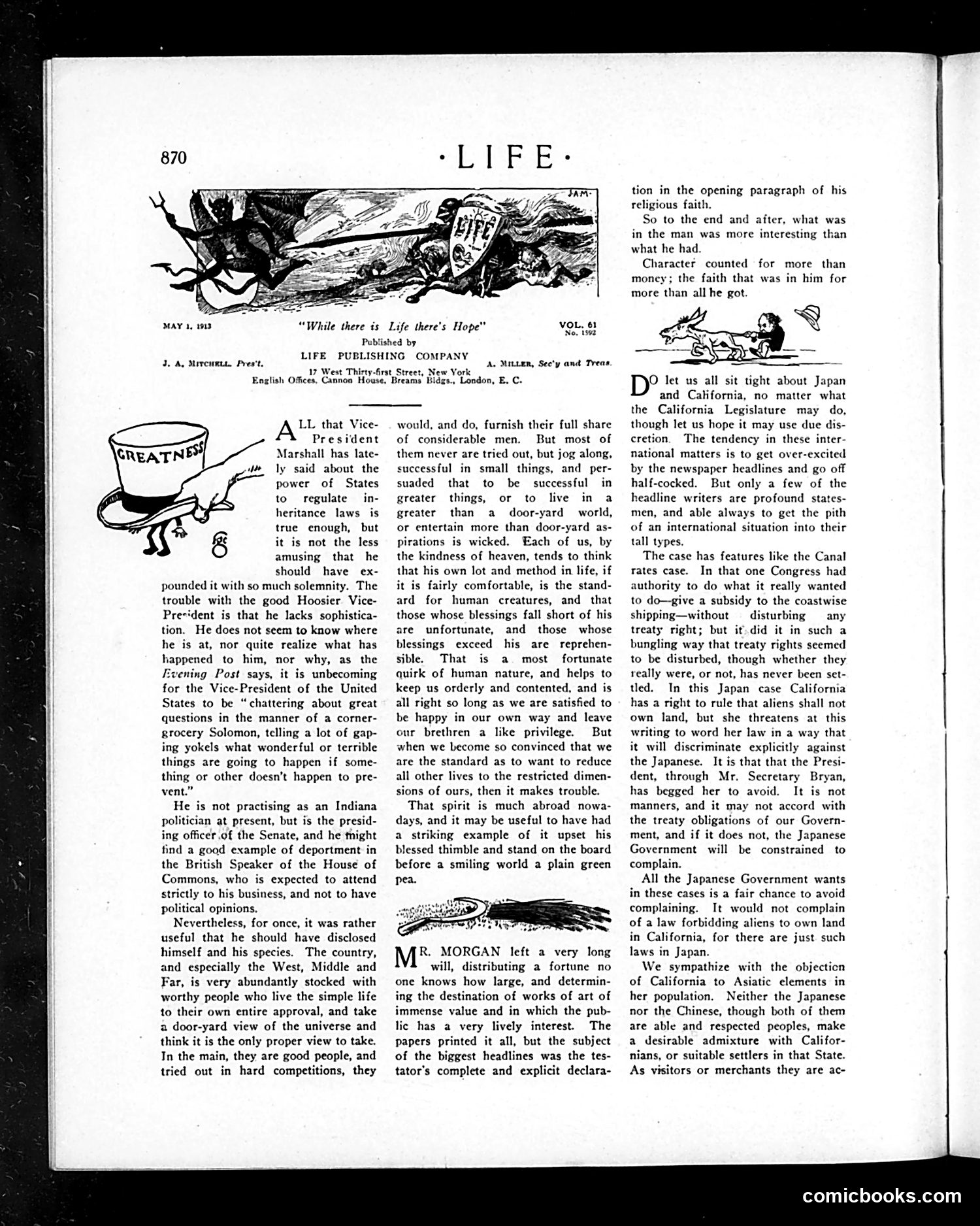
This page from *Life* (May 1, 1913) contains editorial commentary criticizing Vice-President James Sherman's vague political positioning. The text sarcastically notes Sherman "lacks sophistication" and hasn't clearly disclosed his ambitions, comparing him unfavorably to the British Speaker of the House of Commons. The left margin features an illustration of a figure labeled "GREATNESS" climbing into an oversized hat—likely satirizing Sherman's inflated self-regard or unclear grasp of the presidency. The accompanying editorial mocks Sherman for simultaneously denying political ambitions while positioning himself for higher office, suggesting his evasiveness and lack of decisive character rendered him unfit for national leadership.
📄 Transcribed text from this page (OCR, searchable)
Machine-transcribed from the original scan — historical spelling and the odd misread are preserved.
CREAT NES MAY 4, 1913 Pubs LIFE PUBLISHID J. A, Mireume. Pres't, 17 West Thisty English Offices, Cannon Hoi A LL that Vice- President Marshall has late- ly said about the power of States to regulate in- heritance laws is true enough, but it is not the less amusing that he should have ex- pounded it with so much solemnity. The trouble with the good Hoosier Vice- President is that he lacks sophistica- tion. He does not seem to know where he is at, nor quite realize what has happened to him, nor why, as the Evening Post says, it is unbecoming for the Vice-President of the United States to be “chattering about great questions in the manner of a corner- grocery Solomon, telling a lot of gap- ing yokels what wonderful or terrible things are going to happen if some- thing or other doesn’t happen to pre- vent.” He is not practising as an Indiana politician at present, but is the presid- ing officer .of the Senate, and he tight find a good example of deportment in the British Speaker of the House of Commons, who is expected to attend strictly to his business, and not to have political opinions. Nevertheless, for once, it was rather useful that he should have disclosed himself and his species. The country, and especially the West, Middle and Far, is very abundantly stocked with worthy people who live the simple life to their own entire approval, and take a door-yard view of the universe and think it is the only proper view to take. In the main, they are good people, and tried out in hard competitions, they “While there is Life there's Hope” VOL. 61 ‘No. i392 ied by NG COMPANY “5 As MILLER, See'y and Treas, Street, New York Breams’ Bidgs., London, E. C. would, and do, furnish their full share of considerable men. But most of them never are tried out, but jog along, successful in small things, and per- suaded that to be successful in greater things, or to live in a greater than a door-yard world, or entertain more than door-yard as- pirations is wicked. Each of us, by the kindness of heaven, tends to think that his own lot and method in life, if it is fairly comfortable, is the stand- ard for human creatures, and that those whose blessings fall short of his are unfortunate, and those whose blessings exceed his are reprehen- sible. That is a most fortunate quirk of human nature, and helps to keep us orderly and contented, and is all right so long as we are satisfied to be happy in our own way and leave our brethren a like privilege. But when we become so convinced that we are the standard as to want to reduce all other lives to the restricted dimen- sions of ours, then it makes trouble. That spirit is much abroad nowa- days, and it may be useful to have had a striking example of it upset his blessed thimble and stand on the board before a smiling world a plain green R. MORGAN left a very long will, distributing a fortune no one knows how large, and determin- ing the destination of works of art of immense value and in which the pub- lic has a very lively interest. The papers printed it all, but the subject of the biggest headlines was the tes- tator’s complete and explicit declara- tion in the opening paragraph of his religious faith. So to the end and after, what was in the man was more interesting than what he had. Character counted for more than moncy; the faith that was in him for more than all he got. O let us all sit tight about Ja and California, no matter what the California Legislature may do, though let us hope it may use due dis- cretion. The tendency in these inter- national matters is to get over-excited by the newspaper headlines and go off half-cocked. But only a few of the headline writers are profound states- men, and able always to get the pith of an international situation into their tall types. The case has features like the Canal rates case. In that one Congress had authority to do what it really wanted to do—give a subsidy to the coastwise shipping—without disturbing any treaty right; but it did it in such a bungling way that treaty rights seemed to be disturbed, though whether they really were, or not, has never been set- tled. In this Japan case California has a right to rule that aliens shall not own land, but she threatens at this writing to word her law in a way that it will discriminate explicitly against the Japanese. It is that that the Presi- dent, through Mr. Secretary Bryan, has begged her to avoid. It is not manners, and it may not accord with the treaty obligations of our Govern- ment, and if it does not, the Japanese Government will be constrained to complain. All the Japanese Government wants in these cases is a fair chance to avoid complaining. It would not complain of a law forbidding aliens to own land in California, for there are just such laws in Japan. We sympathize with the objection of California to Asiatic elements in her population. Neither the Japanese nor the Chinese, though both of them are able and respected peoples, make a desirable admixture with Califor- nians, or suitable settlers in that State. As visitors or merchants they are ac- comicbooks.com