
Life, 1913-05-01 · page 26 of 48
Life — May 1, 1913 — page 26: what you’re looking at
What you’re looking at
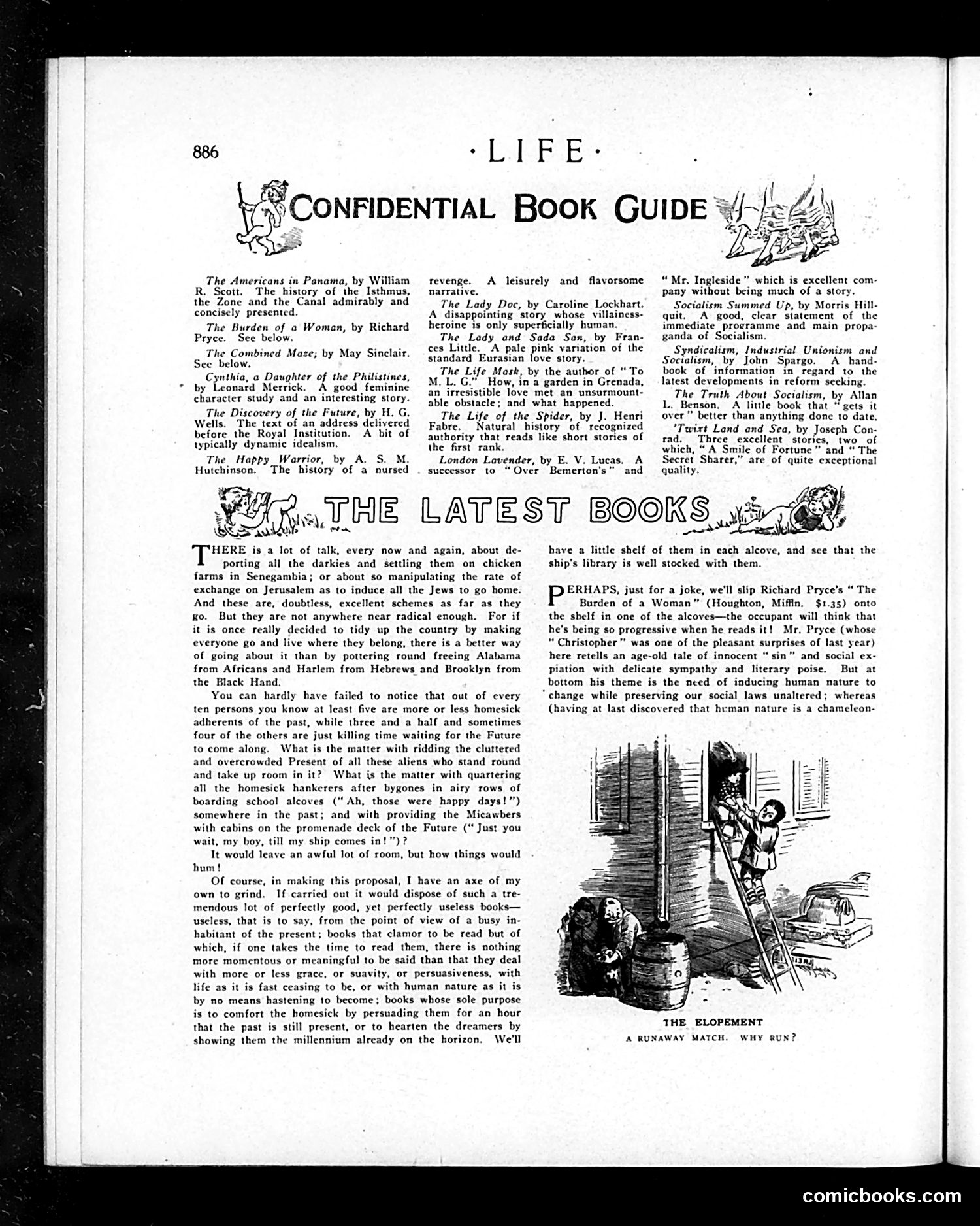
This single-panel cartoon illustrates a domestic crisis: a young couple elopes through a window while an adult (likely a parent) below reaches up desperately trying to stop them. The caption reads "A RUNAWAY MATCH. WHY RUN?" The satire targets early 20th-century social conventions around courtship and parental authority. The "why run?" question is rhetorical—couples eloped precisely *because* they needed to escape parental disapproval, typically due to class differences, religious objections, or age concerns. By asking "why run?" the cartoonist mocks the futility of such elopements and, implicitly, the outdated social restrictions forcing young people to defy their elders. The accompanying text discusses disposing of "homesick" people nostalgic for the past, suggesting the cartoon critiques rigid traditionalists clinging to restrictive social norms that younger generations increasingly reject. The humor lies in exposing the absurdity of circumstances that make secret escape necessary.
📄 Transcribed text from this page (OCR, searchable)
Machine-transcribed from the original scan — historical spelling and the odd misread are preserved.
The Americans in Panama, by William R. Scott. The history of the Isthmus, the Zone and the Canal admirably and concisely presented. The Burden of a Woman, by Richard Pryce. See below. The Combined Maze; by May Sinclair. See below. Cynthia, a Daughter of the Philistines, by Leonard Merrick. A good feminine character study and an interesting story. The Discovery of the Future, by H. G. Wells. The text of an address delivered before the Royal Institution. A bit of typically dynamic idealism. Happy, Warrior, by A. S. M. Hutchinson. The history of a nursed ve\c revenge. narrative. The Lady Doc, by Caroline Lockhart. A disappointing ‘story whose villainess- heroine is only superficially human. The Lady and Sada San, by Fran- ces Little. A pale pink variation of the standard Eurasian love story. The oh Mask, by the author of “To M.L.G.” How, in a garden in Grenada, an irresistible love met an unsurmount- able obstacle; and what happened. The Life of the Spider, by J. Henri Fabre. Natural history of recognized authority that reads like short stories of the first rank. London Lavender, by E. V. Lucas. A successor to “Over Bemerton's" and A leisurely and flavorsome “ Mr, Ingleside” which is excellent com- pany without being much of a story. Socialism Summed Up, by Morris Hill- quit. A good, clear statement of the immediate procramme and main propa- ganda of Socialism. Syndicalism, Industrial Unionism and Socialism, by’ John Spargo. A hand book of information in regard to the latest developments in reform secking. The Truth About Socialism, by Allan L. Benson. A little book that “gets it over” better than anything done to date. ‘Twist Land and Sea, by Joseph Con- rad. Three excellent ‘stories, two. of which, “A Smile of Fortune” and “ The Secret Sharer,” are of quite exceptional quality. THE LATEST BOOKS 5 4 OCS tale HERE is a lot of talk, every now and again, about de- porting all the darkies and settling them on chicken farms in Senegambia; or about so manipulating the rate of exchange on Jerusalem as to induce all the Jews to go home. And these are, doubtless, excellent schemes as far as they go. But they are not anywhere near radical enough. For if it is once really decided to tidy up the country by making everyone go and live where they belong, there is a better way of going about it than by pottering round freeing Alabama from Africans and Harlem from Hebrews and Brooklyn from the Black Hand. You can hardly have failed to notice that out of every ten persons you know at least five are more or less homesick adherents of the past, while three and a half and sometimes four of the others are just killing time waiting for the Future to come along. What is the matter with ridding the cluttered and overcrowded Present of all these aliens who stand round and take up room in it? What is the matter with quartering all the homesick hankerers after bygones in airy rows of boarding school alcoves (Ah, those were happy days!”) somewhere in the past; and with providing the Micawbers with cabins on the promenade deck of the Future (“Just you wait, my boy, till my ship comes in!")? It would leave an awful lot of room, but how things would hum! Of course, in making this proposal, I have an axe of my own to grind. If carried out it would dispose of such a tre- mendous lot of perfectly good, yet perfectly useless books— useless, that is to say, from the point of view of a busy in- habitant of the present; books that clamor to be read but of which, if one takes the time to read them, there is nothing more momentous or meaningful to be said than that they deal with more or less grace, or suavity, or persuasiveness, with life as it is fast ceasing to be, or with human nature as it is by no means hastening to become; books whose sole purpose is to comfort the homesick by persuading them for an hour that the past is still present, or to hearten the dreamers by showing them the millennium already on the horizon. We'll have a little shelf of them in each alcove, and sce that the ship's library is well stocked with them. ERHAPS, just for a joke, we'll slip Richard Pryce’s “ The Burden of a Woman” (Houghton, Miffin. $1.35) onto the shelf in one of the alcoves—the occupant will think that he's being so progressive when he reads it! Mr. Pryce (whose “ Christopher” was one of the pleasant surprises of last year) here retells an age-old tale of innocent “sin” and social ex- piation with delicate sympathy and literary poise. But at bottom his theme is the need of inducing human nature to “change while preserving our social laws unaltered; whereas (having at last discovered that human nature is a chameleon- THE ELOPEMENT A RUNAWAY MATCH. WHY RU comicbooks.com