
Life, 1913-05-01 · page 23 of 48
Life — May 1, 1913 — page 23: what you’re looking at
What you’re looking at
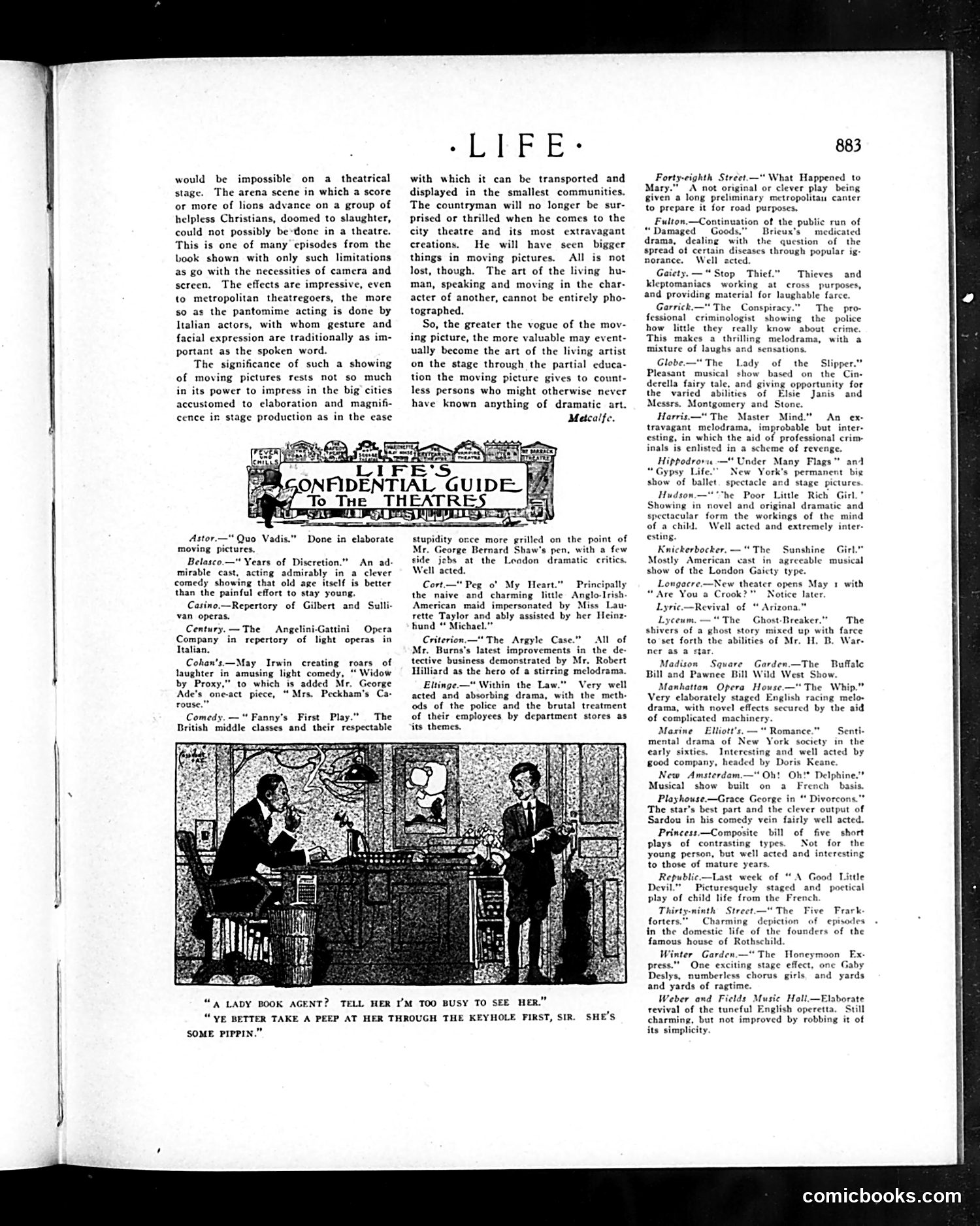
This cartoon satirizes the sexual double standard of early 20th-century society. A man dismisses a female book agent as a nuisance, too busy to see her. His servant suggests he "take a peep at her through the keyhole first, sir. She's some pippin"—implying the man should reconsider if she's attractive. The joke relies on the contrast between polite refusal and crude male behavior: the servant's suggestion to spy on a woman contradicts proper conduct, yet the implication is that male interest in women's appearance overrides business courtesy. The term "pippin" (an attractive woman) reinforces the reduction of the agent to her looks rather than her professional purpose. This reflects contemporary attitudes about women in professional roles and society's expectation that female appearance matters more than female competence.
📄 Transcribed text from this page (OCR, searchable)
Machine-transcribed from the original scan — historical spelling and the odd misread are preserved.
would be impossible on a_ theatrical stage. The arena scene in which a score or more of lions advance on a group of helpless Christians, doomed to slaughter, could not possibly be-done in a theatre, This is one of many’ episodes from the book shown with only such limitations as go with the necessities of camera and screen, The effects are impressive, even to metropolitan theatregoers, the more so as the pantomime acting is done by Italian actors, with whom gesture and facial expression are traditionally as im- portant as the spoken word. The significance of such a showing of moving pictures rests not so much in its power to impress in the big cities accustomed to elaboration and magnifi- cence in stage production as in the ease Lab B OE with which it can be transported and displayed in the smallest communities. The countryman will no longer be sur- prised or thrilled when he comes to the city theatre and its most extravagant creations. He will have seen bigger things in moving pictures. All is not lost, though. The art of the living hu- man, speaking and moving in the char- acter of another, cannot be entirely pho- tographed. So, the greater the vogue of the mov- ing picture, the more valuable may event- ually become the art of the living artist on the stage through the partial educa- tion the moving picture gives to count- less persons who might otherwise never have known anything of dramatic art. Matcalfe. Astor.—" Quo Vadis." Done in elaborate moving pictures, Belasco.—" Years of Discretion.” An ad- mirable cast, acting admirably in a clever comedy showing that old age itself is better than the painful effort to stay young. Casino.—Repertory of Gilbert and Sulli- van operas. Century. —The Angelini-Gattini_ Opera Company in repertory of light operas in Italian. Cohan's—May Irwin creating roars of laughter in amusing light comedy, “ Widow by Proxy,” to which is added Mr. George Ade’s one-act piece, “Mrs, Peckham’s Ca- rouse.” Comedy.—“ Fanny's First Play." The British middle classes and their respectable Supidity ‘once more grilled on the point of Mr. George Bernard Shaw's pen, with a few side jebs at the London dramatic critics. Well acted. Cort.—" Peg o? My Heart.” Principally the naive and charming little Anglo-Irish American maid impersonated by Miss Lau- rette Taylor and ably assisted by her Heinz- bund * Michael. Criterion.—"" The Argyle Case." All of Mr. Burns's latest improvements in the de- tective business demonstrated by Mr, Robert Hilliard as the hero of a stirring melodrama. Eltinge-—" Within the Law." Very well acted and absorbing drama, with the meth- ods of the police and the brutal treatment of their employees by department stores as its themes. “A LADY BOOK AGENT? TELL HER I’M TOO BUSY TO SEE HER.” “YE BETTER TAKE A PEEP AT HER THROUGH THE KEYHOLE FIRST, SIR. SHE'S SOME PIPPI 883 Forty-cighth Street.—" What Happened to Mary.” A not original or clever play being given a long preliminary metropolitan canter to prepare it for road purposes. Fulton.—Continuation of the public run of “Damaged Goods.” Brieux’s medicated drama, dealing with the question of the spread of certain diseases through popular ig- norance, Well acted. Gaiety. —“ Stop Thief.” Thieves and Kleptomaniacs working at cross purposes, and providing material for laughable farce. Garrick.—" The Conspiracy.” The pro- fessional criminologist showing the police how little they really know about crime. This makes a thrilling melodrama, with a mixture of laughs and sensations. Globe-—" The Lady of the Slippe Pleasant musical show based on the Cin+ derella fairy tale, and giving opportunity for the varied abilities of Elsie Janis and Messrs, Montgomery and Stone. Harris—" The Master Mind." An ex- travagant melodrama, improbable but inter esting, in which the aid of professional crim- inals is enli in a scheme of revenge. Hippodrovu -—" Under Many Flags” and y New York's permanent big show of ballet. spectacle and stage pictures. the Poor Little Rich Girl.* Showing in novel and original dramatic and spectacular form the workings of the mind of a child, Well acted and extremely inter- esting. Knickerbocker. — “The Sunshine Girl." Mostly American cast in agreeable musical show of the London Gaiety type. Longacre.—New theater opens May 1 with “Are You a Crook?" Notice later. Lyric.—Revival of “ Arizona.” Lyceum. —“ The Ghost-Breaker.” The shivers of a ghost story mixed up with farce to set forth the abilities of Mr. H, B. Ware ner as a star Madison Square Garden.—The Buffale Bill and Pawnee Bill Wild West Show Manhatten Opera Howse.—" The Whip.” Very elaborately staged English racing melo- drama, with novel effects secured by the aid of complicated machinery. Maxine Elliott's. —" Romance." Senti- mental drama of New York society in the early sixties, Interesting and well acted by good company, headed by Doris Keane. New Amsterdam.—“ Oh! Oh!* Delphine. Musical show built on a French basis. Playhouse.—Grace George in “ Divorcons."* The star's best part and the clever output of Sardou in his comedy vein fairly well acted. Princess—Composite bill of five short plays of contrasting types. Not for the young person, but well acted and interest to those of mature years. Republic—Last week of “\ Good Little Devil.” Picturesquely staged and poetical play of child life from the French Thirty-ninth Street.—" The Five Frark forters.”” Charming depiction of episodes in the domestic life of the founders of the famous house of Rothschild. Winter Garden.—" The Honeymoon _Ex- press.” One exciting stage effect, one Gaby Deslys, numberless chorus girls and yards and yards of ragtime. Weber and Fields Music Hall—Els revival of the tuneful English operetta. charming, but not improved by robbing it of its simplicity. comicbooks.com