
Life, 1913-05-01 · page 22 of 48
Life — May 1, 1913 — page 22: what you’re looking at
What you’re looking at
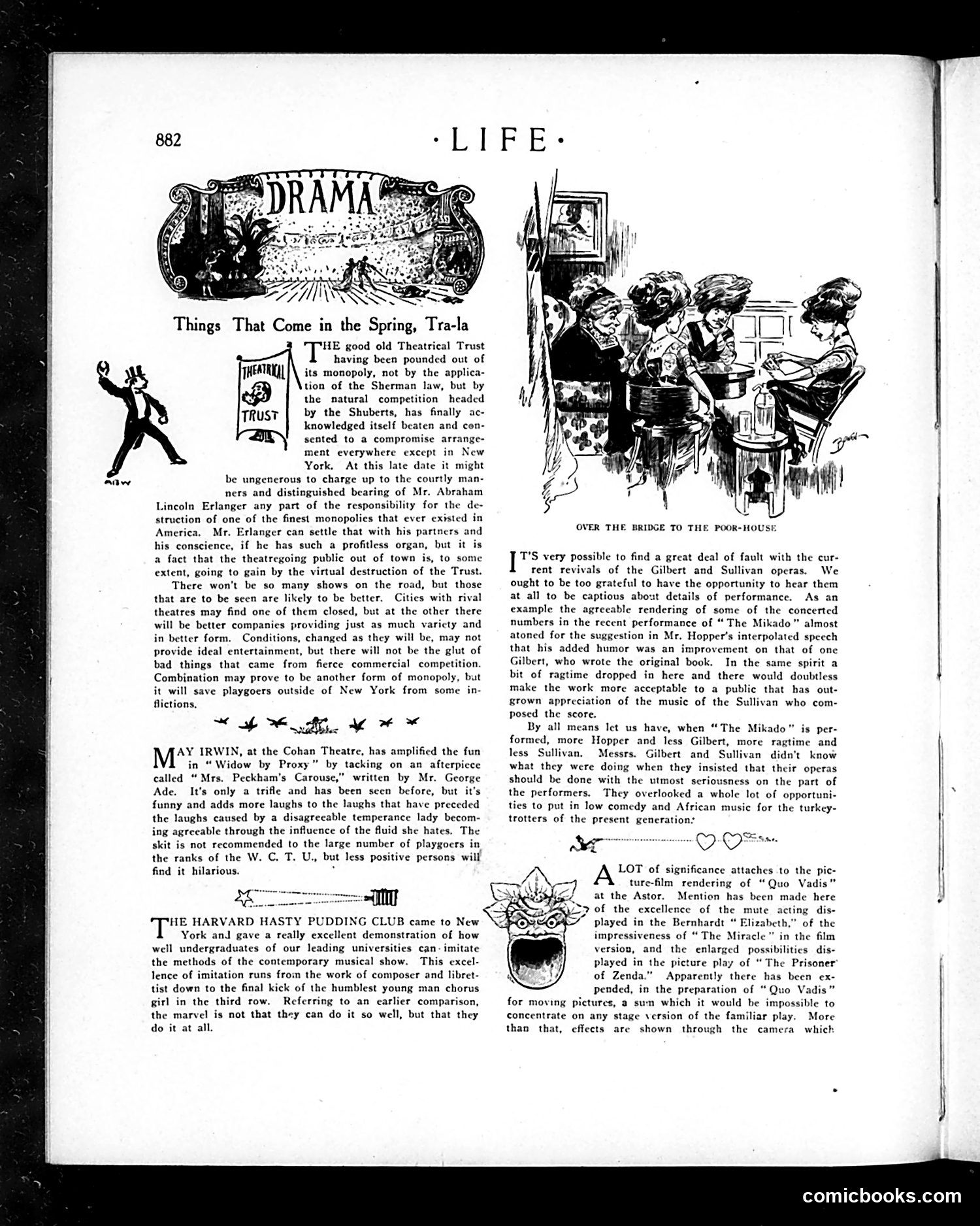
This page satirizes theatrical industry changes and contemporary stage performances circa early 1900s. **Main Articles:** The lead article discusses the **Theatrical Trust's collapse**—a monopoly headed by **Abraham Lincoln Erlanger** that controlled theater bookings. The **Shuberts** broke this monopoly through competition (not legal action), which Life celebrates as beneficial for provincial audiences, though it mocks Erlanger's "courtly manners." **Performance Reviews:** - **May Irwin** in "Widow by Proxy" receives praise for added comedy - **Harvard Hasty Pudding Club** is commended for skillfully imitating professional musical theater - **Gilbert and Sullivan revivals** (particularly "The Mikado") are critiqued for being overly reverent; the piece sarcastically suggests adding ragtime and low comedy would improve them, mocking both modernizers and purists The page's illustrations show theatrical scenes. The satire targets both theatrical monopolies and debates over whether classic operettas should remain faithful or adapt to contemporary taste.
📄 Transcribed text from this page (OCR, searchable)
Machine-transcribed from the original scan — historical spelling and the odd misread are preserved.
Things That Come in the Spring, Tra-la HE good old Theatrical Trust having been pounded out of its monopoly, not by the applica- tion of the Sherman law, but by the natural competition headed by the Shuberts, has finally ac- knowledged itself beaten and con- sented to a compromise arrange- ment everywhere except in New York. At this late date it might be ungenerous to charge up to the courtly man- ners and distinguished bearing of Mr. Abraham Lincoln Erlanger any part of the responsibility for the de- struction of one of the finest monopolies that ever existed in America, Mr. Erlanger can settle that with his p: his conscience, if he has such a profitless organ, but it a fact that the theatregoing public out of town is, to some extent, going to gain by the virtual destruction of the Trust. There won't be so many shows on the road, but those that are to be seen are likely to be better. Cities with rival theatres may find one of them closed, but at the other there will be better companies providing just as much varicty and in better form. Conditions, changed as they will be, may not provide ideal entertainment, but there will not be the glut of bad things that came from fierce commercial competition. Combination may prove to be another form of monopoly, but it will save playgoers outside of New York from some in- fliction: Mb KG KO AY IRWIN, at the Cohan Theatre, has amplified the fun in “Widow by Proxy” by tacking on an afterpicce called “Mrs. Peckham’s Carouse,” written by Mr. George Ade. It's only a trifle and has been scen before, but it’s funny and adds more laughs to the laughs that have preceded the laughs caused by a disagreeable temperance lady becom- ing agreeable through the influence of the fluid she hates. The skit is not recommended to the large number of playgocrs in the ranks of the W. C. T. U., but less positive persons will find it hilarious. ¢ oll HE HARVARD HASTY PUDDING CLUB came to New York and gave a really excellent demonstration of how well undergraduates of our leading universities can- imitate the methods of the contemporary musical show. This excel- lence of imitation runs from the work of composer and libret- tist down to the final kick of the humblest young man chorus girl in the third row. Referring to an earlier comparison, the marvel is not that they can do it so well, but that they do it at all. aaw OVER THE BRIDGE TO THE POOR-HOUSE, T'S very possible to find a great deal of fault with the cur- rent revivals of the Gilbert and Sullivan operas. We ought to be too grateful to have the opportunity to hear them at all to be captious about details of performance. As an example the agreeable rendering of some of the concerted numbers in the recent performance of “ The Mikado” almost atoned for the suggestion in Mr. Hopper’s interpolated speech that his added humor was an improvement on that of one Gilbert, who wrote the original book. In the same spirit a bit of ragtime dropped in here and there would doubtless make the work more acceptable to a public that has out- grown appreciation of the music of the Sullivan who com- posed the score. By all means Iet us have, when “The Mikado” is per- formed, more Hopper and less Gilbert, more ragtime and less Sullivan, Messrs. Gilbert and Sullivan didn’t know what they were doing when they insisted that their operas should be done with the utmost seriousness on the part of the performers. They overlooked a whole lot of opportuni- ties to put in low comedy and African music for the turkey- trotters of the present generation: LOT of significance attaches to the pic- ture-film rendering of “Quo Vadis” at the Astor. Mention has been made here Z>p of the excellence of the mute acting dis- 7” played in the Bernhardt “ Elizabeth,” of the impressiveness of “The Miracle” in the film version, and the enlarged possibilities dis- played in the picture play of “ The Prisoner of Zenda.” Apparently there has been ex- pended, in the preparation of “Quo Vadis” for moving pictures, a sum which it would be impossible to concentrate on any stage version of the familiar play. More than that, effects are shown through the camera which comicbooks.com