
Life, 1913-05-01 · page 28 of 48
Life — May 1, 1913 — page 28: what you’re looking at
What you’re looking at
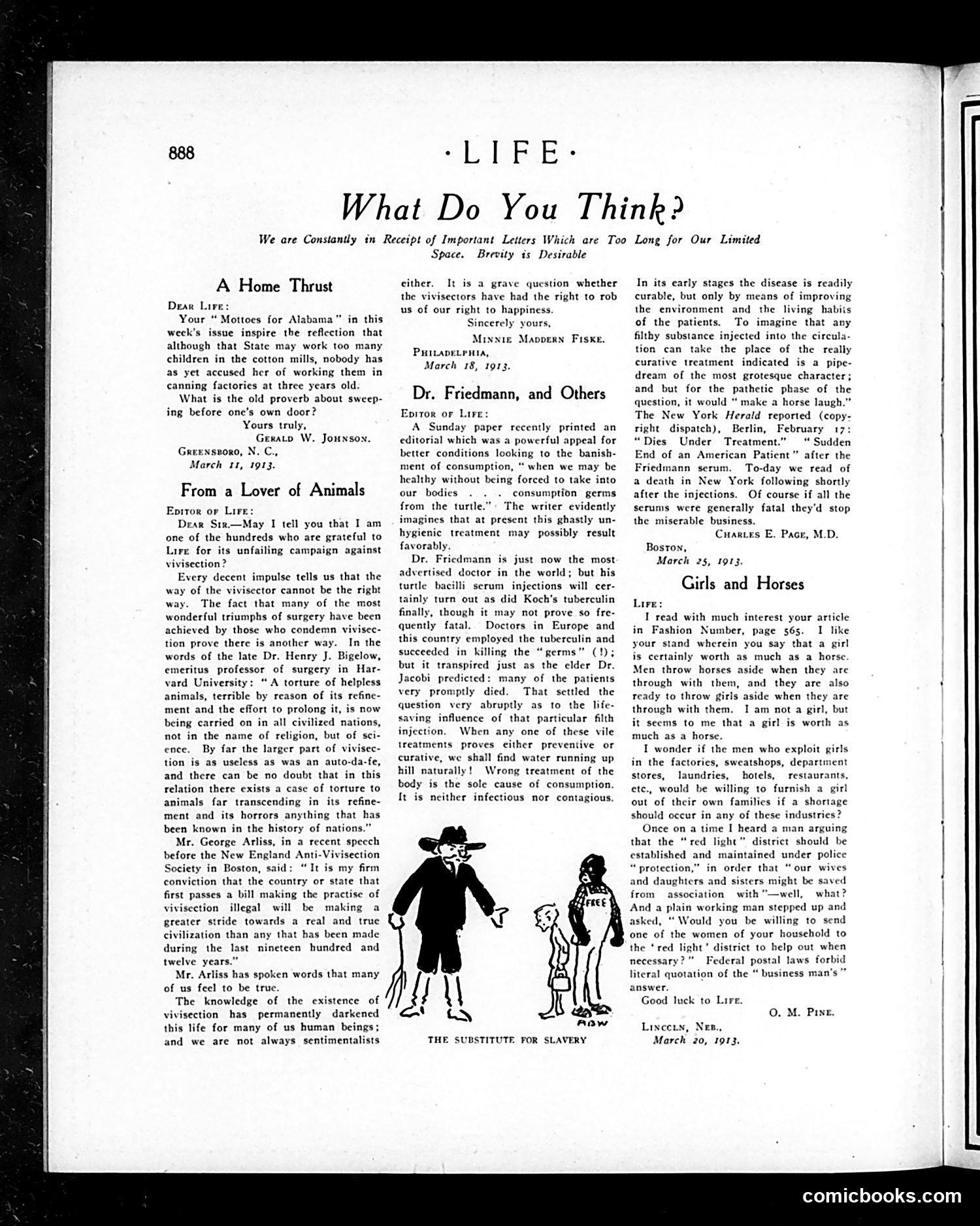
This cartoon responds to a letter praising children's labor in mills. The image shows a man in a top hat (representing wealthy factory owners or society's complicity) offering coins to a small child, with another child already marked "FREE" nearby—a darkly ironic label. The satire compares child labor in factories and mills to slavery. The title "The Substitute for Slavery" argues that although slavery was abolished, exploitative child labor serves the same economic function: extracting labor from the powerless for profit. The coin-exchange imagery echoes slave auctions, suggesting legalized child labor is essentially slavery under a different name. The cartoon attacks the contradiction in the letter-writer's defense: while condemning certain practices, he defends others equally exploitative—revealing moral blindness about contemporary injustices.
📄 Transcribed text from this page (OCR, searchable)
Machine-transcribed from the original scan — historical spelling and the odd misread are preserved.
oy) De) (ei Sag What Do You Think>? We are Constantly tn Receipt of Important Letters Which are Too Long for Our Limited A Home Thrust Dear Lire: Your “ Mottoes for Alabama” in this week's issue inspire the reflection that although that State may work too many children in the cotton mills, nobody has as yet accused her of working them in canning factories at three years old. What is the old proverb about sweep- ing before one’s own door? Yours trul Gerat W. Jonson. Greensvoro, N. C., March 11, 1913. From a Lover of Animals Eprtor or Lire: Dear Stx—May I tell you that I am one of the hundreds who are grateful to Lire for its unfailing campaign against vivisection ? very decent impulse tells us that the way of the vivisector cannot be the right way. The fact that many of the most wonderful triumphs of surgery have been achieved by those who condemn vivisec- tion prove there is another way. In the words of the late Dr. Henry J. Bigelow, emeritus professor of surgery in Har- vard University: “A torture of helpless animals, terrible by reason of its refine- ment and the effort to prolong it, is now being carried on in all civilized nations, not in the name of religion, but of sci- ence. By far the larger part of vivisec- tion is as useless as was an auto-da-fe, and there can be no doubt that in this relation there exists a case of torture to animals far transcending in its refine- ment and its horrors anything that has been known in the history of nations.” Mr. George Arliss, in a recent specch before the New England Anti-Vivisection Society in Boston, said: “It is my firm conviction that the country or state that first passes a bill making the practise of viviseetion illegal will be making a greater stride towards a real and true civilization than any that has been made during the last nineteen hundred and twelve years.” Mr. Arliss has spoken words that many of us feel to be truc. The knowledge of the existence of vivisection has permanently darkened this life for many of us human beings; and we are not always sentimentalists Space. Brevity is Desirable cither. It is a grave question whether the vivisectors have had the right to rob us of our right to happiness. Sincerely yours, Minsie Mappers Fiske. Puitapetruta, March 18, 1913. Dr. Friedmann, and Others Eprror of Lire: A Sunday paper recently printed an editorial which was a powerful appeal for better conditions looking to the banish- ment of consumption, “ when we may be healthy without being forced to take into our bodies . consumption germs from the turtle.” The writer evidently imagines that at present this ghastly un- hygienic treatment may possibly result favorabl Dr. Friedmann is just now the most advertised doctor in the world; but his turtle bacilli serum injections will cer- tainly turn out as did Koch's tuberculin finally, though it may not prove so fre- quently fatal. Doctors in Europe and this country employed the tuberculin and succeeded in killing the “germs” (1); but it transpired just as the elder Dr. Jacobi predicted: many of the patients very promptly died. That settled the question very abruptly as to the life- saving influence of that particular filth injection. When any one of these vile Ireatments proves cither preventive or curative, we shall find water running up hill naturally! Wrong treatment of the body is the sole cause of consumption. ft is neither infectious nor contagious. FREE /\\ a wy Cy Row THE SUBSTITUTE FOR SLAVERY In its early stages the disease is readily curable, but only by means of improving the environment and the living habits of the patients. To imagine that any filthy substance injected into the circula- tion can take the place of the really curative treatment indicated is a pipe- dream of the most grotesque character; and but for the pathetic phase of the question, it would “ make a horse laugh.” The New York Herald reported (copy- right dispatch), Berlin, February 17: “Dies Under Treatment.” “Sudden End of an American Patient” after the Friedmann serum. To-day we read of a death in New York following shortly after the injections. Of course if all the serums were generally fatal they'd stop the miserable business. Citartes E. Paci M.D, Boston, March 25, 1913. Girls and Horses Lire: I read with much interest your article in Fashion Number, page 565. I like your stand wherein you say that a girl is certainly worth as much as a horse Men throw horses aside when they are through with them, and they are also ready to throw girls aside when they are through with them. I am not a girl, but it seems to me that a girl is worth as much as a horse. I wonder if the men who exploit girls in the factories, sweatshops, department stores, laundries, hotels, restaurants, etc, would be willing to furnish a girl out of their own families if a shortage should occur in any of these industries? Once on a time I heard a man arguing that the “red light” district should be established and maintained under police “protection,” in order that “our wives and daughters and sisters might be saved from association with "—well, what? And a plain working man stepped up and ked, “Would you be willing to send one of the women of your household to the ‘red light’ district to help out when necessary?” Federal postal laws forbid literal quotation of the “ business man’s” answer, Good luck to Lire. O. M. Pine. Lincens, Nes. March 20, 1913. comicbooks.com