
A complete issue · 41 pages · 1912
Life — December 26, 1912
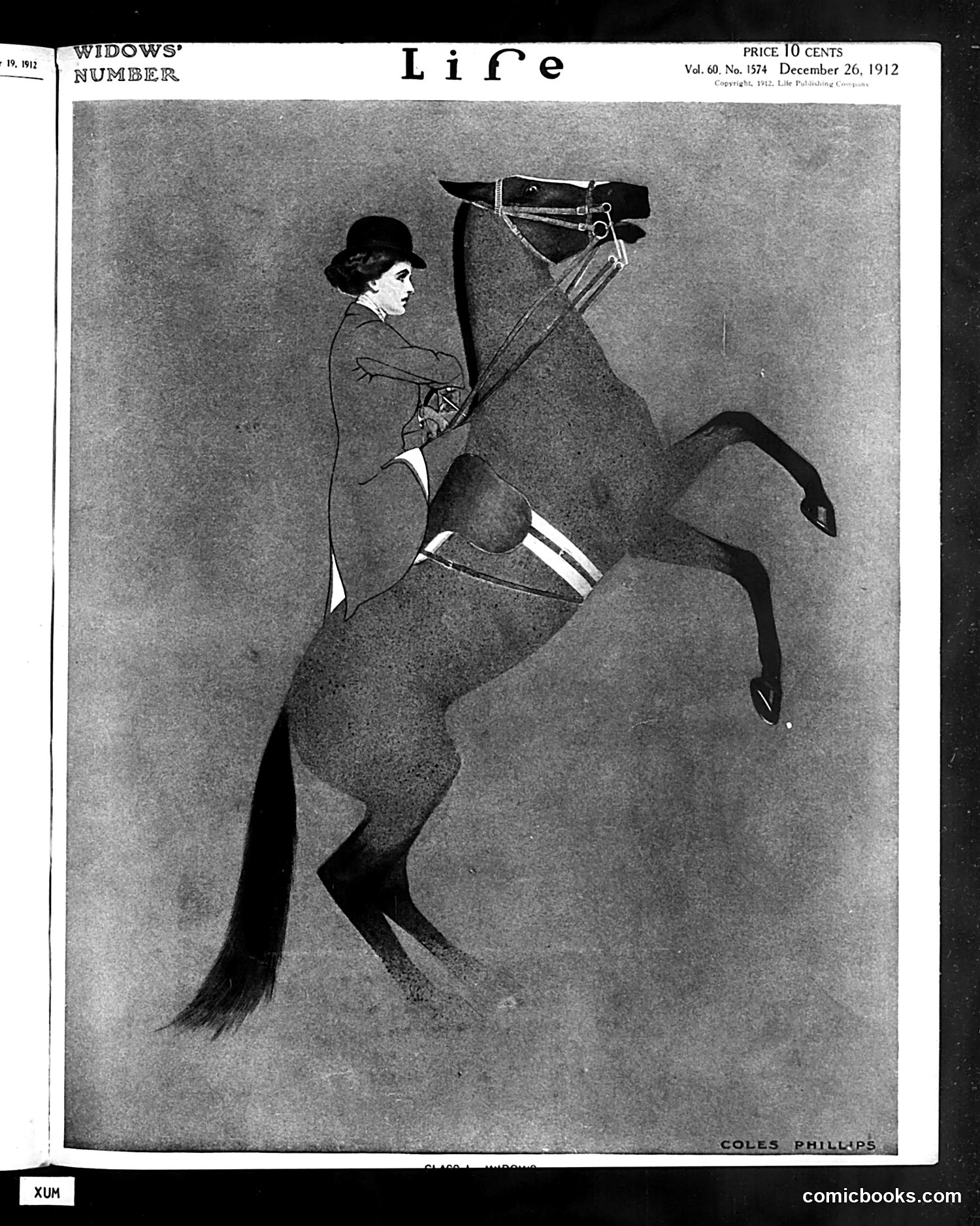
This is the cover illustration by Coles Phillips for Life magazine's "Widows' Number" issue. The artwork depicts a fashionably dressed widow in a dark suit and hat, riding a spirited rearing horse while holding a riding crop. The woman appears elegant and assertive rather than grief-stricken. The satire likely plays on the concept of wealthy widows—specifically their newfound independence and social freedom following their husbands' deaths. Rather than portraying widowhood as a period of mourning and restriction, Phillips shows an active, commanding figure in control of a powerful animal, suggesting liberated agency. The "Widows' Number" designation indicates this was a special issue focused on humorous commentary about widows' social roles and circumstances in 1912.
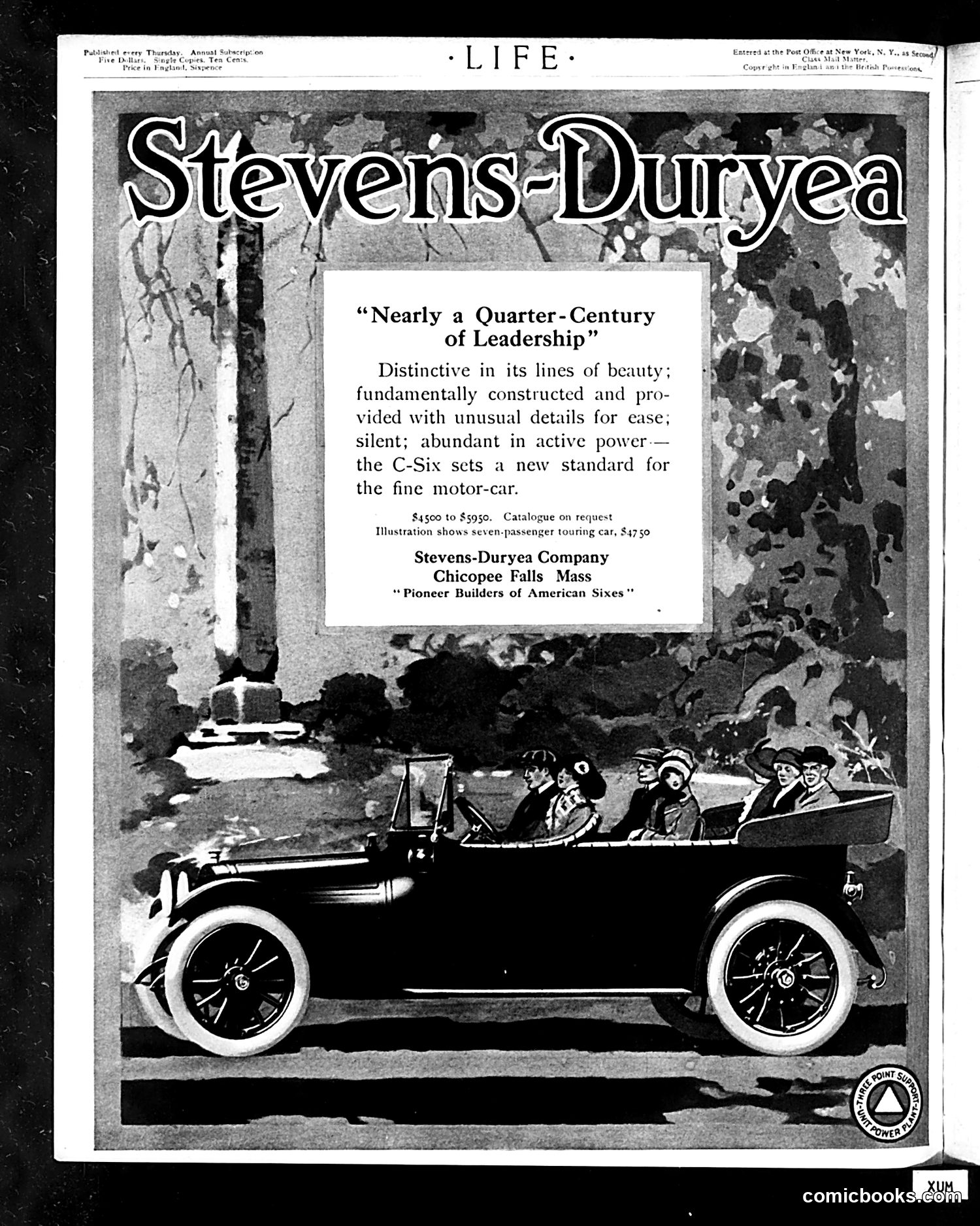
This is primarily a **product advertisement**, not satire or political commentary. It promotes the Stevens-Duryea automobile, a luxury "fine motor-car" manufactured in Chicopee Falls, Massachusetts. The ad emphasizes the C-Six model's qualities: distinctive design, solid construction, ease of operation, power, and reliability. The phrase "Nearly a Quarter-Century of Leadership" references the company's established reputation as "Pioneer Builders of American Sixes." The illustration shows a seven-passenger touring car with well-dressed occupants in what appears to be a scenic natural setting, suggesting leisure and affluence. The tagline and imagery aim to position Stevens-Duryea as a premium automobile choice for wealthy consumers. Pricing ranged from $1,550 to $2,950—substantial sums in this era.
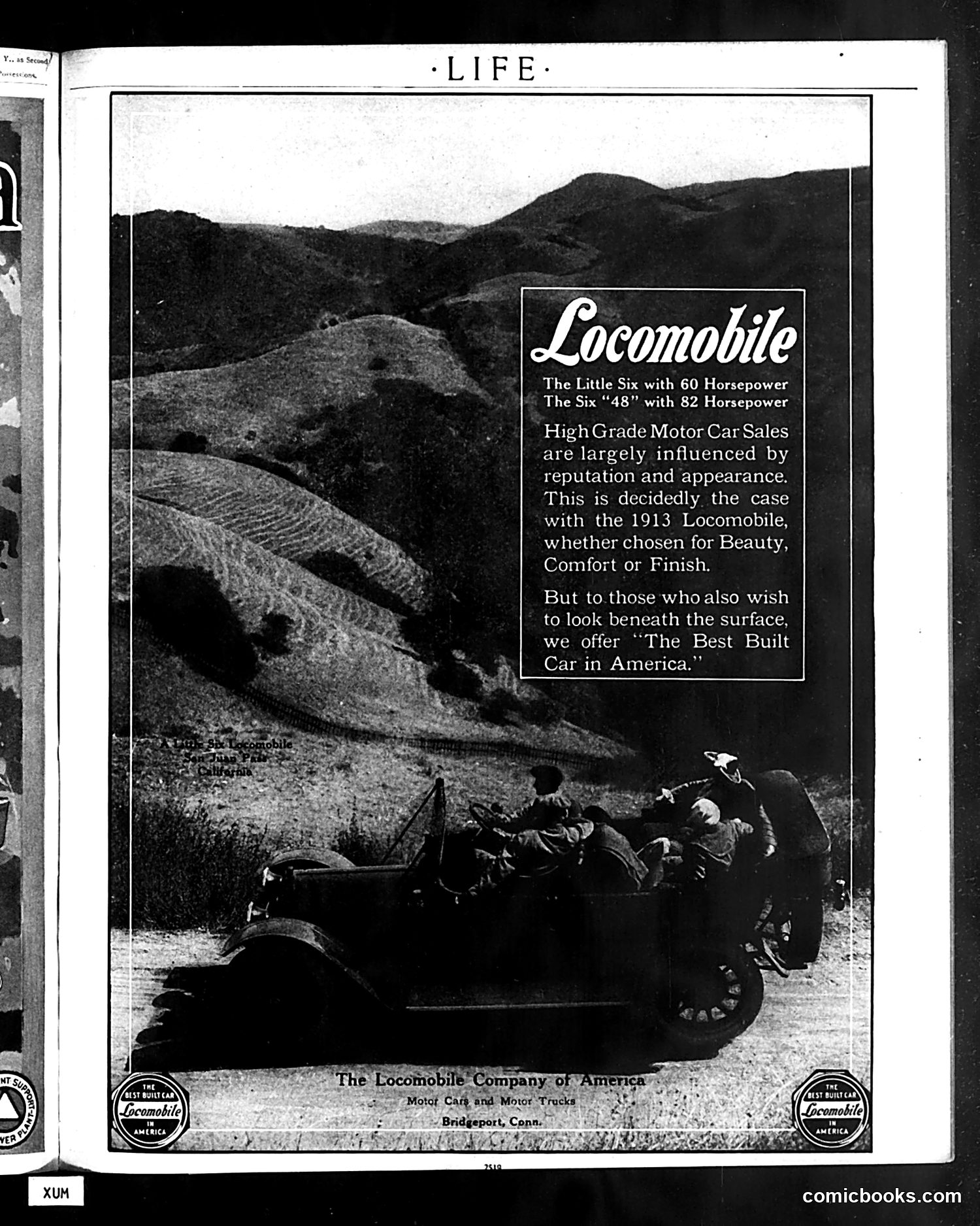
This is **not a political cartoon or satire**—it's a straightforward automobile advertisement for the Locomotile Company of America, published in *Life* magazine (which contained advertising alongside humor content). The ad showcases a 1913 Locomotile motorcar driving through hilly terrain with passengers. The text emphasizes that while high-grade motor cars are "largely influenced by reputation and appearance," the Locomotile offers substance: "The Best Built Car in America." Two models are highlighted: "The Little Six" (60 horsepower) and "The Six '48'" (82 horsepower). The scenic landscape photograph serves as aspirational imagery, suggesting the vehicle's capability for leisure driving through rural America. The company was based in Bridgeport, Connecticut.
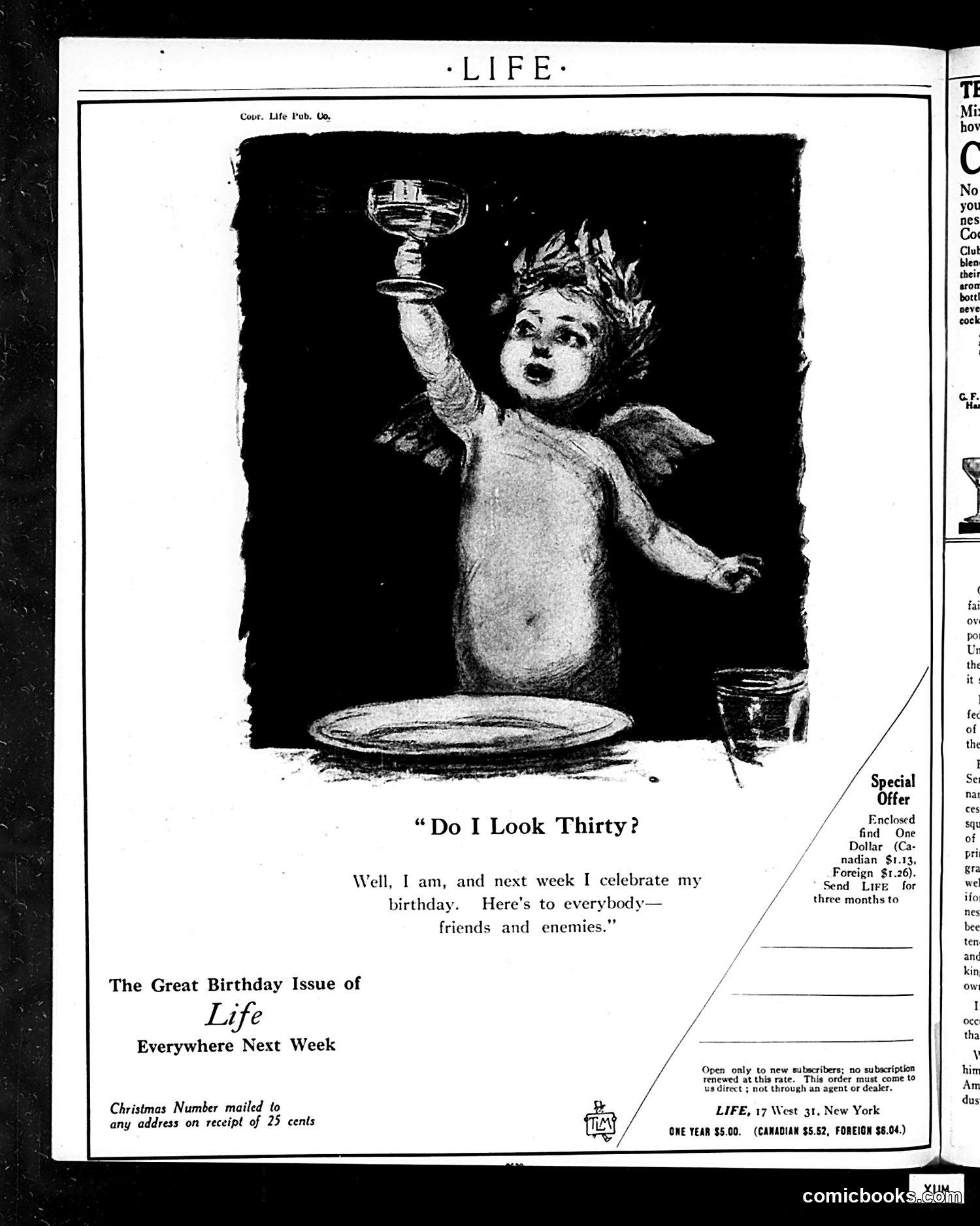
This is primarily a **magazine advertisement** for Life's upcoming "Great Birthday Issue," not a political cartoon. The illustration shows a cherubic, winged child (putto) holding aloft a champagne coupe, with the caption "Do I look Thirty?" The joke plays on **age and vanity**: the cherub—eternally young in classical art—questions whether it appears thirty years old, then quips about celebrating its birthday "Here's to everybody—friends and enemies." This is humorous self-deprecation, suggesting Life magazine itself is turning thirty and remains youthful despite its age. The advertisement promotes the special birthday issue available "Everywhere Next Week" for 25 cents, positioned as a premium offering. The tone is lighthearted and celebratory rather than satirical.
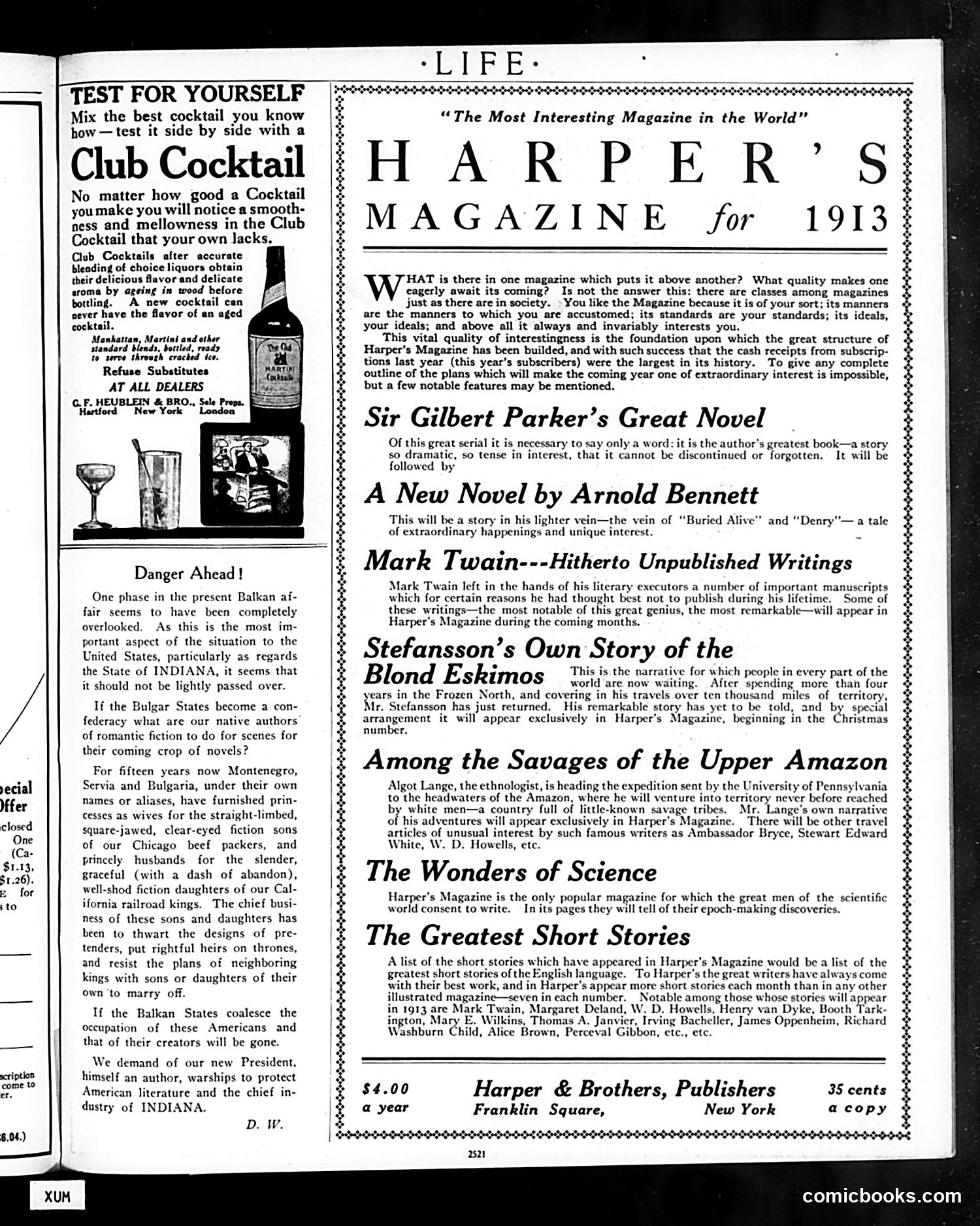
This page is primarily a **Harper's Magazine advertisement** (right side) promoting the magazine's 1913 content, including works by Mark Twain, Arnold Bennett, and Gilbert Parker. The left side contains a brief **political opinion piece titled "Danger Ahead!"** discussing the Balkan situation and American interests in Indiana. The author (D.W.) argues that if Balkan states coalesce under romantic fiction narratives, it could threaten American authors and the literature industry—a satirical concern comparing European political instability to threats against American cultural interests. Above this is a **"Club Cocktail" advertisement** with an illustration of a bottle and glassware. The page is primarily **commercial/advertising content** rather than political satire or editorial cartoons. The "Danger Ahead" piece uses hyperbole to joke about authorial anxieties rather than serious political commentary.
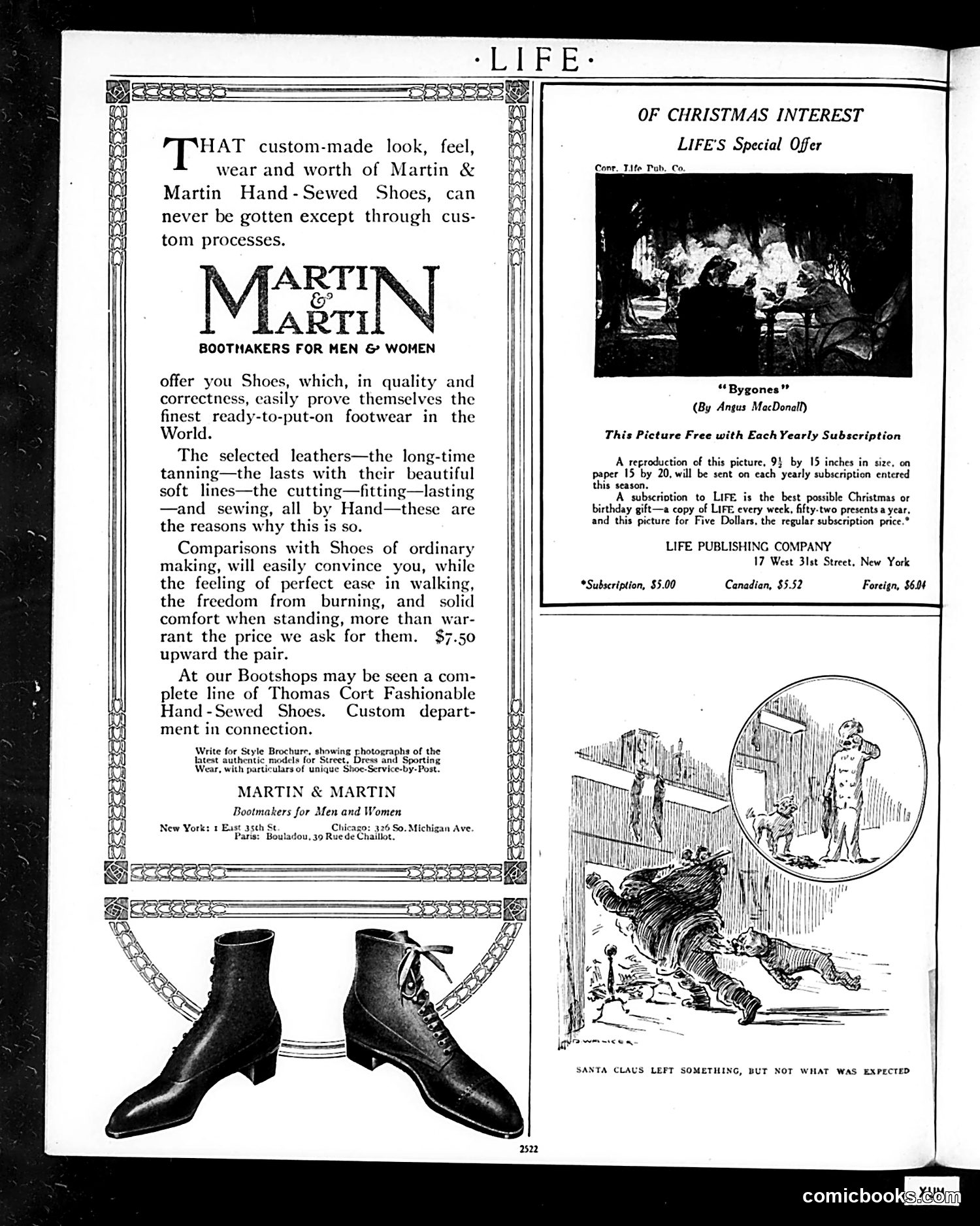
This page contains primarily **advertising content** rather than political satire. The left side features a Martin & Martin bootmakers advertisement for hand-sewn shoes ($7.50+), emphasizing quality craftsmanship and comfort. The right side advertises LIFE's Christmas subscription offer, including a free reproduction of "Bygones" by Angus McConnell. Below this is a humorous cartoon captioned "SANTA CLAUS LEFT SOMETHING, BUT NOT WHAT WAS EXPECTED," depicting Santa apparently stuck in a chimney with comedic consequences—likely referring to the common Christmas Eve scenario of Santa's mishap. This is gentle holiday humor rather than political commentary. The page reflects early 20th-century commercial advertising and seasonal entertainment typical of LIFE magazine's content.
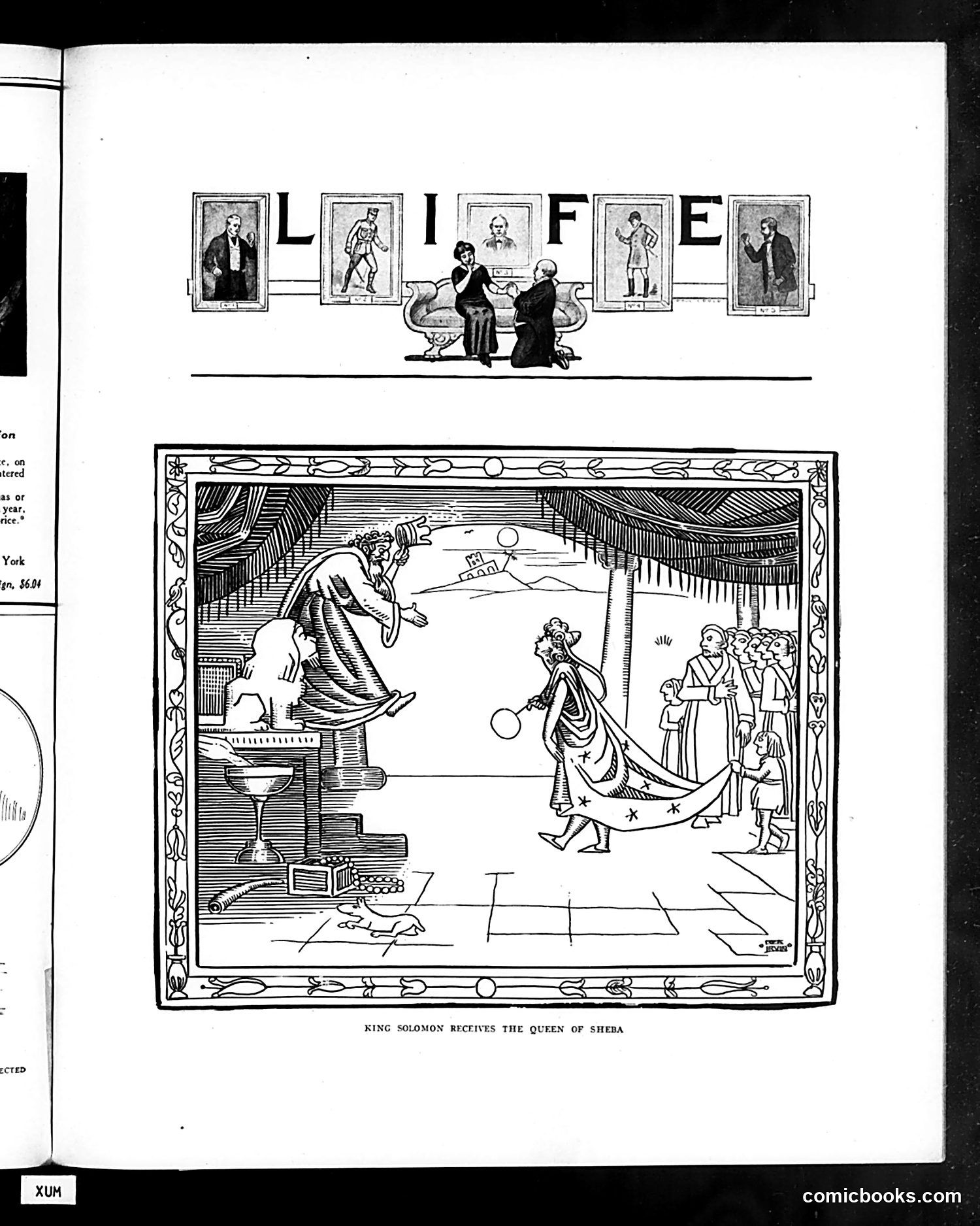
This page from *Life* magazine features the heading "LIFE" with illustrated portraits of what appear to be notable figures of the era, and below it an engraving titled "KING SOLOMON RECEIVES THE QUEEN OF SHEBA." The biblical illustration depicts King Solomon seated on an elevated throne, receiving the Queen of Sheba, who approaches with attendants and gifts. The ornate border and formal composition suggest this is a classical artistic reference rather than contemporary satire. Without additional visible text explaining the connection between the header portraits and this biblical scene, the satirical intent remains unclear—it may comment on diplomacy, wealth, power dynamics, or court life, but the specific contemporary reference cannot be determined from the image alone.
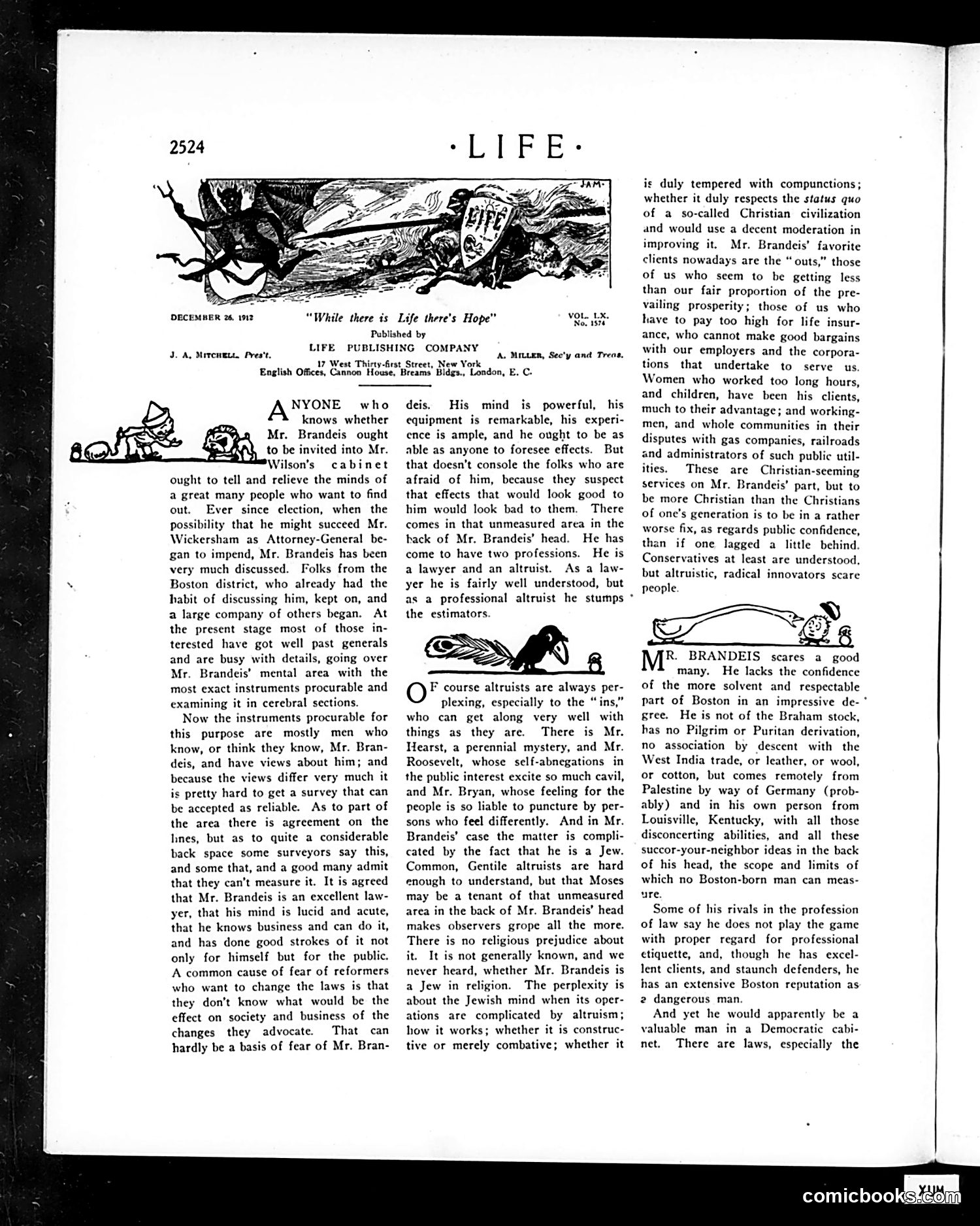
This is a satirical article about **Louis Brandeis**, a lawyer being considered for a major government position (likely the Supreme Court, though not explicitly stated here). The piece criticizes Brandeis as dangerous and unpredictable, noting he's both a lawyer and "altruist" who "stumps the estimators." The author expresses concern about his Jewish identity, his radical views on labor and business practices, and his apparent lack of traditional Boston establishment credentials or family wealth connections. The satire targets conservative fears about Brandeis as an outsider threatening the established order—fears the text suggests are rooted partly in prejudice but also in genuine ideological disagreement about his progressive positions on business regulation and social reform.
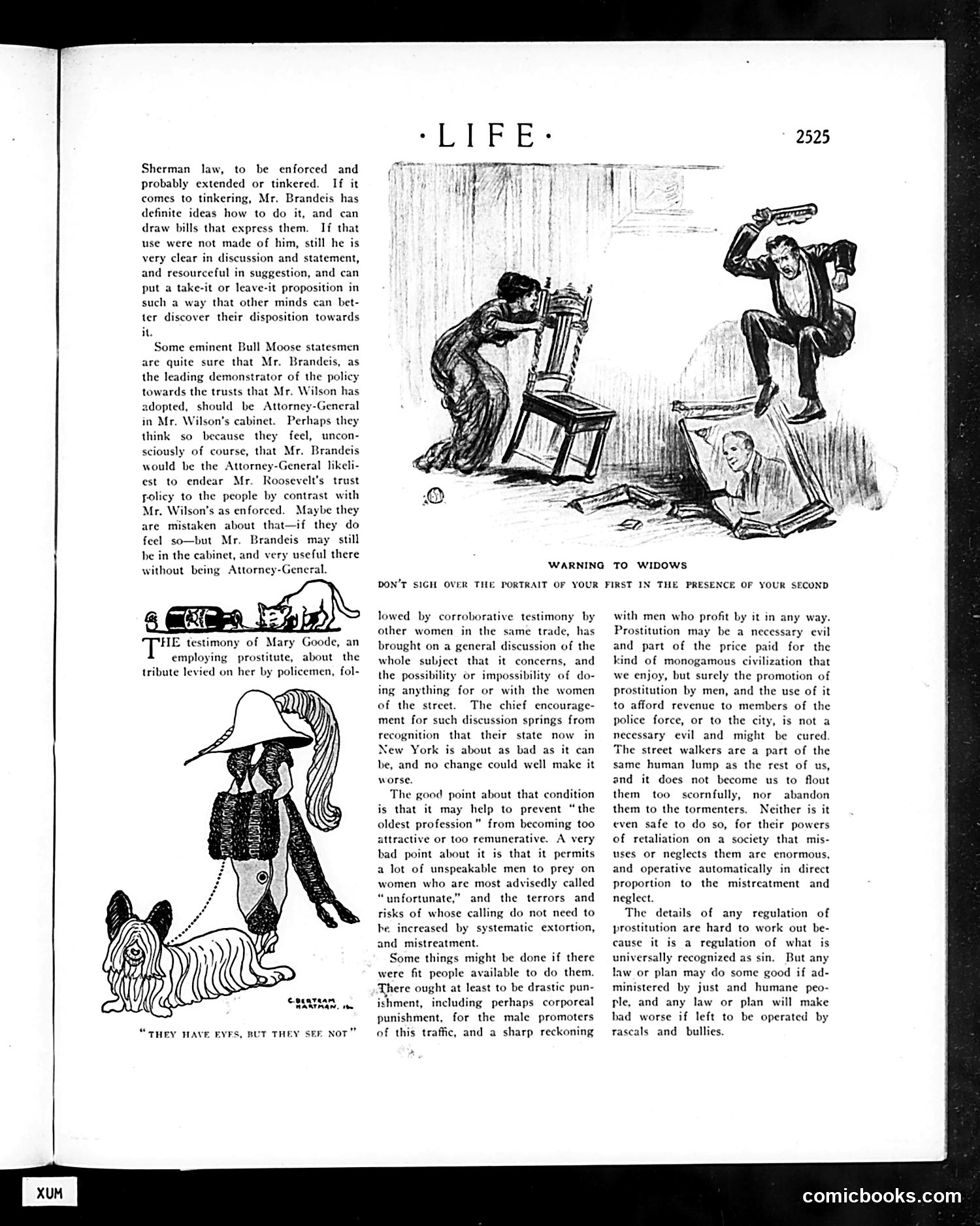
This page contains a satirical cartoon and article about prostitution in early 20th-century New York. The top cartoon depicts a woman sighing over a portrait while a man lurks behind her—illustrating the article's dark humor warning widows against displaying their first husband's portrait, as it apparently attracts unwanted male attention. The larger cartoon "They Have Eyes, but They See Not" shows a woman with exaggerated features, accompanied by commentary about street walkers and male exploitation. The article discusses prostitution as a social problem, arguing for regulation rather than prohibition, and criticizing both the exploitation of vulnerable women and the men who profit from it. The satire critiques society's hypocrisy regarding this "necessary evil."
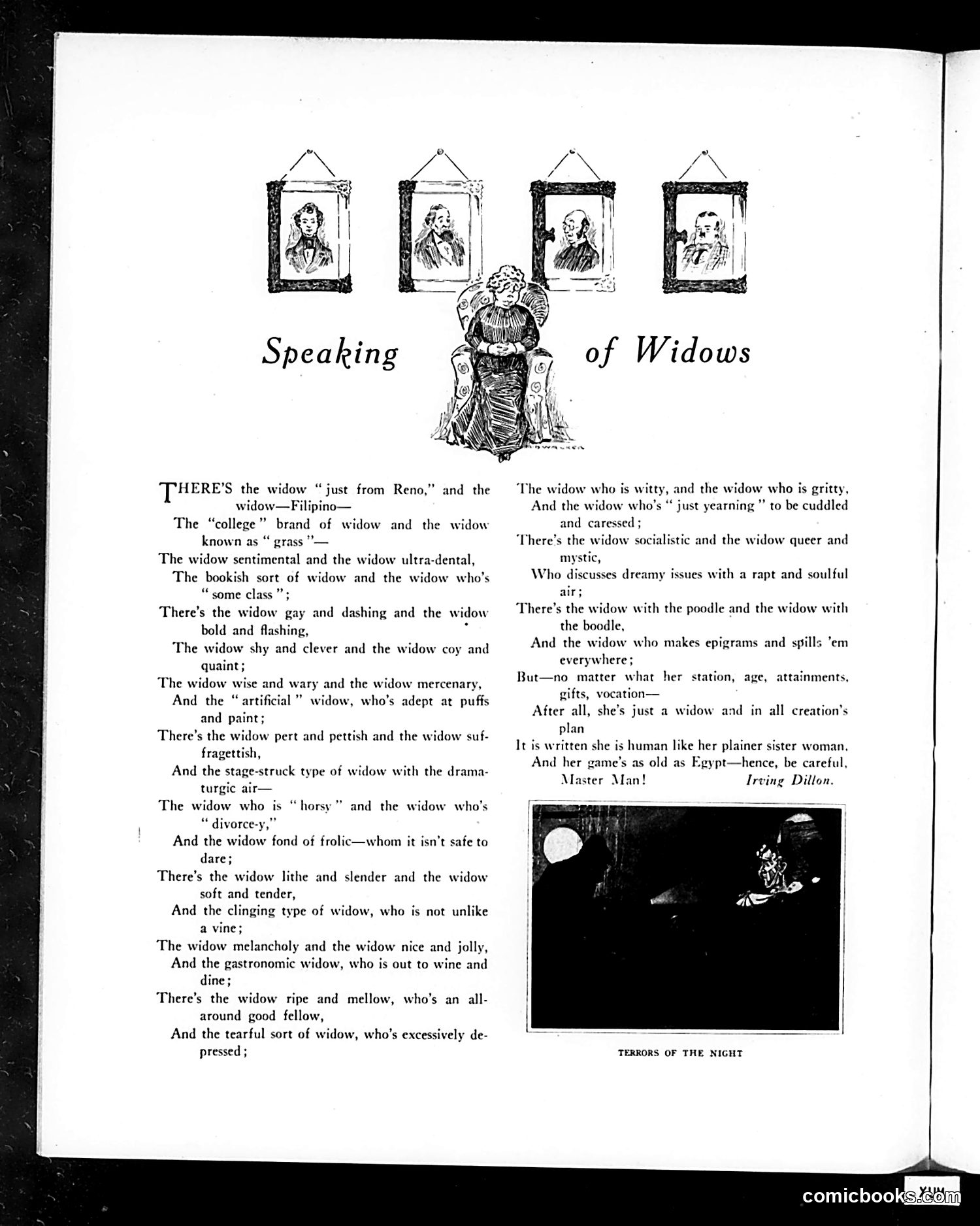
This page satirizes the social types and stereotypes of widows in early 20th-century America. The poem by Irving Dilton catalogs widow archetypes: the sentimental widow, the "grass" widow (separated/divorced woman), the gay widow, the mercenary widow, the dramatic widow, and others—each representing contemporary social anxieties about women's independence and behavior after losing husbands. The four portrait frames at top likely depict specific widow types being mocked. The illustration "Terrors of the Night" shows a frightened woman—possibly satirizing melodramatic widow behavior or gothic fiction tropes. The satire's underlying point: widows occupied an ambiguous social position, freed from marital control yet subject to judgment about how they exercised newfound independence. The poem's exhaustive catalog mocks society's obsession with categorizing and policing women's conduct.
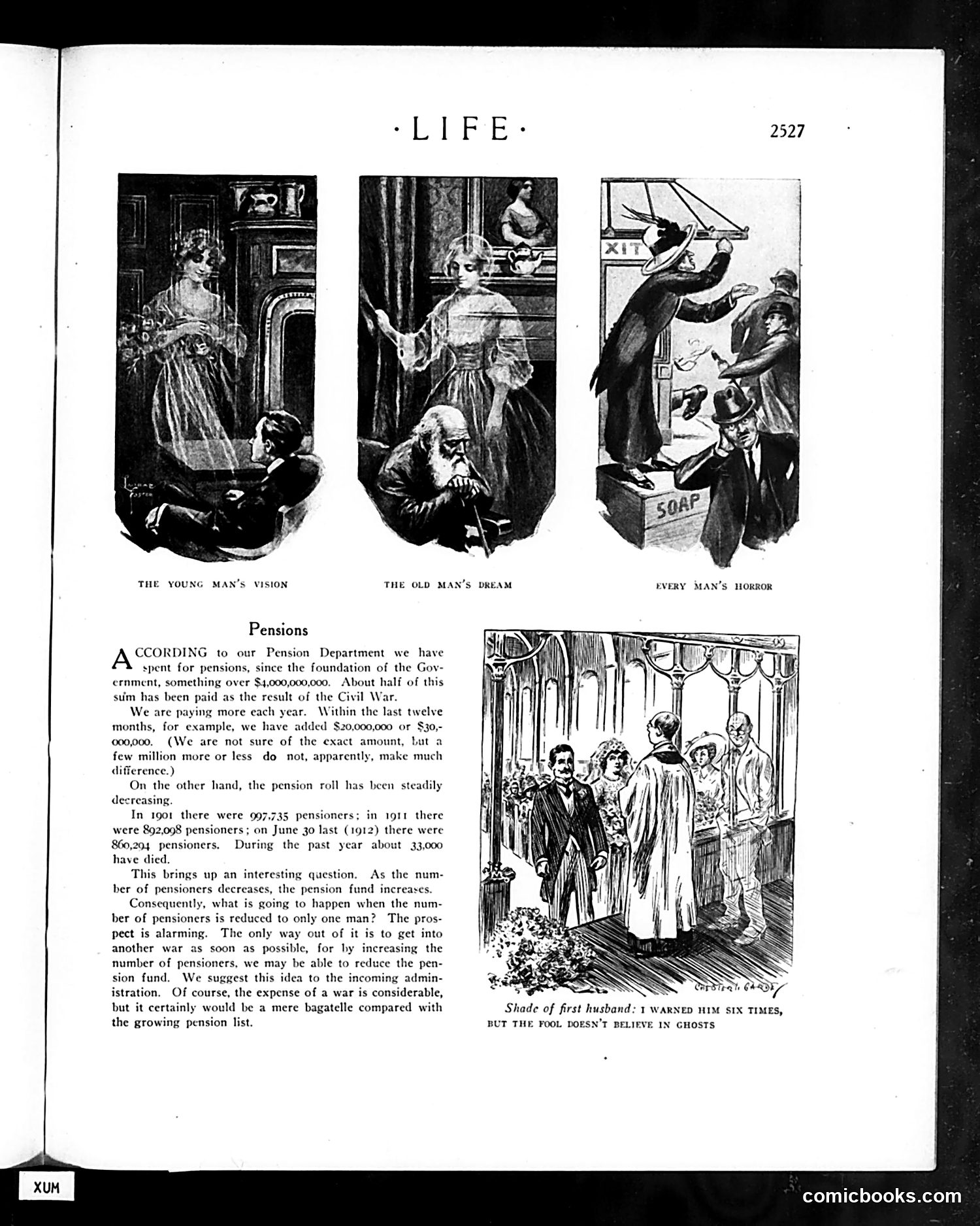
This page contains satirical commentary on U.S. pensions paired with three morality cartoons at top. **Top cartoons** show contrasting male fantasies ("The Young Man's Vision," "The Old Man's Dream") versus reality ("Every Man's Horror"), with the final image depicting financial ruin—a man confronting debt or bankruptcy while others watch. **Main article** discusses the pension system's unsustainable growth: over $1 billion in total pension obligations, with numbers increasing yearly (997,735 pensioners in 1901; 863,294 in 1912). The writer warns that as pensioners decrease through death, fewer people support the growing fund—an alarming prospect. They propose reducing pensions or finding alternative solutions, though acknowledge any "war expense" would pale against rising pension costs. The satire critiques pension system management during this era.
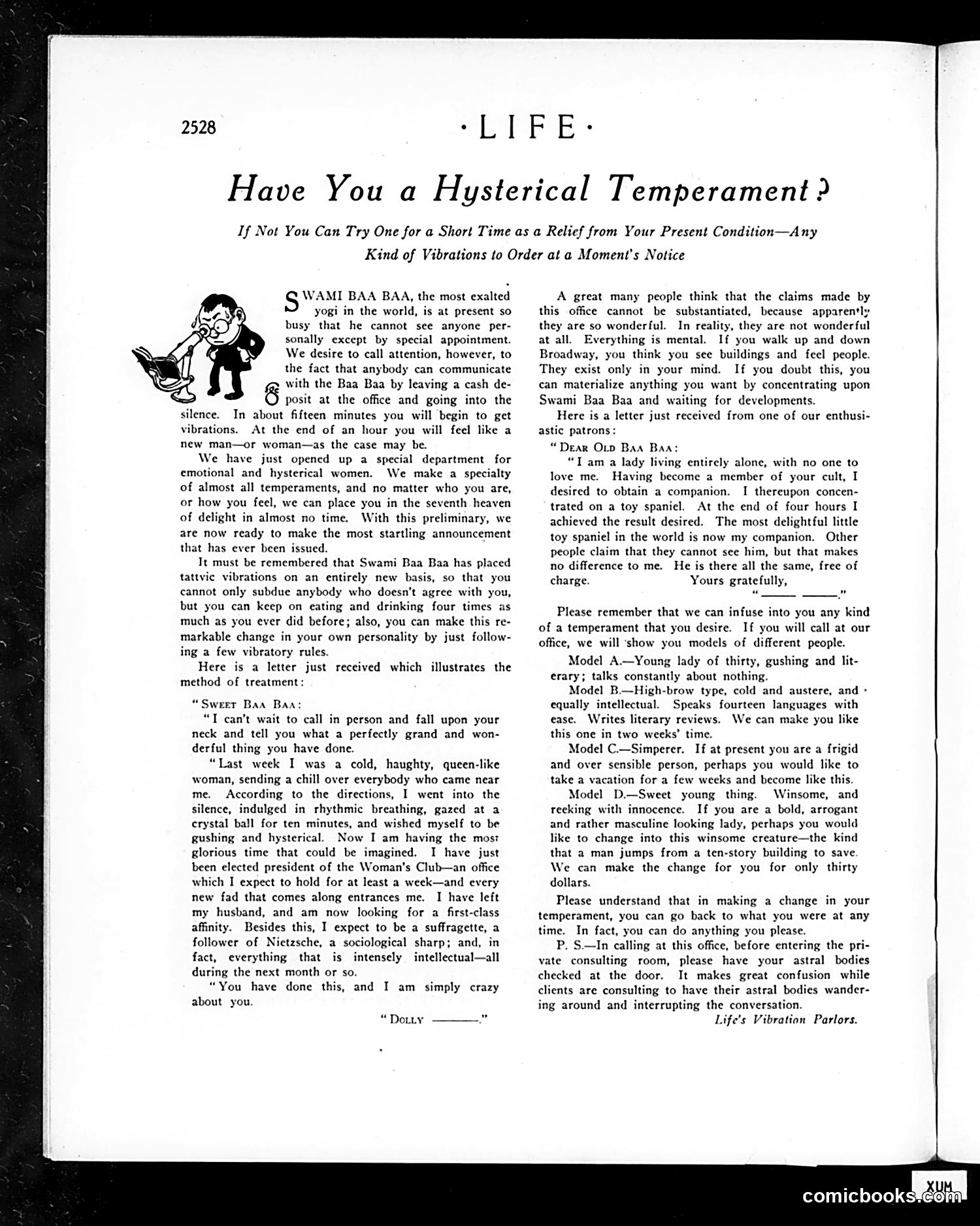
This page satirizes a fraudulent spiritualist scam called "Life's Vibration Parlors." The text mocks "Swami Baa Baa," a fake yogi claiming to cure nervous conditions through vibrations and paid "consultations." The humor targets gullible wealthy clients (illustrated by the small cartoon of a well-dressed man at top left) who pay for imaginary treatments. The included testimonial from "Dolly" describes absurd results—becoming "queen-like" and gaining sudden prominence—revealing how the scam preys on women's desires for social elevation and transformation. The satire criticizes both the fraudulent operators and the credulous public willing to believe that thoughts alone can materialize real-world changes. This reflects Progressive-era skepticism toward new-age wellness schemes and spiritualist cons.
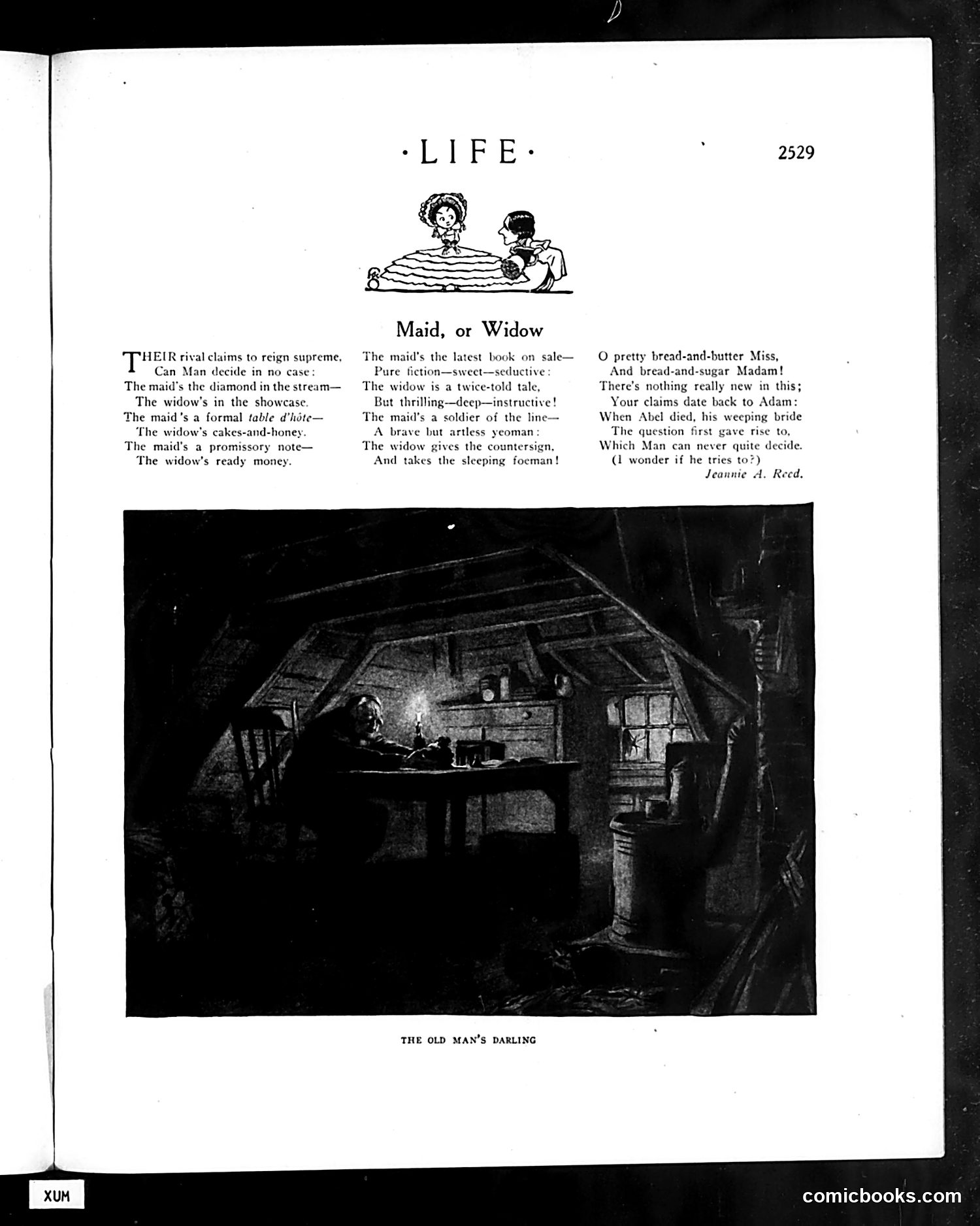
This poem by Jeannie A. Reed humorously compares the social status and desirability of unmarried women versus widows in early 20th-century society. The satire highlights how a woman's marital status determined her value: - **Maids** are depicted as desirable but economically dependent (diamond, formal table d'hôte, promissory notes) - **Widows** are portrayed as more financially secure (ready money) but less romantically appealing The poem cynically suggests that men cannot decide between youth/beauty and financial stability. The accompanying illustration, "The Old Man's Darling," appears to depict an elderly man with a younger woman, reinforcing the satirical point about economic transaction in marriage rather than romantic love.
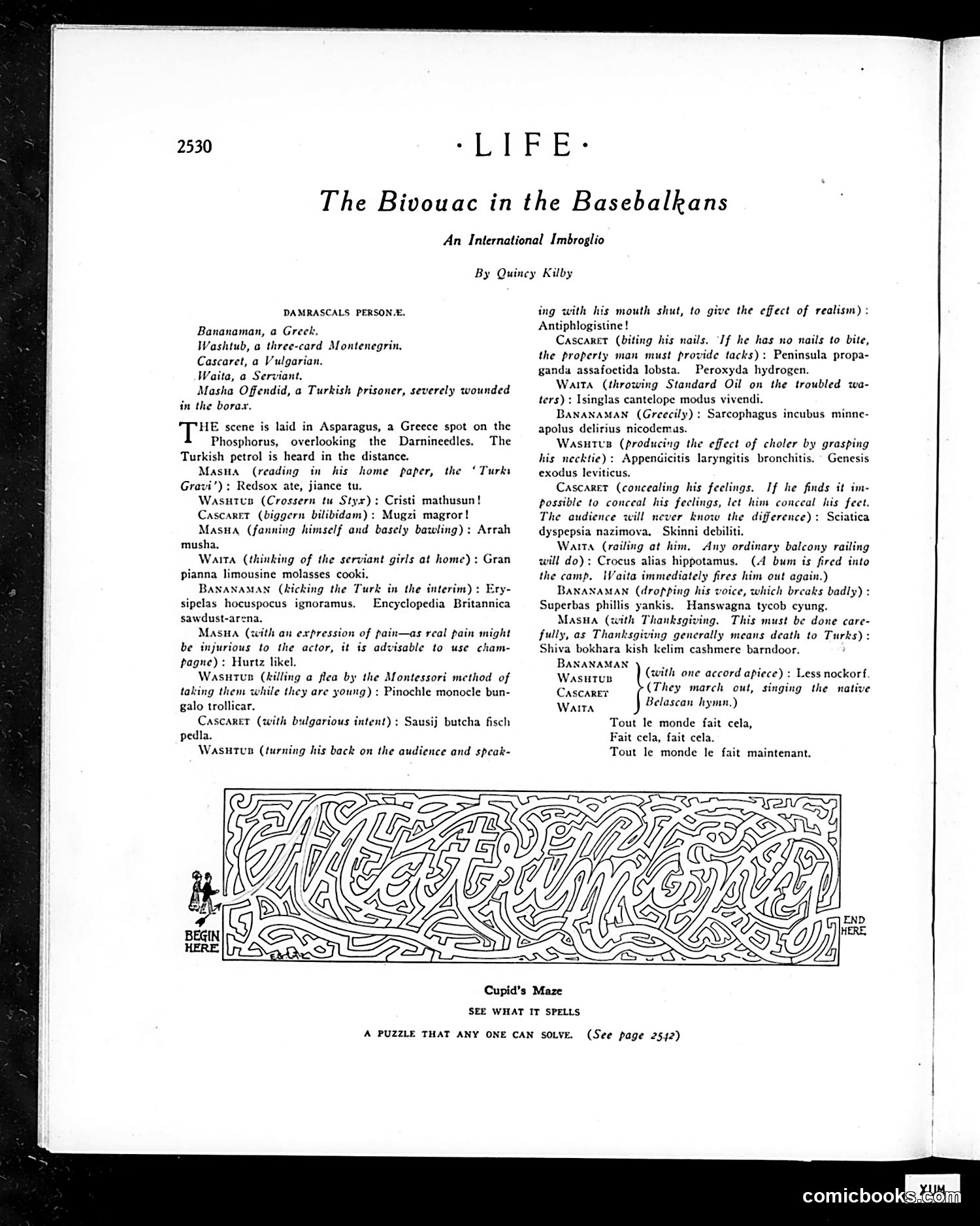
This is a satirical theatrical sketch by Quincy Kilby, presented as "An International Imbroglio." The piece features characters named after Balkan locations and ethnic groups (Damascus Persone, Washtub, Cascaret, Masna Offendid) in what appears to be a parody of Balkan political tensions and military conflict. The dialogue mixes absurdist humor with mock-scientific stage directions (referencing medical conditions and theatrical techniques). Below the text is "Cupid's Maze," a visual puzzle game readers could solve. The sketch satirizes European geopolitical instability, particularly in the Balkans—a region of frequent historical conflict—by presenting international tensions as theatrical farce with ridiculous character names and medical pseudo-scientific pseudo-realism.
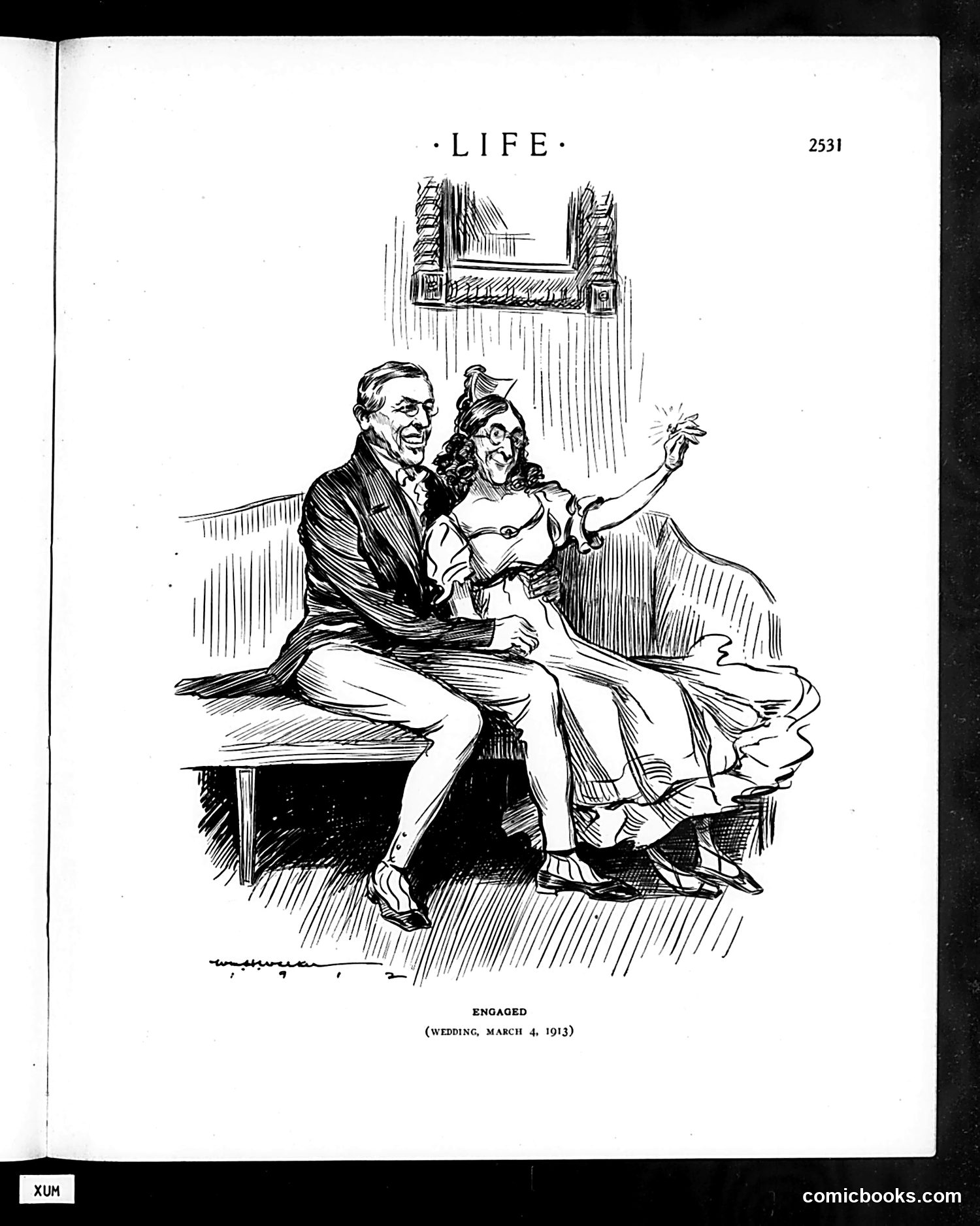
This Life magazine cartoon satirizes a romantic engagement announcement from March 4, 1913. The drawing shows a man and woman sitting together on a bench, with the woman appearing coquettish or theatrical while the man gazes at her fondly. The satire likely mocks either the couple's public announcement or broader contemporary attitudes about engagements and courtship rituals of the era. The exaggerated facial expressions and the woman's dramatic pose suggest the cartoon is poking fun at romantic sentimentality or perhaps the theatrical nature of upper-class engagement announcements. Without additional context identifying the specific couple, the exact target of the satire remains unclear, though it reflects Life magazine's typical approach of lampooning contemporary social customs.
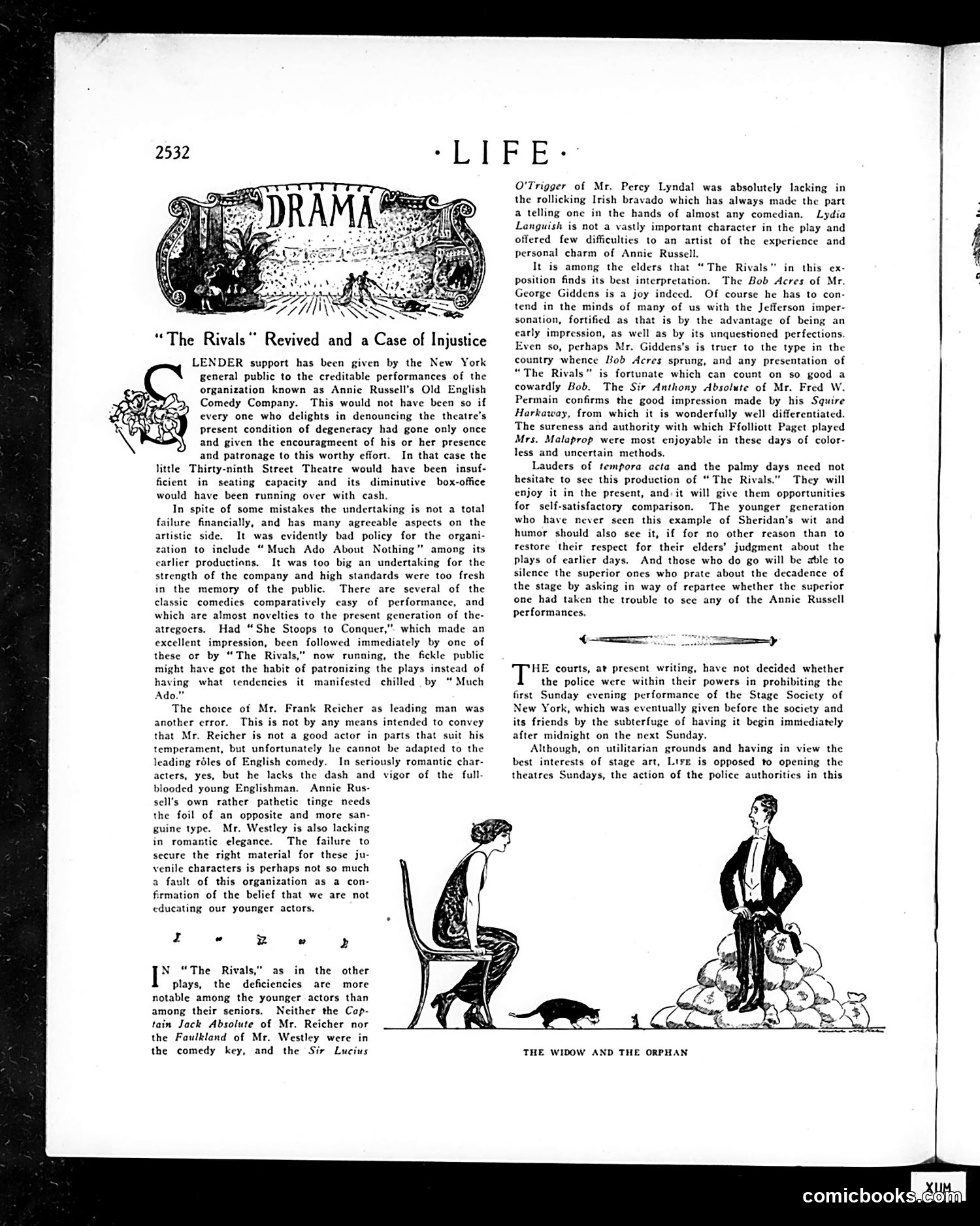
This is a theater review of Annie Russell's Old English Comedy Company's production of Sheridan's classic play "The Rivals." The text critiques both the production choices and the actors' performances. **Key Points:** The reviewer praises the *overall* effort but identifies specific casting problems. Younger actors like Frank Reicher (as Captain Jack Absolute) and Mr. Westley (as Faulkland) lack the necessary romantic vigor and comedic energy their roles demand. Percy Lyndal's O'Trigger supposedly lacks the "rollicking Irish bravado" the character requires. By contrast, older actors excel—George Giddens's Bob Acres and Fred W. Permain's Sir Anthony Absolute are praised as superior. **The Illustration** ("The Widow and the Orphan") appears to be a separate satirical cartoon, though its specific meaning isn't explained in the visible text. The review reflects broader concerns about American theater's decline and inadequate training of younger actors for classical comedic roles.
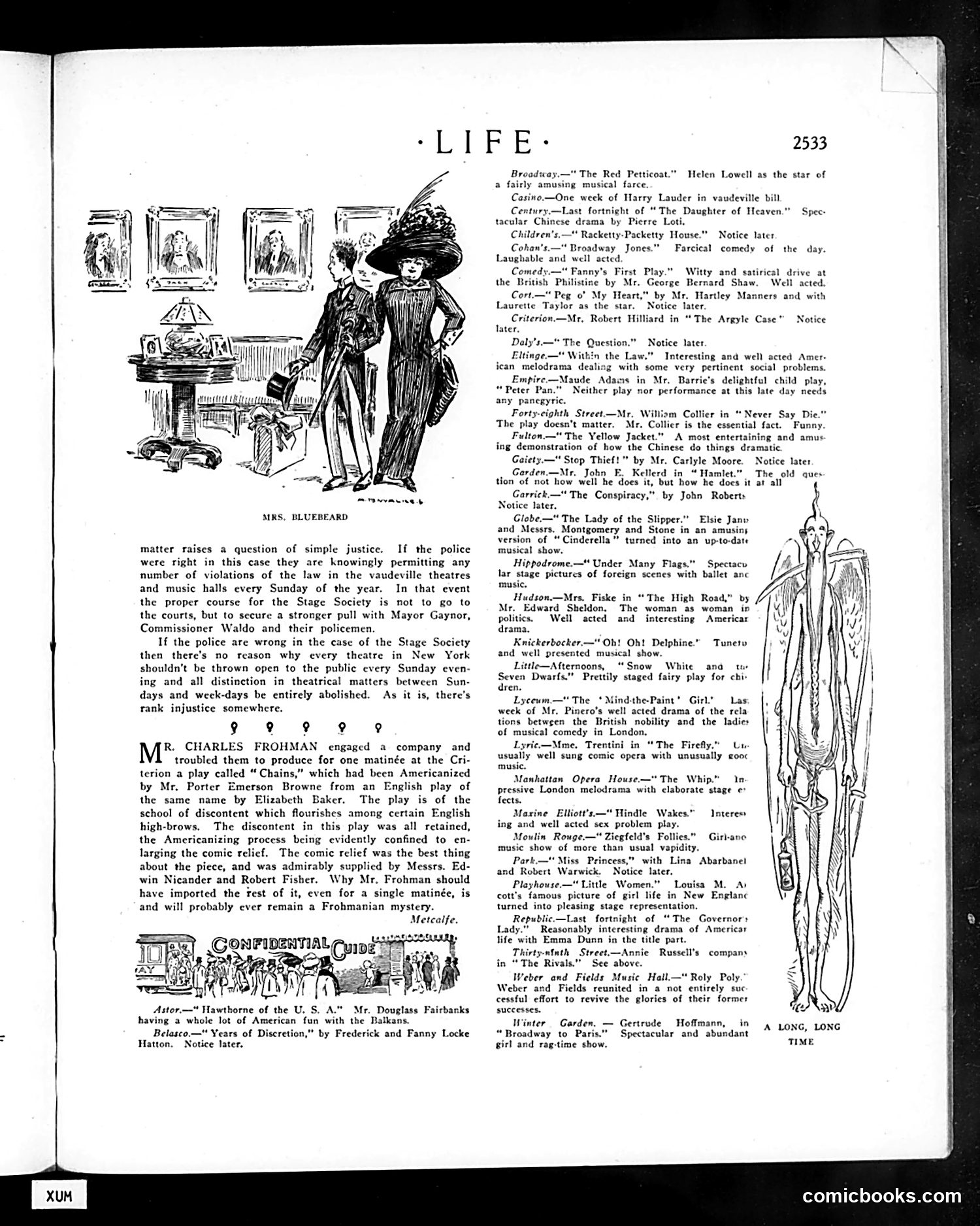
The illustration shows two elegantly dressed women in fashionable early 1910s attire, labeled "Mrs. Bluebeard." This appears to be promotional material for theatrical productions being reviewed on this page. The main text discusses theater licensing disputes in New York City, specifically regarding Sunday performances. It critiques Mayor Gaynor and Commissioner Waldo's police enforcement, arguing they're selectively prohibiting some theaters from Sunday shows while permitting vaudeville violations elsewhere—described as "rank injustice." The page then reviews multiple Broadway productions, including Charles Frohman's "Chains" (adapted from an English play), praising its comic relief while questioning why Frohman bothered importing the serious dramatic material. The cartoon and text together appear aimed at New York's theatrical establishment and city officials, mocking inconsistent censorship policies and importing of mediocre English plays during this era of American theatrical development.
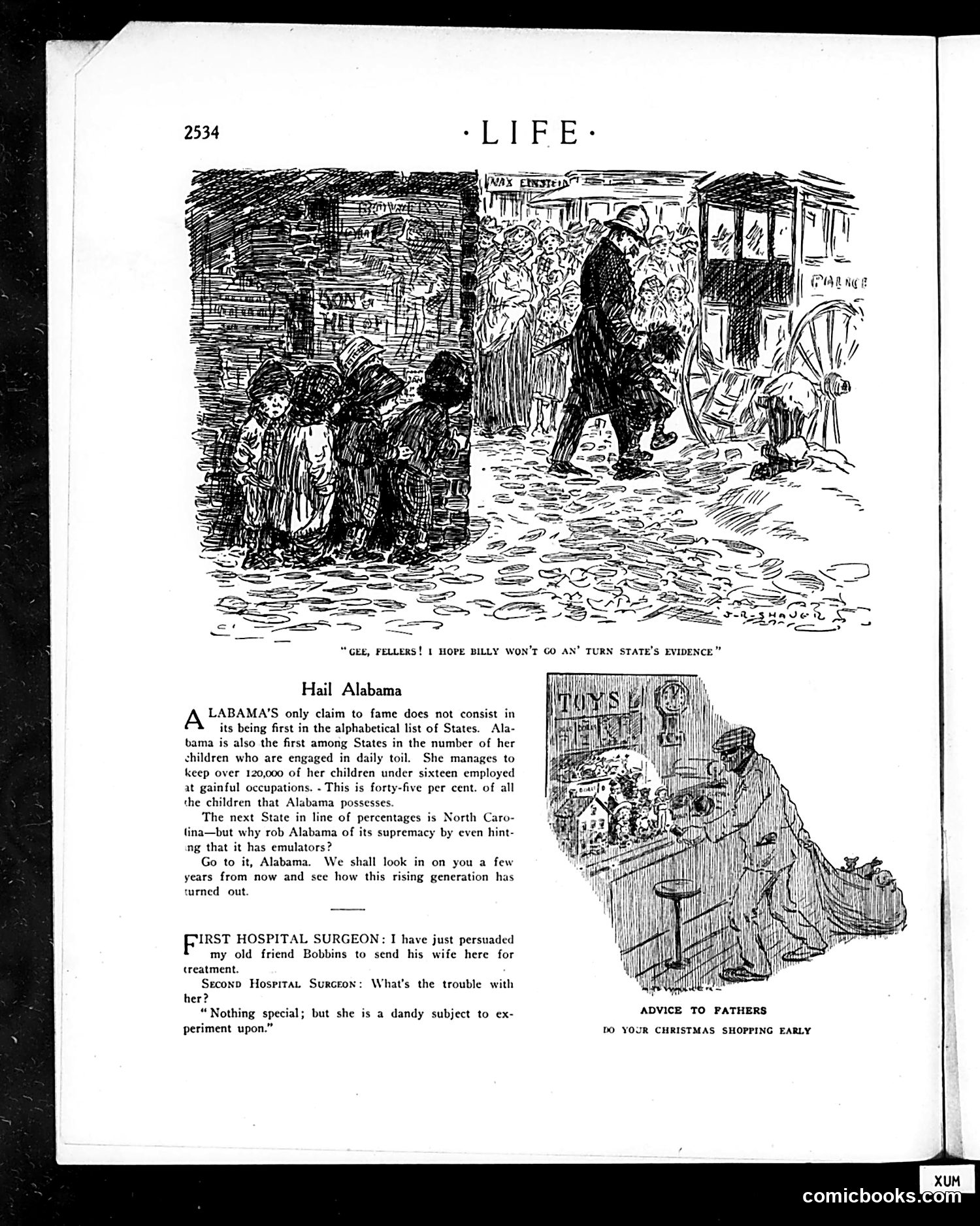
This satirical page from *Life* magazine critiques Alabama's distinction as having the highest percentage of child laborers among U.S. states—45% of its children under sixteen work in "gainful occupations." The text mockingly "praises" Alabama for this dubious record, sarcastically suggesting readers check back in years to see how this exploited generation turns out. This is scathing social commentary on child labor practices. The top cartoon depicts what appears to be a street scene with poor children and adults, likely illustrating the urban poverty driving child labor. The caption references "Billy" and "state's evidence," suggesting a crime or scandal context. A separate hospital joke mocks unethical medical experimentation on vulnerable patients, using a woman as a test subject. The final cartoon—"Advice to Fathers: Do Your Christmas Shopping Early"—appears to be an advertisement tip, contrasting sharply with the page's serious critiques of poverty and exploitation. The satire exposes systemic abuse of children and the poor in early 20th-century America.
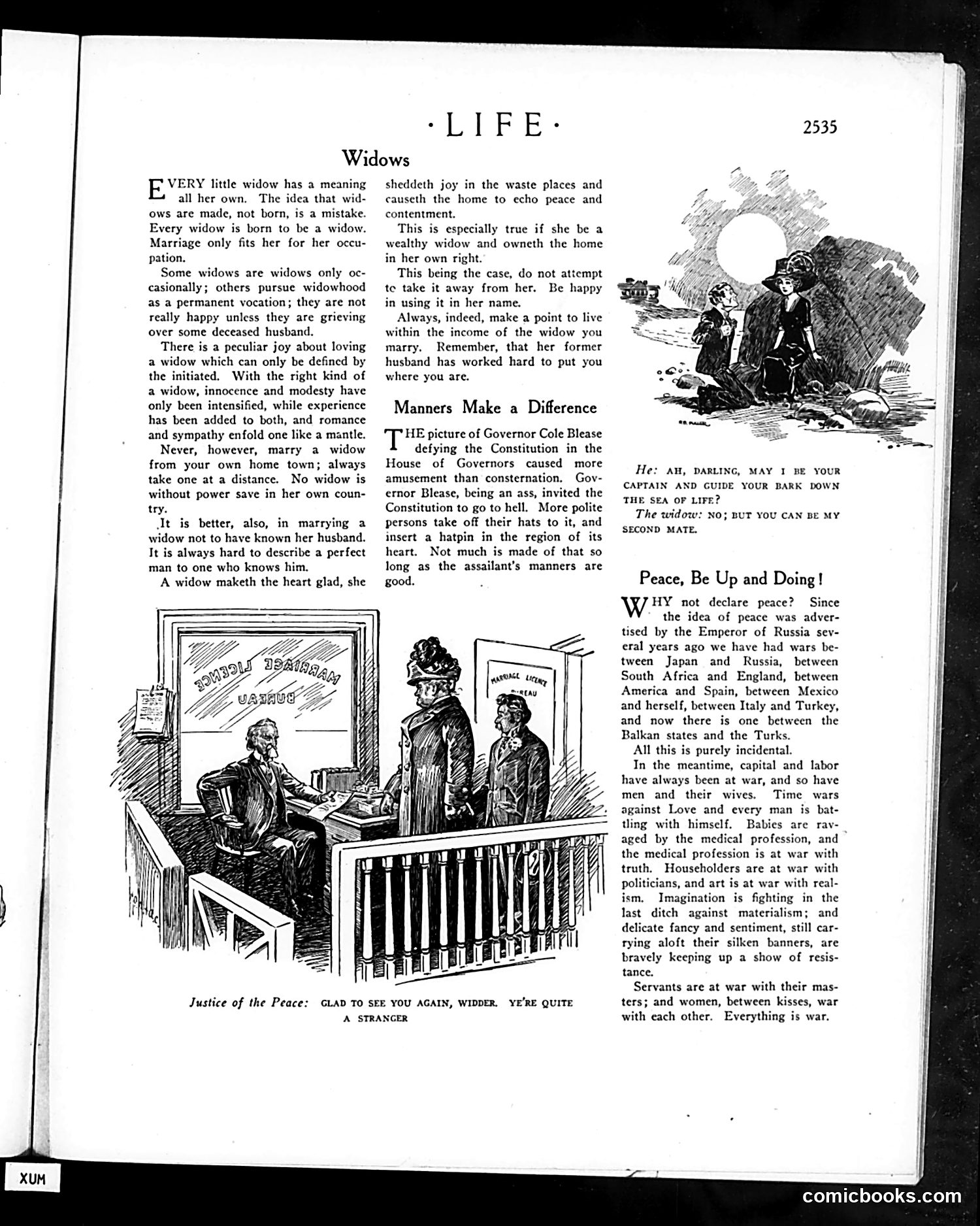
This page contains satirical commentary on three topics: **"Widows"** section: A tongue-in-cheek essay advising men on marrying widows, humorously suggesting widows are "born" to the role and counseling men to marry widows from out of town (where the deceased husband is unknown) to avoid unfavorable comparisons. **"Manners Make a Difference"** cartoon: References Governor Cole Blease of South Carolina, who apparently defied the state Constitution. The joke satirizes how polite society accepts constitutional violations if performed with good manners—comparing it to inserting a hatpin in someone's heart "so long as the assailant's manners are good." It's political satire criticizing performative civility masking serious wrongdoing. **"Peace, Be Up and Doing!"** section: Cynical commentary on the Emperor of Russia's peace proposals, listing recent wars (Russo-Japanese, Boer War, Spanish-American, etc.) to argue that despite peace rhetoric, conflict pervades every level of society—between capital and labor, husbands and wives, even imagination versus materialism. The overall tone is satirical pessimism about human nature and society.
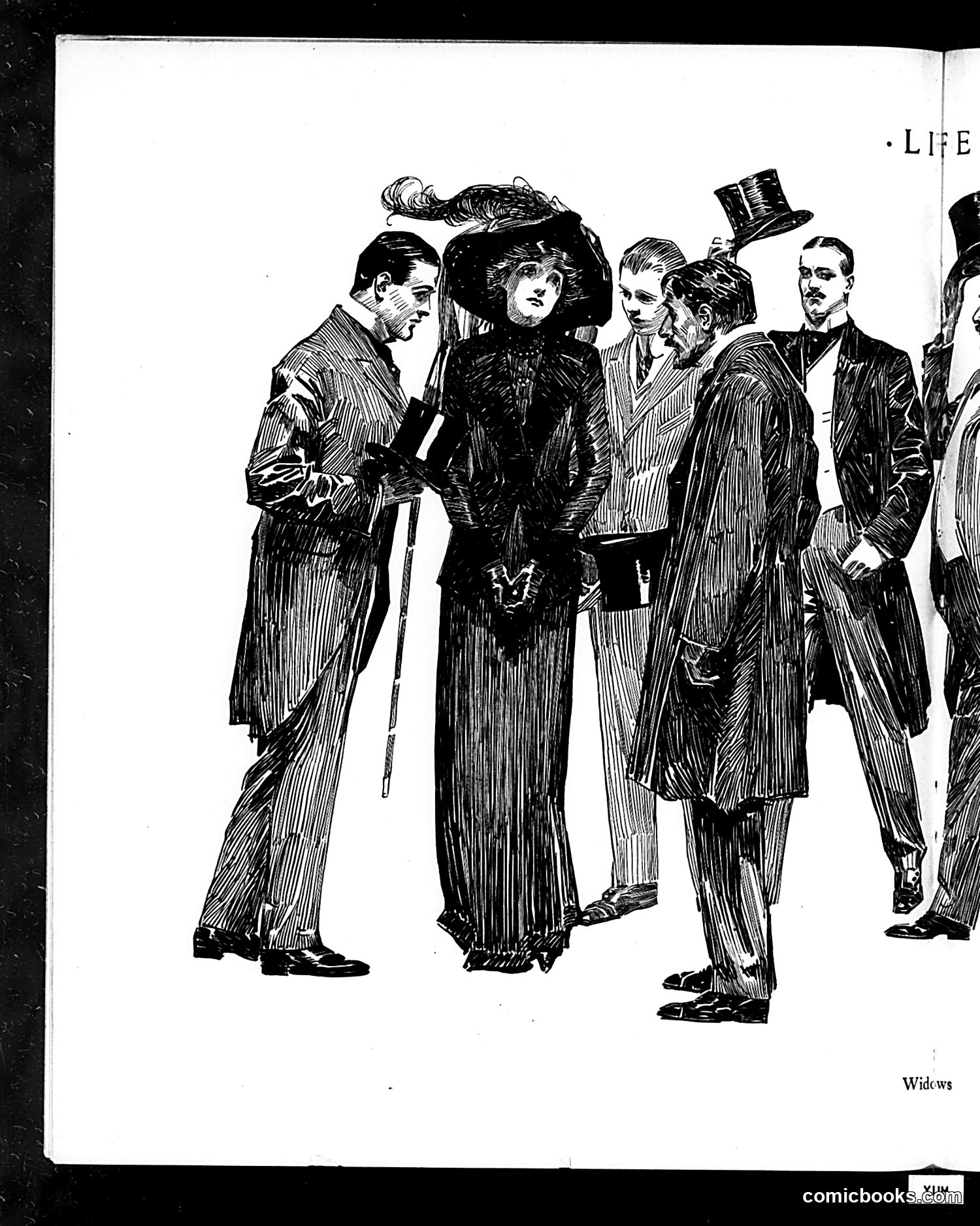
This pen-and-ink illustration depicts a group of well-dressed men in formal attire (suits and top hats) gathered around a single woman dressed in black mourning clothes with a large hat and veil. The woman appears to be the focal point of their attention. The caption "Widows" suggests social satire about wealthy or socially prominent widows. The cartoon likely satirizes how newly widowed women of means attracted male suitors or hangers-on seeking financial or social advantage. The formal dress and gentleman's careful attention suggest either a social gathering or perhaps a humorous commentary on courtship dynamics among the upper classes—specifically, the opportunistic interest shown toward women who had inherited wealth or status through their husbands' deaths.
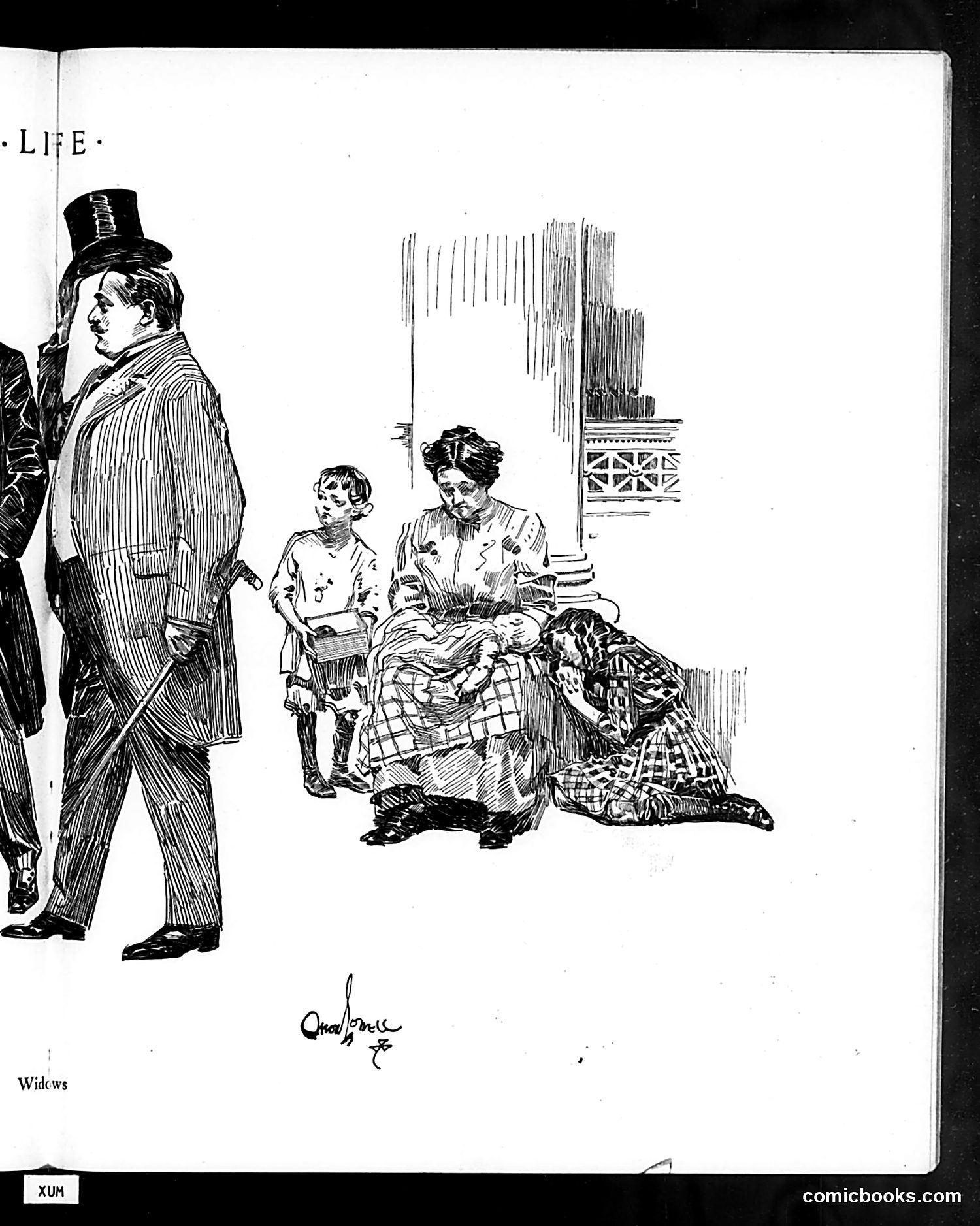
This cartoon illustrates social commentary about widows, likely from the early 20th century. The scene depicts a well-dressed gentleman in a top hat observing a woman (presumably a widow based on the caption) seated with children, apparently in modest circumstances. The interior setting suggests a humble home. The satire appears to address the plight of widows and their families—a contemporary social concern. The contrast between the well-to-do man and the struggling family suggests commentary on class disparities or perhaps the inadequate social support systems for women left without breadwinners. The artist's signature reads "Chas Solis" or similar. The cartoon likely critiques either male indifference to widows' hardships or society's failure to provide adequate assistance.
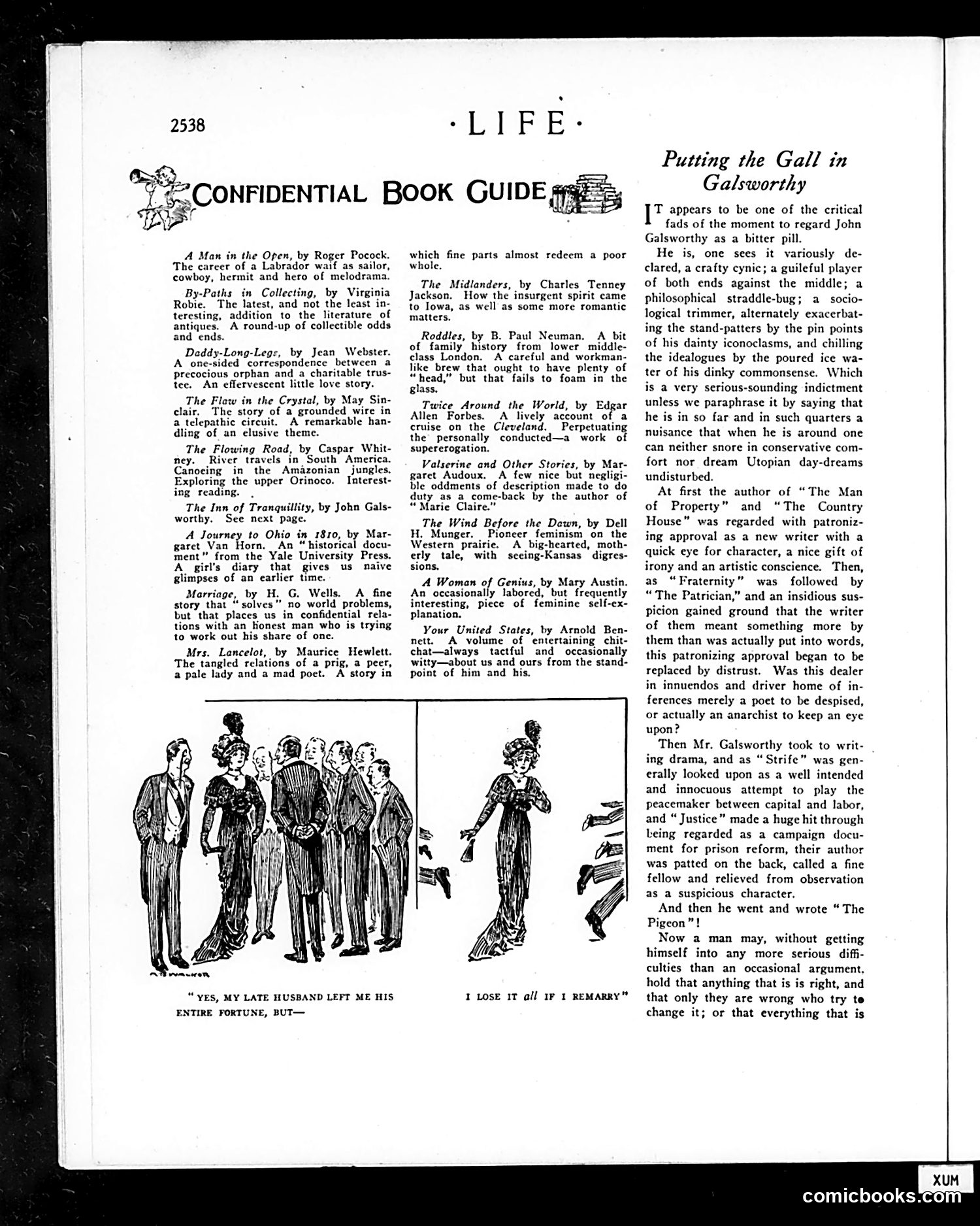
This page is a "Confidential Book Guide"—a satirical book review column from *Life* magazine. The main content critiques author John Galsworthy, who was a celebrated British novelist of the early 1900s. **The Satire:** The article accuses Galsworthy of being a fraudulent intellectual poseur who adopts contradictory positions to appear sophisticated. He's portrayed as a "bitter pill"—alternately provoking conservatives and disappointing idealists, making him essentially useless to both camps. The critic suggests his early work seemed promising, but subsequent novels like *Fraternity* and *The Patrician* revealed his true nature as an unreliable, self-serving writer. **The Cartoon:** Shows a woman telling someone "I lose it all if I remarry"—likely referencing a plot point from one of Galsworthy's works, used mockingly to illustrate his melodramatic tendencies. The page also lists other contemporary books with brief, often dismissive reviews, establishing *Life*'s role as a literary tastemaker dispensing witty, cutting commentary.
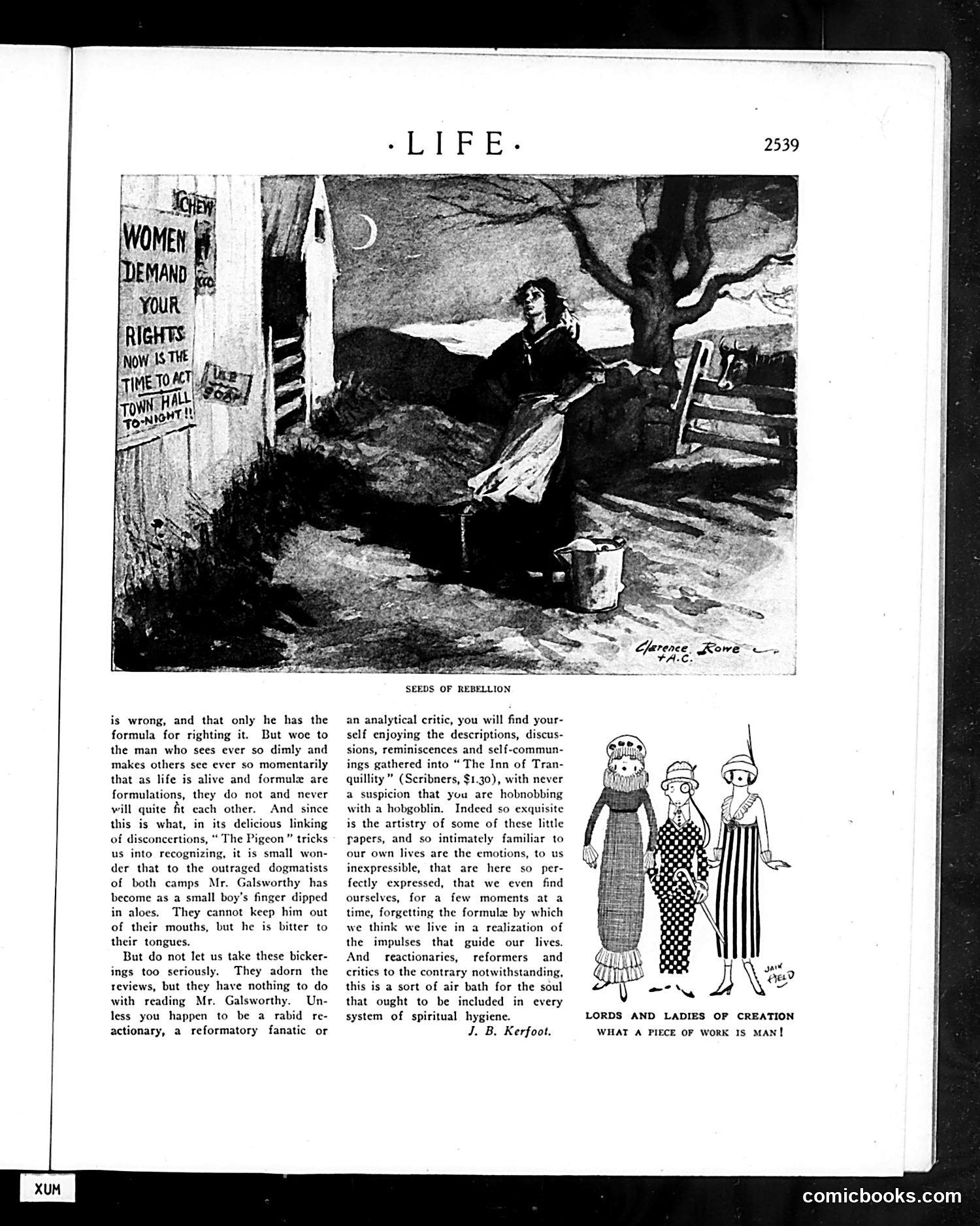
The page contains two distinct satirical elements: **Top image ("Seeds of Rebellion"):** A political cartoon showing a woman posting a suffrage sign reading "Women Demand Your Rights Now Is the Time to Act" near a town hall. A man sits passively nearby, apparently indifferent. This references the women's suffrage movement, mocking male complacency toward women's political demands. **Bottom cartoon ("Lords and Ladies of Creation"):** Three figures in fashionable dress are captioned "What a Piece of Work Is Man!"—a Shakespeare quote. This appears to satirize the pretension of the wealthy or fashionable classes, using ironic praise to mock their self-importance. **Text section:** Reviews John Galsworthy's works ("The Pigeon" and "The Inn of Tranquility"), discussing how his literature frustrates both political reactionaries and reformers by presenting nuanced human experience rather than ideological formulas. The reviewer argues his writing offers spiritual and emotional value beyond political debate. Together, the page juxtaposes political activism with literary sophistication as responses to social questions.
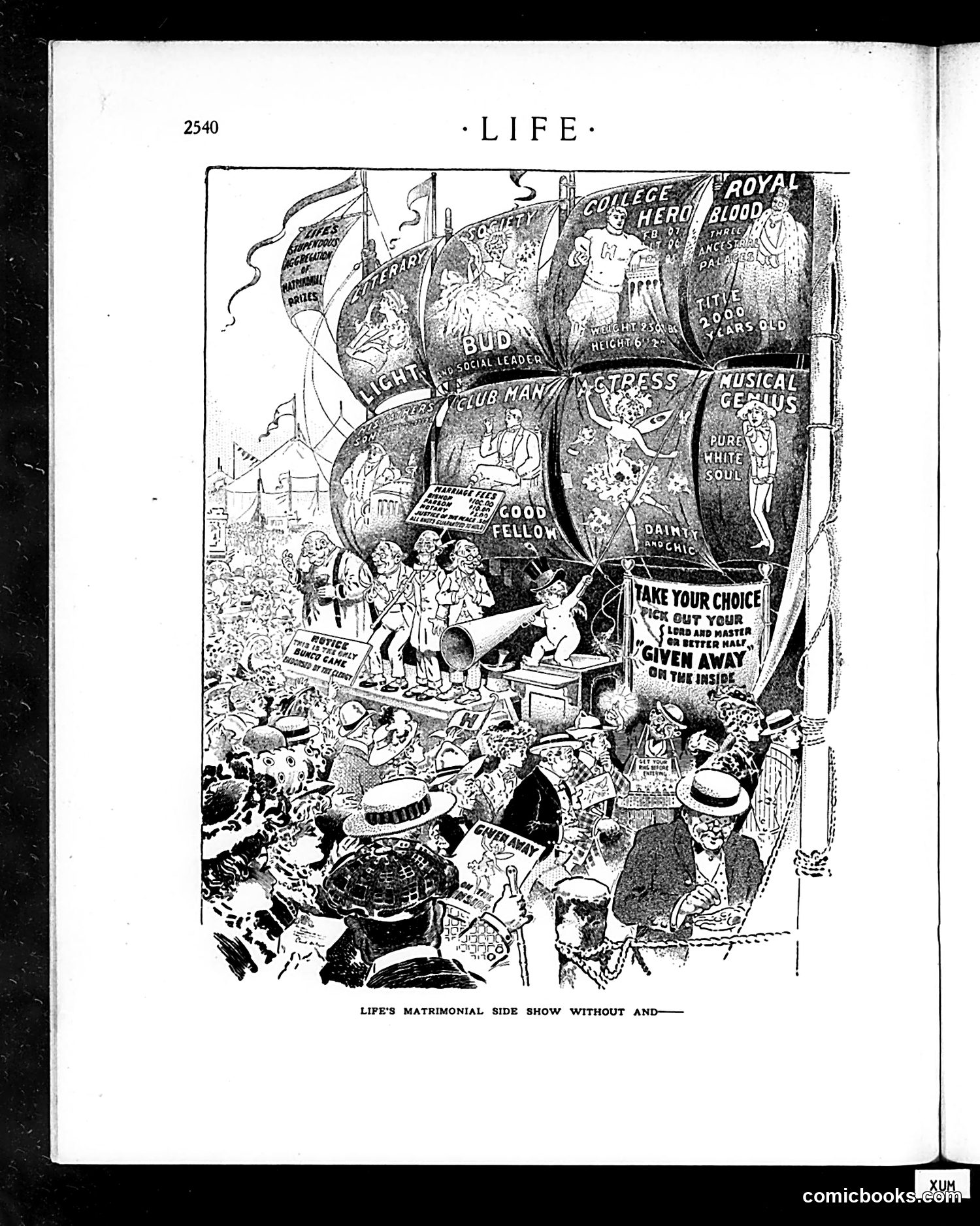
This satirical cartoon depicts a carnival sideshow tent advertising various human "attractions" as marriage prospects. The visible labels on the large balloons/attractions include "College Hero," "Royal Blood," "Club Man," "Grass Widower," "Good Fellow," "Musical Genius," and "Dainty Orchid"—stereotypical male and female types available for matrimonial selection. The caption "Life's Matrimonial Side Show" mocks marriage as a commercial spectacle where people are commodified and displayed like carnival attractions. The crowd of prospective "customers" below reinforces this critique of matrimony as a consumer choice rather than a meaningful union. The satire targets early-20th-century attitudes toward marriage as a transaction where individuals reduce themselves to marketable types and stereotypes. The carnival setting suggests the dehumanizing, circus-like absurdity of this approach to finding spouses.
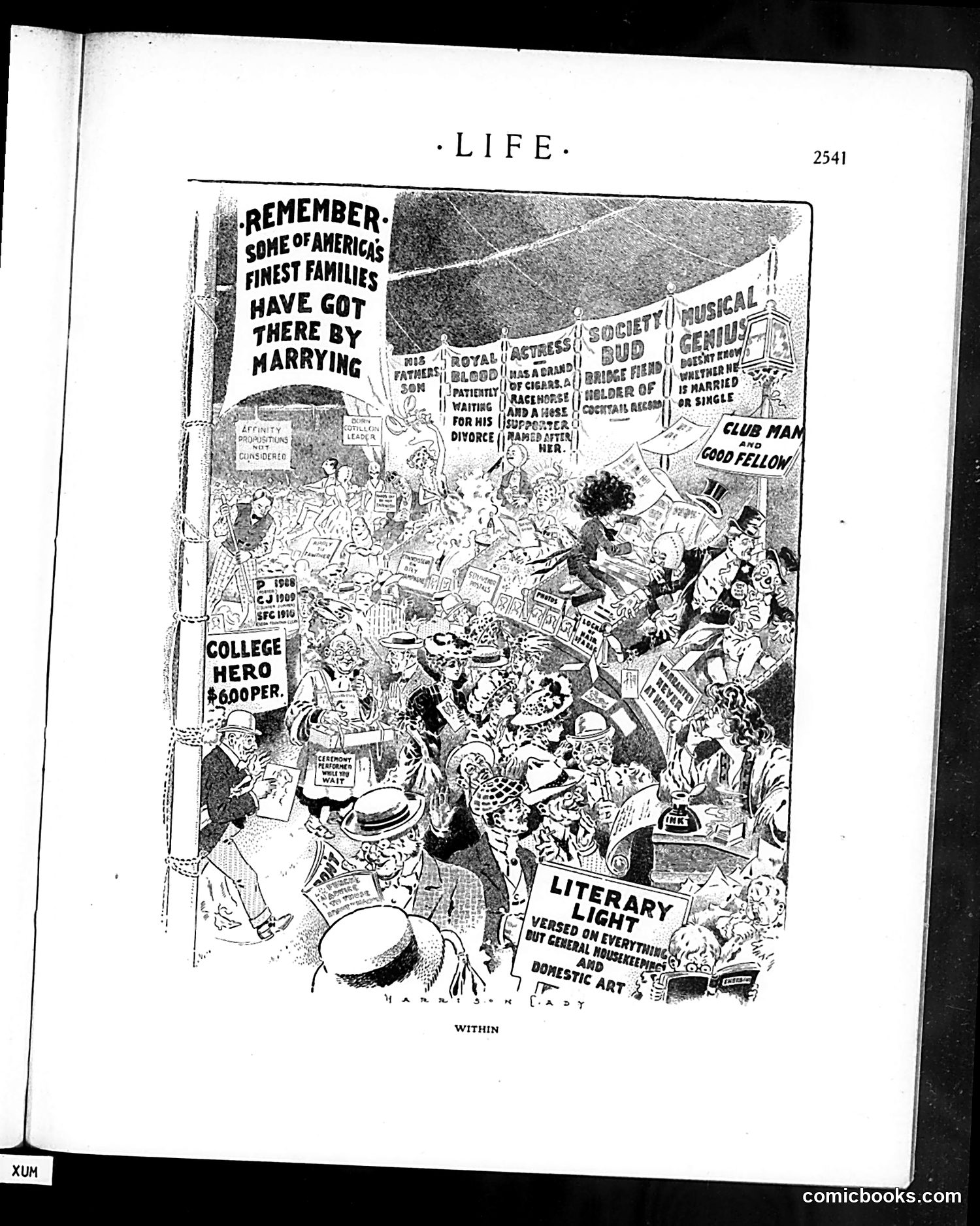
This satirical cartoon mocks American social pretension by depicting a chaotic crowd of people claiming various dubious sources of family prestige. The visible signs reference stereotypical claims: "Royal Fathers," "Actress Blood," "Society Bud," "Musical Genius," and "Club Man & Good Fellow." The largest sign declares "Remember, some of America's finest families have got there by marrying"—the central joke being that wealth and social status are often achieved through matrimonial calculation rather than genuine merit or ancestral accomplishment. Other visible labels mock specific types: "College Hero," "Literary Light" (described as "versed on everything but creditable to housekeeping and domestic art"). The cartoon satirizes how Americans construct false narratives of respectability and inherited superiority, particularly through advantageous marriages rather than actual accomplishment or honest lineage.
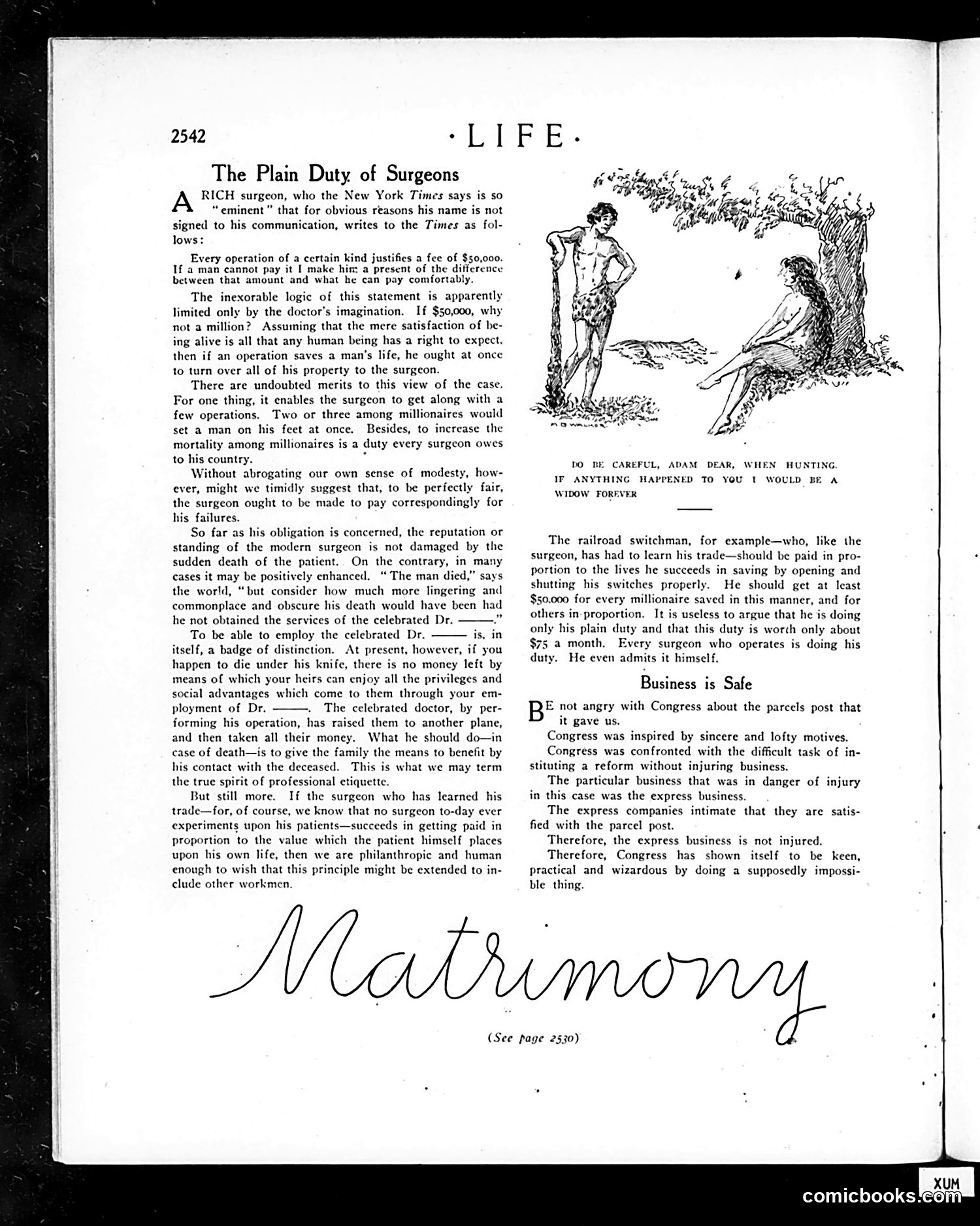
This page satirizes wealthy surgeons' exorbitant fees through caustic irony. An anonymous "eminent" surgeon claims he charges $50,000 per operation, adjusting downward only based on what patients can "comfortably" pay—implying he should claim their entire fortunes since "mere satisfaction of being alive" is all they deserve. Life's editors mock this logic by extending it absurdly: Why not a million? They then pivot to a damning comparison: railroad switchmen save lives daily for ~$75/month, yet surgeons demand astronomical fees for identical work. Both claim they're merely doing their "duty," yet only surgeons are compensated as though performing miracles. The cartoon depicts Adam warning Eve about hunting accidents, establishing that protecting lives has always been ordinary responsibility—not something warranting windfall profits. The "Business is Safe" section sarcastically praises Congress for appearing reformist while protecting express companies' interests against parcel post competition. The satire targets Gilded Age inequality and professional exploitation.
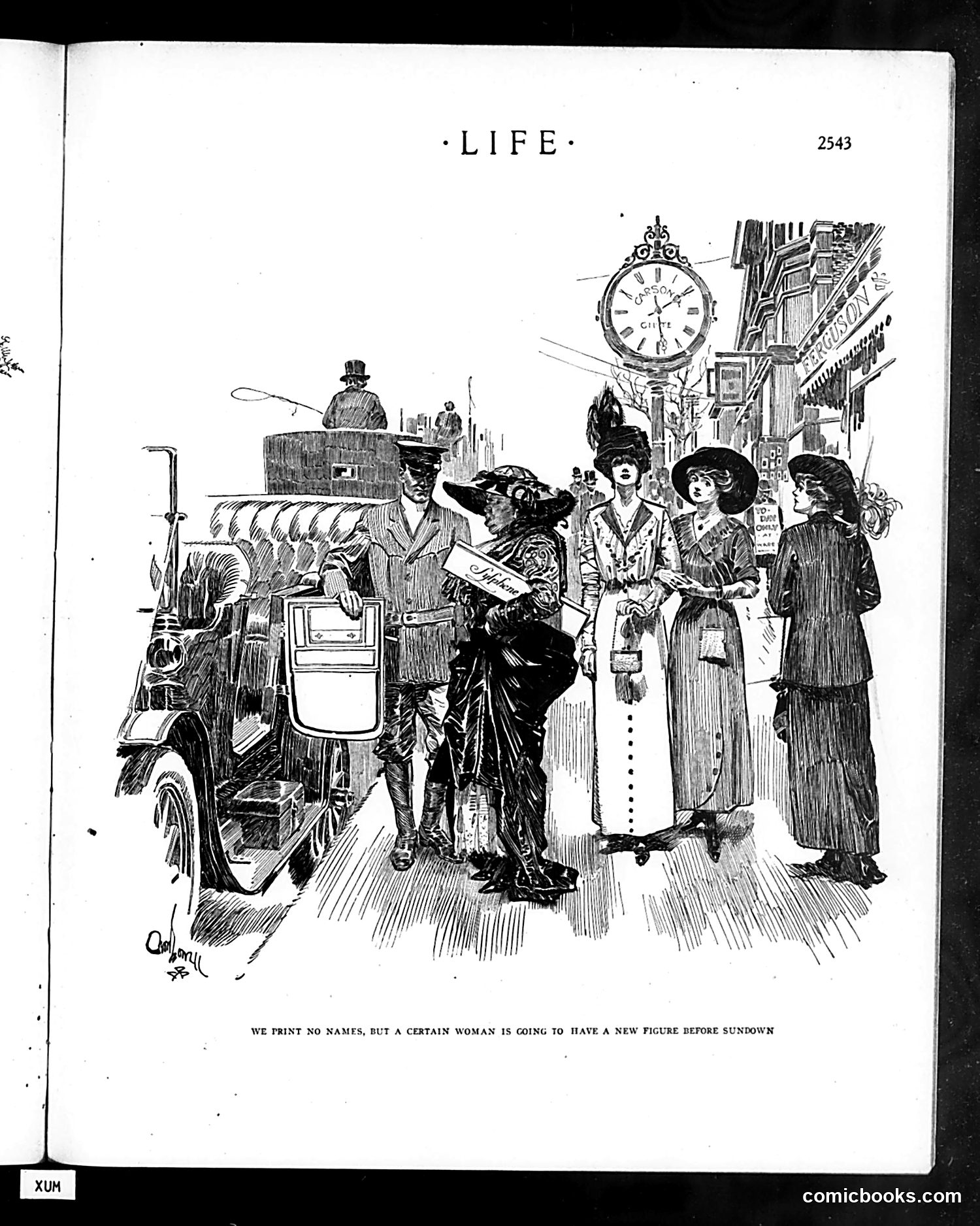
This is a satirical drawing about fashion and body image. The caption cryptically announces that "a certain woman is going to have a new figure before sundown"—a joke about corsetry and girdles, the tight-fitting undergarments women wore to reshape their bodies. The scene shows a fashionable woman being approached on a city street by what appears to be a taxi driver or street vendor. The implication is humorous: her "new figure" won't result from exercise or diet, but from putting on restrictive undergarments that artificially reshape the body. The drawing satirizes the era's obsession with women conforming to narrow beauty standards through mechanical means, while the mysterious caption playfully avoids naming the specific woman or product being mocked.
This page critiques American concert culture and the cult of personality around musical virtuosos. The opening illustration shows "MUSIC" supported by two caricatured figures, symbolizing how performers overshadow the art itself. The article argues that Americans treat musicians as heroes requiring distinctive "personalities"—whether Ysaÿe's paternal manner toward his violin, Mischa Elman's cultivated youth, or Titta Ruffo's emphasis on vocal power. The writer (Sigmund Spaeth) contends this is absurd: audiences now attend concerts to worship the performer rather than appreciate the composer's work. The sidebar celebrates baritone Antonio Scotti, who broke operatic convention by wearing ordinary evening dress instead of costume for *Pagliacci*'s prologue. The management was upset, yet audiences actually *approved*—proving Scotti's point that listeners care more about the performer's personality than theatrical tradition or musical integrity. The satire targets American celebrity culture's tendency to prioritize personality over substance.
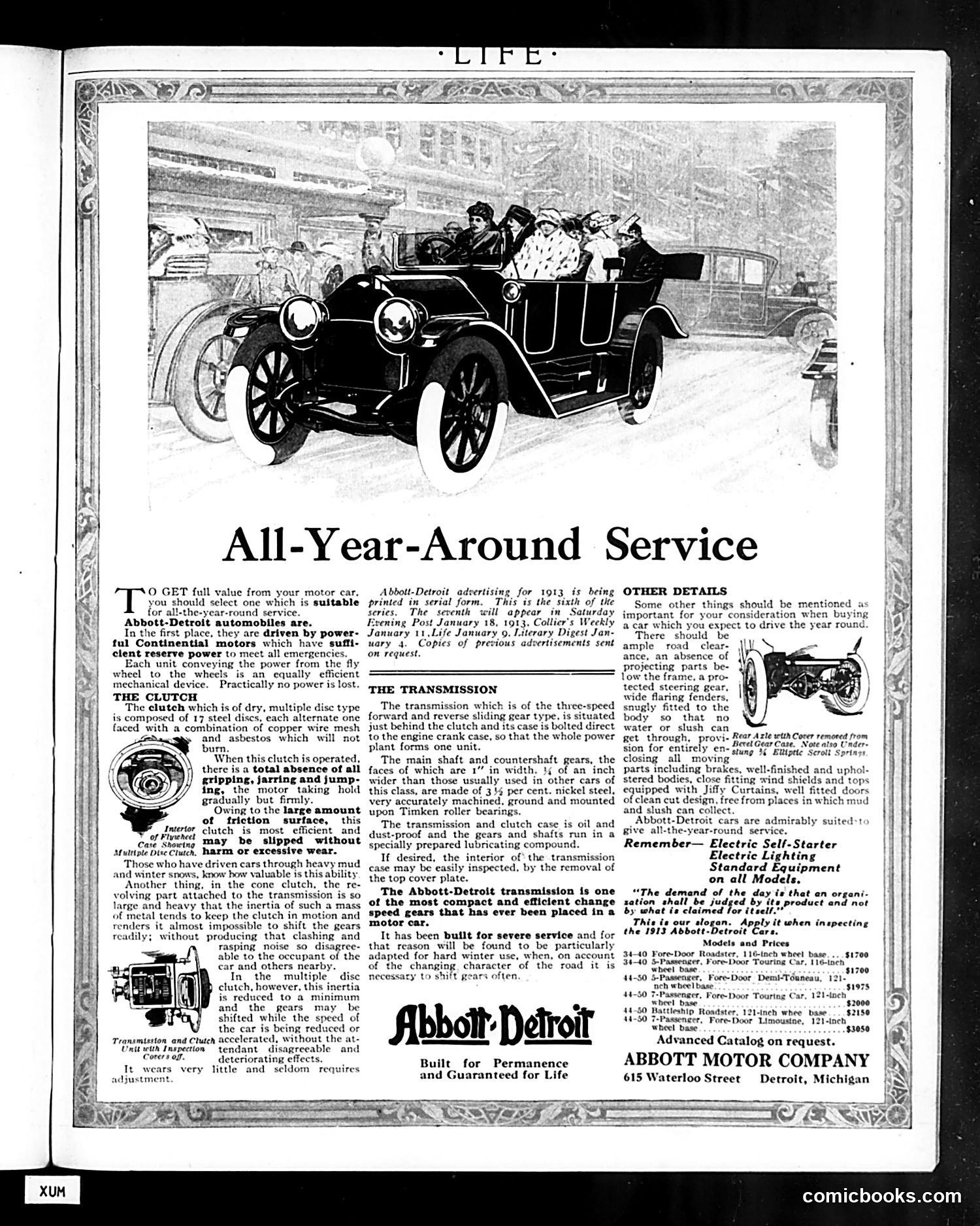
This is **not a cartoon or satire**—it's a straightforward advertisement for Abbott-Detroit automobiles, part of a serial advertising campaign running across major publications (Saturday Evening Post, Collier's Weekly, Life, Literary Digest) in early 1913. The image shows an open touring car filled with well-dressed passengers driving through an urban street. The accompanying text promotes the vehicle's engineering features for "all-year-round service": a powerful Continental motor, an efficient dry-clutch system, and a reliable transmission designed to handle winter driving conditions. The advertisement emphasizes durability and mechanical superiority, using technical specifications (nickel-steel gears, multiple-disc clutch design) to appeal to buyers seeking reliability. The car's slogan—"Built for Permanence and Guaranteed for Life"—reflects early automotive marketing's emphasis on quality as a competitive advantage. This represents typical early-twentieth-century automobile advertising: detailed technical exposition aimed at educated consumers.
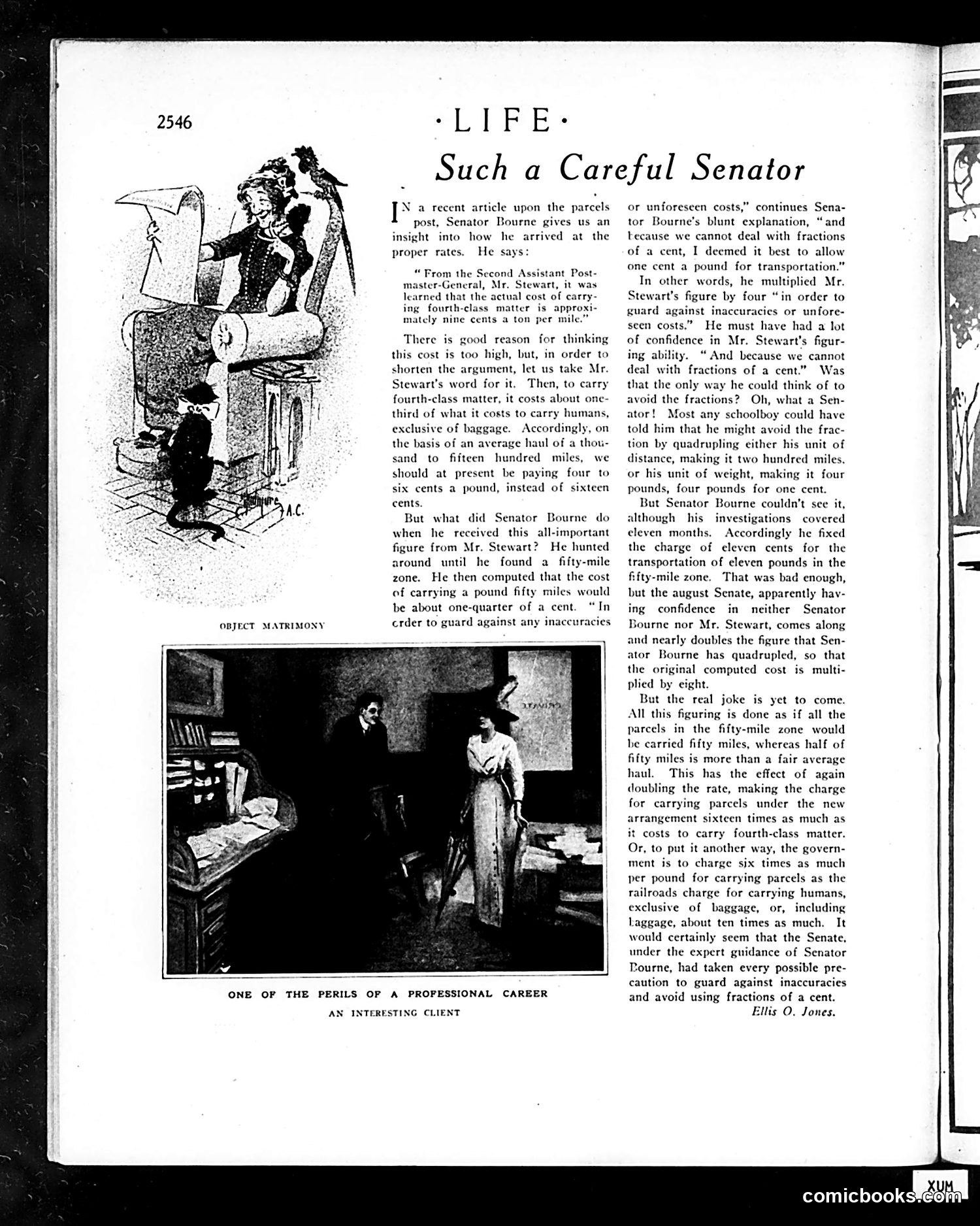
This article mocks Senator Bourne's mathematical reasoning in setting postal rates for fourth-class (parcel post) matter. The satire documents how Bourne inflated costs through questionable calculations: Starting from a base calculation (~3-6 cents per pound), Bourne multiplied by four "to guard against inaccuracies," then the Senate doubled his figure again. The final rate became 16 times the original computed cost—making parcel postage six times more expensive than human railway transport. The humor lies in Bourne's stated justification: avoiding "fractions of a cent" when simple unit adjustments could have achieved the same goal more honestly. The author (Ellis O. Jones) sardonically notes Bourne's "careful" approach actually created absurdly inflated rates. The accompanying illustrations—one labeled "Object Matrimony" and another showing "One of the Perils of a Professional Career"—appear to be unrelated humorous sketches typical of Life's format.
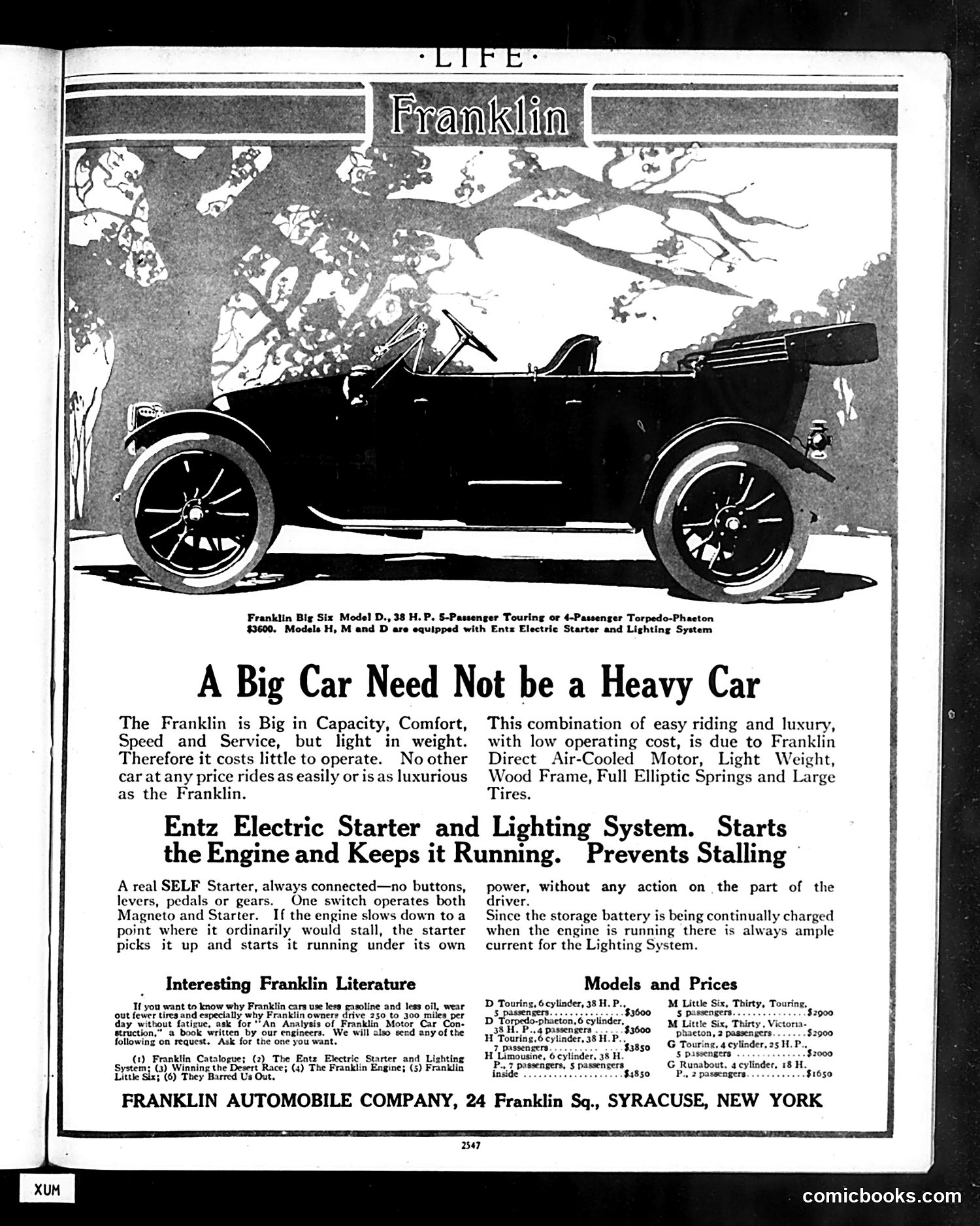
This is primarily a **car advertisement**, not political satire. It promotes the Franklin automobile from Syracuse, New York, circa early 1900s. The page features a side-view illustration of the Franklin Big Six touring car and emphasizes its competitive advantage: it's a large, comfortable vehicle that's surprisingly **light in weight**, making it economical to operate—a key selling point when gasoline was expensive and cars were fuel-inefficient. The headline "A Big Car Need Not be a Heavy Car" directly addresses consumer concerns. Technical features highlighted include an air-cooled motor, wooden frame, and notably, an **Entz Electric Starter**—a significant innovation, as hand-cranking was the standard method. The advertisement positions this as a luxury vehicle for affluent buyers while claiming low operating costs. The page includes pricing information for various models ($2,600-$3,600) and offers promotional literature explaining Franklin's engineering advantages. There is **no cartoon or satire present**—this is straightforward automotive marketing.
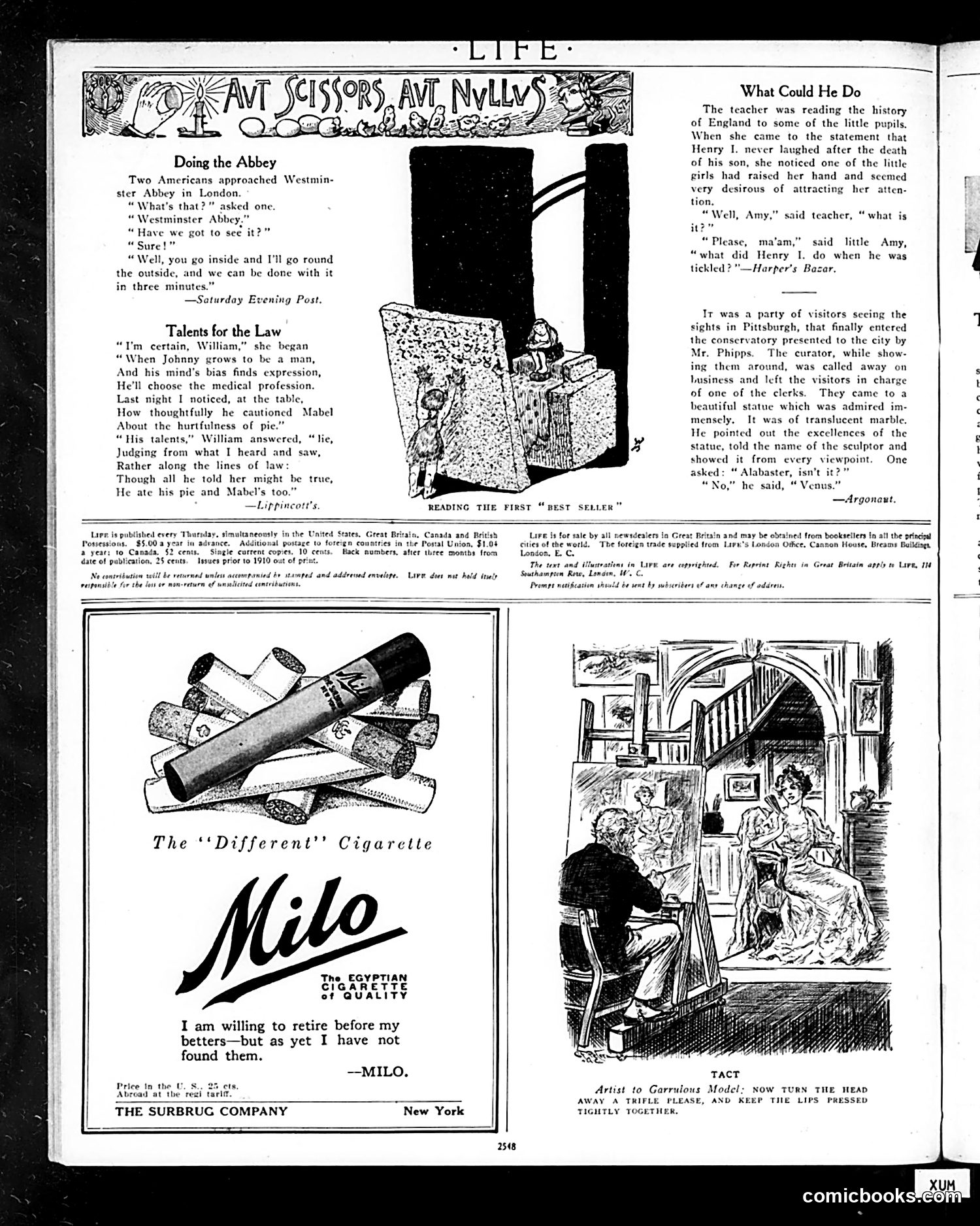
This page contains **primarily advertising and humor pieces** rather than political commentary. The main visual content includes: 1. **"Reading the First 'Best Seller'"** - An illustration showing someone reading a large book, likely satirizing popular literature trends. 2. **"Milo" Cigarette Advertisement** - A commercial promoting Egyptian cigarettes, featuring the slogan "I am willing to retire before my betters—but as yet I have not found them," presenting cigarettes as a mark of superiority. 3. **"Tact" Illustration** - A social scene with accompanying caption about etiquette: "Artist: Darling Model, now turn the head away a trifle please, and keep the lips pressed tightly together." The page reflects early 20th-century consumer culture and social humor rather than political satire. The advertising represents period attitudes toward luxury goods and social status.
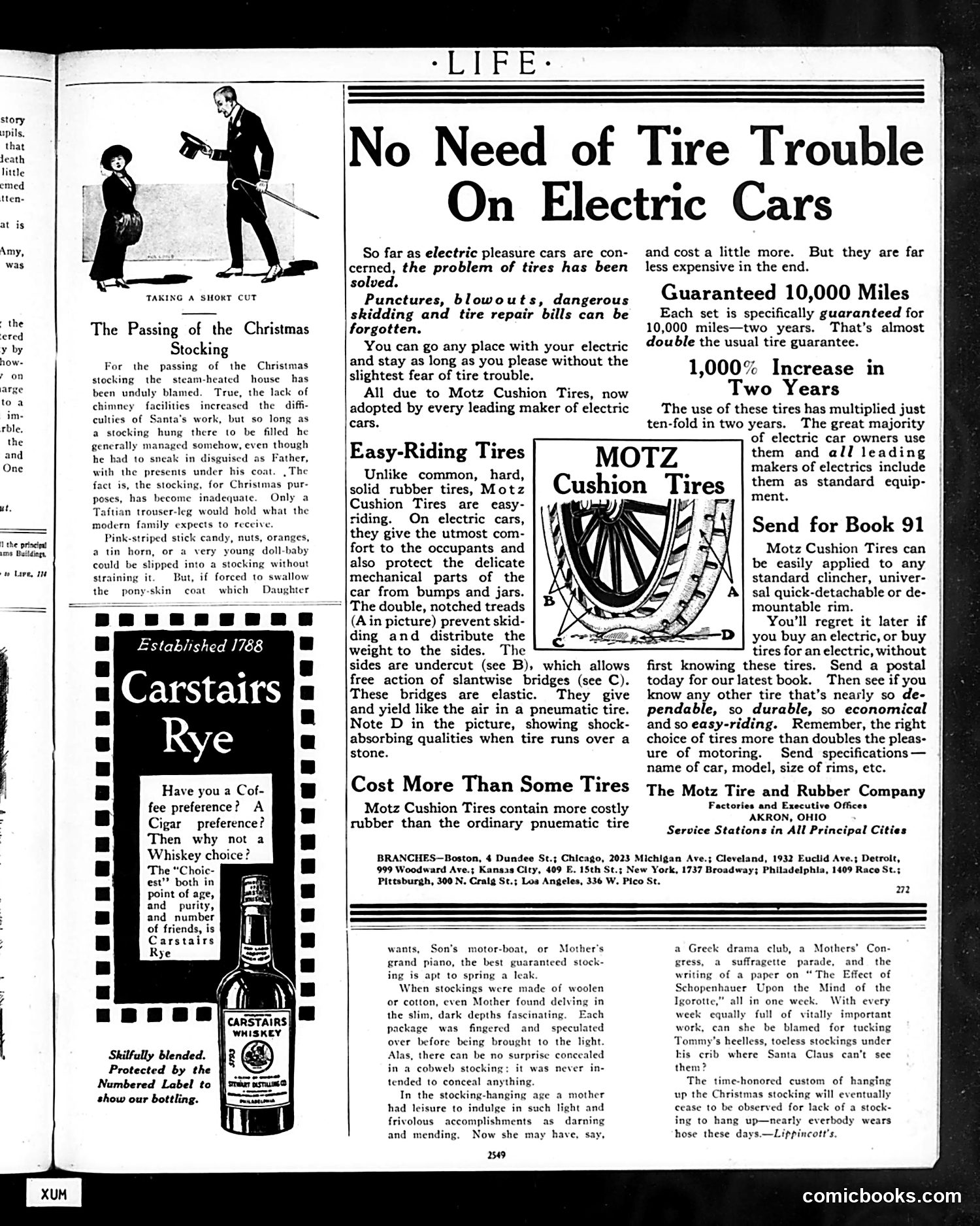
This page contains two distinct elements: a brief cartoon and substantial advertising. **The Cartoon ("Taking a Short Cut"):** A woman and man in formal dress appear to be discussing or gesturing toward something. The caption references Christmas stockings becoming obsolete in modern steam-heated homes. The satire suggests that traditional Christmas gift-giving practices (small items stuffed in stockings) have become inadequate for contemporary expectations—modern families now demand more substantial gifts. The "short cut" likely refers to abandoning the stocking tradition entirely. **The Advertisements:** The page is dominated by ads for Motz Cushion Tires (for electric cars) and Carstairs Rye whiskey. The tire advertisement emphasizes reliability for early electric vehicles, a technology gaining traction in the early 1900s. Electric cars were considered luxury items at this time. The whiskey ad uses straightforward marketing appeal. The page reflects early-20th-century concerns: evolving holiday customs, emerging automobile technology, and consumer product marketing.
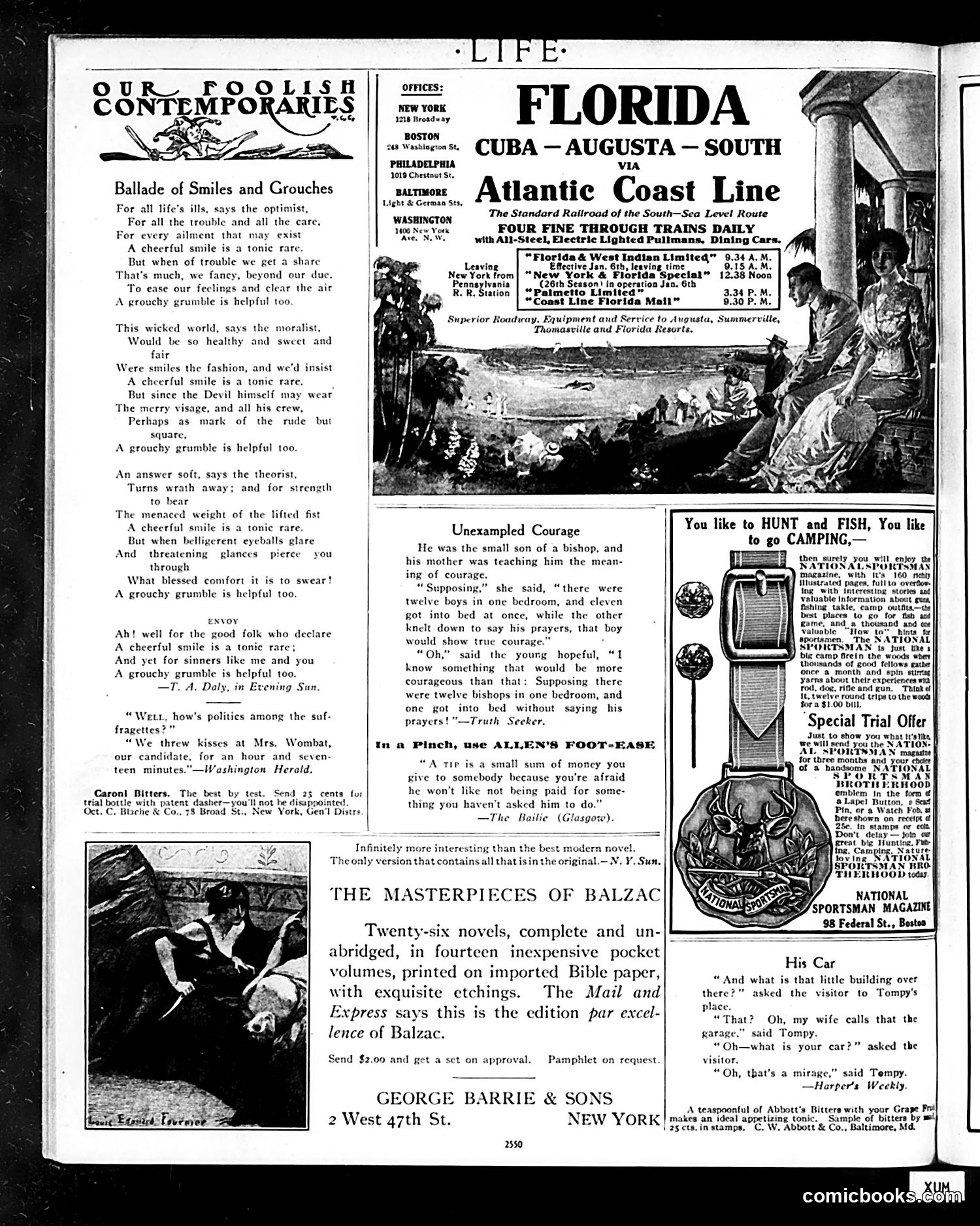
This page from *Life* magazine is primarily **advertising and light humor content**, not political cartooning. The main elements are: **"Ballade of Smiles and Grouches"** — a humorous poem debating whether optimistic smiles or honest grumbling better address life's troubles. It's philosophical satire of competing worldviews, not political commentary. **Brief anecdotes** including one mocking women's suffrage: a headline reports suffragettes "threw kisses" at their candidate for an hour—satirizing their political activism as ineffectual and frivolous. **Scattered jokes** about tips, courage, and car ownership that rely on wordplay rather than topical reference. The page is dominated by **advertisements** for railroad services (Atlantic Coast Line to Florida), Balzac book sets, and sporting magazines—typical *Life* magazine filler. The suffrage reference is the only clearly satirical political content, reflecting early 1900s skepticism toward women's voting rights movements.
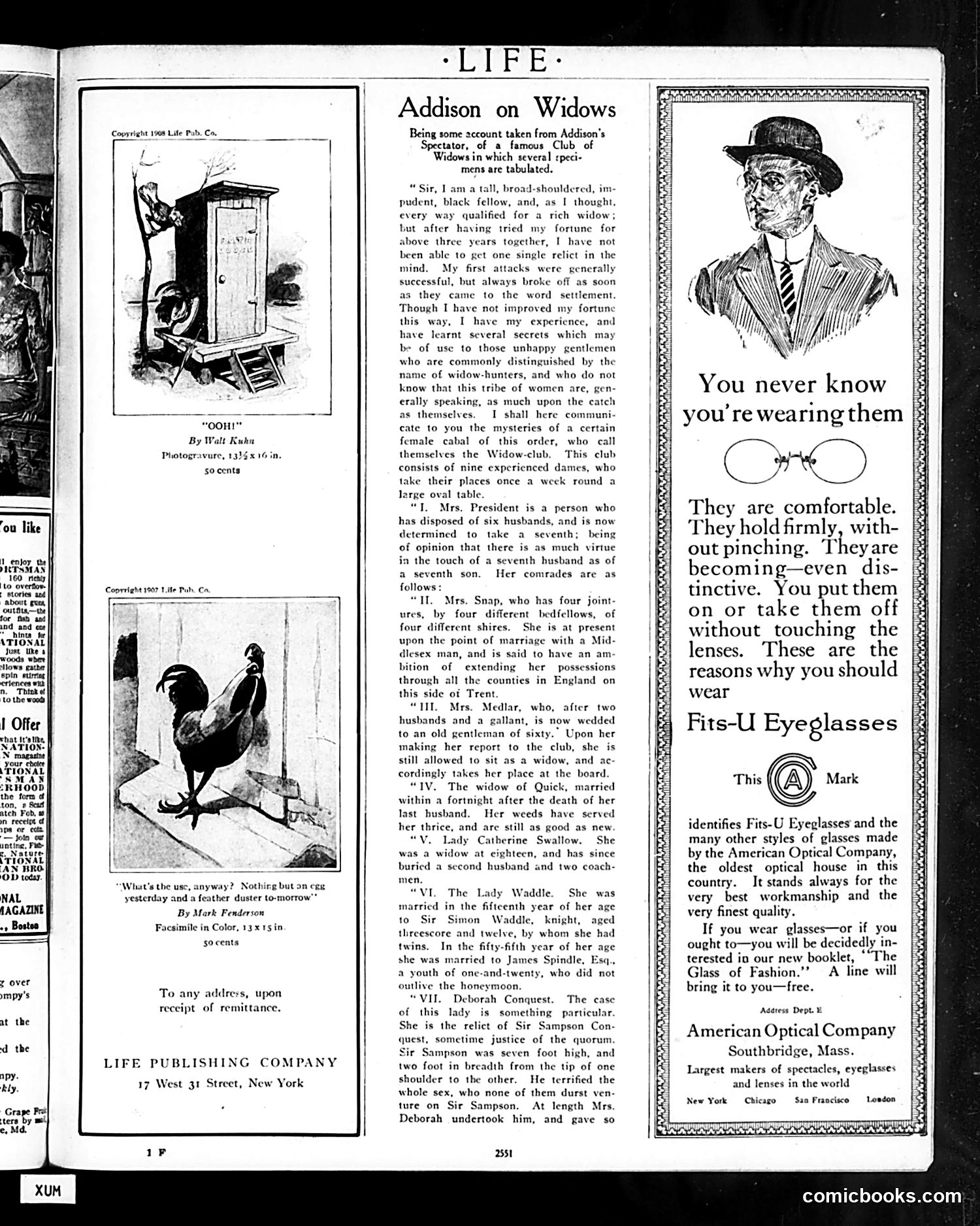
This page adapts Joseph Addison's 18th-century *Spectator* essay describing a "Widow-club"—a satirical portrait of scheming widows hunting for wealthy husbands. The humor targets women's financial motivations and remarriage patterns. The accompanying cartoons mock widows' desperation: one shows a woman at a privy labeled "Nothing but an egg yesterday and a feather duster to-morrow," suggesting economic precarity drives their husband-hunting. Another depicts a rooster, likely playing on sexual/domestic wordplay. The satire's point: wealthy widows weaponize their marital experience and financial independence to secure advantageous matches, treating husbands as acquisitions ("extending her possessions through all the counties"). By listing seven specimen widows with their matrimonial histories, the piece presents remarriage as mercenary calculation rather than romantic sentiment—a critique common to 18th-century satirical literature that Life reprinted for its early 20th-century audience.
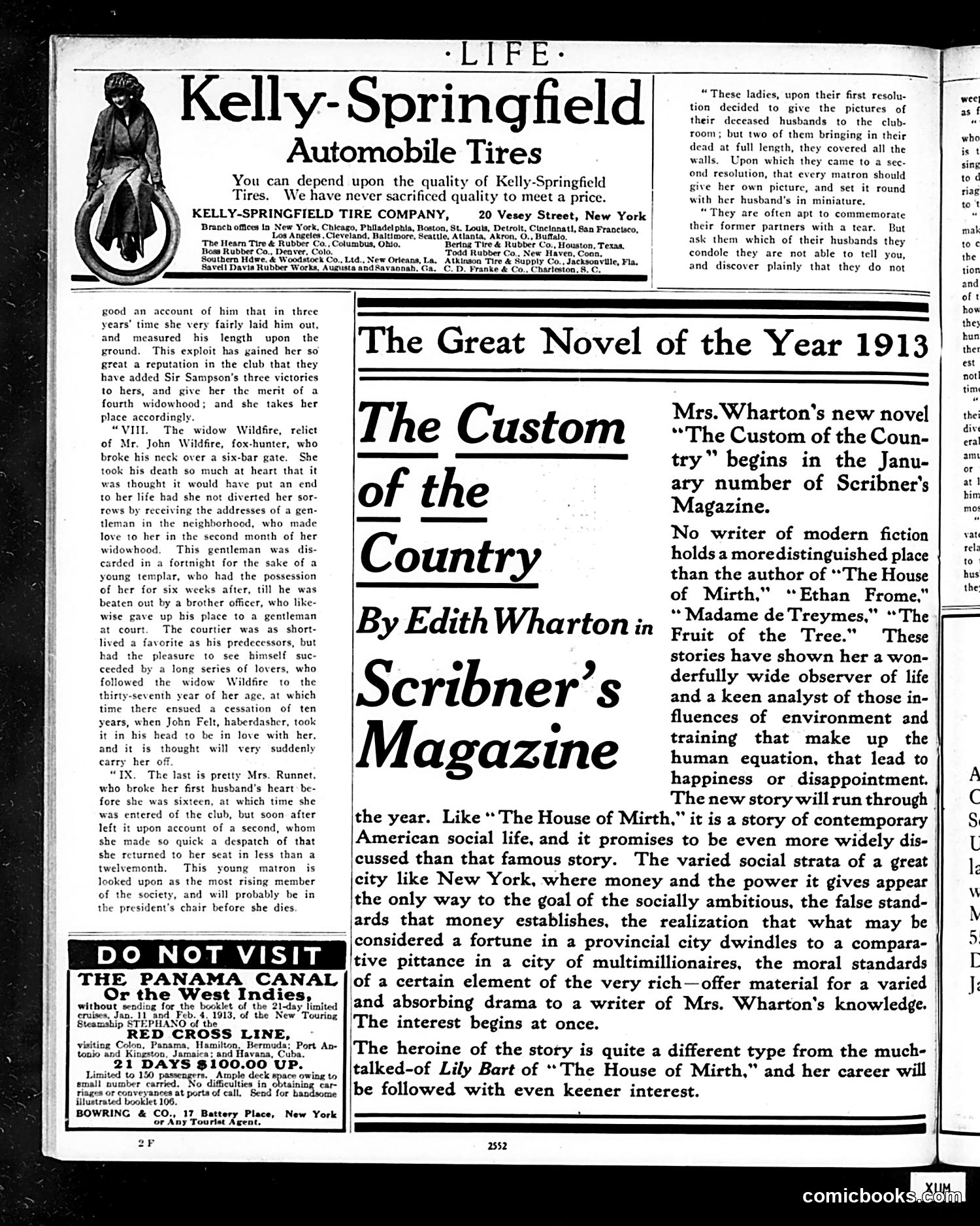
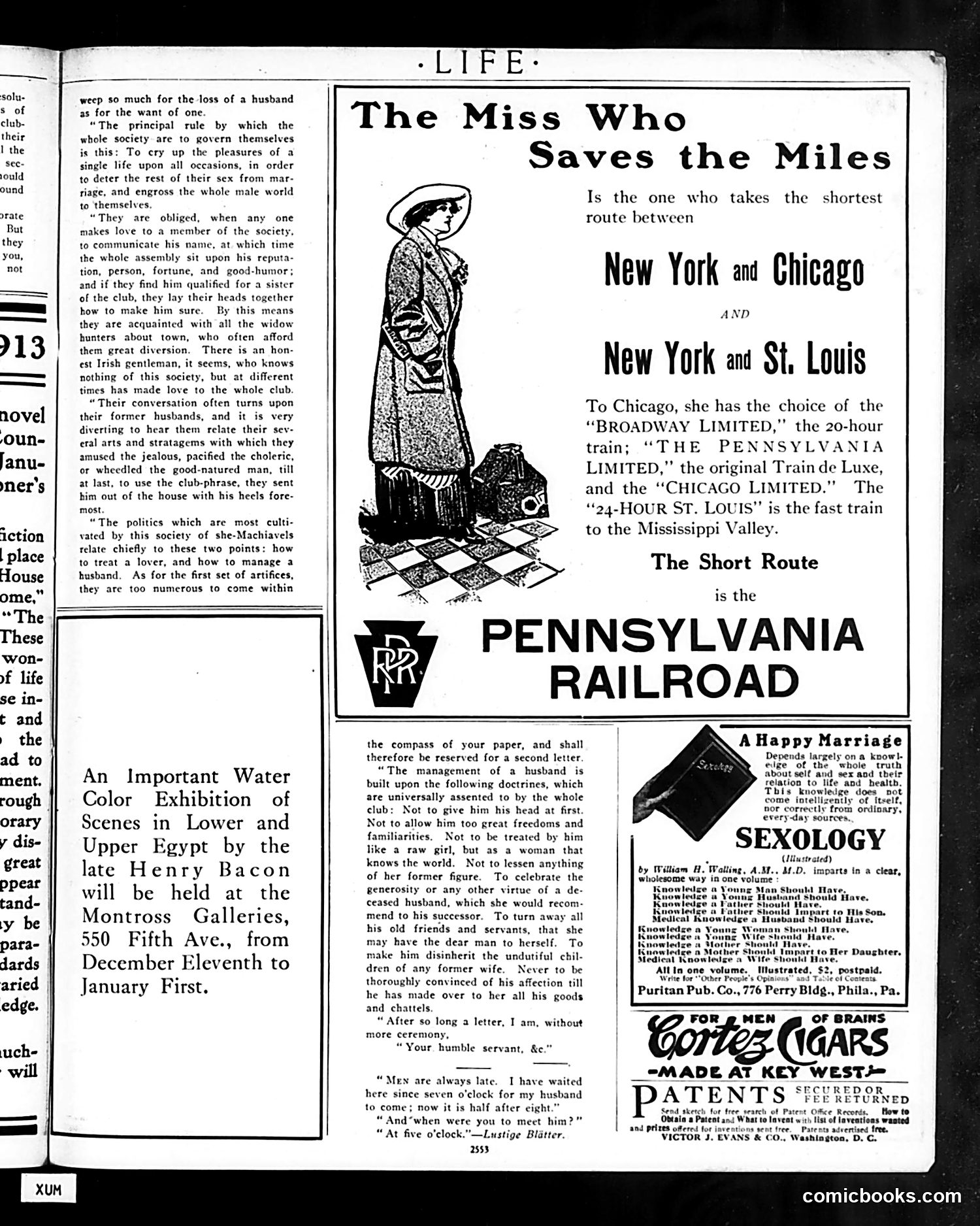
This page combines satirical editorial content with period advertisements. The main feature, "The Miss Who Saves the Miles," is a **railroad advertisement** for the Pennsylvania Railroad, using a stylized illustration of a fashionable woman traveler to promote routes between New York, Chicago, and St. Louis. The left column reprints a **satirical essay** (likely from an earlier source, possibly Jonathan Swift or similar) mocking women's marriage clubs—organizations where unmarried women supposedly strategize about managing husbands and lovers. The piece's humor relies on portraying women as cunning "Machiavels" who manipulate men through various domestic stratagems. Below sits a brief joke about marital punctuality: a wife complains her husband arrived at 8:30 when expected at 5:00. The page exemplifies early 20th-century *Life* magazine's format: mixing literary reprints, advertisements masquerading as editorial content, and brief domestic humor targeting middle-class anxieties about marriage and gender roles. Modern readers would recognize this as selling products through gendered stereotypes and satirizing women's agency through faux-historical commentary.
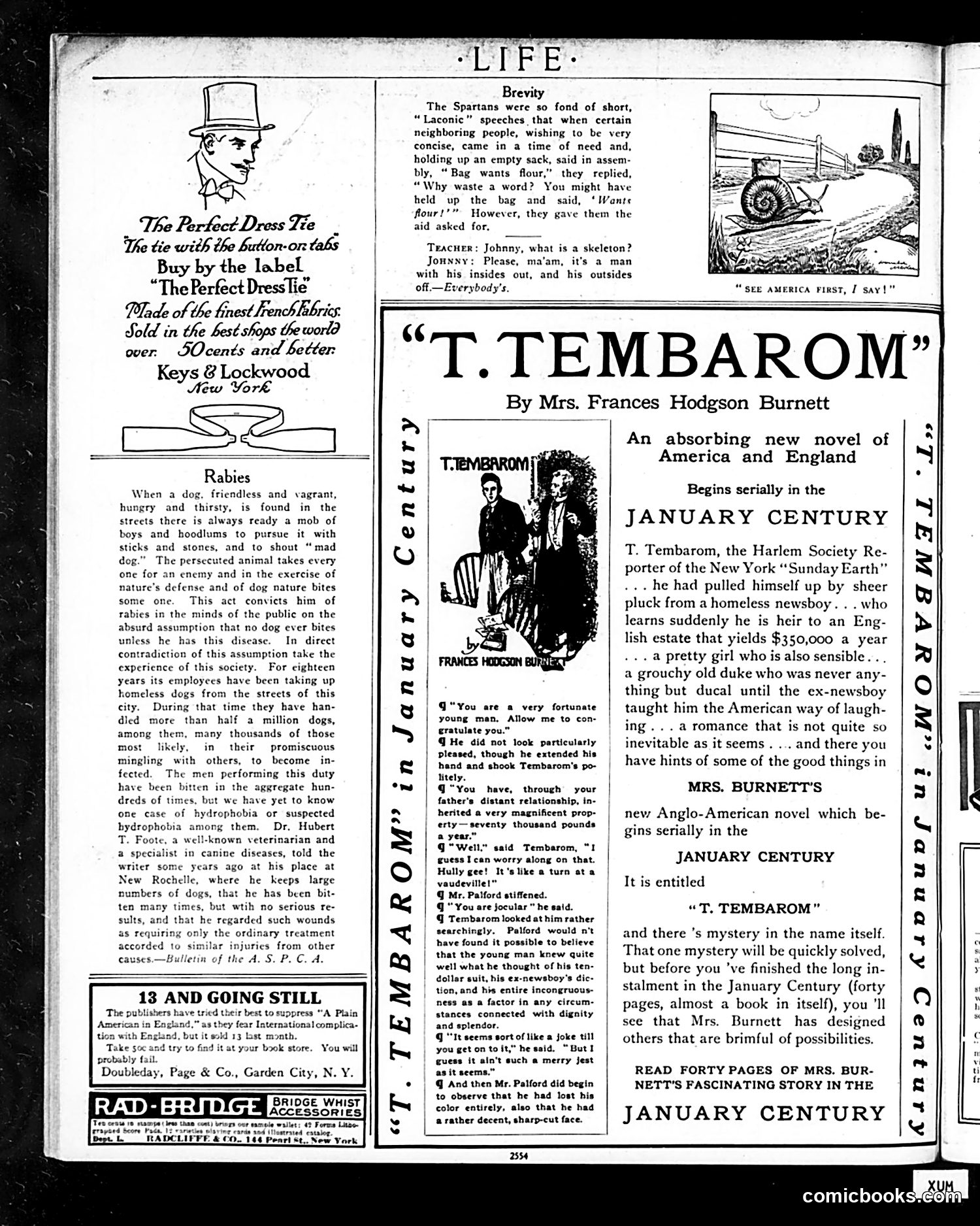
This page primarily advertises a serialized novel by Frances Hodgson Burnett beginning in *The Century* magazine. The story follows T. Tembarom, a Harlem newspaper reporter who unexpectedly inherits a substantial English estate ($350,000 yearly), creating a fish-out-of-water narrative blending American and English society. The brief "Brevity" cartoon on the left is a classical allusion: a teacher asks a student to define a skeleton, and the student quips it's simply "a man with his insides out"—a joke playing on literal versus anatomical definitions. Surrounding content includes advertisements (dress ties, a book about rabies) and an article defending stray dogs against unfair rabies accusations. The page reflects early 20th-century *Life* magazine's mix of light humor, serialized fiction, and practical information aimed at educated readers.
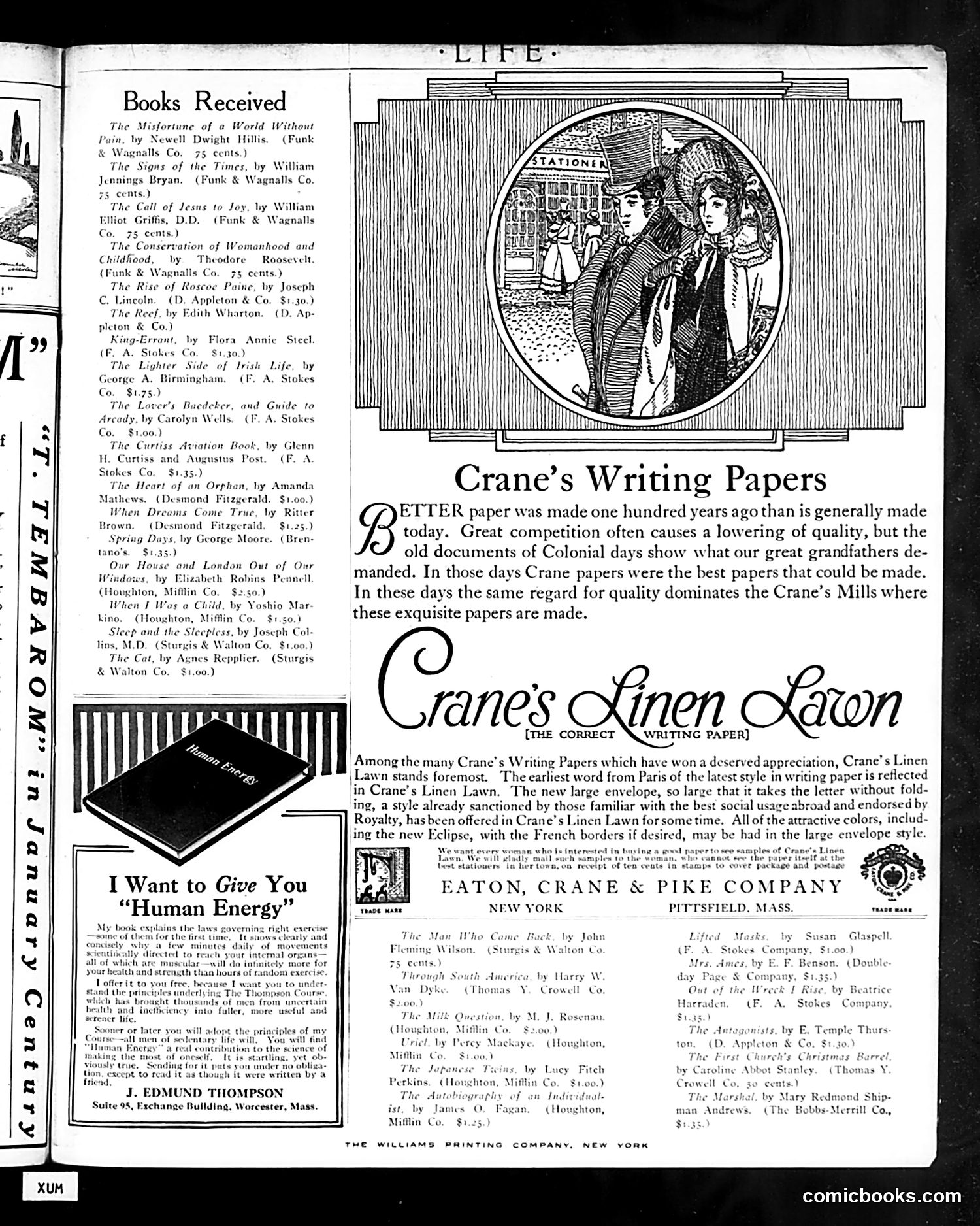
This page is primarily **advertising and book reviews**, not political satire or comics. The main visual element is an **illustration of two well-dressed figures** (appearing to be a man and woman in Edwardian-era clothing) near a train station, accompanying an advertisement for **Crane's Linen Lawn writing paper**. The ad emphasizes that Crane papers maintain superior quality compared to competitors—a claim supported by references to Colonial-era documents and European royal usage. The page contains: - A "Books Received" column listing recent publications (mostly from Funk & Wagnalls) - The Crane's Writing Papers advertisement with decorative period imagery - A smaller ad by J. Edmund Thompson promoting a book about "Human Energy" There is **no discernible political cartoon or satire** on this page. It represents typical early 20th-century *Life* magazine advertising and literary notice content, reflecting consumer goods marketed to educated, affluent readers.

This appears to be an advertisement page from Life magazine (dated December 29, 1912, visible at top). The central image shows an open box of Pall Mall Famous Cigarettes with cigarettes displayed inside. Below the product image is advertising copy (illegible due to image quality) promoting the cigarettes. The decorative border features a floral or botanical pattern in black and white. This is primarily a commercial advertisement rather than political satire or editorial cartoon. Pall Mall was a major cigarette brand of the early 20th century. The page represents typical magazine advertising from this era, when cigarette ads were commonly featured in major publications without health warnings or regulatory restrictions that would later become standard.

I can see this is a mostly blank or very dark page from what appears to be a Life magazine issue, with minimal visible content. The page shows some faint circular designs or watermarks against a black background, along with film strip perforations on the left edge typical of archived materials. There is a small "6" marking visible in the lower right area and "XUM" at the bottom left. The OCR text only provides "comicbooks.com," which appears to be a source attribution rather than original page content. Without legible text or clear imagery, I cannot identify specific political figures, caricatures, or the satire's intended meaning. The page quality makes detailed analysis impossible.