
Life, 1912-12-26 · page 16 of 41
Life — December 26, 1912 — page 16: what you’re looking at
What you’re looking at
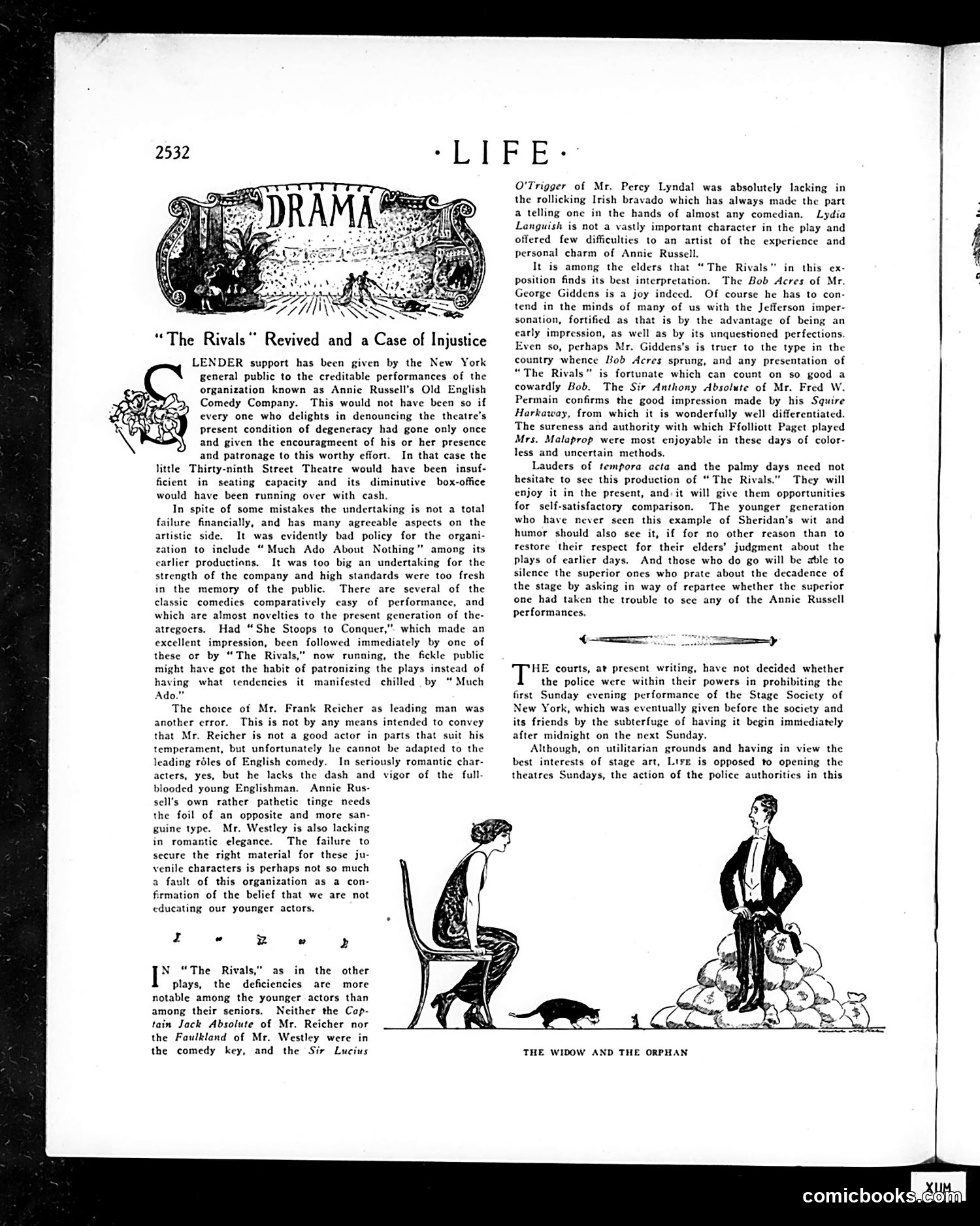
This is a theater review of Annie Russell's Old English Comedy Company's production of Sheridan's classic play "The Rivals." The text critiques both the production choices and the actors' performances. **Key Points:** The reviewer praises the *overall* effort but identifies specific casting problems. Younger actors like Frank Reicher (as Captain Jack Absolute) and Mr. Westley (as Faulkland) lack the necessary romantic vigor and comedic energy their roles demand. Percy Lyndal's O'Trigger supposedly lacks the "rollicking Irish bravado" the character requires. By contrast, older actors excel—George Giddens's Bob Acres and Fred W. Permain's Sir Anthony Absolute are praised as superior. **The Illustration** ("The Widow and the Orphan") appears to be a separate satirical cartoon, though its specific meaning isn't explained in the visible text. The review reflects broader concerns about American theater's decline and inadequate training of younger actors for classical comedic roles.
📄 Transcribed text from this page (OCR, searchable)
Machine-transcribed from the original scan — historical spelling and the odd misread are preserved.
“The Rivals’ Revived and a Case of Injustice LENDER support has been given by the New York general public to the creditable performances of the organization known as Annie Russell's Old English Comedy Company. This would not have been so if every one who delights in denouncing the theatre's present condition of degeneracy had gone only once and given the encouragmeent of his or her presence and patronage to this worthy effort. In that case the little Thirty-ninth Street Theatre would have been insuf- ficient in seating capacity and its diminutive box-office would have been running over with cash. In spite of some mistakes the undertaking is not a total failure financially, and has many agreeable aspects on the artistic side. It was evidently bad policy for the organi- zation to include “ Much Ado About Nothing" among its carlier productions. It was too big an undertaking for the strength of the company and high standards were too fresh in the memory of the public. There are several of the classic comedics comparatively casy of performance, and which are almost novelties to the present generation of the- atregocrs. Had “She Stoops to Conquer,” which made an excellent impression, been followed immediately by onc of these or by “The Rivals,” now running, the fickle public might have got the habit of patronizing the plays instead of having what tendencies it manifested chilled by “ Much Ado.” The choice of Mr. Frank Reicher as leading man was another error. This is not by any means intended to convey that Mr. Reicher is not a good actor in parts that suit his temperament, but unfortunately he cannot be adapted to the leading réles of English comedy. In seriously romantic char- acters, yes, but he lacks the dash and vigor of the full- blooded young Englishman. Annie Rus- sell’s own rather pathetic tinge needs the foil of an opposite and more san- guine type. Mr. Westley is also lacking in romantic elegance. The failure to secure the right material for these ju- venile characters is perhaps not so much a fault of this organization as a con- firmation of the belief that we are not educating our younger actors. z - B ” 2 I “The Rivals,” as in the other plays, the deficiencies are more notable among the younger actors than among their seniors. Neither the Cap- tain Jack Absolute of Mr. Reicher nor the Faulkland of Mr. Westley were in the comedy key, and the Sir Lucius "LiFe * O'Trigger of Mr. Percy Lyndal was absolutely lacking in the rollicking Irish bravado which has always made the part a telling one in the hands of almost any comedian. Lydia Languish is not a vastly important character in the play and offered few difficulties to an artist of the experience and personal charm of Annie Russell. It is among the elders that “The Rivals” in this ex- position finds its best interpretation. The Bob Acres of Mr. George Giddens is a joy indeed. Of course he has to con- tend in the minds of many of us with the Jefferson imper- sonation, fortified as that is by the advantage of being an carly impression, as well as by its unquestioned perfections Even so, perhaps Mr. Giddens’s is trucr to the type in the country whence Bob Acres sprung, and any presentation of “The Rivals” is fortunate which can count on so good a cowardly Bob. The Sir Anthony Absolute of Mr. Fred W. Permain confirms the good impression made by his Squire Harkaway, from which it is wonderfully well differentiated. The sureness and authority with which Ffolliott Paget played Mrs. Malaprop were most enjoyable in these days of color- less and uncertain methods. Lauders of tempora acta and the palmy days need not hesitate to see this production of “The Rivals.” They will enjoy it in the present, and: it will give them opportunities for self-satisfactory comparison. The younger generation who have never seen this example of Sheridan's wit and humor should also see it, if for no other reason than to restore their respect for their elders’ judgment about the plays of earlier days. And those who do go will be able to silence the superior ones who prate about the decadence of the stage by asking in way of repartee whether the superior one had taken the trouble to sce any of the Annic Russell performances. —=="*. SS) HE courts, at present writing, have not decided whether the police were within their powers in prohibiting the first Sunday evening performance of the Stage Society of New York, which was eventually given before the society and its friends by the subterfuge of having it begin immicdiately after midnight on the next Sunday. Although, on utilitarian grounds and having in view the best interests of stage art, Lire is opposed to opening the theatres Sundays, the action of the police authorities in this THE WIDOW AND THE ORPHAN comicbook&e y |