
Life, 1912-12-26 · page 22 of 41
Life — December 26, 1912 — page 22: what you’re looking at
What you’re looking at
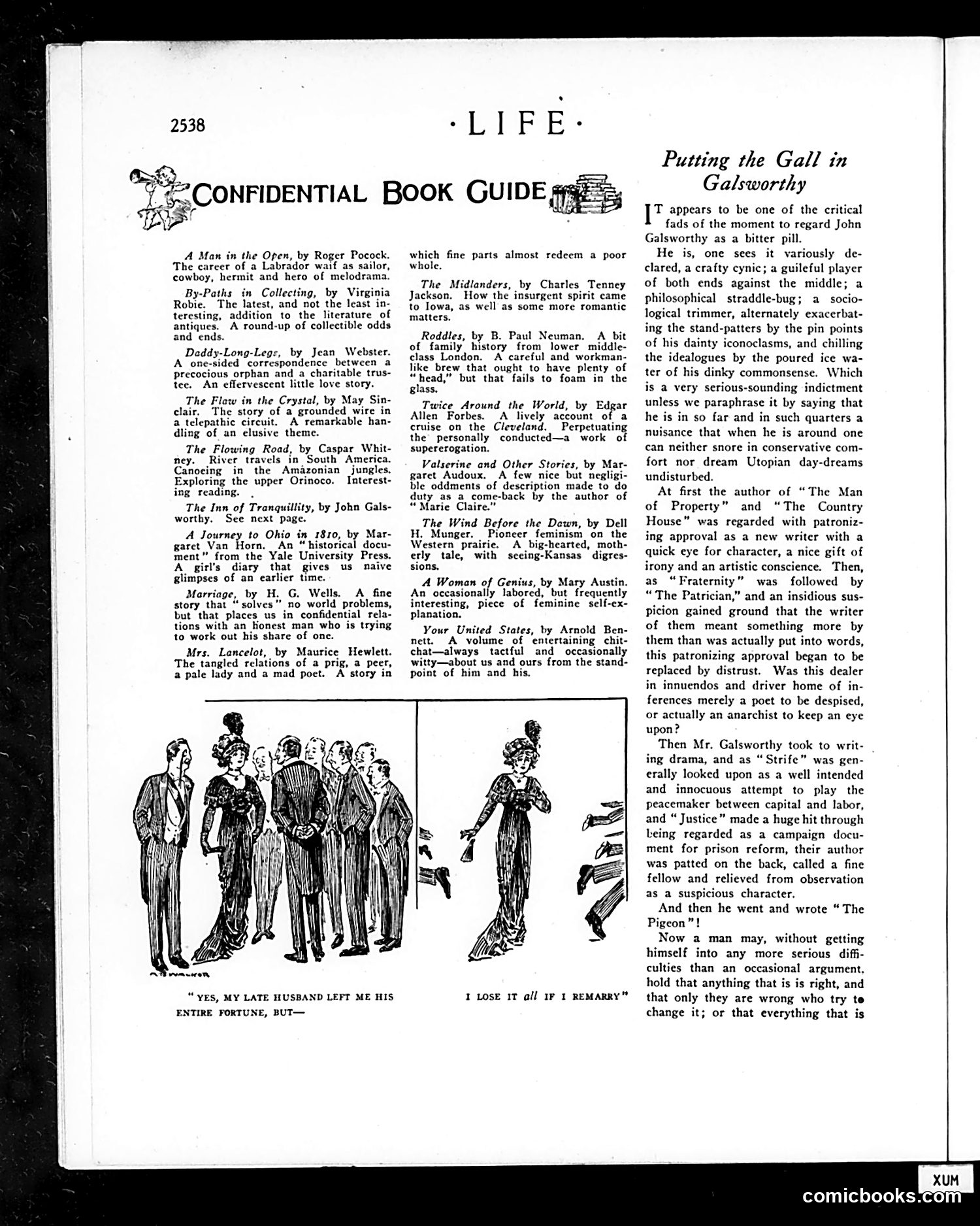
This page is a "Confidential Book Guide"—a satirical book review column from *Life* magazine. The main content critiques author John Galsworthy, who was a celebrated British novelist of the early 1900s. **The Satire:** The article accuses Galsworthy of being a fraudulent intellectual poseur who adopts contradictory positions to appear sophisticated. He's portrayed as a "bitter pill"—alternately provoking conservatives and disappointing idealists, making him essentially useless to both camps. The critic suggests his early work seemed promising, but subsequent novels like *Fraternity* and *The Patrician* revealed his true nature as an unreliable, self-serving writer. **The Cartoon:** Shows a woman telling someone "I lose it all if I remarry"—likely referencing a plot point from one of Galsworthy's works, used mockingly to illustrate his melodramatic tendencies. The page also lists other contemporary books with brief, often dismissive reviews, establishing *Life*'s role as a literary tastemaker dispensing witty, cutting commentary.
📄 Transcribed text from this page (OCR, searchable)
Machine-transcribed from the original scan — historical spelling and the odd misread are preserved.
“€ CONFIDENTIAL BOOK GUIDE 2538 A Man in the Open, by Roger Pocock. The career of a Labrador waif as sailor, cowboy, hermit and hero of melodrama. By-Paths in Collecting, by Virginia Robie. The latest, and not the least in- teresting, addition to the literature of antiques. A round-up of collectible odds and ends. Deddy-Long-Legs, by Jean Webster. A one-sided correspondence between a precocious orphan and a charitable trus- tee, An effervescent little love story. The Flaw in the Crystal, by May Sin- The story of a grounded wire in clair. a telepathic cir A remarkable han- dling of an elusive theme. The Flowing Road, by Caspar Whit- ney. River travels in South America. Canoeing in the Amazonian Exploring the upper Orinoco. ing reading. The Inn_of Tranquillity, by John Gals- worthy. See next page. A Journey to Ohio in 1810, by Mar- garct Van Horn. An “historical docu- ment” from the Yale University Press. A. girl's diary that gives us naive glimpses of an earlier time. Marriage, by H, G. Wells. A. fine story that “solves” no world problems, but that places us in confidential rela- tions with an Honest man who is trying to work out his share of one. Mrs. Lancelot, by Maurice Hewlett. The tangled relations of a prig, a peer, a pale lady and a mad poet. A’ story in jungles. Interest- “ YES, MY LATE HUSBAND LEFT ME HIS ENTIRE FORTUNE, BUT— SCM FE * which fine parts almost redeem a poor whole. The Midlanders, by Charles Tenney Jackson. How the insurgent spirit came to Iowa, as well as some more romantic matters. Roddles, by B. Paul Neuman. A bit of family’ history from lower middle- class London. A careful and workman- like brew that ought to have plenty of “head,” but that fails to foam in the glass. Twice Around the World, by Edgar Allen Forbes. A lively account of a cruise on the Cleveland. Perpetuating the personally conducted—a work of supererogation. Valserine and Other Stories, by Mar- garet Audoux. A few nice but negligi- ble oddments of description made to do duty as a come-back by the author of “Marie Claire.” The Wind Before the Dawn, by Dell H, Munger. Pioneer feminism on the Western prairie. A big-hearted, moth- erly tale, with sceing-Kansas digres- sions, A Woman of Genius, by Mary Austin. An occasionally labored, but frequently interesting, piece of feminine self-ex- planation. Your United States, by Arnold Ben- nett. A volume of entertaining chit- chat—always tactful and occasionally witty—about us and ours from the stand- point of him and his. 1 Lose 1T all IF 1 REMARRY"” Putting the Gall in Galsworthy T appears to be one of the critical fads of the moment to regard John Galsworthy as a bitter pill. He is, one sees it va clared, a crafty cynic; a guileful player of both ends against the middle; a philosophical straddle-bug; a socio- logical trimmer, alternately exacerbat- ing the stand-patters by the pin points of his dainty iconoclasms, and chilling the idealogues by the poured ice wa- ter of his dinky commonsense. Which is a very serious-sounding indictment unless we paraphrase it by saying that he is in so far and in such quarters a nuisance that when he is around one can neither snore in conservative com- fort nor dream Utopian day-dreams undisturbed. At first the author of “The Man of Property” and “The Country House” was regarded with patroniz- ing approval as a new writer with a quick eye for character, a nice gift of irony and an artistic conscience. Then, as “Fraternity” was followed by “The Patrician,” and an insidious sus- picion gained ground that the writer of them meant something more by them than was actually put into words, this patronizing approval began to be replaced by distrust. Was this dealer in innuendos and driver home of in- ferences merely a poet to be despised, or actually an anarchist to keep an eye upon? Then Mr. Galsworthy took to writ- ing drama, and as “ Strife” was gen- erally looked upon as a well intended and innocuous attempt to play the peacemaker between capital and labor, and “ Justice” made a huge hit through Leing regarded as a campaign docu- ment for prison reform, their author was patted on the back, called a fine fellow and relieved from observation as a suspicious character. And then he went and wrote “The Pigeon”! Now a man may, without getting himself into any more serious diffi- culties than an occasional argument. hold that anything that is is right, and that only they are wrong who try te change it; or that everything that is comicbooks