
Life, 1912-12-26 · page 26 of 41
Life — December 26, 1912 — page 26: what you’re looking at
What you’re looking at
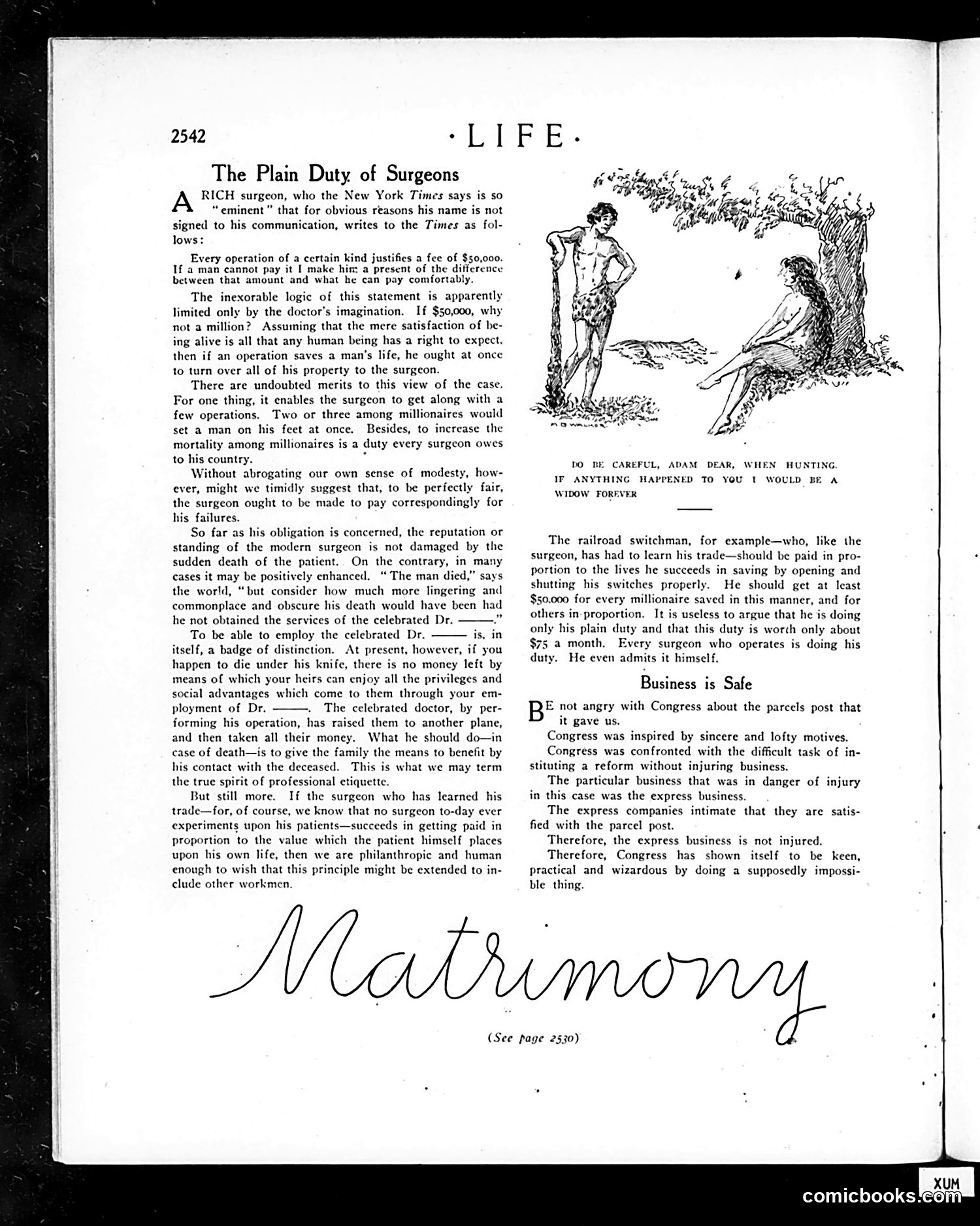
This page satirizes wealthy surgeons' exorbitant fees through caustic irony. An anonymous "eminent" surgeon claims he charges $50,000 per operation, adjusting downward only based on what patients can "comfortably" pay—implying he should claim their entire fortunes since "mere satisfaction of being alive" is all they deserve. Life's editors mock this logic by extending it absurdly: Why not a million? They then pivot to a damning comparison: railroad switchmen save lives daily for ~$75/month, yet surgeons demand astronomical fees for identical work. Both claim they're merely doing their "duty," yet only surgeons are compensated as though performing miracles. The cartoon depicts Adam warning Eve about hunting accidents, establishing that protecting lives has always been ordinary responsibility—not something warranting windfall profits. The "Business is Safe" section sarcastically praises Congress for appearing reformist while protecting express companies' interests against parcel post competition. The satire targets Gilded Age inequality and professional exploitation.
📄 Transcribed text from this page (OCR, searchable)
Machine-transcribed from the original scan — historical spelling and the odd misread are preserved.
2542 The Plain Duty of Surgeons RICH surgeon, who the New York Times says is so “eminent” that for obvious reasons his name is not signed to his communication, writes to the Times as fol- lows: Every operation of a certain kind justifies a fee of $50,000. If a man cannot pay it I make him a present of the difference between that amount and what he can pay comfortably. The inexorable logic of this statement is apparently limited only by the doctor's imagination. If $50,000, why not a million? Assuming that the mere satisfaction of be- ing alive is all that any human being has a right to expect. then if an operation saves a man’s life, he ought at once to turn over all of his property to the surgeon. There are undoubted merits to this view of the case. For one thing, it enables the surgeon to get along with a few operations. Two or three among millionaires would set a man on his feet at once. Besides, to increase the mortality among millionaires is a duty every surgeon owes to his country. . Without abrogating our own sense of modesty, how- ever, might we timidly suggest that, to be perfectly fair, the surgeon ought to be made to pay correspondingly for his failures. So far as his obligation is concerned, the reputation or standing of the modern surgeon is not damaged by the sudden death of the patient. On the contrary, in many cases it may be positively enhanced. ‘ The man died,” says the world, “but consider how much more lingering and commonplace and obscure his death would have been had he not obtained the services of the celebrated Dr. oe To be able to employ the celebrated Dr. is, in itself, a badge of distinction. At present, however, if you happen to die under his knife, there is no money left by means of which your heirs can enjoy all the privileges and social advantages which come to them through your em- ployment of Dr. The celebrated doctor, by per- forming his operation, has raised them to another plane, and then taken all their money. What he should do—in case of death—is to give the family the means to benefit by his contact with the deceased. This is what we may term the true spirit of professional etiquette. But still more. If the surgeon who has learned his trade—for, of course, we know that no surgeon to-day ever experiments upon his patients—succeeds in getting paid in proportion to the value which the patient himself places upon his own life, then we are philanthropic and human enough to wish that this principle might be extended to in- clude other workmen, ‘LPPE : DO RE CAREFUL, ADAM DEAR, WHEN HUNTING. IF ANYTHING HAPPENED TO YOU I WOULD BE A WIDOW FOREVER The railroad switchman, for example—who, like the surgeon, has had to learn his trade—should be paid in pro- portion to the lives he succeeds in saving by opening and shutting his switches properly. He should get at least $50,000 for every millionaire saved in this manner, and for others in proportion. It is useless to argue that he is doing only his plain duty and that this duty is worth only about $75 a month. Every surgeon who operates is doing his duty. He even admits it himself. Business is Safe E not angry with Congress about the parcels post that it gave us. Congress was inspired by sincere and lofty motives. Congress was confronted with the difficult task of in- stituting a reform without injuring business. The particular business that was in danger of injury in this case was the express business. The express companies intimate that they are satis- fied with the parcel post. Therefore, the express business is not injured. Therefore, Congress has shown itself to be keen, practical and wizardous by doing a supposedly impossi- ble thing. (See page 2530) comicbooks Mend