
Life, 1912-12-26 · page 38 of 41
Life — December 26, 1912 — page 38: what you’re looking at
What you’re looking at
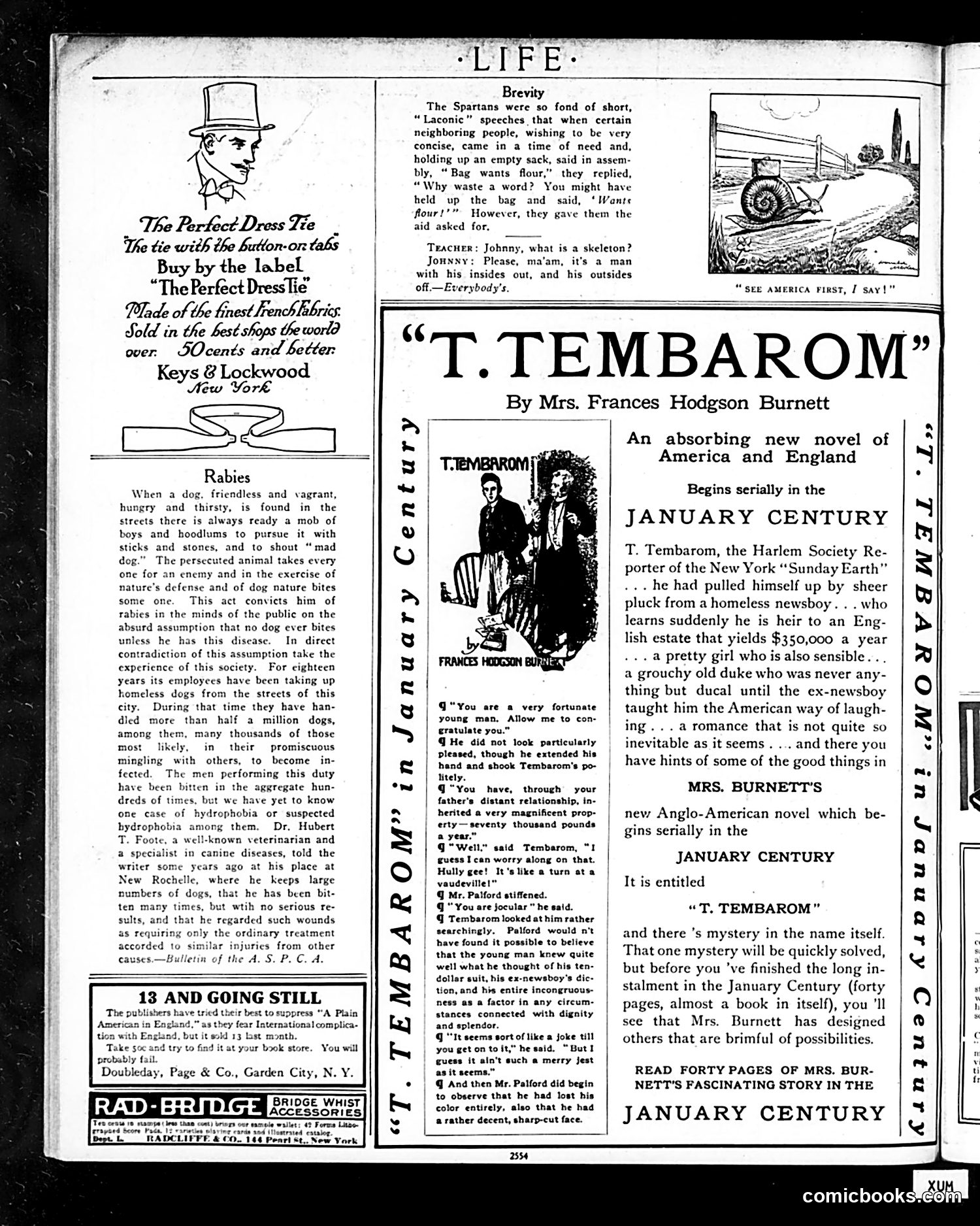
This page primarily advertises a serialized novel by Frances Hodgson Burnett beginning in *The Century* magazine. The story follows T. Tembarom, a Harlem newspaper reporter who unexpectedly inherits a substantial English estate ($350,000 yearly), creating a fish-out-of-water narrative blending American and English society. The brief "Brevity" cartoon on the left is a classical allusion: a teacher asks a student to define a skeleton, and the student quips it's simply "a man with his insides out"—a joke playing on literal versus anatomical definitions. Surrounding content includes advertisements (dress ties, a book about rabies) and an article defending stray dogs against unfair rabies accusations. The page reflects early 20th-century *Life* magazine's mix of light humor, serialized fiction, and practical information aimed at educated readers.
📄 Transcribed text from this page (OCR, searchable)
Machine-transcribed from the original scan — historical spelling and the odd misread are preserved.
aj Webi Brevity The Spartans were so fond of short, “Laconic” speeches that when certain neighboring people, wishing to be very concise, came in a time of need and, holding up an empty sack, said in assem- bly, “Bag wants flour,” they replied, “Why waste a word? You might have held up the bag and said, ‘Wants flour!’” However, they gave them the The Perfect DressTie | aid asked for. The tie with the hutton-or tabs Teactter: Johnny, what is a skeleton? Buy by the label iin hiss insides’ car ‘and Uietcolsite “The Perfect DressTie off—Everybody's. ade of the tinest rench fabrics. — - ~ Sold in the best shops the world over. SOcents and better: Keys 8 Lockwood New York By Mrs. Frances Hodgson Burnett An absorbing new novel of America and England Rabies When a dog, friendless and vagrant, hungry and thirsty, is found in the streets there is always ready a mob of boys and boodlums to pursue it with sticks and stones, and to shout “mad dog.” The persecuted animal takes every one for an enemy and in the exercise of nature's defense and of dog nature bites some one. This act convicts him of rabies in the minds of the public on the absurd assumption that no dog ever bites unless he has this disease. In direct contradiction of this assumption take the experience of this society. For cighteen years its employees have been taking up homeless dogs from the streets of this city. During that time they have han- dled more than half a million dogs, among them, many thousands of those most likely, in their promiscuous mingling with others, to become in- fected. The men performing this duty have been bitten in the aggregate hun- dreds of times, but we have yet to know one case of hydrophobia or suspected hydrophobia among them. Dr, Hubert T. Foote, a well-known veterinarian and a specialist in canine diseases, told the writer some years ago at his place at New Rochelle, where he keeps large numbers of dogs, that he has been bit- ten many times, but wtih no serious re- sults, and that he regarded such wounds as requiring only the ordinary treatment accorded to similar injuries from other causes.—Bulletin of the A. S. P.C. A. Begins serially in the JANUARY CENTURY T. Tembarom, the Harlem Society Re- porter of the New York “Sunday Earth” ...he had pulled himself up by sheer pluck from a homeless newsboy. . . who learns suddenly he is heir to an Eng- lish estate that yields $350,000 a year . . a pretty girl who is also sensible... a grouchy old duke who was never any- thing but ducal until the ex-newsboy GQ" You are a very fortunate taught him the American way of laugh- young man, Allow me to con- | « hat is : gratulate you.” ing... a romance that is not quite so @ He did not look particularly inevitable as it seems . ... and there you pleased, though he extended his | be hints of f th d things i hand and shook Tembarom’s po- ave hints of some of the good things in litely. G“You have, through your MRS. BURNETT'S father's distant relationship, in- herited a very magnificent prop- new Anglo-American novel which be- 5 umd ty the id yands : 5 . year ane pounce | gins serially in the Q “Well,” said Tembarom, “1 guess can worry along on that. JANUARY CENTURY Hully gee! It's like a turn ata | . : vaudeville!” It is entitled q Mr. Palford stiffened. “You are jocular "he said. “TT, TEMBAROM” q Tembarom looked at him rather searchingly. Palford would n't | and there 's mystery in the name itself. have found it possible to believe 7 3 that the young man knew quite That one mystery will be quickly solved, well what he thought of his ten- | but before you ‘ve finished the long in- dollar suit, his ex-newsboy's dic- i . = tion, and his entire incongruous- stalment in the January Century (forty ness factor in any circum- pages, almost a book in itself), you ‘Il nces connected with dignity fe Peppers see that Mrs. Burnett has designed a G “Ie seems sort of like a joke ti! | others that are brimful of possibilities. you geton to it,” he said. “Butl guess it ain't such a merry jest as it seems.” READ FORTY PAGES OF MRS. BUR- @ And then Mr. Palford did begin NETT’S FASCINATING STORY IN THE to observe that he had lost his color entirely, also that be bed | TANUARY CENTURY 13 AND GOING STILL The publishers have tried their best to suppress “A Plain American in En |." as they fear International complica- tion with E but it sold 13 Last month. Take soc and try to find it at your book store. You will probably fail. Doubleday, Page & Co., Garden City, N. Y. ACCESSORIES ‘sod \Tostrated eatalog 44 Peart St. New Vork ST TEMBAROM” in January Century