
Life, 1912-12-26 · page 30 of 41
Life — December 26, 1912 — page 30: what you’re looking at
What you’re looking at
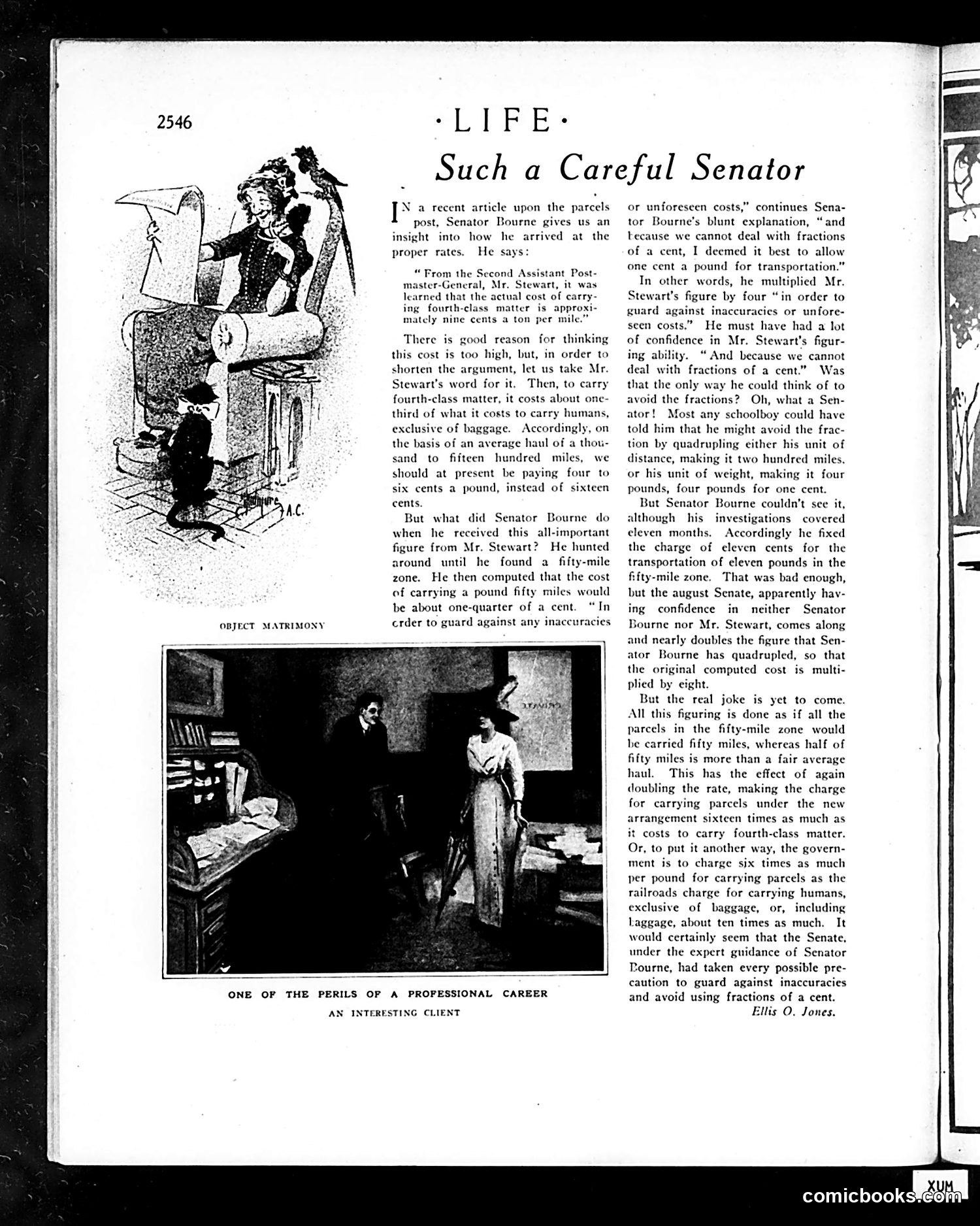
This article mocks Senator Bourne's mathematical reasoning in setting postal rates for fourth-class (parcel post) matter. The satire documents how Bourne inflated costs through questionable calculations: Starting from a base calculation (~3-6 cents per pound), Bourne multiplied by four "to guard against inaccuracies," then the Senate doubled his figure again. The final rate became 16 times the original computed cost—making parcel postage six times more expensive than human railway transport. The humor lies in Bourne's stated justification: avoiding "fractions of a cent" when simple unit adjustments could have achieved the same goal more honestly. The author (Ellis O. Jones) sardonically notes Bourne's "careful" approach actually created absurdly inflated rates. The accompanying illustrations—one labeled "Object Matrimony" and another showing "One of the Perils of a Professional Career"—appear to be unrelated humorous sketches typical of Life's format.
📄 Transcribed text from this page (OCR, searchable)
Machine-transcribed from the original scan — historical spelling and the odd misread are preserved.
OBJECT MATRIMONY “LIP E* Such a Careful Senator a recent article upon the parcels post, Senator Bourne gives us an insight into how he arrived at the proper rates. He say “From the Second Assistant Post- master-General, Mr. Stewart, it was learned that the actual cost of carry- ing fourth-class matter is approx mately nine cents a ton per mile.” There is good reason for thinking this cost is too high, but, in order to shorten the argument, let us take Mr. Stewart’s word for it. Then, to carry fourth-class matter, it costs about one- third of what it costs to carry humans, exclusive of baggage. Accordingly, on the basis of an average haul of a thou- sand to fifteen hundred miles, we should at present be paying four to six cents a pound, instead of sixteen cents. But what did Senator Bourne do when he received this all-important figure from Mr. Stewart? He hunted around until he found a fifty-mile zone. He then computed that the cost of carrying a pound fifty miles would be about one-quarter of a cent. “In crder to guard against any inaccuracies ONE OF THE PERILS OF A PROFESSIONAL CAREER AN INTERESTING CLIENT or unforeseen costs,” continues Sena- tor Bourne's blunt explanation, “and because we cannot deal with fractions of a cent, I deemed it best to allow one cent a pound for transportation.” In other words, he multiplied Mr. Stewart’s figure by four “in order to guard against inaccuracies or unfore- scen costs.” He must have had a lot of confidence in Mr. Stewart's figur- ing ability. “And because we cannot deal with fractions of a cent.” Was that the only way he could think of to avoid the fractions? Oh, what a Sen- ator! Most any schoolboy could have told him that he might avoid the frac- tion by quadrupling either his unit of distance, making it two hundred miles. or his unit of weight, making it four pounds, four pounds for one cent. But Senator Bourne couldn't sce it, although his investigations covered eleven months. Accordingly he fixed the charge of eleven cents for the transportation of eleven pounds in the fifty-mile zone. That was bad enough, but the august Senate, apparently hav- ing confidence in neither Senator Bourne nor Mr. Stewart, comes along and nearly doubles the figure that Sen- ator Bourne has quadrupled, so that the original computed cost is multi- plied by eight. But the real joke is yet to come. All this figuring is done as if all the parcels in the fifty-mile zone would he carried fifty miles, whereas half of fifty miles is more than a fair average haul. This has the effect of again doubling the rate, making the charge for carrying parcels under the new arrangement sixteen times as much as it costs to carry fourth-class matter. Or, to put it another way, the govern- ment is to charge six times as much per pound for carrying parcels as the railroads charge for carrying humans, exclusive of baggage, or, including Laggage, about ten times as much. It would certainly seem that the Senate, under the expert guidance of Senator Tourne, had taken every possible pre- caution to guard against inaccuracies and avoid using fractions of a cent. is O. Jones. comicbook Meum