
A complete issue · 40 pages · 1912
Life — December 19, 1912
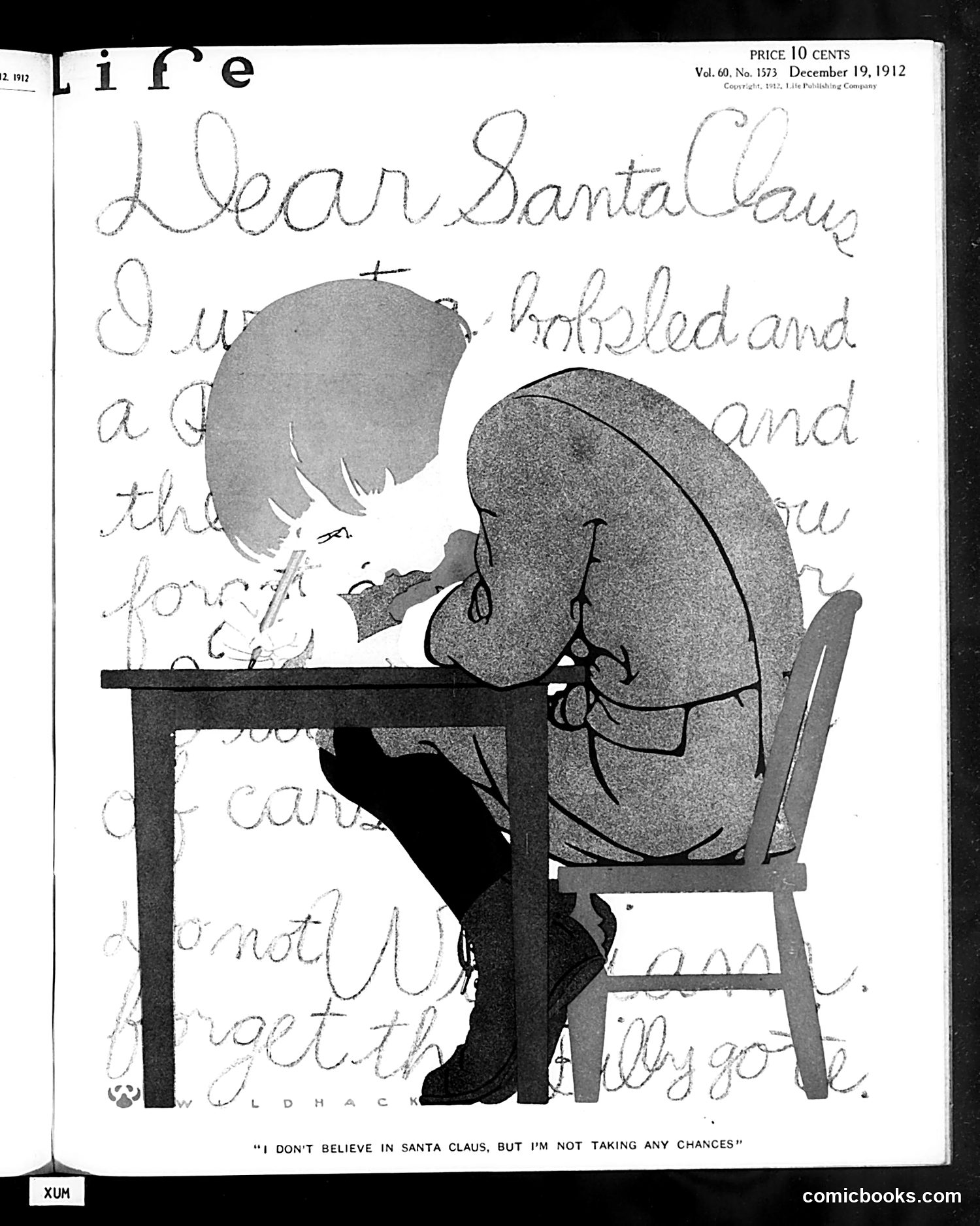
This cover depicts a child writing a letter to Santa Claus, with the caption: "I DON'T BELIEVE IN SANTA CLAUS, BUT I'M NOT TAKING ANY CHANCES." The cartoon's humor turns on childhood skepticism meeting practical caution. The child has apparently become too old or sophisticated to genuinely believe in Santa, yet continues the ritual anyway—hedging bets by maintaining the possibility that Santa might exist and reward good behavior. The satirical point likely extends beyond childhood to adult behavior: people may harbor private doubts about traditional beliefs or institutions, yet maintain outward compliance or participation for pragmatic reasons. Published in 1912, this could also reflect broader social questioning of established traditions during the Progressive Era, while individuals remained cautious about openly rejecting them.
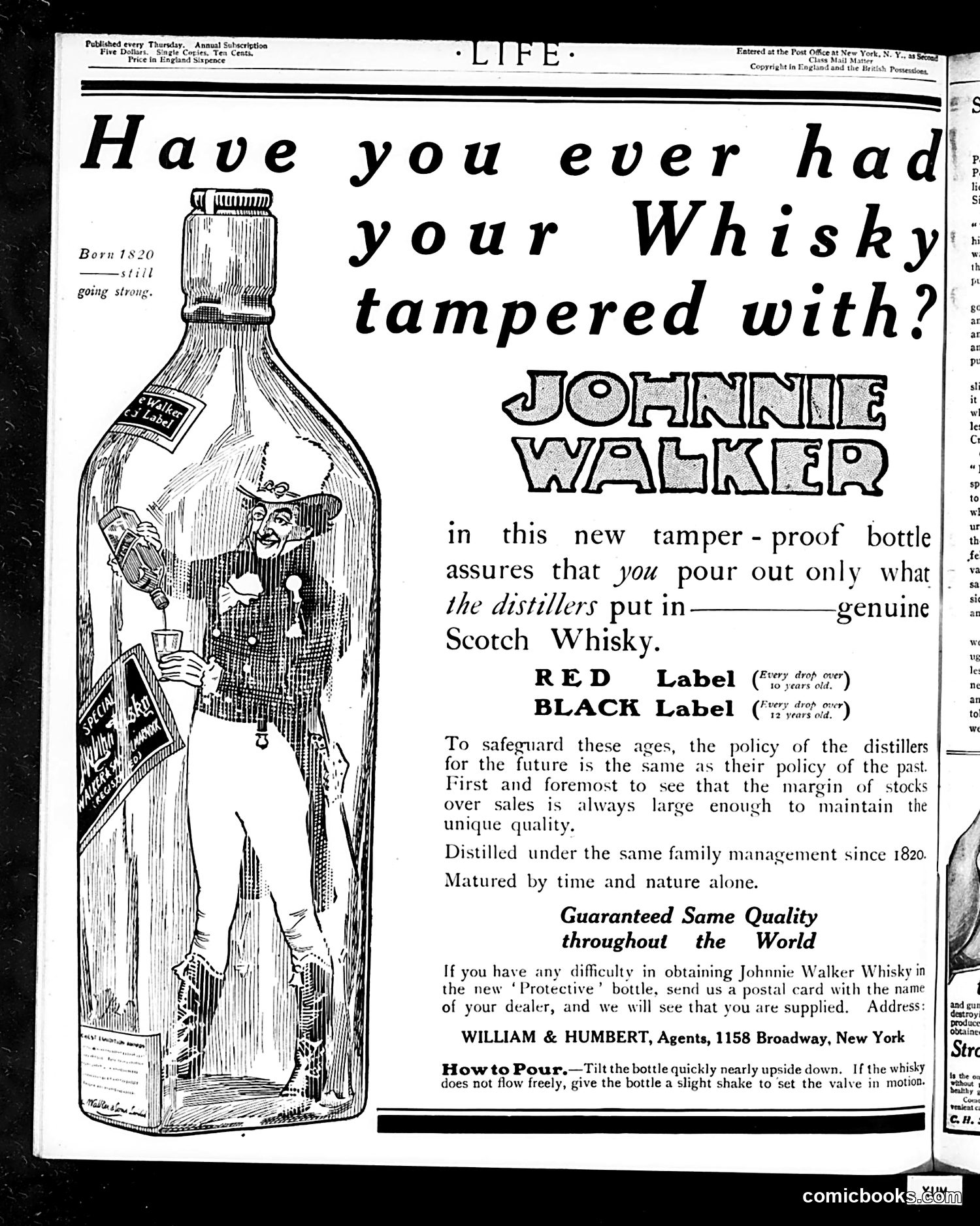
This is primarily a **Johnnie Walker Scotch Whisky advertisement**, not political satire. The large illustration shows a bottle with decorative figures and scenes depicted on its label. The ad emphasizes the product's "tamper-proof bottle" innovation, assuring consumers they receive only genuine whisky "the distillers put in." It highlights the brand's heritage ("Distilled under the same family management since 1820") and quality guarantees. The text references Red and Black Label varieties and includes instructions for proper pouring. The agents' New York address suggests this targets American importers during the early-to-mid 20th century. There is **no political cartoon or satire present**—this is straightforward commercial advertising emphasizing product authenticity and brand prestige.
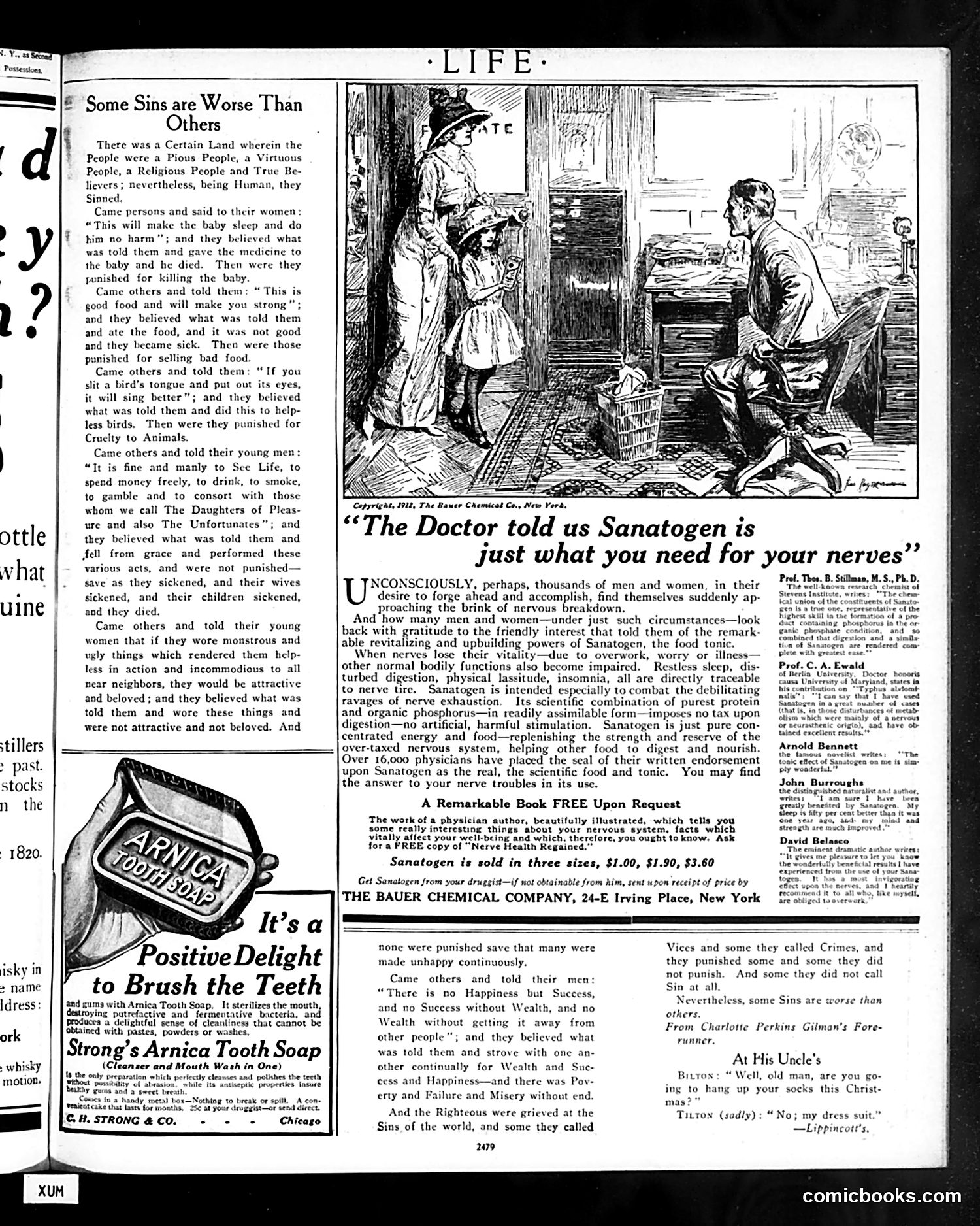
This page combines moral satire with patent medicine advertising. The left column presents a parable titled "Some Sins are Worse Than Others," depicting how different social groups teach their children harmful behaviors—from poisoning babies with laudanum to encouraging gambling and consorting with "Daughters of Pleasure." The narrative suggests that moral hypocrisy is widespread across classes. The central cartoon illustrates the page's ironic conclusion: a doctor recommends "Sanatogen" for nerve troubles. This is itself satire—the advertisement promotes Sanatogen as a scientific cure, claiming 10,000 physicians endorse it, yet the parable just exposed how "doctors" (authority figures) spread false remedies. The Arnica Soap ad below represents typical early-1900s patent medicine marketing, reinforcing Life's satirical point about commercial exploitation of health anxieties.
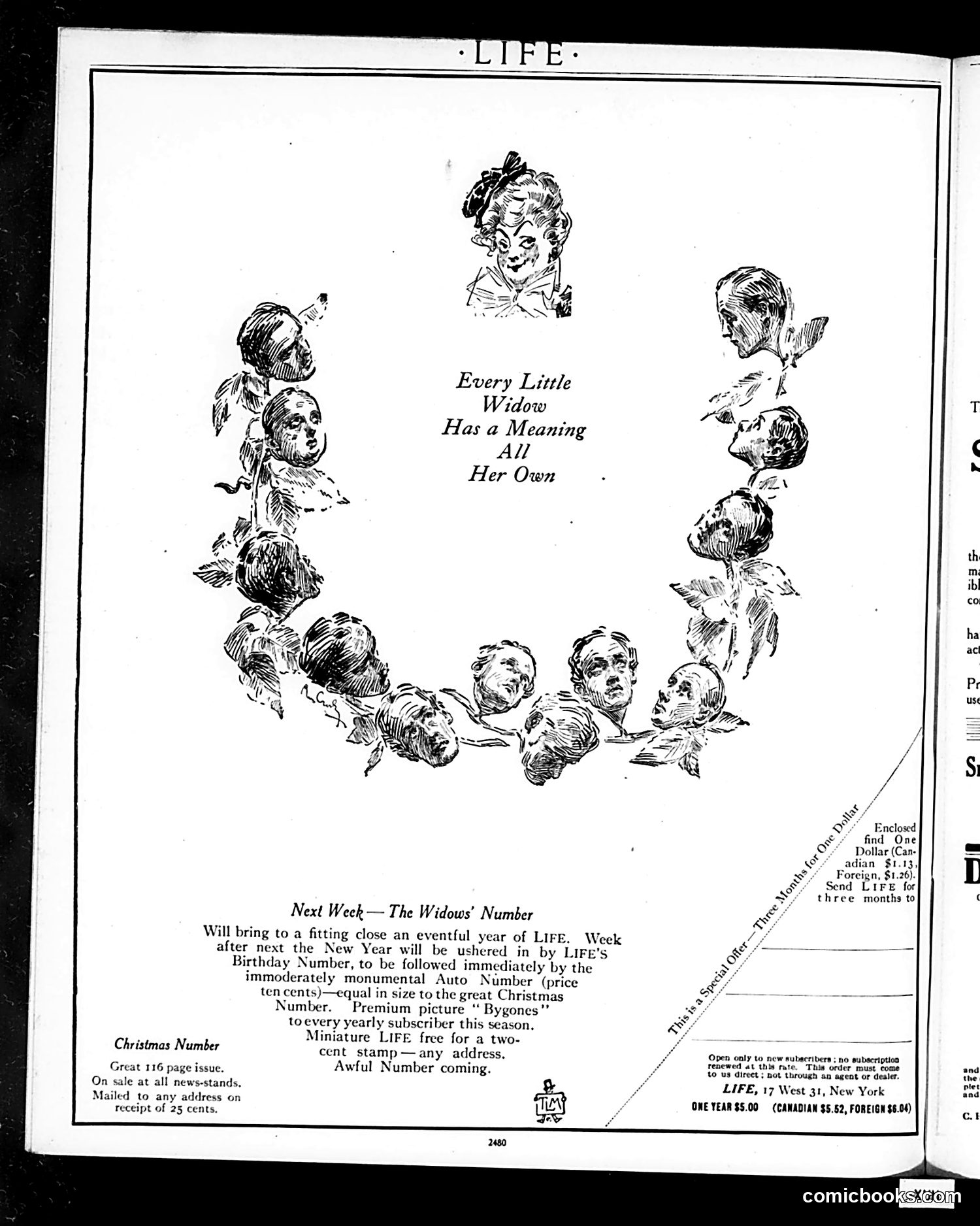
This page is primarily **advertising for Life magazine's upcoming issues**, not political satire. The central illustration shows faces arranged in a wreath or circular pattern around the text "Every Little Widow Has a Meaning All Her Own." This appears to be a **visual pun or joke about widows**—likely satirizing sentimental or humorous portrayals of widowed women, a recurring theme in Life's humor. The text announces upcoming special issues: the Christmas Number (116 pages), followed by the Widows' Number and an Auto Number. These were themed issues Life published seasonally. The illustration style and subject matter suggest **early 20th-century American humor targeting domestic/social situations**, but without clearer context about the specific "widow" reference, the exact satirical point remains unclear to modern readers.
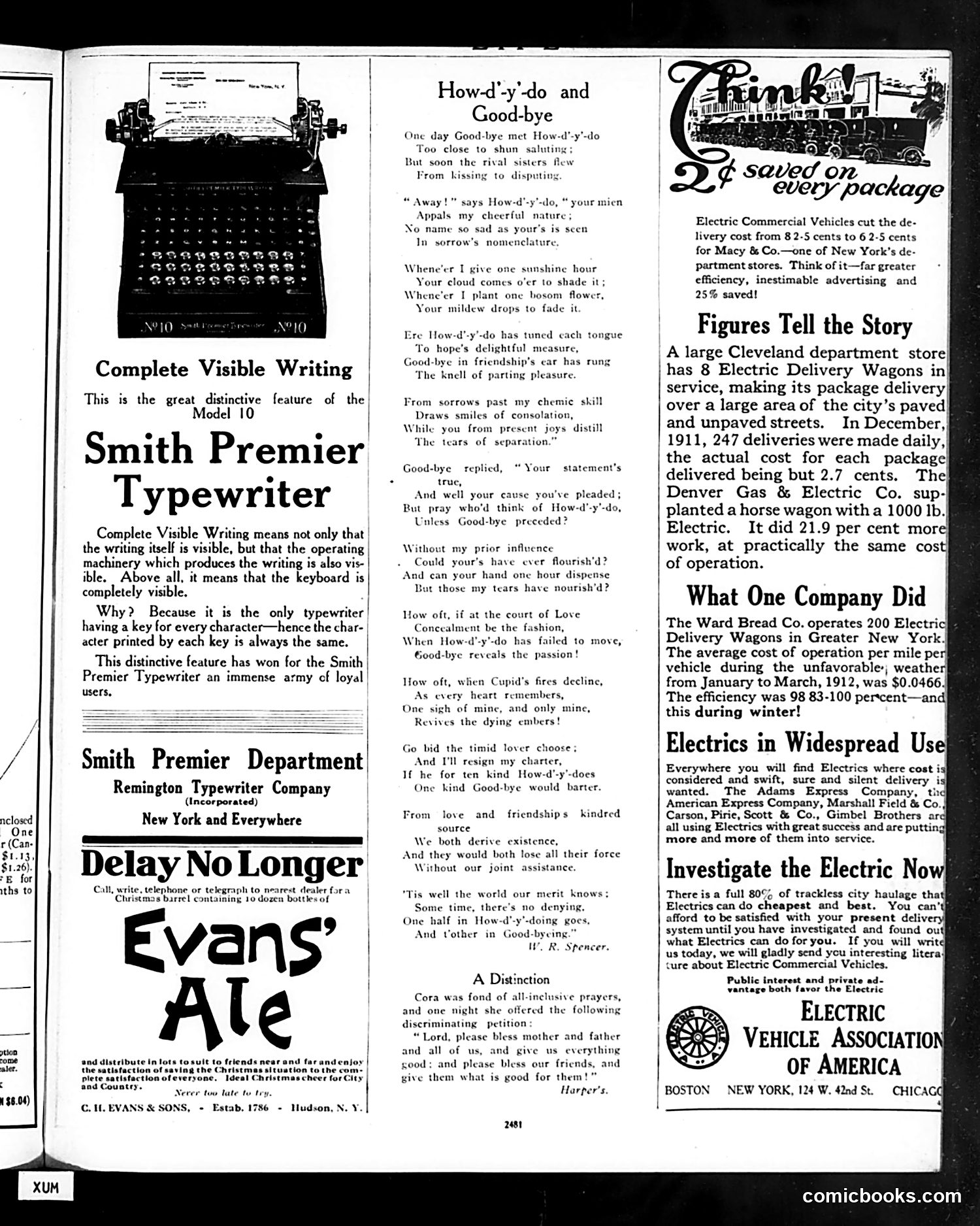
This page is primarily **advertising**, not satirical content. The left side advertises the **Smith Premier Typewriter** by Remington, highlighting "Complete Visible Writing" as its distinctive feature—the keyboard remaining visible while typing. Below this is an ad for **Evans' Ale**. The center features a sentimental poem titled "How-d'y'-do and Good-bye" about parting from loved ones, likely seasonal holiday content. The right side contains multiple ads for **electric commercial delivery vehicles**—wagons and trucks operated by various companies (Macy's, Ward Bread Co., Adams Express). These ads emphasize cost efficiency and reliability compared to horse-drawn wagons, reflecting early 20th-century industrial transition. The **Electric Vehicle Association of America** advertisement concludes the page, promoting broader adoption of electric vehicles. This represents period advertising reflecting technological modernization circa 1912.
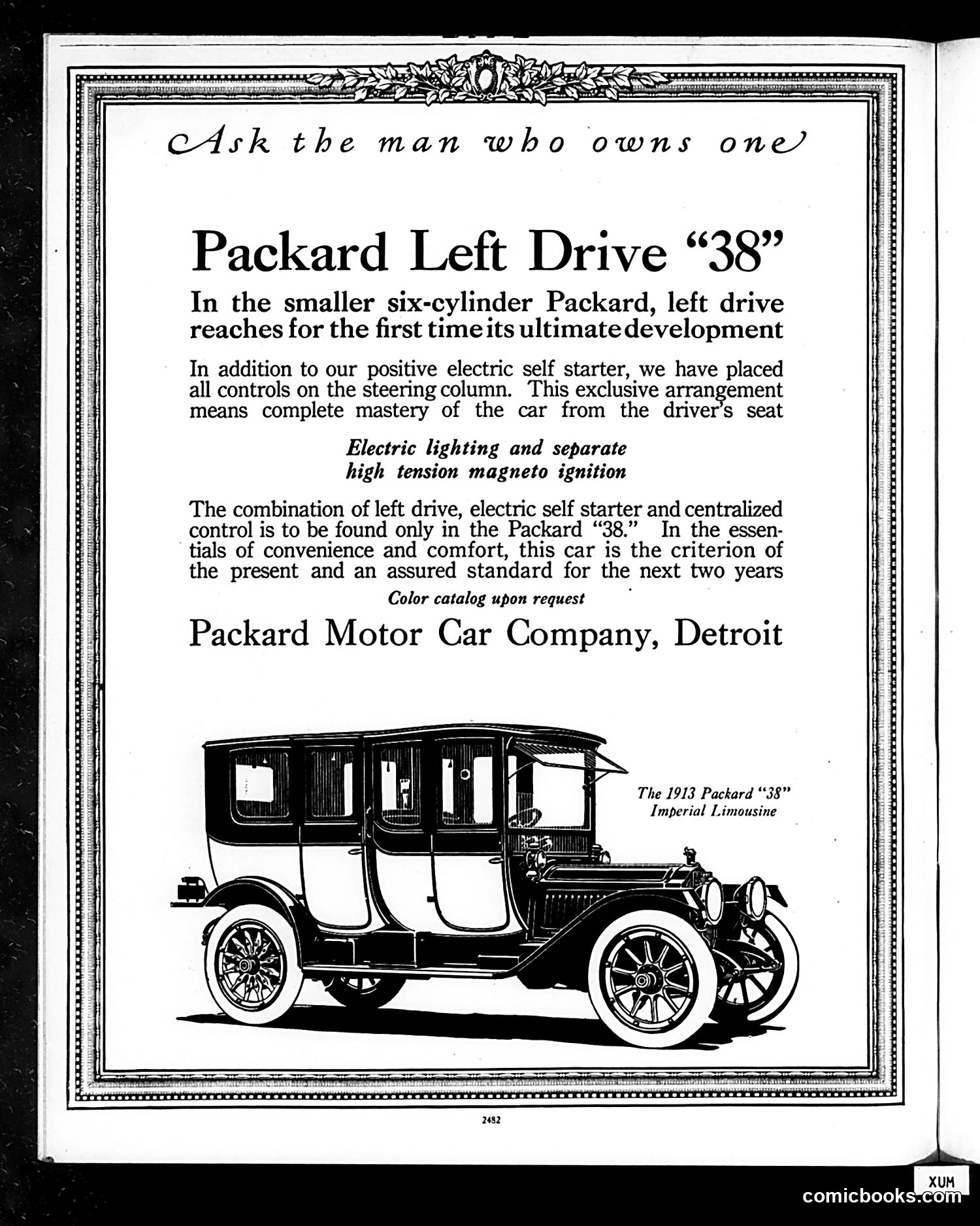
This is **not a cartoon or satire** — it's a straightforward automobile advertisement from approximately 1913. The page promotes the Packard Motor Car Company's "Left Drive '38" model, highlighting modern features: left-hand drive (then innovative), electric self-starter, centralized steering-column controls, electric lighting, and magneto ignition. The text emphasizes these were cutting-edge conveniences positioning Packard as the standard for present and future automobiles. The illustration shows the 1913 Packard "38" Imperial Limousine, a luxury vehicle. This is a standard early-automotive-era advertisement with no political or satirical content — simply marketing advanced engineering to wealthy consumers.
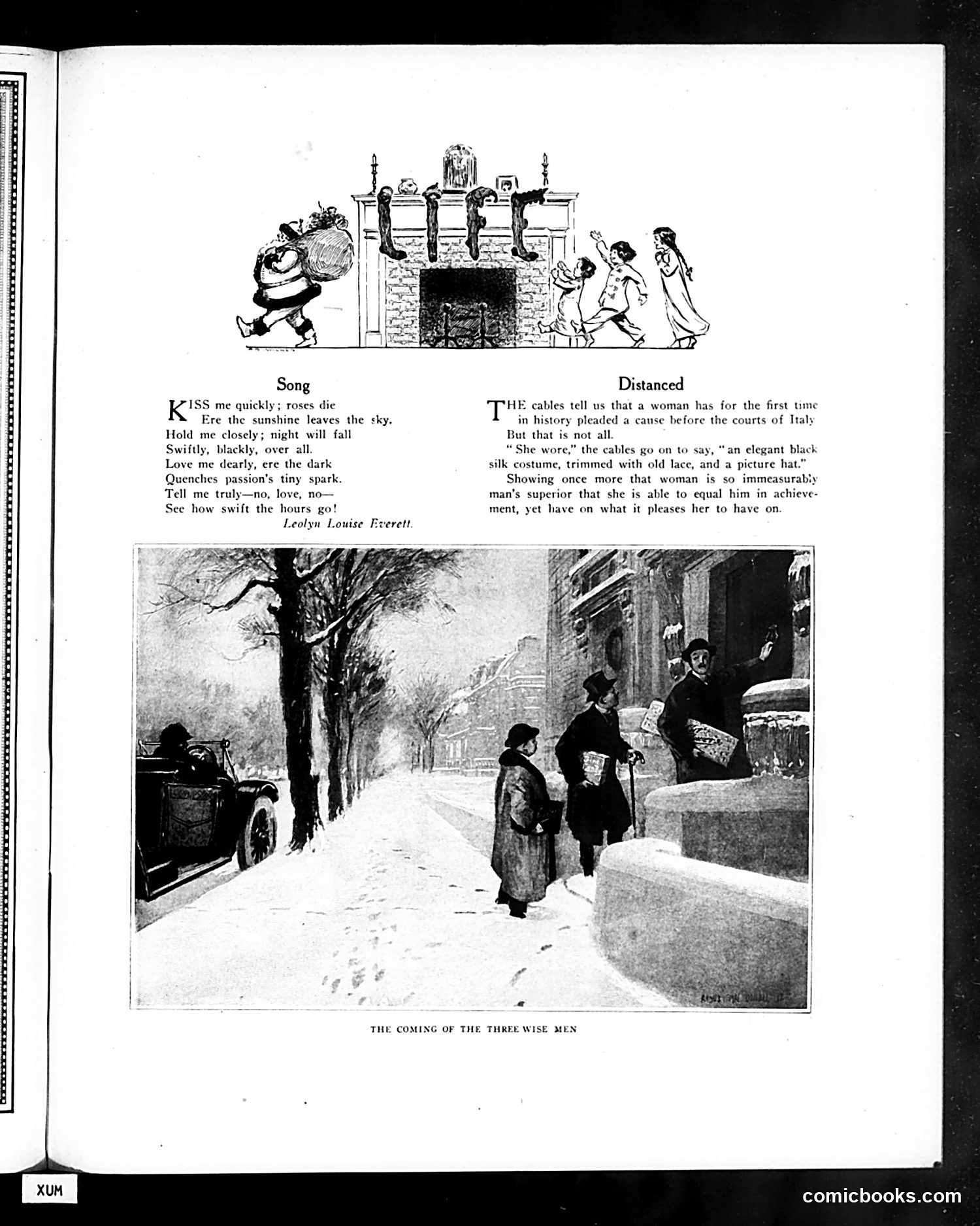
The page contains a poem titled "Song" by Evelyn Louise Everett alongside an illustration of figures around a fireplace mantelpiece. Below is an article titled "Distanced" discussing a woman's legal case in Italy—apparently the first time a woman successfully pleaded a case in Italian courts. The article notes her achievement while commenting on gender inequality in legal achievement versus appearance. The bottom illustration, captioned "The Coming of the Three Wise Men," depicts a snowy winter street scene with pedestrians and a vehicle, likely a seasonal reference to Christmas and the Nativity story. The overall page appears to blend poetry, social commentary on women's rights, and holiday imagery typical of Life magazine's satirical approach.
This page from *Life* magazine (December 19, 1912) contains an editorial about **Thomas Ryan**, a wealthy financier and philanthropist. The small cartoon at top left shows a figure labeled "LIFE" observing Ryan's activities. The article criticizes Ryan's influence, particularly regarding his political connections and money's role in politics. It mentions his donations to the Roman Catholic Church and Democratic Party causes, while questioning whether his wealth gives him outsized political power. The piece expresses concern that Ryan's fortune—allegedly derived partly from railroad stocks and other ventures—allows him to shape political outcomes despite not holding elected office. The author worries about wealthy individuals like Ryan directing political agendas behind the scenes, a common Progressive Era anxiety about plutocratic influence on American democracy.
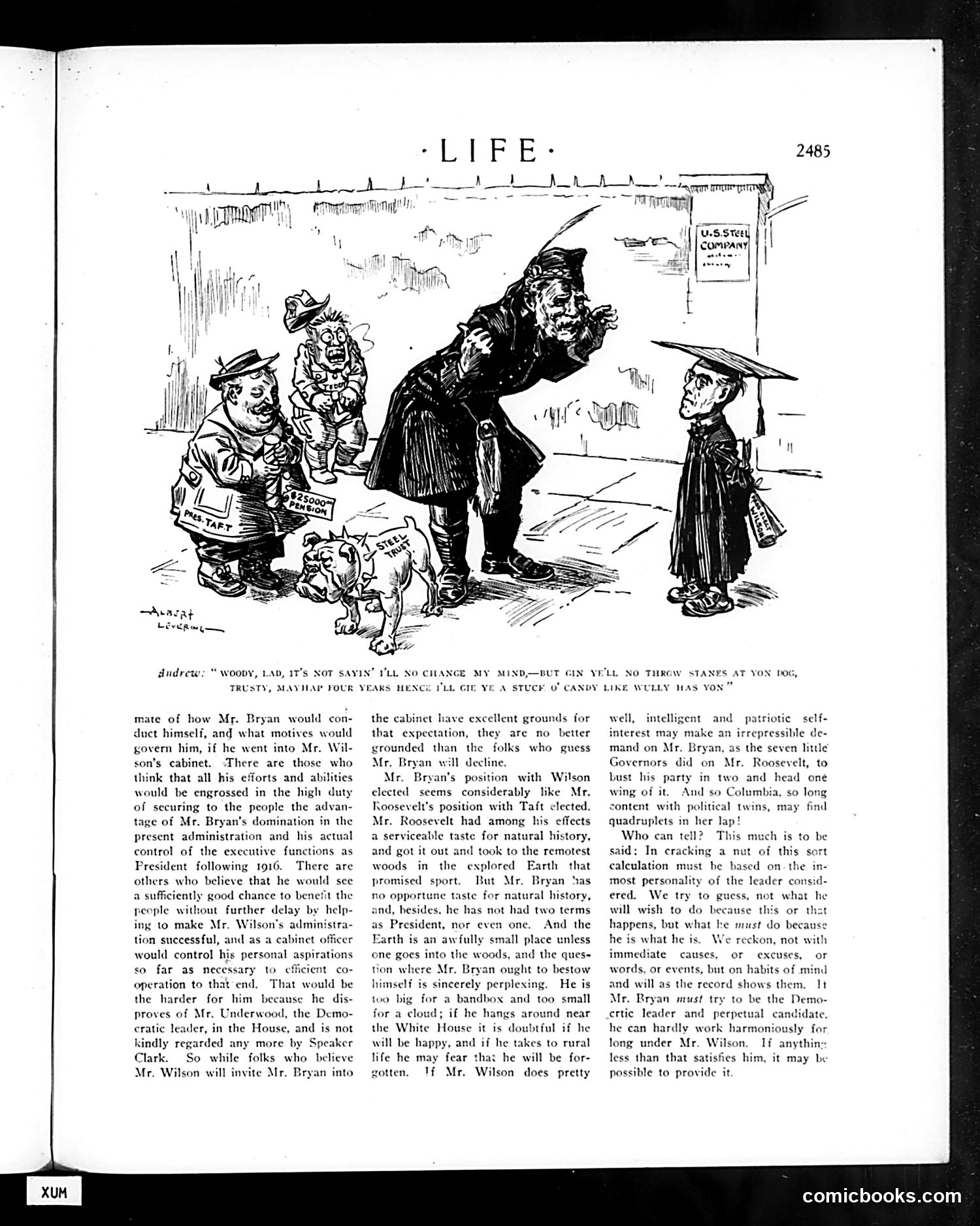
This cartoon satirizes **William Jennings Bryan's** potential cabinet appointment under Woodrow Wilson. The caricatured figures appear to be political figures and their associates, with Bryan shown as a central character being presented or discussed. The text criticizes Bryan's suitability for high office, questioning whether he possesses the temperament, judgment, and experience necessary for cabinet work. The satire suggests Bryan is more suited to rural life or wandering in the woods than governing. References to his "bandbox" appearance and lack of serious administrative experience mock his political credentials. The accompanying article expresses skepticism about whether Bryan and Wilson can work together harmoniously in administration, using pointed language to question Bryan's fitness for national leadership.
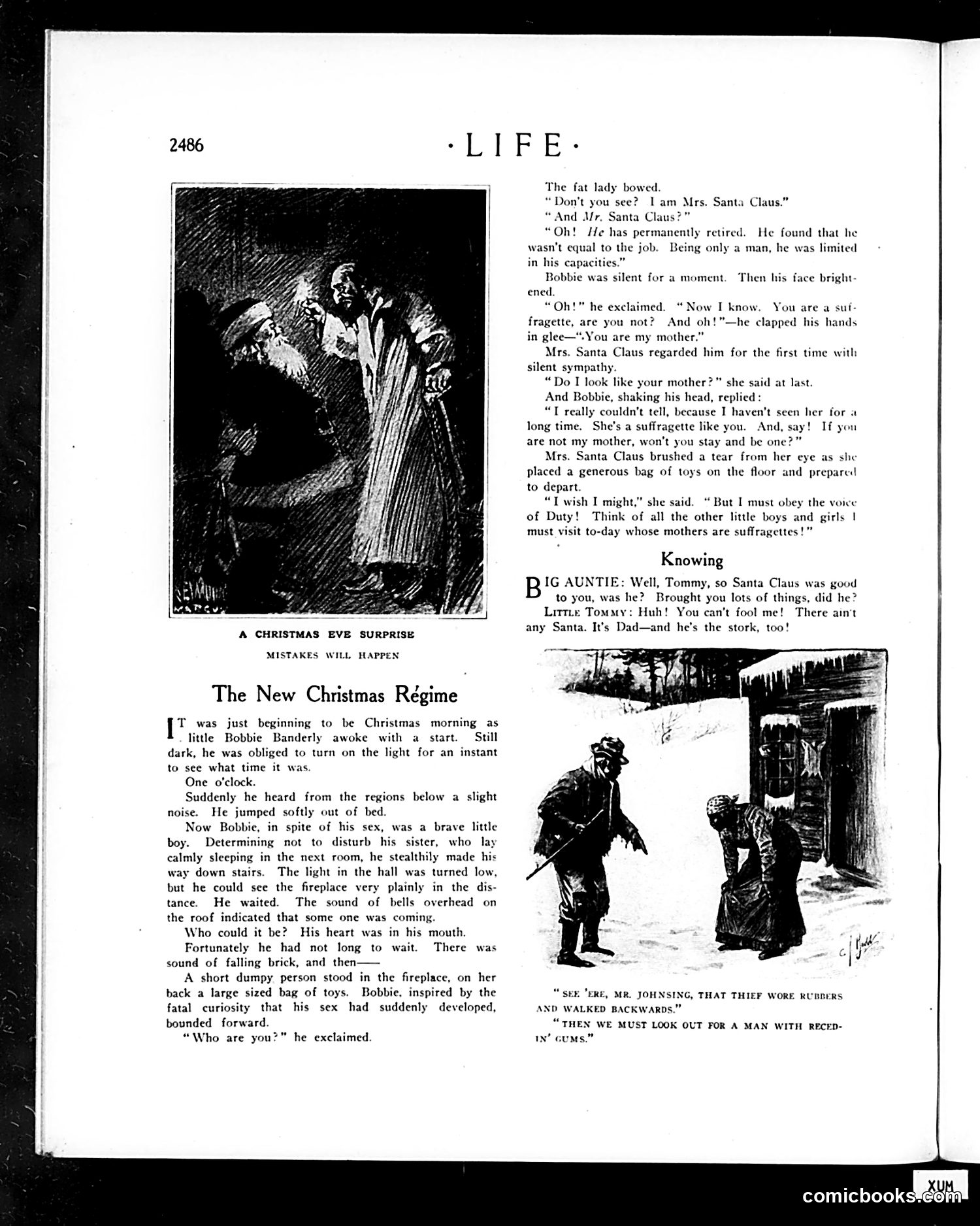
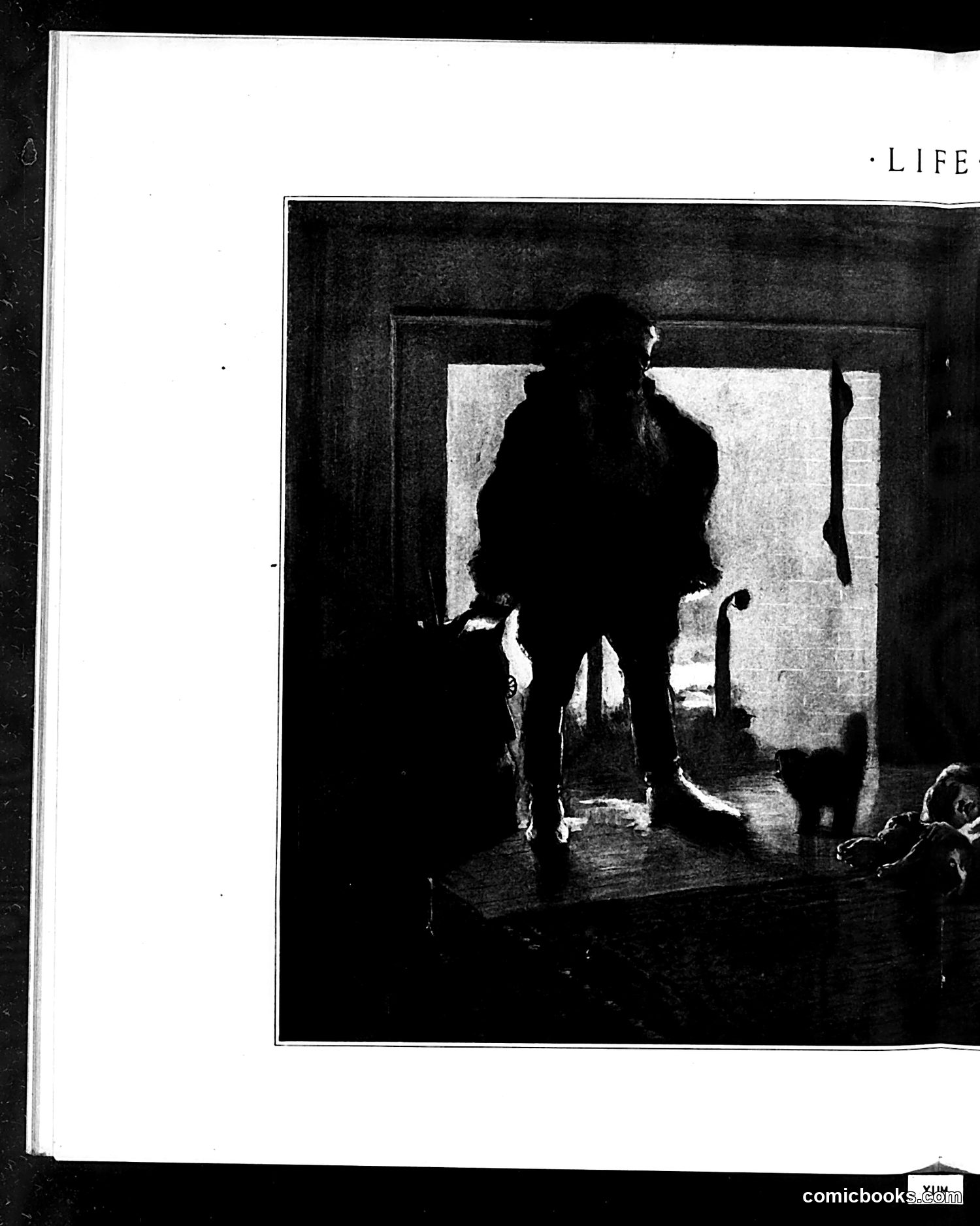
This is a domestic Christmas story, not political satire. The narrative follows young Bobbie Handerly on Christmas morning, who discovers a short, stout person in the fireplace with a bag of toys—identifying herself as "Mrs. Santa Claus." The humor centers on subverting Santa Claus mythology: Mr. Claus has "permanently retired," unable to manage the job alone. The fat lady reveals herself as Bobbie's mother in disguise, explaining she must visit other "suffragette" mothers' homes that day. The accompanying illustrations show domestic scenes: Mrs. Claus with Bobbie, and below, a winter scene with figures and humorous caption about a thief wearing rubbers and walking backwards. The satire gently mocks both Christmas commercialism and early-20th-century women's suffrage activism through this whimsical family scenario.
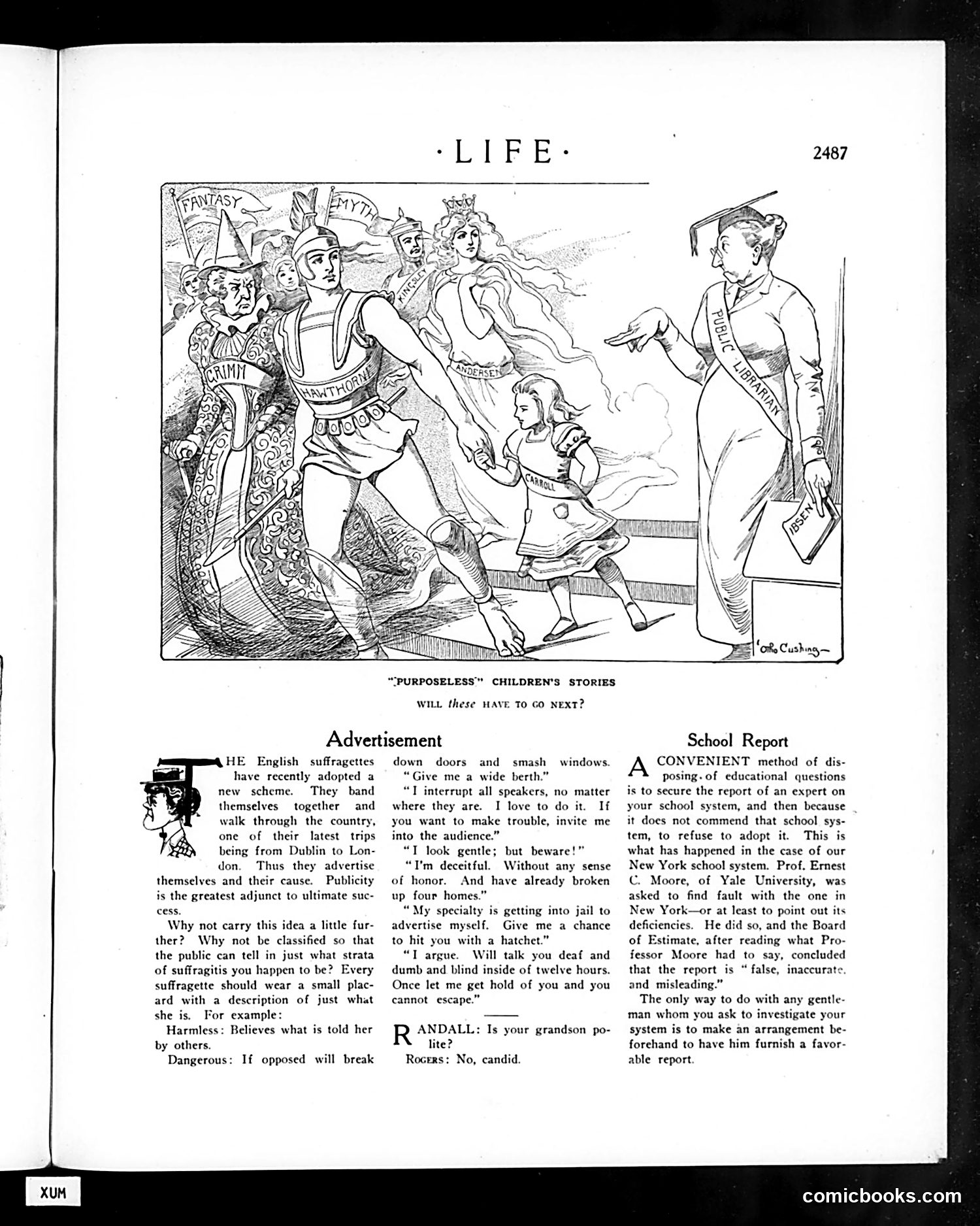
The cartoon satirizes Victorian-era fantasy literature through allegorical figures. On the left, fantastical characters labeled "Fantasy," "Myth," and "Grim" emerge from a storybook, alongside a caricatured old woman (likely representing traditional storytelling). On the right, a stern woman labeled "Practical Liberty" gestures dismissively, suggesting she opposes such frivolous narratives. The caption asks: "Will these have to go next?" — criticizing calls to eliminate imaginative children's stories as "purposeless" in favor of practical education. This reflects early 20th-century debates between progressive educators promoting utilitarian learning versus traditionalists defending imagination's value in childhood development. The satire defends fantasy literature against reformist pressure.
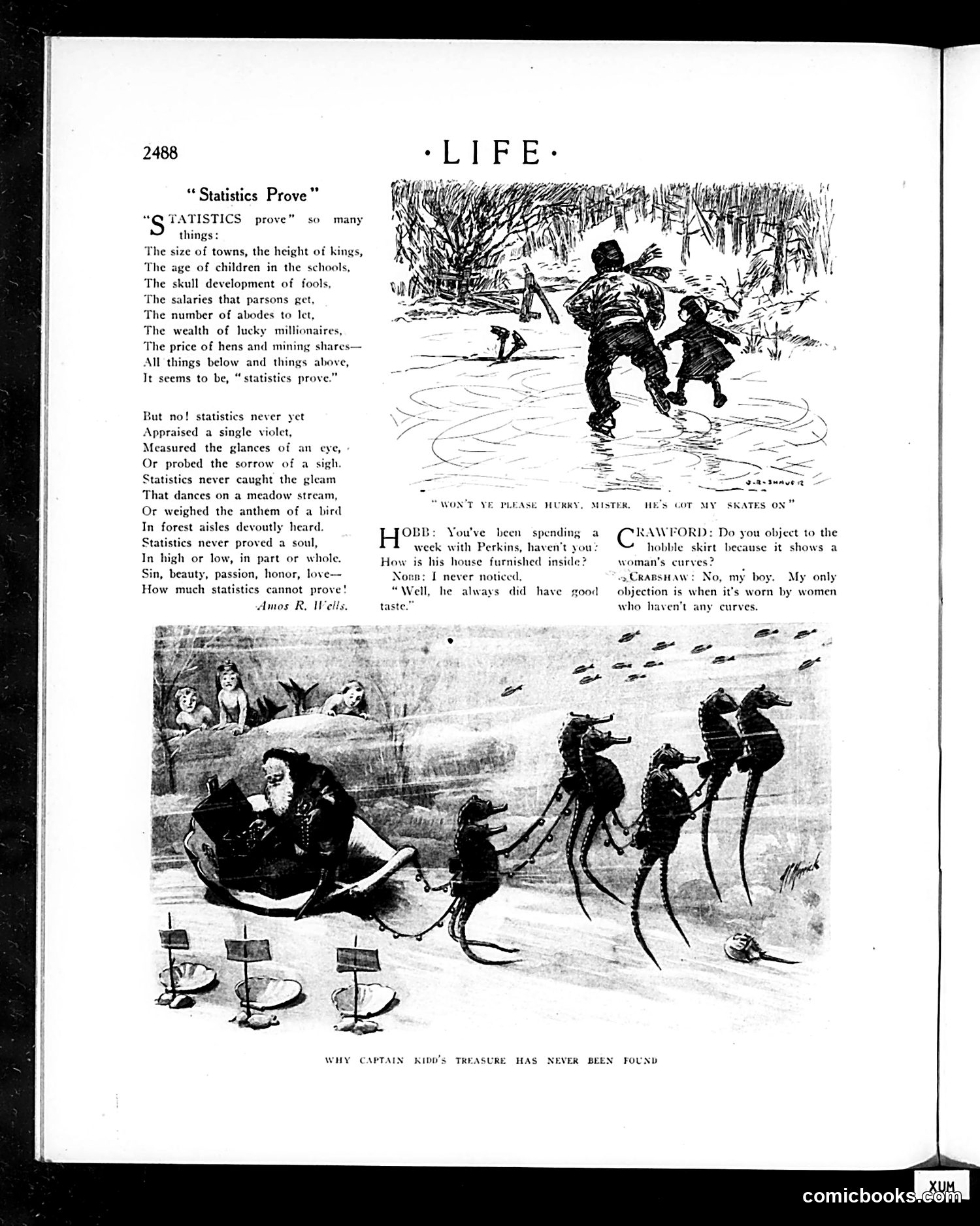
**Upper Section - Poem "Statistics Prove":** A satirical poem mocking the limitations of statistics. It argues that while statistics can measure quantifiable things (town sizes, tool development, wealth), they cannot capture human experience—a violin's beauty, an eye's glance, a sorrow, a bird's song, or the soul itself. The satire targets the era's growing faith in statistical data as proof of progress. **Lower Cartoon - "Why Captain Kidd's Treasure Has Never Been Found":** A humorous illustration depicting underwater explorers (on diving equipment) being chased away by sea creatures, while a woman sits relaxed on the ocean floor, apparently having claimed the treasure herself. The joke plays on the absurdity of where famous pirate treasure actually ended up.
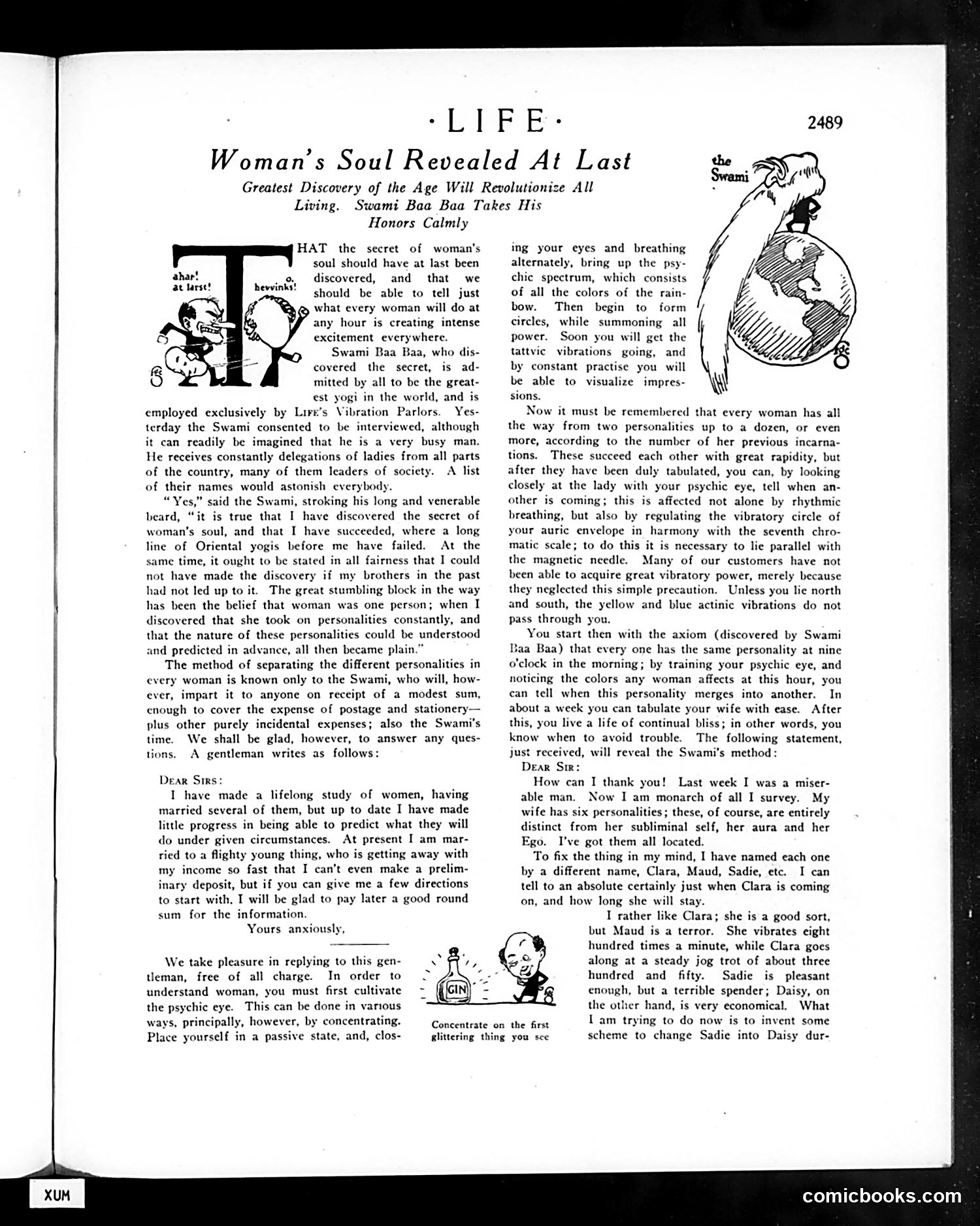
This page satirizes occult spiritualism and pseudoscientific claims about women's psychology. The headline mocks the supposed "discovery" of woman's soul by "Swami Baa Baa," a fictional mystic character (depicted in the illustration as a turbaned figure). The satire targets: 1. **Fake spiritualist experts** claiming secret knowledge about women's inner lives 2. **Dubious "psychic" practices** like visualization and chakra alignment presented as legitimate science 3. **Gullible wealthy clientele** willing to pay for mystical consultation A reader's letter describes absurdly managing multiple "personalities" in his wife through these techniques, which the magazine presents as ridiculous. The cartoons mock both the charlatan guru and the credulous believers. The satire reflects early 20th-century skepticism toward spiritualism and Eastern mysticism marketed to wealthy Americans.
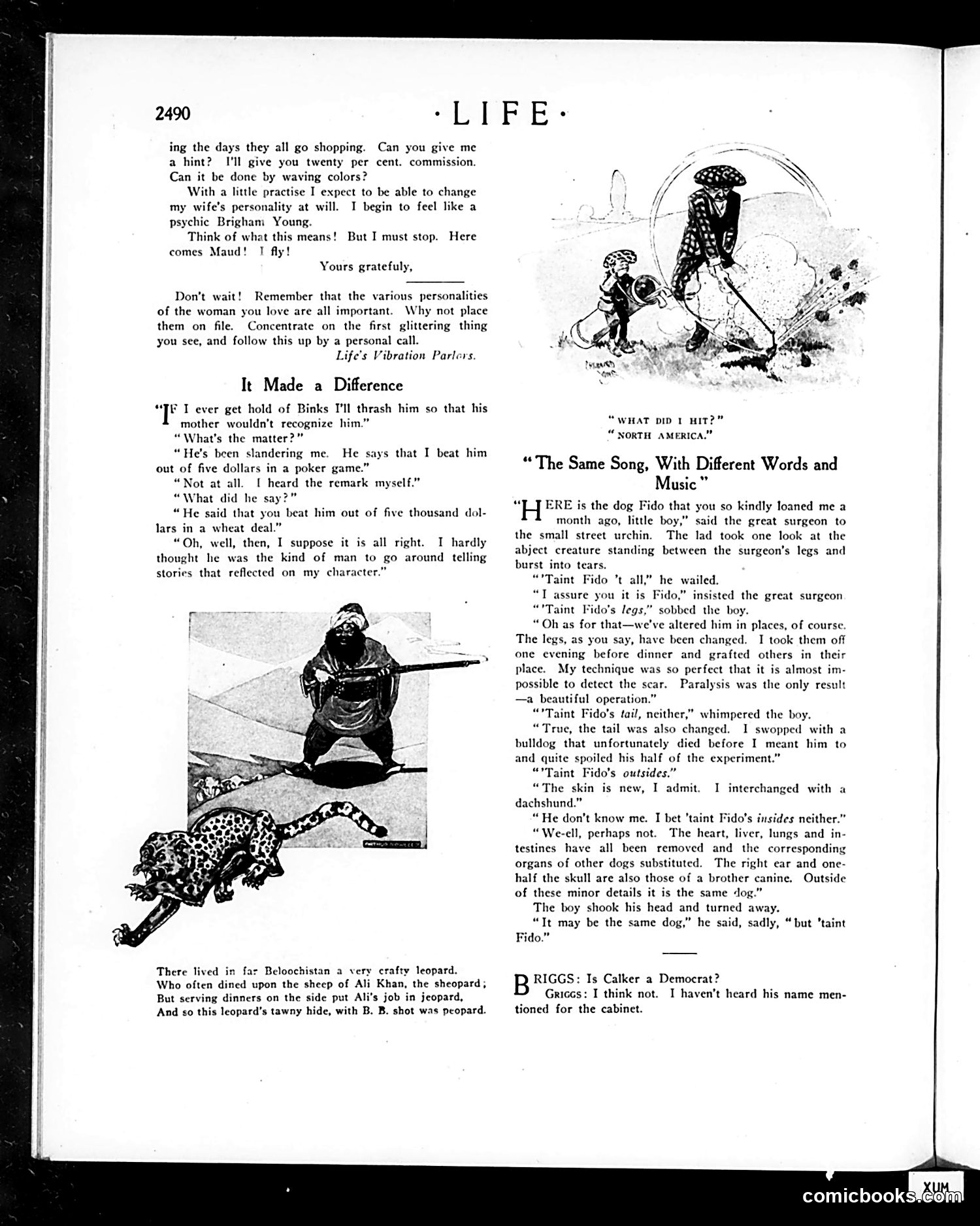
This page contains two unrelated humor pieces from *Life* magazine. **"It Made a Difference"** (left): A dialogue joke about a man named Binks who allegedly beat someone out of money in a poker game. The humor relies on a misunderstanding—the speaker thought Binks beat the victim with physical violence ("thrash him"), not at cards. The joke plays on the ambiguity of "beat." **"The Same Song, With Different Words and Music"** (right): A satirical story about a surgeon who alters a borrowed dog (Fido) so extensively—swapping body parts with other dogs—that it's technically a different animal. The boy owner notices nothing, leading to the surgeon's ironic conclusion: "it may be the same dog, but taint Fido." This mocks over-confident medical/scientific manipulation and the philosophical question of identity. Both pieces are straightforward humor pieces rather than political satire.
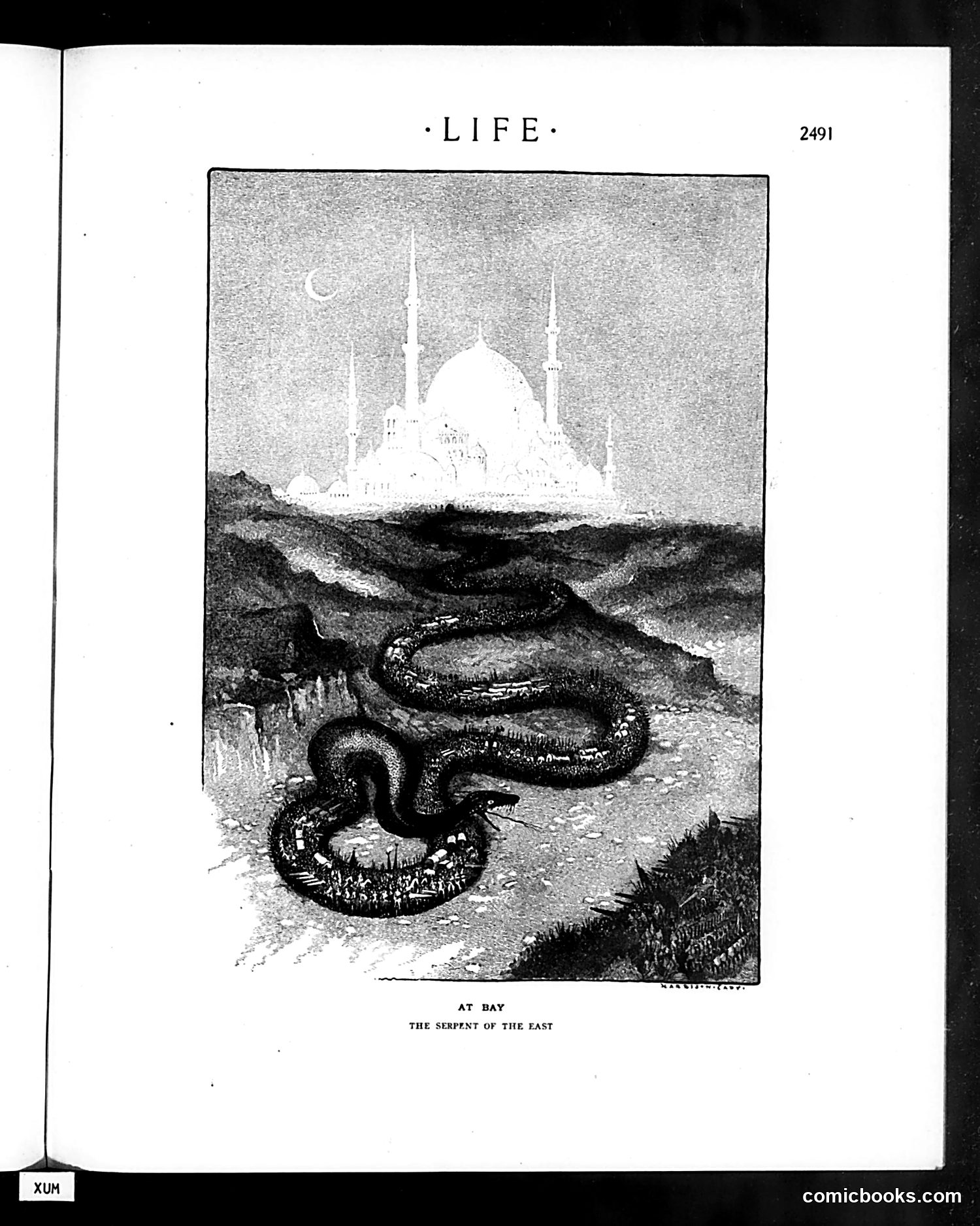
This illustration depicts a large serpent coiled in a desert landscape, with a white domed building (appearing to be a mosque or Eastern religious structure) glowing in the night sky behind it. A crescent moon is visible. The caption identifies this as "The Serpent of the East," likely a political allegory about Eastern or Middle Eastern threats as perceived by early 20th-century American audiences. The serpent—a classic symbol of danger, treachery, or evil—represents some Eastern power or influence. The juxtaposition of the serpent in the foreground with the illuminated Eastern architecture suggests commentary on Western anxieties about the East, possibly relating to colonial tensions, imperial rivalry, or geopolitical instability in that region during this period.
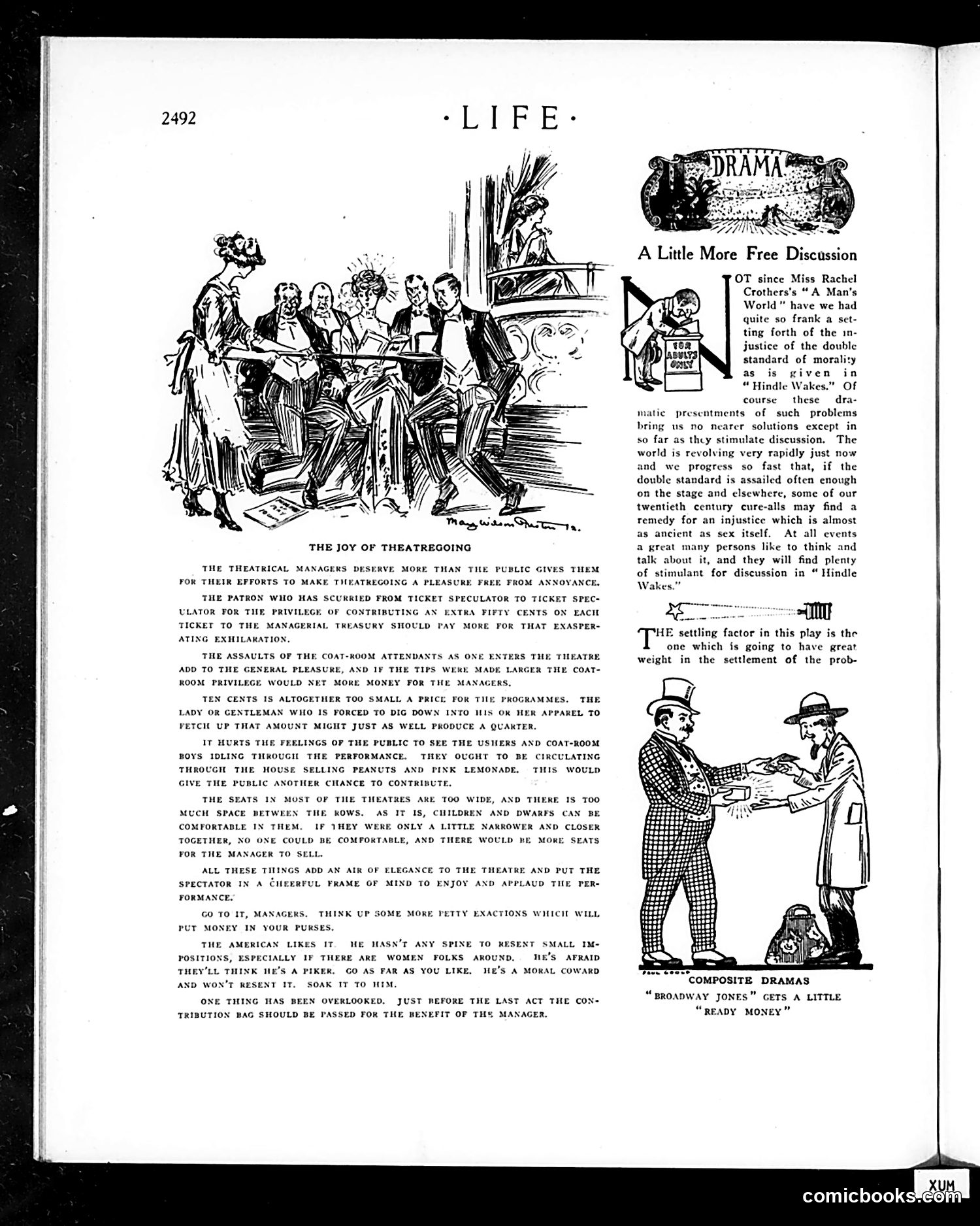
This page presents satirical commentary on theatrical exploitation of patrons. The left illustration depicts well-dressed theatergoers, while the text uses heavy irony to mock theater managers' fee-extraction schemes. The satire targets contemporary theater abuses: inflated ticket prices through scalpers, excessive tips demanded by coat-room and usher staff, overpriced programs (10 cents), cramped seating designed to maximize capacity, and constant upselling (peanuts, lemonade). The author sarcastically "praises" managers for these practices while implicitly condemning them as nickel-and-diming patrons. The piece concludes with a harsh observation: Americans lack the "spine" to resist these "small impositions," especially men afraid to appear cheap before women—calling American men "moral cowards." The right section discusses the play "Hindle Wakes," which addresses the double standard in sexual morality between men and women—contemporary social commentary theater.
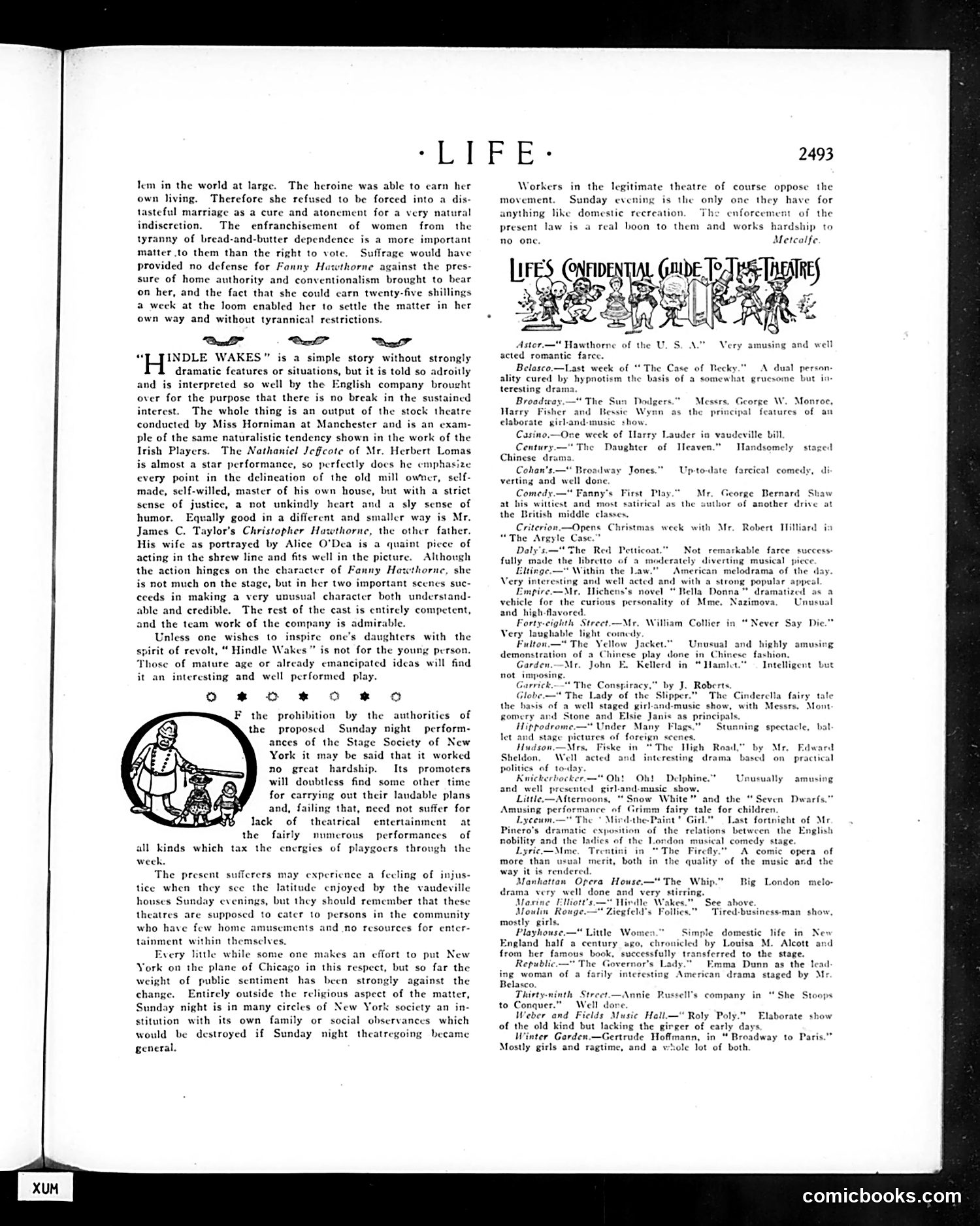
This page discusses two theatrical topics from early 20th-century New York: **"Hindle Wakes"**: A review of an English play about a working-class woman (Fanny Hawthorne) who refuses a forced marriage after a premarital indiscretion because she can earn her own living. The critic praises the naturalistic production by Manchester's Miss Horniman theater, particularly Herbert Lomas's performance as an old mill owner. The review notes the play's feminist implications—that women's economic independence matters more than voting rights—and warns it's unsuitable for young people due to its "revolt" themes. **Sunday Theatre Ban**: A brief discussion of authorities prohibiting Sunday night performances by New York's Stage Society. The critic acknowledges this wasn't a major hardship, noting that vaudeville houses already performed Sundays for workers with few home entertainments. However, theater workers themselves opposed Sunday performances because those evenings represented their only opportunity for domestic recreation with families.
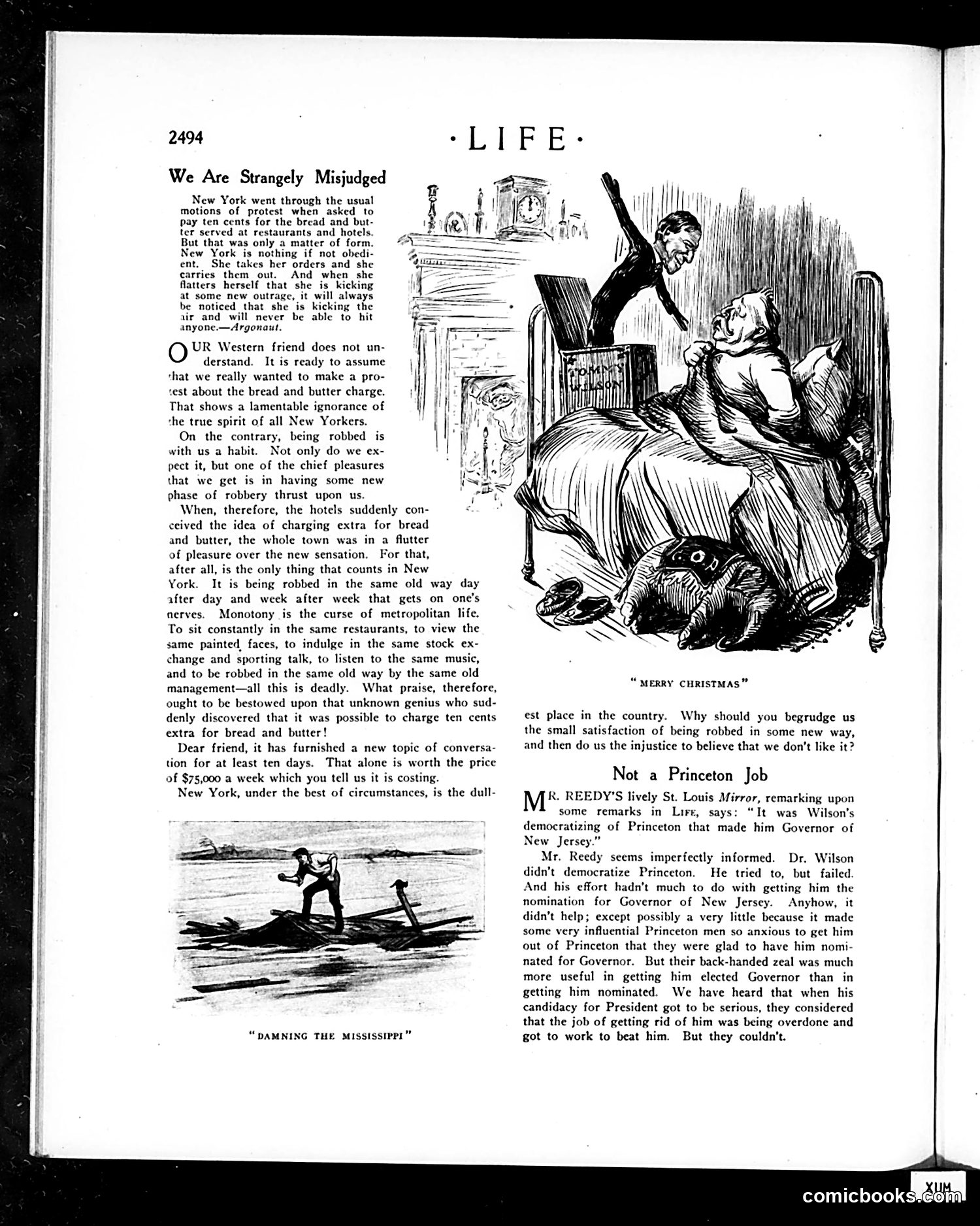
## "We Are Strangely Misjudged" This piece satirizes New Yorkers' acceptance of being exploited. Hotels began charging extra for bread and butter—a routine item previously included—and the city protested only perfunctorily. The satire's point: New Yorkers *enjoy* being robbed because it breaks the monotony of their dull metropolitan existence. Being fleeced in new, creative ways is entertainment. The author mocks this masochistic acceptance, suggesting New Yorkers will protest theatrically but obey anyway, too jaded to genuinely resist. ## The Cartoons **"Merry Christmas"** shows a man playfully whacking a sleeping woman with what appears to be a club or stick—domestic horseplay rendered as slapstick. **"Damning the Mississippi"** depicts a figure struggling against water or terrain, likely illustrating futility or fighting an impossible force. ## "Not a Princeton Job" This section corrects a St. Louis publication's claim that Woodrow Wilson's "democratization" of Princeton led to his New Jersey governorship. Life argues his reform efforts actually failed and played minimal role in his political rise.
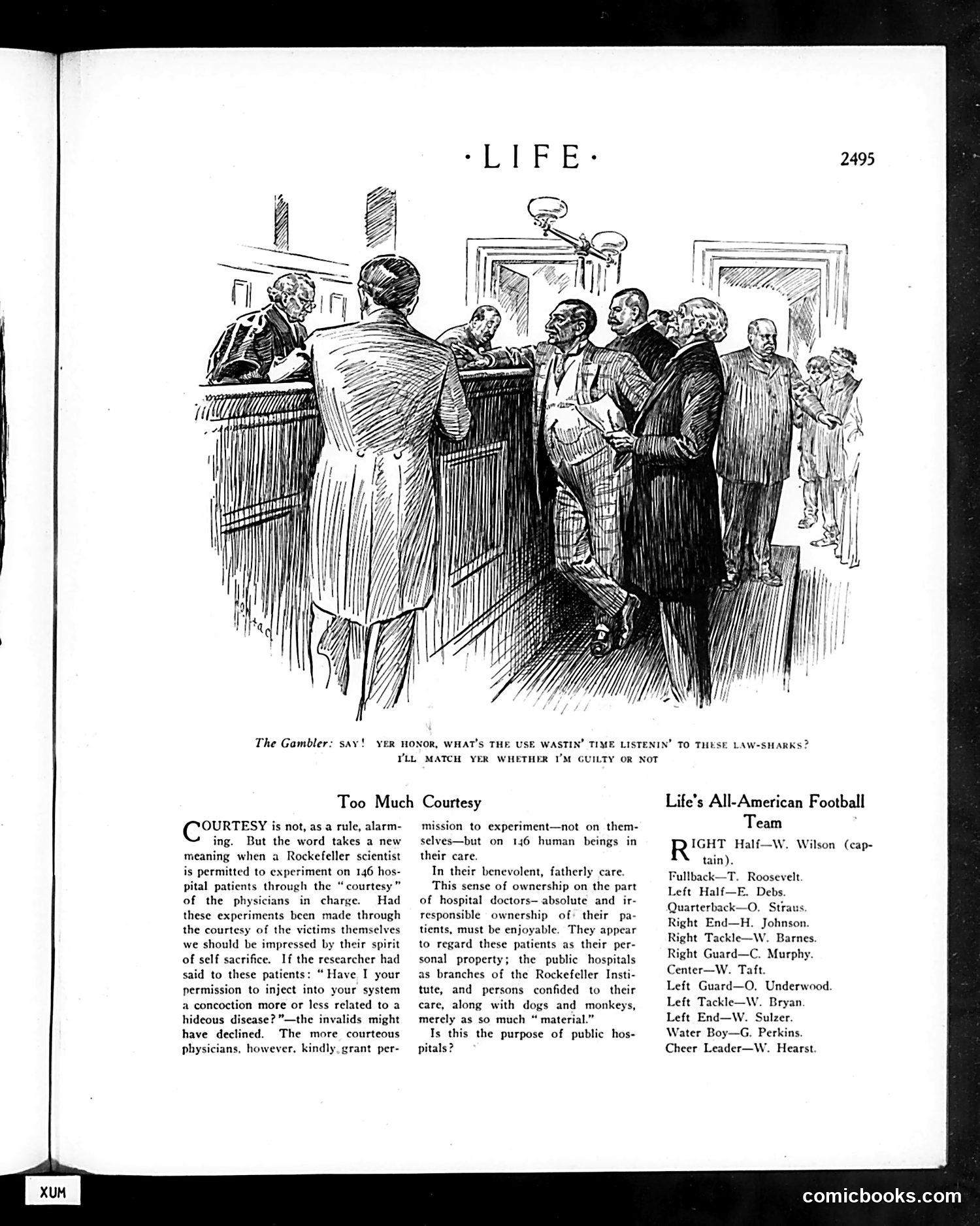
**The Main Cartoon ("The Gambler"):** A man in a courtroom addresses a judge, proposing to gamble on his innocence—he'll accept conviction or acquittal without evidence. This satirizes corrupt legal systems where outcomes are predetermined rather than based on facts, mocking both the defendant's brazen confidence and the court's apparent indifference to actual justice. **"Too Much Courtesy" Article:** This criticizes a Rockefeller Institute scientist conducting experiments on 146 hospital patients without informed consent, framed as "courtesy" by physicians. The satire attacks the paternalistic arrogance of doctors who treat poor hospital patients as "material" for research—essentially property—rather than human beings deserving autonomy. It questions whether public hospitals serve patients or serve wealthy scientific institutions. **Football Team:** A humorous roster mixing contemporary political figures (Wilson, Roosevelt, Debs, Taft, Bryan, Hearst) as players, likely mocking 1912 election politics through sports metaphor. The specific assignments reflect satirical commentary on their political roles.
This page from *Life* magazine shows a stark silhouette photograph rather than a traditional cartoon. The image depicts a figure in a doorway or entrance, backlit against a lighter interior space, with what appear to be additional figures or forms visible in the background rooms. Without visible text, captions, or identifying marks on the page itself, I cannot determine the specific political or social satire intended. The dramatic silhouette technique suggests commentary on secrecy, intrusion, or surveillance, but the particular target—whether a political figure, social institution, or contemporary event—remains unclear from the image alone. The OCR text appears corrupted and provides no useful context.
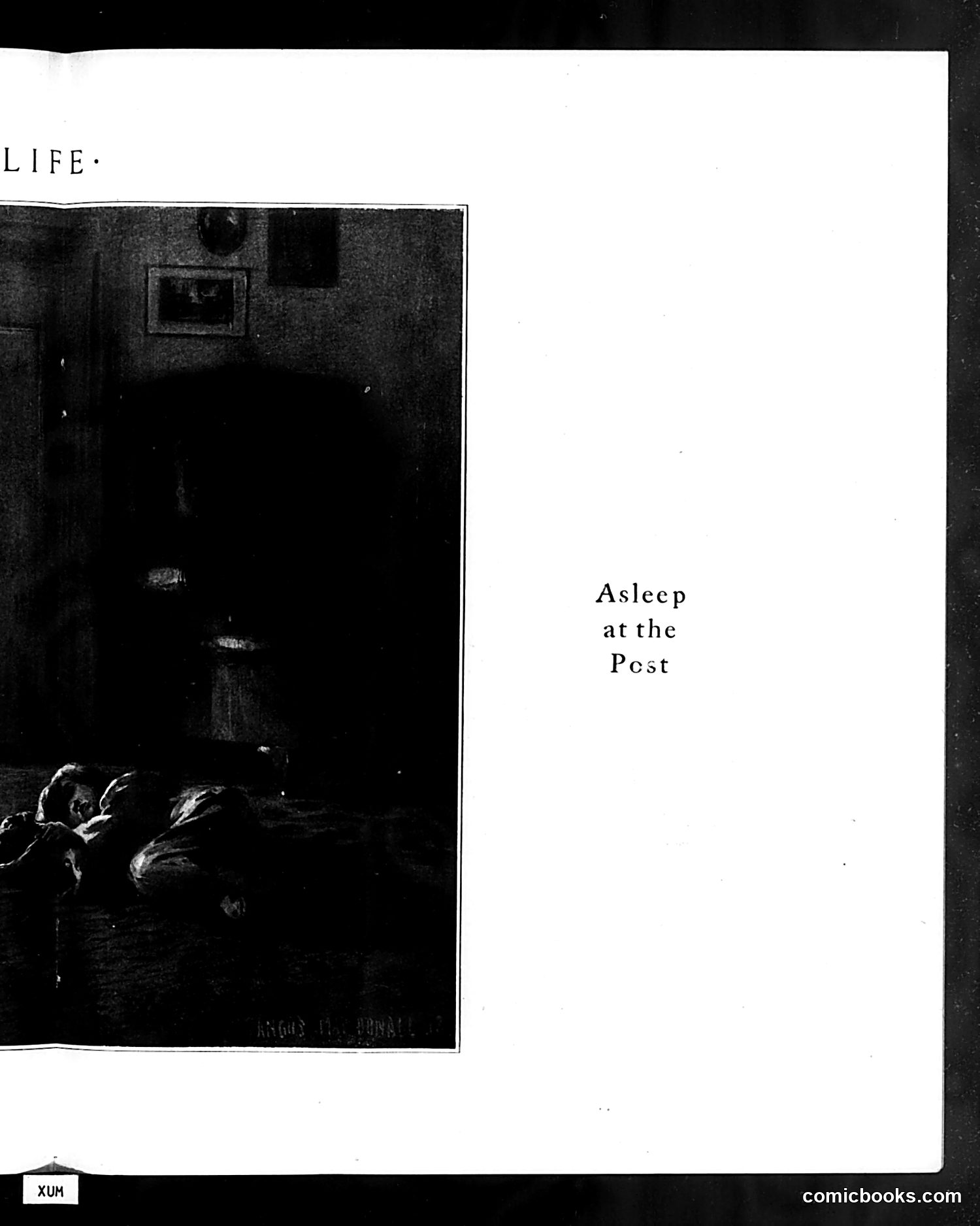
This page from *Life* magazine appears to be a title page or section opener for a satirical piece. The accompanying illustration shows a figure slumped or sleeping at what appears to be a guard post or military position—suggested by the stark, dark interior setting with a doorway or entrance visible. The title's meaning likely plays on the phrase "asleep at the post," a common idiom meaning someone is neglecting their duty or responsibility. Without additional context about the specific historical moment this appeared, the exact target of satire remains unclear, though it likely criticized a public official, government agency, or institution for failing to fulfill their obligations. The dramatic, shadowy artwork emphasizes the serious nature of this dereliction of duty.
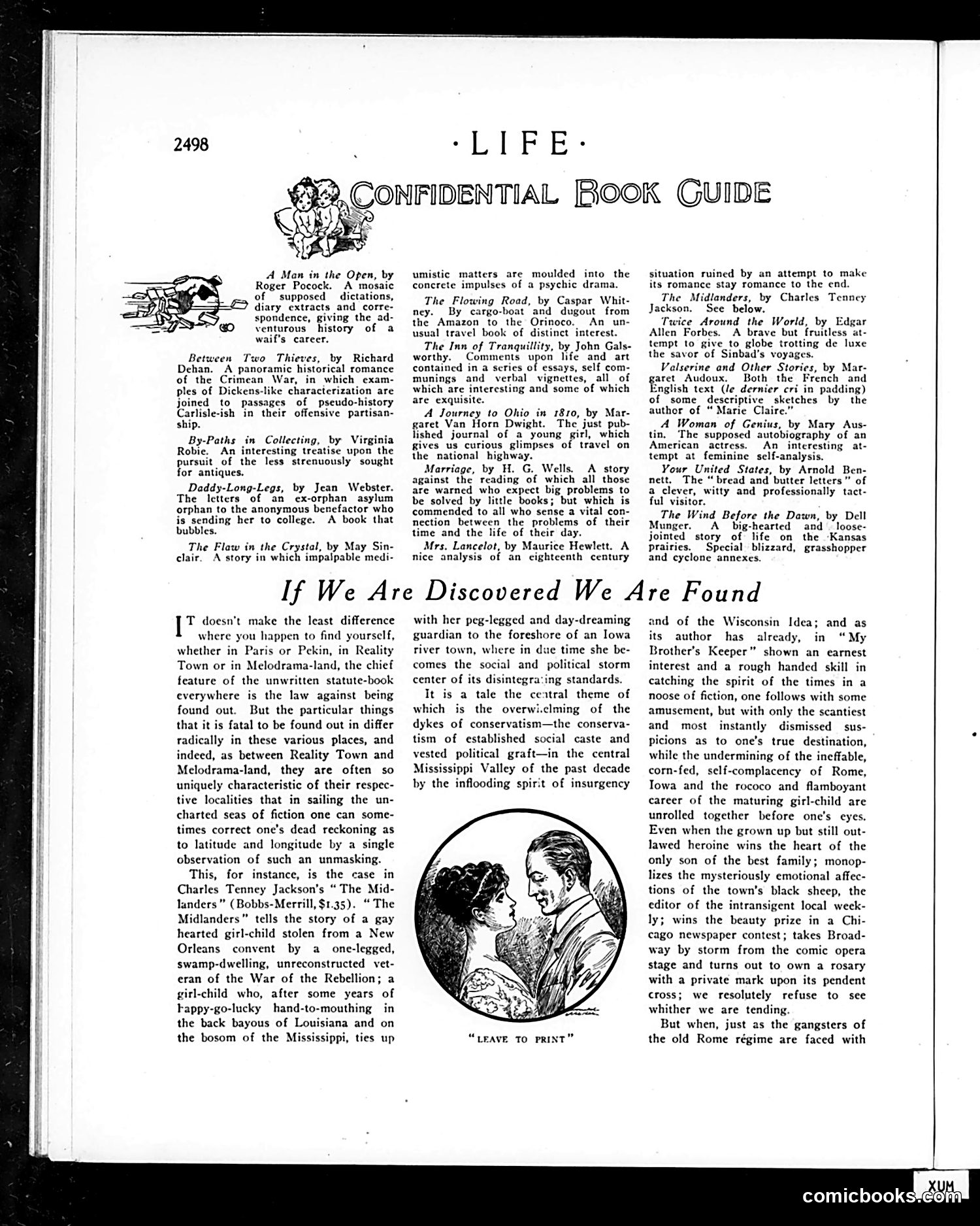
This page is a **book review section** from Life magazine's "Confidential Book Guide," reviewing new publications including works by H.G. Wells, John Galsworthy, and others. The main article, "If We Are Discovered We Are Found," discusses Charles Tenney Jackson's novel *The Midlanders*. Jackson explores how different fictional settings have distinct moral codes—what's scandalous varies between "Reality Town" and "Melodrama-land." The plot involves a girl stolen from a New Orleans convent by a one-legged man during the Civil War era, examining themes of social class, political upheaval, and reputation in the Mississippi Valley. The article suggests the novel explores how established social hierarchies are disrupted by insurgency and changing moral standards. The circular illustration labeled "LEAVE TO PRINT" shows two figures in profile, likely depicting characters from the narrative being discussed.
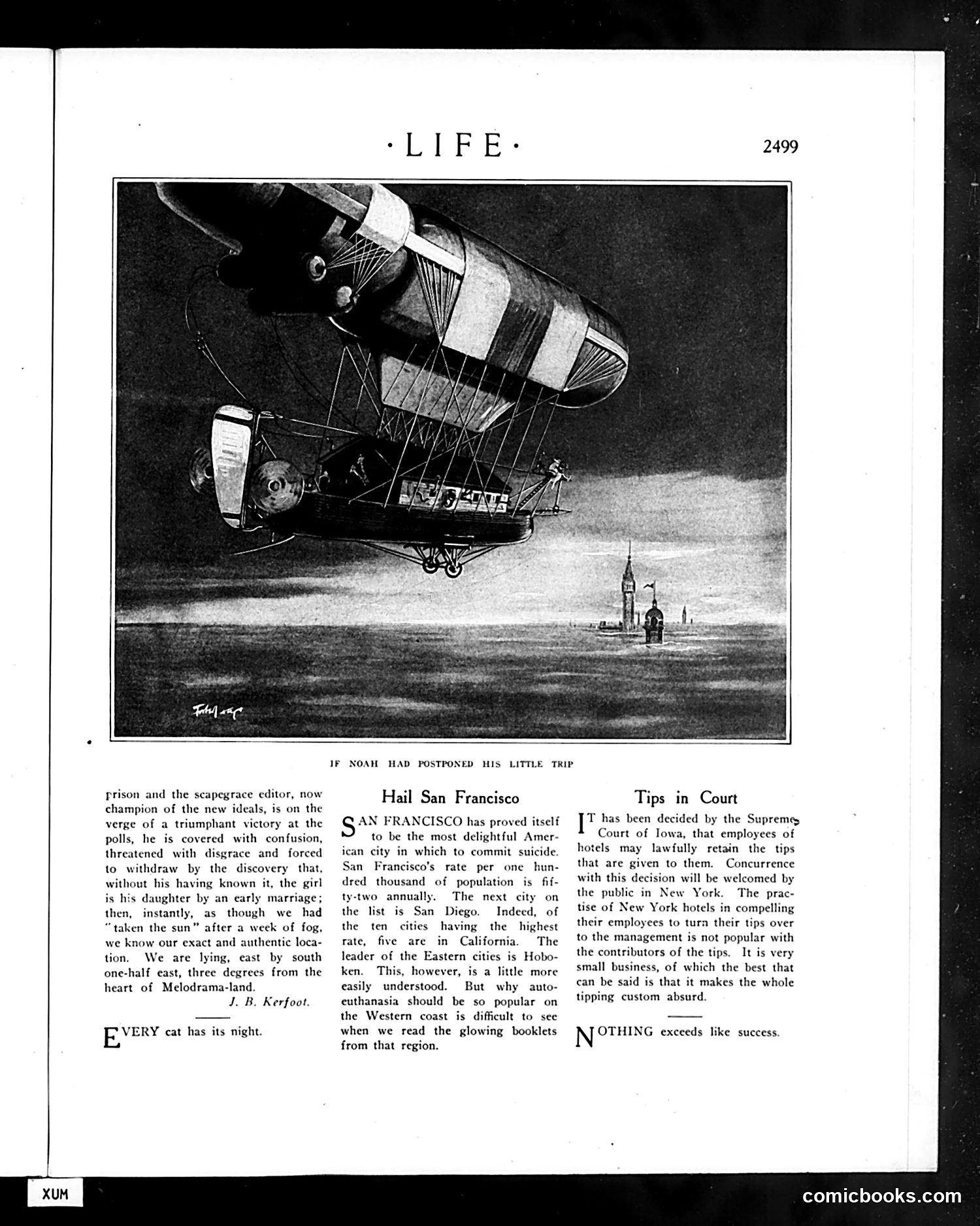
## The Main Illustration The cartoon depicts a large airship (dirigible/zeppelin) hovering above a small cityscape, captioned "IF NOAH HAD POSTPONED HIS LITTLE TRIP." This is a sardonic reference to the Biblical flood—suggesting that if Noah had delayed his ark, modern civilization (represented by the city below) would be destroyed by the airship instead. The satire mocks either early aviation technology as a threat, or possibly the destructive potential of airships as weapons (relevant given WWI-era anxieties). ## The Articles The page includes three brief opinion pieces: 1. **A literary critique** by J.B. Kerfoot about melodramatic plotting in fiction 2. **"Hail San Francisco"** — a dark satirical article mocking San Francisco's high suicide rate (52 per 100,000 annually), noting it's the highest among American cities despite promotional literature praising the region 3. **"Tips in Court"** — reporting an Iowa Supreme Court decision allowing hotel employees to keep tips, contrasting this with exploitative New York hotel practices The overall tone is satirical commentary on contemporary American life and concerns.
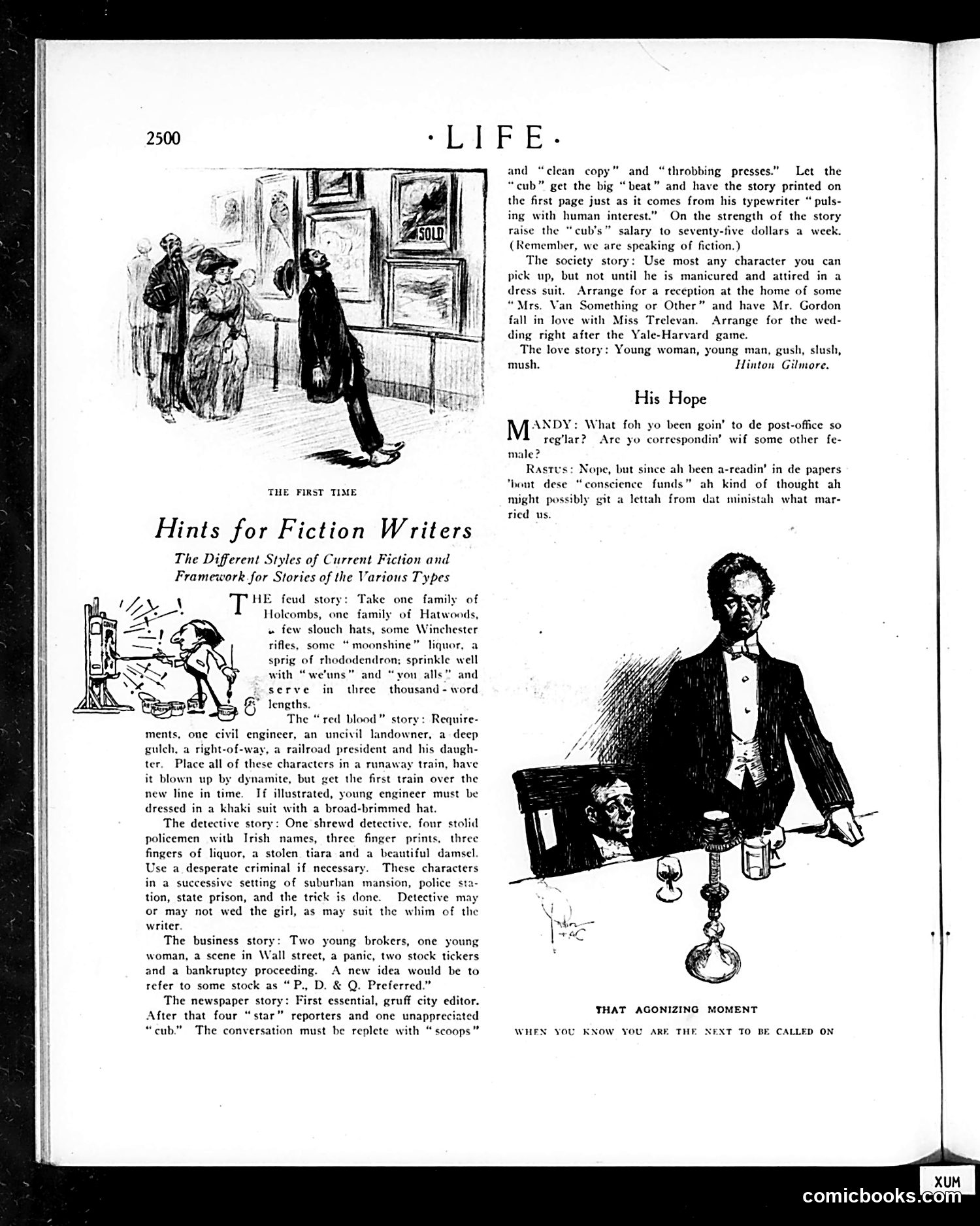
This page satirizes formulaic fiction writing of the early 1900s. The main article, "Hints for Fiction Writers," mockingly outlines recipe-like templates for popular story genres—feuds (with "moonshine" liquor and Appalachian dialect), adventure tales (runaway trains and dynamite), detective stories (Irish cops, stolen tiaras), and newspaper dramas (ambitious young reporters). The humor lies in reducing complex narratives to predictable ingredients: every society story must feature a character named "Mr. Gordon" falling for "Miss Trelevan" before a Yale-Harvard wedding. The cartoon "His Hope" features two Black characters using dialect-heavy speech (characteristic of early 20th-century racial humor), with "Rastus" hopefully checking the post office for a letter from the minister who married him—a joke about "conscience funds" (restitution payments from guilty consciences). This reflects period stereotypes and satirical treatment of African American characters common to *Life* magazine's content. The satire targets publishers' and readers' appetite for predictable, mass-produced stories over originality.
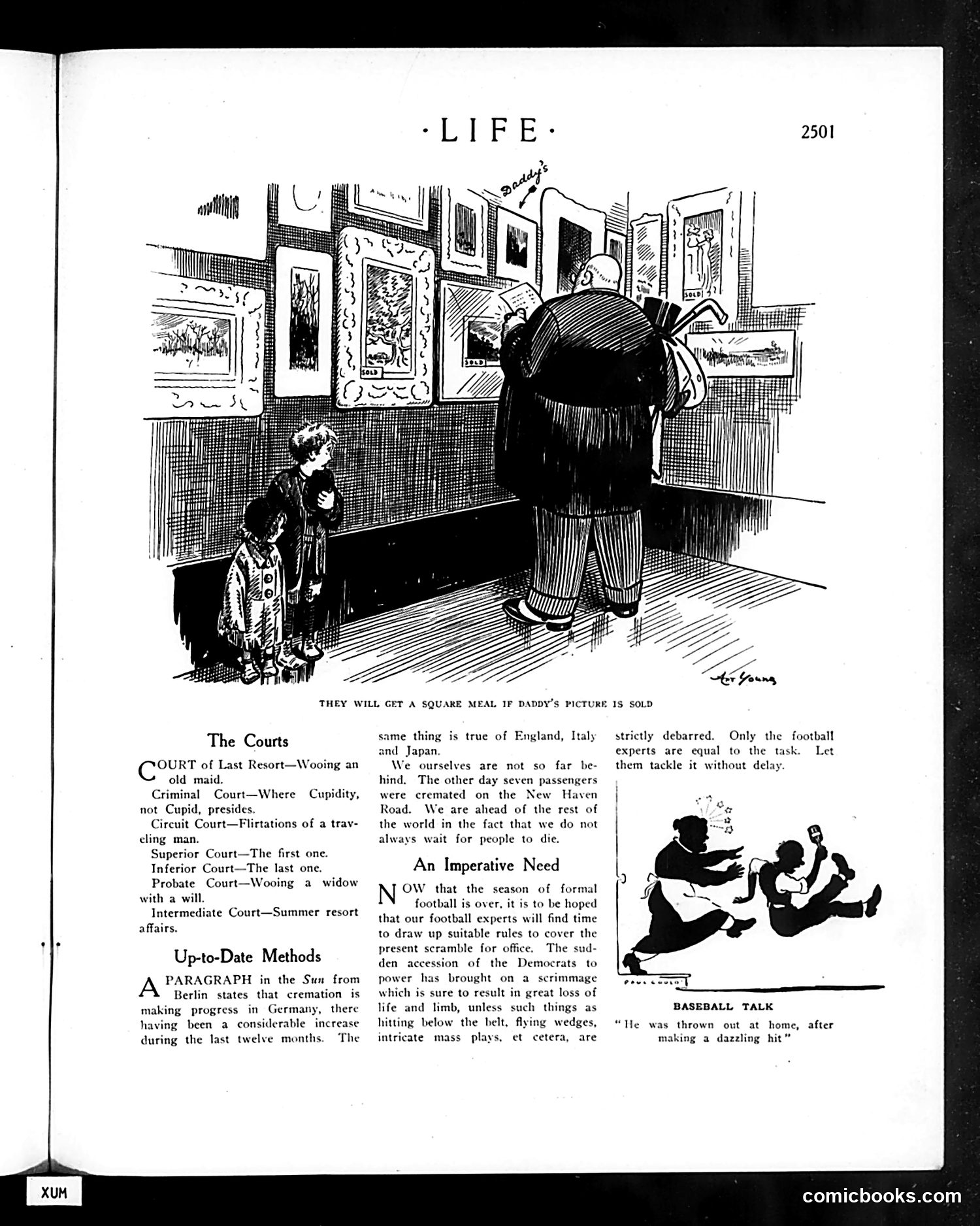
The top cartoon depicts a father and child viewing art in a gallery, with the caption "They will get a square meal if daddy's picture is sold"—mocking both art dealers' commercialism and struggling artists' desperation. The text contains several satirical "courts" that use legal terminology for romantic/social situations (e.g., "Court of Last Resort" = wooing an old maid), poking fun at both the legal system and courtship customs. Most pointedly, "An Imperative Need" uses football metaphors to mock the Democratic Party's recent assumption of power (likely following an election), comparing political jockeying for office positions to a violent rugby match. It suggests Democrats are so chaotic they need football experts to establish rules preventing injuries—satirizing the party as disorganized and cutthroat. The "Up-to-Date Methods" section makes dark jokes about cremation, suggesting Americans are dying in accidents (the New Haven train wreck reference) without waiting for natural death.
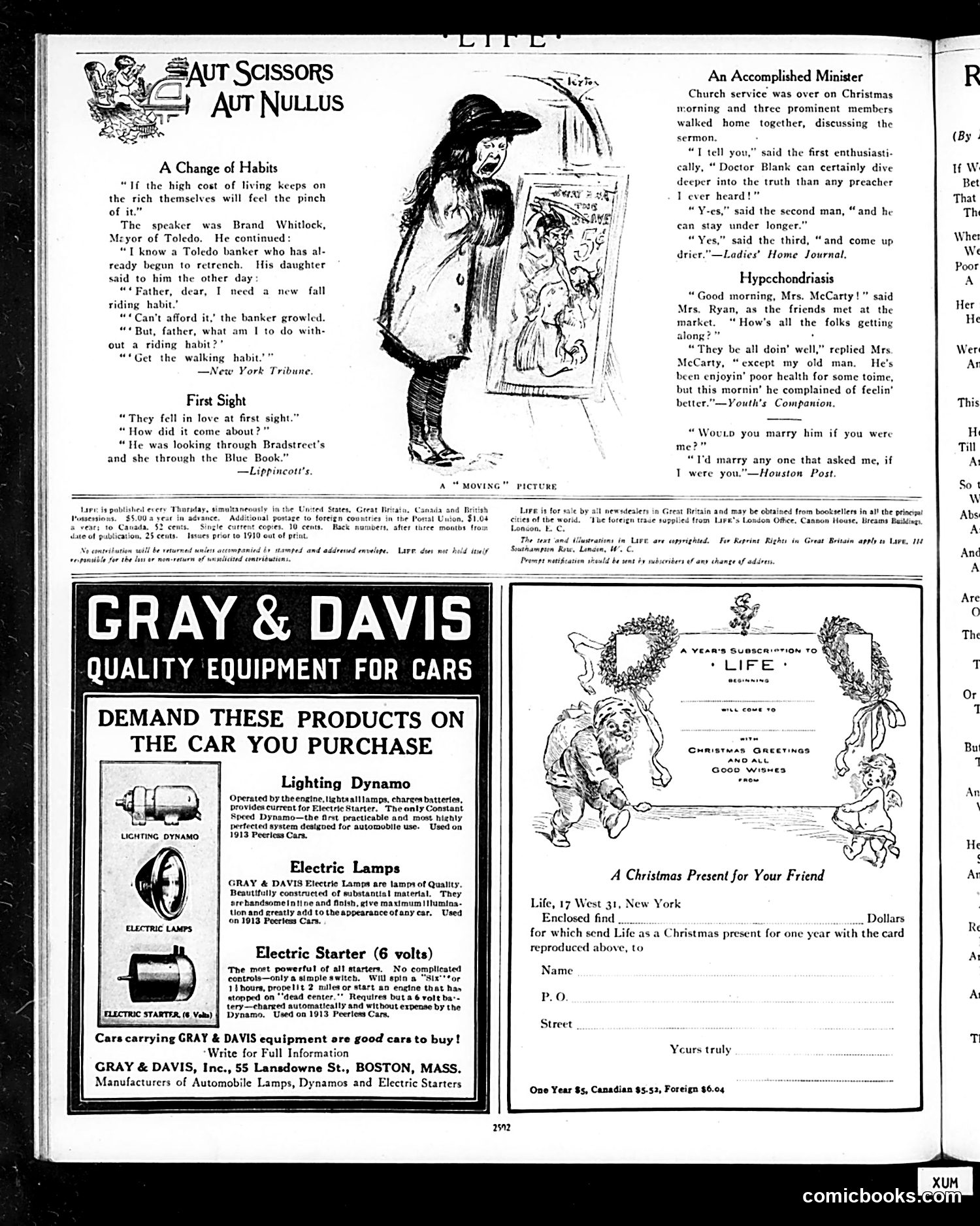
This page contains **humorous anecdotes** rather than political cartoons. The jokes satirize early 20th-century American life: **"A Change of Habits"** mocks the "high cost of living" crisis—even wealthy bankers must economize, forcing his daughter to abandon her riding habit for walking. **"First Sight"** ridicules social climbing: a couple fall in love while reviewing *Bradstreet's* (a business/credit reference) and the *Blue Book* (social registry), suggesting their romance is motivated by financial/social status rather than genuine affection. **"An Accomplished Minister"** jokes darkly that the preacher can "dive deeper into truth" but also "stay under longer"—implying his sermons are so long and tedious they feel like drowning. **"Hypochondriasis"** plays on a wife's malapropism: her husband has been "enjoyin' poor health" but now "complained of feelin' better"—humor from working-class speech and the absurdity of enjoying illness. The remaining content is advertising for Gray & Davis automobile equipment and a Life magazine subscription offer.
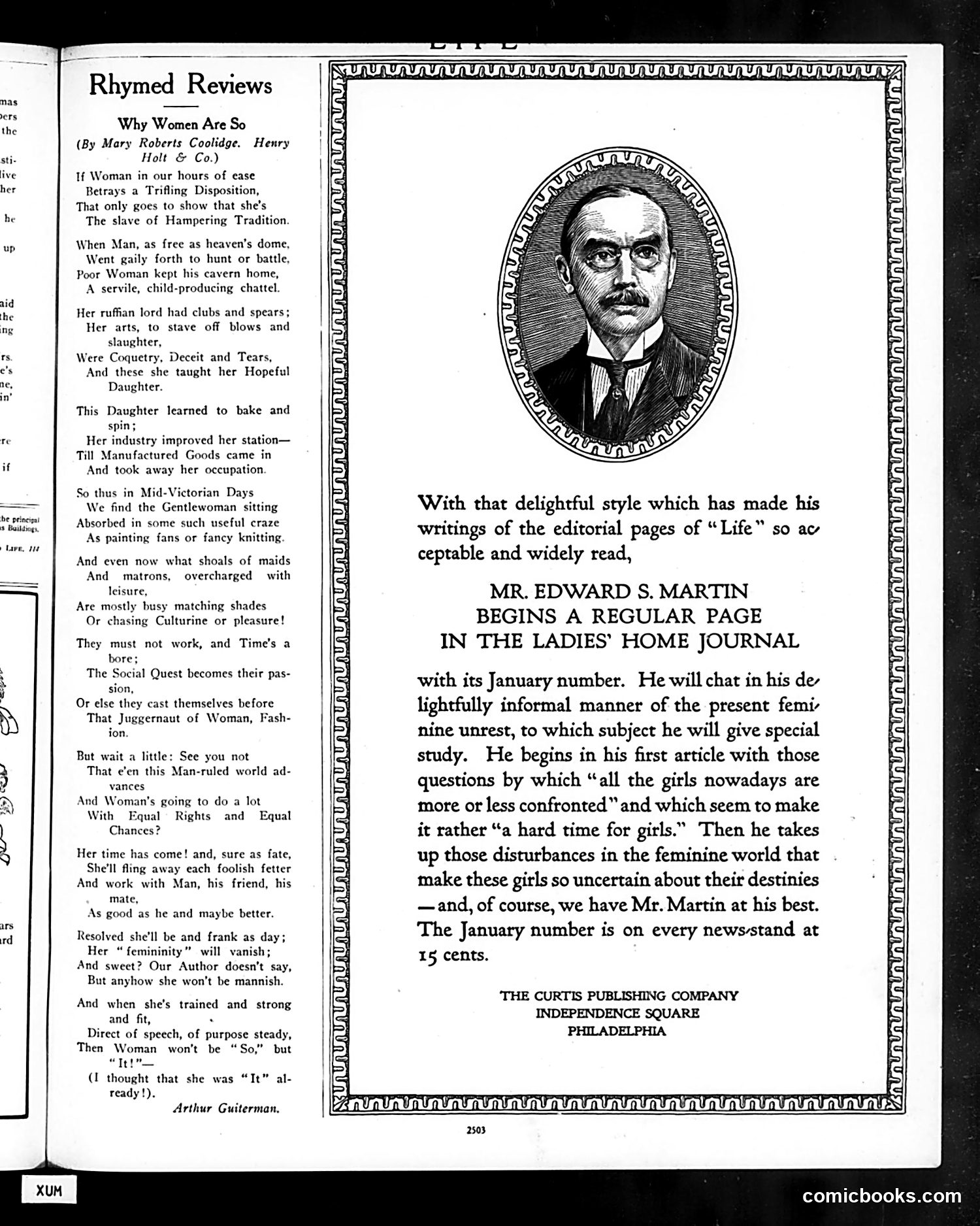
This page contains a satirical poem reviewing Mary Roberts Coolidge's book "Why Women Are So," written by Arthur Guiterman for *Life* magazine. The poem traces women's historical subjugation—from serving as domestic slaves producing children, to being taught "Coquetry, Deceit and Tears" as survival tools, to Victorian idleness with "fancy knitting" and fashion obsession. Guiterman's satire mocks both women's enforced dependency and the leisure-class uselessness it created. The poem's turning point celebrates coming change: women will gain "Equal Rights and Equal Chances," becoming "frank," "resolved," and "strong"—though the final joke undercuts this, suggesting women were already "It" (slang for the ultimate desirable quality), implying their liberation may merely shift rather than solve their social role. The page also announces Edward S. Martin's new column in *Ladies' Home Journal*, addressing "feminine unrest"—the contemporary anxiety about women's changing social position during the early 20th-century suffrage era.
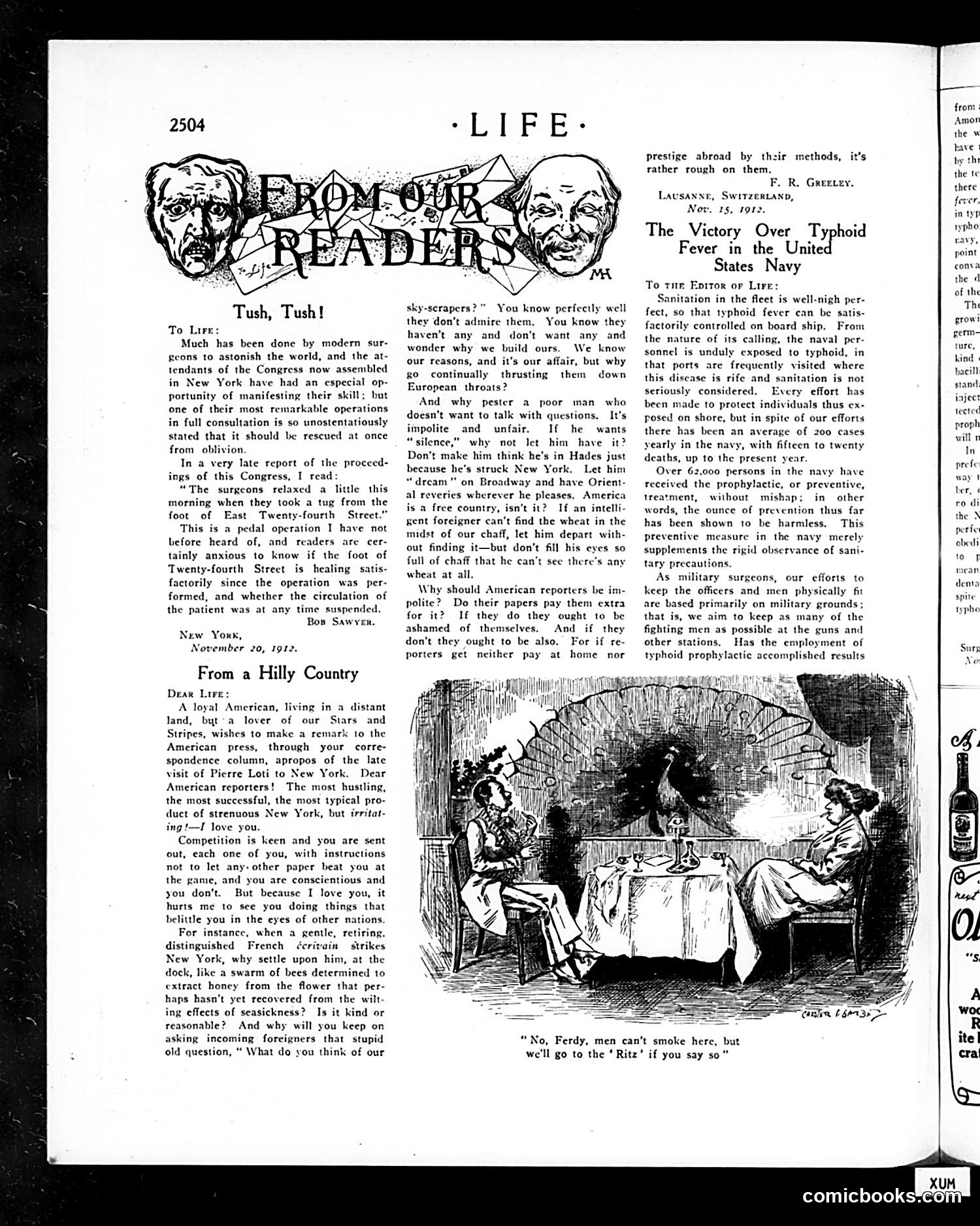
This page contains three readers' letters satirizing different subjects: **"Tush, Tush!"** mocks surgical congresses through wordplay—a surgeon's report mentions taking "a tug from the foot of East Twenty-fourth Street," which the writer treats as an actual medical procedure, humorously questioning whether the "patient" (the street itself) has healed. **"From a Hilly Country"** criticizes American newspaper reporters' behavior toward visiting French writer Pierre Loti. The letter complains that aggressive reporters pester foreign visitors with invasive questions (like "what do you think of our skyscrapers?") and prevent them from peaceful reflection, arguing this rudeness damages America's international reputation. **"The Victory Over Typhoid Fever"** begins a serious letter praising naval sanitation improvements that have controlled typhoid disease among sailors. The cartoon shows two people in conversation; the caption reads "No, Ferdy, men can't smoke here, but we'll go to the 'Ritz' if you say so"—likely satirizing wealthy New Yorkers' casual attitude toward venue restrictions.
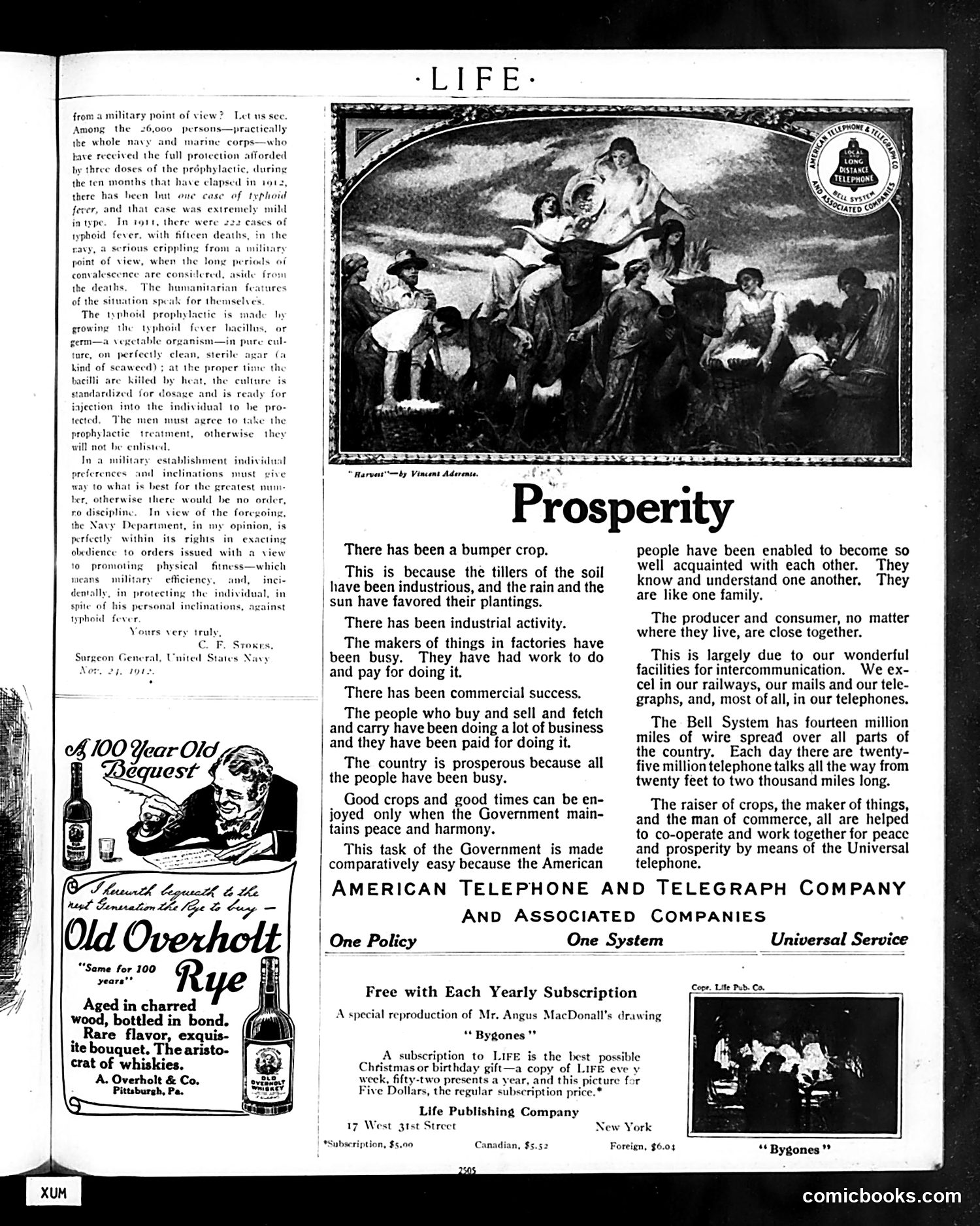
This page combines public health advocacy with corporate advertising. The top section features a letter from Surgeon General C.F. Stokes endorsing typhoid vaccination for Navy personnel—a relatively recent medical intervention (the text references 1912). The satire lies in framing mandatory vaccination as a military discipline issue: individual preference must yield to collective health benefit, establishing "no order, no discipline" without compliance. The central "Prosperity" article celebrates American industrial and agricultural success, attributing it to government-maintained peace and—crucially—the Bell Telephone System's infrastructure. This is transparently corporate messaging disguised as editorial content: the piece argues that national prosperity depends on Americans being "close together" through telephones, culminating in the large AT&T advertisement below. The Old Overholt Rye whiskey ad on the left appears decorative filler typical of the era. The unsigned "Bygones" illustration caption suggests nostalgic imagery, though details are unclear in reproduction. The page essentially sells both public health compliance and corporate telecommunications as patriotic necessities.
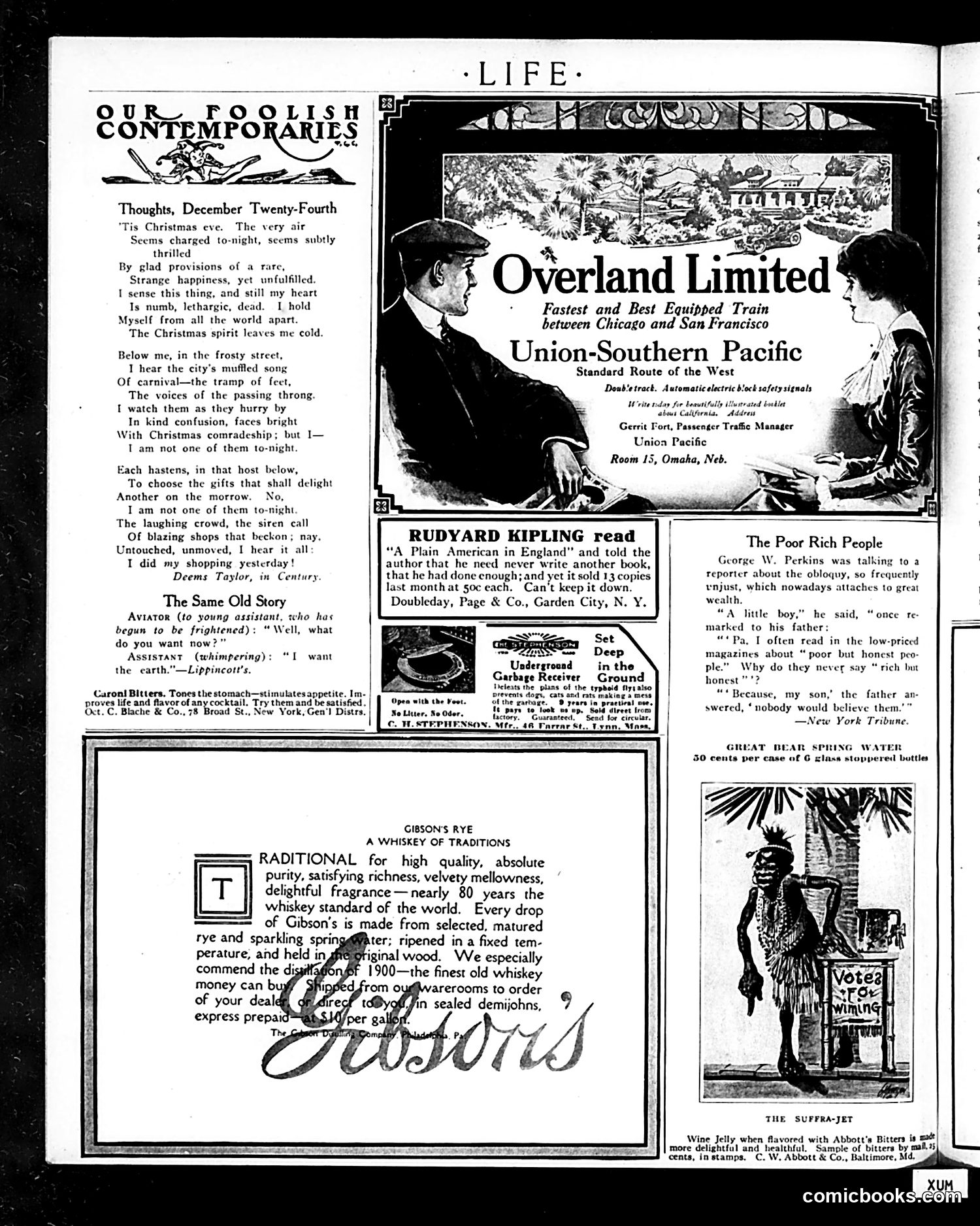
This page is primarily **advertisements and light humor** rather than political satire. The main content includes: **"Our Foolish Contemporaries"** — a humorous poem by Deems Taylor about Christmas Eve cynicism: the speaker feels alienated from holiday cheer because he already finished shopping yesterday, making him emotionally unavailable to the festive crowds below. **"The Same Old Story"** — a brief joke about an aviator and nervous assistant fearing death. **"The Poor Rich People"** — a anecdote where George W. Perkins (apparently a wealthy industrialist) jokes that nobody would believe stories about "rich but honest" people, only "poor but honest" ones — commenting on public skepticism toward the wealthy. The page is dominated by **period advertisements** for trains (Overland Limited), whiskey (Gibson's Rye), liqueurs, and patent medicines — typical Life magazine content from the early 1900s. The small cartoon showing a figure with a "Votes for Women" sign appears to reference **suffrage activism**, though context is unclear from this excerpt alone.
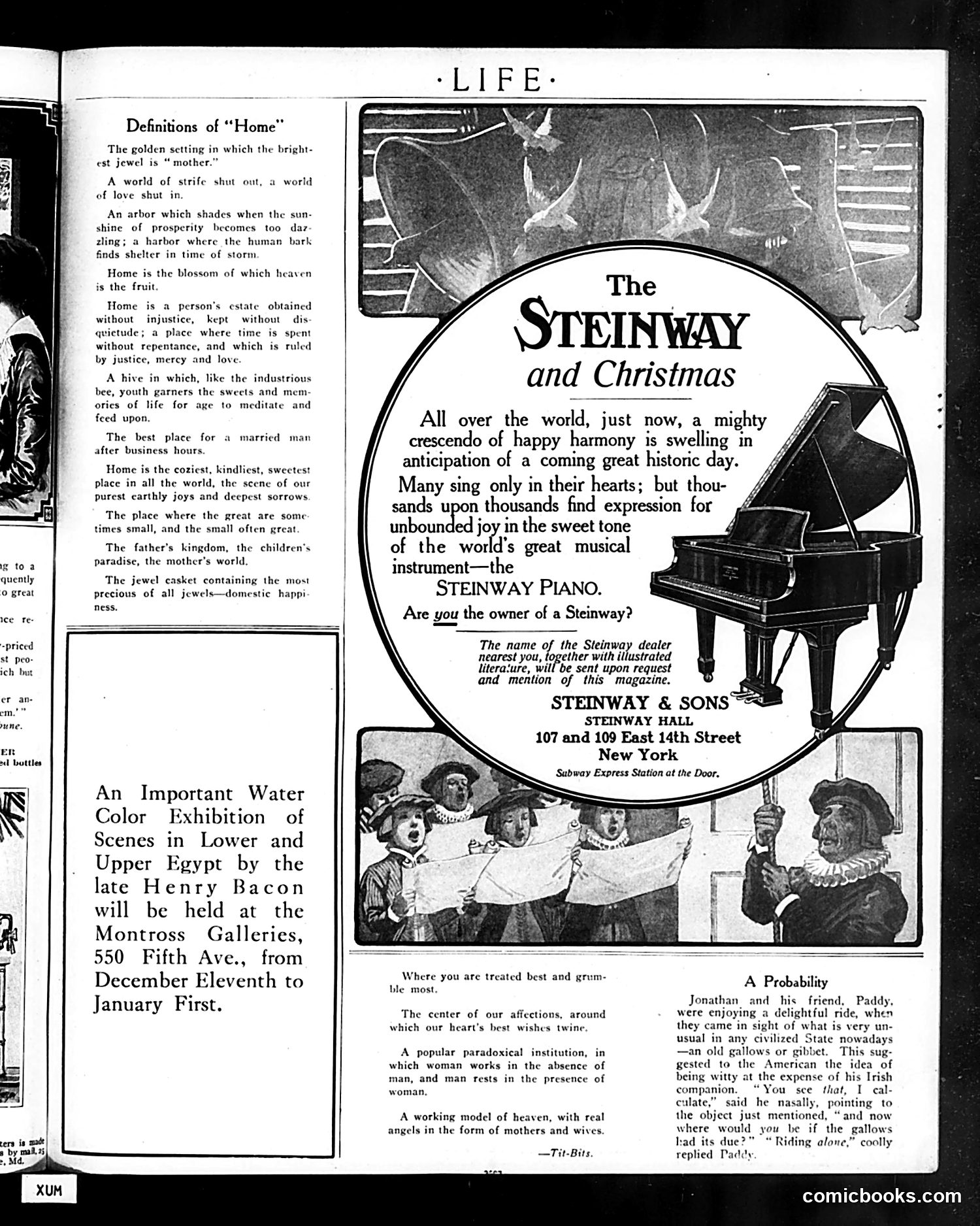
This page is primarily **advertising and sentimental content** rather than political satire. The dominant feature is a **Steinway Piano advertisement** connecting Christmas celebration to piano ownership—marketing pianos as the vehicle for expressing holiday joy. The left column contains nostalgic, flowery definitions of "Home," typical of early 20th-century sentimentality emphasizing domestic happiness, motherhood, and marital comfort. This reflects period ideology about family as society's moral foundation. Below that is an announcement for an Egyptian watercolor exhibition at a Manhattan gallery. The page concludes with a brief humor item titled "A Probability": an ethnic joke where an American sarcastically points out a gallows to his Irish friend "Paddy," implying execution would be Paddy's fate. Paddy replies coolly with a comeback. This represents period **Irish-American stereotype humor** common in Life magazine, playing on ethnic caricature for comic effect. The overall page reflects turn-of-the-century American commercial culture and casual ethnic humor now considered offensive.
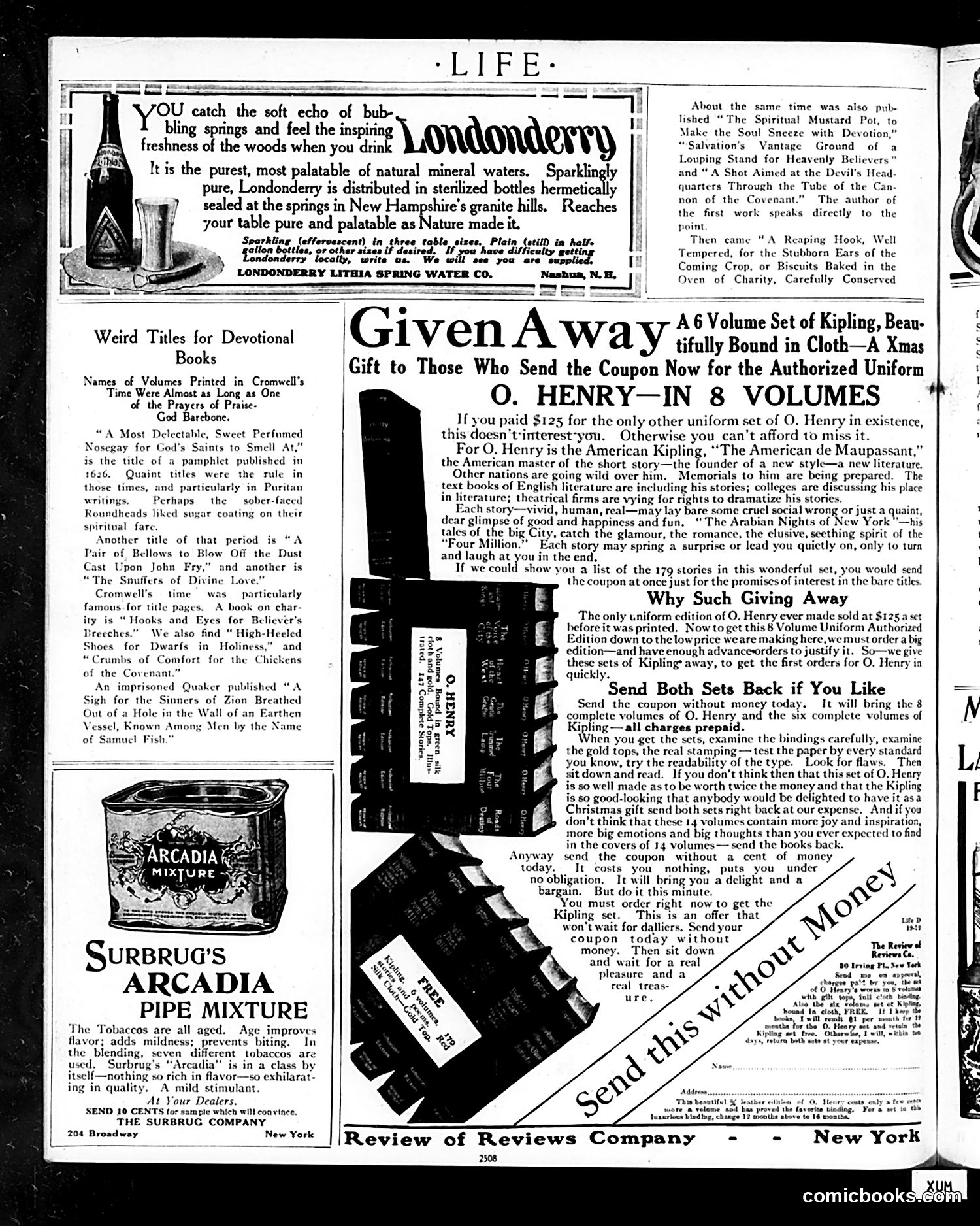
This page is primarily **advertising and promotional content**, not political satire. It contains: 1. **Londonderry mineral water advertisement** (top): Standard product promotion claiming purity and natural sourcing from New Hampshire springs. 2. **"Weird Titles for Devotional Books"** (left column): A historical feature about absurdly long, colorful book titles from Oliver Cromwell's Puritan era (1600s)—examples include "Hooks and Eyes for Believer's Breeches" and "A Pair of Bellows to Blow Off the Dust Cast Upon John Fry." The humor derives from period Puritan culture's elaborate, metaphor-heavy religious publishing style. 3. **O. Henry and Kipling book set giveaway** (center/right): A major promotional offer for a discounted 8-volume O. Henry collection, marketed as the "American Kipling" and compared to literary masters. The offer uses competitive pricing psychology. 4. **Surburg's Arcadia Pipe Mixture advertisement** (bottom left): Tobacco product marketing. The page reflects early 20th-century Life magazine's mix of satirical commentary and commercial content.
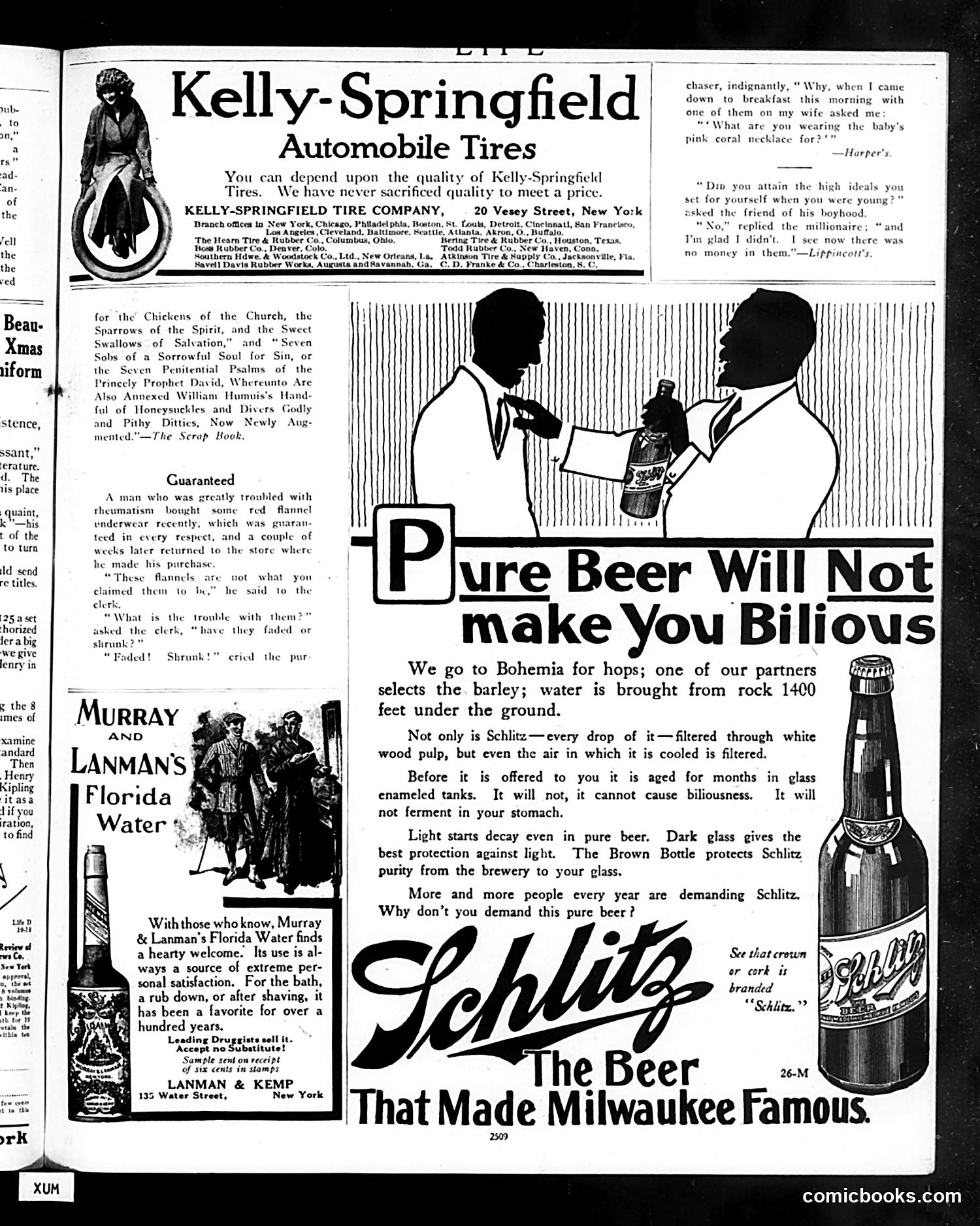
This page contains primarily **advertisements** rather than editorial cartoons. The main content includes: 1. **Kelly-Springfield Automobile Tires** ad (top): Standard product advertisement emphasizing quality. 2. **Murray & Lanman's Florida Water** ad (left): A brief humorous anecdote about a man buying red flannel underwear "guaranteed in every respect," then complaining it shrank. The clerk's exasperated response ("Shrunk!") is the joke's punchline—the guarantee was misunderstood. 3. **Schlitz Beer** ad (right, dominant): A substantial advertisement claiming their beer won't cause biliousness (indigestion). It emphasizes filtration methods, dark bottle protection from light, and aging in glass tanks. This reflects early 20th-century concerns about beer quality and digestive health. The page also includes small literary quotations in the margins—presumably from *Harper's*, *Lippincott's*, and *The Scrap Book*—offering brief humorous observations about social pretension and wealth. The overall page is advertising-heavy, typical of Life magazine's business model.
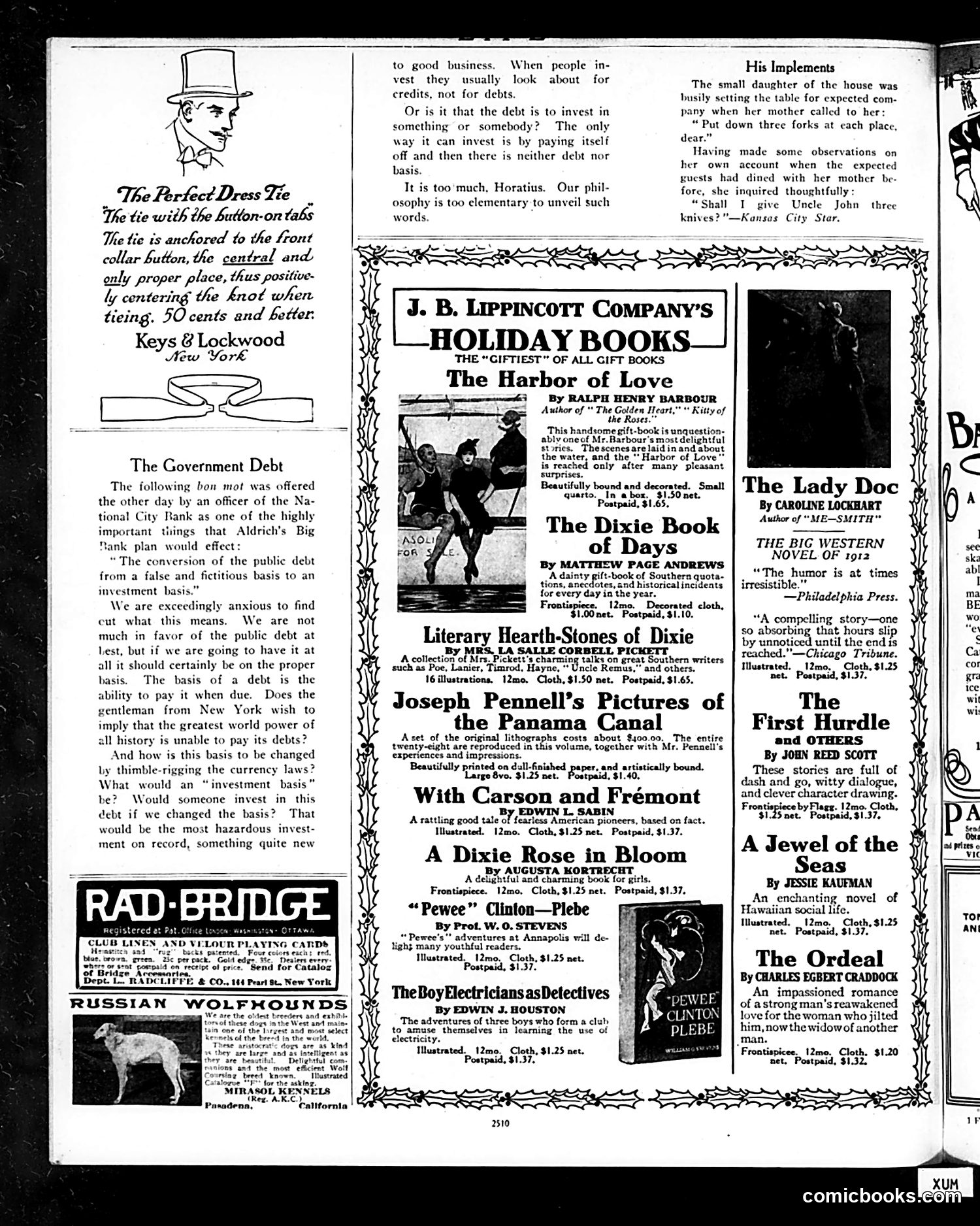
This page contains two distinct pieces of satirical commentary: **"The Government Debt"** article satirizes the Aldrich Plan's financial rhetoric. Life mocks a National City Bank officer's claim that converting public debt from a "false and fictitious basis" to an "investment basis" would benefit the economy. The author argues this is meaningless jargon: a debt's actual basis is the ability to repay it, and the U.S. (as the world's greatest power) should already be able to do so. The satire suggests Wall Street is using confusing language to obscure rather than clarify financial policy—implying the Aldrich Plan is financial trickery dressed in impressive-sounding terminology. **"His Implements"** is a brief humorous anecdote about a child's literal interpretation of social convention. When asked to set three forks per place, she logically assumes each guest also needs three knives, not understanding that implements aren't distributed equally. The page is otherwise dominated by advertisements for holiday books from J.B. Lippincott Company.
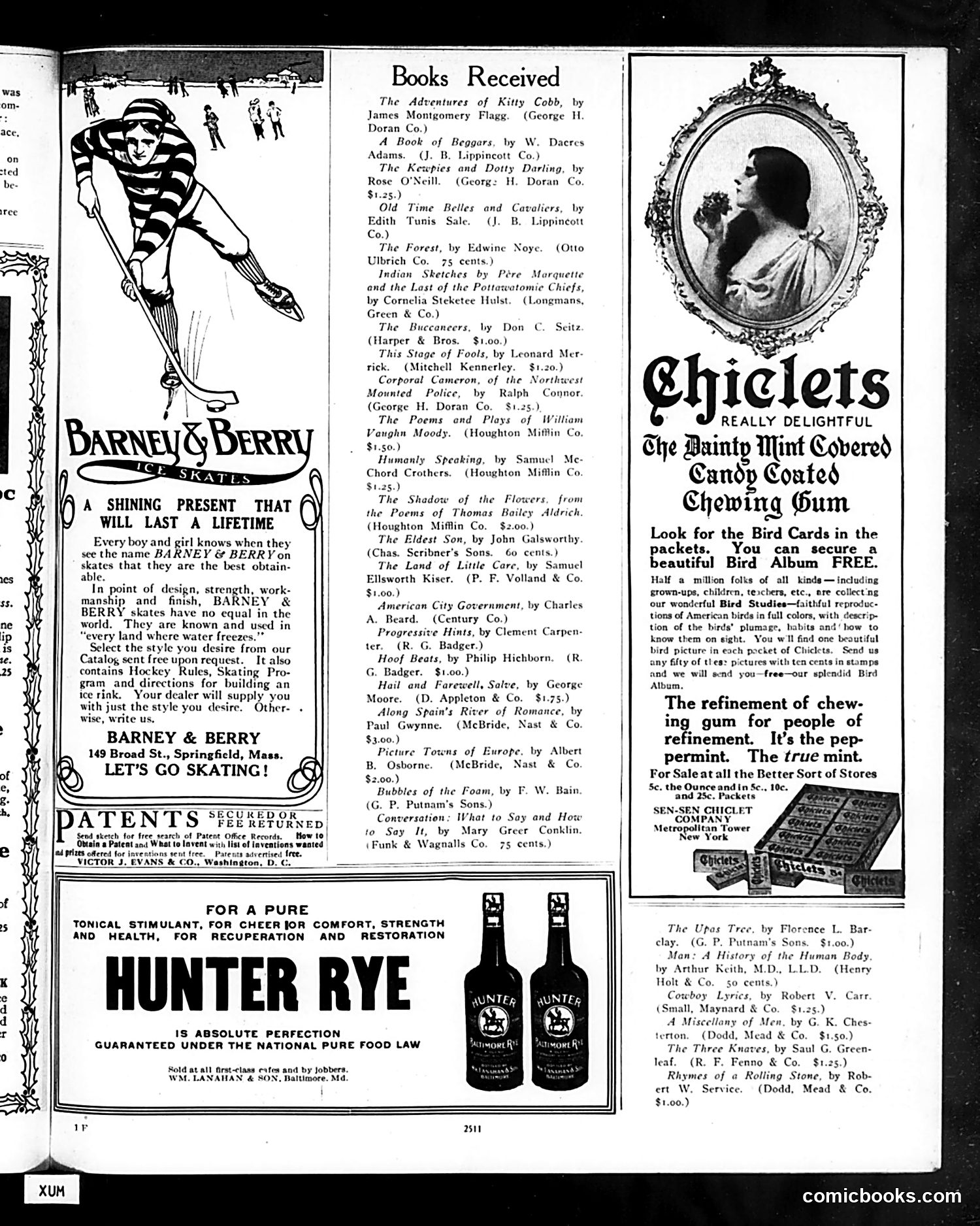
This is primarily a **book review and advertising page** from *Life* magazine. The notable content includes: **Left side:** A Barney & Berry skating advertisement featuring an illustration of a boy in striped clothing performing a skating move. The ad promotes ice skates as a lasting gift for children. **Center/Right:** A "Books Received" section listing recently published titles (novels, poetry, history, and instructional works from 1910s-era publishers like Houghton Mifflin and Century Company). **Right column:** Advertisement for Chiclets chewing gum, promoting collectible bird cards included in packages. Below that is an ad for Sen-Sen mints emphasizing "refinement." **Bottom:** A Hunter Rye whiskey advertisement. The page reflects early 20th-century consumer culture, with ads targeting families (skates, gum) and adults (whiskey) alongside literary content. No political satire is evident on this particular page.
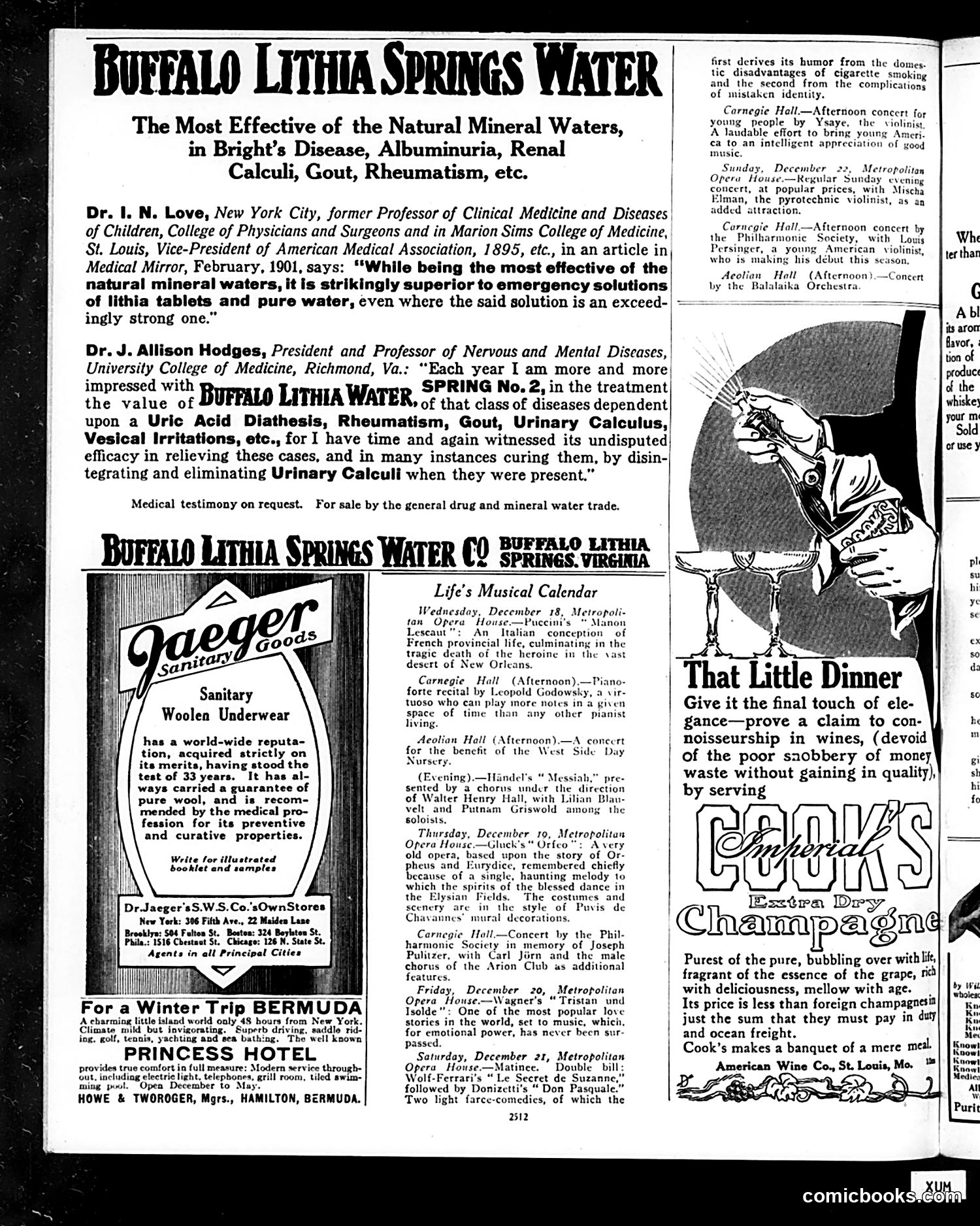
This page is primarily **advertising and entertainment listings**, not political satire. The main content advertises **Buffalo Lithia Springs Water**, a patent medicine claiming to treat Bright's disease, gout, rheumatism, and kidney stones. It features endorsements from medical professionals (Dr. I. N. Love, Dr. J. Allison Hodges) promoting lithia water's effectiveness—typical of early 1900s medical marketing before FDA regulations. Secondary advertisements include **Jaeger's Sanitary Woolen Underwear** (claiming 33 years of medical endorsement) and the **Princess Hotel in Bermuda**. The right column contains "**Life's Musical Calendar**" listing Metropolitan Opera and concert hall performances, and an advertisement for **Cook's Champagne** using a dinner-party illustration. There is **no political cartoon or satire** visible. The page represents routine magazine advertising and entertainment content from approximately 1901.
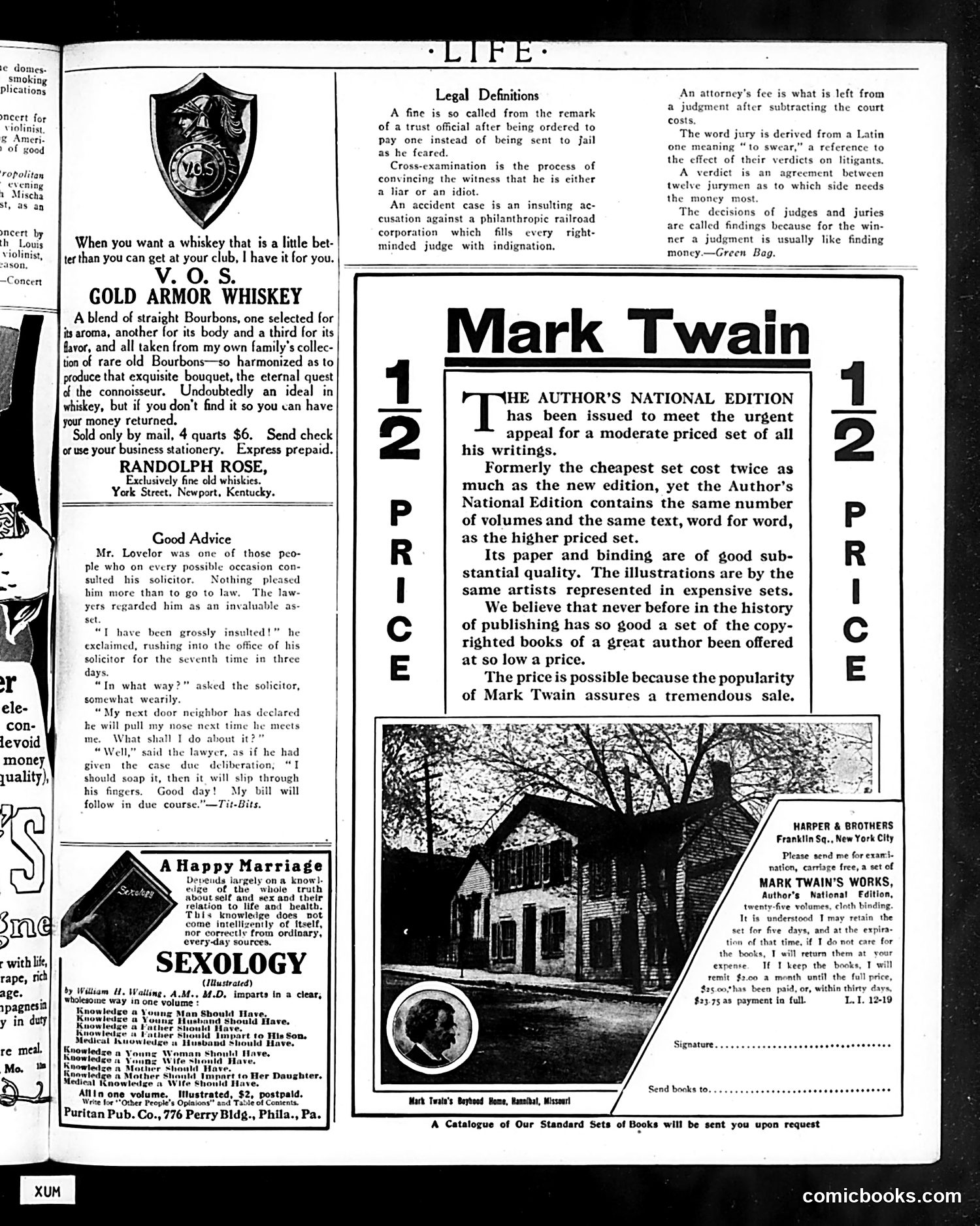
This page is primarily **advertising and promotional content**, not political satire. It contains: 1. **Gold Armor Whiskey advertisement** - a luxury spirits pitch emphasizing quality and mail-order convenience 2. **"Good Advice" humorous anecdote** - a light joke about a litigious man constantly consulting his solicitor, who finally suggests he "soap" his nose so it will slip through his neighbor's fingers when grabbed 3. **Legal definitions section** - satirical definitions of legal terms (fines, cross-examination, verdicts) that poke gentle fun at the legal profession's opacity and irony 4. **Mark Twain Author's National Edition advertisement** - promoting an affordable, multi-volume set of Twain's complete works, emphasizing value (same quality as expensive editions, tremendous sales volume keeps prices low) 5. **Sexology book advertisement** - educational health manual The page's tone is **light, commercial satire** rather than serious political commentary. The humor targets familiar subjects: alcohol consumption, obsessive litigation, legal jargon, and consumer value propositions—typical of Life magazine's general-interest audience.
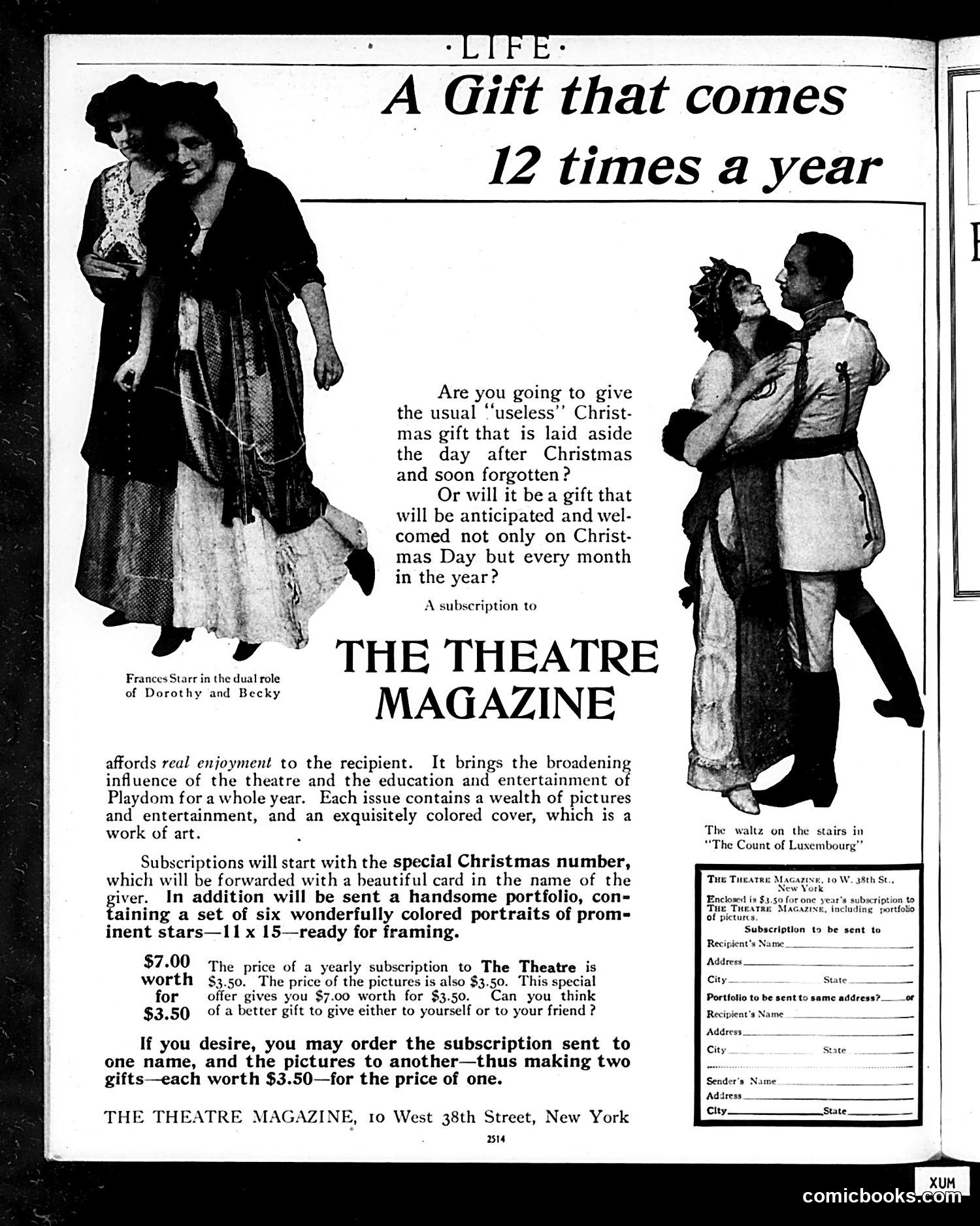
This is primarily a **magazine advertisement**, not satire or political commentary. It promotes *The Theatre Magazine* as a Christmas gift subscription. The page features actress **Frances Starr** in a dual role (Dorothy and Becky), likely from a theatrical production, positioned left. On the right is an image from "The Count of Luxembourg," showing a couple waltzing on stairs—presumably promoting theatrical content readers would receive. The advertisement's pitch targets early 20th-century gift-givers: it argues a magazine subscription is superior to typical "useless" Christmas gifts because it arrives **twelve times yearly**, offering sustained entertainment and education about theater and prominent stage stars. The $3.50 subscription ($7.00 value) includes framed portraits of actors. For modern readers: this reflects an era when magazine subscriptions were prestigious gifts, theater was popular entertainment, and theatrical personalities were celebrated like modern celebrities. The "gift that comes 12 times a year" concept—the subscription's recurring value—was the advertiser's main selling point.
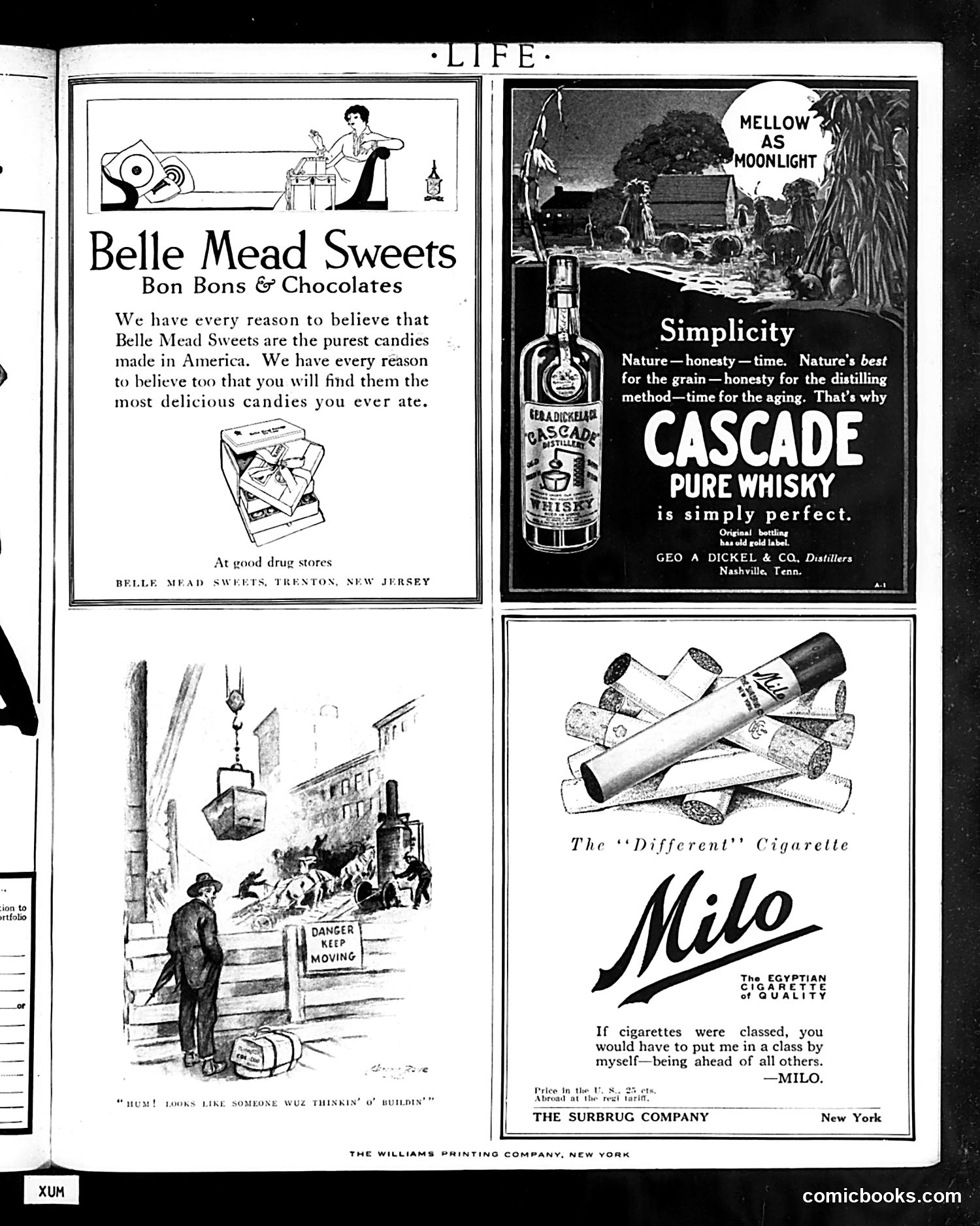
This is primarily an **advertising page** from Life magazine, not a political cartoon. It contains four product advertisements: 1. **Belle Mead Sweets** (candy) – standard product promotion 2. **Cascade Pure Whisky** – emphasizes "simplicity" and natural production methods 3. A **cartoon illustration** (lower left) showing a construction/building scene with the caption "HUM! LOOKS LIKE SOMEONE WUZ THINKIN' OF BUILDIN'!" – appears to be humorous commentary on urban development or construction, though the specific satire isn't clear without more context 4. **Milo Cigarettes** – boasts superiority over competitors The page reflects early-to-mid 20th century advertising standards, including now-banned products (whisky, cigarettes). The cartoon's point remains unclear without additional historical context about contemporary construction debates or local events.
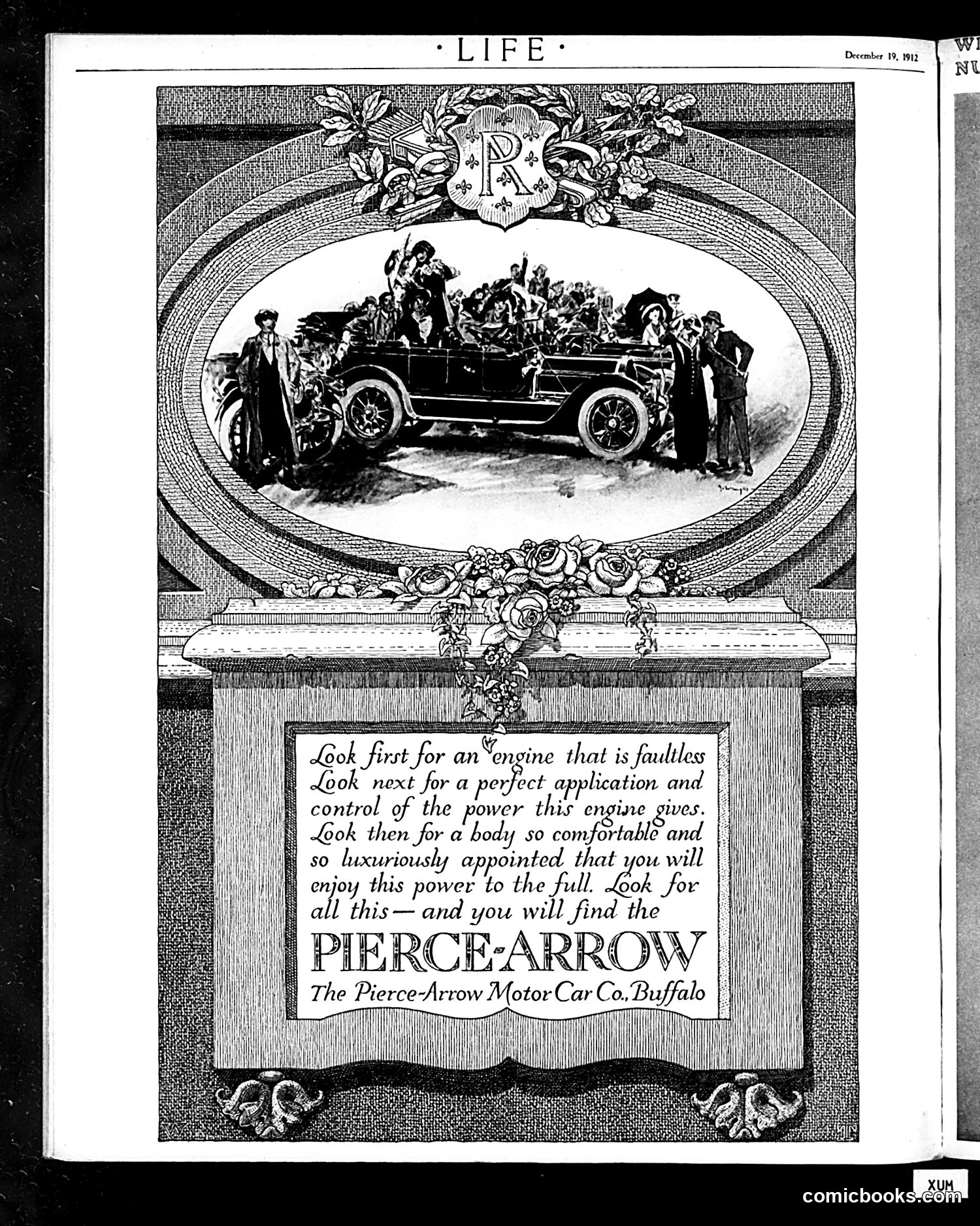
This is a **full-page advertisement**, not political satire. It promotes the Pierce-Arrow automobile, manufactured by the Pierce-Arrow Motor Car Co. of Buffalo. The ad uses elegant, decorative framing typical of 1912 luxury marketing. It depicts a fancy open-air automobile filled with well-dressed passengers, emphasizing the car's appeal to wealthy consumers. The text employs persuasive rhetoric, instructing readers to evaluate the car's engine reliability, power transmission, comfort, and luxurious appointments—positioning Pierce-Arrow as the superior choice for affluent buyers. The ornate baroque-style border with floral motifs reinforces the message of elegance and sophistication. This reflects early automotive advertising's emphasis on status and refined living rather than practical transportation.