
Life, 1912-12-19 · page 24 of 40
Life — December 19, 1912 — page 24: what you’re looking at
What you’re looking at
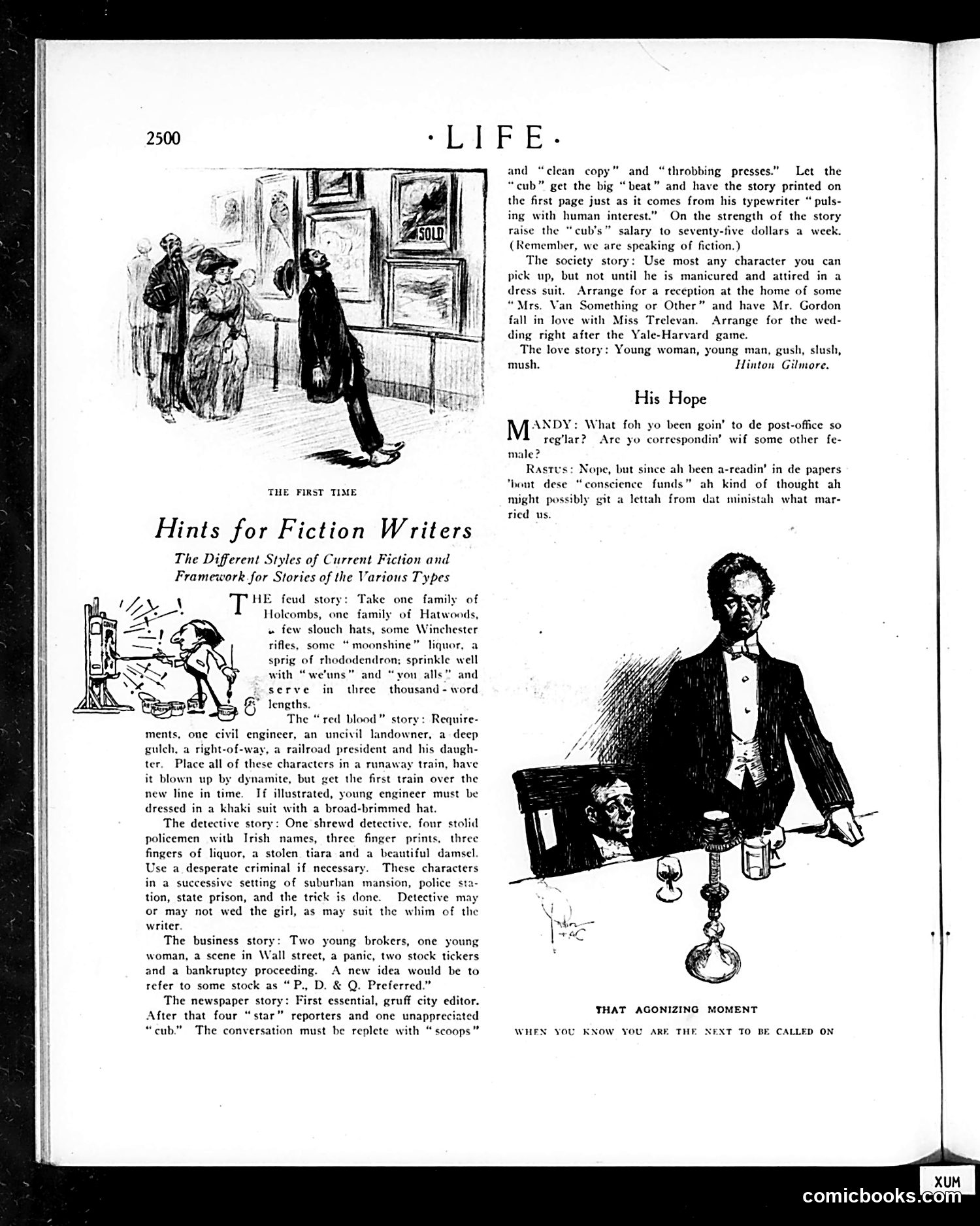
This page satirizes formulaic fiction writing of the early 1900s. The main article, "Hints for Fiction Writers," mockingly outlines recipe-like templates for popular story genres—feuds (with "moonshine" liquor and Appalachian dialect), adventure tales (runaway trains and dynamite), detective stories (Irish cops, stolen tiaras), and newspaper dramas (ambitious young reporters). The humor lies in reducing complex narratives to predictable ingredients: every society story must feature a character named "Mr. Gordon" falling for "Miss Trelevan" before a Yale-Harvard wedding. The cartoon "His Hope" features two Black characters using dialect-heavy speech (characteristic of early 20th-century racial humor), with "Rastus" hopefully checking the post office for a letter from the minister who married him—a joke about "conscience funds" (restitution payments from guilty consciences). This reflects period stereotypes and satirical treatment of African American characters common to *Life* magazine's content. The satire targets publishers' and readers' appetite for predictable, mass-produced stories over originality.
📄 Transcribed text from this page (OCR, searchable)
Machine-transcribed from the original scan — historical spelling and the odd misread are preserved.
“Lal 'E « and “clean copy” and “throbbing presses.” Let the “cub” get the big “beat” and have the story printed on the first page just as it comes from his typewriter “ puls- ing with human interest.” On the strength of the story raise the “cub’s” salary to seventy-five dollars a week. (Remember, we are speaking of fiction.) The society story: Use most any character you can pick up, but not until he is manicured and attired in a dress suit. Arrange for a reception at the home of some “Mrs. Van Something or Other” and have Mr. Gordon fall in love with Miss Trelevan. Arrange for the wed- ding right after the Yale-Harvard game. The love story: Young woman, young man, gush, slush, mush. Hinton Gilmore. His Hope ANDY: What foh yo been goin’ to de post-office so reg’lar? Are yo correspondin’ wif some other fe- male? Rastus: Nope, but since ah been a-readin’ in de papers "bout dese “conscience funds” ah kind of thought ah might possibly git a lettah from dat ministah what mar- ricd us. THE FIRST TIME Hints for Fiction Writers The Different Styles of Current Fiction and Framework for Stories of the Various Types HE feud story: Take one family of Holcombs, one family of Hatwoods, « few slouch hats, some Winchester rifles, some “moonshine” liquor, a sprig of rhododendron; sprinkle well with “we'uns” and “you alls” and serve in three thousand - word lengths. The “red blood” story: Require- ments, one civil engineer, an uncivil landowner, a deep gulch, a right-of-way, a railroad president and his daugh- ter, Place all of these characters in a runaway train, have it blown up by dynamite, but get the first train over the new line in time. If illustrated, young engineer must be dressed in a khaki suit with a broad-brimmed hat. The detective story: One shrewd detective, four stolid policemen with Irish names, three finger prints, three fingers of liquor, a stolen tiara and a beautiful damsel. Use a desperate criminal if necessary. These characters in a suc ve setting of suburban mansion, police tion, state prison, and the trick is done. Detective may or may not wed the girl, as may suit the whim of the writer, The business story: Two young brokers, one young woman, a scene in Wall street, a panic, two stock tickers and a bankruptcy proceeding. A new idea would be to refer to some stock as “P., D. & Q. Preferred.” The newspaper story: First essential, gruff city editor. After that four “star” reporters and one unappreciated “cub.” The conversation must be replete with “scoops” WHEN YOU KNOW YOU ARE THE NENT TO BE CALLED ON THAT AGONIZING MOMENT comicbooks 2 |