
Life, 1912-12-19 · page 17 of 40
Life — December 19, 1912 — page 17: what you’re looking at
What you’re looking at
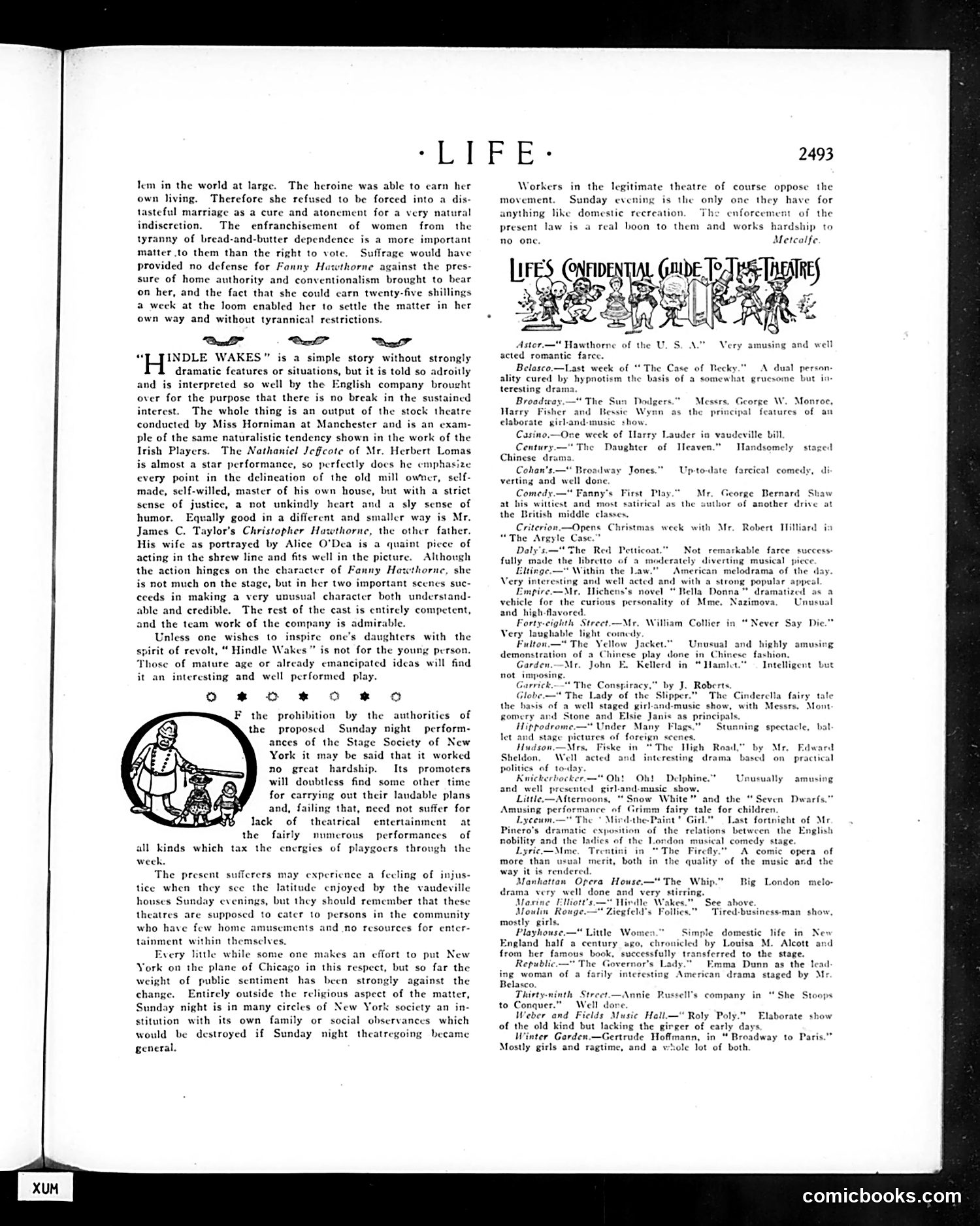
This page discusses two theatrical topics from early 20th-century New York: **"Hindle Wakes"**: A review of an English play about a working-class woman (Fanny Hawthorne) who refuses a forced marriage after a premarital indiscretion because she can earn her own living. The critic praises the naturalistic production by Manchester's Miss Horniman theater, particularly Herbert Lomas's performance as an old mill owner. The review notes the play's feminist implications—that women's economic independence matters more than voting rights—and warns it's unsuitable for young people due to its "revolt" themes. **Sunday Theatre Ban**: A brief discussion of authorities prohibiting Sunday night performances by New York's Stage Society. The critic acknowledges this wasn't a major hardship, noting that vaudeville houses already performed Sundays for workers with few home entertainments. However, theater workers themselves opposed Sunday performances because those evenings represented their only opportunity for domestic recreation with families.
📄 Transcribed text from this page (OCR, searchable)
Machine-transcribed from the original scan — historical spelling and the odd misread are preserved.
‘LIF E# lem in the world at large. The heroine was able to carn her own living. Therefore she refused to be forced into a dis- tasteful marriage as a cure and atonement for a very natural indiscretion. The enfranchisement of women from the tyranny of bread-and-butter dependence is a more important matter to them than the right to vote. Suffrage would have provided no defense for Fanny Hawthorne against the pres- sure of home authority and conventionalism brought to bear on her, and the fact that she could carn twenty-five shillings a week at the loom enabled her to settle the matter in her own way and without tyrannical restrictions. Bae” QoL ta “Hye WAKES” is a simple story without strongly dramatic features or situations, but it is told so adroitly and is interpreted so well by the English company brought over for the purpose that there is no break in the sustained interest. The whole thing is an output of the stock theatre conducted by Miss Horniman at Manchester and is an exam- ple of the same naturalistic tendency shown in the work of the Irish Players. The Nathaniel Jeffcote of Mr. Herbert Lomas is almost a star performance, so perfectly docs he emphasize every point in the delineation of the old mill owncr, self- made, self-willed, master of his own house, but with a strict sense of justice, a not unkindly heart and a sly sense of humor. Equally good in a different and smaller way is Mr. James C. Taylor's Christopher Hawthorne, the other father. His wife as portrayed by Alice O'Dea is a quaint picce of acting in the shrew line and fits well in the picture. Although the action hinges on the character of Fanny Haxthorne, she is not much on the stage, but in her two important scenes suc- cceds in making a very unusual character both understand- able and credible, The rest of the cast is entirely competent, and the team work of the company is admirable. Unless one wishes to inspire one’s daughters with the pirit of revolt, “ Hindle Wakes” is not for the young person. hose of mature age or already emancipated ideas will find it an interesting and well performed play. o *# Oo * O ® F the prohibition by the authorities of the proposed Sunday night perform- ances of the Stage Society of New York it may be said that it worked no great hardship. Its promoters will doubtless find some other time for carrying out their laudable plans and, failing that, need not suffer for lack of theatrical entertainment at the fairly numerous performances of all kinds which tax the cnergies of playgocrs through the week. The present sufferers may experience a feeling of injus- tice when they sce the latitude enjoyed by the vaudeville houses Sunday evenings, but they should remember that these theatres are supposed to cater to persons in the community who have few home amusements a tainment within themsely very little while some one makes an effort to put New York on the plane of Chicago in this respect, but so far the weight of public sentiment has been strongly against the change. Entirely outside the religious aspect of the matter, Sunday night is in many circles of New York society an in- stitution with its own family or social observances which would be destroyed if Sunday night theatregoing became general. dno resources for enter- 2493 Workers in the legitimate theatre of course oppose the movement. Sunday evening is the only one they have for anything like domestic recreation. The enforcement of the present law is a real boon to them and works hardship to Metcalfe. no onc Astor.—" Hawthorne of the U acted romantic farce. Belasco.—Last week of “The Case of Tecky." A dual persons ality cured by hypnotism the basis of a somewhat gruesome but in- teresting dram: Broadseay.—" The Sun Dodgers.” Warry Fisher and Bessie Wynn as the prin elaborate girland-music show Casino.—One week of Harry Lauder in vaudeville bill Century.—" The Daughter of Heaven." Handsomely sta Chinese dram. Cohan's.—" Broalway Jones.” verting and well done Comedy.—" Fanny's First Play at his wittiest and most satirica the British middle classes. Criterion.—Opens Christmas week with Mr. Robert Hilliard i “The Argyle Case.” Daly's." The Red Petticoat." Not remarkable farce success fully made the libretto of a moderately diverting musical piece Eltinge.—* Within the Law." American melodrama of 1 Very interesting and well acted and with a strong popular appeal Empire-—Mr, Hichens’s ne Rella Donna” dramatized as a vehicle for the curious personality of Mme, Nazimova, Unusual and_high-flavored Forty-cighth Strect—Mr. William Collier in “Never Say Di Very laughable light comedy Fulton.—* The Yellow Jacket.” U: demonstration of a Chinese play done Garden.—Mr. John KE. Kellerd in not imposing. A." Very amusing and well Messrs. George W. Monroe, I features of ai Uptodate f ical comedy, di Mr. George Bernard Shaw s the author of another drive at ysual and highly amusing Chinese fashion, Hamlet.” Intelligent bs Garrick." The Conspiracy,” by J. Roberts. Globe.—* The Lady of the Slipper.” The Cinderella fairy tate the basis of a well staged girland-music show, with Messrs. Mont gomery ard Stone and Elsie Janis as principals. Hippodrome.—"* Under Many Flags.” Stunning spectacle, bal let and stage pictures of foreign scenes Hudson.—Mrs. Fiske in The High Road,” by Mr. Edward Sheldon, Well acted and interesting drama based on practical politics of touay. Knickerbocker —" Oh! Oh! Delphine.” and well presented girland-music show. Unusually amusing Little.—Afternoons, “Snow White" and the “Seven Dwarfs.” Amusing performance of Grimm fairy tale for children, Lyceum.—* The * Mind-the-Paint’ Girl." Last fortnieht of Mr Pinero’s dramatic exposition of the relations between nobility and the ladies of the Lordon musical comedy s Lyrie.—Mme. Trentini in “The Firefly.” more than usual merit, both in the quality way it is rendered. Manhattan Opera House.— drama very well done and very. stirr Marine Elliott's Tindle Wal Moulin Roxge.— Ziegfeld's Follies mostly girls. Playhouse.—" Little Wome Simple domestic life in New England half a century ago, chronicled by Louisa M. Alcott and from her famous book, successfully transferred to the stage. lic." The Governor's Lady.” Emma Dunn as the lead ing woman of a farily interesting American drama staged by Mr Belasco, Thirty ; to Conquer.’ Well do Weber and Fields Music Hall.— Roly Poly. Elaborate show of the old kind but lacking the girger of early days Winter Garden.—Gertrude Hoffmann, in “Broadway to Paris.” Mostly girls and ragtime, and a whole lot of both English o A comic opera of of the music ard the ‘The Whip.” 8. s."" See above. Tired-business-man show. Rig London melo- nie Russell's company in “She Stoop comicbooks.com